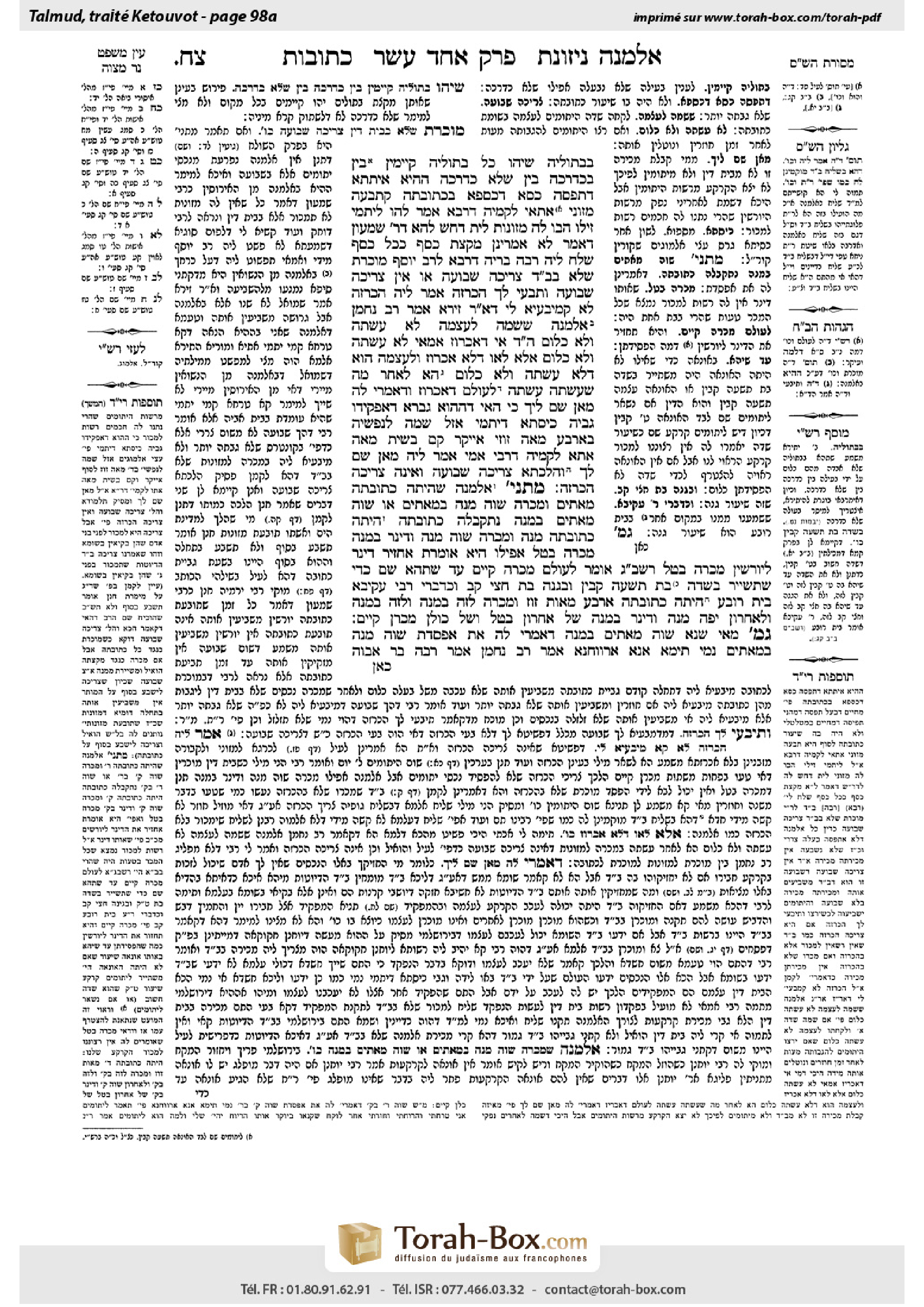
Ketubot 98a: Talmud study for Daf Yomi
Daf Yomi is the daily study of one Talmud folio. Explore 37 tractates with scans, Hebrew text, Sefaria English and AI-generated French translations where annotated.
Passage selection and English or AI-generated French translation are available where the scan has annotations. Daf Study is independent of Torah-Box and Sefaria.
Browse Ketubot · כתובות · All tractatesKetubot 98a text and translations
This page of Ketubot includes the Aramaic text, an English translation and an AI-generated French translation, alongside the scan above.
כתובות צ״ח א · Aramaic and Hebrew text
״בִּבְתוּלֶיהָ״ — שֶׁיְּהוּ כׇּל בְּתוּלֶיהָ קָיְימִין, בֵּין בִּכְדַרְכָּהּ בֵּין שֶׁלֹּא כְּדַרְכָּהּ.
הָהִיא אִיתְּתָא דִּתְפַסָה כָּסָא דְכַסְפָּא בִּכְתוּבְּתַהּ, קָתָבְעָה מְזוֹנֵי. אֲתַאי לְקַמֵּיהּ דְּרָבָא. אֲמַר לְהוּ לְיַתְמֵי: זִילוּ הַבוּ לַהּ מְזוֹנוֹת, לֵית דְּחָשׁ לְהָא דְּרַבִּי שִׁמְעוֹן, דְּאָמַר: לָא אָמְרִינַן מִקְצָת כֶּסֶף כְּכׇל כֶּסֶף.
שְׁלַח לֵיהּ רַבָּה בְּרֵיהּ דְּרָבָא לְרַב יוֹסֵף: מוֹכֶרֶת שֶׁלֹּא בְּבֵית דִּין צְרִיכָה שְׁבוּעָה, אוֹ אֵין צְרִיכָה שְׁבוּעָה? וְתִבְּעֵי לָךְ הַכְרָזָה?!
אֲמַר לֵיהּ: הַכְרָזָה לָא קָמִיבַּעְיָא לִי, דְּאָמַר רַבִּי זֵירָא אָמַר רַב נַחְמָן: אַלְמָנָה שֶׁשָּׁמָה לְעַצְמָהּ — לֹא עָשְׂתָה וְלֹא כְּלוּם.
הֵיכִי דָמֵי? אִי דְּאַכְרוּז — אַמַּאי לֹא עָשְׂתָה וְלֹא כְּלוּם? אֶלָּא לָאו, דְּלָא אַכְרוּז, וּלְעַצְמָהּ הוּא דְּלֹא עָשְׂתָה וְלֹא כְּלוּם, הָא לְאַחֵר — מַה שֶּׁעָשְׂתָה עָשְׂתָה.
לְעוֹלָם דְּאַכְרוּז, וּדְאָמְרִי לַהּ: מַאן שָׁם לִיךְ?
כִּי הַאי דְּהָהוּא גַּבְרָא דְּאַפְקִידוּ גַּבֵּיהּ כִּיסְתָּא דְיַתְמֵי. אֲזַל, שָׁמַהּ לְנַפְשֵׁיהּ בְּאַרְבַּע מְאָה זוּזֵי. אִיַּיקַּר קָם בְּשֵׁית מְאָה.
אֲתָא לְקַמֵּיהּ דְּרַבִּי אַמֵּי. אֲמַר לֵיהּ: מַאן שָׁם לָךְ?
וְהִלְכְתָא: צְרִיכָה שְׁבוּעָה וְאֵינָהּ צְרִיכָה הַכְרָזָה.
מַתְנִי׳ אַלְמָנָה שֶׁהָיְתָה כְּתוּבָּתָהּ מָאתַיִם, וּמָכְרָה שָׁוֶה מָנֶה בְּמָאתַיִם, אוֹ שָׁוֶה מָאתַיִם בְּמָנֶה — נִתְקַבְּלָה כְּתוּבָּתָהּ.
הָיְתָה כְּתוּבָּתָהּ מָנֶה, וּמָכְרָה שָׁוֶה מָנֶה וְדִינָר בְּמָנֶה — מִכְרָהּ בָּטֵל. אֲפִילּוּ הִיא אוֹמֶרֶת אַחְזִיר דִּינָר לַיּוֹרְשִׁין — מָכְרָה בָּטֵל.
רַבָּן שִׁמְעוֹן בֶּן גַּמְלִיאֵל אוֹמֵר: לְעוֹלָם מִכְרָהּ קַיָּים, עַד שֶׁתְּהֵא שָׁם כְּדֵי שֶׁתְּשַׁיֵּיר בְּשָׂדֶה — בַּת תִּשְׁעָה קַבִּין, וּבְגִנָּה — בַּת חֲצִי קַב, וּכְדִבְרֵי רַבִּי עֲקִיבָא — בֵּית רוֹבַע.
הָיְתָה כְּתוּבָּתָהּ אַרְבַּע מֵאוֹת זוּז וּמָכְרָה לָזֶה בְּמָנֶה, וְלָזֶה בְּמָנֶה, וְלָאַחֲרוֹן יָפֶה מָנֶה וְדִינָר בְּמָנֶה — שֶׁל אַחֲרוֹן בָּטֵל, וְשֶׁל כּוּלָּן מִכְרָן קַיָּים.
גְּמָ׳ מַאי שְׁנָא שָׁוֶה מָאתַיִם בְּמָנֶה — דְּאָמְרִי לַהּ: אַתְּ אַפְסֵדְתְּ, שָׁוֶה מָנֶה בְּמָאתַיִם נָמֵי, תֵּימָא: אֲנָא אַרְוַוחְנָא!
אָמַר רַב נַחְמָן אָמַר רַבָּה בַּר אֲבוּהּ:
Ketubot 98a · English translation
When the verse states “in her virginity,” the intent is that her sign of virginity should be fully intact, with her not having engaged in sexual intercourse of any kind, whether in the typical manner or through atypical sexual intercourse. Therefore, this dispute is not relevant to the dispute with regard to whether part of the money can be considered akin to all of the money.
§ The Gemara relates: There was a certain woman who seized a silver cup as partial payment of her marriage contract and who also demanded sustenance. She came before Rava for judgment. He said to the orphans: Go and give her sustenance, as there are none who are concerned about the ruling of Rabbi Shimon, who said that we do not say that part of the money has a status like the entire sum of money.
§ Rabba, son of Rava, sent this question to Rav Yosef: Does a woman who sells her late husband’s property when not in court need to take an oath that she has not taken more than she deserves, or does she not need to take an oath? Rav Yosef replied to him: But you should have raised the dilemma if prior to the sale she needs to make a public announcement in order to properly assess the value of the property.
He said to him in response: I am not raising the dilemma as to whether there needs to be a public announcement, as Rabbi Zeira said that Rav Naḥman said: A widow who assessed the property for herself and took from the property according to her own calculation has accomplished nothing.
Now what are the circumstances here? If they publicly announced that this property was for sale and arrived at an agreed upon assessment of its value, why is it that she has accomplished nothing? The same halakha that applies to any purchaser should apply to her. Rather, is it not that no public announcement was made; and doesn’t this teach that if she took it for herself, she has accomplished nothing, but if she sold it to someone else, then her action is effective, despite there not being any public announcement?
The Gemara rejects this: Actually, this is a case where they made a public announcement and where they said to her: Who assessed this for you? Although the sale was conducted publicly, there was still no assessment of the property value.
That case is similar to this incident of a certain man with whom someone had deposited coral belonging to orphans. He went and assessed the value of the coral for himself at four hundred dinars and then took it for himself. The coral appreciated in value and its value now stood at six hundred dinars.
He came before Rabbi Ammi to determine whether the profit belonged to the orphans or to him. Rabbi Ammi said to him: Who assessed this for you? Since you never had it assessed, neither the court nor the orphans sold it to you. Therefore, you never acquired the coral, and it remained in the possession of the orphans and the profit is theirs.
The Gemara concludes: And the halakha is that she is required to take an oath, but she is not required to make a public announcement.
MISHNA: In the case of a widow whose marriage contract was worth two hundred dinars and she sold property that was worth one hundred dinars for two hundred dinars, or if she sold property worth two hundred dinars for one hundred dinars, she has received payment of her marriage contract and can demand nothing more.
If her marriage contract was worth one hundred dinars and she sold property worth one hundred dinars and a dinar for one hundred dinars, the sale is void because she sold property that did not belong to her. Even if she says: I will return the additional dinar to the heirs, the sale is nevertheless void.
Rabban Shimon ben Gamliel says: Actually, the sale is valid. It is not considered an invalid sale until there is an error so extreme that had there been no mistake, there would have remained in the field an area required for sowing nine kav of seed, the smallest area of land worth working. In that case, the orphans can reasonably claim that they are unwilling to give up on the land that belongs to them. However, if the error is less than this, it is enough if she returns the remainder to the orphans. And in the case of a garden, the sale is void if, had there been no error, there would have remained an area required for sowing a half-kav of seed, as this is the smallest size of garden worth working. Or, according to the statement of Rabbi Akiva, an area required for sowing a quarter-kav of seed.
If her marriage contract was worth four hundred dinars, and she sold property to this one for one hundred dinars, and she sold property to that one for one hundred dinars, and again to a third one, and she sold property to the last one worth one hundred dinars and a dinar for only one hundred dinars, the sale of the last property is void, as the price she charged was below the market value. And all of the others, their sale is valid, as they were sold for the correct price.
GEMARA: The Gemara questions the first halakha mentioned in the mishna, which teaches that if the widow sold property worth two hundred dinars for one hundred dinars, or if she sold property worth one hundred dinars for two hundred dinars, in either case she can no longer demand any payment of her marriage contract. The Gemara asks: What is different about the case where she sold property worth two hundred dinars for one hundred dinars, where the halakha is that she has received her entire marriage contract, as the heirs can say to her: You caused yourself to lose out since you received from the estate the value of your entire marriage contract, but because you sold it improperly, you did not receive its full value. Why then, in the case where she sold property worth one hundred dinars for two hundred dinars, can she not also say to the heirs: I profited from the sale, but I received only the value of one hundred dinars from the estate, and I am entitled to another one hundred dinars?
Rav Naḥman said that Rabba bar Avuh said:
Ketubot 98a · Traduction française (IA)
Lorsque le verset précise « dans sa virginité », il signifie que le signe de sa virginité doit être entièrement intact : elle ne doit avoir eu aucun rapport sexuel, que ce soit de manière habituelle ou inhabituelle. Cette controverse n’a donc aucun rapport avec le débat sur la question de savoir si une partie de la somme peut être considérée comme équivalente à la somme entière.
§ La Guemara rapporte : Une certaine femme avait saisi une coupe d’argent à titre de paiement partiel de sa ketouba et réclamait également sa subsistance. Elle se présenta devant Rava pour qu’il tranche. Il dit aux orphelins : « Allez lui fournir sa subsistance », car nul ne se soucie de l’avis de Rabbi Shimon, qui dit qu’on ne considère pas une partie de la somme comme équivalente à la somme entière.
§ Rabba, fils de Rava, posa la question suivante à Rav Yossef : Une femme qui vend les biens de son défunt mari hors du tribunal doit-elle prêter serment qu’elle n’a pas pris plus que ce qui lui revient, ou n’a-t-elle pas à prêter serment ? Rav Yossef lui répondit : Tu aurais plutôt dû poser la question de savoir si, avant la vente, elle doit faire publier une annonce afin que la valeur des biens soit correctement estimée.
Il lui répondit : Je ne soulève pas la question de savoir s’il faut faire publier une annonce, car Rabbi Zeïra a dit au nom de Rav Naḥman : Une veuve qui a estimé elle-même les biens et en a pris une partie selon son propre calcul n’a rien obtenu.
Dans quelles circonstances ? Si l’on a publié une annonce indiquant que ces biens étaient à vendre et que leur valeur a fait l’objet d’une estimation convenue, pourquoi n’aurait-elle rien obtenu ? La même halakha que pour tout acheteur devrait s’appliquer à elle. N’est-ce pas plutôt qu’aucune annonce n’a été publiée ? Cela n’enseigne-t-il pas que, si elle a pris les biens pour elle-même, elle n’a rien obtenu, mais que si elle les a vendus à quelqu’un d’autre, son acte est valable, même sans publication d’annonce ?
La Guemara rejette cette interprétation : en réalité, il s’agit d’un cas où une annonce a été publiée et où l’on lui a dit : « Qui a estimé les biens pour toi ? » Bien que la vente ait été annoncée publiquement, la valeur des biens n’avait pas été estimée.
Ce cas ressemble à cette histoire concernant un homme à qui l’on avait confié du corail appartenant à des orphelins. Il alla estimer lui-même la valeur du corail à quatre cents dinars, puis le prit pour lui. Le corail prit de la valeur, qui atteignait désormais six cents dinars.
Il se présenta devant Rabbi Ammi pour déterminer si le bénéfice revenait aux orphelins ou à lui. Rabbi Ammi lui dit : « Qui a estimé les biens pour toi ? » Puisque tu ne les as jamais fait estimer, ni le tribunal ni les orphelins ne te les ont vendus. Tu n’as donc jamais acquis le corail : il est resté en possession des orphelins, et le bénéfice leur revient.
La Guemara conclut : la halakha est qu’elle doit prêter serment, mais qu’elle n’est pas tenue de faire publier une annonce.
Michna : Dans le cas d’une veuve dont la ketouba s’élevait à deux cents dinars et qui a vendu pour deux cents dinars des biens valant cent dinars, ou qui a vendu pour cent dinars des biens valant deux cents dinars, elle a reçu le paiement de sa ketouba et ne peut rien réclamer de plus.
Si sa ketouba s’élevait à cent dinars et qu’elle a vendu pour cent dinars des biens valant cent un dinars, la vente est nulle, car elle a vendu des biens qui ne lui appartenaient pas. Même si elle dit : « Je rendrai aux héritiers le dinar supplémentaire », la vente reste néanmoins nulle.
Rabban Shimon ben Gamliel dit : En réalité, la vente est valable. Elle n’est considérée comme nulle que si l’erreur est si importante que, sans cette erreur, il serait resté dans le champ une superficie suffisante pour y semer neuf kav de semence, la plus petite superficie de terre qui vaille la peine d’être cultivée. Dans ce cas, les orphelins peuvent raisonnablement prétendre qu’ils ne veulent pas renoncer à la terre qui leur appartient. Toutefois, si l’erreur est inférieure à cela, il suffit qu’elle rende le reste aux orphelins. Dans le cas d’un jardin, la vente est nulle si, sans cette erreur, il serait resté une superficie suffisante pour y semer un demi-kav de semence, car c’est la plus petite superficie de jardin qui vaille la peine d’être cultivée. Ou bien, selon l’avis de Rabbi Akiva, la superficie suffisante pour y semer un quart de kav de semence.
Si sa ketouba s’élevait à quatre cents dinars et qu’elle a vendu des biens à celui-ci pour cent dinars, à celui-là pour cent dinars, puis à un troisième acheteur, et qu’elle a vendu au dernier des biens valant cent un dinars pour seulement cent dinars, la vente de ces derniers biens est nulle, car le prix demandé était inférieur à leur valeur marchande. Toutes les autres ventes sont valables, car elles ont été conclues au juste prix.
Guemara : La Guemara examine la première halakha mentionnée dans la Michna, qui enseigne que si la veuve a vendu pour cent dinars des biens valant deux cents dinars, ou si elle a vendu pour deux cents dinars des biens valant cent dinars, elle ne peut plus réclamer aucun paiement au titre de sa ketouba. La Guemara demande : En quoi le cas où elle a vendu pour cent dinars des biens valant deux cents dinars diffère-t-il ? La halakha est alors qu’elle a reçu l’intégralité de sa ketouba, car les héritiers peuvent lui dire : « C’est toi qui as subi une perte, puisque tu as reçu de la succession la valeur totale de ta ketouba, mais, en raison de la manière incorrecte dont tu as vendu les biens, tu n’en as pas obtenu la pleine valeur. » Pourquoi, alors, dans le cas où elle a vendu pour deux cents dinars des biens valant cent dinars, ne peut-elle pas également dire aux héritiers : « J’ai fait un bénéfice sur la vente, mais je n’ai reçu de la succession que l’équivalent de cent dinars, et j’ai droit à cent dinars supplémentaires » ?
Rav Naḥman a dit au nom de Rabba bar Avuh :
Traduction française générée par IA à partir de l’édition anglaise de Sefaria. Vérifie toujours un passage avec le texte source.
Text from Sefaria: William Davidson Edition - Vocalized Aramaic (CC BY NC); William Davidson Edition - English (CC BY NC).