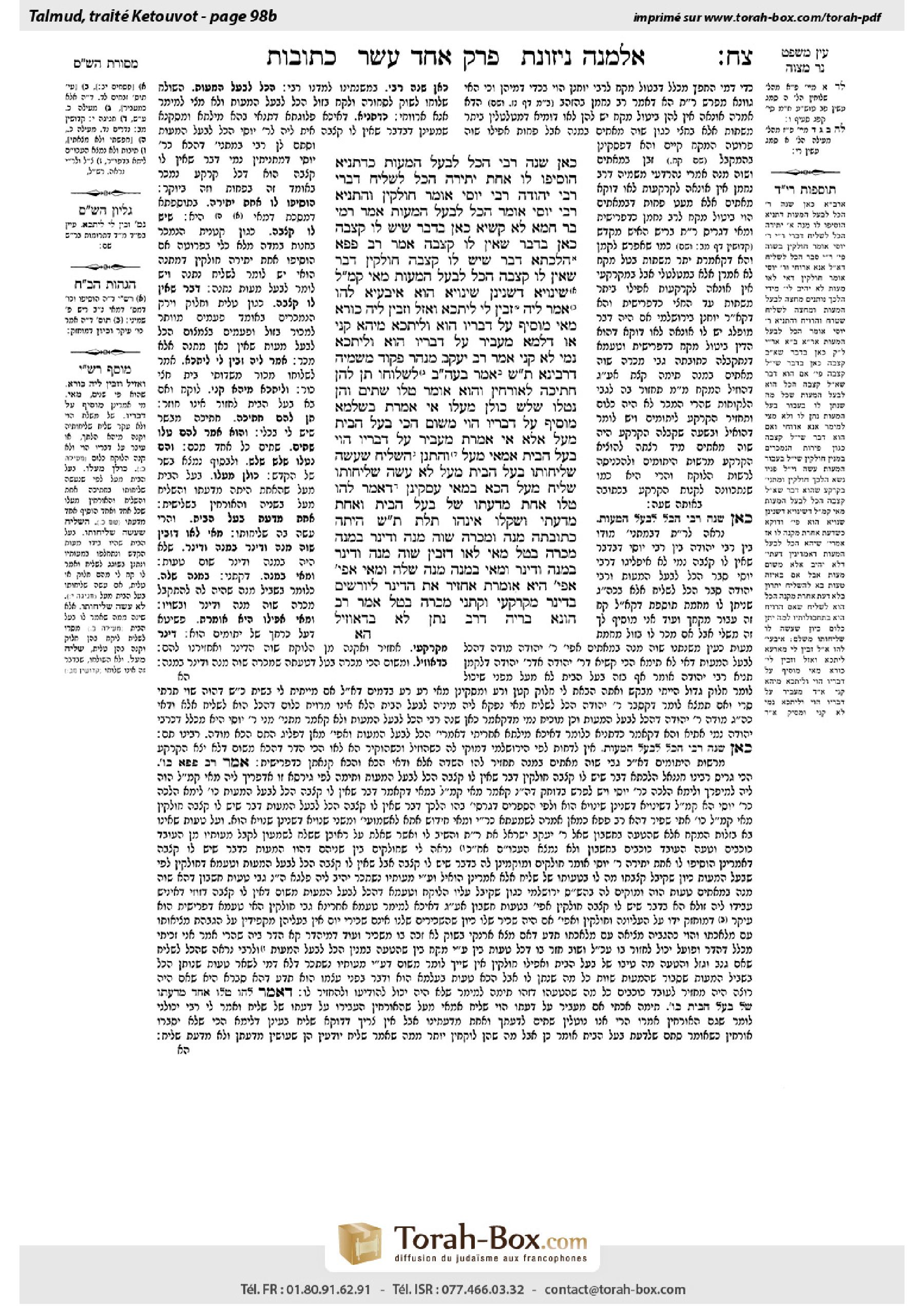
Ketubot 98b: Talmud study for Daf Yomi
Daf Yomi is the daily study of one Talmud folio. Explore 37 tractates with scans, Hebrew text, Sefaria English and AI-generated French translations where annotated.
Passage selection and English or AI-generated French translation are available where the scan has annotations. Daf Study is independent of Torah-Box and Sefaria.
Browse Ketubot · כתובות · All tractatesKetubot 98b text and translations
This page of Ketubot includes the Aramaic text, an English translation and an AI-generated French translation, alongside the scan above.
כתובות צ״ח ב · Aramaic and Hebrew text
כָּאן שָׁנָה רַבִּי, הַכֹּל לְבַעַל הַמָּעוֹת, כִּדְתַנְיָא: הוֹסִיפוּ לוֹ אַחַת יְתֵירָה, הַכֹּל לַשָּׁלִיחַ, דִּבְרֵי רַבִּי יְהוּדָה. רַבִּי יוֹסֵי אוֹמֵר: חוֹלְקִין.
וְהָתַנְיָא, רַבִּי יוֹסֵי אוֹמֵר: הַכֹּל לְבַעַל הַמָּעוֹת! אָמַר רָמֵי בַּר חָמָא: לָא קַשְׁיָא. כָּאן בְּדָבָר שֶׁיֵּשׁ לוֹ קִצְבָה, כָּאן בְּדָבָר שֶׁאֵין לוֹ קִצְבָה.
אָמַר רַב פָּפָּא, הִלְכְתָא: דָּבָר שֶׁיֵּשׁ לוֹ קִצְבָה — חוֹלְקִין, דָּבָר שֶׁאֵין לוֹ קִצְבָה — הַכֹּל לְבַעַל הַמָּעוֹת. מַאי קָא מַשְׁמַע לַן? שִׁינּוּיָא דְּשַׁנִּינַן שִׁינּוּיָא הוּא.
אִיבַּעְיָא לְהוּ, אֲמַר לֵיהּ: זַבֵּין לִי לִיתְכָּא, וַאֲזַל וְזַבֵּין לֵיהּ כּוֹרָא, מַאי? מוֹסִיף עַל דְּבָרָיו הוּא, וְלִיתְכָּא מִיהָא קָנֵי, אוֹ דִלְמָא מַעֲבִיר עַל דְּבָרָיו הוּא, וְלִיתְכָּא נָמֵי לָא קָנֵי?
אָמַר רַב יַעֲקֹב מִנְּהַר פְּקוֹד מִשְּׁמֵיהּ דְּרָבִינָא: תָּא שְׁמַע, אָמַר בַּעַל הַבַּיִת לִשְׁלוּחוֹ: ״תֵּן לָהֶן חֲתִיכָה לָאוֹרְחִין״, וְהוּא אוֹמֵר: ״טְלוּ שְׁתַּיִם״, וְהֵן נָטְלוּ שָׁלֹשׁ — כּוּלָּן מָעֲלוּ.
אִי אָמְרַתְּ בִּשְׁלָמָא מוֹסִיף עַל דְּבָרָיו הָוֵי — מִשּׁוּם הָכִי בַּעַל הַבַּיִת מָעַל. אֶלָּא אִי אָמְרַתְּ מַעֲבִיר עַל דְּבָרָיו הָוֵי — בַּעַל הַבַּיִת אַמַּאי מָעַל? וְהָתְנַן: הַשָּׁלִיחַ שֶׁעָשָׂה שְׁלִיחוּתוֹ — בַּעַל הַבַּיִת מָעַל, לֹא עָשָׂה שְׁלִיחוּתוֹ — שָׁלִיחַ מָעַל!
הָכָא בְּמַאי עָסְקִינַן, דְּאָמַר לְהוּ: ״טְלוּ אַחַת מִדַּעְתּוֹ שֶׁל בַּעַל הַבַּיִת, וְאַחַת מִדַּעְתִּי״, וּשְׁקַלוּ אִינְהוּ תְּלָת.
תָּא שְׁמַע: הָיְתָה כְּתוּבָּתָהּ מָנֶה, וּמָכְרָה שָׁוֶה מָנֶה וְדִינָר בְּמָנֶה — מִכְרָהּ בָּטֵל.
מַאי לָאו דְּזַבֵּין שָׁוֶה מָנֶה וְדִינָר בְּמָנֶה וְדִינָר, וּמַאי ״בְּמָנֶה״ — מָנֶה שֶׁלָּהּ. וּמַאי ״אֲפִילּוּ״? אֲפִילּוּ הִיא אוֹמֶרֶת ״אַחְזִיר אֶת הַדִּינָר לַיּוֹרְשִׁים בְּדִינָר מְקַרְקְעֵי״, וְקָתָנֵי: מִכְרָהּ בָּטֵל.
אָמַר רַב הוּנָא בְּרֵיהּ דְּרַב נָתָן: לָא, בִּדְאוֹזֵיל.
Ketubot 98b · English translation
Here Rabbi Yehuda HaNasi taught, i.e., it can be learned from this mishna that it is Rabbi Yehuda HaNasi’s opinion that everything belongs to the owner of the money. If one earned a profit through the actions of his agent, the profit belongs to him and not to the agent, as it is taught in a baraita where the Sages debate this matter: In a case where one sent an agent to the marketplace to purchase merchandise at a certain price, if in addition to items that the agent purchased they added for him one extra item, the entire profit belongs to the agent; this is the statement of Rabbi Yehuda. Rabbi Yosei says: The owner of the money and the agent split the profit.
The Gemara asks: But isn’t it taught in a baraita that Rabbi Yosei says: Everything belongs to the owner of the money? Rami bar Ḥama said: This is not difficult. Here the baraita is referring to an item that has a fixed price. If the seller added something, it is clear that the additional item is a gift, but it is unclear if the gift is meant for the agent or for the owner of the money, so it is split between the two. Whereas there, the baraita is referring to an item that does not have a fixed price, and one can say that any additional items that were given were not intended for the agent, but were part of the overall deal and belong to the owner of the money.
Rav Pappa said: The halakha is that an item that has a fixed price is split, and with regard to an item that does not have a fixed price, the entire profit belongs to the owner of the money. The Gemara asks: What is he teaching us with that statement? That is exactly what Rami bar Ḥama said. The Gemara explains: He wanted to say that the answer that we taught is the correct answer, and one can issue practical halakhic rulings based on it.
§ A dilemma was raised before the Sages: If one said to his agent: Sell on my behalf a half-kor, and the agent went and sold for him a kor, what is the halakha? Is he considered to be adding to the words of his employer? In that case, though he also performed an action that he was not assigned to do, part of his action was performing his assigned agency, and the buyer at least acquired a half-kor. Or perhaps he is considered to be disregarding his employer’s words, since he did not perform exactly what he was told to do, in which case the entire transaction was performed by his own volition, without the authorization of his employer, and even the half-kor is not acquired by the buyer.
Rav Ya’akov of Pekod River said in the name of Ravina: Come and hear proof from a mishna (Me’ila 20a): The mishna teaches with regard to the halakhot of misuse of consecrated property: If the host said to his agent: Give the guests a piece of meat, and the agent went and said to the guests: Take two pieces, and they went and took three, and in the end it was ascertained that the meat was consecrated, they are all guilty of misusing consecrated property.
Granted, if you say that the agent is adding to the words of the host, this halakha is understandable, because then, when the agent said to the guests: Take two pieces, he presented one of the pieces as the agent of the host. It is due to that reason that the host is guilty of misusing consecrated property. However, if you say that the agent is disregarding the words of the host, why is the host guilty of misusing consecrated property? Didn’t we learn in a mishna (Me’ila 20a): If an agent who performed his assigned agency caused consecrated property to be misused, it is the host who appointed him who is guilty of misusing consecrated property; however, if the agent did not perform his assigned agency, and did not act in accordance with his instructions, it is the agent who is guilty of the misuse and not the employer?
The Gemara answers: With what are we dealing here? This is a case where the agent said explicitly to the guests: Take one piece with the consent of the host, and one piece with my consent, and they took three pieces. Since every piece of meat was taken with the consent of someone else, they are all guilty of the misuse of consecrated property.
The Gemara suggests: Come and hear an understanding of the mishna: If her marriage contract was worth one hundred dinars, and she sold property worth one hundred dinars and a dinar for one hundred dinars, the sale is void.
The Gemara interprets the case of the mishna: What, is it not that she sold property worth one hundred dinars and a dinar for one hundred dinars and a dinar, and there was no error in the sale? And what does it mean when the mishna says that she sold the property for one hundred dinars? It means that she sold it in order to receive the one hundred dinars owed to her because of her marriage contract. And what does it mean when it says in the mishna: Even if she says: I will return the one extra dinar to the heirs, nevertheless the sale is voided? It means that even if she says: I will return the dinar to the heirs by giving them a dinar’s worth from my land, the heirs will not be losing anything at all. The Gemara concludes the proof: And the mishna teaches that even so the sale is void, implying that not just what she added is void, but the entire sale is voided.
Rav Huna, son of Rav Natan, said: No, the correct understanding of the mishna is not that she sold the land for its proper price. Rather, the mishna is referring to a situation where she reduced its price and sold the property for less than its worth, and there was an error in the sale itself.
Ketubot 98b · Traduction française (IA)
Ici, Rabbi Yehouda HaNassi a enseigné, c’est-à-dire que l’on peut déduire de cette Michna que, selon Rabbi Yehouda HaNassi, tout revient au propriétaire de l’argent. Si quelqu’un réalise un bénéfice grâce aux actes de son mandataire, ce bénéfice lui revient, et non au mandataire. C’est ce qui est enseigné dans une baraïta où les Sages débattent de cette question : si quelqu’un envoie un mandataire au marché pour acheter des marchandises à un certain prix et que, en plus des articles achetés par le mandataire, on lui ajoute un article, tout le bénéfice revient au mandataire ; telle est l’opinion de Rabbi Yehouda. Rabbi Yossi dit : le propriétaire de l’argent et le mandataire se partagent le bénéfice.
La Guemara demande : Mais n’est-il pas enseigné dans une baraïta que Rabbi Yossi dit : « Tout revient au propriétaire de l’argent » ? Rami bar Ḥama dit : Il n’y a pas de difficulté. Ici, la baraïta parle d’un article dont le prix est fixe. Si le vendeur a ajouté quelque chose, il est clair que l’article supplémentaire est un cadeau, mais on ne sait pas si ce cadeau est destiné au mandataire ou au propriétaire de l’argent ; ils se le partagent donc. Là, en revanche, la baraïta parle d’un article dont le prix n’est pas fixe. On peut alors dire que les articles supplémentaires remis n’étaient pas destinés au mandataire, mais faisaient partie de la transaction dans son ensemble et reviennent au propriétaire de l’argent.
Rav Pappa dit : La halakha est que, pour un article dont le prix est fixe, le bénéfice est partagé, tandis que, pour un article dont le prix n’est pas fixe, tout le bénéfice revient au propriétaire de l’argent. La Guemara demande : Que nous enseigne-t-il par cette déclaration ? C’est exactement ce qu’a dit Rami bar Ḥama. La Guemara explique : Il voulait dire que la réponse que nous avons donnée est la bonne et que l’on peut rendre des décisions halakhiques pratiques sur cette base.
§ Une question fut soumise aux Sages : si quelqu’un dit à son mandataire : « Vends pour moi un demi-kor », et que le mandataire va vendre un kor pour lui, quelle est la halakha ? Doit-on considérer qu’il ajoute aux paroles de son mandant ? Dans ce cas, bien qu’il ait aussi accompli un acte qui ne lui avait pas été confié, une partie de son acte relevait de la mission qui lui avait été assignée, et l’acheteur a au moins acquis un demi-kor. Ou bien doit-on considérer qu’il n’a pas tenu compte des paroles de son mandant, puisqu’il n’a pas fait exactement ce qui lui avait été demandé ? Dans ce cas, toute la transaction a été effectuée de sa propre initiative, sans l’autorisation de son mandant, et l’acheteur n’a même pas acquis le demi-kor.
Rav Ya’akov de Pekod River dit au nom de Ravina : Viens entendre une preuve tirée d’une Michna (Meïla 20a). La Michna enseigne, au sujet des lois relatives à l’usage illicite de biens consacrés : si l’hôte dit à son mandataire : « Donne aux invités un morceau de viande », que le mandataire va dire aux invités : « Prenez deux morceaux », qu’ils en prennent trois et qu’il s’avère finalement que la viande était consacrée, ils sont tous coupables d’usage illicite de biens consacrés.
Il est compréhensible que l’hôte soit coupable d’usage illicite de biens consacrés si l’on considère que le mandataire ajoute aux paroles de l’hôte, car, lorsque le mandataire a dit aux invités : « Prenez deux morceaux », il a présenté l’un de ces morceaux comme étant mandaté par l’hôte. C’est pour cette raison que l’hôte est coupable d’usage illicite de biens consacrés. Cependant, si l’on considère que le mandataire n’a pas tenu compte des paroles de l’hôte, pourquoi l’hôte serait-il coupable d’usage illicite de biens consacrés ? N’avons-nous pas appris dans une Michna (Meïla 20a) que, si un mandataire qui a accompli la mission qui lui était confiée a causé un usage illicite de biens consacrés, c’est l’hôte qui l’a mandaté qui en est coupable ; en revanche, si le mandataire n’a pas accompli la mission qui lui était confiée et n’a pas agi conformément à ses instructions, c’est le mandataire qui est coupable de l’usage illicite, et non son mandant ?
La Guemara répond : De quoi s’agit-il ici ? D’un cas où le mandataire a dit explicitement aux invités : « Prenez un morceau avec l’accord de l’hôte et un morceau avec mon accord », et où ils en ont pris trois. Puisque chaque morceau de viande a été pris avec l’accord de quelqu’un d’autre, ils sont tous coupables d’usage illicite de biens consacrés.
La Guemara propose : Viens entendre une explication de la Michna : si sa ketouba valait cent dinars et qu’elle a vendu pour cent dinars un bien qui en valait cent un, la vente est annulée.
La Guemara interprète le cas de la Michna : N’est-ce pas qu’elle a vendu pour cent dinars et un dinar un bien qui en valait cent un, sans qu’il y ait eu d’erreur dans la vente ? Et que signifie la formule de la Michna selon laquelle elle a vendu le bien pour cent dinars ? Cela signifie qu’elle l’a vendu afin de recevoir les cent dinars qui lui étaient dus au titre de sa ketouba. Et que signifie la formule de la Michna : « Même si elle dit : “Je rendrai aux héritiers le dinar supplémentaire”, la vente est néanmoins annulée » ? Cela signifie que, même si elle dit : « Je rendrai le dinar aux héritiers en leur donnant une valeur équivalente prise sur mes terres », les héritiers ne perdront absolument rien. La Guemara conclut la preuve : la Michna enseigne que, malgré cela, la vente est annulée, ce qui implique que ce n’est pas seulement ce qu’elle a ajouté qui est annulé, mais la vente tout entière.
Rav Houna, fils de Rav Natan, dit : Non, il ne faut pas comprendre que, selon la Michna, elle a vendu la terre à son juste prix. La Michna parle plutôt d’une situation où elle en a réduit le prix et vendu le bien au-dessous de sa valeur, de sorte qu’il y a eu une erreur dans la vente elle-même.
Traduction française générée par IA à partir de l’édition anglaise de Sefaria. Vérifie toujours un passage avec le texte source.
Text from Sefaria: William Davidson Edition - Vocalized Aramaic (CC BY NC); William Davidson Edition - English (CC BY NC).