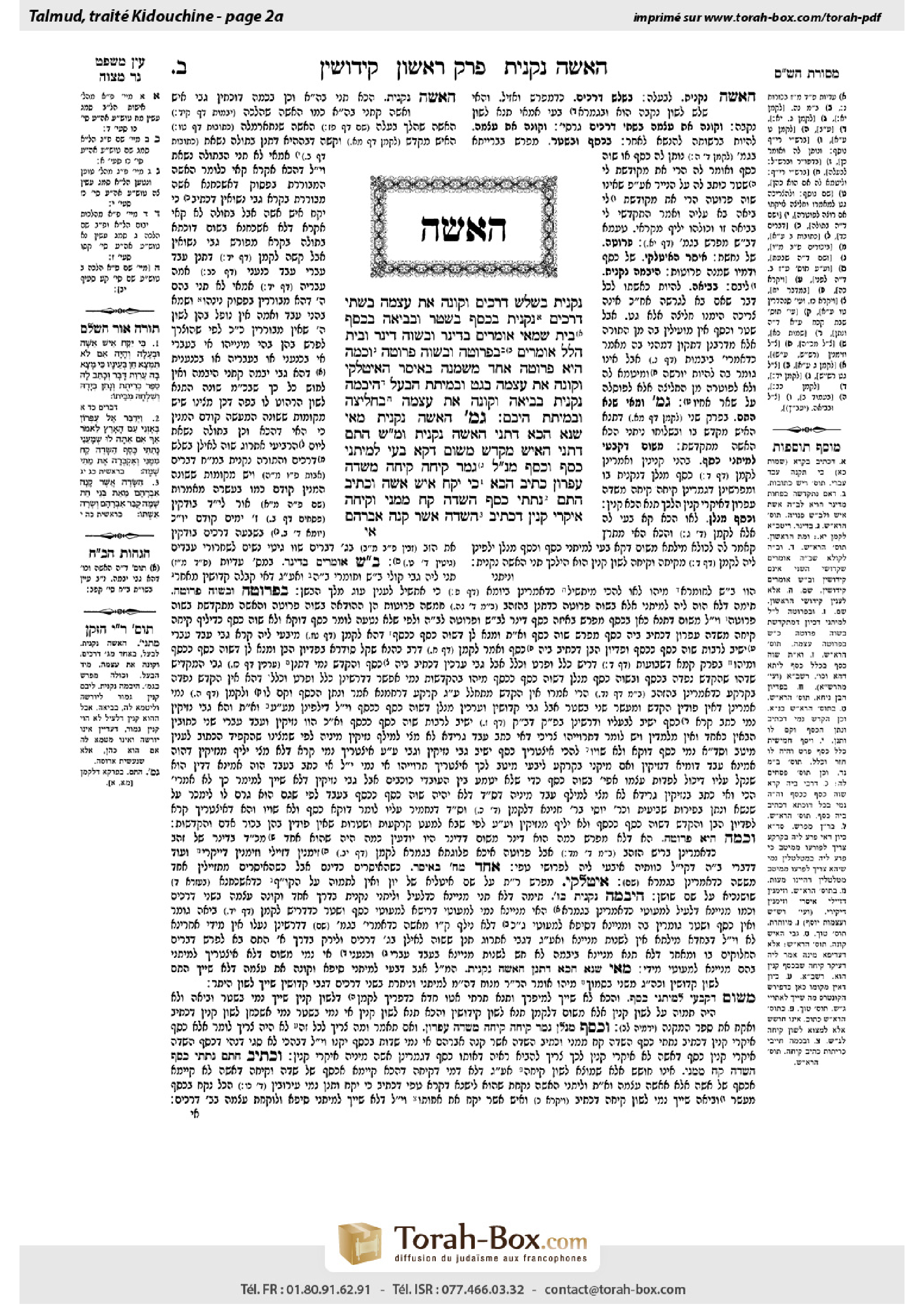
Kiddushin 2a: Talmud study for Daf Yomi
Daf Yomi is the daily study of one Talmud folio. Explore 37 tractates with scans, Hebrew text, Sefaria English and AI-generated French translations where annotated.
Passage selection and English or AI-generated French translation are available where the scan has annotations. Daf Study is independent of Torah-Box and Sefaria.
Browse Kiddushin · קידושין · All tractatesKiddushin 2a text and translations
This page of Kiddushin includes the Aramaic text, an English translation and an AI-generated French translation, alongside the scan above.
קידושין ב׳ א · Aramaic and Hebrew text
הָאִשָּׁה נִקְנֵית בְּשָׁלֹשׁ דְּרָכִים, וְקוֹנָה אֶת עַצְמָהּ בִּשְׁתֵּי דְרָכִים. נִקְנֵית בְּכֶסֶף, בִּשְׁטָר, וּבְבִיאָה. בְּכֶסֶף: בֵּית שַׁמַּאי אוֹמְרִים בְּדִינָר וּבְשָׁוֶה דִּינָר, וּבֵית הִלֵּל אוֹמְרִים: בִּפְרוּטָה וּבְשָׁוֶה פְּרוּטָה. וְכַמָּה הִיא פְּרוּטָה – אֶחָד מִשְּׁמֹנָה בָּאִיסָּר הָאִיטַלְקִי.
וְקוֹנָה אֶת עַצְמָהּ בְּגֵט וּבְמִיתַת הַבַּעַל. הַיְּבָמָה נִקְנֵית בְּבִיאָה, וְקוֹנָה אֶת עַצְמָהּ בַּחֲלִיצָה וּבְמִיתַת הַיָּבָם.
גְּמָ׳ הָאִשָּׁה נִקְנֵית. מַאי שְׁנָא הָכָא דְּתָנֵי ״הָאִשָּׁה נִקְנֵית״, וּמַאי שְׁנָא הָתָם דְּתָנֵי ״הָאִישׁ מְקַדֵּשׁ״? מִשּׁוּם דְּקָא בָּעֵי לְמִיתְנֵי כֶּסֶף,
וְכֶסֶף מְנָא לַן – גָּמַר ״קִיחָה״ ״קִיחָה״ מִשְּׂדֵה עֶפְרוֹן. כְּתִיב הָכָא: ״כִּי יִקַּח אִישׁ אִשָּׁה״, וּכְתִיב הָתָם: ״נָתַתִּי כֶּסֶף הַשָּׂדֶה קַח מִמֶּנִּי״,
וְקִיחָה אִיקְּרִי ״קִנְיָן״, דִּכְתִיב: ״הַשָּׂדֶה אֲשֶׁר קָנָה אַבְרָהָם״.
Kiddushin 2a · English translation
MISHNA: A woman is acquired by, i.e., becomes betrothed to, a man to be his wife in three ways, and she acquires herself, i.e., she terminates her marriage, in two ways. The mishna elaborates: She is acquired through money, through a document, and through sexual intercourse. With regard to a betrothal through money, there is a dispute between tanna’im: Beit Shammai say that she can be acquired with one dinar or with anything that is worth one dinar. And Beit Hillel say: She can be acquired with one peruta, a small copper coin, or with anything that is worth one peruta. The mishna further clarifies: And how much is the value of one peruta, by the fixed value of silver? The mishna explains that it is one-eighth of the Italian issar, which is a small silver coin.
And a woman acquires herself through a bill of divorce or through the death of the husband. A woman whose husband, who had a brother, died childless [yevama], can be acquired by the deceased husband’s brother, the yavam, only through intercourse. And she acquires herself, i.e., she is released from her levirate bond, through ḥalitza or through the death of the yavam.
GEMARA: The mishna teaches that a woman can be acquired in three ways. The Gemara asks: What is different here that this mishna teaches: A woman is acquired, using the language of acquisition, and what is different there, in the beginning of the next chapter (42a), which teaches: A man betroths, using the language of betrothal? The Gemara explains: In this mishna the tanna utilized the language of acquisition because he wanted to teach about betrothal through money, which is the standard means of exchange in an act of acquisition.
The Gemara continues its explanation: And from where do we derive that betrothal is accomplished by means of giving money? It is derived by means of a verbal analogy between the term expressing taking stated with regard to betrothal and from the term expressing taking with regard to the field of Ephron. How so? It is written here, with regard to marriage: “When a man takes a woman” (Deuteronomy 24:1), and it is written there, concerning Abraham’s purchase of the field of the Cave of Machpelah from Ephron the Hittite: “I will give money for the field; take it from me” (Genesis 23:13). This verbal analogy teaches that just as Ephron’s field was acquired with money, so too, a woman can be acquired with money.
The Gemara continues: And the taking of Ephron’s field is called an acquisition in the Torah, as it is written with regard to the same issue: “The field which Abraham acquired” (Genesis 25:10).
Kiddushin 2a · Traduction française (IA)
MICHNA : Une femme est acquise par un homme, c’est-à-dire qu’elle lui est fiancée en vue de devenir son épouse, de trois façons, et elle acquiert sa liberté, c’est-à-dire qu’elle met fin à son mariage, de deux façons. La Michna détaille : elle est acquise par de l’argent, par un acte écrit et par des relations sexuelles. Au sujet des fiançailles par l’argent, les tannaïm sont en désaccord : Beit Chammaï disent qu’elle peut être acquise pour un dinar ou pour tout objet d’une valeur d’un dinar. Beit Hillel disent qu’elle peut être acquise pour une perouta, une petite pièce de cuivre, ou pour tout objet d’une valeur d’une perouta. La Michna précise encore : quelle est la valeur d’une perouta, selon la valeur fixe de l’argent ? Elle vaut un huitième d’issar italien, une petite pièce d’argent.
Une femme acquiert sa liberté au moyen d’un acte de divorce ou par la mort de son mari. Une femme dont le mari, qui avait un frère, est mort sans enfant [yevama] ne peut être acquise par le frère du défunt, le yavam, que par des relations sexuelles. Elle acquiert sa liberté, c’est-à-dire qu’elle est libérée de son lien de lévirat, par la ḥalitsa ou par la mort du yavam.
GUEMARA : La Michna enseigne qu’une femme peut être acquise de trois façons. La Guemara demande : Pourquoi cette Michna dit-elle ici : « Une femme est acquise », en employant le terme d’acquisition, tandis qu’au début du chapitre suivant (42a), elle dit : « Un homme fiance », en employant le terme de fiançailles ? La Guemara explique : dans cette Michna, le tanna a employé le terme d’acquisition parce qu’il voulait enseigner les fiançailles par l’argent, qui est le moyen d’échange usuel dans une acquisition.
La Guemara poursuit son explication : D’où déduisons-nous que les fiançailles s’accomplissent par le don d’argent ? Cela se déduit d’une analogie verbale entre le terme exprimant la prise, employé à propos des fiançailles, et le terme exprimant la prise, employé à propos du champ d’Efron. Comment cela ? Il est écrit ici, à propos du mariage : « Lorsqu’un homme prend une femme » (Deutéronome 24:1), et il est écrit là, au sujet de l’achat par Avraham du champ de la grotte de Makhpéla auprès d’Efron le Hittite : « Je donnerai de l’argent pour le champ ; prends-le de moi » (Genèse 23:13). Cette analogie verbale enseigne que, tout comme le champ d’Efron a été acquis avec de l’argent, une femme peut elle aussi être acquise avec de l’argent.
La Guemara poursuit : la prise du champ d’Efron est appelée une acquisition dans la Torah, comme il est écrit à propos de la même affaire : « Le champ qu’Avraham avait acquis » (Genèse 25:10).
Traduction française générée par IA à partir de l’édition anglaise de Sefaria. Vérifie toujours un passage avec le texte source.
Text from Sefaria: William Davidson Edition - Vocalized Aramaic (CC BY NC); William Davidson Edition - English (CC BY NC).