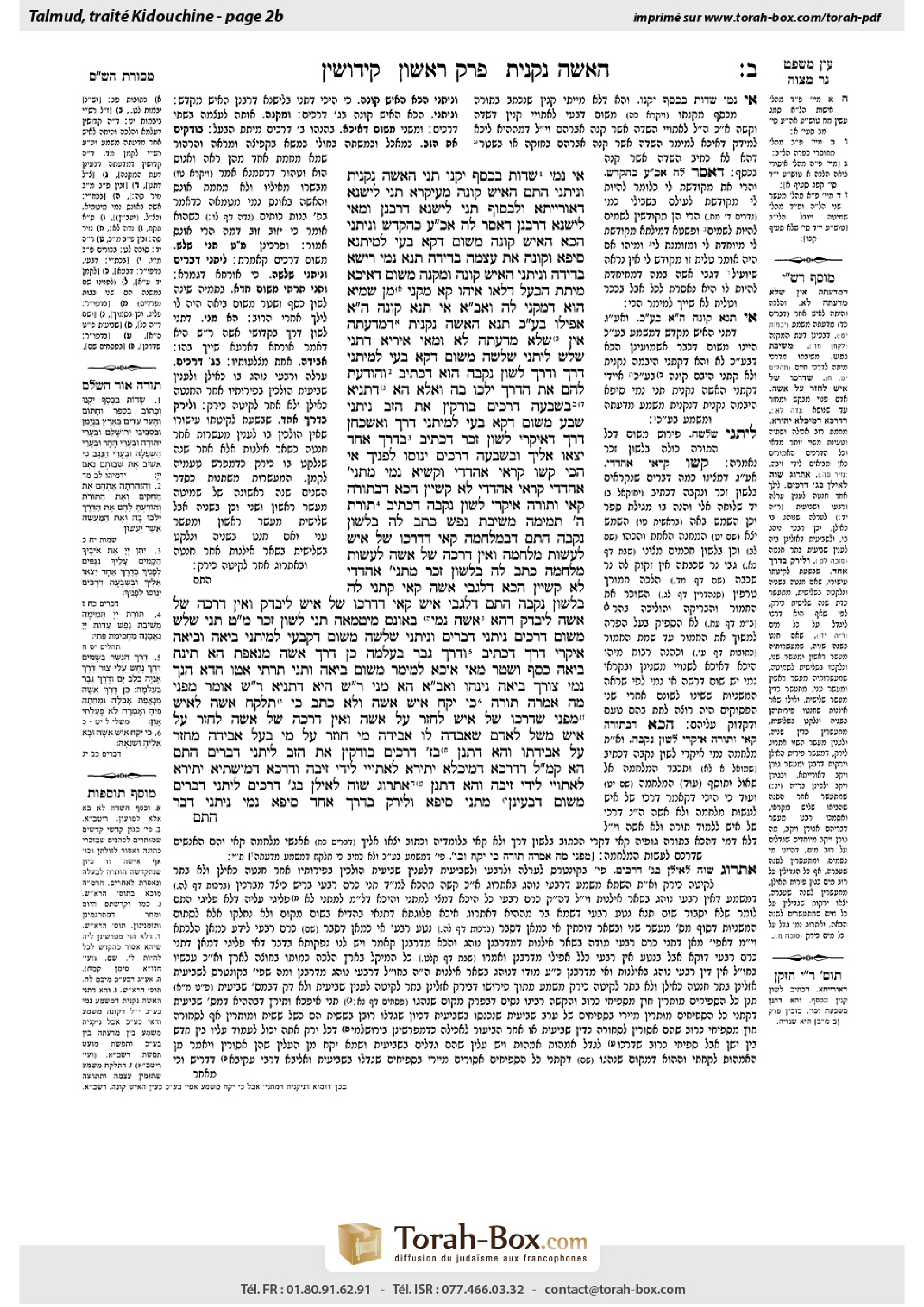
Kiddushin 2b: Talmud study for Daf Yomi
Daf Yomi is the daily study of one Talmud folio. Explore 37 tractates with scans, Hebrew text, Sefaria English and AI-generated French translations where annotated.
Passage selection and English or AI-generated French translation are available where the scan has annotations. Daf Study is independent of Torah-Box and Sefaria.
Browse Kiddushin · קידושין · All tractatesKiddushin 2b text and translations
This page of Kiddushin includes the Aramaic text, an English translation and an AI-generated French translation, alongside the scan above.
קידושין ב׳ ב · Aramaic and Hebrew text
אִי נָמֵי, ״שָׂדוֹת בַּכֶּסֶף יִקְנוּ״, תָּנֵי ״הָאִשָּׁה נִקְנֵית״.
וְנִיתְנֵי הָתָם ״הָאִישׁ קוֹנֶה״! מֵעִיקָּרָא תָּנֵי לִישָּׁנָא דְאוֹרָיְיתָא, וּלְבַסּוֹף תָּנֵי לִישָּׁנָא דְרַבָּנַן, וּמַאי לִישָּׁנָא דְרַבָּנַן? – דְּאָסַר לַהּ אַכּוּלֵּי עָלְמָא כְּהֶקְדֵּשׁ.
וְנִיתְנֵי הָכָא ״הָאִישׁ קוֹנֶה״! מִשּׁוּם דְּקָא בָּעֵי לְמִיתְנָא סֵיפָא: ״וְקוֹנָה אֶת עַצְמָהּ״ בְּדִידַהּ, תְּנָא נָמֵי רֵישָׁא בְּדִידַהּ.
וְנִיתְנֵי ״הָאִישׁ קוֹנֶה וּמַקְנֶה״! מִשּׁוּם דְּאִיכָּא מִיתַת הַבַּעַל, דְּלָאו אִיהוּ קָא מַקְנֵי – מִן שְׁמַיָּא הוּא דְּמַקְנִי לָהּ.
וְאִי בָּעֵית אֵימָא: אִי תְּנָא ״קוֹנֶה״, הֲוָה אָמֵינָא אֲפִילּוּ בְּעַל כׇּרְחָהּ – תְּנָא ״הָאִשָּׁה נִקְנֵית״, דְּמִדַּעְתָּהּ – אִין, שֶׁלֹּא מִדַּעְתָּהּ – לָא.
וּמַאי אִירְיָא דְּתָנֵי ״שָׁלֹשׁ״? לִיתְנֵי ״שְׁלֹשָׁה״! מִשּׁוּם דְּקָא בָּעֵי לְמִיתְנֵי ״דֶּרֶךְ״ וְ״דֶרֶךְ״ לְשׁוֹן נְקֵבָה הוּא, דִּכְתִיב: ״וְהוֹדַעְתָּ לָהֶם אֶת הַדֶּרֶךְ יֵלְכוּ בָהּ״.
וְאֶלָּא הָא דְּתַנְיָא: ״בְּשִׁבְעָה דְּרָכִים בּוֹדְקִין אֶת הַזָּב״, נִיתְנֵי ״שֶׁבַע״! מִשּׁוּם דְּקָא בָּעֵי לְמִיתְנֵי ״דֶּרֶךְ״, וְאַשְׁכְּחַן ״דֶּרֶךְ״ דְּאִיקְּרִי לְשׁוֹן זָכָר, דִּכְתִיב: ״בְּדֶרֶךְ אֶחָד יֵצְאוּ אֵלֶיךָ וּבְשִׁבְעָה דְרָכִים יָנוּסוּ לְפָנֶיךָ״. אִי הָכִי, קָשׁוּ קְרָאֵי אַהֲדָדֵי! וְקַשְׁיָא נָמֵי מַתְנִיתִין אַהֲדָדֵי!
קְרָאֵי אַהֲדָדֵי לָא קַשְׁיָין: הָכָא, דִּבְתוֹרָה קָאֵי, וְתוֹרָה אִיקְּרִי לְשׁוֹן נְקֵבָה, דִּכְתִיב: ״תּוֹרַת ה׳ תְּמִימָה מְשִׁיבַת נָפֶשׁ״ – כָּתַב לָהּ בִּלְשׁוֹן נְקֵבָה. הָתָם, דִּבְמִלְחָמָה קָאֵי, דְּדַרְכּוֹ שֶׁל אִישׁ לַעֲשׂוֹת מִלְחָמָה וְאֵין דַּרְכָּהּ שֶׁל אִשָּׁה לַעֲשׂוֹת מִלְחָמָה – כָּתַב לָהּ בִּלְשׁוֹן זָכָר.
מַתְנִיתִין אַהֲדָדֵי לָא קַשְׁיָין: הָכָא, דִּלְגַבֵּי אִשָּׁה קָאֵי – קָתָנֵי לַהּ בִּלְשׁוֹן נְקֵבָה. הָתָם, דִּלְגַבֵּי אִישׁ קָאֵי, דְּדַרְכּוֹ שֶׁל אִישׁ לִיבָּדֵק וְאֵין דַּרְכָּהּ שֶׁל אִשָּׁה לִיבָּדֵק, דְּהָא אִשָּׁה נָמֵי בְּאוֹנֶס מִיטַּמְּאָהּ – תָּנֵי לְשׁוֹן זָכָר.
מַאי טַעְמָא תָּנֵי ״שָׁלֹשׁ״ – מִשּׁוּם ״דְּרָכִים״? נִיתְנֵי ״דְּבָרִים״ וְנִיתְנֵי ״שְׁלֹשָׁה״! מִשּׁוּם דְּקָבָעֵי לְמִיתְנֵי ״בִּיאָה״, וּבִיאָה אִיקְּרִי ״דֶּרֶךְ״, דִּכְתִיב: ״וְדֶרֶךְ גֶּבֶר בְּעַלְמָה כֵּן דֶּרֶךְ אִשָּׁה מְנָאָפֶת״.
הָא תִּינַח ״בִּיאָה״, ״כֶּסֶף״ וּ״שְׁטָר״ מַאי אִיכָּא לְמֵימַר? מִשּׁוּם ״בִּיאָה״.
וְתָנֵי תַּרְתֵּי אַטּוּ חֲדָא? הָנָךְ נָמֵי צוֹרֶךְ בִּיאָה נִינְהוּ.
וְאִי בָּעֵית אֵימָא: הָא מַנִּי – רַבִּי שִׁמְעוֹן הִיא, דְּתַנְיָא, רַבִּי שִׁמְעוֹן אוֹמֵר: מִפְּנֵי מָה אָמְרָה תּוֹרָה ״כִּי יִקַּח אִישׁ אִשָּׁה״, וְלֹא כָּתַב ״כִּי תִּלָּקַח אִשָּׁה לְאִישׁ״? – מִפְּנֵי שֶׁדַּרְכּוֹ שֶׁל אִישׁ לְחַזֵּר עַל אִשָּׁה וְאֵין דַּרְכָּהּ שֶׁל אִשָּׁה לְחַזֵּר עַל אִישׁ. מָשָׁל לְאָדָם שֶׁאָבְדָה לוֹ אֲבֵידָה – מִי חוֹזֵר עַל מִי? בַּעַל אֲבֵידָה מְחַזֵּר עַל אֲבֵידָתוֹ.
וְהָא דִּתְנַן: ״בְּשִׁבְעָה דְּרָכִים בּוֹדְקִין אֶת הַזָּב״, לִיתְנֵי ״דְּבָרִים״! הָתָם הָא קָא מַשְׁמַע לַן, דְּדַרְכָּא דְּמֵיכְלָא יַתִּירָא לְאֵתוֹיֵי לִידֵי זִיבָה, וְדַרְכָּא דְּמִישְׁתְּיָא יַתִּירָא לְאֵתוֹיֵי לִידֵי זִיבָה.
וְהָא דִּתְנַן: ״אֶתְרוֹג שָׁוֶה לָאִילָן בִּשְׁלֹשָׁה דְּרָכִים״, לִיתְנֵי ״דְּבָרִים״! מִשּׁוּם דְּבָעֵינַן מִתְנֵי סֵיפָא: ״וְלַיָּרָק בְּדֶרֶךְ אֶחָד״. סֵיפָא נָמֵי, נִיתְנֵי ״דָּבָר״!
Kiddushin 2b · English translation
Alternatively, it can be proven that purchasing a field with money is called an acquisition from the verse: “They shall acquire fields with money” (Jeremiah 32:44). Consequently, as the tanna wanted to teach that a woman can be betrothed with money, he taught: A woman is acquired. This explains why the terminology of acquisition is used in this mishna.
The Gemara asks: But let the mishna teach there, in the next chapter: A man acquires. The Gemara explains: Initially, the mishna taught using the language of the Torah, in which betrothal is called taking. And ultimately, in the next chapter, it taught using the language of the Sages. And what is the reason that betrothal is called kiddushin, literally, consecration, in the language of the Sages? The reason is that through betrothal the husband renders her forbidden to everyone like consecrated property. Therefore, this act is referred to as consecration.
The Gemara asks another question with regard to the difference in wording between the two mishnayot: And let it teach here, as in the following chapter: A man acquires. Why does this mishna teach: The woman is acquired, with the woman as the subject of the sentence? The Gemara answers: This is because the tanna wanted to teach in the latter clause of the mishna: And she acquires herself, which is stated with regard to her. Therefore, the tanna also taught the halakha stated with regard to her in the first clause.
The Gemara further asks: But if this is the reason, the mishna could have been formulated entirely differently. Let it teach: The man can acquire a woman and transfer authority, i.e., grant her the release from marriage in the form of a bill of divorce. The Gemara answers: The mishna could not use the expression: Transfer, because there is the case of the husband’s death, in which it is not he who transfers authority. Rather, it is from Heaven that her freedom is transferred to her. Therefore, the mishna could not issue a general statement that the man can actively transfer to the woman her release from marriage.
And if you wish, say instead another explanation. If the mishna had taught: The man acquires the woman, I would say that he can acquire her even against her will, as indicated by the expression: He acquires. One might have assumed that the betrothal depends on the husband, without the need for the woman’s consent. Therefore the mishna taught: The woman is acquired, from which it may be inferred that with her consent, yes, he can acquire her as a wife, but when he acts without her consent, no, she is not betrothed to him.
The Gemara continues to analyze the style of the mishna: And why does the tanna specifically teach: Three [shalosh] ways, formulated in the feminine? Let it teach: Three [shelosha] ways, formulated in the masculine. The Gemara explains: The mishna uses this form because it wants to teach the word way [derekh], and derekh is formulated in the feminine, as it is written: “And you shall show them the way [derekh] in which [bah] they must walk” (Exodus 18:20). The term bah, which is referring to derekh, is formulated in the feminine.
The Gemara challenges: But with regard to that which is taught in a mishna (Nazir 65b): One examines a zav in seven [shiva] ways [derakhim], where shiva is formulated in the masculine, let it teach: Seven [sheva] ways, formulated in the feminine. The Gemara answers: The mishna uses the masculine formulation of the term seven because it wanted to teach: Derekh, and we find that the word derekh is referred to in the masculine form, as it is written: “They shall come out against you one way [derekh], and shall flee before you seven [shiva] ways” (Deuteronomy 28:7). The Gemara asks: If so, the verses contradict each other, as in one verse the term derekh is masculine, and in the other verse it is feminine. And furthermore, the mishnayot contradict each other, as in one mishna derekh is masculine while in the other it is feminine.
The Gemara answers: The verses do not contradict each other. Here, that verse: “The way in which they must walk” (Exodus 18:20), is referring to the Torah, i.e., the way mentioned here is referring to the path of the Torah, and Torah is referred to in the feminine form, as it is written: “The Torah of the Lord is perfect [temima], restoring the soul” (Psalms 19:8). The word temima is in the feminine. Consequently, in reference to the Torah the verse writes: Derekh, formulated in the feminine. There, that verse: “Shall flee before you seven ways” (Deuteronomy 28:7), is referring to war, and as it is the way of a man to wage war and it is not the way of a woman to wage war, it is appropriate to speak in the masculine. Therefore, the verse writes the word derekh formulated in the masculine.
Likewise, the mishnayot do not contradict each other: Here, where it is referring to a woman, the mishna teaches derekh formulated in the feminine. There, with regard to the examination of a zav, where it is referring to a man, as it is common for a man to undergo an examination to determine if his emission has a cause other than a gonorrhea-like discharge [ziva] but it is not common for a woman to undergo an examination, since, unlike a man, a woman is rendered impure even by circumstances beyond her control, it taught and used the word derekh formulated in the masculine. Even if a woman has an emission of blood for a reason other than illness, she is still impure. Consequently, in her case there is no reason for an examination to see what might have caused her discharge.
The Gemara asks another question with regard to the language of the mishna: What is the reason that the mishna teaches: Three [shalosh], formulated in the feminine? This is because it wanted to teach: Ways. But if so, let it teach instead the word: Matters, i.e., a woman can be acquired through three matters, and as this term is masculine, let it teach three [shelosha], in the masculine. The Gemara answers: The mishna did do so because it wanted to teach intercourse as one of these ways, and intercourse is called a way in the Torah, as it is written: “And the way of a man with a young woman, so is the way of an adulterous woman” (Proverbs 30:19-20). For this reason the mishna used the term ways rather than matters.
The Gemara raises a difficulty: This works out well with regard to intercourse, which is referred to as a way. But what is there to say concerning money and a document? The mishna could have used the word matters with regard to these modes of betrothal. The Gemara answers: Because it was necessary to mention intercourse, which is called a way, the mishna used the word way in reference to the other two modes as well.
The Gemara asks: And would the mishna teach two cases in a particular manner due to one? Since the word way suits only one of the three modes of betrothal, why didn’t the mishna use the term: Matters, on account of the other two? The Gemara answers: These, too, are for the sake of sexual intercourse. Since the marital relationship, in which intercourse is paramount, is the ultimate purpose of betrothal, the mishna considers this clause as the most important part of the halakha.
And if you wish, say instead: In accordance with whose opinion is this mishna, which teaches derekh? It is in accordance with the opinion of Rabbi Shimon, as it is taught in a baraita that Rabbi Shimon says: For what reason did the Torah say: “When a man takes a woman” (Deuteronomy 22:13) and did not write: “When a woman is taken by a man? Because it is the way [derekh] of a man to pursue a woman, and it is not the way of a woman to pursue a man. The Gemara cites a parable of a man who lost an item. Who searches for what? Certainly the owner of the lost item searches for his lost item, not the other way around. Since woman was created from man’s lost side, the man seeks that which he has lost. To allude to this statement of Rabbi Shimon, the mishna employs the term derekh in this context.
The Gemara asks: But with regard to that which we learned in a mishna: One examines a zav in seven ways, why does it use this phraseology? Let it teach the word: Matters. The Gemara answers that the mishna there teaches us this halakha, that it is the way of excessive eating to lead to ziva, and likewise it is the way of excessive drinking to lead to ziva. Therefore, the mishna uses the phrase: Seven ways, to emphasize that there are ways of behavior that can cause the emission of a zav.
The Gemara further challenges: And with regard to that which we learned in a mishna (Bikkurim 2:6): The halakhot of an etrog tree correspond to those of a tree in three ways. Let it teach instead: Three matters. The Gemara answers: Because it wants to teach in the latter clause: And the halakhot of an etrog tree correspond to those of a vegetable in one way, therefore the mishna uses the term: Ways, in the first clause as well. The Gemara asks: In the latter clause too, let the mishna teach: Matter, rather than: Way.
Kiddushin 2b · Traduction française (IA)
On peut également démontrer que l’achat d’un champ avec de l’argent est appelé une acquisition à partir du verset : « Ils acquerront des champs avec de l’argent » (Jérémie 32,44). Par conséquent, puisque le tanna voulait enseigner qu’une femme peut être fiancée avec de l’argent, il a enseigné : « La femme est acquise. » Cela explique pourquoi cette Michna emploie le terme d’acquisition.
La Guemara demande : Mais que la Michna enseigne, dans le chapitre suivant : « L’homme acquiert » ! La Guemara explique : Dans un premier temps, la Michna a enseigné dans le langage de la Torah, où les fiançailles sont appelées « prise ». Puis, dans le chapitre suivant, elle a enseigné dans le langage des Sages. Et pourquoi les Sages appellent-ils les fiançailles kiddouchin, littéralement « consécration » ? Parce que, par les fiançailles, le mari la rend interdite à tous les autres, comme un bien consacré. C’est pourquoi cet acte est désigné par le terme de consécration.
La Guemara soulève une autre question concernant la différence de formulation entre les deux Michnayot : Que la Michna enseigne ici, comme dans le chapitre suivant : « L’homme acquiert » ! Pourquoi cette Michna enseigne-t-elle : « La femme est acquise », en faisant de la femme le sujet de la phrase ? La Guemara répond : C’est parce que le tanna voulait enseigner, dans la dernière partie de la Michna : « Et elle acquiert sa liberté », formulation qui la prend pour sujet. Le tanna a donc également enseigné, dans la première partie, la halakha formulée à son sujet.
La Guemara demande encore : Mais, si telle est la raison, la Michna aurait pu être formulée tout autrement. Qu’elle enseigne : « L’homme peut acquérir une femme et lui transférer l’autorité », c’est-à-dire lui accorder la libération du mariage au moyen d’un acte de divorce. La Guemara répond : La Michna ne pouvait pas employer le terme « transférer », car il existe le cas de la mort du mari, où ce n’est pas lui qui lui transfère l’autorité. C’est plutôt du Ciel que sa liberté lui est accordée. La Michna ne pouvait donc pas énoncer de manière générale que l’homme peut activement accorder à la femme sa libération du mariage.
Et si tu le souhaites, donne plutôt une autre explication. Si la Michna avait enseigné : « L’homme acquiert la femme », j’aurais dit qu’il peut l’acquérir même contre sa volonté, comme le suggère l’expression « il acquiert ». On aurait pu supposer que les fiançailles dépendent du mari et ne nécessitent pas le consentement de la femme. La Michna enseigne donc : « La femme est acquise », ce qui permet d’en déduire que, si elle y consent, oui, il peut l’acquérir comme épouse, mais que, s’il agit sans son consentement, non, elle n’est pas fiancée avec lui.
La Guemara poursuit l’analyse du style de la Michna : Et pourquoi le tanna enseigne-t-il précisément : « Trois [shalosh] voies », au féminin ? Qu’il enseigne : « Trois [shelosha] voies », au masculin ! La Guemara explique : La Michna emploie cette forme parce qu’elle veut enseigner le mot « voie » [derekh], et derekh est féminin, comme il est écrit : « Tu leur montreras la voie [derekh] qu’ils doivent suivre [bah] » (Exode 18,20). Le terme bah, qui se rapporte à derekh, est au féminin.
La Guemara objecte : Mais, dans la Michna (Nazir 65b), il est enseigné : « On examine un zav selon sept [shiva] voies [derakhim] » ; puisque shiva est au masculin, pourquoi n’enseigne-t-elle pas : « Sept [sheva] voies », au féminin ? La Guemara répond : La Michna emploie la forme masculine de « sept » parce qu’elle voulait enseigner le mot derekh, et l’on trouve que le mot derekh est employé au masculin, comme il est écrit : « Ils viendront contre toi par une seule voie [derekh] et fuiront devant toi par sept [shiva] voies » (Deutéronome 28,7). La Guemara demande : Si tel est le cas, les versets se contredisent, car dans l’un le terme derekh est masculin et dans l’autre, il est féminin. De plus, les Michnayot se contredisent : dans l’une, derekh est masculin, tandis que dans l’autre, il est féminin.
La Guemara répond : Les versets ne se contredisent pas. Ici, ce verset — « La voie qu’ils doivent suivre » (Exode 18,20) — fait référence à la Torah ; autrement dit, la voie mentionnée ici désigne le chemin de la Torah, et la Torah est désignée au féminin, comme il est écrit : « La Torah de l’Éternel est parfaite [temima], elle restaure l’âme » (Psaumes 19,8). Le mot temima est au féminin. Par conséquent, le verset emploie derekh au féminin en référence à la Torah. Là, ce verset — « Ils fuiront devant toi par sept voies » (Deutéronome 28,7) — fait référence à la guerre. Puisqu’il est courant qu’un homme fasse la guerre, mais non une femme, il convient d’employer le masculin. Le verset emploie donc le mot derekh au masculin.
De même, les Michnayot ne se contredisent pas : ici, puisqu’il est question d’une femme, la Michna emploie derekh au féminin. Là, dans le cas de l’examen d’un zav, puisqu’il est question d’un homme — car il est courant qu’un homme soit examiné afin de déterminer si son écoulement a une cause autre qu’un écoulement semblable à la gonorrhée [ziva], tandis qu’il est rare qu’une femme soit examinée, puisqu’à la différence d’un homme, elle devient impure même en raison de circonstances indépendantes de sa volonté —, la Michna emploie le mot derekh au masculin. Même si une femme a un écoulement de sang pour une raison autre qu’une maladie, elle demeure impure. Par conséquent, dans son cas, il n’y a aucune raison de procéder à un examen pour déterminer ce qui a pu causer son écoulement.
La Guemara pose une autre question concernant le langage de la Michna : Pourquoi la Michna enseigne-t-elle : « Trois [shalosh] », au féminin ? Parce qu’elle voulait enseigner : « Voies ». Mais, dans ce cas, qu’elle emploie plutôt le mot « choses », c’est-à-dire qu’une femme peut être acquise par trois choses ; puisque ce terme est masculin, qu’elle enseigne « trois [shelosha] » au masculin ! La Guemara répond : La Michna a procédé ainsi parce qu’elle voulait mentionner les relations sexuelles comme l’une de ces voies, et que, dans la Torah, les relations sexuelles sont appelées une voie, comme il est écrit : « La voie d’un homme auprès d’une jeune fille, telle est la voie d’une femme adultère » (Proverbes 30,19-20). C’est pourquoi la Michna a employé le terme « voies » plutôt que « choses ».
La Guemara soulève une difficulté : Cela convient pour les relations sexuelles, qui sont désignées comme une voie. Mais qu’en est-il de l’argent et d’un document ? La Michna aurait pu employer le mot « choses » pour ces modes de fiançailles. La Guemara répond : Comme il était nécessaire de mentionner les relations sexuelles, qui sont appelées une voie, la Michna a également employé le mot « voie » pour les deux autres modes.
La Guemara demande : La Michna emploierait-elle une formulation adaptée à deux cas en raison d’un seul ? Puisque le mot « voie » ne convient qu’à l’un des trois modes de fiançailles, pourquoi la Michna n’a-t-elle pas employé le terme « choses », qui convient aux deux autres ? La Guemara répond : Ceux-ci aussi sont en vue des relations sexuelles. Puisque la relation conjugale, dont les relations sexuelles constituent l’élément essentiel, est la finalité des fiançailles, la Michna considère cette partie de la halakha comme la plus importante.
Et si tu le souhaites, donne plutôt cette réponse : De l’avis de qui est cette Michna, qui enseigne derekh ? Elle suit l’avis de Rabbi Shimon, comme il est enseigné dans une baraïta : Rabbi Shimon dit : Pour quelle raison la Torah a-t-elle dit : « Lorsqu’un homme prend une femme » (Deutéronome 22,13), et n’a-t-elle pas écrit : « Lorsqu’une femme est prise par un homme » ? Parce qu’il est dans la nature [derekh] d’un homme de poursuivre une femme, mais non dans celle d’une femme de poursuivre un homme. La Guemara cite la parabole d’un homme qui a perdu un objet. Qui cherche quoi ? C’est certainement le propriétaire de l’objet perdu qui recherche ce qu’il a perdu, et non l’inverse. Puisque la femme a été créée à partir du côté perdu de l’homme, l’homme recherche ce qu’il a perdu. Pour faire allusion à cette déclaration de Rabbi Shimon, la Michna emploie ici le terme derekh.
La Guemara demande : Mais pourquoi, dans la Michna que nous avons apprise, est-il dit : « On examine un zav selon sept voies » ? Qu’elle enseigne plutôt le mot « choses » ! La Guemara répond que la Michna nous enseigne cette halakha : l’excès de nourriture peut provoquer la ziva, et il en va de même de l’excès de boisson. La Michna emploie donc l’expression « sept voies » pour souligner qu’il existe des comportements susceptibles de provoquer l’écoulement d’un zav.
La Guemara objecte encore : Et pourquoi, dans la Michna (Bikkourim 2,6) que nous avons apprise, est-il dit : « Les halakhot d’un cédratier correspondent à celles d’un arbre selon trois voies » ? Qu’elle enseigne plutôt : « trois choses » ! La Guemara répond : Comme la Michna veut enseigner, dans la dernière partie, que « les halakhot d’un cédratier correspondent à celles d’un légume selon une voie », elle emploie également le terme « voies » dans la première partie. La Guemara demande : Dans la dernière partie aussi, que la Michna enseigne « chose » plutôt que « voie » !
Traduction française générée par IA à partir de l’édition anglaise de Sefaria. Vérifie toujours un passage avec le texte source.
Text from Sefaria: William Davidson Edition - Vocalized Aramaic (CC BY NC); William Davidson Edition - English (CC BY NC).