Kiddushin 3a: Talmud study for Daf Yomi
Daf Yomi is the daily study of one Talmud folio. Explore 37 tractates with scans, Hebrew text, Sefaria English and AI-generated French translations where annotated.
Passage selection and English or AI-generated French translation are available where the scan has annotations. Daf Study is independent of Torah-Box and Sefaria.
Browse Kiddushin · קידושין · All tractatesKiddushin 3a text and translations
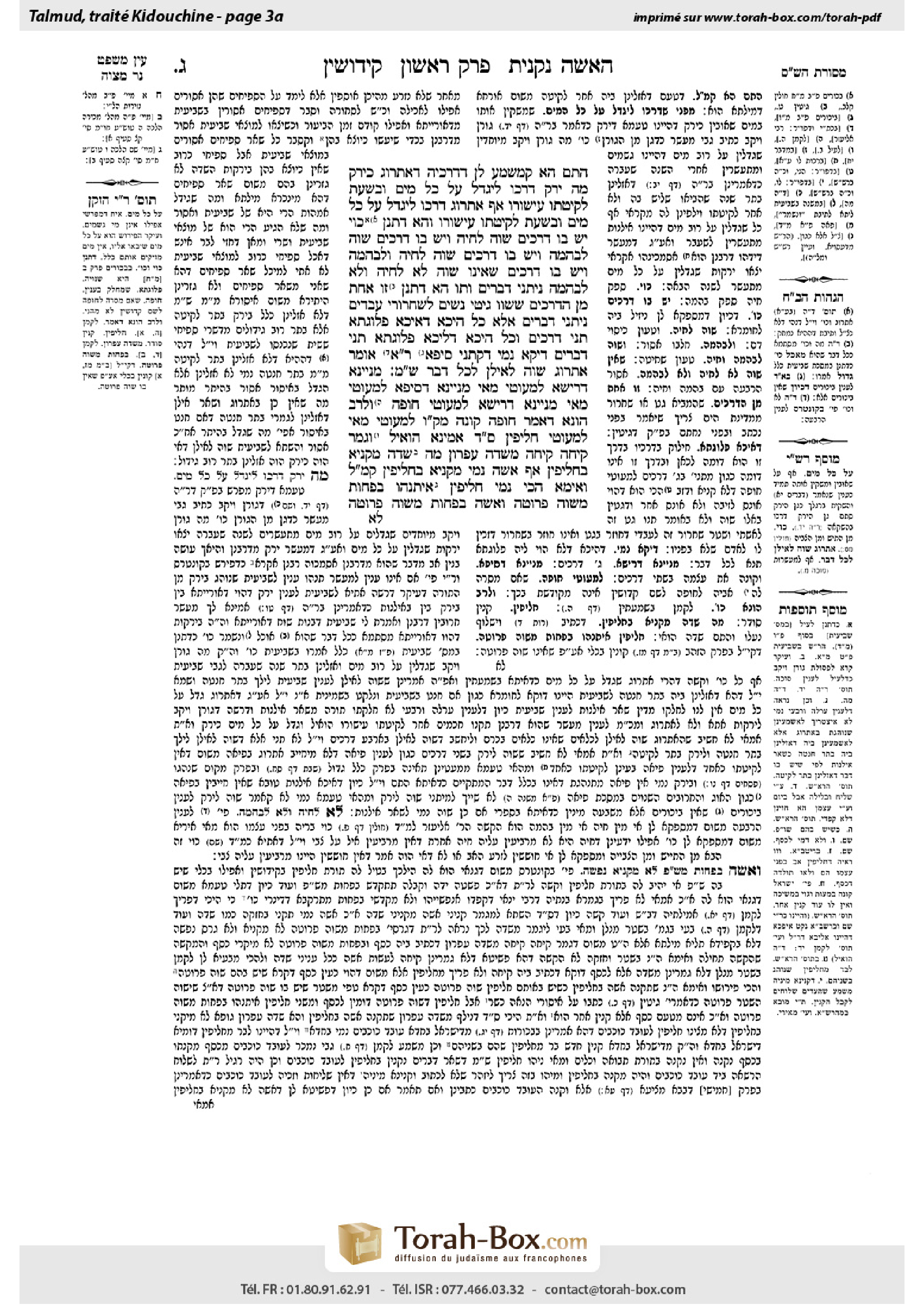
This page of Kiddushin includes the Aramaic text, an English translation and an AI-generated French translation, alongside the scan above.
קידושין ג׳ א · Aramaic and Hebrew text
הָתָם הָא קָמַשְׁמַע לַן, דְּדַרְכֵּיהּ דְּאֶתְרוֹג כְּיָרָק – מָה יָרָק דַּרְכּוֹ לִיגְדַּל עַל כׇּל מַיִם וּבִשְׁעַת לְקִיטָתוֹ עִישּׂוּרוֹ, אַף אֶתְרוֹג דַּרְכּוֹ לִיגְדַּל עַל כׇּל מַיִם וּבִשְׁעַת לְקִיטָתוֹ עִישּׂוּרוֹ.
וְהָא דִּתְנַן: ״כּוֹי – יֵשׁ בּוֹ דְּרָכִים שָׁוֶה לַחַיָּה, וְיֵשׁ בּוֹ דְּרָכִים שָׁוֶה לַבְּהֵמָה, וְיֵשׁ בּוֹ דְּרָכִים שָׁוֶה לַחַיָּה וְלַבְּהֵמָה, וְיֵשׁ בּוֹ דְּרָכִים שֶׁאֵינוֹ שָׁוֶה לֹא לַחַיָּה וְלֹא לַבְּהֵמָה״. נִיתְנֵי ״דְּבָרִים״! וְתוּ, הָא דִּתְנַן: ״זוֹ אַחַת מִן הַדְּרָכִים שֶׁשָּׁווּ גִּיטֵּי נָשִׁים לְשִׁחְרוּרֵי עֲבָדִים״, נִיתְנֵי ״דְּבָרִים״!
אֶלָּא, כֹּל הֵיכָא דְּאִיכָּא פְּלוּגְתָּא תָּנֵי ״דְּרָכִים״, וְכֹל הֵיכָא דְּלֵיכָּא פְּלוּגְתָּא תָּנֵי ״דְּבָרִים״. דַּיְקָא נָמֵי, דְּקָתָנֵי סֵיפָא: ״רַבִּי אֱלִיעֶזֶר אוֹמֵר: אֶתְרוֹג שָׁוֶה לָאִילָן לְכׇל דָּבָר״. שְׁמַע מִינַּהּ.
מִנְיָינָא דְרֵישָׁא לְמַעוֹטֵי מַאי, מִנְיָינָא דְסֵיפָא לְמַעוֹטֵי מַאי?
מִנְיָינָא דְרֵישָׁא – לְמַעוֹטֵי חוּפָּה. וּלְרַב הוּנָא, דְּאָמַר חוּפָּה קוֹנָה מִקַּל וָחוֹמֶר, לְמַעוֹטֵי מַאי?
לְמַעוֹטֵי חֲלִיפִין. סָלְקָא דַּעְתָּךְ אָמֵינָא, הוֹאִיל וְגָמַר ״קִיחָה״ ״קִיחָה״ מִשְּׂדֵה עֶפְרוֹן – מָה שָׂדֶה מִקַּנְיָא בַּחֲלִיפִין, אַף אִשָּׁה נָמֵי מִקַּנְיָא בַּחֲלִיפִין, קָמַשְׁמַע לַן.
וְאֵימָא הָכִי נָמֵי! חֲלִיפִין אִיתַנְהוּ בְּפָחוֹת מִשָּׁוֶה פְּרוּטָה, וְאִשָּׁה בְּפָחוֹת מִשָּׁוֶה פְּרוּטָה
Kiddushin 3a · English translation
The Gemara explains: There, the mishna teaches us this, that the way an etrog grows is like a vegetable: Just as it is the way of a vegetable to grow by being watered by all water, i.e., in addition to rainwater it requires irrigation, and its tithing is according to when it is harvested, i.e., its tithing is based on when it is collected from the field, so too, it is the way of an etrog to grow by being watered by all water, as it requires more water than rain provides, and its tithing is according to the time when it is harvested. If, for example, a vegetable is collected during a year when poor man’s tithe is given, that tithe is separated from it, even if it formed a bud during the previous year, when second tithe was separated. The same applies to an etrog. Therefore, the mishna specifically uses the term: Way, to allude to this reason.
The Gemara further asks: But concerning that which we learned in a mishna (Bikkurim 2:8): With regard to a koy, an animal whose classification was uncertain, as the Sages were unsure whether it is a domesticated or a non-domesticated animal, there are ways, i.e., halakhot, in which its halakhot correspond to those of a non-domesticated animal and there are ways in which its halakhot correspond to those of a domesticated animal. And there are ways in which its halakhot correspond to those of both a non-domesticated animal and a domesticated animal, and there are ways in which its halakhot correspond to those of neither a non-domesticated animal nor a domesticated animal. Let that mishna teach the term: Matters. And furthermore, with regard to that which we learned in a mishna (Gittin 9a): This is one of the ways in which the halakhot of bills of divorce correspond to those of bills of manumission, let that mishna teach the word: Matters.
Rather, the Gemara rejects the previous explanations, as the phraseology is not dependent on the nature of the topic at hand. Instead, anywhere that there is a distinction with regard to an issue the mishna teaches the term: Ways, as there are different ways or possibilities available. And anywhere that there is no distinction it teaches the word: Matters. The Gemara comments: The language of the mishna is also precise in this regard, as it teaches in the latter clause of that mishna that Rabbi Eliezer says: The halakhot of an etrog tree correspond to those of a tree with regard to every matter. This indicates that when no distinctions apply, the mishna will use the term matter. The Gemara concludes: Learn from this clause in the mishna that this explanation is correct.
§ The Gemara continues to analyze the language of the mishna: With regard to the number in the first clause of the mishna, i.e., a woman is acquired in three ways, this serves to exclude what? The fact that the mishna mentions a number indicates that other modes of acquisition do not apply to betrothal. What mode is excluded? Similarly, the number in the latter clause of the mishna, that a woman acquires herself in two ways, serves to exclude what?
The Gemara explains: The number in the first clause serves to exclude a wedding canopy, which does not effect betrothal. The Gemara asks: And according to the opinion of Rav Huna, who said: A wedding canopy acquires a woman, and it alone could be a mode of betrothal, as derived by an a fortiori inference (see 5a), this number serves to exclude what?
The Gemara answers: The number serves to exclude acquisition through symbolic exchange, i.e., a pro forma act of acquisition effecting the transfer of ownership of an article. Although a woman can be betrothed by means of money or an item of monetary value, she is not betrothed if she is given an item by symbolic exchange. The Gemara explains why this needs to be excluded: It might enter your mind to say that since the Sages derive the acquisition of a woman by verbal analogy between the term expressing taking stated with regard to betrothal from the term expressing taking with regard to the field of Ephron, it can be suggested that just as a field can be acquired through symbolic exchange, so too, a woman can be acquired through symbolic exchange. Therefore, the tanna teaches us that this is not the case.
The Gemara asks: And perhaps one should say that so too, it is possible to betroth a woman by means of symbolic exchange. The Gemara answers: This cannot be the case, as symbolic exchange is effective using an item worth less than the value of one peruta, and with an item worth less than the value of one peruta, a woman
Kiddushin 3a · Traduction française (IA)
La Guemara explique : Là, la Michna nous enseigne que l’étrog pousse comme un légume. De même qu’un légume pousse en étant arrosé avec toutes sortes d’eau, c’est-à-dire qu’il a besoin d’irrigation en plus de l’eau de pluie, et que sa dîme est déterminée selon le moment de sa récolte, c’est-à-dire selon le moment où il est cueilli dans le champ, de même l’étrog pousse en étant arrosé avec toutes sortes d’eau, car il a besoin de plus d’eau que la pluie ne lui en apporte, et sa dîme est déterminée selon le moment de sa récolte. Par exemple, si un légume est cueilli pendant une année où l’on prélève la dîme du pauvre, cette dîme en est prélevée, même s’il avait formé un bourgeon l’année précédente, où l’on prélevait la seconde dîme. Il en va de même pour l’étrog. La Michna emploie donc précisément le terme « manière » afin de faire allusion à cette raison.
La Guemara demande encore : Mais à propos de ce que nous avons appris dans une Michna (Bikkourim 2:8) : Concernant un koy, un animal dont la classification est incertaine, car les Sages ne savaient pas s’il s’agissait d’un animal domestique ou d’un animal sauvage, il y a des manières, c’est-à-dire des halakhot, selon lesquelles son statut correspond à celui d’un animal sauvage, et d’autres selon lesquelles il correspond à celui d’un animal domestique. Il y a aussi des manières selon lesquelles son statut correspond à la fois à celui d’un animal sauvage et à celui d’un animal domestique, et d’autres selon lesquelles il ne correspond ni à celui d’un animal sauvage ni à celui d’un animal domestique. Que cette Michna emploie le terme « cas ». En outre, à propos de ce que nous avons appris dans une Michna (Guitin 9a) : « Voici l’une des manières dont les halakhot des actes de divorce correspondent à celles des actes d’affranchissement », que cette Michna emploie le terme « cas ».
La Guemara rejette plutôt les explications précédentes, car la formulation ne dépend pas de la nature du sujet traité. Au contraire, partout où il existe une distinction concernant une question, la Michna emploie le terme « manières », puisqu’il existe différentes possibilités. Et partout où il n’y a pas de distinction, elle emploie le terme « cas ». La Guemara fait remarquer que la formulation de la Michna est également précise à cet égard, puisqu’à la fin de cette Michna, elle enseigne que Rabbi Éliézer dit : « Les halakhot de l’étrog correspondent à celles d’un arbre à tous égards. » Cela indique que, lorsqu’aucune distinction ne s’applique, la Michna emploie le terme « égard ». La Guemara conclut : Déduis de cette dernière clause de la Michna que cette explication est correcte.
§ La Guemara poursuit l’analyse de la formulation de la Michna : Que vient exclure le nombre indiqué au début de la Michna, à savoir qu’une femme est acquise de trois manières ? Le fait que la Michna mentionne un nombre indique que d’autres modes d’acquisition ne s’appliquent pas aux fiançailles. Quel mode est exclu ? De même, que vient exclure le nombre indiqué à la fin de la Michna, selon lequel une femme se rend elle-même libre de deux manières ?
La Guemara explique : Le nombre indiqué au début de la Michna vient exclure le dais nuptial, qui ne réalise pas les fiançailles. La Guemara demande : Et selon l’opinion de Rav Houna, qui a dit qu’un dais nuptial acquiert une femme et peut, à lui seul, constituer un mode de fiançailles, comme on le déduit par raisonnement a fortiori (voir 5a), que vient exclure ce nombre ?
La Guemara répond : Ce nombre vient exclure l’acquisition par échange symbolique, c’est-à-dire un acte d’acquisition formel qui entraîne le transfert de propriété d’un objet. Bien qu’une femme puisse être fiancée au moyen d’argent ou d’un objet ayant une valeur monétaire, elle ne l’est pas si on lui donne un objet par échange symbolique. La Guemara explique pourquoi cette exclusion est nécessaire : On pourrait penser que, puisque les Sages déduisent l’acquisition d’une femme par analogie verbale entre le terme exprimant la prise, employé à propos des fiançailles, et le terme exprimant la prise, employé à propos du champ d’Efron, on pourrait en conclure que, de même qu’un champ peut être acquis par échange symbolique, une femme peut elle aussi être acquise par échange symbolique. Le tanna nous enseigne donc que ce n’est pas le cas.
La Guemara demande : Et peut-être devrait-on dire qu’il est également possible de fiancer une femme par échange symbolique. La Guemara répond : Cela ne peut pas être le cas, car l’échange symbolique est valable au moyen d’un objet dont la valeur est inférieure à celle d’une perouta, et avec un objet dont la valeur est inférieure à celle d’une perouta, une femme
Traduction française générée par IA à partir de l’édition anglaise de Sefaria. Vérifie toujours un passage avec le texte source.
Text from Sefaria: William Davidson Edition - Vocalized Aramaic (CC BY NC); William Davidson Edition - English (CC BY NC).