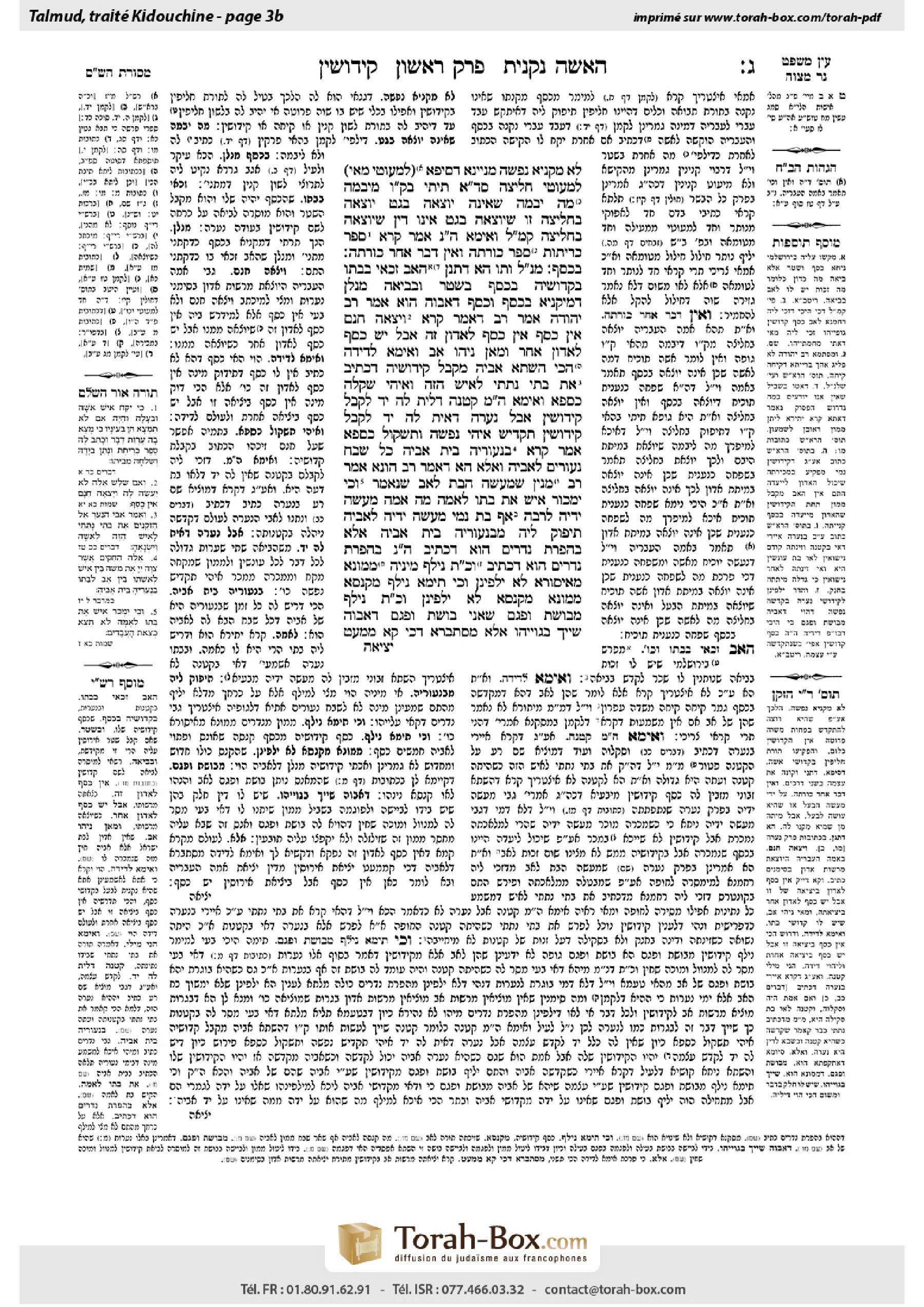
Kiddushin 3b: Talmud study for Daf Yomi
Daf Yomi is the daily study of one Talmud folio. Explore 37 tractates with scans, Hebrew text, Sefaria English and AI-generated French translations where annotated.
Passage selection and English or AI-generated French translation are available where the scan has annotations. Daf Study is independent of Torah-Box and Sefaria.
Browse Kiddushin · קידושין · All tractatesKiddushin 3b text and translations
This page of Kiddushin includes the Aramaic text, an English translation and an AI-generated French translation, alongside the scan above.
קידושין ג׳ ב · Aramaic and Hebrew text
לָא מַקְנְיָא נַפְשַׁהּ.
מִנְיָינָא דְסֵיפָא לְמַעוֹטֵי מַאי – לְמַעוֹטֵי חֲלִיצָה. סָלְקָא דַּעְתָּךְ אָמֵינָא: תֵּיתֵי בְּקַל וָחוֹמֶר מִיְּבָמָה, מָה יְבָמָה שֶׁאֵינָהּ יוֹצְאָה בְּגֵט – יוֹצְאָה בַּחֲלִיצָה, זוֹ, שֶׁיּוֹצְאָה בְּגֵט – אֵינוֹ דִּין שֶׁיּוֹצְאָה בַּחֲלִיצָה? קָמַשְׁמַע לַן.
וְאֵימָא הָכִי נָמֵי! אָמַר קְרָא: ״סֵפֶר כְּרִיתֻת״ – סֵפֶר כּוֹרְתָהּ, וְאֵין דָּבָר אַחֵר כּוֹרְתָהּ.
בְּכֶסֶף. מְנָא לַן? וְתוּ, הָא דִּתְנַן: ״הָאָב זַכַּאי בְּבִתּוֹ בְּקִדּוּשֶׁיהָ, בְּכֶסֶף בִּשְׁטָר וּבְבִיאָה״, מְנָלַן דְּמִיקַּנְיָא בְּכֶסֶף, וְכֶסֶף דַּאֲבוּהּ הוּא?
אָמַר רַב יְהוּדָה אָמַר רַב: דְּאָמַר קְרָא ״וְיָצְאָה חִנָּם אֵין כָּסֶף״ – אֵין כֶּסֶף לְאָדוֹן זֶה, אֲבָל יֵשׁ כֶּסֶף לְאָדוֹן אַחֵר. וּמַאן נִיהוּ – אָב.
וְאֵימָא לְדִידַהּ! הָכִי הַשְׁתָּא?! אָבִיהָ מְקַבֵּל קִידּוּשֶׁיהָ, דִּכְתִיב: ״אֶת בִּתִּי נָתַתִּי לָאִישׁ הַזֶּה״, וְאִיהִי שָׁקְלָה כַּסְפָּא?!
וְאֵימָא הָנֵי מִילֵּי קְטַנָּה, דְּלֵית לַהּ יָד לְקַבֵּל קִידּוּשִׁין, אֲבָל נַעֲרָה, דְּאִית לַהּ יָד לְקַבֵּל קִידּוּשִׁין – תְּקַדֵּישׁ אִיהִי נַפְשָׁהּ וְתִשְׁקוֹל כַּסְפָּא! אָמַר קְרָא: ״בִּנְעֻרֶיהָ בֵּית אָבִיהָ״ – כׇּל שֶׁבַח נְעוּרִים לְאָבִיהָ.
וְאֶלָּא הָא דְּאָמַר רַב הוּנָא אָמַר רַב: מִנַּיִן שֶׁמַּעֲשֵׂה הַבַּת לָאָב? שֶׁנֶּאֱמַר: ״וְכִי יִמְכֹּר אִישׁ אֶת בִּתּוֹ לְאָמָה״, מָה אָמָה מַעֲשֵׂה יָדֶיהָ לְרַבָּהּ – אַף בַּת נָמֵי מַעֲשֵׂה יָדֶיהָ לְאָבִיהָ. תִּיפּוֹק לֵיהּ מִ״בִּנְעֻרֶיהָ בֵּית אָבִיהָ״!
אֶלָּא, בַּהֲפָרַת נְדָרִים הוּא דִּכְתִיב. הָכִי נָמֵי, בַּהֲפָרַת נְדָרִים הוּא דִּכְתִיב. וְכִי תֵּימָא נֵילַף מִינֵּיהּ – מָמוֹנָא מֵאִיסּוּרָא לָא יָלְפִינַן.
וְכִי תֵּימָא נֵילַף מִקְּנָסָא – מָמוֹנָא מִקְּנָסָא לָא יָלְפִינַן.
וְכִי תֵּימָא נֵילַף מִבּוֹשֶׁת וּפְגָם – שָׁאנֵי בּוֹשֶׁת וּפְגָם דַּאֲבוּהּ שָׁיֵיךְ בְּגַוַּיְיהוּ.
אֶלָּא, מִסְתַּבְּרָא דְּכִי קָא מְמַעֵט –
Kiddushin 3b · English translation
does not render herself acquired by a man.
The Gemara asks: The number in the latter clause of the mishna, that a woman acquires herself in two ways, serves to exclude what? The Gemara answers that it serves to exclude ḥalitza, i.e., a woman is not released from marriage through ḥalitza. Without this exclusion it might enter your mind to say that this can be derived through an a fortiori inference from the halakha of a yevama, as follows: Just as a yevama, who is not released from the yavam through a bill of divorce, is nevertheless released from him through ḥalitza, with regard to this married woman, who can be released from her husband through a bill of divorce, is it not logical that she can be released from him through ḥalitza? Therefore, the tanna teaches us that a married woman cannot be released from her husband by means of ḥalitza.
The Gemara asks: And perhaps one should say that so too, this is the case, i.e., a married woman can be released from marriage through ḥalitza. The Gemara answers: The verse states with regard to divorce: “A scroll of severance” (Deuteronomy 24:3), which teaches: A scroll, i.e., a written document, severs her from her husband, and nothing else severs her from him.
§ The mishna teaches that a woman can be acquired with money. The Gemara asks: From where do we derive that a woman can be acquired through money? And furthermore, with regard to that which we learned in a mishna (Ketubot 46b): A father has authority over his daughter with regard to her betrothal, whether it is through money, through a document, or through sexual intercourse, from where do we derive that she is acquired by her husband with money, and that this money is her father’s?
Rav Yehuda said that Rav said: The reason is that the verse states with regard to a Hebrew maidservant acquiring freedom from her master: “Then shall she go out for nothing, without money” (Exodus 21:11). The extraneous phrase: Without money, indicates that there is no money for this master, i.e., in this case the master she leaves loses the money he paid for her, but there is money for a different master, i.e., another master receives money for her when she leaves his authority. And who is the other master who can transfer her to someone else and receives money for her? This is her father.
The Gemara asks: But why not say that this money is given to her? The Gemara rejects this: How can one suggest this? Her father receives her betrothal, i.e., the money or document of betrothal, when he marries her off to her husband, as it is written: “I gave my daughter to this man” (Deuteronomy 22:16), and shall she take the money? Since he is the one who marries her off, he is certainly entitled to the money of her betrothal.
The Gemara asks: But why not say that this halakha applies only when she is a minor girl, as she does not have the power to receive her betrothal. Since she lacks the intellectual capacity, she likewise does not have the legal right to conduct this transaction. But with regard to a young woman, who does have the power to receive her betrothal, as a female older than twelve years is considered an adult, let her betroth herself and take the money. The Gemara answers that the verse states: “Being in her youth, in her father’s house” (Numbers 30:17), which teaches: Any profit she gains in her youth belongs to her father.
The Gemara questions this explanation: But with regard to that which Rav Huna says that Rav says: From where is it derived that the earnings of a daughter, i.e., the profit from her labor, belongs to her father? As it is stated: “And if a man sells his daughter as a maidservant” (Exodus 21:7). This comparison between a daughter and a Hebrew maidservant teaches the following: Just as with regard to a Hebrew maidservant, her earnings belong to her master, so too, with regard to a daughter, her earnings belong to her father. The Gemara now asks: Why does Rav Huna need this derivation? Let him derive this halakha from the verse “being in her youth, in her father’s house,” which indicates that any profit from her earnings as a young woman belongs to her father.
Rather, Rav Huna maintains that that verse is written with regard to the nullification of vows, and it is not referring to the halakhot of acquisition. The Gemara asks: If that is so, then so too, with regard to her betrothal money, one can say that this verse is written only with regard to the nullification of vows and does not apply to betrothal money. And if you would say: Let us derive the halakha of her betrothal money from the halakha of the nullification of vows, i.e., just as a father has the right to nullify his daughter’s vows when she is a young woman, so too, he has rights to her money, this is not possible, as there is a principle: We do not derive monetary matters from ritual matters.
And if you would say: Let us derive this halakha of the betrothal of a young woman from the halakha of fines, as it is stated explicitly in the Torah that a man who rapes a young woman must pay a fine to her father, there is another principle that is applicable here: We do not derive monetary matters from fines, as the imposition of a fine is considered a unique case from which ordinary monetary rights cannot be derived.
And if you would say: Let us derive this halakha from the reimbursements for the humiliation and degradation of a young woman who was raped, which are also given to the father, one can answer that the following distinction applies: Reimbursement for humiliation and degradation are different, as her father has an interest in them. The father has the ability to derive benefit from her humiliation and degradation in other ways, e.g., by marrying her to a man afflicted with boils, which would humiliate her and cause a reduction in her value. Therefore, one cannot derive from the fact that the father receives the reimbursements for the humiliation and degradation of a young woman who was raped that he receives other monies due to her.
Rather, the halakha that a young woman’s betrothal money belongs to her father is derived from the verse: “Then shall she go out for nothing, without money” (Exodus 21:11), as previously stated. As for the question why the money does not belong to her, the Gemara answers that it is reasonable that when the verse excludes another situation and indicates that there is no money for this master but there is money for a different master,
Kiddushin 3b · Traduction française (IA)
ne se rend pas acquise à un homme.
La Guemara demande : À quoi sert le nombre indiqué dans la seconde partie de la Michna, selon laquelle une femme acquiert sa liberté de deux manières ? La Guemara répond qu’il sert à exclure la ḥalitsa, c’est-à-dire qu’une femme n’est pas libérée du mariage par la ḥalitsa. Sans cette exclusion, on pourrait penser que cela se déduit par un raisonnement a fortiori de la halakha de la yevama, comme suit : De même qu’une yevama, qui n’est pas libérée de son lien avec le yavam par un acte de divorce, en est néanmoins libérée par la ḥalitsa, à plus forte raison cette femme mariée, qui peut être libérée de son mari par un acte de divorce, peut-elle en être libérée par la ḥalitsa. Le tanna nous enseigne donc qu’une femme mariée ne peut pas être libérée de son mari par la ḥalitsa.
La Guemara demande : Peut-être faudrait-il dire qu’il en va de même, c’est-à-dire qu’une femme mariée peut être libérée du mariage par la ḥalitsa. La Guemara répond : Le verset dit, à propos du divorce : « Un acte de séparation » (Deutéronome 24:3), ce qui enseigne qu’un acte, c’est-à-dire un document écrit, la sépare de son mari, et que rien d’autre ne la sépare de lui.
§ La Michna enseigne qu’une femme peut être acquise par de l’argent. La Guemara demande : D’où déduisons-nous qu’une femme peut être acquise par de l’argent ? En outre, au sujet de ce que nous avons appris dans une Michna (Ketoubot 46b) — un père a autorité sur sa fille en matière de fiançailles, qu’elles se fassent par de l’argent, par un acte écrit ou par des relations sexuelles —, d’où déduisons-nous qu’elle est acquise par son mari au moyen d’argent et que cet argent revient à son père ?
Rav Yehouda a dit au nom de Rav : La raison en est que le verset dit, à propos d’une servante hébreue qui recouvre sa liberté vis-à-vis de son maître : « Alors elle sortira gratuitement, sans argent » (Exode 21:11). L’expression superflue « sans argent » indique que ce maître ne reçoit pas d’argent, c’est-à-dire que, dans ce cas, le maître qu’elle quitte perd l’argent qu’il a payé pour elle ; mais un autre maître reçoit de l’argent lorsqu’elle quitte son autorité. Et qui est cet autre maître, qui peut la transférer à quelqu’un d’autre et recevoir de l’argent pour elle ? C’est son père.
La Guemara demande : Mais pourquoi ne pas dire que cet argent lui est remis ? La Guemara rejette cette possibilité : Comment peut-on suggérer cela ? C’est son père qui reçoit l’argent ou l’acte de fiançailles lorsqu’il la marie à son mari, comme il est écrit : « J’ai donné ma fille à cet homme » (Deutéronome 22:16). Et ce serait elle qui prendrait l’argent ? Puisque c’est lui qui la marie, il a certainement droit à l’argent de ses fiançailles.
La Guemara demande : Mais pourquoi ne pas dire que cette halakha ne s’applique que lorsqu’elle est une fille mineure, puisqu’elle n’a pas le pouvoir de recevoir ses fiançailles ? Comme elle n’a pas la capacité intellectuelle requise, elle n’a pas non plus le droit légal d’effectuer cette transaction. Mais une jeune fille, qui a le pouvoir de recevoir ses fiançailles — car une fille âgée de plus de douze ans est considérée comme majeure —, qu’elle se fiance elle-même et prenne l’argent. La Guemara répond que le verset dit : « Durant sa jeunesse, dans la maison de son père » (Nombres 30:17), ce qui enseigne que tout profit qu’elle réalise durant sa jeunesse appartient à son père.
La Guemara met cette explication en question : Mais au sujet de ce que Rav Houna dit au nom de Rav — d’où déduit-on que les gains d’une fille, c’est-à-dire le produit de son travail, appartiennent à son père ? —, il est dit : « Si un homme vend sa fille comme servante » (Exode 21:7). Cette comparaison entre une fille et une servante hébreue enseigne ceci : de même que, pour une servante hébreue, ses gains reviennent à son maître, de même, pour une fille, ses gains reviennent à son père. La Guemara demande alors : Pourquoi Rav Houna a-t-il besoin de cette déduction ? Qu’il déduise cette halakha du verset « Durant sa jeunesse, dans la maison de son père », qui indique que tout profit tiré du travail d’une jeune fille appartient à son père.
Rav Houna soutient plutôt que ce verset concerne l’annulation des vœux et non les halakhot de l’acquisition. La Guemara demande : Dans ce cas, au sujet de l’argent de ses fiançailles également, on pourrait dire que ce verset ne concerne que l’annulation des vœux et ne s’applique pas à l’argent de ses fiançailles. Et si tu dis : Déduisons la halakha concernant l’argent de ses fiançailles de celle de l’annulation des vœux — de même qu’un père a le droit d’annuler les vœux de sa fille lorsqu’elle est une jeune fille, il a aussi des droits sur son argent —, cela est impossible, car il existe un principe : on ne déduit pas les questions pécuniaires des questions rituelles.
Et si tu dis : Déduisons cette halakha concernant les fiançailles d’une jeune fille de celle des amendes, puisque la Torah dit explicitement qu’un homme qui viole une jeune fille doit verser une amende à son père, un autre principe s’applique ici : on ne déduit pas les questions pécuniaires des amendes, car une amende constitue un cas particulier dont on ne peut déduire les droits pécuniaires ordinaires.
Et si tu dis : Déduisons cette halakha des indemnités pour l’humiliation et l’avilissement d’une jeune fille violée, qui sont elles aussi versées à son père, on peut répondre qu’une distinction s’applique : les indemnités pour l’humiliation et l’avilissement sont différentes, car son père y trouve un intérêt. Le père peut tirer profit de son humiliation et de son avilissement par d’autres moyens, par exemple en la mariant à un homme couvert de furoncles, ce qui l’humilierait et diminuerait sa valeur. On ne peut donc pas déduire du fait que le père reçoit les indemnités pour l’humiliation et l’avilissement d’une jeune fille violée qu’il reçoit d’autres sommes qui lui sont dues.
La halakha selon laquelle l’argent des fiançailles d’une jeune fille appartient à son père se déduit plutôt du verset : « Alors elle sortira gratuitement, sans argent » (Exode 21:11), comme il a été dit précédemment. Quant à la question de savoir pourquoi l’argent ne lui appartient pas, la Guemara répond qu’il est raisonnable de comprendre que, lorsque le verset exclut une autre situation et indique que ce maître ne reçoit pas d’argent, mais qu’un autre maître en reçoit,
Traduction française générée par IA à partir de l’édition anglaise de Sefaria. Vérifie toujours un passage avec le texte source.
Text from Sefaria: William Davidson Edition - Vocalized Aramaic (CC BY NC); William Davidson Edition - English (CC BY NC).