Kiddushin 4a: Talmud study for Daf Yomi
Daf Yomi is the daily study of one Talmud folio. Explore 37 tractates with scans, Hebrew text, Sefaria English and AI-generated French translations where annotated.
Passage selection and English or AI-generated French translation are available where the scan has annotations. Daf Study is independent of Torah-Box and Sefaria.
Browse Kiddushin · קידושין · All tractatesKiddushin 4a text and translations
This page of Kiddushin includes the Aramaic text, an English translation and an AI-generated French translation, alongside the scan above.
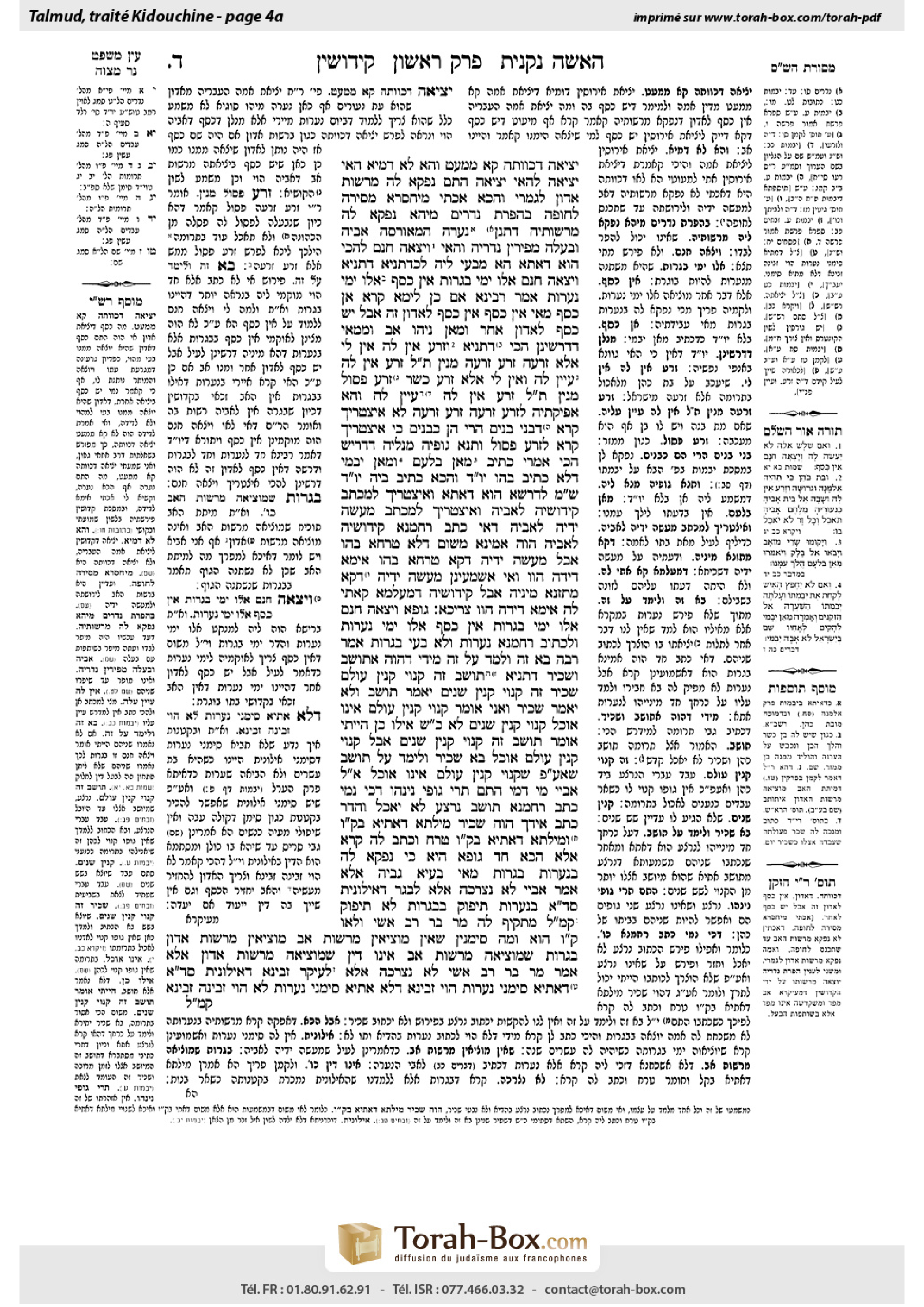
קידושין ד׳ א · Aramaic and Hebrew text
יְצִיאָה דִּכְווֹתַהּ קָא מְמַעֵט.
וְהָא לָא דָּמְיָא הַאי יְצִיאָה לְהַאי יְצִיאָה, הָתָם נָפְקָא לַהּ מֵרְשׁוּת אָדוֹן לִגְמָרֵי, וְהָכָא אַכַּתִּי מִיחַסְּרָא מְסִירָה לְחוּפָּה! בַּהֲפָרַת נְדָרִים מִיהָא נָפְקָא לַהּ מֵרְשׁוּתֵיהּ. דִּתְנַן: נַעֲרָה הַמְאוֹרָסָה אָבִיהָ וּבַעְלָהּ מְפִירִין נְדָרֶיהָ.
וְהַאי ״וְיָצְאָה חִנָּם״ לְהָכִי הוּא דַּאֲתָא? הָא מִבְּעֵי לֵיהּ לְכִדְתַנְיָא, דְּתַנְיָא: ״וְיָצְאָה חִנָּם״ – אֵלּוּ יְמֵי בַּגְרוּת, ״אֵין כָּסֶף״ – אֵלּוּ יְמֵי נַעֲרוּת.
אָמַר רָבִינָא: אִם כֵּן, לֵימָא קְרָא ״אֵן כָּסֶף״. מַאי ״אֵין כָּסֶף״ – אֵין כֶּסֶף לְאָדוֹן זֶה אֲבָל יֵשׁ כֶּסֶף לְאָדוֹן אַחֵר, וּמַאן נִיהוּ – אָב.
וּמִמַּאי דְּדָרְשִׁינַן הָכִי – דְּתַנְיָא: ״וְזֶרַע אֵין לָהּ״
– אֵין לִי אֶלָּא זַרְעָהּ. זֶרַע זַרְעָהּ מִנַּיִן? תַּלְמוּד לוֹמַר ״זֶרַע אֵין לָהּ״ – עַיֵּין לָהּ. וְאֵין לִי אֶלָּא זֶרַע כָּשֵׁר. זֶרַע פָּסוּל מִנַּיִן? תַּלְמוּד לוֹמַר ״זֶרַע אֵין לָהּ״ – עַיֵּין לָהּ.
וְהָא אַפֵּיקְתֵּיהּ לְזֶרַע זַרְעָהּ! זֶרַע זַרְעָהּ לָא אִיצְטְרִיךְ קְרָא, דִּבְנֵי בָנִים הֲרֵי הֵן כְּבָנִים. כִּי אִיצְטְרִיךְ קְרָא – לְזֶרַע פָּסוּל.
וְתַנָּא גּוּפֵיהּ מְנָלֵיהּ דְּדָרֵישׁ הָכִי? אָמְרִי: כְּתִיב ״מֵאֵן בִּלְעָם״ וּ״מֵאֵן יְבָמִי״, דְּלָא כְּתִיב בְּהוּ יוֹד. וְהָכָא, כְּתִיב בֵּיהּ יוֹד – שְׁמַע מִינַּהּ לִדְרָשָׁא הוּא דַּאֲתָא.
וְאִיצְטְרִיךְ לְמִכְתַּב קִידּוּשֶׁיהָ לְאָבִיהָ, וְאִיצְטְרִיךְ לְמִכְתַּב מַעֲשֵׂה יָדֶיהָ לְאָבִיהָ. דְּאִי כְּתַב רַחֲמָנָא קִידּוּשֶׁיהָ לְאָבִיהָ, הֲוָה אָמֵינָא מִשּׁוּם דְּלָא טָרְחָא בְּהוּ, אֲבָל מַעֲשֵׂה יָדֶיהָ דְּקָא טָרְחָא בְּהוּ אֵימָא דִּידַהּ הָווּ.
וְאִי אַשְׁמְעִינַן מַעֲשֵׂה יָדֶיהָ, דְּקָא מִתַּזְנָא מִינֵּיהּ, אֲבָל קִידּוּשֶׁיהָ דְּמֵעָלְמָא קָאָתֵי לַהּ אֵימָא דִּידַהּ הָווּ, צְרִיכָא.
גּוּפָא: ״וְיָצְאָה חִנָּם״ – אֵלּוּ יְמֵי בַּגְרוּת, ״אֵין כֶּסֶף״ – אֵלּוּ יְמֵי נַעֲרוּת. וְלִכְתּוֹב רַחֲמָנָא נַעֲרוּת, וְלָא בָּעֵי בַּגְרוּת!
אָמַר רַבָּה: בָּא זֶה וְלִמֵּד עַל זֶה.
מִידֵּי דְּהָוֵה אַתּוֹשָׁב וְשָׂכִיר. דְּתַנְיָא: ״תּוֹשָׁב״ – זֶה קָנוּי קִנְיַן עוֹלָם, ״שָׂכִיר״ – זֶה קָנוּי קִנְיַן שָׁנִים.
יֵאָמֵר ״תּוֹשָׁב״ וְלֹא יֵאָמֵר ״שָׂכִיר״, וַאֲנִי אוֹמֵר: קָנוּי קִנְיַן עוֹלָם אֵינוֹ אוֹכֵל, קָנוּי קִנְיַן שָׁנִים לֹא כׇּל שֶׁכֵּן?
אִילּוּ כֵּן, הָיִיתִי אוֹמֵר: ״תּוֹשָׁב״ – זֶה קָנוּי קִנְיַן שָׁנִים. אֲבָל קְנוּי קִנְיַן עוֹלָם – אוֹכֵל. בָּא ״שָׂכִיר״ וְלִימֵּד עַל ״תּוֹשָׁב״, שֶׁאַף עַל פִּי שֶׁקָּנוּי קִנְיַן עוֹלָם – אֵינוֹ אוֹכֵל.
אֲמַר לֵיהּ אַבָּיֵי: מִי דָּמֵי? הָתָם תְּרֵי גוּפֵי נִינְהוּ, דְּכִי נָמֵי כְּתַב רַחֲמָנָא ״תּוֹשָׁב נִרְצָע לֹא יֹאכַל״ וַהֲדַר כְּתַב אִידַּךְ, הֲוָה שָׂכִיר מִילְּתָא דְּאָתְיָא בְּקַל וָחוֹמֶר, וּמִילְּתָא דְּאָתְיָא בְּקַל וָחוֹמֶר טָרַח וְכָתַב לַהּ קְרָא.
אֶלָּא הָכָא, חַד גּוּפָא הִיא – כִּי נָפְקָא לַהּ בְּנַעֲרוּת, בַּגְרוּת מַאי בָּעֲיָא גַּבֵּיהּ?
אֶלָּא אָמַר אַבָּיֵי: לֹא נִצְרְכָה אֶלָּא לְבֶגֶר דְּאַיְלוֹנִית,
סָלְקָא דַּעְתָּךְ אָמֵינָא: בְּנַעֲרוּת תִּיפּוֹק, בְּבַגְרוּת לָא תִּיפּוֹק, קָא מַשְׁמַע לַן.
מַתְקֵיף לַהּ מָר בַּר רַב אָשֵׁי: וְלָאו קַל וָחוֹמֶר הוּא? וּמָה סִימָנִין שֶׁאֵין מוֹצִיאִין מֵרְשׁוּת אָב – מוֹצִיאִין מֵרְשׁוּת אָדוֹן, בַּגְרוּת שֶׁמּוֹצִיאָה מֵרְשׁוּת אָב – אֵינוֹ דִּין שֶׁמּוֹצִיאָה מֵרְשׁוּת אָדוֹן?
אֶלָּא אָמַר מָר בַּר רַב אָשֵׁי: לֹא נִצְרְכָה אֶלָּא לְעִיקַּר זְבִינָא דְאַיְלוֹנִית, סָלְקָא דַּעְתָּךְ אָמֵינָא: דְּאַתְיָא סִימָנֵי נַעֲרוּת – הָוֵי זְבִינָא, דְּלָא אַתְיָא סִימָנֵי נַעֲרוּת – לָא הָוֵי זְבִינַהּ זְבִינָא,
Kiddushin 4a · English translation
it excludes a departure that is like it, i.e., a departure wherein the two masters are the potential recipients. Just as when no money is paid, the individual who might have received the payment is her master, so too, when money is paid, in a different set of circumstances, the money goes to the one who has authority over her, i.e., her father.
The Gemara asks: But this departure is not similar to that departure, as there, she leaves the authority of the master entirely upon being freed and she no longer retains any connection to him, and here, she still lacks the act of passing her over to the wedding canopy. Until she actually enters the wedding canopy, she has not left her father’s authority completely. The Gemara answers: Nevertheless, there is a similarity between her departures in both cases, as she leaves her father’s authority at least as far as the nullification of vows is concerned. As we learned in a mishna (Nedarim 66b): With regard to a betrothed young woman, her father and her husband together nullify her vows, and her father cannot nullify them alone.
The Gemara asks: But does this verse: “Then shall she go out for nothing” (Exodus 21:11), come for that purpose, to teach that there is no money for this master, but there is money for a different master? But it is required for that which is taught in the following baraita. As it is taught in a baraita: The verse “Then shall she go out for nothing, without money” should be understood as follows: “Then shall she go out for nothing”; these words are referring to the days of adulthood, i.e., a Hebrew maidservant leaves her owner’s authority once she becomes an adult. “Without money [ein kasef]”; these words are referring to the days of her youth, i.e., when she becomes a young woman she leaves his authority.
Ravina said: If so, that the verse is to be used only for this derivation, let the verse say: En kasef, without the letter yod. What is indicated by the full spelling with a yod: Ein kasef? This serves to teach the halakha stated above: There is no money for this master, but there is money for a different master. And who is he? He is her father, who has a right to receive the money when his daughter leaves his authority upon her betrothal.
The Gemara explains: And from where is it derived that one interprets the verse homiletically in this manner? How is it known that the full form of the word ein teaches a halakha? As it is taught in a baraita with regard to the daughter of a priest who married a non-priest and was subsequently widowed or divorced: “And she has no child, and is returned to her father’s house, as in her youth, she may eat of her father’s bread” (Leviticus 22:13). This verse indicates that if she has no children from her non-priest husband she may once again partake of teruma.
I have derived only that this halakha applies to her actual children. From where do I derive that her children’s children are equivalent to children with regard to this halakha? The verse states: “She has no [ein lah] child,” where ein is spelled with a yod inserted in the middle. This additional letter serves to enable an alternative articulation of the term, specifically, one examines her [ayyein lah] to see if she has any descendants. And I have derived only that this halakha applies to children of unflawed lineage, i.e., her legitimate offspring. From where do I derive that children of flawed lineage, e.g., mamzerim, are also considered her children for the purposes of this halakha? The verse states: “She has no child,” which indicates that one examines her, as explained above.
With regard to the last derivation, the Gemara asks: But you have already derived one halakha from this word, that her children’s children are considered like her children in this case. The Gemara answers: In fact, a verse was not necessary to teach about her children’s children, as there is an established principle that children’s children are considered like children. And therefore, when the verse was necessary, it was to teach the requirement of examining her for children of flawed lineage.
The Gemara asks: And the tanna himself, from where does he know that one can expound the yod in ein in this manner? The Gemara answers: They say in explanation that it is written: “Balaam refuses [me’en]” (Numbers 22:14), and it is similarly written: “My yavam refuses [me’en]” (Deuteronomy 25:7), and in neither case is a yod written. And here the word ein is written with a yod. Learn from it that the yod is superfluous and comes for the sake of an exposition.
The Gemara comments: And it was necessary to write a verse that teaches that her betrothal, i.e., the money or document of betrothal, belongs to her father, and it was necessary to write another verse that teaches that her earnings belong to her father, as one could not derive one halakha from the other. As, if the Merciful One had written only that her betrothal money belongs to her father, I would say that this is because she did not toil for it and therefore is not entitled to this sum. But with regard to her earnings, for which she toiled, say that they are hers. Therefore, it is necessary to state that her earnings also belong to her father.
And conversely, if the verse had taught us only the halakha of her earnings, one would have said that they belong to her father because his daughter is sustained by him through his property. But with regard to her betrothal, i.e., the money or document of betrothal, which comes to her from an external source, I would say that it is hers. Therefore, it is necessary for the verse to teach both halakhot.
The Gemara returns to the matter itself: The baraita states with regard to a Hebrew maidservant: “Then shall she go out for nothing,” these are the days of adulthood; “without money,” these are the days of her youth. The Gemara asks: And let the Merciful One write that she leaves her master when she reaches her youth, and it would not be necessary to state that she leaves upon reaching adulthood. If she has already left her master when she becomes a young woman, it is not necessary to state that she leaves him upon reaching adulthood.
Rabba says: This phrase comes and teaches about that phrase. In other words, since it is not explicitly stated that this particular verse is referring to her departure when she becomes a young woman, if there was only one superfluous phrase one would conclude that it is referring to adulthood, as the halakha that she leaves the master when she becomes an adult is a lesser novelty. Therefore, two extraneous verses are required.
Rabba cites an analogous case. This is just as it is with regard to a tenant and a hired worker. As it is taught in a baraita concerning teruma: The verse states: “A tenant of a priest or a hired worker shall not eat of the consecrated” (Leviticus 22:10). “A tenant”; this is referring to a Hebrew slave who has been acquired as a permanent acquisition, i.e., one who said he wishes to stay with his master. This Hebrew slave has his ear pierced and he remains with his master until the Jubilee Year. “A hired worker”; this is referring to a Hebrew slave who has been acquired for an acquisition of six years, the standard period of servitude for a Hebrew slave.
The baraita asks: Let the verse say “tenant” and let it not say “hired worker,” and I would say: If one who is acquired as a permanent acquisition does not partake of his owner’s, i.e., the priest’s, teruma, as despite his status as a Hebrew slave he is not considered his owner’s property, is it not all the more so that one who is acquired for an acquisition of six years should not be permitted to partake of teruma?
The baraita answers: If so, that the verse were stated in this manner, I would say: “A tenant”; this is one who was acquired for an acquisition of six years, as the term itself is ambiguous. But one who was acquired as a permanent acquisition may partake of teruma. Therefore, the term “hired worker,” which is certainly referring to one who is less permanent than a tenant, comes and teaches about the meaning of the term “tenant,” that even if a Hebrew slave was acquired as a permanent acquisition he may not partake of teruma. A similar line of reasoning applies in the above case of a young woman and an adult.
Abaye said to Rabba: Are these cases really comparable? There, the tenant and the hired worker are two bodies. This is significant, as even if the Merciful One had written explicitly that a pierced tenant may not partake of teruma, from which the halakha of a Hebrew slave for six years could have been inferred, and then the Merciful One wrote the other case of a Hebrew slave acquired temporarily, this would not present a serious difficulty. The reason is that, although the halakha of a hired worker is a matter that could be derived by means of an a fortiori inference, and therefore it does not have to be stated explicitly, there is a principle: Sometimes with regard to a matter that can be derived through an a fortiori inference, the verse nevertheless takes the trouble and writes it explicitly.
But here, with regard to a woman, she is one body, i.e., it is the same Hebrew maidservant. Once she has left upon the arrival of her youth, what is she doing in his authority as an adult? It is entirely unnecessary for the verse to teach that she leaves her master upon becoming an adult, as she has already left him.
Rather, Abaye rejects the previous suggestion that one verse teaches about the other, and said: The claim that the verse “Then shall she go out for nothing” is referring to adulthood is necessary only for the adulthood of a sexually underdeveloped woman who is incapable of bearing children [ailonit]. An ailonit will never develop the physical signs of maturity, i.e., two pubic hairs. Consequently, she does not go through the halakhic stage of a young woman. Instead, she remains a minor until the age of twenty, at which point she immediately becomes an adult.
Consequently, if the Torah did not teach that a Hebrew maidservant leaves her master upon becoming an adult, it might enter your mind to say: She leaves only when entering her youth, but when entering adulthood directly she does not leave. Since an ailonit is never classified as a young woman, she would never leave servitude. Therefore, the verse teaches us that a Hebrew maidservant leaves her master even if she reaches adulthood directly.
Mar bar Rav Ashi objects to this: But is it not an a fortiori inference? And if the signs indicating that a young woman has entered puberty do not fully release a young woman from her father’s authority, as he can still betroth her, nevertheless, they do release her from the master’s authority; is it not logical that adulthood, which completely releases her from her father’s authority, should release her from the master’s authority? If so, one can derive by this reasoning that an ailonit leaves her master in adulthood, which means the verse is unnecessary.
Rather, Mar bar Rav Ashi says: This verse is necessary only with regard to the basic halakha of the sale of an ailonit as a Hebrew maidservant. As it might enter your mind to say that if a female will show the signs of a young woman, i.e., puberty, her sale is a valid sale, whereas in a case where she will not show the signs of a young woman, her sale is not a valid sale. The reason one might think this is the case is that if the maidservant turns out to be an ailonit, one cannot fulfill the requirements of the verse, as she will never become a young woman.
Kiddushin 4a · Traduction française (IA)
Cela exclut une mode de sortie qui lui est analogue, c’est-à-dire une sortie où les deux maîtres sont les bénéficiaires potentiels. De même que, lorsqu’aucune somme n’est versée, le maître de la jeune fille est celui qui aurait pu recevoir le paiement, de même, lorsqu’une somme est versée dans une autre situation, elle revient à celui qui a autorité sur elle, c’est-à-dire à son père.
La Guemara demande : Mais cette sortie n’est pas analogue à l’autre, car dans le premier cas, lorsqu’elle est libérée, elle quitte entièrement l’autorité du maître et n’a plus aucun lien avec lui, tandis qu’ici, il manque encore l’acte par lequel on la fait entrer sous la houppa. Tant qu’elle n’est pas effectivement entrée sous la houppa, elle n’a pas complètement quitté l’autorité de son père. La Guemara répond : Il existe néanmoins une similitude entre les deux sorties, car elle quitte l’autorité de son père, du moins en ce qui concerne l’annulation des vœux. Comme nous l’avons appris dans une Michna (Nedarim 66b) : Pour une jeune fille fiancée, son père et son mari annulent ensemble ses vœux, et son père ne peut pas les annuler seul.
La Guemara demande : Mais le verset « Alors elle sortira gratuitement » (Exode 21,11) vient-il à cette fin, pour enseigner qu’il n’y a pas d’argent pour ce maître, mais qu’il y en a pour un autre maître ? Or il est nécessaire pour ce qui est enseigné dans la baraïta suivante. En effet, il est enseigné dans une baraïta : Le verset « Alors elle sortira gratuitement, sans argent » doit être compris ainsi : « Alors elle sortira gratuitement » se rapporte aux années de l’âge adulte, c’est-à-dire qu’une servante hébraïque quitte l’autorité de son maître lorsqu’elle devient adulte. « Sans argent [ein kasef] » se rapporte aux années de sa jeunesse, c’est-à-dire qu’elle quitte son autorité lorsqu’elle devient jeune fille.
Ravina dit : Dans ce cas, si le verset ne sert qu’à cette déduction, qu’il écrive en kasef, « sans argent », sans la lettre yod. Que vient indiquer l’orthographe complète avec un yod, ein kasef ? Cela enseigne la halakha énoncée plus haut : il n’y a pas d’argent pour ce maître, mais il y en a pour un autre maître. Et qui est-ce ? C’est son père, qui a le droit de recevoir l’argent lorsque sa fille quitte son autorité en se fiançant.
La Guemara explique : Et d’où déduit-on que l’on interprète le verset de cette manière, par exégèse ? Comment sait-on que la forme complète du mot ein enseigne une halakha ? Comme il est enseigné dans une baraïta au sujet de la fille d’un prêtre qui a épousé un non-prêtre, puis est devenue veuve ou a été répudiée : « Si elle n’a pas d’enfant et retourne dans la maison de son père, comme dans sa jeunesse, elle pourra manger du pain de son père » (Lévitique 22,13). Ce verset indique que si elle n’a pas d’enfants de son mari non prêtre, elle peut de nouveau consommer de la terouma.
J’ai seulement déduit que cette halakha s’applique à ses enfants proprement dits. D’où déduit-on que les enfants de ses enfants sont considérés comme ses enfants pour cette halakha ? Le verset dit : « Elle n’a pas [ein lah] d’enfant », le mot ein étant écrit avec un yod au milieu. Cette lettre supplémentaire permet une autre lecture du terme : on examine ses descendants [ayyein lah] pour voir si elle en a. Et j’ai seulement déduit que cette halakha s’applique aux enfants de filiation régulière, c’est-à-dire à ses descendants légitimes. D’où déduit-on que les enfants de filiation irrégulière, par exemple les mamzerim, sont également considérés comme ses enfants pour cette halakha ? Le verset dit : « Elle n’a pas d’enfant », ce qui indique qu’on l’examine, comme expliqué plus haut.
À propos de la dernière déduction, la Guemara demande : Mais tu as déjà tiré une halakha de ce mot, à savoir que, dans ce cas, les enfants de ses enfants sont considérés comme ses enfants. La Guemara répond : En réalité, un verset n’était pas nécessaire pour enseigner cela, car il existe un principe établi selon lequel les enfants des enfants sont considérés comme des enfants. Par conséquent, le verset était nécessaire pour enseigner qu’il faut vérifier si elle a des enfants de filiation irrégulière.
La Guemara demande : Et le tanna lui-même, d’où sait-il que l’on peut interpréter ainsi le yod de ein ? La Guemara répond : On explique que le texte dit : « Balaam refuse [me’en] » (Nombres 22,14), et de même : « Mon yavam refuse [me’en] » (Deutéronome 25,7) ; dans aucun de ces deux cas, le mot ne comporte de yod. Ici, en revanche, le mot ein est écrit avec un yod. Déduis-en que le yod est superflu et qu’il est présent en vue d’une exégèse.
La Guemara fait remarquer qu’il fallait un verset pour enseigner que les fiançailles de la jeune fille, c’est-à-dire l’argent ou l’acte écrit servant aux fiançailles, reviennent à son père, et un autre verset pour enseigner que son salaire revient à son père, car on ne pouvait pas déduire une de ces halakhot de l’autre. En effet, si le Miséricordieux avait seulement écrit que l’argent de ses fiançailles revient à son père, j’aurais dit que c’est parce qu’elle n’a pas travaillé pour l’obtenir et qu’elle n’a donc pas droit à cette somme. Mais, en ce qui concerne son salaire, pour lequel elle a travaillé, on aurait pu dire qu’il lui revient. Il est donc nécessaire de préciser que son salaire revient également à son père.
À l’inverse, si le verset ne nous avait enseigné que la halakha de son salaire, on aurait dit qu’il revient à son père parce que celui-ci subvient aux besoins de sa fille avec ses propres biens. Mais, en ce qui concerne ses fiançailles, c’est-à-dire l’argent ou l’acte écrit servant aux fiançailles, qui lui vient d’une source extérieure, j’aurais dit que cela lui appartient. Le verset doit donc enseigner les deux halakhot.
La Guemara revient à la question elle-même : La baraïta dit au sujet d’une servante hébraïque : « Alors elle sortira gratuitement » se rapporte aux années de l’âge adulte ; « sans argent » se rapporte aux années de sa jeunesse. La Guemara demande : Pourquoi le Miséricordieux n’écrit-il pas qu’elle quitte son maître lorsqu’elle atteint la jeunesse, sans préciser qu’elle le quitte lorsqu’elle atteint l’âge adulte ? Si elle a déjà quitté son maître lorsqu’elle devient jeune fille, il n’est pas nécessaire de préciser qu’elle le quitte lorsqu’elle devient adulte.
Rabba dit : Cette expression vient enseigner au sujet de l’autre expression. Autrement dit, puisqu’il n’est pas explicitement indiqué que ce verset précis se rapporte au départ de la jeune fille lorsqu’elle devient jeune fille, s’il n’y avait eu qu’une seule expression superflue, on aurait conclu qu’elle se rapporte à l’âge adulte, car la halakha selon laquelle elle quitte son maître lorsqu’elle devient adulte est moins novatrice. Il faut donc deux expressions superflues.
Rabba cite un cas analogue. Il en va de même pour le résident et le salarié. En effet, il est enseigné dans une baraïta concernant la terouma : Le verset dit : « Un résident d’un prêtre ou un salarié ne mangera pas des choses consacrées » (Lévitique 22,10). « Un résident » désigne un esclave hébreu acquis à titre permanent, c’est-à-dire celui qui a déclaré vouloir rester auprès de son maître. On lui perce l’oreille et il demeure auprès de son maître jusqu’à l’année du Jubilé. « Un salarié » désigne un esclave hébreu acquis pour une période de six ans, durée normale de la servitude d’un esclave hébreu.
La baraïta demande : Que le verset dise « résident » et ne dise pas « salarié », et j’aurais dit : Si celui qui a été acquis à titre permanent ne consomme pas la terouma de son propriétaire, c’est-à-dire du prêtre — bien que son statut d’esclave hébreu ne fasse pas de lui un bien de son propriétaire —, à plus forte raison celui qui a été acquis pour une période de six ans ne devrait-il pas être autorisé à consommer la terouma.
La baraïta répond : Si le verset avait été formulé ainsi, j’aurais dit : « Un résident » désigne celui qui a été acquis pour une période de six ans, car le terme lui-même est ambigu. Mais celui qui a été acquis à titre permanent pourrait consommer la terouma. C’est pourquoi le terme « salarié », qui désigne certainement quelqu’un dont le statut est moins permanent que celui d’un résident, vient éclairer le sens du terme « résident » et enseigne que même un esclave hébreu acquis à titre permanent ne peut pas consommer la terouma. Un raisonnement semblable s’applique au cas évoqué plus haut de la jeune fille et de la femme adulte.
Abayé dit à Rabba : Ces cas sont-ils réellement comparables ? Là, le résident et le salarié sont deux personnes distinctes. Cela importe, car même si le Miséricordieux avait explicitement écrit qu’un résident à l’oreille percée ne peut pas consommer la terouma, ce dont on aurait pu déduire la halakha concernant l’esclave hébreu pour six ans, puis que le Miséricordieux avait écrit l’autre cas, celui de l’esclave hébreu acquis temporairement, cela n’aurait pas posé de difficulté majeure. En effet, bien que la halakha du salarié puisse être déduite par un raisonnement a fortiori et n’ait donc pas besoin d’être énoncée explicitement, il existe un principe : parfois, à propos d’une règle qui peut être déduite par un raisonnement a fortiori, le verset prend néanmoins la peine de l’énoncer explicitement.
Mais ici, s’agissant d’une femme, il s’agit d’une seule personne, c’est-à-dire de la même servante hébraïque. Dès lors qu’elle est partie lorsqu’elle est devenue jeune fille, que ferait-elle encore sous l’autorité de son maître une fois adulte ? Il est tout à fait inutile que le verset enseigne qu’elle quitte son maître lorsqu’elle devient adulte, puisqu’elle l’a déjà quitté.
Abayé rejette alors la suggestion précédente selon laquelle un verset enseigne au sujet de l’autre, et dit : L’affirmation selon laquelle le verset « Alors elle sortira gratuitement » se rapporte à l’âge adulte n’est nécessaire que pour une femme sexuellement sous-développée, incapable d’avoir des enfants [ailonit], lorsqu’elle atteint l’âge adulte. Une ailonit ne présentera jamais les signes physiques de la maturité, à savoir deux poils pubiens. Par conséquent, elle ne passe pas par le stade halakhique de jeune fille. Elle demeure mineure jusqu’à l’âge de vingt ans, âge auquel elle devient immédiatement adulte.
Par conséquent, si la Torah n’avait pas enseigné qu’une servante hébraïque quitte son maître lorsqu’elle devient adulte, on aurait pu penser qu’elle ne le quitte qu’en devenant jeune fille, mais que si elle passe directement à l’âge adulte, elle ne le quitte pas. Puisqu’une ailonit n’est jamais considérée comme une jeune fille, elle ne quitterait jamais la servitude. Le verset nous enseigne donc qu’une servante hébraïque quitte son maître même si elle passe directement à l’âge adulte.
Mar bar Rav Ashi objecte : Mais n’est-ce pas un raisonnement a fortiori ? Si les signes indiquant qu’une jeune fille est entrée dans la puberté ne la libèrent pas entièrement de l’autorité de son père, puisqu’il peut encore la fiancer, ils la libèrent néanmoins de l’autorité du maître. N’est-il pas logique que l’âge adulte, qui la libère entièrement de l’autorité de son père, la libère de l’autorité de son maître ? Dans ce cas, on peut déduire par ce raisonnement qu’une ailonit quitte son maître lorsqu’elle devient adulte, ce qui rend le verset superflu.
Mar bar Rav Ashi dit plutôt : Ce verset n’est nécessaire que pour établir la halakha fondamentale concernant la vente d’une ailonit comme servante hébraïque. On pourrait en effet penser que si une fille doit présenter les signes d’une jeune fille, c’est-à-dire ceux de la puberté, sa vente est valide, tandis que si elle ne doit pas présenter ces signes, sa vente n’est pas valide. On pourrait le penser parce que, si la servante se révèle être une ailonit, on ne peut pas satisfaire aux exigences du verset, puisqu’elle ne deviendra jamais une jeune fille.
Traduction française générée par IA à partir de l’édition anglaise de Sefaria. Vérifie toujours un passage avec le texte source.
Text from Sefaria: William Davidson Edition - Vocalized Aramaic (CC BY NC); William Davidson Edition - English (CC BY NC).