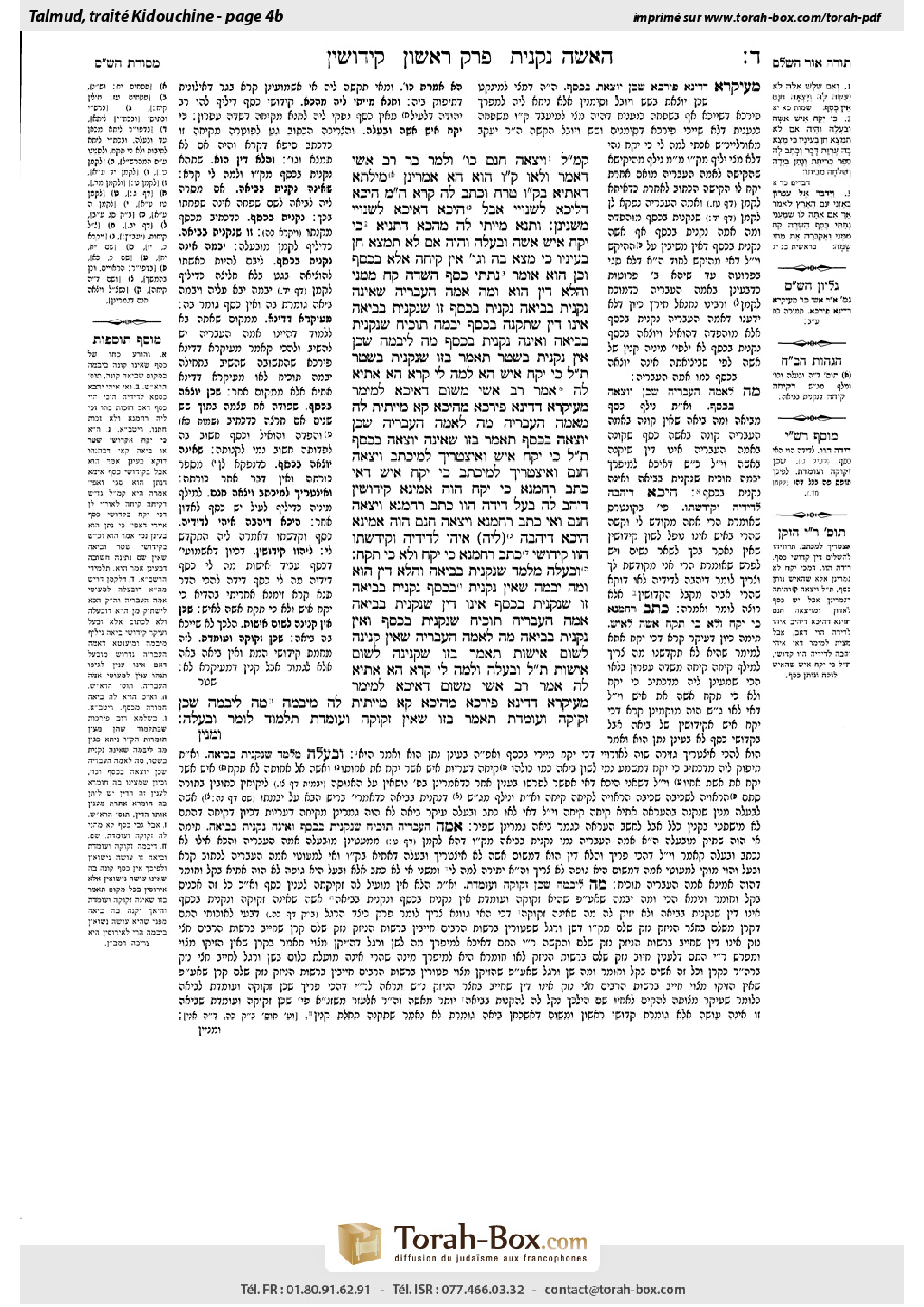
Kiddushin 4b: Talmud study for Daf Yomi
Daf Yomi is the daily study of one Talmud folio. Explore 37 tractates with scans, Hebrew text, Sefaria English and AI-generated French translations where annotated.
Passage selection and English or AI-generated French translation are available where the scan has annotations. Daf Study is independent of Torah-Box and Sefaria.
Browse Kiddushin · קידושין · All tractatesKiddushin 4b text and translations
This page of Kiddushin includes the Aramaic text, an English translation and an AI-generated French translation, alongside the scan above.
קידושין ד׳ ב · Aramaic and Hebrew text
קָא מַשְׁמַע לַן ״וְיָצְאָה חִנָּם כּוּ׳״.
וּלְמָר בַּר רַב אָשֵׁי, דְּאָמַר: וְלָאו קַל וָחוֹמֶר הוּא, הָא אָמְרִינַן מִילְּתָא דְּאָתְיָא בְּקַל וָחוֹמֶר טָרַח וְכָתַב לַהּ קְרָא! הָנֵי מִילֵּי הֵיכָא דְּלֵיכָּא לְשַׁנּוֹיֵי, אֲבָל הֵיכָא דְּאִיכָּא לְשַׁנּוֹיֵי – מְשַׁנִּינַן.
וְתַנָּא מַיְיתֵי לַהּ מֵהָכָא, דְּתַנְיָא: ״כִּי יִקַּח אִישׁ אִשָּׁה וּבְעָלָהּ וְהָיָה אִם לֹא תִמְצָא חֵן בְּעֵינָיו כִּי מָצָא בָהּ וְגוֹ׳״ – אֵין קִיחָה אֶלָּא בְּכֶסֶף. וְכֵן הוּא אוֹמֵר: ״נָתַתִּי כֶּסֶף הַשָּׂדֶה קַח מִמֶּנִּי״.
וַהֲלֹא דִּין הוּא: וּמָה אָמָה הָעִבְרִיָּה שֶׁאֵינָהּ נִקְנֵית בְּבִיאָה – נִקְנֵית בְּכֶסֶף, זוֹ, שֶׁנִּקְנֵית בְּבִיאָה – אֵינוֹ דִּין שֶׁתִּקָּנֶה בְּכֶסֶף?
יְבָמָה תּוֹכִיחַ, שֶׁנִּקְנֵית בְּבִיאָה וְאֵינָהּ נִקְנֵית בְּכֶסֶף! מָה לִיבָמָה, שֶׁכֵּן אֵין נִקְנֵית בִּשְׁטָר, תֹּאמַר בְּזוֹ, שֶׁנִּקְנֵית בִּשְׁטָר!
תַּלְמוּד לוֹמַר: ״כִּי יִקַּח אִישׁ״. הָא לְמָה לִי קְרָא, הָא אָתְיָא לַהּ! אָמַר רַב אָשֵׁי: מִשּׁוּם דְּאִיכָּא לְמֵימַר מֵעִיקָּרָא דְּדִינָא פִּירְכָא.
מֵהֵיכָא קָא מַיְיתֵית לַהּ – מֵאָמָה הָעִבְרִיָּה. מָה לְאָמָה הָעִבְרִיָּה, שֶׁכֵּן יוֹצְאָה בְּכֶסֶף, תֹּאמַר בְּזוֹ, שֶׁאֵינָהּ יוֹצְאָה בְּכֶסֶף. תַּלְמוּד לוֹמַר ״כִּי יִקַּח אִישׁ״.
וְאִיצְטְרִיךְ לְמִיכְתַּב ״וְיָצְאָה חִנָּם״, וְאִיצְטְרִיךְ לְמִיכְתַּב ״כִּי יִקַּח אִישׁ״. דְּאִי כְּתַב רַחֲמָנָא ״כִּי יִקַּח״, הֲוָה אָמֵינָא: קִידּוּשִׁין דִּיהַב לַהּ בַּעַל – דִּידַהּ הָווּ, כְּתַב רַחֲמָנָא ״וְיָצְאָה חִנָּם״.
וְאִי כְּתַב רַחֲמָנָא ״וְיָצְאָה חִנָּם״, הֲוָה אָמֵינָא: הֵיכָא דְּיָהֲבָה לֵיהּ אִיהִי לְדִידֵיהּ וְקִידְּשַׁתּוּ – הָווּ קִידּוּשֵׁי, כְּתַב רַחֲמָנָא ״כִּי יִקַּח״ – וְלָא ״כִּי תִּקַּח״.
״וּבְעָלָהּ״ – מְלַמֵּד שֶׁנִּקְנֵית בְּבִיאָה. וַהֲלֹא דִּין הוּא: וּמָה יְבָמָה שֶׁאֵין נִקְנֵית בְּכֶסֶף – נִקְנֵית בְּבִיאָה, זוֹ, שֶׁנִּקְנֵית בְּכֶסֶף – אֵינוֹ דִּין שֶׁנִּקְנֵית בְּבִיאָה?
אָמָה הָעִבְרִיָּה תּוֹכִיחַ, שֶׁנִּקְנֵית בְּכֶסֶף וְאֵין נִקְנֵית בְּבִיאָה. מָה לְאָמָה הָעִבְרִיָּה, שֶׁאֵין קִנְיָנָהּ לְשׁוּם אִישׁוּת, תֹּאמַר בְּזוֹ, שֶׁקִּנְיָנָהּ לְשׁוּם אִישׁוּת.
תַּלְמוּד לוֹמַר: ״וּבְעָלָהּ״. וּלְמָה לִי קְרָא, הָא אָתְיָא לַהּ! אָמַר רַב אָשֵׁי: מִשּׁוּם דְּאִיכָּא לְמֵימַר מֵעִיקָּרָא דְּדִינָא פִּירְכָא: מֵהֵיכָא קָא מַיְיתֵית לַהּ – מִיְּבָמָה.
מָה לִיבָמָה, שֶׁכֵּן זְקוּקָה וְעוֹמֶדֶת, תֹּאמַר בָּזוֹ, שֶׁאֵין זְקוּקָה וְעוֹמֶדֶת. תַּלְמוּד לוֹמַר: ״וּבְעָלָהּ״.
Kiddushin 4b · English translation
Therefore the superfluous phrase: “Then shall she go out for nothing, without money” (Exodus 21:11), teaches us that even an ailonit can be sold as a Hebrew maidservant and is released upon reaching adulthood.
The Gemara asks: And according to the opinion of Mar bar Rav Ashi, who said: But is it not an a fortiori inference that adulthood releases a woman from her master’s authority, how does he respond to the fact that we say in general, with regard to a matter that can be derived through an a fortiori inference, the verse nevertheless takes the trouble and writes it explicitly? The Gemara answers: That matter applies only where there is no other way to resolve the difficulty of why a halakha is written when it could be derived through an a fortiori inference. But when there is another, more substantial way to resolve the difficulty, one resolves it in that manner.
§ The Gemara notes: And a tanna cites the halakha that a woman can be betrothed with money from here, a different source. As it is taught in a baraita that when the verse states: “When a man takes a woman and engages in sexual intercourse with her, and it comes to pass, if she finds no favor in his eyes, because he has found some unseemly matter in her, and he writes her a scroll of severance” (Deuteronomy 24:1), in this verse, the term taking is only with money. And so it says: “I will give money for the field; take it from me” (Genesis 23:13).
The Gemara asks: But is there any need for this derivation? Could this not be derived through an a fortiori inference, as follows: And if a Hebrew maidservant, who cannot be acquired as a maidservant through intercourse, nevertheless can be acquired through money, is it not logical that this woman, who can be acquired through intercourse for the purpose of betrothal, can likewise be acquired through money?
Nevertheless, this a fortiori inference can be refuted. A yevama proves otherwise, as she is acquired by the yavam through intercourse, and yet she cannot be acquired through money. The Gemara rejects this refutation: What is unique about a yevama is that she cannot be acquired through a document. Will you say that the same applies to this woman, who can be acquired through a document for the purpose of betrothal, and consequently the acquisition of money applies to her as well?
The Gemara reiterates its question. The verse states: “When a man takes a woman.” Why do I need a verse for this purpose? It was already derived through this a fortiori inference, as the proposed refutation of this inference was rejected. Rav Ashi said: It is needed because one can say that the refutation of the a fortiori inference is present from the outset, i.e., there is a difficulty with the comparison between a woman and a Hebrew maidservant.
Rav Ashi elaborates: From where do you derive that a woman can be betrothed with money? It is derived through an a fortiori inference from the case of a Hebrew maidservant. This derivation can be refuted. What is unique about a Hebrew maidservant is that she can be released with money, i.e., she pays her master her value as a maidservant and she is then freed, and therefore she can likewise be acquired through money. Will you say the same with regard to this woman, who cannot be released, i.e., divorced, through money? Since this a fortiori inference is rejected, one must rely on the source cited in the baraita, that the verse states: “When a man takes.”
After mentioning an additional proof for the option of betrothal with money, the Gemara comments: And it was necessary for the Torah to write, with regard to a Hebrew maidservant: “Then shall she go out for nothing,” and it was also necessary to write: “When a man takes a woman.” As, if the Merciful One had written only: “When he takes,” I would say: The betrothal money that the husband gives her is invariably hers. Therefore, the Merciful One writes: “Then shall she go out for nothing,” to teach that when she is not an adult her father has the right to her betrothal money.
And conversely, had the Merciful One written only: “Then shall she go out for nothing,” I would say that in a case where she gave him money and betrothed him, it is a valid betrothal, as this verse does not specify who gives the money to whom. Therefore, the Merciful One writes: “When he takes,” and not: When she takes, to teach that only a man may betroth a woman, not vice versa.
The baraita continues to interpret the verse. The phrase: “And engages in sexual intercourse with her” (Deuteronomy 24:1), teaches that a woman can be acquired through intercourse. Why is it necessary for the verse to state this explicitly? Could this not be derived through an a fortiori inference: And if a yevama, who cannot be acquired through money, can be acquired through intercourse, is it not logical that this woman, who can be acquired through money, as derived above, can also be acquired through intercourse?
The Gemara counters: The case of a Hebrew maidservant proves otherwise, as she is acquired through money and yet she cannot be acquired through intercourse. The Gemara dismisses this refutation: What is distinct about a Hebrew maidservant is that her acquisition is not for the sake of marriage, as she is acquired as a servant. Will you say the same with regard to this woman, whose acquisition is for the sake of marriage? Therefore, it is logical that a woman can be acquired through sexual intercourse.
The Gemara reiterates its question. The verse states: “And engages in sexual intercourse with her.” But why do I need a verse for this purpose? It was already derived through the above a fortiori inference. Rav Ashi said: It is needed because it is possible to say that the refutation of the a fortiori inference is present from the outset. From where do you derive that intercourse is a mode of acquisition? From the case of a yevama.
One could say: What is unique about a yevama is that she is bound to the yavam and stands waiting for him to act, and for this reason sexual intercourse is sufficient to render her his wife. Will you say the same with regard to this woman, who is not bound and is not standing waiting for anyone? It is therefore possible that intercourse is not enough to acquire a woman in ordinary circumstances. Consequently, the a fortiori inference does not bear close scrutiny. For this reason an additional proof is required, that the verse states: “And engages in sexual intercourse with her.”
Kiddushin 4b · Traduction française (IA)
Par conséquent, l’expression superflue « Alors elle sortira gratuitement, sans argent » (Exode 21,11) nous enseigne qu’une aïlonit peut elle aussi être vendue comme servante hébreue et être libérée lorsqu’elle atteint la majorité.
La Guemara demande : Et selon l’opinion de Mar bar Rav Ashi, qui a dit : « N’est-il pas évident, par raisonnement a fortiori, que la majorité libère une femme de l’autorité de son maître ? », comment répond-il à l’argument selon lequel, en général, même lorsqu’une règle peut être déduite par raisonnement a fortiori, le verset prend néanmoins la peine de l’énoncer explicitement ? La Guemara répond : Cela ne s’applique que lorsqu’il n’existe aucun autre moyen de résoudre la difficulté de comprendre pourquoi une halakha est écrite alors qu’elle pourrait être déduite par raisonnement a fortiori. Mais lorsqu’il existe une autre manière, plus convaincante, de résoudre cette difficulté, on la résout de cette manière.
§ La Guemara relève qu’un tanna cite une autre source pour la halakha selon laquelle une femme peut être fiancée au moyen d’argent. En effet, il est enseigné dans une baraïta que, lorsque le verset dit : « Lorsqu’un homme prend une femme et s’unit à elle, et qu’il arrive que celle-ci ne trouve pas grâce à ses yeux, parce qu’il a découvert en elle quelque chose d’inconvenant, et qu’il lui écrit un acte de répudiation » (Deutéronome 24,1), le terme « prend », dans ce verset, désigne une prise au moyen d’argent uniquement. Et il est dit de même : « Je donnerai l’argent du champ ; prends-le de moi » (Genèse 23,13).
La Guemara demande : Mais cette déduction est-elle nécessaire ? Ne peut-on pas le déduire par raisonnement a fortiori, de la manière suivante : si une servante hébreue, qui ne peut pas être acquise comme servante par l’union sexuelle, peut néanmoins être acquise au moyen d’argent, n’est-il pas logique que cette femme, qui peut être acquise par l’union sexuelle en vue de ses fiançailles, puisse elle aussi être acquise au moyen d’argent ?
Néanmoins, ce raisonnement a fortiori peut être réfuté. Le cas d’une yevama le prouve, car le yavam l’acquiert par l’union sexuelle, et pourtant il ne peut pas l’acquérir au moyen d’argent. La Guemara rejette cette réfutation : Ce qui distingue une yevama, c’est qu’elle ne peut pas être acquise au moyen d’un document. En diras-tu autant de cette femme, qui peut être acquise au moyen d’un document en vue de ses fiançailles, et à laquelle s’applique donc également l’acquisition au moyen d’argent ?
La Guemara reprend sa question. Le verset dit : « Lorsqu’un homme prend une femme. » Pourquoi ai-je besoin d’un verset à cette fin ? Cela a déjà été déduit par ce raisonnement a fortiori, puisque la réfutation proposée de ce raisonnement a été rejetée. Rav Ashi a dit : Il est nécessaire parce qu’on peut dire que la réfutation du raisonnement a fortiori se présente d’emblée, c’est-à-dire qu’il y a une difficulté à comparer une femme à une servante hébreue.
Rav Ashi développe : D’où déduis-tu qu’une femme peut être fiancée au moyen d’argent ? On le déduit par raisonnement a fortiori du cas d’une servante hébreue. Cette déduction peut être réfutée. Ce qui distingue une servante hébreue, c’est qu’elle peut être libérée au moyen d’argent, c’est-à-dire qu’elle verse à son maître la valeur qu’elle a en tant que servante, puis elle est libérée ; elle peut donc également être acquise au moyen d’argent. En diras-tu autant de cette femme, qui ne peut pas être libérée, c’est-à-dire répudiée, au moyen d’argent ? Puisque ce raisonnement a fortiori est rejeté, il faut s’appuyer sur la source citée dans la baraïta, à savoir que le verset dit : « Lorsqu’un homme prend. »
Après avoir mentionné une preuve supplémentaire en faveur de la possibilité de se fiancer au moyen d’argent, la Guemara commente : La Torah devait écrire, au sujet d’une servante hébreue, « Alors elle sortira gratuitement », et elle devait aussi écrire : « Lorsqu’un homme prend une femme. » En effet, si le Miséricordieux n’avait écrit que « Lorsqu’il prend », j’aurais dit que l’argent des fiançailles que le mari lui donne lui appartient toujours. Le Miséricordieux écrit donc : « Alors elle sortira gratuitement », pour enseigner que, lorsqu’elle n’est pas majeure, son père a droit à l’argent de ses fiançailles.
Inversement, si le Miséricordieux n’avait écrit que « Alors elle sortira gratuitement », j’aurais dit que, dans le cas où elle lui donne de l’argent et le fiance, les fiançailles sont valides, puisque ce verset ne précise pas qui donne l’argent à qui. Le Miséricordieux écrit donc : « Lorsqu’il prend », et non : « Lorsqu’elle prend », pour enseigner que seul un homme peut fiancer une femme, et non l’inverse.
La baraïta poursuit son interprétation du verset. L’expression « et s’unit à elle » (Deutéronome 24,1) enseigne qu’une femme peut être acquise par l’union sexuelle. Pourquoi le verset doit-il le dire explicitement ? Ne peut-on pas le déduire par raisonnement a fortiori : si une yevama, qui ne peut pas être acquise au moyen d’argent, peut être acquise par l’union sexuelle, n’est-il pas logique que cette femme, qui peut être acquise au moyen d’argent, comme cela a été déduit plus haut, puisse elle aussi être acquise par l’union sexuelle ?
La Guemara objecte : Le cas d’une servante hébreue prouve le contraire, car elle est acquise au moyen d’argent, et pourtant elle ne peut pas être acquise par l’union sexuelle. La Guemara écarte cette réfutation : Ce qui distingue une servante hébreue, c’est qu’elle n’est pas acquise en vue du mariage, puisqu’elle est acquise comme servante. En diras-tu autant de cette femme, qui est acquise en vue du mariage ? Il est donc logique qu’une femme puisse être acquise par l’union sexuelle.
La Guemara reprend sa question. Le verset dit : « Et s’unit à elle. » Mais pourquoi ai-je besoin d’un verset à cette fin ? Cela a déjà été déduit par le raisonnement a fortiori ci-dessus. Rav Ashi a dit : Il est nécessaire parce qu’on peut dire que la réfutation du raisonnement a fortiori se présente d’emblée. D’où déduis-tu que l’union sexuelle est un mode d’acquisition ? Du cas d’une yevama.
On pourrait dire : Ce qui distingue une yevama, c’est qu’elle est liée au yavam et attend qu’il agisse ; pour cette raison, l’union sexuelle suffit à faire d’elle son épouse. En diras-tu autant de cette femme, qui n’est liée à personne et n’attend personne ? Il est donc possible que, dans les circonstances ordinaires, l’union sexuelle ne suffise pas à acquérir une femme. Par conséquent, le raisonnement a fortiori ne résiste pas à un examen approfondi. C’est pourquoi une preuve supplémentaire est nécessaire : le verset dit « et s’unit à elle ».
Traduction française générée par IA à partir de l’édition anglaise de Sefaria. Vérifie toujours un passage avec le texte source.
Text from Sefaria: William Davidson Edition - Vocalized Aramaic (CC BY NC); William Davidson Edition - English (CC BY NC).