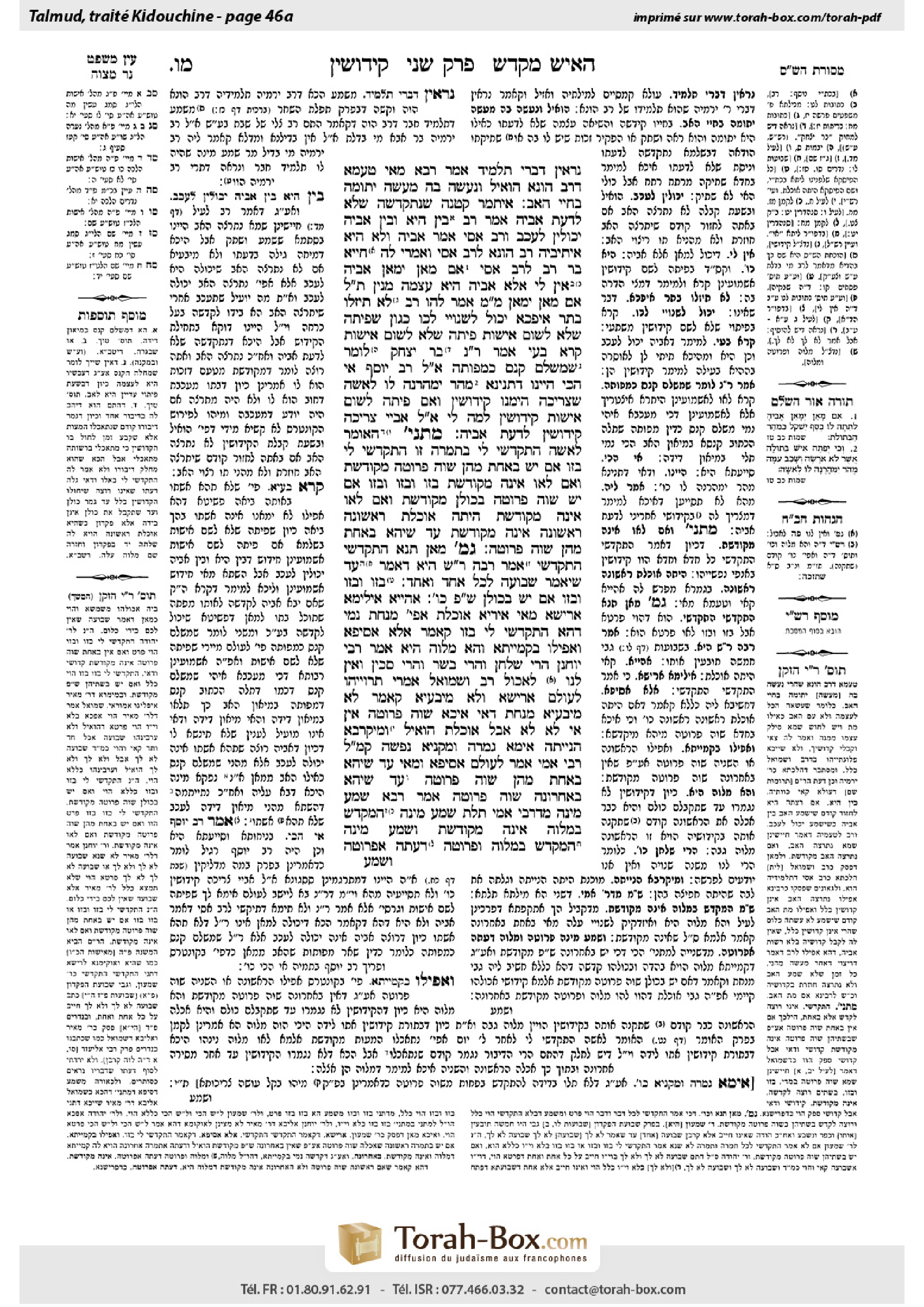
Kiddushin 46a: Talmud study for Daf Yomi
Daf Yomi is the daily study of one Talmud folio. Explore 37 tractates with scans, Hebrew text, Sefaria English and AI-generated French translations where annotated.
Passage selection and English or AI-generated French translation are available where the scan has annotations. Daf Study is independent of Torah-Box and Sefaria.
Browse Kiddushin · קידושין · All tractatesKiddushin 46a text and translations
This page of Kiddushin includes the Aramaic text, an English translation and an AI-generated French translation, alongside the scan above.
קידושין מ״ו א · Aramaic and Hebrew text
נִרְאִין דִּבְרֵי תַלְמִיד. אָמַר רָבָא: מַאי טַעְמָא דְּרַב הוּנָא – הוֹאִיל וְנַעֲשָׂה בָּהּ מַעֲשֵׂה יְתוֹמָה בְּחַיֵּי הָאָב.
אִיתְּמַר: קְטַנָּה שֶׁנִּתְקַדְּשָׁה שֶׁלֹּא לְדַעַת אָבִיהָ, אָמַר רַב: בֵּין הִיא וּבֵין אָבִיהָ יְכוֹלִין לְעַכֵּב. וְרַב אַסִּי אָמַר: אָבִיהָ וְלֹא הִיא. אֵיתִיבֵיהּ רַב הוּנָא לְרַב אַסִּי, וְאָמְרִי לַהּ חִיָּיא בַּר רַב לְרַב אַסִּי: ״אִם מָאֵן יְמָאֵן אָבִיהָ״, אֵין לִי אֶלָּא אָבִיהָ, הִיא עַצְמָהּ מִנַּיִן? תַּלְמוּד לוֹמַר: ״אִם מָאֵן יְמָאֵן״ – מִכׇּל מָקוֹם.
אֲמַר לְהוּ רַב: לָא תֵּיזְלוּ בָּתַר אִיפְּכָא. יָכֵול לְשַׁנּוֹיֵי לְכוּ: כְּגוֹן שֶׁפִּיתָּהּ שֶׁלֹּא לְשׁוּם אִישׁוּת. פִּיתָּהּ שֶׁלֹּא לְשׁוּם אִישׁוּת קְרָא בָּעֵי? אָמַר רַב נַחְמָן בַּר יִצְחָק: לוֹמַר שֶׁמְּשַׁלֵּם קְנָס כִּמְפוּתָּה.
אֲמַר לֵיהּ רַב יוֹסֵף: אִי הָכִי, הַיְינוּ דִּתְנֵינָא: ״מָהֹר יִמְהָרֶנָּה לּוֹ לְאִשָּׁה״ – שֶׁצְּרִיכָה הֵימֶנּוּ קִידּוּשִׁין. וְאִם פִּיתָּהּ לְשׁוּם אִישׁוּת, קִידּוּשִׁין לְמָה לִי? אֲמַר לֵיהּ אַבָּיֵי: צְרִיכָה קִידּוּשִׁין לְדַעַת אָבִיהָ.
מַתְנִי׳ הָאוֹמֵר לְאִשָּׁה ״הִתְקַדְּשִׁי לִי בִּתְמָרָה זוֹ״, ״הִתְקַדְּשִׁי לִי בָּזוֹ״ אִם יֵשׁ בְּאַחַת מֵהֶן שָׁוֶה פְּרוּטָה – מְקוּדֶּשֶׁת, וְאִם לָאו – אֵינָהּ מְקוּדֶּשֶׁת. ״בָּזוֹ וּבָזוֹ וּבָזוֹ״ אִם יֵשׁ שָׁוֶה פְּרוּטָה בְּכוּלָּן – מְקוּדֶּשֶׁת, וְאִם לָאו – אֵינָהּ מְקוּדֶּשֶׁת. הָיְתָה אוֹכֶלֶת רִאשׁוֹנָה רִאשׁוֹנָה – אֵינָהּ מְקוּדֶּשֶׁת, עַד שֶׁיְּהֵא בְּאַחַת מֵהֶן שָׁוֶה פְּרוּטָה.
גְּמָ׳ מַאן תְּנָא ״הִתְקַדְּשִׁי״ ״הִתְקַדְּשִׁי״? אָמַר רַבָּה: רַבִּי שִׁמְעוֹן הִיא, דְּאָמַר עַד שֶׁיֹּאמַר שְׁבוּעָה לְכׇל אֶחָד וְאֶחָד.
״בָּזוֹ וּבָזוֹ וּבָזוֹ״ אִם יֵשׁ בְּכוּלָּן שָׁוֶה פְּרוּטָה כּוּ׳. אַהֵיָיא? אִילֵּימָא אַרֵישָׁא, מַאי אִירְיָא אוֹכֶלֶת? אֲפִילּוּ מִנְחַת נָמֵי, דְּהָא ״הִתְקַדְּשִׁי לִי בָּזוֹ״ קָאָמַר! אֶלָּא אַסֵּיפָא.
וַאֲפִילּוּ בְּקַמַּיְיתָא? וְהָא מִלְוָה הִיא! אָמַר רַבִּי יוֹחָנָן: הֲרֵי שֻׁלְחָן, וַהֲרֵי בָּשָׂר, וַהֲרֵי סַכִּין, וְאֵין לָנוּ [פֶּה] לֶאֱכוֹל!
רַב וּשְׁמוּאֵל אָמְרִי תַּרְוַיְיהוּ: לְעוֹלָם אַרֵישָׁא, וְלָא מִיבַּעְיָא קָאָמַר: לָא מִיבַּעְיָא מַנַּחַת, דְּאִי אִיכָּא שָׁוֶה פְּרוּטָה – אִין, אִי לָא – לָא. אֲבָל אוֹכֶלֶת, הוֹאִיל וּמִיקָּרְבָא הֲנָיָיתַהּ, אֵימָא גָּמְרָה וּמַקְנְיָא נַפְשַׁהּ, קָא מַשְׁמַע לַן.
רַבִּי אַמֵּי אָמַר: לְעוֹלָם אַסֵּיפָא, וּמַאי ״עַד שֶׁיְּהֵא בְּאַחַת מֵהֶן שָׁוֶה פְּרוּטָה״ – עַד שֶׁיְּהֵא בָּאַחֲרוֹנָה שָׁוֶה פְּרוּטָה.
אָמַר רָבָא: שְׁמַע מִינַּהּ מִדְּרַבִּי אַמֵּי תְּלָת. שְׁמַע מִינַּהּ: הַמְקַדֵּשׁ בְּמִלְוָה אֵינָהּ מְקוּדֶּשֶׁת, וּשְׁמַע מִינַּהּ: הַמְקַדֵּשׁ בְּמִלְוָה וּפְרוּטָה, דַּעְתַּהּ אַפְּרוּטָה,
Kiddushin 46a · English translation
Rather, the statement of the student seems reasonable. Although Rav Yirmeya bar Abba was like a student compared with Rav Huna, his opinion makes more sense. Rava said: What is the reason of Rav Huna? Since an action was done with her that renders her like an orphan in the lifetime of her father, she is considered married and may partake of teruma. The fact that her father ignored both her betrothal and her marriage indicates that he has waived his rights to control whom she marries. She is therefore considered like an orphan, whose marriage is valid with her own consent.
§ It was stated that amora’im disputed the following issue: In the case of a minor girl who became betrothed without her father’s consent, Rav says: Either she or her father is able to prevent the betrothal from taking effect. And Rav Asi says: Her father can prevent it but not she, since she initially agreed. Rav Huna raised an objection to Rav Asi, and some say it was Ḥiyya bar Rav who raised an objection to Rav Asi: The baraita states in the case of a seduced woman: “If her father refuses to give her to him, he shall pay money according to the dowry of virgins” (Exodus 22:16). The Sages expounded: I have derived only the halakha that her father can refuse to give her to the seducer in marriage; from where do I derive that she herself can also refuse? The verse states: “If he refuses [ma’en yema’en].” The repetition of the verb indicates that the right of refusal exists in any case. Despite the fact that she was seduced, she can change her mind and say that she does not want to marry him.
Rav said to those who tried to offer support for his opinion: Do not go after the opposite, i.e., do not cite a proof from a source that could be understood in the opposite manner. Rav Asi can answer your argument by claiming that the baraita is referring to a case where he initially seduced her not for the sake of marriage. Their initial act of intercourse was not performed in order to effect betrothal, so they are not betrothed. The Gemara questions this: In the case of a seduction that is not for the sake of marriage, is a verse required to teach that she can refuse to marry him? Rav Naḥman bar Yitzḥak says: It serves to say that if she refuses to marry him despite her father’s consent to the match, the seducer nevertheless pays the fine like a standard case of a seduced woman. The obligation to pay the fine is not only for a case where her father refuses to let her marry the seducer.
Rav Yosef said to him: If so, if the baraita is discussing a case where intercourse was not performed to effect betrothal, this is what we learned in a baraita with regard to a seduced woman: “He shall pay a dowry for her to be his wife” (Exodus 22:15). This teaches that she requires betrothal from him. And if the verse is speaking of one who seduced her for the sake of marriage, why do I need betrothal? The act of intercourse can serve as the betrothal. Rather, the baraita must be referring to a case where he seduced her not for the sake of marriage. Abaye said to him: Even if he seduced her for the sake of marriage, she requires an additional betrothal with her father’s consent, since she is a minor and became betrothed without it.
MISHNA: In the case of one who says to a woman: Be betrothed to me with this date, and adds: Be betrothed to me with that one, then if one of the dates is worth one peruta she is betrothed, but if not, she is not betrothed, since he mentioned betrothal in connection with each date. But if he said: Be betrothed to me with this one, and with this one, and with this one, then even if all of them together are worth one peruta she is betrothed, but if not, she is not betrothed. If he gave her dates with the intention of betrothing her with them, and she was eating them one by one as she received them, she is not betrothed unless one of them is worth one peruta.
GEMARA: Who is the tanna who taught that it is only if he says: Be betrothed to me, be betrothed to me, in connection with each date that each act of betrothal is considered distinct? Rabba says: It is the opinion of Rabbi Shimon, who said in the context of the laws of deposit oaths: He is never liable to bring more than one offering unless he will state an expression of an oath to each and every one.
The mishna teaches: If one said: With this one, and with this one, and with this one, she is betrothed even if all of them together are worth one peruta. The mishna subsequently states that if she was eating the dates one by one, she is betrothed only if one of them is worth one peruta. The Gemara asks: To which clause of the mishna is the case of the woman eating the dates one by one referring? If we say it is referring to the first clause of the mishna, when he betrothed her separately with each date, why would the mishna specifically state that she ate them? Even if she placed them down without eating them the same halakha would also apply, as he said: Be betrothed to me with this date, so each date must be worth one peruta. Rather, it must be referring to the latter clause, when he said that he is betrothing her with all the dates. In such a situation, if she ate them one by one, she is betrothed only if one of them is worth one peruta.
The Gemara proceeds to ask: And is she betrothed even if the first date is worth one peruta? But until he has given her all the dates for the betrothal, each individual date is considered to be a loan, because if he were to retract his betrothal before giving her all of the dates she would have to return them to him, and one cannot betroth a woman by giving her a loan. By the time he finishes giving her the dates, the first one has already been eaten, so it is not able to effect the betrothal. With regard to this difficulty Rabbi Yoḥanan says: There is a table, and there is meat, and there is a knife, and we have nothing to eat. In other words, everything in the mishna is explicit yet we cannot explain it.
Rav and Shmuel both said: Actually, the case of the woman eating the dates one by one is referring to the first clause of the mishna, where one betrothed the woman with each date separately, and it is speaking utilizing the style of: It is not necessary. The mishna stated, for stylistic reasons, a halakha that it did not need to state, and should be understood as follows: It is not necessary to state the halakha in the case of a woman who placed the dates down, that if one of them is worth one peruta, yes, she is betrothed, and if not, she is not betrothed. But in a case where she was eating them, one might think that since her benefit is immediate, say that she has decided to transfer herself to him by means of that date, although it is worth less than one peruta. The mishna therefore teaches us that she is nevertheless not betrothed.
Rabbi Ami said a different explanation: Actually, the case of the woman eating the dates one by one is referring to the latter clause of the mishna, where he betrothed her by giving her all of the dates. And what is the meaning of: Unless one of them is worth one peruta? It means: Unless the last of them is worth one peruta. But if one of the other dates is worth one peruta she is not betrothed, since they are considered a loan until all the dates have been given.
Rava says: Conclude three conclusions from this statement of Rabbi Ami: Conclude from it that in the case of one who betroths a woman with a loan, she is not betrothed, since she is not betrothed with a date that she has already eaten. And conclude from it that in the case of one who betroths a woman by forgiving a loan and giving her one peruta, her mind is focused on the peruta although the debt is far larger, and she will be betrothed. In the latter case, although the value of the dates she ate was more than the value of the last date, which was merely worth one peruta, she is nevertheless betrothed.
Kiddushin 46a · Traduction française (IA)
L’opinion de l’élève semble plutôt raisonnable. Bien que Rav Yirmeya bar Abba fût comme un élève par rapport à Rav Huna, son opinion est plus convaincante. Rava dit : Quelle est la raison de Rav Huna ? Puisqu’un acte a été accompli à son égard qui la rend semblable à une orpheline du vivant de son père, elle est considérée comme mariée et peut consommer la terouma. Le fait que son père ait ignoré aussi bien ses fiançailles que son mariage indique qu’il a renoncé à son droit de décider avec qui elle se mariera. Elle est donc considérée comme une orpheline, dont le mariage est valide avec son propre consentement.
§ Il a été rapporté que des amoraïm ont divergé sur la question suivante : dans le cas d’une jeune fille mineure qui s’est fiancée sans le consentement de son père, Rav dit : elle-même ou son père peut empêcher les fiançailles de prendre effet. Rav Asi dit : son père peut les empêcher, mais pas elle, puisqu’elle y a d’abord consenti. Rav Huna objecta à Rav Asi, et certains disent que ce fut Ḥiyya bar Rav qui lui objecta : la baraïta enseigne, à propos d’une femme séduite : « Si son père refuse de la lui donner, il lui paiera une somme correspondant à la dot des vierges » (Exode 22, 16). Les Sages ont déduit : « Je n’ai appris que la halakha selon laquelle son père peut refuser de la donner en mariage au séducteur ; d’où apprend-on qu’elle-même peut également refuser ? » Le verset dit : « S’il refuse, il refusera [ma’en yema’en]. » La répétition du verbe indique que le droit de refus existe dans tous les cas. Bien qu’elle ait été séduite, elle peut changer d’avis et dire qu’elle ne veut pas l’épouser.
Rav dit à ceux qui tentaient d’appuyer son opinion : Ne vous fondez pas sur l’inverse, c’est-à-dire ne tirez pas de preuve d’une source qui pourrait être comprise en sens contraire. Rav Asi peut répondre à votre argument que la baraïta parle d’un cas où il l’a d’abord séduite sans intention de l’épouser. Leur premier rapport sexuel n’avait pas pour but de contracter des fiançailles ; ils ne sont donc pas fiancés. La Guemara objecte : dans le cas d’une séduction sans intention de mariage, faut-il un verset pour enseigner qu’elle peut refuser de l’épouser ? Rav Naḥman bar Yitzḥak dit : cela vient enseigner que si elle refuse de l’épouser, malgré le consentement de son père à cette union, le séducteur doit néanmoins payer l’amende, comme dans le cas ordinaire d’une femme séduite. L’obligation de payer l’amende ne concerne pas seulement le cas où son père refuse de la laisser épouser le séducteur.
Rav Yosef lui dit : Dans ce cas, si la baraïta traite d’un cas où le rapport sexuel n’avait pas pour but de contracter des fiançailles, voici ce que nous avons appris dans une baraïta à propos d’une femme séduite : « Il lui paiera une dot pour qu’elle devienne sa femme » (Exode 22, 15). Cela enseigne qu’elle doit recevoir de lui des fiançailles. Et si le verset parle d’un homme qui l’a séduite dans l’intention de l’épouser, pourquoi faut-il des fiançailles ? Le rapport sexuel peut tenir lieu de fiançailles. La baraïta doit donc parler d’un cas où il l’a séduite sans intention de l’épouser. Abaye lui dit : même s’il l’a séduite dans l’intention de l’épouser, elle doit recevoir de nouvelles fiançailles avec le consentement de son père, puisqu’elle est mineure et s’est fiancée sans ce consentement.
Michna : Dans le cas de celui qui dit à une femme : « Sois fiancée à moi avec cette datte », puis ajoute : « Sois fiancée à moi avec celle-là », si l’une des dattes vaut une perouta, elle est fiancée ; sinon, elle ne l’est pas, puisqu’il a mentionné les fiançailles à propos de chacune des dattes. Mais s’il dit : « Sois fiancée à moi avec celle-ci, et avec celle-ci, et avec celle-ci », alors, même si leur valeur totale atteint une perouta, elle est fiancée ; sinon, elle ne l’est pas. S’il lui a donné des dattes dans l’intention de la fiancer avec elles et qu’elle les mangeait une par une au fur et à mesure qu’elle les recevait, elle n’est fiancée que si l’une d’elles vaut une perouta.
Guemara : Quel est le tanna qui a enseigné que c’est seulement lorsqu’il dit : « Sois fiancée à moi », « Sois fiancée à moi », à propos de chacune des dattes que chaque acte de fiançailles est considéré comme distinct ? Rabba dit : C’est l’opinion de Rabbi Shimon, qui a dit, au sujet des lois relatives aux serments portant sur des dépôts, qu’il n’est jamais tenu d’apporter plus d’un sacrifice, à moins qu’il ne prononce une formule de serment pour chacun d’eux.
La Michna enseigne : s’il a dit : « Avec celle-ci, et avec celle-ci, et avec celle-ci », elle est fiancée même si leur valeur totale atteint une perouta. La Michna précise ensuite que si elle mangeait les dattes une par une, elle n’est fiancée que si l’une d’elles vaut une perouta. La Guemara demande : à quelle clause de la Michna se rapporte le cas de la femme qui mange les dattes une par une ? Si l’on dit qu’il se rapporte à la première clause de la Michna, où il l’a fiancée séparément avec chaque datte, pourquoi la Michna précise-t-elle qu’elle les a mangées ? Même si elle les avait simplement posées sans les manger, la même halakha s’appliquerait, puisqu’il a dit : « Sois fiancée à moi avec cette datte » ; chaque datte doit donc valoir une perouta. Il faut plutôt dire que ce cas se rapporte à la dernière clause, où il a dit qu’il la fiançait avec toutes les dattes. Dans une telle situation, si elle les mange une par une, elle n’est fiancée que si l’une d’elles vaut une perouta.
La Guemara poursuit : est-elle fiancée même si la première datte vaut une perouta ? Mais tant qu’il ne lui a pas donné toutes les dattes destinées aux fiançailles, chacune d’elles est considérée comme un prêt, car s’il revenait sur son engagement avant de les lui avoir toutes données, elle devrait les lui rendre ; or, on ne peut pas fiancer une femme en lui donnant un prêt. Au moment où il finit de lui donner les dattes, la première a déjà été mangée ; elle ne peut donc pas servir à contracter les fiançailles. À propos de cette difficulté, Rabbi Yoḥanan dit : « Il y a une table, il y a de la viande, il y a un couteau, et nous n’avons rien à manger. » Autrement dit, tout est explicite dans la Michna, et pourtant nous ne parvenons pas à l’expliquer.
Rav et Shmuel ont dit tous deux : en réalité, le cas de la femme qui mange les dattes une par une se rapporte à la première clause de la Michna, où l’homme la fiance séparément avec chaque datte ; la Michna adopte ici la tournure « il n’est pas nécessaire ». Pour des raisons de style, elle énonce une halakha qu’elle n’avait pas besoin d’énoncer. Il faut comprendre ainsi : il n’est pas nécessaire d’énoncer la halakha dans le cas d’une femme qui a posé les dattes : si l’une d’elles vaut une perouta, oui, elle est fiancée ; sinon, elle ne l’est pas. Mais, dans le cas où elle les mangeait, on aurait pu penser que, puisque le bénéfice est immédiat, elle a décidé de se donner à lui au moyen de cette datte, même si elle vaut moins d’une perouta. La Michna nous enseigne donc que, malgré cela, elle n’est pas fiancée.
Rabbi Ami donna une autre explication : en réalité, le cas de la femme qui mange les dattes une par une se rapporte à la dernière clause de la Michna, où il la fiance en lui donnant toutes les dattes. Et que signifie : « À moins que l’une d’elles ne vaille une perouta » ? Cela signifie : à moins que la dernière ne vaille une perouta. Mais si l’une des autres dattes vaut une perouta, elle n’est pas fiancée, puisqu’elles sont considérées comme un prêt jusqu’à ce que toutes les dattes lui aient été données.
Rava dit : tirez trois conclusions de cette déclaration de Rabbi Ami. Déduisez-en que celui qui fiance une femme au moyen d’un prêt ne la fiance pas, puisqu’elle n’est pas fiancée avec une datte qu’elle a déjà mangée. Déduisez-en également que celui qui fiance une femme en lui remettant une perouta et en lui remettant sa dette l’a fiancée, car son attention se porte sur la perouta, bien que la dette soit beaucoup plus importante. Dans ce dernier cas, bien que la valeur des dattes qu’elle a mangées soit supérieure à celle de la dernière datte, qui ne vaut qu’une perouta, elle est néanmoins fiancée.
Traduction française générée par IA à partir de l’édition anglaise de Sefaria. Vérifie toujours un passage avec le texte source.
Text from Sefaria: William Davidson Edition - Vocalized Aramaic (CC BY NC); William Davidson Edition - English (CC BY NC).