Kiddushin 45b: Talmud study for Daf Yomi
Daf Yomi is the daily study of one Talmud folio. Explore 37 tractates with scans, Hebrew text, Sefaria English and AI-generated French translations where annotated.
Passage selection and English or AI-generated French translation are available where the scan has annotations. Daf Study is independent of Torah-Box and Sefaria.
Browse Kiddushin · קידושין · All tractatesKiddushin 45b text and translations
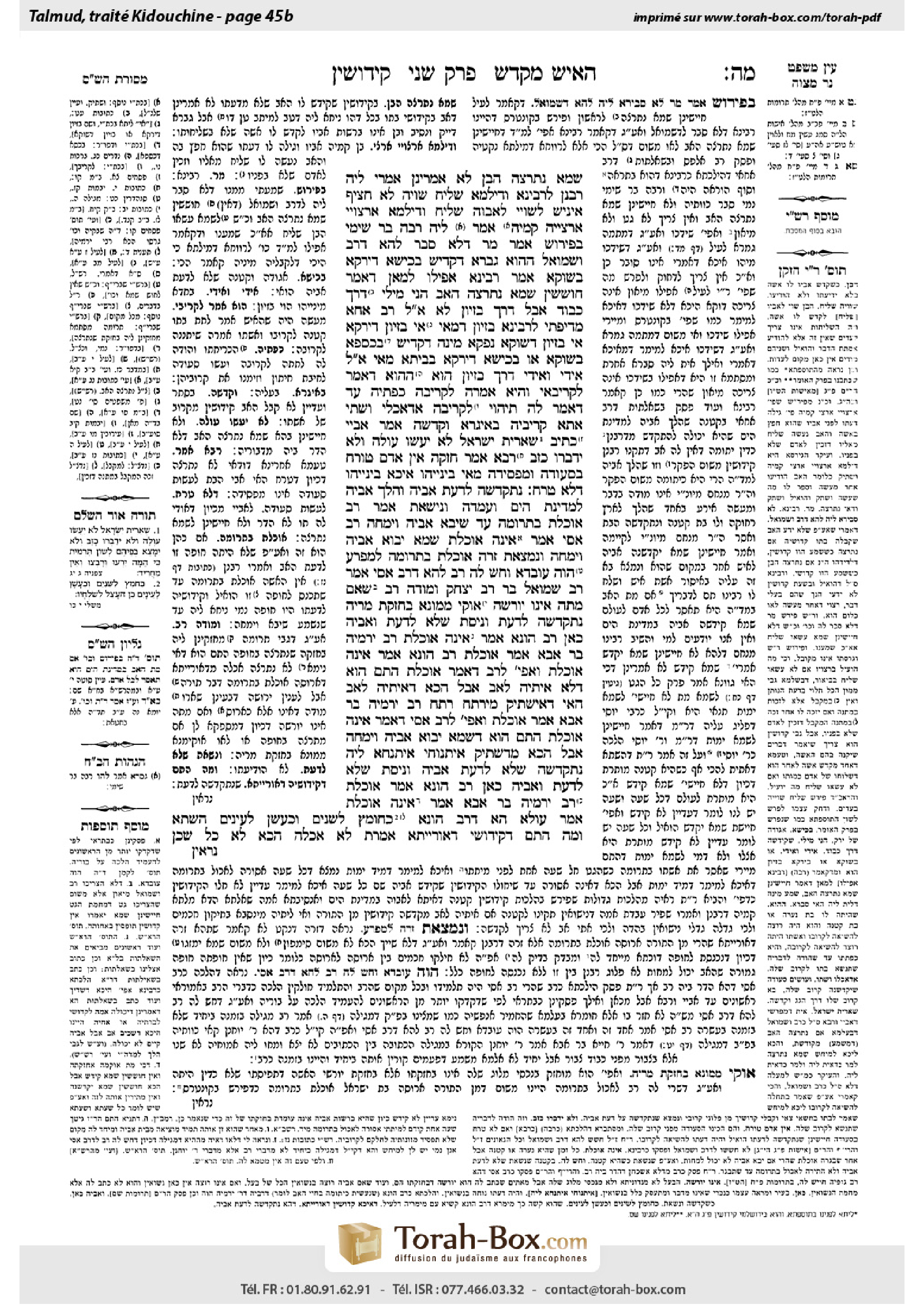
This page of Kiddushin includes the Aramaic text, an English translation and an AI-generated French translation, alongside the scan above.
קידושין מ״ה ב · Aramaic and Hebrew text
שֶׁמָּא נִתְרַצָּה הַבֵּן לָא אָמְרִינַן. אָמְרִי לֵיהּ רַבָּנַן לְרָבִינָא: וְדִילְמָא שָׁלִיחַ שַׁוְּיֵהּ? לָא חֲצִיף אִינִישׁ לְשַׁוּוֹיֵי לַאֲבוּהּ שָׁלִיחַ. וְדִילְמָא אַרְצוֹיֵי אַרְצְיַיהּ קַמֵּיהּ? אֲמַר לֵיהּ רַבָּה בַּר שִׁימִי: בְּפֵירוּשׁ אָמַר מָר דְּלָא סָבַר לְהָא דְּרַב וּשְׁמוּאֵל.
הָהוּא גַּבְרָא דְּקַדֵּישׁ בְּכִישָׁא דְיַרְקָא בְּשׁוּקָא. אֲמַר רָבִינָא: אֲפִילּוּ לְמַאן דְּאָמַר חוֹשְׁשִׁין שֶׁמָּא נִתְרַצָּה הָאָב – הָנֵי מִילֵּי דֶּרֶךְ כָּבוֹד, אֲבָל דֶּרֶךְ בִּזָּיוֹן – לָא.
אֲמַר לֵיהּ רַב אַחָא מִדִּיפְתִּי לְרָבִינָא: בִּזָּיוֹן דְּמַאי? אִי בִּזָּיוֹן דְּיַרְקָא, אִי בִּזָּיוֹן דְּשׁוּקָא? נָפְקָא מִינַּהּ דְּקַדֵּישׁ בְּכַסְפָּא בְּשׁוּקָא, אוֹ בְּכִישָׁא דְיַרְקָא בְּבֵיתָא, מַאי? אֲמַר לֵיהּ: אִידֵּי וְאִידֵּי דֶּרֶךְ בִּזָּיוֹן הוּא.
הַהוּא דְּאָמַר לְקָרִיבַאי, וְהִיא אָמְרָה לְקָרִיבַהּ. כְּפַתֵּיהּ עַד דַּאֲמַר לַהּ: ״תֶּיהְוֵי לְקָרִיבַהּ״. אַדְּאָכְלִי וְשָׁתוּ אֲתָא קָרִיבֵיהּ בְּאִיגָּרָא וְקַדְּשַׁהּ.
אָמַר אַבָּיֵי: כְּתִיב ״שְׁאֵרִית יִשְׂרָאֵל לֹא יַעֲשׂוּ עַוְלָה וְלֹא יְדַבְּרוּ כָזָב״. רָבָא אָמַר: חֲזָקָה אֵין אָדָם טוֹרֵחַ בִּסְעוּדָה וּמַפְסִידָהּ.
מַאי בֵּינַיְיהוּ? אִיכָּא בֵּינַיְיהוּ דְּלָא טְרַח.
נִתְקַדְּשָׁה לְדַעַת אָבִיהָ, וְהָלַךְ אָבִיהָ לִמְדִינַת הַיָּם וְעָמְדָה וְנִישֵּׂאת, אָמַר רַב: אוֹכֶלֶת בִּתְרוּמָה עַד שֶׁיָּבֹא אָבִיהָ וִימַחֶה. רַב אַסִּי אָמַר: אֵינָהּ אוֹכֶלֶת, שֶׁמָּא יָבוֹא אָבִיהָ וִימַחֶה, וְנִמְצֵאת זָרָה אוֹכֶלֶת בִּתְרוּמָה לְמַפְרֵעַ. הֲוָה עוֹבָדָא וְחַשׁ לַהּ רַב לְהָא דְּרַב אַסִּי.
אָמַר רַב שְׁמוּאֵל בַּר רַב יִצְחָק: וּמוֹדֶה רַב שֶׁאִם מֵתָה – אֵינוֹ יוֹרְשָׁהּ. אוֹקִי מָמוֹנָא בְּחֶזְקַת מָרֵיהּ.
נִתְקַדְּשָׁה לְדַעַת וְנִיסֵּת שֶׁלֹּא לְדַעַת, וְאָבִיהָ כָּאן, רַב הוּנָא אָמַר: אֵינָהּ אוֹכֶלֶת. רַב יִרְמְיָה בַּר אַבָּא אָמַר: אוֹכֶלֶת.
רַב הוּנָא אָמַר: אֵינָהּ אוֹכֶלֶת. וַאֲפִילּוּ לְרַב, דְּאָמַר אוֹכֶלֶת – הָתָם הוּא דְּלָא אִיתֵיהּ לְאָב, אֲבָל הָכָא דְּאִיתֵיהּ לְאָב, הַאי דְּאִישְׁתִּיק – מִירְתָּח רָתַח. רַב יִרְמְיָה בַּר אַבָּא אָמַר: אוֹכֶלֶת. וַאֲפִילּוּ לְרַב אַסִּי דְּאָמַר אֵינָהּ אוֹכֶלֶת, הָתָם הוּא דְּשֶׁמָּא יָבוֹא אָבִיהָ וִימַחֶה, אֲבָל הָכָא מִדִּשְׁתֵיק – אִיתְנוֹחֵי אִיתְנְחָא לֵיהּ.
נִתְקַדְּשָׁה שֶׁלֹּא לְדַעַת אָבִיהָ, וְנִיסֵּת שֶׁלֹּא לְדַעַת, וְאָבִיהָ כָּאן, רַב הוּנָא אָמַר: אוֹכֶלֶת, רַב יִרְמְיָה בַּר אַבָּא אָמַר: אֵינָהּ אוֹכֶלֶת. אָמַר עוּלָּא: הָא דְּרַב הוּנָא ״כַּחֹמֶץ לַשִּׁנַּיִם וְכֶעָשָׁן לָעֵינָיִם״. הַשְׁתָּא וּמָה הָתָם דְּקִידּוּשֵׁי דְּאוֹרָיְיתָא אָמְרַתְּ לָא אָכְלָה, הָכָא לֹא כׇּל שֶׁכֵּן?!
Kiddushin 45b · English translation
and we do not say that perhaps the son desired the betrothal. The Sages said to Ravina: But perhaps the son appointed his father as an agent to betroth her, and the betrothal should take effect. He replied: A person is not so brazen as to appoint his father as his agent and thereby treat him as an assistant of sorts. They further inquired: But perhaps the son made his desire known to his father by speaking of his desire to marry the woman, and the father acted of his own accord upon his son’s wishes and betrothed her to him. Rabba bar Shimi said to Ravina: This is not a concern, since the Master, i.e., Ravina, explicitly said that he does not agree with this opinion of Rav and Shmuel that when a minor girl accepts betrothal there is a concern that perhaps the father desired it. So too, there is no concern that a father can act for the son without his awareness.
The Gemara relates: There was a certain man who betrothed a minor girl without her father’s consent with a bundle of vegetables in the marketplace. Ravina says: Even according to the one who says that when a minor becomes betrothed without her father’s consent we are concerned that perhaps the father desired the betrothal, this matter applies only if the man betrothed her in a dignified manner. But as the betrothal in this case was done in a degrading manner, there is no concern.
Rav Aḥa of Difti said to Ravina: What was the degradation in this manner of betrothal? Was the degradation from the fact that he used vegetables, or was the degradation due to the betrothal having been performed in the marketplace? The practical difference concerns cases where one betrothed a minor girl with money in the marketplace, or where one betrothed a minor girl with a bundle of vegetables in a house. What is the halakha? Ravina said to him: Both this and that, i.e., each of them is considered a degrading manner.
The Gemara further relates: A couple wanted to marry off their minor daughter. That one, the father, said: I want to marry her off to my relative, while she, the mother, said she wanted to marry the daughter off to her relative. His wife pressured him and forced him until he said to her: Let the girl be married to her, i.e., the mother’s, relative. While they were eating and drinking the festive meal before the betrothal, his relative came to the roof and betrothed her to himself.
The Gemara assumes that the father did not desire this betrothal. Why? Abaye said: It is written: “The remnant of Israel shall not do iniquity, nor speak lies” (Zephaniah 3:13). The father had agreed that she would marry his wife’s relative, and he would stand by his word. Since the betrothal of his minor daughter is dependent on his desire, there is no concern that the father desired his relative’s betrothal. Rava said a different reason: There is a presumption that a person does not take the trouble of preparing a meal and then cause it to be lost. Since he prepared a festive meal in honor of his daughter’s betrothal to his wife’s relative, he would not desire a betrothal that would render his efforts for naught.
The Gemara asks: What is the difference between these two explanations? The Gemara answers: The difference between them concerns a case where he did not take the trouble of preparing a meal. According to Rava, since he had not gone to any effort, there should be concern that the betrothal is valid. Abaye would hold that since he would not go back on his word, they are not betrothed.
§ If a minor became betrothed with her father’s consent, and her father left for overseas, and she went ahead and got married of her own accord in her father’s absence, Rav says: If she is an Israelite who married a priest, she may partake of teruma until her father comes and protests, explicitly stating that he does not agree to the marriage. Rav Asi said: She may not partake of teruma. Perhaps her father will come and protest, and it will be found retroactively that a non-priest has partaken of teruma. The Gemara relates: There was an incident of this kind, and Rav was concerned for this opinion of Rav Asi and did not allow a girl in this situation to partake of teruma.
Rav Shmuel bar Rav Yitzḥak says: And Rav concedes that if the minor girl dies, the husband does not inherit from her, because of the principle: Establish money in the possession of its owner. Since the validity of her marriage is a matter of uncertainty, as the father might protest it, the money remains with her previous inheritors.
The Gemara cites another dispute between the Sages: If a minor became betrothed with her father’s consent, and she married without his consent, and her father is here, i.e., present, Rav Huna said: She may not partake of teruma. Rav Yirmeya bar Abba said: She may partake of teruma.
The Gemara explains the two opinions: Rav Huna said she may not partake of teruma, and even according to Rav, who said that if her father is overseas she may partake of teruma, this is so only there, in the case where the father is not present. But here, where the father is present, he does not consent to the marriage; the reason that he was silent in this situation and refrained from protesting is that he was so angry that he did not wish even to speak to her. Conversely, Rav Yirmeya bar Abba said: She may partake of teruma, and even according to Rav Asi, who said that she may not partake of teruma, it is there that there is a concern that perhaps her father will come and protest. But here, from the fact that he was silent the assumption is that he is comfortable with the marriage.
The Gemara cites another case: If a minor became betrothed without the consent of her father, and married without his consent, and her father is here, Rav Huna said: She may partake of teruma. Rav Yirmeya bar Abba said: She may not partake of teruma. Ulla said: This opinion of Rav Huna, that in this case she may partake of teruma, is irritating “as vinegar to the teeth, and as smoke to the eyes” (Proverbs 10:26), as it contradicts his earlier ruling. Now consider: And what about there, i.e., in a case where her betrothal was with her father’s consent, when there is at least betrothal by Torah law, you said she may not partake of teruma in case he did not consent to the marriage. Is it not all the more so the case that here, i.e., where even the betrothal was performed without her father’s consent, she should not be permitted to partake of teruma?
Kiddushin 45b · Traduction française (IA)
et nous ne disons pas que peut-être le fils désirait la fiançaille. Les Sages dirent à Ravina : Mais peut-être le fils a-t-il désigné son père comme agent pour la fiancer, et la fiançaille devrait-elle prendre effet. Il répondit : Une personne n'est pas assez audacieuse pour désigner son père comme son agent et ainsi le traiter comme une sorte d'assistant. Ils interrogèrent davantage : Mais peut-être le fils a-t-il fait connaître son désir à son père en parlant de son intention d'épouser la femme, et le père a-t-il agi de sa propre initiative conformément aux vœux de son fils et l'a fiancée à lui. Rabba bar Shimi dit à Ravina : Ce n'est pas une préoccupation, puisque le Maître, c'est-à-dire Ravina, a explicitement déclaré qu'il n'est pas d'accord avec cet avis de Rav et de Chmouel selon lequel, lorsqu'une fille mineure accepte une fiançaille, il y a une préoccupation que peut-être le père la désirait. De même, il n'y a pas de préoccupation qu'un père puisse agir pour le fils sans que celui-ci en ait conscience.
La Guemara rapporte : Il y avait un certain homme qui a fiancé une fille mineure sans le consentement de son père avec un bouquet de légumes sur le marché. Ravina dit : Même selon celui qui dit que lorsqu'une mineure est fiancée sans le consentement de son père, nous sommes préoccupés par la possibilité que le père désirait la fiançaille, cette règle ne s'applique que si l'homme l'a fiancée d'une manière digne. Mais comme la fiançaille dans ce cas a été effectuée d'une manière dégradante, il n'y a pas de préoccupation.
Rav Aḥa de Difti dit à Ravina : Quelle était la dégradation dans cette manière de fiancer ? La dégradation venait-elle du fait qu'il a utilisé des légumes, ou la dégradation était-elle due au fait que la fiançaille a été effectuée sur le marché ? La différence pratique concerne les cas où l'on a fiancé une fille mineure avec de l'argent sur le marché, ou où l'on a fiancé une fille mineure avec un bouquet de légumes dans une maison. Quelle est la halakha ? Ravina lui dit : L'un et l'autre, c'est-à-dire chacun d'eux, sont considérés comme une manière dégradante.
La Guemara rapporte également : Un couple souhaitait marier leur fille mineure. L'un, le père, déclara : « Je veux la marier à mon parent », tandis que l'autre, la mère, déclara vouloir marier la fille à son parent. Son épouse le pressa et le contraignit jusqu'à ce qu'il lui dise : « Que la fille soit mariée à son parent, c'est-à-dire au parent de la mère. » Pendant qu'ils mangeaient et buvaient le repas festif avant la fiançaille, son parent vint sur le toit et la fiança à lui-même.
La Guemara suppose que le père ne désirait pas cette fiançaille. Pourquoi ? Abaye dit : Il est écrit : « Le reste d'Israël ne commettra pas d'iniquité, ni ne parlera de mensonge » (Sophonie 3:13). Le père avait accepté qu'elle épouse le parent de son épouse, et il tiendrait sa parole. Puisque la fiançaille de sa fille mineure dépend de son désir, il n'y a pas de crainte que le père ait désiré la fiançaille par son parent. Rava a donné une raison différente : Il y a une présomption qu'une personne ne prend pas la peine de préparer un repas pour ensuite le rendre vain. Puisqu'il a préparé un repas festif à l'honneur de la fiançaille de sa fille avec le parent de son épouse, il ne désirerait pas une fiançaille qui rendrait ses efforts vains.
La Guemara demande : Quelle est la différence entre ces deux explications ? La Guemara répond : La différence entre elles concerne un cas où il n'a pas pris la peine de préparer un repas. Selon Rava, puisqu'il n'a fait aucun effort, il devrait y avoir une crainte que la fiançaille soit valide. Abaye serait d'avis que, puisqu'il ne reviendrait pas sur sa parole, ils ne sont pas fiancés.
§ Si une mineure a été fiancée avec le consentement de son père, que son père est parti à l'étranger, et qu'elle a procédé au mariage de sa propre initiative en l'absence de son père, Rav dit : Si elle est une Israélite qui a épousé un prêtre, elle peut consommer de la terouma jusqu'à ce que son père revienne et proteste, en déclarant explicitement qu'il n'est pas d'accord avec le mariage. Rav Asi dit : Elle ne peut pas consommer de la terouma. Peut-être son père reviendra-t-il et protestera-t-il, et il se trouvera rétroactivement qu'un non-prêtre a consommé de la terouma. La Guemara rapporte : Il y a eu un incident de ce genre, et Rav était préoccupé par cet avis de Rav Asi et n'a pas permis à une fille dans cette situation de consommer de la terouma.
Rav Chmouel bar Rav Yitsḥak dit : Et Rav concède que si la fille mineure meurt, le mari n'hérite pas d'elle, en vertu du principe : Établissez l'argent dans la possession de son propriétaire. Puisque la validité de son mariage est une question d'incertitude, car le père pourrait protester, l'argent reste avec ses héritiers précédents.
La Guemara cite une autre dispute entre les Sages : Si une mineure a été fiancée avec le consentement de son père, et qu'elle s'est mariée sans son consentement, et que son père est ici, c'est-à-dire présent, Rav Houna dit : Elle ne peut pas consommer de la terouma. Rav Yirmeya bar Abba dit : Elle peut consommer de la terouma.
La Guemara explique les deux avis : Rav Houna dit qu'elle ne peut pas consommer de terouma, et même selon Rav, qui a dit que si son père est à l'étranger elle peut consommer de terouma, cela ne s'applique que là, dans le cas où le père n'est pas présent. Mais ici, où le père est présent, il ne consent pas au mariage ; la raison pour laquelle il est resté silencieux dans cette situation et s'est abstenu de protester est qu'il était si en colère qu'il ne souhaitait même pas lui parler. En revanche, Rav Yirmeya bar Abba dit : Elle peut consommer de terouma, et même selon Rav Asi, qui a dit qu'elle ne peut pas consommer de terouma, c'est là qu'il y a une préoccupation que peut-être son père reviendra et protestera. Mais ici, du fait qu'il est resté silencieux, la présomption est qu'il est à l'aise avec le mariage.
La Guemara cite un autre cas : si une mineure s'est fiancée sans le consentement de son père, puis s'est mariée sans son consentement, et que son père est présent, Rav Huna a dit : Elle peut consommer de terouma. Rav Yirmeya bar Abba a dit : Elle ne peut pas consommer de terouma. Oula a dit : Cet avis de Rav Huna, selon lequel dans ce cas elle peut consommer de terouma, est irritant « comme le vinaigre pour les dents, et comme la fumée pour les yeux » (Proverbes 10:26), car il contredit sa décision antérieure. Réfléchis donc : et quant au cas où, c'est-à-dire dans une situation où ses fiançailles ont eu lieu avec le consentement de son père, lorsqu'il y a au moins des fiançailles selon la loi de la Torah, tu as dit qu'elle ne peut pas consommer de terouma au cas où il n'aurait pas consenti au mariage. N'est-il pas d'autant plus vrai que, ici, c'est-à-dire lorsque même les fiançailles ont été contractées sans le consentement de son père, elle ne devrait pas être autorisée à consommer de terouma ?
Traduction française générée par IA à partir de l’édition anglaise de Sefaria. Vérifie toujours un passage avec le texte source.
Text from Sefaria: William Davidson Edition - Vocalized Aramaic (CC BY NC); William Davidson Edition - English (CC BY NC).