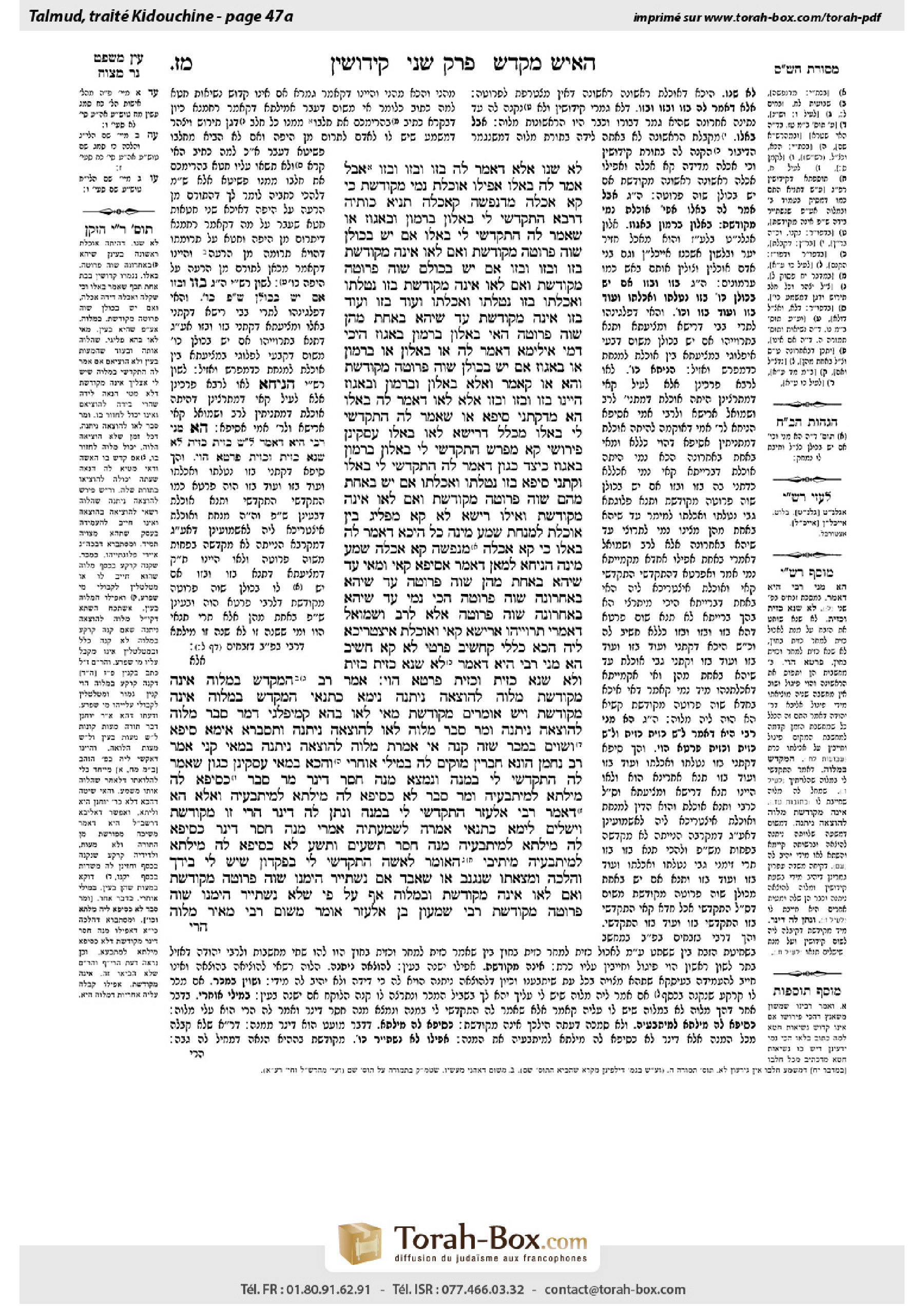
Kiddushin 47a: Talmud study for Daf Yomi
Daf Yomi is the daily study of one Talmud folio. Explore 37 tractates with scans, Hebrew text, Sefaria English and AI-generated French translations where annotated.
Passage selection and English or AI-generated French translation are available where the scan has annotations. Daf Study is independent of Torah-Box and Sefaria.
Browse Kiddushin · קידושין · All tractatesKiddushin 47a text and translations
This page of Kiddushin includes the Aramaic text, an English translation and an AI-generated French translation, alongside the scan above.
קידושין מ״ז א · Aramaic and Hebrew text
לֹא שָׁנוּ אֶלָּא דְּאָמַר לָהּ: ״בָּזוֹ וּבָזוֹ וּבָזוֹ״. אֲבָל אָמַר לָהּ: ״בְּאֵלּוּ״ – אֲפִילּוּ אוֹכֶלֶת נָמֵי מְקוּדֶּשֶׁת, כִּי קָא אָכְלָה – מִדְּנַפְשַׁהּ קָאָכְלָה.
תַּנְיָא כְּוָתֵיהּ דְּרָבָא: ״הִתְקַדְּשִׁי לִי בְּאַלּוֹן בְּרִמּוֹן וּבֶאֱגוֹז״ אוֹ שֶׁאָמַר לָהּ: ״הִתְקַדְּשִׁי לִי בְּאֵלּוּ״, אִם יֵשׁ בְּכוּלָּן שָׁוֶה פְּרוּטָה – מְקוּדֶּשֶׁת, וְאִם לָאו – אֵינָהּ מְקוּדֶּשֶׁת. ״בָּזוֹ וּבָזוֹ וּבָזוֹ״, אִם יֵשׁ בְּכוּלָּם שָׁוֶה פְּרוּטָה – מְקוּדֶּשֶׁת, וְאִם לָאו – אֵינָהּ מְקוּדֶּשֶׁת. ״בָּזוֹ״ – נְטָלַתּוּ וַאֲכָלַתּוּ, ״בָּזוֹ״ – נְטָלַתּוּ וַאֲכָלַתּוּ, וְעוֹד ״בָּזוֹ״ וְעוֹד ״בָּזוֹ״ – אֵינָהּ מְקוּדֶּשֶׁת עַד שֶׁיְּהֵא בְּאַחַת מֵהֶן שָׁוֶה פְּרוּטָה.
הַאי ״בְּאַלּוֹן בְּרִמּוֹן בֶּאֱגוֹז״, הֵיכִי דָּמֵי? אִילֵימָא דְּאָמַר לַהּ: ״אוֹ בְּאַלּוֹן, אוֹ בְּרִמּוֹן, אוֹ בֶּאֱגוֹז״, אִם יֵשׁ בְּכוּלָּן שָׁוֶה פְּרוּטָה מְקוּדֶּשֶׁת? וְהָא ״אוֹ״ קָאָמַר! וְאֶלָּא ״בְּאַלּוֹן וּבְרִמּוֹן וּבֶאֱגוֹז״ – הַיְינוּ ״בָּזוֹ וּבָזוֹ וּבָזוֹ״! אֶלָּא לָאו דַּאֲמַר לַהּ: ״בְּאֵלּוּ״, הָא מִדְּקָתָנֵי סֵיפָא: אוֹ שֶׁאָמַר לָהּ ״הִתְקַדְּשִׁי לִי בְּאֵלּוּ״ – מִכְּלָל דְּרֵישָׁא לָאו בְּ״אֵלּוּ״ עָסְקִינַן.
פָּירוּשֵׁי קָא מְפָרֵשׁ: ״הִתְקַדְּשִׁי לִי בְּאַלּוֹן בְּרִמּוֹן בֶּאֱגוֹז״, כֵּיצַד? כְּגוֹן דְּאָמַר לַהּ ״הִתְקַדְּשִׁי לִי בְּאֵלּוּ״.
וְקָתָנֵי סֵיפָא ״בָּזוֹ״ נְטָלַתּוּ וַאֲכָלַתּוּ, אִם יֵשׁ בְּאַחַת מֵהֶם שָׁוֶה פְּרוּטָה – מְקוּדֶּשֶׁת, וְאִם לָאו – אֵינָהּ מְקוּדֶּשֶׁת.
וְאִילּוּ רֵישָׁא, לָא קָא מְפַלֵּיג בֵּין אוֹכֶלֶת לְמַנַּחַת. שְׁמַע מִינַּהּ: כֹּל הֵיכָא דַּאֲמַר לַהּ ״בְּאֵלּוּ״ כִּי קָא אָכְלָה – מִנַּפְשַׁהּ קָא אָכְלָה, שְׁמַע מִינַּהּ.
הָנִיחָא לְמַאן דְּאָמַר אַסֵּיפָא קָאֵי, וּמַאי ״עַד שֶׁיְּהֵא בְּאַחַת מֵהֶן שָׁוֶה פְּרוּטָה״ – עַד שֶׁיְּהֵא בָּאַחֲרוֹנָה שָׁוֶה פְּרוּטָה, הָכִי נָמֵי: עַד שֶׁיְּהֵא בָּאַחֲרוֹנָה שָׁוֶה פְּרוּטָה.
אֶלָּא לְרַב וּשְׁמוּאֵל דְּאָמְרִי תַּרְוַיְיהוּ: אַרֵישָׁא קָאֵי, וְאוֹכֶלֶת אִיצְטְרִיכָא לֵיהּ – הָכָא כְּלָלֵי קָחָשֵׁיב, פְּרָטֵי לָא קָא חָשֵׁיב.
הָא מַנִּי – רַבִּי הִיא, דַּאֲמַר: לָא שְׁנָא ״כְּזַיִת כְּזַיִת״, וְלָא שְׁנָא ״כְּזַיִת וּכְזַיִת״, פְּרָטָא הָוֵי.
אָמַר רַב: הַמְקַדֵּשׁ בְּמִלְוֶה – אֵינָהּ מְקוּדֶּשֶׁת, מִלְוָה לְהוֹצָאָה נִיתְּנָה. נֵימָא כְּתַנָּאֵי: הַמְקַדֵּשׁ בְּמִלְוֶה – אֵינָהּ מְקוּדֶּשֶׁת, וְיֵשׁ אוֹמְרִים: מְקוּדֶּשֶׁת. מַאי לָאו בְּהָא קָמִיפַּלְגִי, דְּמָר סָבַר מִלְוָה לְהוֹצָאָה נִיתְּנָה, וּמָר סָבַר מִלְוָה לָאו לְהוֹצָאָה נִיתְּנָה?
וְתִסְבְּרָא?! אֵימָא סֵיפָא: וְשָׁוִים בְּמֶכֶר שֶׁזֶּה קָנָה. אִי אָמְרַתְּ מִלְוָה לְהוֹצָאָה נִיתְּנָה, בְּמַאי קָנֵי?!
אָמַר רַב נַחְמָן: הוּנָא חַבְרִין מוֹקֵים לַהּ בְּמִילֵּי אוּחְרֵי, וְהָכָא בְּמַאי עָסְקִינַן — כְּגוֹן שֶׁאָמַר לַהּ: ״הִתְקַדְּשִׁי לִי בְּמָנֶה״ וְנִמְצָא מָנֶה חָסֵר דִּינָר. מָר סָבַר: כְּסִיפָא לַהּ מִילְּתָא לְמִיתְבְּעֵיהּ. וּמָר סָבַר: לָא כְּסִיפָא לַהּ מִילְּתָא לְמִיתְבְּעֵיהּ.
וְאֶלָּא הָא דְּאָמַר רַבִּי אֶלְעָזָר: ״הִתְקַדְּשִׁי לִי בְּמָנֶה״ וְנָתַן לָהּ דִּינָר – הֲרֵי זוֹ מְקוּדֶּשֶׁת וְיַשְׁלִים, לֵימָא כְּתַנָּאֵי אַמְרַהּ לִשְׁמַעְתֵּיהּ? אָמְרִי: מָנֶה חָסֵר דִּינָר כְּסִיפָא לַהּ מִילְּתָא לְמִיתְבְּעֵיהּ, מָנֶה חָסֵר תִּשְׁעִים וָתֵשַׁע לָא כְּסִיפָא לַהּ מִילְּתָא לְמִיתְבְּעֵיהּ.
מֵיתִיבִי: הָאוֹמֵר לְאִשָּׁה ״הִתְקַדְּשִׁי לִי בְּפִקָּדוֹן שֶׁיֵּשׁ לִי בְּיָדֵךְ״ וְהָלְכָה וּמְצָאַתּוּ שֶׁנִּגְנַב אוֹ שֶׁאָבַד, אִם נִשְׁתַּיֵּיר הֵימֶנּוּ שָׁוֶה פְּרוּטָה – מְקוּדֶּשֶׁת, וְאִם לָאו – אֵינָהּ מְקוּדֶּשֶׁת. וּבְמִלְוָה, אַף עַל פִּי שֶׁלֹּא נִשְׁתַּיֵּיר הֵימֶנּוּ שָׁוֶה פְּרוּטָה – מְקוּדֶּשֶׁת. רַבִּי שִׁמְעוֹן בֶּן אֶלְעָזָר אוֹמֵר מִשּׁוּם רַבִּי מֵאִיר: מִלְוָה
Kiddushin 47a · English translation
The mishna taught that if she ate the dates one by one their value is not added together only if he said to her that she is betrothed: With this one, and with this one, and with this one, which indicates that she is not betrothed until she has received them all. But if he said to her that he is betrothing her: With these, i.e., with all of them together, even if she is eating them one by one she is also betrothed if their combined value is one peruta. The reason is that when she eats, she eats of her own food. Once she has accepted the dates as money for betrothal, they become her own property and she is betrothed.
The Gemara comments: It is taught in a baraita in accordance with the opinion of Rava: If one said to a woman: Be betrothed to me with the fruit of an oak tree, i.e., an acorn, with a pomegranate, and with a nut, or if he said to her: Be betrothed to me with these, if combined they are worth one peruta, she is betrothed. But if not, she is not betrothed. If he said to her: Be betrothed to me with this one, and with this one, and with this one, if combined they are worth one peruta, she is betrothed. But if not, she is not betrothed. If he said to her: Be betrothed to me with this one, and she took it and ate it; with this one, and she took it and ate it; and also with this one and also with this one, she is not betrothed unless one of them is worth one peruta. This concludes the baraita.
The Gemara proceeds to prove Rava’s ruling from the baraita. What are the circumstances in this first case, where he said: With the fruit of an oak tree, with a pomegranate, with a nut? If we say that he said to her: Either with the fruit of an oak tree, or with a pomegranate, or with a nut, why is the halakha that if combined they are worth one peruta she is betrothed? But didn’t he say: Or, which indicates that she is betrothed with only one of them, and that one item should need to be worth one peruta? But rather, if we say that he said to her: With the fruit of an oak tree, and with a pomegranate, and with a nut together, that is the same as saying: With this one, and with this one, and with this one. That halakha is stated in the subsequent clause of the baraita, and would be redundant. Rather, is it not referring to a case where he said to her: Be betrothed to me with these? But from the fact that the latter clause teaches: Or if he said to her: Be betrothed to me with these, it may be inferred that in the first clause we are not dealing with a situation where he said: These.
The Gemara continues with the explication of the baraita: Rather, it is to be understood as an initial, general statement, which the tanna is then explaining, as follows: If one says to a woman: Be betrothed to me with the fruit of an oak tree, with a pomegranate, with a nut; the baraita pauses and explains the circumstances of the case: How so? For example, when he gave her these three items and said to her: Be betrothed to me with these.
The Gemara continues with its proof: And the latter clause of the baraita teaches a second possibility: If he said to her that she is betrothed: With this one, and she took it and ate it, then if one of them is worth one peruta, she is betrothed. And if not, she is not betrothed.
While in contrast to this, in the first clause of the baraita the tanna does not distinguish between a woman who is eating the items and one who is placing them in her possession. In either case, she is betrothed. You can conclude from the baraita that any case where he said to her: With these, if they were worth one peruta combined, then when she is eating them she is eating of her own food. It is not considered a loan. The Gemara affirms: Conclude from the baraita that Rava’s statement is correct.
The Gemara asks: This works out well according to the one, i.e., Rabbi Ami, who says that the case of the woman eating the dates one by one is referring to the latter clause of the mishna, where he said: Be betrothed to me with this and with that, and who explained: What is the meaning of: She is not betrothed unless one of them is worth one peruta? Unless the last one is worth one peruta. So too, the baraita can be explained: Unless the last one is worth one peruta.
But according to Rav and Shmuel, who both say that the case of the woman eating the dates one by one is referring to the first clause of the mishna, how would they explain the statement of the baraita? In the first clause of the mishna, one said: Be betrothed to me with this, be betrothed to me with that, and if one of them is worth one peruta she is betrothed. And Rav and Shmuel explained that it was necessary for the tanna to mention the case of a woman who is eating to teach that despite her immediate benefit, one of the dates must be worth one peruta for her to be betrothed. The phrase: Unless one of them is worth one peruta, indicates that one alone must be worth one peruta. But here the baraita lists only groupings; it does not list individual items. The baraita states a case where he said to her: Be betrothed to me, only once, followed by a statement that the three items should serve as the betrothal money. Why, then, does one of them need to be worth one peruta?
The Gemara answers: In accordance with whose opinion is this halakha of the baraita taught? It is that of Rabbi Yehuda HaNasi, who says with regard to the laws of piggul, which is an offering that was sacrificed with the intent to consume an olive-bulk of it after its appointed time or outside the boundaries of where it must be consumed: There is no difference whether he says that he intends to consume: An olive-bulk after its time, an olive-bulk outside its boundaries, i.e., without employing the word: And; or whether he said that he intends to consume an olive-bulk after its time and an olive-bulk outside its boundaries, i.e., employing the word: And. Both expressions are considered individual statements, since he is treating each statement separately, and in neither case does he intend to combine the two amounts. According to Rabbi Yehuda HaNasi, when one says: With this and with this, each statement is distinct. Consequently, although she derives immediate benefit by eating the dates she receives, she is betrothed only if one of them is worth one peruta on its own.
§ Rav says: With regard to one who betroths a woman with a loan, she is not betrothed, since a loan is given to be spent. Consequently, from the moment the money is lent it no longer belongs to the lender, and he cannot betroth a woman with it. The Gemara suggests: Let us say that this is subject to a dispute between tanna’im, as it was taught in a baraita: With regard to one who betroths a woman with a loan, she is not betrothed, and some say she is betrothed. What, is it not that they disagree with regard to this: One Sage holds that a loan is given to be spent, and one Sage holds that a loan is not given to be spent?
The Gemara questions this suggestion: And how can you understand it that way? Say the latter clause of that same baraita: And they agree with regard to the case of a sale that he acquires it. Although they disagree as to whether one can betroth a woman with a loan he has given her, they agree that a lender can purchase an item from the debtor in exchange for forgiving the money he has lent him. If you say that a loan is given to be spent, with what has he acquired it? There is no money with which to effect an acquisition. No proof can be derived from this baraita, which cannot be understood as stated.
Rav Naḥman says: Our colleague Rav Huna interprets the baraita as referring to other matters and not as referring to a straightforward case of a loan. And with what are we dealing here? A case where he said to her: Be betrothed to me with one hundred dinars, and it was found to be one hundred dinars less one dinar, the missing dinar is considered to be a loan that he has taken from her. One Sage, who said the woman is not betrothed, holds that the matter is embarrassing for her, preventing her from claiming the final dinar from him, and since he has failed to fulfill his statement she is not betrothed. And one Sage, who said that she is betrothed, holds that the matter is not embarrassing for her and is not preventing her from claiming the final dinar. He is therefore considered to have fulfilled his statement and borrowed one dinar from her, which he will repay in due course, but she is nevertheless betrothed.
The Gemara asks: But rather, with regard to that which Rabbi Elazar says: If one said to a woman: Be betrothed to me with one hundred dinars, and he gave her one dinar, she is betrothed and he must later finish giving the full sum; let us say that his statement is parallel to a dispute between tanna’im. The Sages say to distinguish between the cases: Where he gave her one hundred dinars less a dinar, the matter is embarrassing for her, preventing her from claiming the final dinar from him, since he has given her almost the entire sum. But if he gave her one hundred dinars less ninety-nine, the matter is not embarrassing for her and is not preventing her from claiming the rest of the dinars. Therefore, all would agree that she is betrothed in the latter case.
The Gemara raises an objection to the statement of Rav from a baraita: In the case of one who says to a woman: Be betrothed to me with the deposit that I have in your possession, and she went and found that the deposit had been stolen or that it had been lost, if the value of one peruta of it remains she is betrothed with that amount. And if not, she is not betrothed, since there is nothing to effect the betrothal. But if he said to her that he is betrothing her with a loan that he had given her, she is betrothed, even though the value of one peruta of it does not remain. Rabbi Shimon ben Elazar says in the name of Rabbi Meir: A loan
Kiddushin 47a · Traduction française (IA)
La Michna a enseigné que, si elle mange les dattes une à une, leur valeur ne s’additionne que dans le cas où il lui a dit qu’elle serait fiancée « avec celle-ci, avec celle-ci et avec celle-ci », ce qui indique qu’elle n’est fiancée qu’après les avoir toutes reçues. Mais s’il lui a dit qu’il la fiançait « avec celles-ci », c’est-à-dire avec toutes ensemble, elle est également fiancée, même si elle les mange une à une, pourvu que leur valeur totale soit d’une perouta. En effet, lorsqu’elle les mange, elle mange ce qui lui appartient. Dès qu’elle a accepté les dattes comme argent de fiançailles, elles deviennent sa propriété et elle est fiancée.
La Guemara fait remarquer qu’une baraïta est enseignée conformément à l’opinion de Rava : si quelqu’un dit à une femme : « Sois fiancée à moi avec le fruit d’un chêne », c’est-à-dire un gland, « avec une grenade et avec une noix », ou s’il lui dit : « Sois fiancée à moi avec celles-ci », elle est fiancée si leur valeur totale est d’une perouta. Sinon, elle n’est pas fiancée. S’il lui dit : « Sois fiancée à moi avec celle-ci, avec celle-ci et avec celle-ci », elle est fiancée si leur valeur totale est d’une perouta. Sinon, elle n’est pas fiancée. S’il lui dit : « Sois fiancée à moi avec celle-ci », qu’elle la prend et la mange, puis : « Avec celle-ci », qu’elle la prend et la mange, puis encore : « Avec celle-ci » et « avec celle-ci », elle n’est pas fiancée, à moins que l’un de ces objets ne vaille une perouta. La baraïta s’achève ici.
La Guemara poursuit en apportant la preuve de la décision de Rava à partir de la baraïta. Dans quelles circonstances se présente le premier cas, où il lui a dit : « Avec le fruit d’un chêne, avec une grenade, avec une noix » ? Si l’on suppose qu’il lui a dit : « Sois fiancée à moi avec le fruit d’un chêne, ou avec une grenade, ou avec une noix », pourquoi la halakha est-elle que, si leur valeur totale est d’une perouta, elle est fiancée ? N’a-t-il pas dit « ou », ce qui indique qu’elle est fiancée avec un seul de ces objets, lequel devrait donc valoir à lui seul une perouta ? Mais si l’on suppose qu’il lui a dit : « Sois fiancée à moi avec le fruit d’un chêne, avec une grenade et avec une noix », ensemble, cela revient à dire : « Avec celle-ci, avec celle-ci et avec celle-ci ». Cette halakha est énoncée dans la clause suivante de la baraïta et serait donc redondante. Ne faut-il pas plutôt comprendre qu’il lui a dit : « Sois fiancée à moi avec celles-ci » ? Mais puisque la clause suivante enseigne : « Ou s’il lui a dit : “Sois fiancée à moi avec celles-ci” », on peut en déduire que, dans la première clause, il ne s’agit pas d’un cas où il lui a dit : « Celles-ci ».
La Guemara poursuit l’explication de la baraïta : il faut plutôt comprendre qu’il s’agit d’une formulation générale initiale, que le tanna explique ensuite ainsi : si quelqu’un dit à une femme : « Sois fiancée à moi avec le fruit d’un chêne, avec une grenade, avec une noix » — la baraïta s’interrompt alors pour préciser les circonstances du cas : qu’est-ce à dire ? Par exemple, il lui a donné ces trois objets et lui a dit : « Sois fiancée à moi avec ceux-ci ».
La Guemara poursuit sa démonstration : la clause suivante de la baraïta enseigne une deuxième possibilité : s’il lui a dit qu’elle serait fiancée « avec celle-ci », et qu’elle l’a prise et mangée, elle est fiancée si l’un de ces objets vaut une perouta. Sinon, elle n’est pas fiancée.
En revanche, dans la première clause de la baraïta, le tanna ne distingue pas entre une femme qui mange les objets et une femme qui les garde en sa possession. Dans les deux cas, elle est fiancée. On peut donc conclure de la baraïta que, chaque fois qu’il lui a dit : « Avec celles-ci », et que leur valeur totale est d’une perouta, lorsqu’elle les mange, elle mange ce qui lui appartient. Ce n’est pas considéré comme un prêt. La Guemara confirme : concluons de la baraïta que la déclaration de Rava est exacte.
La Guemara demande : Cela s’explique bien selon celui qui — c’est-à-dire Rabbi Ami — dit que le cas de la femme qui mange les dattes une à une renvoie à la clause suivante de la Michna, où il lui a dit : « Sois fiancée à moi avec celle-ci et avec celle-là », et qui explique la formule « elle n’est fiancée que si l’une d’elles vaut une perouta » ainsi : il faut que la dernière vaille une perouta. De même, on peut expliquer la baraïta ainsi : il faut que la dernière vaille une perouta.
Mais, selon Rav et Shmuel, qui disent tous deux que le cas de la femme qui mange les dattes une à une renvoie à la première clause de la Michna, comment expliqueraient-ils la déclaration de la baraïta ? Dans la première clause de la Michna, un homme dit : « Sois fiancée à moi avec celle-ci, sois fiancée à moi avec celle-là », et elle est fiancée si l’une d’elles vaut une perouta. Rav et Shmuel expliquent que le tanna devait mentionner le cas d’une femme qui mange pour enseigner que, malgré l’avantage immédiat qu’elle en tire, l’une des dattes doit valoir une perouta pour qu’elle soit fiancée. La formule « à moins que l’une d’elles ne vaille une perouta » indique qu’une seule doit valoir une perouta à elle seule. Mais ici, la baraïta ne mentionne que des groupes ; elle ne présente pas les objets individuellement. Elle décrit un cas où il lui a dit une seule fois : « Sois fiancée à moi », puis a indiqué que les trois objets serviraient d’argent de fiançailles. Pourquoi, alors, l’un d’eux doit-il valoir une perouta ?
La Guemara répond : Selon l’opinion de qui cette halakha de la baraïta est-elle enseignée ? Selon celle de Rabbi Yehouda HaNassi, qui dit, au sujet des lois du piggoul — une offrande sacrifiée avec l’intention d’en consommer une mesure de la taille d’une olive après le délai fixé ou hors des limites où elle doit être consommée — qu’il n’y a pas de différence entre dire qu’on a l’intention d’en consommer une mesure de la taille d’une olive après le délai fixé et une mesure de la taille d’une olive hors des limites, sans employer le mot « et », et dire qu’on a l’intention d’en consommer une mesure de la taille d’une olive après le délai fixé et une mesure de la taille d’une olive hors des limites, en employant le mot « et ». Les deux formulations sont considérées comme des déclarations distinctes, puisqu’il traite chaque intention séparément ; dans aucun des deux cas, il n’a l’intention de combiner les deux quantités. Selon Rabbi Yehouda HaNassi, lorsqu’on dit : « Avec celle-ci et avec celle-ci », chaque déclaration est distincte. Par conséquent, bien qu’elle tire un avantage immédiat en mangeant les dattes qu’elle reçoit, elle n’est fiancée que si l’une d’elles vaut à elle seule une perouta.
§ Rav dit : Celui qui fiance une femme au moyen d’un prêt qu’il lui a accordé ne la fiance pas, car un prêt est destiné à être dépensé. Par conséquent, dès que l’argent est prêté, il n’appartient plus au prêteur, qui ne peut donc pas s’en servir pour la fiancer. La Guemara suggère : Peut-on dire que cette question fait l’objet d’un désaccord entre des tannaïm, comme l’enseigne une baraïta : celui qui fiance une femme au moyen d’un prêt qu’il lui a accordé ne la fiance pas, mais certains disent qu’elle est fiancée. Ne sont-ils pas en désaccord sur ce point : un Sage tient qu’un prêt est destiné à être dépensé, et un autre tient qu’un prêt n’est pas destiné à être dépensé ?
La Guemara met cette suggestion en question : comment peux-tu comprendre les choses ainsi ? Lis la clause suivante de cette même baraïta : « Et ils sont d’accord, dans le cas d’une vente, qu’il acquiert l’objet. » Bien qu’ils soient en désaccord sur la possibilité de fiancer une femme au moyen d’un prêt qu’on lui a accordé, ils conviennent qu’un prêteur peut acheter un objet au débiteur en échange de l’annulation de la dette correspondant au prêt qu’il lui a accordé. Si tu dis qu’un prêt est destiné à être dépensé, avec quoi l’a-t-il acquis ? Il n’y a pas d’argent permettant de réaliser l’acquisition. On ne peut tirer aucune preuve de cette baraïta, qui ne peut être comprise selon cette interprétation.
Rav Naḥman dit : Notre collègue Rav Houna interprète la baraïta comme portant sur d’autres questions, et non sur un simple cas de prêt. De quoi s’agit-il ici ? D’un cas où il lui a dit : « Sois fiancée à moi avec cent dinars », mais où l’on a découvert qu’il manquait un dinar sur les cent ; ce dinar manquant est considéré comme un prêt qu’il lui a emprunté. Le Sage qui dit que la femme n’est pas fiancée tient que la situation est embarrassante pour elle et l’empêche de lui réclamer le dernier dinar ; puisqu’il n’a pas tenu sa parole, elle n’est pas fiancée. Le Sage qui dit qu’elle est fiancée tient que la situation n’est pas embarrassante pour elle et ne l’empêche pas de lui réclamer le dernier dinar. Il est donc considéré comme ayant tenu sa parole et lui ayant emprunté un dinar, qu’il lui remboursera en temps voulu ; elle est néanmoins fiancée.
La Guemara demande : Mais alors, au sujet de ce que dit Rabbi Elazar — si quelqu’un dit à une femme : « Sois fiancée à moi avec cent dinars », et qu’il lui en donne un, elle est fiancée et il devra ensuite compléter la somme —, ne faut-il pas dire que sa position correspond à l’un des avis dans le désaccord entre les tannaïm ? Les Sages distinguent les cas ainsi : s’il lui a donné cent dinars moins un dinar, la situation est embarrassante pour elle et l’empêche de lui réclamer le dernier dinar, puisqu’il lui a donné presque toute la somme. Mais s’il lui a donné cent dinars moins quatre-vingt-dix-neuf dinars, la situation n’est pas embarrassante pour elle et ne l’empêche pas de lui réclamer le reste. Par conséquent, tous conviendraient qu’elle est fiancée dans ce dernier cas.
La Guemara soulève une objection à la déclaration de Rav à partir d’une baraïta : dans le cas de quelqu’un qui dit à une femme : « Sois fiancée à moi avec le dépôt que j’ai en ta possession », et qui découvre ensuite que le dépôt a été volé ou perdu, s’il en reste une valeur d’une perouta, elle est fiancée pour ce montant. Sinon, elle n’est pas fiancée, puisqu’il n’y a rien pour réaliser les fiançailles. Mais s’il lui a dit qu’il la fiançait au moyen d’un prêt qu’il lui avait accordé, elle est fiancée, même s’il ne reste rien qui vaille une perouta. Rabbi Shimon ben Elazar dit au nom de Rabbi Meir : un prêt
Traduction française générée par IA à partir de l’édition anglaise de Sefaria. Vérifie toujours un passage avec le texte source.
Text from Sefaria: William Davidson Edition - Vocalized Aramaic (CC BY NC); William Davidson Edition - English (CC BY NC).