Kiddushin 47b: Talmud study for Daf Yomi
Daf Yomi is the daily study of one Talmud folio. Explore 37 tractates with scans, Hebrew text, Sefaria English and AI-generated French translations where annotated.
Passage selection and English or AI-generated French translation are available where the scan has annotations. Daf Study is independent of Torah-Box and Sefaria.
Browse Kiddushin · קידושין · All tractatesKiddushin 47b text and translations
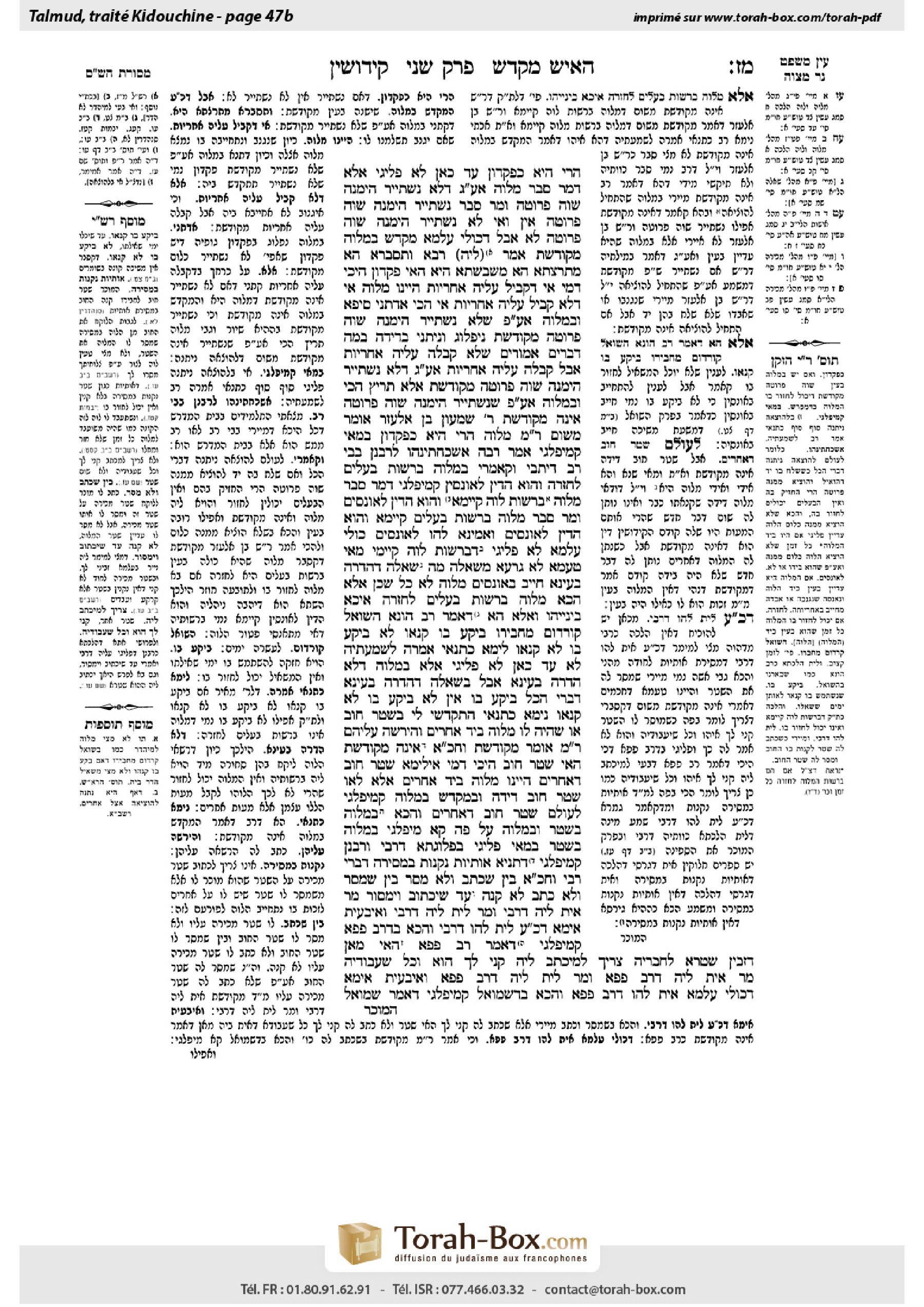
This page of Kiddushin includes the Aramaic text, an English translation and an AI-generated French translation, alongside the scan above.
קידושין מ״ז ב · Aramaic and Hebrew text
הֲרֵי הִיא כְּפִקָּדוֹן. עַד כָּאן לָא פְּלִיגִי אֶלָּא דְּמָר סָבַר: מִלְוָה, אַף עַל גַּב דְּלֹא נִשְׁתַּיֵּיר הֵימֶנָּה שָׁוֶה פְּרוּטָה, וּמָר סָבַר: נִשְׁתַּיֵּיר הֵימֶנָּה שָׁוֶה פְּרוּטָה – אִין, וְאִי לָא נִשְׁתַּיֵּיר הֵימֶנָּה שָׁוֶה פְּרוּטָה – לָא. אֲבָל דְּכוּלֵּי עָלְמָא מְקַדֵּשׁ בְּמִלְוָה מְקוּדֶּשֶׁת!
אֲמַר לֵיהּ רָבָא: וְתִסְבְּרַאּ הָא מְתָרַצְתָּא? הָא מְשַׁבַּשְׁתָּא הִיא.
הַאי פִּקָּדוֹן הֵיכִי דָמֵי? אִי דְּקַבִּיל עֲלַיהּ אַחְרָיוּת, הַיְינוּ מִלְוָה. אִי דְּלָא קַבִּיל עֲלַיהּ אַחְרָיוּת – אִי הָכִי אַדְּתָנֵי סֵיפָא: וּבְמִלְוָה, אַף עַל פִּי שֶׁלֹּא נִשְׁתַּיֵּיר הֵימֶנָּה שָׁוֶה פְּרוּטָה – מְקוּדֶּשֶׁת, נִיפְלוֹג וְנִיתְנֵי בְּדִידַהּ: בַּמֶּה דְּבָרִים אֲמוּרִים – שֶׁלֹּא קִבְּלָה עָלֶיהָ אַחְרָיוּת, אֲבָל קִבְּלָה עָלֶיהָ אַחְרָיוּת, אַף עַל גַּב דְּלֹא נִשְׁתַּיֵּיר הֵימֶנָּה שָׁוֶה פְּרוּטָה מְקוּדֶּשֶׁת!
אֶלָּא, תָּרֵיץ הָכִי: וּבְמִלְוָה, אַף עַל פִּי שֶׁנִּשְׁתַּיֵּיר הֵימֶנָּה שָׁוֶה פְּרוּטָה – אֵינָהּ מְקוּדֶּשֶׁת.
רַבִּי שִׁמְעוֹן בֶּן אֶלְעָזָר אוֹמֵר מִשּׁוּם רַבִּי מֵאִיר: מִלְוָה הֲרֵי הִיא כְּפִקָּדוֹן. בְּמַאי קָמִיפַּלְגִי? אָמַר רַבָּה: אַשְׁכַּחְתִּינְהוּ לְרַבָּנַן בְּבֵי רַב דְּיָתְבִי וְקָאָמְרִי: בְּמִלְוָה בִּרְשׁוּת בְּעָלִים לַחֲזָרָה וְהוּא הַדִּין לְאוּנְסִין קָמִיפַּלְגִי,
דְּמָר סָבַר: מִלְוָה בִּרְשׁוּת לֹוֶה קָיְימָא, וְהוּא הַדִּין לָאוֹנָסִים. וּמָר סָבַר: מִלְוָה בִּרְשׁוּת בְּעָלִים קָיְימָא, וְהוּא הַדִּין לָאוֹנָסִים.
וְאָמֵינָא לְהוּ: לָאוֹנָסִים – כּוּלֵּי עָלְמָא לָא פְּלִיגִי דְּבִרְשׁוּת לֹוֶה קָיְימִי, מַאי טַעְמָא – לָא גָּרְעָא מִשְּׁאֵלָה, מָה שְׁאֵלָה דְּהָדְרָה בְּעֵינַהּ חַיָּיב בָּאוֹנָסִים, מִלְוָה לֹא כׇּל שֶׁכֵּן. אֶלָּא הָכָא מִלְוָה בִּרְשׁוּת בְּעָלִים לַחֲזָרָה אִיכָּא בֵּינַיְיהוּ.
וְאֶלָּא הָא דְּאָמַר רַב הוּנָא: הַשּׁוֹאֵל קוּרְדּוֹם מֵחֲבֵירוֹ, בִּיקַּע בּוֹ – קְנָאוֹ. לֹא בִּיקַּע בּוֹ – לֹא קְנָאוֹ. לֵימָא כְּתַנָּאֵי אַמְרַהּ לִשְׁמַעְתֵּיהּ?
לָא, עַד כָּאן לָא פְּלִיגִי אֶלָּא בְּמִלְוָה, דְּלָא הָדְרָה בְּעֵינַהּ. אֲבָל בִּשְׁאֵלָה, דְּהָדְרָה בְּעֵינַהּ, דִּבְרֵי הַכֹּל בִּיקַּע בּוֹ – אִין, לֹא בִּיקַּע בּוֹ – לֹא קְנָאוֹ.
נֵימָא כְּתַנָּאֵי? ״הִתְקַדְּשִׁי לִי בִּשְׁטַר חוֹב״, אוֹ שֶׁהָיָה לוֹ מִלְוָה בְּיַד אֲחֵרִים וְהִירְשָׁהּ עֲלֵיהֶם, רַבִּי מֵאִיר אוֹמֵר: מְקוּדֶּשֶׁת, וַחֲכָמִים אוֹמְרִים: אֵינָהּ מְקוּדֶּשֶׁת. הַאי שְׁטַר חוֹב הֵיכִי דָמֵי? אִילֵּימָא שְׁטַר חוֹב דַּאֲחֵרִים – הַיְינוּ מִלְוָה בְּיַד אֲחֵרִים! אֶלָּא לָאו שְׁטַר חוֹב דִּידַהּ, וּבִמְקַדֵּשׁ בְּמִלְוָה קָמִיפַּלְגִי?
לְעוֹלָם שְׁטַר חוֹב דַּאֲחֵרִים, וְהָכָא בְּמִלְוָה בִּשְׁטָר וּבְמִלְוָה עַל פֶּה קָא מִיפַּלְגִי.
בְּמִלְוָה בִּשְׁטָר בְּמַאי פְּלִיגִי – בִּפְלוּגְתָּא דְּרַבִּי וְרַבָּנַן קָמִיפַּלְגִי. דְּתַנְיָא: אוֹתִיּוֹת נִקְנוֹת בִּמְסִירָה, דִּבְרֵי רַבִּי. וַחֲכָמִים אוֹמְרִים: בֵּין שֶׁכָּתַב וְלֹא מָסַר, בֵּין שֶׁמָּסַר וְלָא כָּתַב – לֹא קָנָה עַד שֶׁיִּכְתּוֹב וְיִמְסוֹר.
מָר אִית לֵיהּ דְּרַבִּי וּמָר לֵית לֵיהּ דְּרַבִּי.
וְאִיבָּעֵית אֵימָא: דְּכוּלֵּי עָלְמָא לֵית לְהוּ דְּרַבִּי, וְהָכָא בִּדְרַב פָּפָּא קָמִיפַּלְגִי, דְּאָמַר רַב פָּפָּא: הַאי מַאן דְּזָבֵין שְׁטָרָא לְחַבְרֵיהּ, צָרִיךְ לְמִיכְתַּב לֵיהּ: ״קְנִי לָךְ הוּא וְכׇל שִׁעְבּוּדֵיהּ״. מָר אִית לֵיהּ דְּרַב פָּפָּא, וּמָר לֵית לֵיהּ דְּרַב פָּפָּא.
וְאִיבָּעֵית אֵימָא: דְּכוּלֵּי עָלְמָא אִית לְהוּ דְּרַב פָּפָּא וְהָכָא בְּדִשְׁמוּאֵל קָמִיפַּלְגִי. דְּאָמַר שְׁמוּאֵל:
Kiddushin 47b · English translation
is like a deposit. The Gemara analyzes this: They disagree only with regard to this: There is one Sage who holds that one can betroth a woman with a loan, even though the value of one peruta does not remain of it. And one Sage holds that if the value of one peruta remains from it, yes, he can betroth her with it, but if the value of one peruta does not remain of it, he cannot. But everyone agrees that if one betroths a woman with a loan, she is betrothed. This presents a difficulty for Rav, who stated that one cannot betroth a woman with a loan.
Rava said to him: And how can you understand it that way? Is this baraita fully explainable? It is corrupted and cannot be cited as a proof.
He explains why the baraita must be corrupted: What are the circumstances of this deposit discussed in the baraita? If she assumed financial responsibility to repay the owner for it if it is stolen or lost, it is the same as a loan, as even if it is entirely lost she must still repay its value. If she did not assume financial responsibility for it, then if so, rather than teaching in the latter clause of the baraita: But if he betroths her with a loan that he had given her, she is betrothed despite the fact that the value of one peruta of it does not remain; let him distinguish and teach the distinction within the case itself, as follows: In what case is this statement said, that she is not betrothed if less than the value of one peruta remains from the deposit? If she did not assume financial responsibility upon herself for it. But if she assumed financial responsibility upon herself, even though the value of one peruta did not remain from it, she is betrothed.
Rather, since the wording of the baraita cannot remain as is, answer this way: But if he betroths her with a loan that he had given her, she is not betrothed, despite the fact that the value of one peruta of it remains.
The baraita stated that Rabbi Shimon ben Elazar says in the name of Rabbi Meir: A loan is like a deposit. The Gemara asks: With regard to what principle do they disagree? Rabba said: I found the scholars in the study hall of Rav who were sitting and saying: They disagree with regard to the issue of whether a loan the debtor had not yet begun to spend is in the possession of the owner with regard to the possibility of retraction of the loan by the lender. And the same is true, i.e., they also disagree, with regard to who bears responsibility for accidents.
As one Sage, the first tanna, holds: A loan stands in the possession of the debtor, i.e., even if it has not been spent, the lender cannot demand the return of the money. And the same is true with regard to responsibility for accidents, i.e., if the money is lost, it is considered lost from the debtor’s possession and he bears responsibility for it. And one Sage, Rabbi Shimon ben Elazar, holds: A loan that the debtor has not yet begun to spend stands in the possession of the owner, and the same is true with regard to responsibility for accidents. He can therefore betroth a woman with the money he has already lent her, provided that she has not yet begun to spend it.
Rabba continues: And I said to them: With regard to accidents, everyone agrees that it stands in the possession of the debtor and he is responsible for the money. What is the reason? A loan of money is no worse than borrowing an item. Just as in the case of borrowing an item, whereby the item is returned to its owner intact and yet the debtor is liable for accidents, as explicitly stated in the Torah, is it not all the more so that with regard to a loan, which the debtor spends and repays with other money, it should be considered in the debtor’s possession and he should bear responsibility for it? Rather, here the practical difference between them concerns the question of a loan in the possession of the owner with regard to the possibility of retraction of the loan. The first tanna is of the opinion that he cannot retract the loan, whereas Rabbi Shimon ben Elazar holds that he can do so.
The Gemara asks: But rather, with regard to that which Rav Huna says: In the case of one who borrows an ax from his friend for a certain period of time, if he chops wood with it he has acquired it in the sense that the lender cannot demand its immediate return. If he has not chopped wood with it he has not acquired it. Let us say that this halakha that Rav Huna stated is parallel to a dispute between tanna’im. According to the explanation of Rabba, it would be a dispute between the first tanna and Rabbi Shimon ben Elazar.
The Gemara rejects this suggestion: No, they disagree only with regard to a loan, which is not returned intact. Since there is no need for the debtor to return the same money to the lender, this means that the money has been transferred to the debtor’s domain, and the first tanna holds that the lender may not retract the loan. But with regard to the borrowing of an item, for example the ax, which is returned intact, everyone agrees that if one chopped with it, yes, he has acquired it and is responsible for it. If he has not chopped with it, he has not acquired it.
The Gemara suggests: Let us say that Rav’s statement that one cannot betroth a woman with a loan is subject to a dispute between tanna’im. The baraita teaches: If one says to a woman: Be betrothed to me with a promissory note, or if he had a loan in the possession of others and he authorized her to collect the money for herself, Rabbi Meir says she is betrothed and the Rabbis say she is not betrothed. The Gemara clarifies: What are the circumstances of this promissory note? If we say it is a promissory note of others who owe him money, this is the same as a loan in the possession of others, and why would the baraita state it twice? Rather, is it not referring to her promissory note, i.e., a loan she has taken from him, and they disagree with regard to one who betroths a woman with a loan, whether forgiving the debt by returning the promissory note counts as betrothal money?
The Gemara rejects this suggestion: Actually, the baraita is referring to a promissory note of others, and here they disagree in two cases: In the case of a loan with a promissory note and in the case of a loan by oral agreement.
The Gemara explains: With regard to a loan with a promissory note, concerning what matter do they disagree? They disagree concerning the dispute between Rabbi Yehuda HaNasi and the Rabbis, as it is taught in a baraita: Letters, i.e., the content of a promissory note, are acquired by merely transferring the document. If the lender hands over a promissory note to a third party, the latter can collect the debt. This is the statement of Rabbi Yehuda HaNasi. And the Rabbis say: Whether one wrote a document of sale for the promissory note but did not transfer the promissory note itself, or whether he transferred the promissory note but did not write a document of sale for it, the recipient has not acquired the promissory note. The recipient acquires it only once the other writes a document of sale and transfers the promissory note.
The suggestion is that one Sage, Rabbi Meir, is of the opinion that the halakha is in accordance with the opinion of Rabbi Yehuda HaNasi, and therefore one can betroth a woman by giving her a promissory note even without writing a document of sale for it. And one Sage, i.e., the Rabbis, is not of the opinion that the halakha is in accordance with the opinion of Rabbi Yehuda HaNasi, and she is not betrothed because she has not received anything.
And if you wish, say instead the following answer: No one is of the opinion that the halakha is in accordance with the opinion of Rabbi Yehuda HaNasi, and here they disagree with regard to the statement of Rav Pappa, as Rav Pappa says: This one who sells a promissory note to his friend must write the following formula for him: Let it be acquired by you, it and all its liens. Otherwise, the debt discussed in the promissory note is not transferred. One Sage, i.e., the Rabbis, is of the opinion that the halakha is in accordance with the opinion of Rav Pappa. And one Sage, Rabbi Meir, is not of the opinion that the halakha is in accordance with the opinion of Rav Pappa. He holds that the debt is acquired even if one did not write this phrase, and a man can betroth a woman by giving a promissory note to her.
And if you wish, say instead: Everyone is of the opinion that the halakha is in accordance with the opinion of Rav Pappa, and even Rabbi Meir agrees that she is betrothed only if he wrote in the document: Let it be acquired by you, it and all its liens. And here they disagree with regard to the statement of Shmuel, as Shmuel says:
Kiddushin 47b · Traduction française (IA)
est comme un dépôt. La Guemara analyse cette affirmation : ils ne sont en désaccord que sur le point suivant. Un Sage estime qu’on peut fiancer une femme au moyen d’un prêt, même s’il n’en reste pas l’équivalent d’une perouta. Un autre Sage estime que si l’équivalent d’une perouta en subsiste, oui, on peut la fiancer avec cela, mais que si l’équivalent d’une perouta n’en subsiste pas, on ne le peut pas. Toutefois, tous sont d’accord que si un homme fiance une femme au moyen d’un prêt, elle est fiancée. Cela pose une difficulté à Rav, qui a déclaré qu’on ne peut pas fiancer une femme au moyen d’un prêt.
Rava lui dit : Comment peux-tu comprendre les choses ainsi ? Cette baraïta est-elle entièrement explicable ? Son texte est altéré et elle ne peut pas être citée comme preuve.
Il explique pourquoi le texte de la baraïta doit être altéré : dans quelles circonstances le dépôt évoqué par la baraïta est-il concerné ? Si elle a assumé la responsabilité financière de le rembourser au propriétaire en cas de vol ou de perte, il est équivalent à un prêt, car même s’il est entièrement perdu, elle doit tout de même en rembourser la valeur. Si elle n’en a pas assumé la responsabilité financière, alors pourquoi enseigner, dans la dernière clause de la baraïta : « Mais s’il la fiance au moyen d’un prêt qu’il lui avait accordé, elle est fiancée », même s’il n’en reste pas l’équivalent d’une perouta ? Qu’il distingue plutôt les cas à l’intérieur même de cette situation, en enseignant ceci : Dans quel cas cette affirmation est-elle formulée, à savoir qu’elle n’est pas fiancée s’il reste moins que l’équivalent d’une perouta du dépôt ? Si elle n’en a pas assumé la responsabilité financière. Mais si elle en a assumé la responsabilité financière, elle est fiancée, même s’il n’en reste pas l’équivalent d’une perouta.
Par conséquent, puisque le texte de la baraïta ne peut être conservé tel quel, réponds ainsi : mais s’il la fiance au moyen d’un prêt qu’il lui avait accordé, elle n’est pas fiancée, même s’il en reste l’équivalent d’une perouta.
La baraïta rapportait que Rabbi Shimon ben Elazar dit au nom de Rabbi Meir : un prêt est comme un dépôt. La Guemara demande : Sur quel principe sont-ils en désaccord ? Rabba dit : J’ai trouvé les savants de la maison d’étude de Rav assis et disant qu’ils sont en désaccord sur la question de savoir si un prêt que le débiteur n’a pas encore commencé à dépenser reste en possession du propriétaire, en ce qui concerne la possibilité pour le prêteur de revenir sur le prêt. Il en va de même, c’est-à-dire qu’ils sont également en désaccord, quant à la personne qui assume la responsabilité en cas d’accident.
En effet, un Sage, le premier tanna, estime qu’un prêt est en possession du débiteur : même s’il n’a pas été dépensé, le prêteur ne peut pas exiger que l’argent lui soit rendu. Il en va de même pour la responsabilité en cas d’accident : si l’argent est perdu, il est considéré comme perdu alors qu’il était en possession du débiteur, qui en assume donc la responsabilité. Un autre Sage, Rabbi Shimon ben Elazar, estime qu’un prêt que le débiteur n’a pas encore commencé à dépenser reste en possession du propriétaire ; il en va de même pour la responsabilité en cas d’accident. Il peut donc fiancer une femme avec l’argent qu’il lui a déjà prêté, à condition qu’elle n’ait pas encore commencé à le dépenser.
Rabba poursuit : Je leur ai dit : en cas d’accident, tous sont d’accord que l’argent est en possession du débiteur et qu’il en est responsable. Pour quelle raison ? Un prêt d’argent n’est pas moins contraignant que l’emprunt d’un objet. De même que dans le cas de l’emprunt d’un objet, celui-ci doit être rendu intact à son propriétaire, et que pourtant le débiteur est responsable en cas d’accident, comme la Torah l’énonce explicitement, à combien plus forte raison un prêt, que le débiteur dépense et rembourse avec un autre argent, doit-il être considéré comme étant en possession du débiteur, qui doit en assumer la responsabilité ! Ici, la différence pratique entre eux porte plutôt sur la question de savoir si le prêt reste en possession du propriétaire au point que celui-ci puisse revenir dessus. Le premier tanna estime que le prêteur ne peut pas revenir sur le prêt, tandis que Rabbi Shimon ben Elazar estime qu’il le peut.
La Guemara demande : Mais alors, à propos de ce que Rav Houna dit : celui qui emprunte une hache à son ami pour une certaine période l’a acquise, au sens où le prêteur ne peut pas en exiger la restitution immédiate, s’il coupe du bois avec ; s’il n’en a pas coupé, il ne l’a pas acquise. Peut-on dire que cette halakha énoncée par Rav Houna correspond à un désaccord entre des tannaïm ? Selon l’explication de Rabba, il s’agirait d’un désaccord entre le premier tanna et Rabbi Shimon ben Elazar.
La Guemara rejette cette proposition : Non, ils ne sont en désaccord qu’au sujet d’un prêt, qui n’est pas rendu intact. Puisque le débiteur n’a pas à rendre au prêteur le même argent, cela signifie que l’argent est passé dans le domaine du débiteur, et le premier tanna estime que le prêteur ne peut pas revenir sur le prêt. Mais dans le cas de l’emprunt d’un objet, par exemple la hache, qui doit être rendu intact, tous sont d’accord que si l’emprunteur a coupé du bois avec, oui, il l’a acquise et en est responsable. S’il n’a pas coupé de bois avec, il ne l’a pas acquise.
La Guemara propose : Peut-on dire que la déclaration de Rav, selon laquelle on ne peut pas fiancer une femme au moyen d’un prêt, fait l’objet d’un désaccord entre des tannaïm ? La baraïta enseigne : si un homme dit à une femme : « Sois fiancée à moi au moyen d’un billet de dette », ou s’il détient une créance sur un tiers et l’autorise à percevoir elle-même l’argent, Rabbi Meir dit qu’elle est fiancée, et les Sages disent qu’elle n’est pas fiancée. La Guemara précise : dans quelles circonstances s’agit-il de ce billet de dette ? Si l’on dit qu’il s’agit du billet de dette d’un tiers qui lui doit de l’argent, cela revient au même que la créance sur un tiers ; pourquoi la baraïta le mentionnerait-elle deux fois ? Ne s’agit-il pas plutôt de son billet de dette à elle, c’est-à-dire d’un prêt qu’elle lui a emprunté, et ne sont-ils pas en désaccord sur la question de savoir si l’on peut fiancer une femme au moyen d’un prêt, autrement dit si l’effacement de la dette par la remise du billet de dette compte comme argent de fiançailles ?
La Guemara rejette cette proposition : en réalité, la baraïta parle du billet de dette d’un tiers, et ils sont ici en désaccord dans deux cas : celui d’un prêt garanti par un billet de dette et celui d’un prêt conclu oralement.
La Guemara explique : Sur quel point sont-ils en désaccord à propos d’un prêt garanti par un billet de dette ? Ils sont en désaccord au sujet de la controverse entre Rabbi Yehuda HaNassi et les Sages, comme l’enseigne une baraïta : les lettres, c’est-à-dire le contenu d’un billet de dette, sont acquises par la simple remise du document. Si le prêteur remet un billet de dette à un tiers, celui-ci peut recouvrer la créance. Telle est l’opinion de Rabbi Yehuda HaNassi. Les Sages disent : que l’on ait rédigé un acte de vente pour le billet de dette sans remettre le billet lui-même, ou que l’on ait remis le billet sans rédiger d’acte de vente pour celui-ci, le bénéficiaire n’a pas acquis le billet de dette. Il ne l’acquiert que lorsque l’autre rédige un acte de vente et lui remet le billet de dette.
La proposition est qu’un Sage, Rabbi Meir, estime que la halakha suit l’opinion de Rabbi Yehuda HaNassi ; on peut donc fiancer une femme en lui donnant un billet de dette, même sans rédiger d’acte de vente pour celui-ci. L’autre Sage, c’est-à-dire les Sages, n’estime pas que la halakha suive l’opinion de Rabbi Yehuda HaNassi ; elle n’est donc pas fiancée, car elle n’a rien reçu.
Et si tu le souhaites, réponds plutôt ainsi : personne n’estime que la halakha suit l’opinion de Rabbi Yehuda HaNassi, et leur désaccord porte ici sur la déclaration de Rav Pappa. Rav Pappa dit : celui qui vend un billet de dette à son ami doit rédiger pour lui la formule suivante : « Qu’il soit acquis par toi, lui-même et tous ses privilèges de créance. » Sinon, la créance mentionnée dans le billet de dette n’est pas transférée. Un Sage, c’est-à-dire les Sages, estime que la halakha suit l’opinion de Rav Pappa. L’autre Sage, Rabbi Meir, n’estime pas que la halakha suive l’opinion de Rav Pappa. Il soutient que la créance est acquise même si l’on n’a pas rédigé cette formule, et qu’un homme peut fiancer une femme en lui remettant un billet de dette.
Et si tu le souhaites, réponds plutôt ainsi : tous estiment que la halakha suit l’opinion de Rav Pappa, et même Rabbi Meir convient qu’elle n’est fiancée que s’il a écrit dans le document : « Qu’il soit acquis par toi, lui-même et tous ses privilèges de créance. » Leur désaccord porte ici sur la déclaration de Shmuel, car Shmuel dit :
Traduction française générée par IA à partir de l’édition anglaise de Sefaria. Vérifie toujours un passage avec le texte source.
Text from Sefaria: William Davidson Edition - Vocalized Aramaic (CC BY NC); William Davidson Edition - English (CC BY NC).