Kiddushin 48a: Talmud study for Daf Yomi
Daf Yomi is the daily study of one Talmud folio. Explore 37 tractates with scans, Hebrew text, Sefaria English and AI-generated French translations where annotated.
Passage selection and English or AI-generated French translation are available where the scan has annotations. Daf Study is independent of Torah-Box and Sefaria.
Browse Kiddushin · קידושין · All tractatesKiddushin 48a text and translations
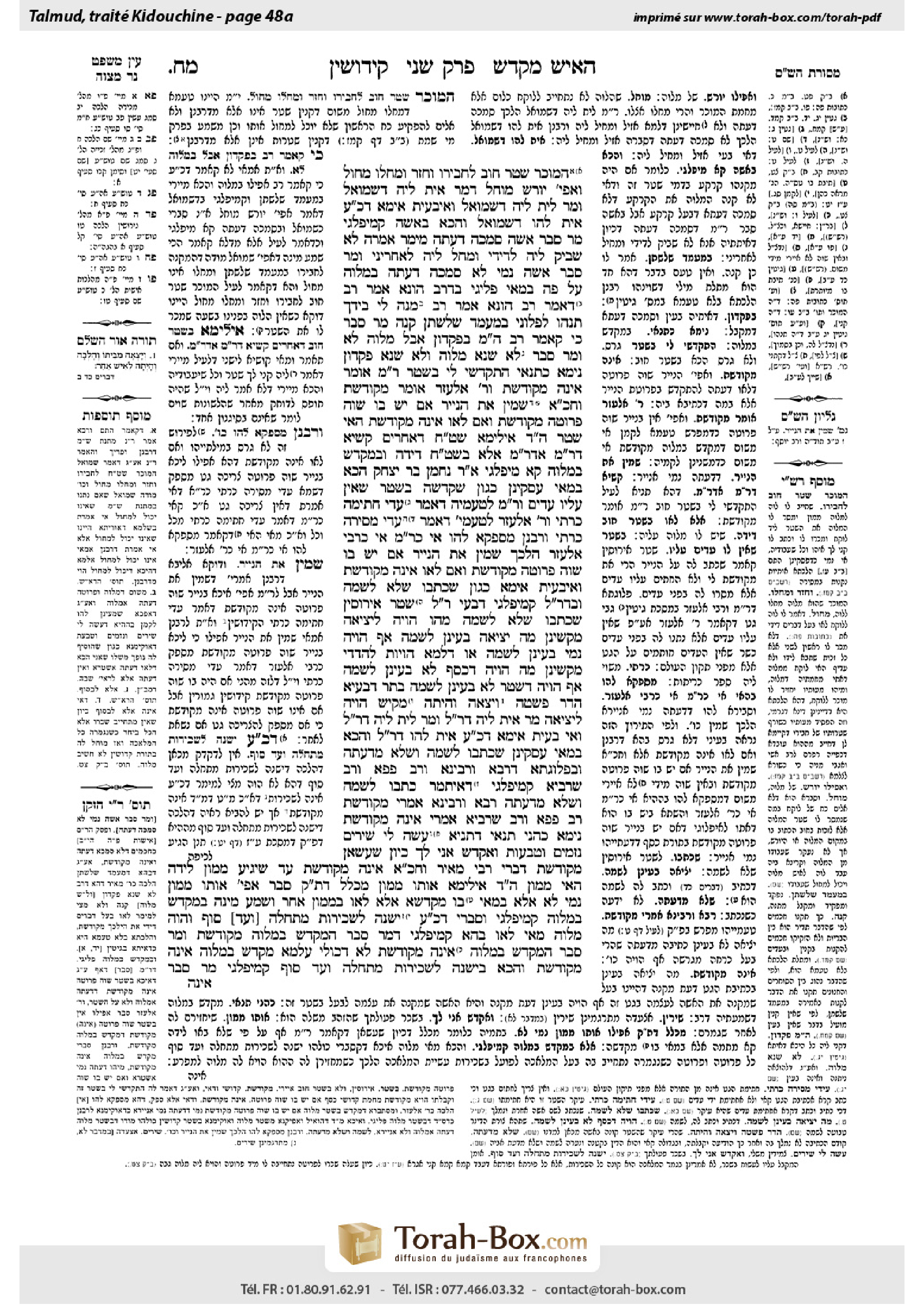
This page of Kiddushin includes the Aramaic text, an English translation and an AI-generated French translation, alongside the scan above.
קידושין מ״ח א · Aramaic and Hebrew text
הַמּוֹכֵר שְׁטַר חוֹב לַחֲבֵירוֹ, וְחָזַר וּמְחָלוֹ – מָחוּל, וַאֲפִילּוּ יוֹרֵשׁ מוֹחֵל. דְּמָר אִית לֵיהּ דִּשְׁמוּאֵל. וּמָר לֵית לֵיהּ דִּשְׁמוּאֵל.
וְאִיבָּעֵית אֵימָא: דְּכוּלֵּי עָלְמָא אִית לְהוּ דִּשְׁמוּאֵל, וְהָכָא בְּאִשָּׁה קָמִיפַּלְגִי. מָר סָבַר: אִשָּׁה סָמְכָה דַּעְתַּהּ, מֵימָר אָמְרָה: לָא שָׁבֵיק לֵיהּ לְדִידִי וּמָחֵל לֵיהּ לְאַחֲרִינֵי, וּמָר סָבַר: אִשָּׁה נָמֵי לָא סָמְכָה דַּעְתַּהּ
בְּמִלְוָה עַל פֶּה. בְּמַאי פְּלִיגִי? בִּדְרַב הוּנָא אָמַר רַב, דְּאָמַר רַב הוּנָא אָמַר רַב: מָנֶה לִי בְּיָדְךָ, תְּנֵהוּ לִפְלוֹנִי בְּמַעֲמַד שְׁלָשְׁתָּן – קָנָה.
מָר סָבַר: כִּי קָאָמַר רַב הָנֵי מִילֵּי בְּפִקָּדוֹן, אֲבָל מִלְוָה – לָא. וּמָר סָבַר: לָא שְׁנָא מִלְוָה וְלָא שְׁנָא פִּקָּדוֹן.
נֵימָא כְּתַנָּאֵי: ״הִתְקַדְּשִׁי לִי בִּשְׁטָר״ – רַבִּי מֵאִיר אוֹמֵר: אֵינָהּ מְקוּדֶּשֶׁת, וְרַבִּי אֶלְעָזָר אוֹמֵר: מְקוּדֶּשֶׁת, וַחֲכָמִים אוֹמְרִים: שָׁמִין אֶת הַנְּיָיר, אִם יֵשׁ בּוֹ שָׁוֶה פְּרוּטָה – מְקוּדֶּשֶׁת, וְאִם לָאו – אֵינָהּ מְקוּדֶּשֶׁת.
הַאי שְׁטָר הֵיכִי דָמֵי? אִילֵּימָא שְׁטַר חוֹב דַּאֲחֵרִים – קַשְׁיָא דְּרַבִּי מֵאִיר אַדְּרַבִּי מֵאִיר. אֶלָּא בִּשְׁטַר חוֹב דִּידַהּ, וּבִמְקַדֵּשׁ בְּמִלְוָה קָא מִיפַּלְגִי!
אָמַר רַב נַחְמָן בַּר יִצְחָק, הָכָא בְּמַאי עָסְקִינַן כְּגוֹן שֶׁקִּדְּשָׁהּ בִּשְׁטָר שֶׁאֵין עָלָיו עֵדִים.
וְרַבִּי מֵאִיר לְטַעְמֵיהּ דְּאָמַר: עֵדֵי חֲתִימָה כָּרְתִי, וְרַבִּי אֶלְעָזָר לְטַעְמֵיהּ דְּאָמַר: עֵדֵי מְסִירָה כָּרְתִי, וְרַבָּנַן מְסַפְּקָא לְהוּ אִי כְּרַבִּי מֵאִיר אִי כְּרַבִּי אֶלְעָזָר, הִלְכָּךְ שָׁמִין אֶת הַנְּיָיר, אִם יֵשׁ בּוֹ שָׁוֶה פְּרוּטָה – מְקוּדֶּשֶׁת, וְאִם לָאו אֵינָהּ מְקוּדֶּשֶׁת.
וְאִיבָּעֵית אֵימָא, כְּגוֹן שֶׁכְּתָבוֹ שֶׁלֹּא לִשְׁמָהּ, וּבִדְרֵישׁ לָקִישׁ קָמִיפַּלְגִי. דְּבָעֵי רֵישׁ לָקִישׁ: שְׁטַר אֵירוּסִין שֶׁכְּתָבוֹ שֶׁלֹּא לִשְׁמָהּ, מַהוּ? הֲוָיָה לִיצִיאָה מַקְּשִׁינַן, מָה יְצִיאָה בָּעֵינַן לִשְׁמָהּ, אַף הֲוָיָה נָמֵי בָּעֵינַן לִשְׁמָהּ. אוֹ דִלְמָא: הֲוָיוֹת לַהֲדָדֵי מַקְּשִׁינַן, מָה הֲוָיָה דְכֶסֶף לָא בָּעֵינַן לִשְׁמָהּ, אַף הֲוָיָה דִשְׁטָר לָא בָּעֵינַן לִשְׁמָהּ.
בָּתַר דְּבַעְיַהּ הֲדַר פַּשְׁטַהּ: ״וְיָצְאָה... וְהָיְתָה״, מַקִּישׁ הֲוָיָה לִיצִיאָה. מָר אִית לֵיהּ דְּרֵישׁ לָקִישׁ, וּמָר לֵית לֵיהּ דְּרֵישׁ לָקִישׁ.
וְאִי בָּעֵית אֵימָא: דְּכוּלֵּי עָלְמָא אִית לְהוּ דְּרֵישׁ לָקִישׁ, וְהָכָא בְּמַאי עָסְקִינַן, שֶׁכְּתָבוֹ לִשְׁמָהּ וְשֶׁלֹּא מִדַּעְתָּהּ. וּבִפְלוּגְתָּא דְּרָבָא וְרָבִינָא, וְרַב פָּפָּא וְרַב שֵׁרֵבְיָא קָמִיפַּלְגִי. דְּאִיתְּמַר: כְּתָבוֹ לִשְׁמָהּ וְשֶׁלֹּא מִדַּעְתָּהּ, רָבָא וְרָבִינָא אָמְרִי: מְקוּדֶּשֶׁת, רַב פָּפָּא וְרַב שֵׁרֵבְיָא אָמְרִי: אֵינָהּ מְקוּדֶּשֶׁת.
נֵימָא כְּהָנֵי תַּנָּאֵי, דְּתַנְיָא: ״עֲשֵׂה לִי שִׁירִים נְזָמִים וְטַבָּעוֹת, וְאֶקַּדֵּשׁ אֲנִי לָךְ״, כֵּיוָן שֶׁעֲשָׂאָן – מְקוּדֶּשֶׁת, דִּבְרֵי רַבִּי מֵאִיר, וַחֲכָמִים אוֹמְרִים: אֵינָהּ מְקוּדֶּשֶׁת עַד שֶׁיַּגִּיעַ מָמוֹן לְיָדָהּ.
הַאי מָמוֹן הֵיכִי דָמֵי? אִילֵּימָא אוֹתוֹ מָמוֹן, מִכְּלָל דְּתַנָּא קַמָּא סָבַר: אֲפִילּוּ אוֹתוֹ מָמוֹן נָמֵי לָא! אֶלָּא בְּמַאי כּוּ מִקַּדְּשָׁא? אֶלָּא לָאו בְּמָמוֹן אַחֵר, וּשְׁמַע מִינַּהּ בִּמְקַדֵּשׁ בְּמִלְוָה קָמִיפַּלְגִי.
וְסָבְרִי דְּכוּלֵּי עָלְמָא יֶשְׁנָהּ לִשְׂכִירוּת מִתְּחִלָּה [וְעַד] סוֹף וְהָוֵה מִלְוָה. מַאי לָאו בְּהָא קָמִיפַּלְגִי, דְּמָר סָבַר: הַמְקַדֵּשׁ בְּמִלְוָה מְקוּדֶּשֶׁת, וּמָר סָבַר: הַמְקַדֵּשׁ בְּמִלְוָה אֵינָהּ מְקוּדֶּשֶׁת?
לָא, דְּכוּלֵּי עָלְמָא מְקַדֵּשׁ בְּמִלְוָה אֵינָהּ מְקוּדֶּשֶׁת, וְהָכָא – בְּיֶשְׁנָהּ לִשְׂכִירוּת מִתְּחִלָּה וְעַד סוֹף קָמִיפַּלְגִי, מָר סָבַר:
Kiddushin 48a · English translation
In the case of one who sells a promissory note to another, and he, the seller, went back and forgave the debtor his debt, it is forgiven, since the debtor essentially had a non-transferable obligation to the creditor alone. And even the creditor’s inheritor can forgive the debt. It can be explained that one Sage, i.e., the Rabbis, is of the opinion that the ruling is in accordance with the opinion of Shmuel. Since the man can forgive the debt, the woman will not rely on her ability to collect using the promissory note she has received for her betrothal. And one Sage, Rabbi Meir, is not of the opinion that the ruling is in accordance with the opinion of Shmuel; the woman relies on her ability to collect using the promissory note and is betrothed.
And if you wish, say instead that everyone is of the opinion that the ruling is in accordance with the opinion of Shmuel, and here they disagree with regard to a woman who is becoming betrothed. One Sage, Rabbi Meir, holds that a woman relies on a promissory note she receives, since she says to herself: He would not leave aside my benefit and forgive the debt of others. And one Sage, i.e., the Rabbis, holds that even a woman who received the promissory note for betrothal does not rely on being able to collect the debt, since she is concerned he might forgive it.
Having enumerated several possibilities for the dispute in the case of a loan with a promissory note, the Gemara explains the dispute in the case of a loan by oral agreement: In the case of one who betroths a woman with a loan by oral agreement, with regard to what do they disagree? They disagree with regard to the statement of Rav Huna, who quoted a statement that Rav says, as Rav Huna says that Rav says: If one said to another: I have one hundred dinars in your possession, give it to so-and-so, if he stated this in the presence of all three parties, i.e., the one who had the money, the one who was the owner of the money, and the intended recipient, the intended recipient has acquired it.
One Sage, i.e., the Rabbis, holds that when Rav said that it can be acquired in the presence of all three parties, this applies in the case of a deposit, since the item is intact. But in the case of a loan, which is meant to be spent, he did not rule that it can be transferred this way, since there is no actual money but merely a debt. And one Sage, Rabbi Meir, holds: There is no difference whether it is a loan or a deposit. The third party acquires it in both cases. A woman is therefore betrothed if he gave her a loan in the above manner.
The Gemara again suggests: Let us say that Rav’s statement that one cannot betroth a woman with a loan is subject to a dispute between tanna’im. A baraita teaches: If one says to a woman: Be betrothed to me with a document, Rabbi Meir says she is not betrothed, and Rabbi Elazar says she is betrothed, and the Rabbis say the court appraises the paper the document is written on: If the paper itself has the value of one peruta, she is betrothed. But if not, she is not betrothed.
The Gemara clarifies the case of this baraita: What are the circumstances of this document? If we say it is a promissory note of a debt owed him by others, then the statement of Rabbi Meir is difficult in light of another statement of Rabbi Meir, as he stated in the previous baraita that a woman can be betrothed by giving her a promissory note. Rather, this baraita must be referring to a promissory note of a debt owed him by her, and they disagree with regard to the halakha of one who betroths a woman with a loan.
Rav Naḥman bar Yitzḥak says that this is not necessarily so. With what are we dealing here? With a case where he betrothed her with a document of betrothal that had no witnesses to it.
And Rabbi Meir conforms to his standard line of reasoning, as he says with regard to a bill of divorce: Signatory witnesses on the bill of divorce effect the divorce, and the same applies to a document of betrothal. Since no witnesses signed the document, it cannot be used for betrothal. And Rabbi Elazar conforms to his standard line of reasoning, as he says: Witnesses to the transmission of the bill of divorce effect the divorce, and she is betrothed if the document was handed over in the presence of witnesses. And the Rabbis are uncertain if the halakha is in accordance with the opinion of Rabbi Meir or if it is in accordance with the opinion of Rabbi Elazar. Therefore, they rule that the betrothal is not effected by means of the document, but it is betrothal effected by means of giving an item worth money. The court appraises the paper: If it has the value of one peruta, she is betrothed. But if not, she is not betrothed.
And if you wish, say instead that this baraita is referring to a case where he wrote the document of betrothal not for her sake, i.e., not for this particular woman’s sake. And they disagree with regard to a statement of Reish Lakish, as Reish Lakish asks: What is the halakha of a document of betrothal that the scribe wrote not for her sake? The Gemara clarifies the question: Do we juxtapose becoming a wife through betrothal to leaving a marriage through divorce and say: Just as in the document that causes her to leave the marriage we require that it be written for her sake, so too, in the document that causes her to become betrothed we require that it be written for her sake as well. Or perhaps we juxtapose different ways of becoming betrothed to each other: Just as in the act of becoming betrothed by means of money we do not require that money be minted for her sake and he can use any money, so too, with regard to the act of becoming betrothed by means of a document, we do not require that it be written for her sake.
After Reish Lakish raised the dilemma, he then resolved it: The verse states: “And she departs out of his house and goes and becomes another man’s wife” (Deuteronomy 24:2). The verse thereby juxtaposes the verb becoming to the verb leaving, so a bill of divorce and a document of betrothal must be written for her sake to be valid. One Sage, Rabbi Meir, is of the opinion that the halakha is in accordance with the opinion of Reish Lakish, and maintains that she is not betrothed if the document was not written for her sake. And one Sage, Rabbi Elazar, is not of the opinion that the halakha is in accordance with the opinion of Reish Lakish. The Rabbis remain uncertain, and therefore view the case as betrothal by means of giving an item worth money.
And if you wish, say instead that everyone is of the opinion that the halakha is in accordance with the opinion of Reish Lakish, and with what are we dealing here? With a case where he wrote the document for her sake but unbeknownst to her. And they disagree concerning the dispute between Rava and Ravina, and Rav Pappa and Rav Sherevya, as it was stated that these amora’im engaged in a dispute with regard to the following issue: If he wrote a document of betrothal for her sake but unbeknownst to her and gave it to her for betrothal, Rava and Ravina say she is betrothed; Rav Pappa and Rav Sherevya say she is not betrothed.
The Gemara again suggests: Let us say that Rav’s statement that one cannot betroth a woman with a loan is subject to a dispute between these tanna’im, as it is taught in a baraita: If a woman gave gold to a goldsmith, instructing him: Make bracelets, earrings, and rings for me, and I will be betrothed to you as payment for your work, once he has made them she is betrothed; this is the statement of Rabbi Meir. And the Rabbis say: She is not betrothed until money enters her possession.
The Gemara asks: What are the circumstances of this money mentioned by the Rabbis? If we say it means that very money, i.e., the jewelry she requested, then by inference the first tanna, Rabbi Meir, holds that even that same money is also not required to be given for her to be betrothed, but she is betrothed as soon as he made the jewelry. But with what does he betroth her? It is only with the jewelry that she is betrothed, since he has given her nothing but the jewelry. Rather, is the statement of the Rabbis not referring to when he betroths her with the other money, i.e., the payment she owes him for his service, and they hold that she is not betrothed? And conclude from it that Rabbi Meir and the Rabbis disagree with regard to one who betroths a woman with a loan, since the payment she owes him for making the rings is like a loan.
The Gemara clarifies: And it must be they hold that everyone agrees that the obligation to pay a wage is incurred continuously from the beginning of the period he was hired to its end, i.e., the obligation to pay for a service begins when the hired party starts to work, and the sum owed increases as he proceeds. And it is therefore a loan, as when he gives her the finished article she was already obligated to pay for the work he had performed earlier. What, is it not the case that they disagree with regard to this, i.e., that one Sage, Rabbi Meir, holds that in the case of one who betroths a woman with a loan, she is betrothed, and one Sage, the Rabbis, holds that in the case of one who betroths a woman with a loan, she is not betrothed?
The Gemara rejects this: No, it is possible that everyone agrees that in the case of one who betroths a woman with a loan, she is not betrothed, and here they in fact disagree over the question of whether or not the obligation to pay a wage is incurred continuously from the beginning of the period he was hired to its end. One Sage, Rabbi Meir, holds:
Kiddushin 48a · Traduction française (IA)
Dans le cas de celui qui vend à un autre un acte de créance, puis qui, lui, le vendeur, revient sur sa décision et remet au débiteur sa dette, celle-ci est remise, puisque le débiteur était en réalité tenu envers le seul créancier et que cette obligation n’était pas cessible. Même l’héritier du créancier peut remettre la dette. On peut expliquer qu’un Sage, c’est-à-dire les Rabbins, estime que la halakha suit l’opinion de Chmouel. Puisque le créancier peut remettre la dette, la femme ne se fie pas à la possibilité de la recouvrer au moyen de l’acte de créance qu’elle a reçu pour ses kidouchin. Et un Sage, Rabbi Meïr, n’estime pas que la halakha suive l’opinion de Chmouel ; la femme se fie à la possibilité de recouvrer la dette au moyen de l’acte de créance et les kidouchin sont donc valides.
Et si tu le souhaites, dis plutôt que tous estiment que la halakha suit l’opinion de Chmouel, et qu’ici, ils sont en désaccord au sujet d’une femme qui reçoit des kidouchin. Un Sage, Rabbi Meïr, estime qu’une femme se fie à l’acte de créance qu’elle reçoit, car elle se dit : « Il ne négligerait pas mon intérêt en remettant la dette d’autrui. » Et un Sage, c’est-à-dire les Rabbins, estime que même une femme qui a reçu l’acte de créance pour ses kidouchin ne se fie pas à la possibilité de recouvrer la dette, car elle craint qu’il ne la remette.
Après avoir énuméré plusieurs explications possibles du désaccord dans le cas d’un prêt accompagné d’un acte de créance, la Guemara explique le désaccord dans le cas d’un prêt oral : dans le cas de celui qui donne à une femme ses kidouchin au moyen d’un prêt oral, sur quoi porte leur désaccord ? Il porte sur une déclaration de Rav rapportée par Rav Houna. En effet, Rav Houna dit au nom de Rav : si quelqu’un dit à un autre : « J’ai cent dinars en ta possession ; donne-les à untel », et qu’il le déclare en présence des trois parties — celui qui détient l’argent, celui à qui l’argent appartient et le destinataire prévu —, le destinataire prévu en acquiert la propriété.
Un Sage, c’est-à-dire les Rabbins, estime que lorsque Rav a dit que l’argent peut être acquis en présence des trois parties, cela s’applique à un dépôt, puisque l’objet est intact. Mais dans le cas d’un prêt, qui est destiné à être dépensé, il n’a pas statué qu’il pouvait être transféré de cette manière, puisqu’il n’y a pas d’argent réel, mais seulement une dette. Et un Sage, Rabbi Meïr, estime qu’il n’y a pas de différence entre un prêt et un dépôt : le tiers en acquiert la propriété dans les deux cas. Par conséquent, la femme reçoit des kidouchin si l’homme lui a transféré un prêt de la manière décrite.
La Guemara suggère de nouveau : Disons que la déclaration de Rav, selon laquelle on ne peut pas donner à une femme ses kidouchin au moyen d’un prêt, fait l’objet d’un désaccord entre des tanaïm. Une baraïta enseigne : si quelqu’un dit à une femme : « Sois ma femme au moyen de ce document », Rabbi Meïr dit qu’elle ne reçoit pas les kidouchin, Rabbi Elazar dit qu’elle les reçoit, et les Rabbins disent que le tribunal évalue le papier sur lequel le document est écrit : si le papier lui-même vaut une prouta, elle reçoit les kidouchin ; sinon, elle ne les reçoit pas.
La Guemara précise les circonstances de cette baraïta : de quel document s’agit-il ? Si nous disons qu’il s’agit d’un acte de créance constatant une dette que d’autres lui doivent, la déclaration de Rabbi Meïr est difficile à concilier avec une autre de ses déclarations, puisqu’il a dit dans la baraïta précédente qu’une femme peut recevoir les kidouchin au moyen d’un acte de créance. Il faut donc que cette baraïta parle d’un acte de créance constatant une dette qu’elle lui doit, et que les tanaïm soient en désaccord au sujet de la halakha concernant celui qui donne à une femme ses kidouchin au moyen d’un prêt.
Rav Naḥman bar Yitzḥak dit que ce n’est pas nécessairement le cas. De quoi s’agit-il ici ? D’un cas où il lui a donné ses kidouchin au moyen d’un document de kidouchin dépourvu de témoins.
Rabbi Meïr reste fidèle à sa position habituelle, car il dit au sujet d’un acte de divorce que les témoins qui le signent rendent le divorce effectif ; il en va de même pour un document de kidouchin. Puisqu’aucun témoin n’a signé le document, celui-ci ne peut pas servir à donner les kidouchin. Rabbi Elazar reste fidèle à sa position habituelle, car il dit que ce sont les témoins de la remise de l’acte de divorce qui rendent le divorce effectif ; la femme reçoit donc les kidouchin si le document lui a été remis en présence de témoins. Les Rabbins ne savent pas si la halakha suit l’opinion de Rabbi Meïr ou celle de Rabbi Elazar. Ils statuent donc que les kidouchin ne sont pas effectués au moyen du document, mais par la remise d’un objet ayant une valeur monétaire. Le tribunal évalue le papier : s’il vaut une prouta, elle reçoit les kidouchin ; sinon, elle ne les reçoit pas.
Et si tu le souhaites, dis plutôt que cette baraïta parle d’un cas où il a rédigé le document de kidouchin non pour elle, c’est-à-dire pas à l’intention de cette femme en particulier. Les tanaïm sont alors en désaccord au sujet d’une déclaration de Reish Lakish. En effet, Reish Lakish demande : quelle est la halakha concernant un document de kidouchin que le scribe a rédigé non pour elle ? La Guemara précise la question : rapprochons-nous le fait de devenir épouse par les kidouchin du fait de sortir du mariage par le divorce, et dirons-nous que, tout comme l’acte qui la fait sortir du mariage doit être rédigé pour elle, l’acte qui la fait recevoir les kidouchin doit lui aussi être rédigé pour elle ? Ou bien rapprochons-nous les différentes manières de recevoir les kidouchin entre elles : tout comme, lorsqu’on reçoit les kidouchin au moyen d’argent, nous n’exigeons pas que l’argent ait été frappé à son intention et l’homme peut utiliser n’importe quelle pièce, de même, lorsqu’on reçoit les kidouchin au moyen d’un document, nous n’exigeons pas que celui-ci ait été rédigé pour elle.
Après avoir soulevé cette question, Reish Lakish l’a résolue : le verset dit : « Elle sort de sa maison, s’en va et devient la femme d’un autre homme » (Deutéronome 24, 2). Le verset rapproche ainsi le verbe « devenir » du verbe « sortir » ; un acte de divorce et un document de kidouchin doivent donc être rédigés pour elle afin d’être valides. Un Sage, Rabbi Meïr, estime que la halakha suit l’opinion de Reish Lakish et soutient qu’elle ne reçoit pas les kidouchin si le document n’a pas été rédigé pour elle. Et un Sage, Rabbi Elazar, n’estime pas que la halakha suive l’opinion de Reish Lakish. Les Rabbins restent dans l’incertitude et considèrent donc le cas comme des kidouchin effectués par la remise d’un objet ayant une valeur monétaire.
Et si tu le souhaites, dis plutôt que tous estiment que la halakha suit l’opinion de Reish Lakish. De quoi s’agit-il ici ? D’un cas où il a rédigé le document pour elle, mais à son insu. Les tanaïm sont en désaccord au sujet du débat entre Rava et Ravina, d’une part, et Rav Pappa et Rav Sherevya, d’autre part. En effet, il a été rapporté que ces amoraïm ont débattu de la question suivante : s’il a rédigé un document de kidouchin pour elle, mais à son insu, et le lui a remis pour les kidouchin, Rava et Ravina disent qu’elle reçoit les kidouchin ; Rav Pappa et Rav Sherevya disent qu’elle ne les reçoit pas.
La Guemara suggère de nouveau : Disons que la déclaration de Rav, selon laquelle on ne peut pas donner à une femme ses kidouchin au moyen d’un prêt, fait l’objet d’un désaccord entre ces tanaïm, comme l’enseigne une baraïta : si une femme a remis de l’or à un orfèvre en lui demandant : « Fabrique-moi des bracelets, des boucles d’oreilles et des bagues, et je recevrai tes kidouchin en paiement de ton travail », dès qu’il les a fabriqués, elle reçoit les kidouchin ; telle est la déclaration de Rabbi Meïr. Les Rabbins disent : elle ne reçoit pas les kidouchin tant que de l’argent n’est pas entré en sa possession.
La Guemara demande : dans quelles circonstances les Rabbins parlent-ils de cet argent ? Si nous disons qu’ils désignent ce même argent, c’est-à-dire les bijoux qu’elle a demandés, il s’ensuit que le premier tanna, Rabbi Meïr, estime qu’il n’est même pas nécessaire qu’on lui remette ces mêmes bijoux pour qu’elle reçoive les kidouchin, mais qu’elle les reçoit dès qu’il les a fabriqués. Mais avec quoi lui donne-t-il les kidouchin ? Elle ne les reçoit qu’au moyen des bijoux, puisqu’il ne lui a rien remis d’autre. Les Rabbins ne parlent-ils pas plutôt du cas où il lui donne les kidouchin au moyen d’un autre argent, c’est-à-dire le paiement qu’elle lui doit pour son travail, et où ils estiment qu’elle ne reçoit pas les kidouchin ? Il faut donc en conclure que Rabbi Meïr et les Rabbins sont en désaccord au sujet de celui qui donne à une femme ses kidouchin au moyen d’un prêt, puisque le paiement qu’elle lui doit pour la fabrication des bagues est assimilable à un prêt.
La Guemara précise : ils doivent nécessairement estimer que tous reconnaissent que l’obligation de payer un salaire naît progressivement du début à la fin de la période pour laquelle la personne a été engagée ; autrement dit, l’obligation de payer un service commence lorsque la personne engagée se met au travail, et la somme due augmente au fur et à mesure de son travail. Il s’agit donc d’un prêt, puisque, lorsqu’il lui remet l’article achevé, elle était déjà tenue de payer le travail qu’il avait effectué auparavant. N’est-ce pas le cas qu’ils sont en désaccord à ce sujet, c’est-à-dire qu’un Sage, Rabbi Meïr, estime que, dans le cas de celui qui donne à une femme ses kidouchin au moyen d’un prêt, elle reçoit les kidouchin, tandis qu’un Sage, les Rabbins, estime qu’elle ne les reçoit pas ?
La Guemara rejette cette explication : non, il est possible que tous reconnaissent que, dans le cas de celui qui donne à une femme ses kidouchin au moyen d’un prêt, elle ne les reçoit pas. En réalité, leur désaccord porte ici sur la question de savoir si l’obligation de payer un salaire naît progressivement du début à la fin de la période pour laquelle la personne a été engagée. Un Sage, Rabbi Meïr, estime :
Traduction française générée par IA à partir de l’édition anglaise de Sefaria. Vérifie toujours un passage avec le texte source.
Text from Sefaria: William Davidson Edition - Vocalized Aramaic (CC BY NC); William Davidson Edition - English (CC BY NC).