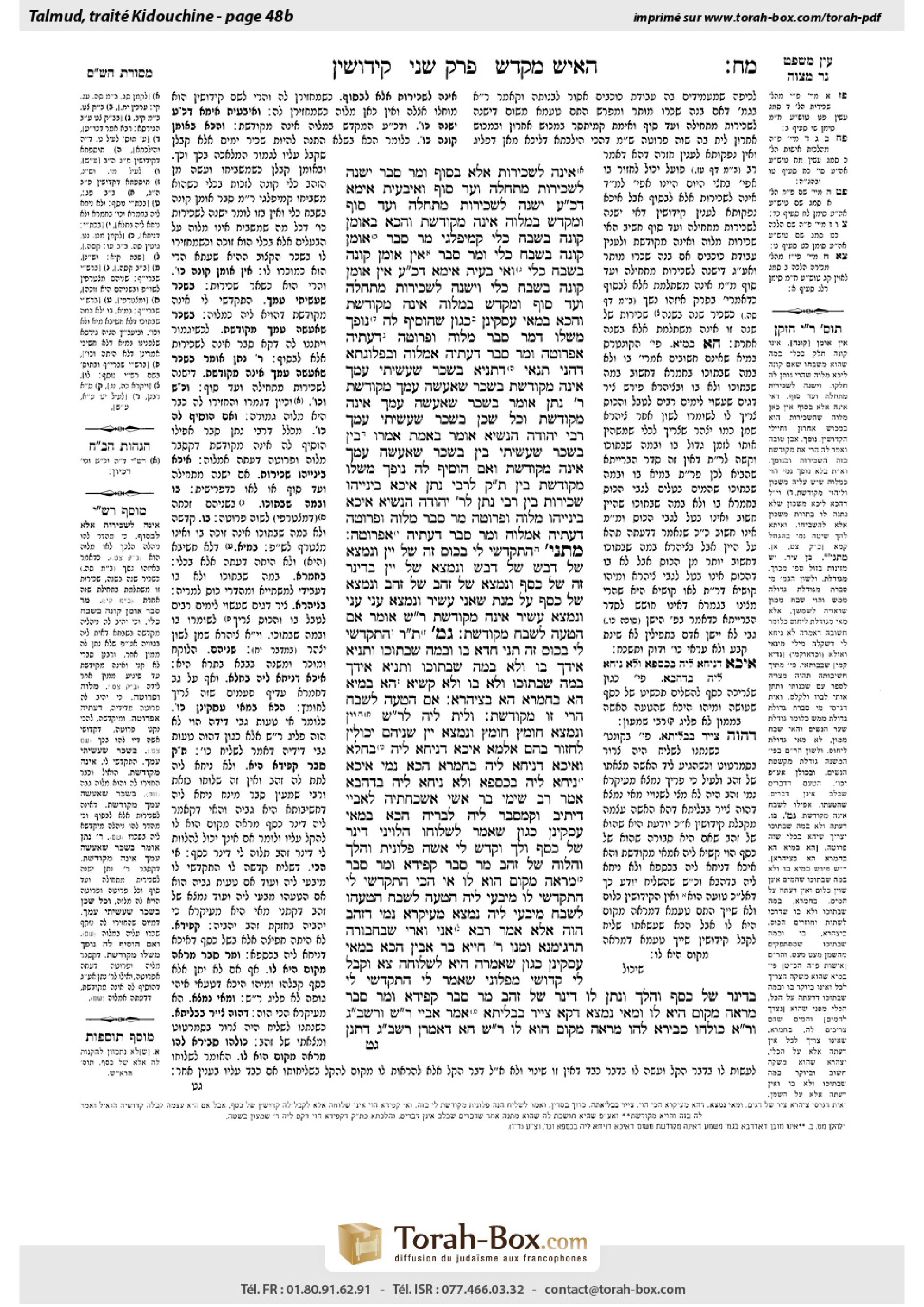
Kiddushin 48b: Talmud study for Daf Yomi
Daf Yomi is the daily study of one Talmud folio. Explore 37 tractates with scans, Hebrew text, Sefaria English and AI-generated French translations where annotated.
Passage selection and English or AI-generated French translation are available where the scan has annotations. Daf Study is independent of Torah-Box and Sefaria.
Browse Kiddushin · קידושין · All tractatesKiddushin 48b text and translations
This page of Kiddushin includes the Aramaic text, an English translation and an AI-generated French translation, alongside the scan above.
קידושין מ״ח ב · Aramaic and Hebrew text
אֵינָהּ לִשְׂכִירוּת אֶלָּא בַּסּוֹף. וּמָר סָבַר: יֶשְׁנָהּ לִשְׂכִירוּת מִתְּחִלָּה וְעַד סוֹף.
וְאִיבָּעֵית אֵימָא: דְּכוּלֵּי עָלְמָא יֶשְׁנָהּ לִשְׂכִירוּת מִתְּחִלָּה וְעַד סוֹף, וּמְקַדֵּשׁ בְּמִלְוָה – אֵינָהּ מְקוּדֶּשֶׁת, וְהָכָא, בְּאוּמָּן קוֹנָה בִּשְׁבַח כְּלִי קָמִיפַּלְגִי. מָר סָבַר: אוּמָּן קוֹנָה בִּשְׁבַח כְּלִי, וּמַר סָבַר: אֵין אוּמָּן קוֹנֶה בִּשְׁבַח כְּלִי.
וְאִי בָּעֵית אֵימָא: דְּכוּלֵּי עָלְמָא אֵין אוּמָּן קוֹנָה בִּשְׁבַח כְּלִי, וְיֶשְׁנָהּ לִשְׂכִירוּת מִתְּחִלָּה וְעַד סוֹף, וּמְקַדֵּשׁ בְּמִלְוָה אֵינָהּ מְקוּדֶּשֶׁת, וְהָכָא בְּמַאי עָסְקִינַן – כְּגוֹן שֶׁהוֹסִיף לָהּ נוֹפֶךְ מִשֶּׁלּוֹ. דְּמָר סָבַר: מִלְוָה וּפְרוּטָה, דַּעְתֵּיהּ אַפְּרוּטָה, וּמָר סָבַר: דַּעְתֵּיהּ אַמִּלְוָה.
וּבִפְלוּגְתָּא דְּהָנֵי תַּנָּאֵי, דְּתַנְיָא: ״בִּשְׂכַר שֶׁעָשִׂיתִי עִמָּךְ״ – אֵינָהּ מְקוּדֶּשֶׁת. ״בִּשְׂכַר שֶׁאֶעֱשֶׂה עִמָּךְ״ – מְקוּדֶּשֶׁת. רַבִּי נָתָן אוֹמֵר: ״בִּשְׂכַר שֶׁאֶעֱשֶׂה עִמָּךְ״ – אֵינָהּ מְקוּדֶּשֶׁת, וְכׇל שֶׁכֵּן ״בִּשְׂכַר שֶׁעָשִׂיתִי עִמָּךְ״.
רַבִּי יְהוּדָה הַנָּשִׂיא אוֹמֵר: בֶּאֱמֶת אָמְרוּ: בֵּין ״בִּשְׂכַר שֶׁעָשִׂיתִי״, בֵּין ״בִּשְׂכַר שֶׁאֶעֱשֶׂה עִמָּךְ״ – אֵינָהּ מְקוּדֶּשֶׁת. וְאִם הוֹסִיף לָהּ נוֹפֶךְ מִשֶּׁלּוֹ – מְקוּדֶּשֶׁת.
בֵּין תַּנָּא קַמָּא לְרַבִּי נָתָן – אִיכָּא בֵּינַיְיהוּ שְׂכִירוּת, בֵּין רַבִּי נָתָן לְרַבִּי יְהוּדָה הַנָּשִׂיא – אִיכָּא בֵּינַיְיהוּ מִלְוָה וּפְרוּטָה. מָר סָבַר: מִלְוָה וּפְרוּטָה, דַּעְתֵּיהּ אַמִּלְוָה, וּמָר סָבַר: דַּעְתֵּיהּ אַפְּרוּטָה.
מַתְנִי׳ ״הִתְקַדְּשִׁי לִי בְּכוֹס זֶה שֶׁל יַיִן״ וְנִמְצָא שֶׁל דְּבַשׁ, ״שֶׁל דְּבַשׁ״ וְנִמְצָא שֶׁל יַיִן, ״בְּדִינָר זֶה שֶׁל כֶּסֶף״ וְנִמְצָא שֶׁל זָהָב, ״שֶׁל זָהָב״ וְנִמְצָא שֶׁל כֶּסֶף, ״עַל מְנָת שֶׁאֲנִי עָשִׁיר״ וְנִמְצָא עָנִי, ״עָנִי״ וְנִמְצָא עָשִׁיר – אֵינָהּ מְקוּדֶּשֶׁת. רַבִּי שִׁמְעוֹן אוֹמֵר: אִם הִטְעָהּ לְשֶׁבַח, מְקוּדֶּשֶׁת.
גְּמָ׳ תָּנוּ רַבָּנַן: ״הִתְקַדְּשִׁי לִי בְּכוֹס זֶה״, תָּנֵי חֲדָא: בּוֹ וּבַמֶּה שֶׁבְּתוֹכוֹ, וְתַנְיָא אִידַּךְ: בּוֹ וְלֹא בַּמֶּה שֶׁבְּתוֹכוֹ. וְתַנְיָא אִידַּךְ: בַּמֶּה שֶׁבְּתוֹכוֹ וְלֹא בּוֹ. וְלָא קַשְׁיָא: הָא – בְּמַיָּא, הָא – בְּחַמְרָא, הָא – בְּצִיהֲרָא.
אִם הִטְעָהּ לְשֶׁבַח הֲרֵי זוֹ מְקוּדֶּשֶׁת. וְלֵית לֵיהּ לְרַבִּי שִׁמְעוֹן יַיִן וְנִמְצָא חוֹמֶץ, חוֹמֶץ וְנִמְצָא יַיִן – שְׁנֵיהֶם יְכוֹלִין לַחֲזוֹר בָּהֶם. אַלְמָא, אִיכָּא דְּנִיחָא לֵיהּ בְּחַלָּא וְאִיכָּא דְּנִיחָא לֵיהּ בְּחַמְרָא. הָכָא נָמֵי: אִיכָּא נִיחָא לֵיהּ בְּכַסְפָּא וְלָא נִיחָא לֵיהּ בְּדַהֲבָא!
אָמַר רַב שִׁימִי בַּר אָשֵׁי: אַשְׁכַּחְתֵּיהּ לְאַבָּיֵי דְּיָתֵיב וְקָמַסְבַּר לֵיהּ לִבְרֵיהּ: הָכָא בְּמַאי עָסְקִינַן – כְּגוֹן שֶׁאָמַר לִשְׁלוּחוֹ: ״הַלְוֵינִי דִּינָר שֶׁל כֶּסֶף, וְלֵךְ וְקַדֵּשׁ לִי אִשָּׁה פְּלוֹנִית״ וְהָלַךְ וְהִלְוָה שֶׁל זָהָב. מָר סָבַר: קְפֵידָא. וּמָר סָבַר: מַרְאֶה מָקוֹם הוּא לוֹ.
אִי הָכִי ״הִתְקַדְּשִׁי לִי״? ״הִתְקַדְּשִׁי לוֹ״ מִיבְּעֵי לֵיהּ! הִטְעָהּ לְשֶׁבַח? הִטְעָהוּ לְשֶׁבַח מִיבְּעֵי לֵיהּ! ״נִמְצָא״ מֵעִיקָּרָא נָמֵי דְּזָהָב הֲוָה!
אֶלָּא אָמַר רָבָא: אֲנִי וַאֲרִי שֶׁבַּחֲבוּרָה (תַּרְגֵּימְנָא) [תַּרְגֵּימְנוּהָ] וּמַנּוּ – רַבִּי חִיָּיא בַּר אָבִין, הָכָא בְּמַאי עָסְקִינַן – כְּגוֹן שֶׁאָמְרָה הִיא לִשְׁלוּחָהּ ״צֵא וְקַבֵּל לִי קִדּוּשַׁי מִפְּלוֹנִי שֶׁאָמַר לִי הִתְקַדְּשִׁי לִי בְּדִינָר שֶׁל כֶּסֶף״ וְהָלַךְ וְנָתַן לוֹ דִּינָר שֶׁל זָהָב, מָר סָבַר: קְפֵידָא, וּמָר סָבַר: מַרְאֶה מָקוֹם הִיא לוֹ, וּמַאי ״נִמְצָא״ – דְּקָא צַיִיר בִּבְלִיתָא.
אָמַר אַבָּיֵי: רַבִּי שִׁמְעוֹן וְרַבָּן שִׁמְעוֹן בֶּן גַּמְלִיאֵל וְרַבִּי אֶלְעָזָר כּוּלְּהוּ סְבִירָא לְהוּ מַרְאֶה מָקוֹם הוּא לוֹ. רַבִּי שִׁמְעוֹן – הָא דַּאֲמַרַן, רַבָּן שִׁמְעוֹן בֶּן גַּמְלִיאֵל – דִּתְנַן:
Kiddushin 48b · English translation
The obligation to pay a wage is incurred only at the end of the labor, when he returns the item to her. Since it is at this stage that he forgives the money due him and converts it to money for betrothal, it was never considered to be a loan. And one Sage, i.e., the Rabbis, holds: The obligation to pay a wage is incurred continuously from the beginning of the period he was hired to its end, at which point the debt is viewed as a loan that has accumulated throughout the period of hire.
And if you wish, say instead that everyone agrees that the obligation to pay a wage is incurred continuously from the beginning of the period he was hired to its end. And they also agree that in the case of one who betroths a woman with a loan, she is not betrothed. And here the case is not discussing a hired worker but a contractor, who is entitled to payment only upon completion of the job, and they disagree with regard to the question of whether or not a craftsman acquires ownership rights through enhancement of the vessel. Is it viewed that the contractor has acquired the item by improving it, and he is then selling it back to the one who hired him? Or is he merely being paid for his labor? One Sage, Rabbi Meir, holds: A craftsman acquires ownership rights through enhancement of the vessel, and since he partly owns the jewelry he can betroth a woman with it. And one Sage, i.e., the Rabbis, holds: A craftsman does not acquire ownership rights through enhancement of the vessel.
And if you wish, say instead that everyone agrees that a craftsman does not acquire ownership rights through enhancement of the vessel, and also that the obligation to pay a wage is incurred continuously from the beginning of the period he was hired to its end. And everyone also agrees that in the case of one who betroths a woman with a loan, she is not betrothed. And with what are we dealing here? A case where he added a jewel [nofekh] of his own for her, as one Sage, Rabbi Meir, holds that if a man betroths a woman with a loan and one peruta, his mind is focused on the peruta. And one Sage, i.e., the Rabbis, holds that his mind is focused on the loan. Here too, the question is whether her intention is to become betrothed with the payment for the work, which is a loan, or with the jewel he added.
And they disagree in the dispute between these tanna’im. As it is taught in a baraita (Tosefta 3:4): If one says to a woman: Be betrothed to me with the payment for that which I have worked for you, she is not betrothed because it is a loan, since she already owes him the money. But if he said: Be betrothed to me with the payment for that which I will work for you, she is betrothed, as at the moment he becomes entitled to the money it is considered as though he gives it to her for her betrothal. Rabbi Natan says: If he says: With the payment for that which I will work for you, she is not betrothed, as Rabbi Natan holds that the obligation to pay a wage is incurred continuously from the beginning of the period he was hired to its end, which means that by the end of the job it is a loan. And this is all the more so if he says: With the payment for that which I have worked for you.
The baraita cites a third opinion: Rabbi Yehuda HaNasi says: Actually, they said that the halakha is that whether he said: With the payment for that which I have worked for you, or: With the payment for that which I will work for you, she is not betrothed. But if he added a nofekh of his own for her, she is betrothed.
The Gemara clarifies the dispute: The difference between the first tanna and Rabbi Natan concerns a wage: Is the obligation incurred continuously or only at the end? The difference between Rabbi Natan and Rabbi Yehuda HaNasi is the issue of a loan and one peruta. One Sage, Rabbi Natan, holds that if a man betroths a woman with a loan and one peruta his mind is focused on the loan, and his jewel is disregarded. And one Sage, Rabbi Yehuda HaNasi, holds that his mind is focused on the peruta, and she is betrothed with the jewel.
MISHNA: If a man said to a woman: Be betrothed to me with this cup of wine, and it was found to be a cup of honey; or if he said: With this cup of honey, and it was found to be a cup of wine; or if he said: With this dinar made of silver, and it was found to be made of gold; or if he said: With this dinar made of gold, and it was found to be made of silver; or if he said: On the condition that I am wealthy, and he was found to be poor; or if he said: On the condition that I am poor, and he was found to be wealthy, she is not betrothed in any of these cases. Rabbi Shimon says: If he misled her to her advantage by giving her something better than what he stated, or if his status was greater than he claimed, she is betrothed.
GEMARA: The Sages taught: With regard to one who says to a woman: Be betrothed to me with this cup, without further specification, it is taught in one baraita (Tosefta 2:3) that the betrothal is effected with the cup and also with its contents. And it is taught in another baraita that the betrothal is effected with the cup but not with its contents. And it is taught in yet another baraita that the betrothal is effected with its contents but not with it. The Gemara comments: And this is not difficult: The baraitot do not contradict one another since this one is stated with regard to a cup of water, this one is stated with regard to a cup of wine, and this one is stated with regard to a cup of oil.
§ The mishna teaches that Rabbi Shimon says: If he misled her to her advantage, she is betrothed. The Gemara asks: But doesn’t Rabbi Shimon accept the statement of the mishna (Bava Batra 83a) that if one sells wine and it was found to be vinegar, or if he sold vinegar and it was found to be wine, both the buyer and the seller can retract from the sale? Although wine is more valuable than vinegar, the seller is not considered to have defrauded the buyer, in which case only the buyer could retract. Apparently, this is because there is one for whom it is preferable to have vinegar and there is one for whom it is preferable to have wine. Consequently, receiving wine instead of vinegar is not objectively better. If so, here too, there is one for whom it is preferable to have silver and it is not preferable for him to have gold. Why does Rabbi Shimon say that she is betrothed if he gave her gold instead of silver?
Rav Shimi bar Ashi says: I found Abaye sitting and explaining this mishna to his son: With what are we dealing here? With a case where one said to his agent: Lend me a dinar made of silver and go and betroth for me such and such a woman with it, and he went and lent him a dinar made of gold and betrothed her with that. One Sage, the first tanna, holds that he is particular in his requirement that a silver dinar be used, and consequently she is not betrothed. And one Sage, Rabbi Shimon, holds that he is merely indicating his position to him. He stated silver only as a guideline, but does not care if it is gold.
The Gemara raises a difficulty: If so, if the case involves an agent, why does the mishna state: Be betrothed to me? The mishna should have stated: Be betrothed to him. Furthermore, why does it say: He misled her to her advantage? The mishna should have stated: He misled him to his advantage, as the agent did not mislead the woman but the one who designated him. Similarly, there is a difficulty with regard to the wording: If it was found to be made of gold, as according to this explanation, from the outset, when the agent gave it to the woman, it was also known to be made of gold. This fact was not discovered later.
Rather, Rava says: I and the lion of the group explained it, and the Gemara interjects: And who is the lion of the group? It is Rabbi Ḥiyya bar Avin: With what are we dealing here? With a case where she said to her agent: Go and accept my betrothal for me from so-and-so, who said to me: Be betrothed to me with a dinar made of silver, and the prospective husband went and gave the agent a dinar made of gold. One Sage, the first tanna, holds that she is particular about becoming betrothed with a silver dinar rather than a gold one. And one Sage, Rabbi Shimon, holds that she is merely indicating her position to him but does not care what the agent receives from the man. And what is the meaning of: It was found, as it was evident from the outset that it was gold? The mishna is referring to a case where the coin was wrapped in a cloth, and the agent was unaware that he was receiving a different dinar from what she had requested.
Abaye said: With regard to Rabbi Shimon, and Rabban Shimon ben Gamliel, and Rabbi Elazar, they all hold that when one instructs an agent in such a manner he is merely indicating his position to him, as opposed to expressing an insistence on certain details. If the agent makes insignificant changes to the instructions the agency is still fulfilled. Rabbi Shimon holds this, as seen in this mishna that we just said. Rabban Shimon ben Gamliel holds this, as we learned in a mishna (Bava Batra 160a):
Kiddushin 48b · Traduction française (IA)
L’obligation de payer un salaire ne naît qu’à la fin du travail, lorsqu’il lui rend l’objet. Puisque c’est à ce moment qu’il renonce à la somme qui lui est due et la transforme en argent destiné aux fiançailles, cette somme n’a jamais été considérée comme un prêt. Un Sage, c’est-à-dire les Rabbins, soutient que l’obligation de payer un salaire naît continuellement, du début à la fin de la période pour laquelle il a été engagé ; à la fin, la dette est considérée comme un prêt qui s’est accumulé tout au long de cette période.
Et si tu préfères, dis plutôt que tous conviennent que l’obligation de payer un salaire naît continuellement, du début à la fin de la période pour laquelle il a été engagé. Ils conviennent également que la femme n’est pas fiancée si un homme la fiance au moyen d’un prêt. Ici, toutefois, il ne s’agit pas d’un salarié, mais d’un artisan travaillant à forfait, qui n’a droit à son paiement qu’une fois le travail achevé. Leur désaccord porte sur la question de savoir si un artisan acquiert un droit de propriété grâce à l’amélioration de l’objet. Considère-t-on que l’artisan a acquis l’objet en l’améliorant et qu’il le revend ensuite à celui qui l’a engagé ? Ou bien est-il simplement rémunéré pour son travail ? Un Sage, Rabbi Meïr, soutient qu’un artisan acquiert un droit de propriété grâce à l’amélioration de l’objet ; comme il est en partie propriétaire du bijou, il peut le donner à une femme pour la fiancer. L’autre Sage, c’est-à-dire les Rabbins, soutient qu’un artisan n’acquiert pas de droit de propriété grâce à l’amélioration de l’objet.
Et si tu préfères, dis plutôt que tous conviennent qu’un artisan n’acquiert pas de droit de propriété grâce à l’amélioration de l’objet, que l’obligation de payer un salaire naît continuellement, du début à la fin de la période pour laquelle il a été engagé, et que la femme n’est pas fiancée si un homme la fiance au moyen d’un prêt. De quoi s’agit-il ici ? D’un cas où il a ajouté pour elle un bijou [nofekh] qui lui appartenait, car un Sage, Rabbi Meïr, soutient que si un homme fiance une femme au moyen d’un prêt et d’une perouta, son intention porte sur la perouta. L’autre Sage, c’est-à-dire les Rabbins, soutient que son intention porte sur le prêt. Ici aussi, la question est de savoir si elle entend être fiancée au moyen du paiement du travail, qui constitue un prêt, ou au moyen du bijou qu’il a ajouté.
Ils sont en désaccord sur le différend entre ces tannaïm. En effet, il est enseigné dans une baraïta (Tosefta 3:4) : Si un homme dit à une femme : « Sois fiancée à moi avec le paiement du travail que j’ai effectué pour toi », elle n’est pas fiancée, car il s’agit d’un prêt : elle lui doit déjà cet argent. Mais s’il lui dit : « Sois fiancée à moi avec le paiement du travail que j’effectuerai pour toi », elle est fiancée, car au moment où il acquiert le droit à cet argent, c’est comme s’il le lui donnait pour la fiancer. Rabbi Natan dit : S’il lui dit : « Avec le paiement du travail que j’effectuerai pour toi », elle n’est pas fiancée, car Rabbi Natan soutient que l’obligation de payer un salaire naît continuellement, du début à la fin de la période pour laquelle il a été engagé ; cela signifie qu’à la fin du travail, il s’agit d’un prêt. À plus forte raison, elle n’est pas fiancée s’il lui dit : « Avec le paiement du travail que j’ai effectué pour toi ».
La baraïta cite un troisième avis : Rabbi Yehouda HaNassi dit : En réalité, ils ont enseigné que la halakha est que, qu’il lui dise : « Avec le paiement du travail que j’ai effectué pour toi » ou : « Avec le paiement du travail que j’effectuerai pour toi », elle n’est pas fiancée. Mais s’il ajoute pour elle un nofekh qui lui appartient, elle est fiancée.
La Guemara précise le différend : la différence entre le premier tanna et Rabbi Natan porte sur le salaire : l’obligation naît-elle continuellement ou seulement à la fin ? La différence entre Rabbi Natan et Rabbi Yehouda HaNassi porte sur la question du prêt et d’une perouta. Un Sage, Rabbi Natan, soutient que si un homme fiance une femme au moyen d’un prêt et d’une perouta, son intention porte sur le prêt, et le bijou n’est pas pris en compte. L’autre Sage, Rabbi Yehouda HaNassi, soutient que son intention porte sur la perouta et que la femme est fiancée au moyen du bijou.
MICHNA : Si un homme dit à une femme : « Sois fiancée à moi avec cette coupe de vin », mais qu’on découvre qu’elle contient du miel ; ou s’il dit : « Avec cette coupe de miel », mais qu’on découvre qu’elle contient du vin ; ou s’il dit : « Avec ce dinar d’argent », mais qu’on découvre qu’il est en or ; ou s’il dit : « Avec ce dinar d’or », mais qu’on découvre qu’il est en argent ; ou s’il dit : « À condition que je sois riche », mais qu’on découvre qu’il est pauvre ; ou s’il dit : « À condition que je sois pauvre », mais qu’on découvre qu’il est riche, elle n’est fiancée dans aucun de ces cas. Rabbi Shimon dit : S’il l’a induite en erreur à son avantage en lui donnant quelque chose de meilleur que ce qu’il avait annoncé, ou si sa situation est meilleure qu’il ne l’avait prétendu, elle est fiancée.
GUEMARA : Les Sages ont enseigné : À propos de celui qui dit à une femme : « Sois fiancée à moi avec cette coupe », sans autre précision, une baraïta (Tosefta 2:3) enseigne que la femme est fiancée au moyen de la coupe et de son contenu. Une autre baraïta enseigne qu’elle est fiancée au moyen de la coupe, mais non de son contenu. Une troisième baraïta enseigne qu’elle est fiancée au moyen du contenu, mais non de la coupe elle-même. La Guemara fait remarquer que cela ne présente aucune difficulté : les baraïtot ne se contredisent pas, car l’une concerne une coupe d’eau, l’autre une coupe de vin et la troisième une coupe d’huile.
§ La Michna enseigne que Rabbi Shimon dit : S’il l’a induite en erreur à son avantage, elle est fiancée. La Guemara demande : Rabbi Shimon ne souscrit-il pas à l’énoncé de la Michna (Bava Batra 83a), selon lequel, si quelqu’un vend du vin et qu’on découvre qu’il s’agit de vinaigre, ou s’il vend du vinaigre et qu’on découvre qu’il s’agit de vin, l’acheteur comme le vendeur peuvent revenir sur la vente ? Bien que le vin ait plus de valeur que le vinaigre, le vendeur n’est pas considéré comme ayant trompé l’acheteur, auquel cas seul l’acheteur pourrait revenir sur la vente. Cela s’explique apparemment par le fait que certains préfèrent le vinaigre et d’autres le vin. Par conséquent, recevoir du vin à la place du vinaigre n’est pas objectivement préférable. Si tel est le cas, ici aussi, certains préfèrent l’argent et ne préfèrent pas l’or. Pourquoi Rabbi Shimon dit-il qu’elle est fiancée s’il lui a donné de l’or à la place de l’argent ?
Rav Shimi bar Ashi dit : J’ai trouvé Abayé assis et expliquant cette Michna à son fils : De quoi s’agit-il ici ? D’un cas où un homme a dit à son mandataire : « Prête-moi un dinar d’argent et va fiancer pour moi telle femme avec celui-ci. » Mais le mandataire lui a prêté un dinar d’or et a fiancé la femme avec celui-ci. Un Sage, le premier tanna, soutient qu’il exigeait que l’on utilise un dinar d’argent ; par conséquent, la femme n’est pas fiancée. L’autre Sage, Rabbi Shimon, soutient qu’il ne faisait que lui indiquer sa préférence. Il a mentionné l’argent à titre indicatif, mais cela ne le dérange pas qu’il s’agisse d’or.
La Guemara soulève une difficulté : si tel est le cas, et qu’il s’agit d’un mandataire, pourquoi la Michna dit-elle : « Sois fiancée à moi » ? Elle aurait dû dire : « Sois fiancée à lui. » En outre, pourquoi dit-elle : « Il l’a induite en erreur à son avantage » ? Elle aurait dû dire : « Il l’a induit en erreur à son avantage », car le mandataire n’a pas induit la femme en erreur, mais celui qui l’avait désigné. De même, la formulation « on découvrit qu’il était en or » pose problème : selon cette explication, dès le départ, lorsque le mandataire a donné la pièce à la femme, on savait qu’elle était en or. Ce fait n’a donc pas été découvert par la suite.
Rava dit plutôt : « Moi et le lion du groupe avons expliqué cette Michna. » La Guemara intervient : « Et qui est le lion du groupe ? » C’est Rabbi Ḥiyya bar Avin. De quoi s’agit-il ici ? D’un cas où elle a dit à son mandataire : « Va accepter pour moi les fiançailles de la part d’untel, qui m’a dit : “Sois fiancée à moi avec un dinar d’argent.” » Le futur mari est alors allé donner au mandataire un dinar d’or. Un Sage, le premier tanna, soutient qu’elle tient à être fiancée avec un dinar d’argent plutôt qu’avec un dinar d’or. L’autre Sage, Rabbi Shimon, soutient qu’elle ne faisait que lui indiquer sa préférence, sans se soucier de ce que le mandataire recevrait de l’homme. Et que signifie « on découvrit », alors qu’il était évident dès le départ que la pièce était en or ? La Michna parle d’un cas où la pièce était enveloppée dans un tissu et où le mandataire ignorait qu’il recevait un dinar différent de celui qu’elle avait demandé.
Abayé dit : Rabbi Shimon, Rabban Shimon ben Gamliel et Rabbi Elazar soutiennent tous que, lorsqu’on donne à un mandataire des instructions de cette manière, on ne fait que lui indiquer sa préférence, sans exprimer d’exigence concernant certains détails. Si le mandataire apporte des modifications mineures aux instructions, le mandat est néanmoins exécuté. Rabbi Shimon soutient cette opinion, comme on le voit dans la Michna que nous venons de citer. Rabban Shimon ben Gamliel la soutient également, comme nous l’avons appris dans une Michna (Bava Batra 160a) :
Traduction française générée par IA à partir de l’édition anglaise de Sefaria. Vérifie toujours un passage avec le texte source.
Text from Sefaria: William Davidson Edition - Vocalized Aramaic (CC BY NC); William Davidson Edition - English (CC BY NC).