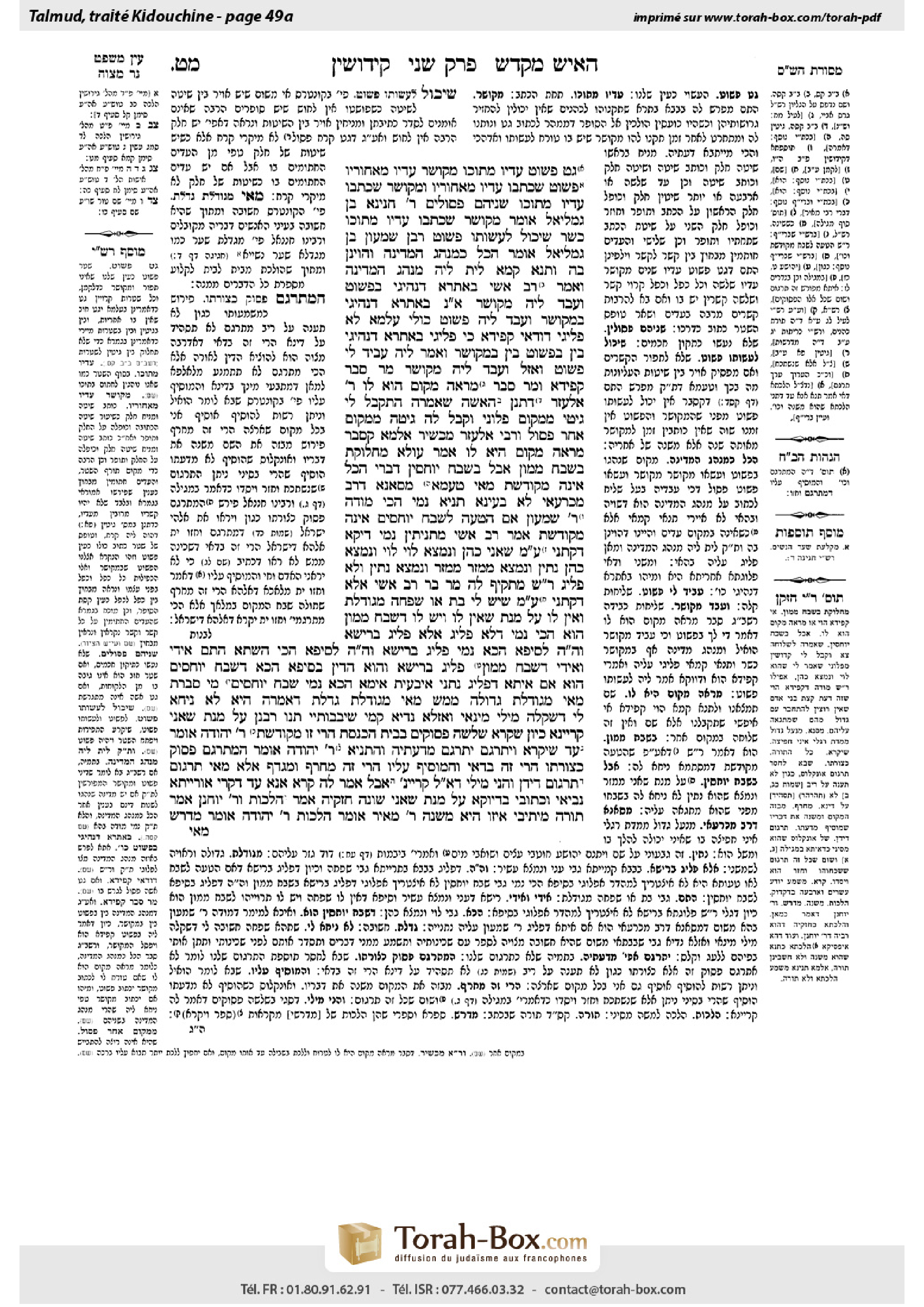
Kiddushin 49a: Talmud study for Daf Yomi
Daf Yomi is the daily study of one Talmud folio. Explore 37 tractates with scans, Hebrew text, Sefaria English and AI-generated French translations where annotated.
Passage selection and English or AI-generated French translation are available where the scan has annotations. Daf Study is independent of Torah-Box and Sefaria.
Browse Kiddushin · קידושין · All tractatesKiddushin 49a text and translations
This page of Kiddushin includes the Aramaic text, an English translation and an AI-generated French translation, alongside the scan above.
קידושין מ״ט א · Aramaic and Hebrew text
גֵּט פָּשׁוּט, עֵדָיו מִתּוֹכוֹ. מְקוּשָּׁר, עֵדָיו מֵאֲחוֹרָיו. פָּשׁוּט שֶׁכָּתְבוּ עֵדָיו מֵאֲחוֹרָיו, וּמְקוּשָּׁר שֶׁכָּתְבוּ עֵדָיו מִתּוֹכוֹ – שְׁנֵיהֶם פְּסוּלִים. רַבִּי חֲנִינָא בֶּן גַּמְלִיאֵל אוֹמֵר: מְקוּשָּׁר שֶׁכָּתְבוּ עֵדָיו מִתּוֹכוֹ – כָּשֵׁר, שֶׁיָּכוֹל לַעֲשׂוֹתוֹ פָּשׁוּט. רַבָּן שִׁמְעוֹן בֶּן גַּמְלִיאֵל אוֹמֵר: הַכֹּל כְּמִנְהַג הַמְּדִינָה.
וְהָוֵינַן בַּהּ: וְתַנָּא קַמָּא לֵית לֵיהּ מִנְהַג הַמְּדִינָה? וְאָמַר רַב אָשֵׁי: בְּאַתְרָא דִּנְהִיגִי בְּפָשׁוּט וַעֲבַד לֵיהּ מְקוּשָּׁר, אִי נָמֵי: בְּאַתְרָא דִּנְהִיגִי בִּמְקוּשָּׁר וַעֲבַד לֵיהּ פָּשׁוּט – כּוּלֵּי עָלְמָא לָא פְּלִיגִי דְּוַדַּאי קְפִידָא.
כִּי פְּלִיגִי, בְּאַתְרָא דִּנְהִיגִי בֵּין בְּפָשׁוּט בֵּין בִּמְקוּשָּׁר, וַאֲמַר לֵיהּ: ״עֲבֵיד לִי פָּשׁוּט״, וַאֲזַל וַעֲבַד לֵיהּ מְקוּשָּׁר. מָר סָבַר: קְפֵידָא, וּמָר סָבַר: מַרְאֶה מָקוֹם הוּא לוֹ.
רַבִּי אֶלְעָזָר – דִּתְנַן: הָאִשָּׁה שֶׁאָמְרָה: ״הִתְקַבֵּל לִי גִּיטִּי מִמָּקוֹם פְּלוֹנִי״, וְקִבֵּל לָהּ גִּיטָּהּ מִמָּקוֹם אַחֵר – פָּסוּל, וְרַבִּי אֶלְעָזָר מַכְשִׁיר. אַלְמָא קָסָבַר: מַרְאָה מָקוֹם הִיא לוֹ.
אָמַר עוּלָּא: מַחֲלוֹקֶת בְּשֶׁבַח מָמוֹן, אֲבָל בְּשֶׁבַח יוּחֲסִין, דִּבְרֵי הַכֹּל – אֵינָהּ מְקוּדֶּשֶׁת. מַאי טַעְמָא – ״מְסָאנָא דְּרַב מִכַּרְעַאי לָא בָּעֵינָא״. תַּנְיָא נָמֵי הָכִי: מוֹדֶה רַבִּי שִׁמְעוֹן, אִם הִטְעָהּ לִשְׁבַח יוּחֲסִים אֵינָהּ מְקוּדֶּשֶׁת.
אָמַר רַב אָשֵׁי: מַתְנִיתִין נָמֵי דַּיְקָא. דְּקָתָנֵי: ״עַל מְנָת שֶׁאֲנִי כֹּהֵן״ וְנִמְצָא לֵוִי, ״לֵוִי״ וְנִמְצָא כֹּהֵן, נָתִין וְנִמְצָא מַמְזֵר, ״מַמְזֵר״ וְנִמְצָא נָתִין. וְלָא פְּלִיג רַבִּי שִׁמְעוֹן.
מַתְקֵיף לַהּ מָר בַּר רַב אָשֵׁי: אֶלָּא דְּקָתָנֵי: ״עַל מְנָת שֶׁיֵּשׁ לִי בַּת אוֹ שִׁפְחָה מְגוּדֶּלֶת״ וְאֵין לוֹ, עַל מְנָת שֶׁאֵין לוֹ וְיֵשׁ לוֹ, דִּשְׁבַח מָמוֹן הוּא, הָכִי נָמֵי דְּלָא פְּלִיג?!
אֶלָּא פְּלִיג בְּרֵישָׁא וְהוּא הַדִּין לְסֵיפָא. הָכָא נָמֵי פְּלִיג בְּרֵישָׁא וְהוּא הַדִּין לְסֵיפָא.
הָכִי הַשְׁתָּא? הָתָם, אִידֵּי וְאִידֵּי דִּשְׁבַח מָמוֹן, פְּלִיג בְּרֵישָׁא וְהוּא הַדִּין בְּסֵיפָא. הָכָא, דִּשְׁבַח יוּחֲסִים הוּא, אִם אִיתָא דִּפְלִיג, נִתְנֵי!
אִיבָּעֵית אֵימָא: הָכָא נָמֵי שְׁבַח יוּחֲסִים, מִי סָבְרַתְּ מַאי מְגוּדֶּלֶת – גְּדוֹלָה מַמָּשׁ? מַאי מְגוּדֶּלֶת – גַּדֶּלֶת, דְּאָמְרָה הִיא: לָא נִיחָא לִי דְּשָׁקְלָה מִילֵּי מִינַּאי וְאָזְלָא נָדְיָא קַמֵּי שִׁיבָבוֹתַיי.
תָּנוּ רַבָּנַן: ״עַל מְנָת שֶׁאֲנִי קַרְיָינָא״, כֵּיוָן שֶׁקָּרָא שְׁלֹשָׁה פְּסוּקִים בְּבֵית הַכְּנֶסֶת – הֲרֵי זוֹ מְקוּדֶּשֶׁת. רַבִּי יְהוּדָה אוֹמֵר עַד שֶׁיִּקְרָא וִיתַרְגֵּם. יְתַרְגֵּם מִדַּעְתֵּיהּ?! וְהָתַנְיָא רַבִּי יְהוּדָה אוֹמֵר: הַמְתַרְגֵּם פָּסוּק כְּצוּרָתוֹ – הֲרֵי זֶה בַּדַּאי. וְהַמּוֹסִיף עָלָיו – הֲרֵי זֶה מְחָרֵף וּמְגַדֵּף. אֶלָּא מַאי תַּרְגּוּם – תַּרְגּוּם דִּידַן.
וְהָנֵי מִילֵּי דַּאֲמַר לַהּ: ״קַרְיָינָא״, אֲבָל אָמַר לַהּ: ״קָרָא אֲנָא״ – עַד דְּקָרֵי אוֹרָיְיתָא נְבִיאֵי וּכְתוּבֵי בְּדִיּוּקָא.
״עַל מְנָת שֶׁאֲנִי שׁוֹנֶה״, חִזְקִיָּה אָמַר: הֲלָכוֹת, וְרַבִּי יוֹחָנָן אָמַר: תּוֹרָה.
מֵיתִיבִי: אֵיזוֹ הִיא מִשְׁנָה? רַבִּי מֵאִיר אוֹמֵר: הֲלָכוֹת, רַבִּי יְהוּדָה אוֹמֵר: מִדְרָשׁ!
Kiddushin 49a · English translation
In an ordinary document, its witnesses are to sign inside it, i.e., on the written side of the paper. In a folded and tied document, its witnesses are to sign on the back of it. With regard to an ordinary document whose witnesses wrote their signatures on the back of it, or a tied document whose witnesses wrote their signatures inside of it, both of these are not valid. Rabbi Ḥanina ben Gamliel says: A tied document whose witnesses wrote their signatures inside of it is valid, because one can transform it into an ordinary document by untying it. Rabban Shimon ben Gamliel says: Everything is in accordance with regional custom. If an ordinary document is generally used and one wrote a bound one, or vice versa, the document is invalid.
And we discussed it: And does the first tanna not accept that one should follow the regional custom? It is not reasonable that he should take issue with such a basic concept. And Rav Ashi says that they have a dispute in a case where one instructed a scribe to write a document for him: If they are in a place where the custom is to write an ordinary document, and he made a tied one for him; alternatively, if they are in a place where the custom is to write a tied document, and he made an ordinary one for him; in both of these cases, everyone agrees that he was certainly particular in his instructions to the agent that he should follow the regional custom, and if the latter deviated from the custom the document is invalid.
The situation in which they disagree is where they are in a place where the custom is to use either an ordinary document or a tied one, and the one requesting the document said to the scribe: Make an ordinary document for me, and the scribe went and made a tied document for him. In such a case, one Sage, the first tanna, holds that the one requesting the document was particular about wanting an ordinary document, and since the scribe wrote a tied document, it is considered to have been written without his consent. And one Sage, Rabban Shimon ben Gamliel, holds that the one requesting the document was merely indicating his position to the scribe, stating that if the scribe wanted to save himself the trouble of writing a tied document there would no objection.
Rabbi Elazar also holds that when one instructs an agent in such a manner he is merely indicating his position to him, as we learned in a mishna (Gittin 65a): If there was a woman who said to her agent: Receive my bill of divorce for me from my husband in such and such a place, and he received her bill of divorce for her elsewhere, it is invalid. And Rabbi Elazar deems it valid. Apparently, he holds that she is merely indicating a place to him where he can receive the bill of divorce, but she does not insist that he accept it in that particular spot.
§ Ulla says: The dispute in the mishna between the first tanna and Rabbi Shimon is only where he misled her with enhanced monetary value, i.e., he gave her something worth more than the item he had stipulated. But where he misled her with enhanced lineage, so that she was under the impression that his genealogy was less impressive than it in fact is, everyone agrees that she is not betrothed. What is the reason for this? A woman says: I do not desire a shoe that is larger than my foot. She does not wish to marry a man whose social standing is far greater than her own. This is also taught in a baraita (Tosefta 2:6): Rabbi Shimon concedes that if he misled her with enhanced lineage, she is not betrothed.
Rav Ashi says: The wording of the mishna is also precise, as the following mishna (49b) teaches: If one betroths a woman and states that the betrothal is: On the condition that I am a priest, and he was found to be a Levite; or: On the condition that I am a Levite, and he was found to be a priest; or: On the condition that I am a Gibeonite, a people prohibited by rabbinic law from marrying into the congregation, i.e., from marrying a Jew of fit lineage, and he was found to be a mamzer, who is prohibited by Torah law from marrying into the congregation; or: On the condition that I am a mamzer, and he was found to be a Gibeonite, in all of these cases she is not betrothed. And Rabbi Shimon does not disagree with these rulings. This indicates that if one misled a woman with regard to his lineage, Rabbi Shimon concedes that she is not betrothed.
Mar bar Rav Ashi objects to this inference: But what about that which is taught in the same mishna: If one betroths a woman and states that the betrothal is: On the condition that I have a grown daughter or maidservant, and he does not have one; or if one betroths a woman on the condition that he does not have a grown daughter or maidservant and he does have one, the latter of which is an issue of enhanced monetary value, as the difference between one who has a maidservant and one who does not impacts how hard the woman will have to work in the home; in these cases will you also say that Rabbi Shimon does not disagree simply because the mishna does not mention his opinion in that case?
Rather, it must be that he disagrees in the first clause of the mishna with regard to enhanced monetary value, and the same is true with regard to the latter clause, i.e., he also disagrees in that clause, and it was not necessary to state his dispute another time. Here too, with regard to lineage, he disagrees in the first clause, and the same is true with regard to the latter clause.
The Gemara rejects this: How can these cases be compared? There, where both this case and that case involve an inaccuracy of enhanced monetary value, it is possible that he disagreed in the first clause and the same is true in the last clause, and the mishna did not need to restate his opinion. But here, where it is a case of enhanced lineage, which is a different issue, if it is so that Rabbi Shimon disagrees, let him teach that explicitly. The fact that no dispute is recorded in the case of enhanced lineage is proof that he concedes in that case.
If you wish, say instead: Here too, the issue of a daughter or maidservant involves enhanced lineage, not enhanced monetary value. His statement should be understood differently. Do you maintain that what is the meaning of his statement that he has a grown daughter or maidservant; that she is actually grown up, so that she can be of help to his wife? That is not the meaning of his statement. Rather, what is the meaning of: Grown? That she grows and plaits hair, i.e., he has a daughter or maidservant who is a hairdresser. Why might the potential bride view this as a drawback? Because she can say: It is not satisfactory for me to live in the house with a hairdresser, as she will take words she hears from me and will go pass them before my neighbors, meaning she will gossip about me to others. This concern is more akin to a matter of lineage than a matter of monetary value.
§ The Sages taught: If one said to a woman: Be betrothed to me on the condition that I am literate with regard to the Torah, once he has read three verses in the synagogue she is betrothed. Rabbi Yehuda says that she is not betrothed until he reads and translates the verses. The Gemara asks: Does Rabbi Yehuda mean that one translates according to his own understanding? But isn’t it taught in a baraita (Tosefta, Megilla 3:21) that Rabbi Yehuda says: One who translates a verse literally is a liar, since he distorts the meaning of the text, and conversely, one who adds his own translation is tantamount to one who curses and blasphemes God? Rather, to which translation is Rabbi Yehuda referring? He is referring to our accepted translation.
And this statement applies only if he said to her: I am literate, but if he said to her: I am a reader, this indicates that he is an expert in the reading of the Torah, and she is not betrothed unless he knows how to read the Torah, the Prophets, and the Writings with precision.
The Gemara discusses a similar case: If one said to a woman: Be betrothed to me on the condition that I study [shoneh], Ḥizkiyya says it means that he studies halakhot, and Rabbi Yoḥanan says it means that he studies Torah, i.e., the written Torah.
The Gemara raises an objection to Rabbi Yoḥanan from a baraita: What is the meaning of: Mishna? Rabbi Meir says halakhot, Rabbi Yehuda says homiletics. Neither of them, however, says that it refers to the written Torah.
Kiddushin 49a · Traduction française (IA)
Dans un acte ordinaire, les témoins doivent signer à l’intérieur, c’est-à-dire sur la face écrite du papier. Dans un acte plié et lié, ils doivent signer au verso. Un acte ordinaire dont les témoins ont signé au verso, ou un acte plié dont les témoins ont signé à l’intérieur, est dans les deux cas invalide. Rabbi Ḥanina ben Gamliel dit : « Un acte plié dont les témoins ont signé à l’intérieur est valide, car on peut le transformer en acte ordinaire en le dépliant. » Rabban Shimon ben Gamliel dit : « Tout dépend de l’usage local. » Si l’usage est de rédiger un acte ordinaire et que l’on a rédigé un acte plié, ou inversement, l’acte est invalide.
Nous avons discuté de cette Michna : le premier tanna n’admet-il pas qu’il faut suivre l’usage local ? Il n’est pas raisonnable qu’il conteste un principe aussi élémentaire. Rav Ashi dit que leur désaccord porte sur le cas où quelqu’un a chargé un scribe de rédiger un acte pour lui. S’ils se trouvent dans un endroit où l’usage est de rédiger un acte ordinaire et que le scribe lui en a rédigé un plié, ou, à l’inverse, dans un endroit où l’usage est de rédiger un acte plié et que le scribe lui en a rédigé un ordinaire, tous conviennent que le commanditaire avait certainement demandé à son mandataire de suivre l’usage local ; si celui-ci s’en est écarté, l’acte est invalide.
Leur désaccord porte sur le cas où l’usage local admet aussi bien l’acte ordinaire que l’acte plié, et où la personne qui demande l’acte dit au scribe : « Rédige-moi un acte ordinaire », mais où le scribe lui rédige un acte plié. Dans un tel cas, un Sage — le premier tanna — estime que le commanditaire tenait à avoir un acte ordinaire et que, puisque le scribe a rédigé un acte plié, celui-ci est réputé avoir été rédigé sans son consentement. L’autre Sage, Rabban Shimon ben Gamliel, estime que le commanditaire ne faisait qu’indiquer sa préférence au scribe, lui signifiant que, s’il voulait s’épargner la peine de rédiger un acte plié, cela ne poserait pas de problème.
Rabbi Elazar estime lui aussi que, lorsqu’on donne de telles instructions à un mandataire, on ne fait que lui indiquer sa préférence, comme nous l’avons appris dans une Michna (Gittin 65a) : si une femme dit à son mandataire : « Reçois pour moi mon acte de divorce de mon mari à tel endroit », et que celui-ci le reçoit pour elle ailleurs, l’acte est invalide. Rabbi Elazar le considère comme valide. Il apparaît donc qu’à ses yeux, elle lui indique simplement un endroit où il peut recevoir l’acte de divorce, sans exiger qu’il le reçoive précisément à cet endroit.
§ Oulla dit : Dans la Michna, le désaccord entre le premier tanna et Rabbi Shimon ne porte que sur le cas où il l’a induite en erreur en lui donnant un objet de valeur supérieure à celle de l’objet convenu. Mais s’il l’a induite en erreur au sujet de ses origines, en lui laissant croire que sa généalogie était moins prestigieuse qu’elle ne l’est en réalité, tous conviennent qu’elle n’est pas fiancée. Pour quelle raison ? Une femme dit : « Je ne veux pas d’une chaussure plus grande que mon pied. » Elle ne souhaite pas épouser un homme dont le rang social est très supérieur au sien. Cela est également enseigné dans une baraïta (Tosefta 2:6) : Rabbi Shimon reconnaît que, s’il l’a induite en erreur au sujet de ses origines, elle n’est pas fiancée.
Rav Ashi dit : La formulation de la Michna est également précise, comme l’enseigne la Michna suivante (49b) : si quelqu’un fiance une femme à la condition qu’il soit prêtre, mais qu’il se révèle être lévite ; ou à la condition qu’il soit lévite, mais qu’il se révèle être prêtre ; ou à la condition qu’il soit guibonite — peuple auquel la loi rabbinique interdit de s’intégrer à l’assemblée, c’est-à-dire d’épouser un Juif de filiation régulière —, mais qu’il se révèle être mamzer, auquel la Torah écrite interdit de s’intégrer à l’assemblée ; ou à la condition qu’il soit mamzer, mais qu’il se révèle être guibonite, dans tous ces cas elle n’est pas fiancée. Rabbi Shimon ne conteste pas ces décisions. Cela indique que, si quelqu’un a induit une femme en erreur au sujet de ses origines, Rabbi Shimon reconnaît qu’elle n’est pas fiancée.
Mar bar Rav Ashi objecte à cette déduction : mais qu’en est-il de ce qui est enseigné dans la même Michna ? Si quelqu’un fiance une femme à la condition qu’il ait une fille adulte ou une servante adulte, alors qu’il n’en a pas ; ou s’il la fiance à la condition qu’il n’ait ni fille adulte ni servante adulte, alors qu’il en a une — ce dernier cas relevant d’une valeur supérieure, puisque le fait qu’il ait ou non une servante influe sur la quantité de travail que la femme devra accomplir à la maison —, diras-tu aussi que Rabbi Shimon ne conteste pas cette décision simplement parce que la Michna ne mentionne pas son avis dans ce cas ?
Il faut plutôt dire que Rabbi Shimon conteste le premier cas de la Michna concernant la valeur supérieure, et qu’il en va de même pour le dernier cas : il le conteste également, sans qu’il soit nécessaire de mentionner à nouveau son désaccord. Ici aussi, concernant les origines, il conteste le premier cas, et il en va de même pour le dernier cas.
La Guemara rejette cette réponse : comment comparer ces cas ? Là-bas, puisque les deux cas portent sur une erreur concernant une valeur supérieure, il est possible qu’il ait contesté le premier cas et qu’il en aille de même pour le dernier, sans qu’il soit nécessaire que la Michna répète son avis. Mais ici, puisqu’il s’agit d’une question d’origines, qui est différente, si Rabbi Shimon contestait cette décision, que la Michna le dise explicitement ! Le fait qu’aucun désaccord ne soit rapporté concernant la supériorité des origines prouve qu’il reconnaît la décision dans ce cas.
Si tu le souhaites, on peut plutôt dire qu’ici aussi, la question d’une fille ou d’une servante relève de la supériorité des origines et non de la valeur supérieure. Il faut comprendre autrement ses propos. Crois-tu que dire qu’il a une fille adulte ou une servante adulte signifie qu’elle est effectivement adulte, de sorte qu’elle puisse aider son épouse ? Ce n’est pas le sens de ses paroles. Que signifie donc « adulte » ? Cela signifie qu’elle fait pousser et tresse des cheveux, c’est-à-dire qu’il a une fille ou une servante coiffeuse. Pourquoi la future épouse pourrait-elle considérer cela comme un inconvénient ? Elle peut dire : « Il ne me convient pas de vivre dans la même maison qu’une coiffeuse, car elle prendra les propos qu’elle m’entend dire et ira les rapporter à mes voisines », autrement dit, elle colportera des ragots à mon sujet. Cette préoccupation se rapproche davantage d’une question d’origines que d’une question de valeur monétaire.
§ Les Sages ont enseigné : si quelqu’un dit à une femme : « Sois fiancée à moi à la condition que je sois lettré en Torah », dès qu’il a lu trois versets à la synagogue, elle est fiancée. Rabbi Yehuda dit qu’elle n’est pas fiancée tant qu’il n’a pas lu et traduit les versets. La Guemara demande : Rabbi Yehuda veut-il dire qu’il les traduit selon sa propre compréhension ? Pourtant, il est enseigné dans une baraïta (Tosefta, Megilla 3:21) que Rabbi Yehuda dit : « Celui qui traduit un verset littéralement est un menteur, car il déforme le sens du texte ; à l’inverse, celui qui ajoute à la traduction de son propre chef est comme quelqu’un qui maudit et blasphème Dieu. » À quelle traduction Rabbi Yehuda fait-il donc référence ? Il s’agit de la traduction reçue.
Cette déclaration ne s’applique que s’il lui a dit : « Je suis lettré ». Mais s’il lui a dit : « Je suis lecteur », cela indique qu’il maîtrise la lecture de la Torah, et elle n’est fiancée que s’il sait lire avec précision la Torah, les Prophètes et les Écrits.
La Guemara examine un cas similaire : si quelqu’un dit à une femme : « Sois fiancée à moi à la condition que j’étudie [shoneh] », Ḥizkiyya dit que cela signifie qu’il étudie les halakhot, tandis que Rabbi Yoḥanan dit que cela signifie qu’il étudie la Torah, c’est-à-dire la Torah écrite.
La Guemara soulève une objection à Rabbi Yoḥanan à partir d’une baraïta : que signifie le terme Michna ? Rabbi Meir dit : « Les halakhot » ; Rabbi Yehuda dit : « Les enseignements homilétiques ». Cependant, aucun des deux ne dit qu’il s’agit de la Torah écrite.
Traduction française générée par IA à partir de l’édition anglaise de Sefaria. Vérifie toujours un passage avec le texte source.
Text from Sefaria: William Davidson Edition - Vocalized Aramaic (CC BY NC); William Davidson Edition - English (CC BY NC).