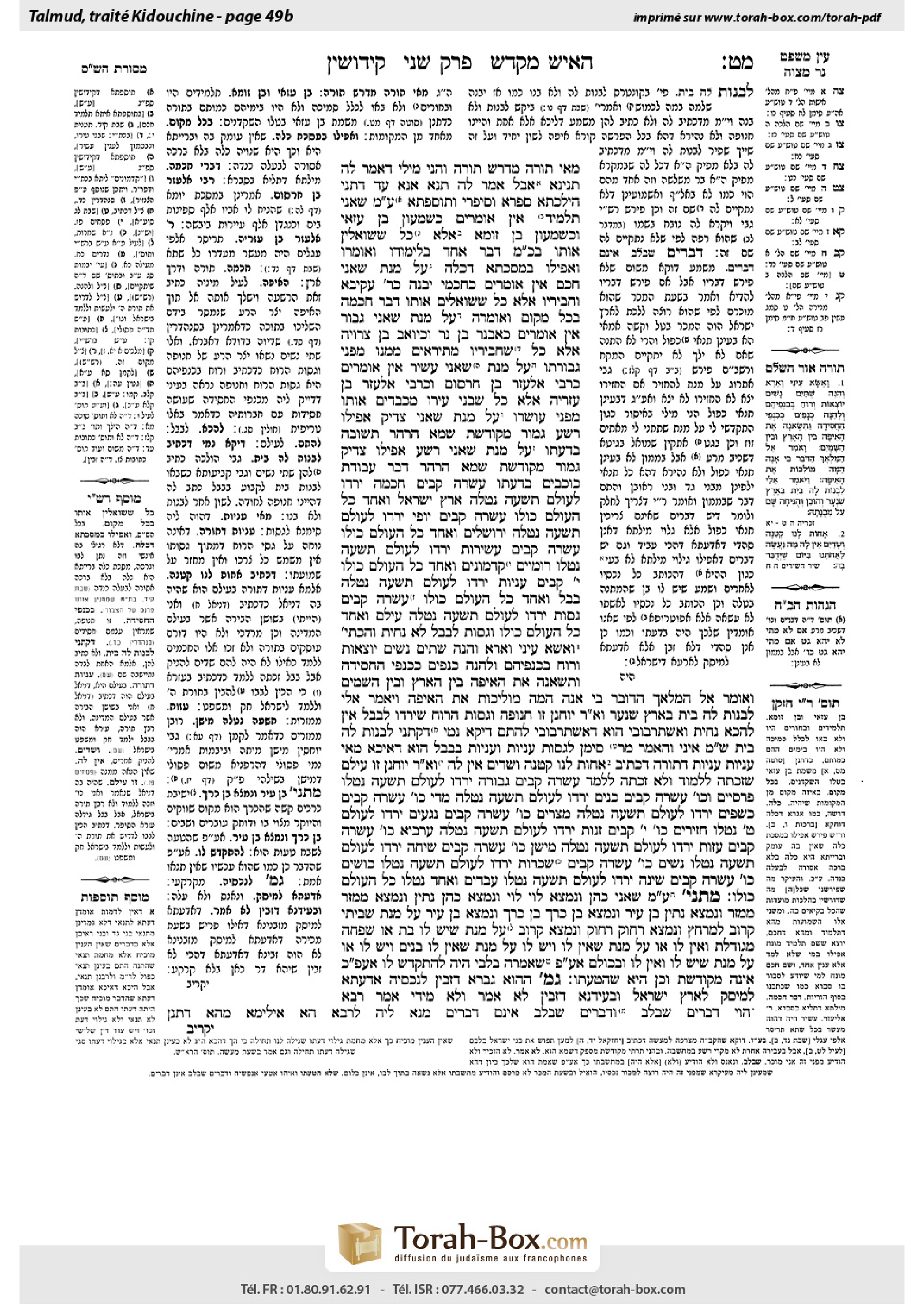
Kiddushin 49b: Talmud study for Daf Yomi
Daf Yomi is the daily study of one Talmud folio. Explore 37 tractates with scans, Hebrew text, Sefaria English and AI-generated French translations where annotated.
Passage selection and English or AI-generated French translation are available where the scan has annotations. Daf Study is independent of Torah-Box and Sefaria.
Browse Kiddushin · קידושין · All tractatesKiddushin 49b text and translations
This page of Kiddushin includes the Aramaic text, an English translation and an AI-generated French translation, alongside the scan above.
קידושין מ״ט ב · Aramaic and Hebrew text
מַאי תּוֹרָה – מִדְרַשׁ תּוֹרָה. וְהָנֵי מִילֵּי דַּאֲמַר לַהּ: ״תָּנֵינָא״, אֲבָל אֲמַר לַהּ: ״תַּנָּא אֲנָא״, עַד דְּתָנֵי הִילְכְתָא, סִפְרָא, וְסִיפְרֵי, וְתוֹסֶפְתָּא.
״עַל מְנָת שֶׁאֲנִי תַּלְמִיד״ – אֵין אוֹמְרִים כְּשִׁמְעוֹן בֶּן עַזַּאי וּכְשִׁמְעוֹן בֶּן זוֹמָא, אֶלָּא, כֹּל שֶׁשּׁוֹאֲלִין אוֹתוֹ בְּכׇל מָקוֹם דָּבָר אֶחָד בְּתַלְמוּדוֹ וְאוֹמְרוֹ, וַאֲפִילּוּ בְּמַסֶּכְתָּא דְכַלָּה. ״עַל מְנָת שֶׁאֲנִי חָכָם״ – אֵין אוֹמְרִים כְּחַכְמֵי יַבְנֶה, כְּרַבִּי עֲקִיבָא וַחֲבֵירָיו, אֶלָּא, כֹּל שֶׁשּׁוֹאֲלִים אוֹתוֹ דְּבַר חׇכְמָה בְּכׇל מָקוֹם וְאוֹמְרָהּ.
״עַל מְנָת שֶׁאֲנִי גִּבּוֹר״ – אֵין אוֹמְרִים כְּאַבְנֵר בֶּן נֵר וּכְיוֹאָב בֶּן צְרוּיָה, אֶלָּא כֹּל שֶׁחֲבֵירָיו מִתְיָרְאִים מִמֶּנּוּ מִפְּנֵי גְבוּרָתוֹ. ״עַל מְנָת שֶׁאֲנִי עָשִׁיר״ – אֵין אוֹמְרִים כְּרַבִּי אֶלְעָזָר בֶּן חַרְסוֹם וּכְרַבִּי אֶלְעָזָר בֶּן עֲזַרְיָה, אֶלָּא כֹּל שֶׁבְּנֵי עִירוֹ מְכַבְּדִים אוֹתוֹ מִפְּנֵי עוֹשְׁרוֹ.
״עַל מְנָת שֶׁאֲנִי צַדִּיק״ – אֲפִילּוּ רָשָׁע גָּמוּר – מְקוּדֶּשֶׁת, שֶׁמָּא הִרְהֵר תְּשׁוּבָה בְּדַעְתּוֹ. ״עַל מְנָת שֶׁאֲנִי רָשָׁע״ – אֲפִילּוּ צַדִּיק גָּמוּר – מְקוּדֶּשֶׁת, שֶׁמָּא הִרְהֵר דְּבַר עֲבוֹדָה זָרָה בְּדַעְתּוֹ.
עֲשָׂרָה קַבִּים חׇכְמָה יָרְדוּ לָעוֹלָם, תִּשְׁעָה נָטְלָה אֶרֶץ יִשְׂרָאֵל וְאֶחָד כׇּל הָעוֹלָם כּוּלּוֹ. עֲשָׂרָה קַבִּים יוֹפִי יָרְדוּ לָעוֹלָם, תִּשְׁעָה נָטְלָה יְרוּשָׁלַיִם וְאֶחָד כׇּל הָעוֹלָם כּוּלּוֹ. עֲשָׂרָה קַבִּים עֲשִׁירוּת יָרְדוּ לָעוֹלָם, תִּשְׁעָה נָטְלָה רוֹמִי וְאֶחָד כׇּל הָעוֹלָם כּוּלּוֹ. עֲשָׂרָה קַבִּים עֲנִיּוּת יָרְדוּ לָעוֹלָם, תִּשְׁעָה נָטְלָה בָּבֶל וְאֶחָד כׇּל הָעוֹלָם כּוּלּוֹ. עֲשָׂרָה קַבִּים גַּסּוּת יָרְדוּ לָעוֹלָם, תִּשְׁעָה נָטְלָה עֵילָם וְאֶחָד כׇּל הָעוֹלָם כּוּלּוֹ.
וְגַסּוּת לְבָבֶל לָא נְחִית? וְהָכְתִיב: ״וָאֶשָּׂא עֵינַי וָאֵרֶא וְהִנֵּה שְׁתַּיִם נָשִׁים יוֹצְאוֹת וְרוּחַ בְּכַנְפֵיהֶם וְלָהֵנָּה כְנָפַיִם כְּכַנְפֵי הַחֲסִידָה וְתִשְׁנֶה אֶת הָאֵיפָה בֵּין הָאָרֶץ וּבֵין הַשָּׁמָיִם. וָאֹמַר אֶל הַמַּלְאָךְ הַדֹּבֵר בִּי אָנָה הֵמָּה מוֹלִכוֹת אֶת הָאֵיפָה. וַיֹּאמֶר אֵלַי לִבְנוֹת לָהֿ בַיִת בְּאֶרֶץ שִׁנְעָר״. וְאָמַר רַבִּי יוֹחָנָן: זוֹ חֲנוּפָּה וְגַסּוּת הָרוּחַ שֶׁיָּרְדוּ לְבָבֶל!
אִין, לְהָכָא נְחִית, וְאִשְׁתַּרְבּוֹבֵי הוּא דְּאִשְׁתַּרְבּוּב לְהָתָם. דַּיְקָא נָמֵי דְּקָתָנֵי: ״לִבְנוֹת לָהּ בַּיִת״, שְׁמַע מִינַּהּ.
אִינִי?! וְהָאָמַר מָר: סִימָן לְגַסּוּת – עֲנִיּוּת, וַעֲנִיּוּת בְּבָבֶל הוּא דְּאִיכָּא! מַאי עֲנִיּוּת – עֲנִיּוּת דְּתוֹרָה. דִּכְתִיב: ״אָחוֹת לָנוּ קְטַנָּה וְשָׁדַיִם אֵין לָהּ״, וְאָמַר רַבִּי יוֹחָנָן: זוֹ עֵילָם, שֶׁזָּכְתָה לִלְמוֹד, וְלֹא זָכְתָה לְלַמֵּד.
עֲשָׂרָה קַבִּים גְּבוּרָה יָרְדוּ לָעוֹלָם, תִּשְׁעָה נָטְלוּ פָּרְסִיִּים וְכוּ׳. עֲשָׂרָה קַבִּים כִּנִּים יָרְדוּ לָעוֹלָם, תִּשְׁעָה נָטְלָה מָדַי כּוּ׳. עֲשָׂרָה קַבִּים כְּשָׁפִים יָרְדוּ לָעוֹלָם תִּשְׁעָה נָטְלָה מִצְרַיִם כּוּ׳. עֲשָׂרָה קַבִּים נְגָעִים יָרְדוּ לָעוֹלָם, תִּשְׁעָה נָטְלוּ חֲזִירִים כּוּ׳. עֲשָׂרָה קַבִּים זְנוּת יָרְדוּ לָעוֹלָם, תִּשְׁעָה נָטְלָה עַרְבִיָּא כּוּ׳.
עֲשָׂרָה קַבִּים עַזּוּת יָרְדוּ לָעוֹלָם, תִּשְׁעָה נָטְלָה מֵישָׁן כּוּ׳. עֲשָׂרָה קַבִּים שִׂיחָה יָרְדוּ לָעוֹלָם, תִּשְׁעָה נָטְלוּ נָשִׁים כּוּ׳. עֲשָׂרָה קַבִּים שִׁכְרוּת יָרְדוּ לָעוֹלָם, תִּשְׁעָה נָטְלוּ כּוּשִׁים כּוּ׳. עֲשָׂרָה קַבִּים שֵׁינָה יָרְדוּ לָעוֹלָם, תִּשְׁעָה נָטְלוּ עֲבָדִים וְאֶחָד נָטְלוּ כָּל הָעוֹלָם כּוּלּוֹ.
מַתְנִי׳ ״עַל מְנָת שֶׁאֲנִי כֹּהֵן״ וְנִמְצָא לֵוִי, ״לֵוִי״ וְנִמְצָא כֹּהֵן, ״נָתִין״ וְנִמְצָא מַמְזֵר. ״מַמְזֵר״ וְנִמְצָא נָתִין, ״בֶּן עִיר״ וְנִמְצָא בֶּן כְּרַךְ, ״בֶּן כְּרַךְ״ וְנִמְצָא בֶּן עִיר. ״עַל מְנָת שֶׁבֵּיתִי קָרוֹב לַמֶּרְחָץ״ וְנִמְצָא רָחוֹק, ״רָחוֹק״ וְנִמְצָא קָרוֹב.
״עַל מְנָת שֶׁיֵּשׁ לוֹ בַּת אוֹ שִׁפְחָה מְגוּדֶּלֶת״ וְאֵין לוֹ, אוֹ ״עַל מְנָת שֶׁאֵין לוֹ״ וְיֵשׁ לוֹ. ״עַל מְנָת שֶׁאֵין לוֹ בָּנִים״ וְיֵשׁ לוֹ, אוֹ עַל מְנָת שֶׁיֵּשׁ לוֹ וְאֵין לוֹ. וּבְכוּלָּם, אַף עַל פִּי שֶׁאָמְרָה: ״בְּלִבִּי הָיָה לְהִתְקַדֵּשׁ לוֹ״ – אַף עַל פִּי כֵן אֵינָהּ מְקוּדֶּשֶׁת. וְכֵן הִיא שֶׁהִטְעַתּוּ.
גְּמָ׳ הָהוּא גַּבְרָא דְּזַבֵּין לְנִכְסֵיהּ אַדַּעְתָּא לְמִיסַּק לְאֶרֶץ יִשְׂרָאֵל, וּבְעִידָּנָא דְּזַבֵּין לָא אֲמַר וְלָא מִידֵּי. אָמַר רָבָא: הָוֵי דְּבָרִים שֶׁבַּלֵּב, וּדְבָרִים שֶׁבַּלֵּב אֵינָם דְּבָרִים. מְנָא לֵיהּ לְרָבָא הָא? אִילֵּימָא מֵהָא דִּתְנַן:
Kiddushin 49b · English translation
What is the meaning of: Torah, that Rabbi Yoḥanan said? It is homiletic interpretation of the Torah. And this statement applies only if he said to her: I study [taneina]. But if he says to her: I am a tanna [tanna ana], she is not betrothed unless he studies halakha, i.e., Mishna, Sifra and Sifrei, and Tosefta.
If a man says to a woman: Be betrothed to me on the condition that I am a student of Torah, one does not say that he must be a student who is scholarly like Shimon ben Azzai or like Shimon ben Zoma, who were called students despite their great knowledge, as they were never ordained. Rather, it means anyone who, when he is asked one matter in any topic of his studies, responds appropriately and can say what he has learned, and this suffices even if his statement was in the tractate of Kalla. Similarly, if a man says to a woman: Be betrothed to me on the condition that I am a scholar, one does not say that he must be like the scholars of Yavne, like Rabbi Akiva and his colleagues. Rather, it is referring to anyone who, when he is asked about a matter of wisdom on any topic related to the Torah, responds appropriately and can say what he has learned.
If a man says to a woman: Be betrothed to me on the condition that I am strong, one does not say that he must be as strong as Abner ben Ner, King Saul’s cousin and general, or as strong as Joab ben Zeruiah, King David’s nephew and general. Rather, it means anyone of whom others are afraid due to his strength. If a man says to a woman: Be betrothed to me on the condition that I am wealthy, one does not say he must be as wealthy as Rabbi Elazar ben Ḥarsom or as wealthy as Rabbi Elazar ben Azarya, but rather it can refer to anyone who is honored by the members of his town due to his wealth.
If one says to a woman: Be betrothed to me on the condition that I am a righteous man, then even if he was a completely wicked man she is betrothed, as perhaps in the meantime he had thoughts of repentance in his mind and is now righteous. Similarly, if one says to a woman: Be betrothed to me on the condition that I am a wicked man, then even if he was a completely righteous man she is betrothed, as perhaps he had thoughts of idol worship in his mind, a serious sin that would earn him the label of wicked.
§ Apropos the discussion with regard to various attributes, the Gemara cites a related statement: Ten kav of wisdom descended to the world; Eretz Yisrael took nine of them and all the rest of the world took one. Ten kav of beauty descended to the world; Jerusalem took nine and all the rest of the world in its entirety took one. Ten kav of wealth descended to the world; Rome took nine and all the rest of the world in its entirety took one. Ten kav of poverty descended to the world; Babylonia took nine and all the rest of the world in its entirety took one. Ten kav of arrogance descended to the world; Eilam took nine and all the rest of the world in its entirety took one.
The Gemara asks: But did arrogance not descend to Babylonia? But isn’t it written: “Then I lifted my eyes and saw, and behold there came forth two women, and the wind was in their wings, for they had wings like the wings of a stork. And they lifted up the measure between the earth and the heaven. Then I said to the angel that spoke with me: ‘To where do they take the measure?’ And he said to me: ‘To build her a house in the land of Shinar’” (Zechariah 5:9–11). And Rabbi Yoḥanan says: This refers to flattery and arrogance that descended to Babylonia, i.e., Shinar. This indicates that arrogance reached Babylonia as well.
The Gemara answers: Yes, it descended to here, to Babylonia, and it made its way to there, to Eilam. The language of the verse is also precise, as it teaches: “To build her a house,” which indicates that the original intention was to build a house in Babylonia, but it was not built there. The Gemara comments: Conclude from it that arrogance did not remain in Babylonia.
The Gemara further asks: Is that so? But didn’t the Master say: A sign of arrogance is poverty, and there is poverty in Babylonia, and not in Eilam. The Gemara answers: To what kind of poverty is this referring? It is poverty with regard to Torah, which was characteristic of Eilam. As it is written: “We have a little sister, and she has no breasts” (Song of Songs 8:8), and Rabbi Yoḥanan said: This refers to Eilam, whose inhabitants merited to learn but did not merit to teach. They did not produce Torah scholars capable of imparting their wisdom to others.
The Gemara returns to its list of endowments of various groups: Ten kav of strength descended to the world; the Persians took nine and the rest of the world took one. Ten kav of lice descended to the world; Media took nine and the rest of the world took one. Ten kav of witchcraft descended to the world; Egypt took nine and the rest of the world took one. Ten kav of plagues descended to the world; pigs, which carry disease, took nine and the rest of the world took one. Ten kav of licentiousness descended to the world; Arabia took nine and the rest of the world took one.
Ten kav of brazenness descended to the world; Meishan, near Babylonia, took nine and the rest of the world took one. Ten kav of conversation descended to the world; women took nine and the rest of the world took one. Ten kav of drunkenness descended to the world; the Kushites took nine and the rest of the world took one. Ten kav of sleep descended to the world; slaves took nine and all the rest of the world in its entirety took one.
MISHNA: If one said to a woman: Be betrothed to me on the condition that I am a priest, and he was found to be a Levite; or if he said: A Levite, and he was found to be a priest; or if he said: Be betrothed to me on the condition that I am a Gibeonite, a people prohibited by rabbinic law from marrying into the congregation, i.e., from marrying a Jew of fit lineage, and he was found to be a mamzer, who is prohibited by Torah law to marry into the congregation; or he said: A mamzer, and he was found to be a Gibeonite; or if he said: Be betrothed to me on the condition that I am a resident of a small town, and he was found to be a resident of a large city; or he said: A resident of a city, and he was found to be a resident of a town; or if he said: Be betrothed to me on the condition that my house is close to the bathhouse, and it was found to be far; or he said: Far from the bathhouse, and it was found to be close, she is not betrothed.
Or if he said that she is betrothed to him on the condition that he has a grown daughter or a maidservant, and he does not have one, or on the condition that he does not have one and he has one; or on the condition that he has no sons, and he has sons, or on the condition that he has sons and he does not have sons, then she is not betrothed. And in all these cases, despite the fact that she later stated: I intended to become betrothed to him nevertheless, whether or not he fulfilled the condition, she is not betrothed. And similarly, if it was she who misled him by making the betrothal conditional upon a statement of hers that turned out to be incorrect, the betrothal will not take effect.
GEMARA: The Gemara relates: There was a certain man who sold his property with the intention of ascending to Eretz Yisrael, but at the time that he sold the property he did not say anything with regard to his intention. Ultimately, he did not ascend to Eretz Yisrael, and he wished to renege on the sale. Rava said: Since he did not explicitly state that he was selling his property on the condition that he ascend to Eretz Yisrael, that is an unspoken matter that remained in the heart, and unspoken matters that remain in the heart are not significant matters. The Gemara asks: From where does Rava learn this principle? If we say it is from that which we learn in a baraita:
Kiddushin 49b · Traduction française (IA)
Que signifie « Torah » dans la déclaration de Rabbi Yoḥanan ? Il s’agit d’une interprétation homilétique de la Torah. Cette règle ne s’applique que s’il lui a dit : « J’étudie » [taneina]. Mais s’il lui dit : « Je suis un tanna » [tanna ana], elle n’est pas fiancée à moins qu’il étudie la halakha, c’est-à-dire la Michna, le Sifra, le Sifrei et la Tosefta.
Si un homme dit à une femme : « Sois fiancée à moi à condition que je sois un étudiant en Torah », cela ne signifie pas qu’il doive être aussi érudit que Shimon ben Azzai ou Shimon ben Zoma, qui étaient appelés étudiants malgré leur immense savoir, puisqu’ils n’ont jamais reçu l’ordination. Cela désigne plutôt toute personne qui, lorsqu’on l’interroge sur un point quelconque de ses études, répond de manière appropriée et peut exposer ce qu’elle a appris ; cela suffit même si sa réponse porte sur le traité de Kalla. De même, si un homme dit à une femme : « Sois fiancée à moi à condition que je sois un sage », cela ne signifie pas qu’il doive être comme les sages de Yavné, tels que Rabbi Akiva et ses collègues. Cela désigne plutôt toute personne qui, lorsqu’on l’interroge sur une question de sagesse liée à la Torah, quel qu’en soit le sujet, répond de manière appropriée et peut exposer ce qu’elle a appris.
Si un homme dit à une femme : « Sois fiancée à moi à condition que je sois fort », cela ne signifie pas qu’il doive être aussi fort qu’Avner ben Ner, cousin du roi Saül et son général, ou que Yoav ben Tserouya, neveu du roi David et son général. Cela désigne plutôt toute personne dont les autres ont peur en raison de sa force. Si un homme dit à une femme : « Sois fiancée à moi à condition que je sois riche », cela ne signifie pas qu’il doive être aussi riche que Rabbi Elazar ben Ḥarsom ou Rabbi Elazar ben Azarya ; cela peut plutôt désigner toute personne que les habitants de sa ville honorent en raison de sa richesse.
Si un homme dit à une femme : « Sois fiancée à moi à condition que je sois un homme juste », alors, même s’il était tout à fait méchant, elle est fiancée, car il se peut qu’entre-temps il ait eu des pensées de repentir et soit désormais juste. De même, si un homme dit à une femme : « Sois fiancée à moi à condition que je sois un homme méchant », alors, même s’il était tout à fait juste, elle est fiancée, car il se peut qu’il ait eu des pensées d’idolâtrie, un péché grave qui lui vaudrait d’être qualifié de méchant.
§ À propos de la discussion sur les différentes qualités, la Guemara rapporte une déclaration connexe : dix kav de sagesse descendirent dans le monde ; la terre d’Israël en prit neuf et tout le reste du monde en prit un. Dix kav de beauté descendirent dans le monde ; Jérusalem en prit neuf et tout le reste du monde, dans son ensemble, en prit un. Dix kav de richesse descendirent dans le monde ; Rome en prit neuf et tout le reste du monde, dans son ensemble, en prit un. Dix kav de pauvreté descendirent dans le monde ; la Babylonie en prit neuf et tout le reste du monde, dans son ensemble, en prit un. Dix kav d’arrogance descendirent dans le monde ; Élam en prit neuf et tout le reste du monde, dans son ensemble, en prit un.
La Guemara demande : Mais l’arrogance n’est-elle pas aussi descendue en Babylonie ? N’est-il pas écrit : « Puis je levai les yeux et je vis : voici que deux femmes s’avançaient, le vent dans leurs ailes, car elles avaient des ailes semblables à celles de la cigogne. Elles soulevèrent l’épha entre la terre et le ciel. Je dis alors à l’ange qui me parlait : “Où emportent-elles l’épha ?” Il me répondit : “Pour lui construire une maison au pays de Shinar” » (Zacharie 5, 9-11). Et Rabbi Yoḥanan dit : Cela désigne la flatterie et l’arrogance qui descendirent en Babylonie, c’est-à-dire à Shinar. Cela indique que l’arrogance atteignit également la Babylonie.
La Guemara répond : Oui, elle descendit jusque-là, en Babylonie, puis elle se rendit là-bas, en Élam. La formulation du verset est également précise, puisqu’il enseigne : « Pour lui construire une maison », ce qui indique que l’intention initiale était de construire une maison en Babylonie, mais qu’elle n’y fut pas construite. La Guemara conclut : Déduis-en que l’arrogance ne demeura pas en Babylonie.
La Guemara demande encore : Est-ce bien le cas ? Le maître n’a-t-il pas dit : « La pauvreté est un signe d’arrogance » ? Or, il y a de la pauvreté en Babylonie, mais pas en Élam. La Guemara répond : De quel type de pauvreté s’agit-il ? De la pauvreté en Torah, qui caractérisait Élam. Car il est écrit : « Nous avons une petite sœur, qui n’a pas de seins » (Cantique des Cantiques 8, 8), et Rabbi Yoḥanan a dit : Cela désigne Élam, dont les habitants méritèrent d’étudier, mais ne méritèrent pas d’enseigner. Ils ne produisirent pas de sages de Torah capables de transmettre leur savoir aux autres.
La Guemara revient à sa liste des dons attribués aux différents groupes : dix kav de force descendirent dans le monde ; les Perses en prirent neuf et le reste du monde en prit un. Dix kav de poux descendirent dans le monde ; les Mèdes en prirent neuf et le reste du monde en prit un. Dix kav de sorcellerie descendirent dans le monde ; l’Égypte en prit neuf et le reste du monde en prit un. Dix kav de maladies descendirent dans le monde ; les porcs, porteurs de maladies, en prirent neuf et le reste du monde en prit un. Dix kav de débauche descendirent dans le monde ; l’Arabie en prit neuf et le reste du monde en prit un.
Dix kav d’impudence descendirent dans le monde ; Meishan, près de la Babylonie, en prit neuf et le reste du monde en prit un. Dix kav de conversation descendirent dans le monde ; les femmes en prirent neuf et le reste du monde en prit un. Dix kav d’ivresse descendirent dans le monde ; les Koushites en prirent neuf et le reste du monde en prit un. Dix kav de sommeil descendirent dans le monde ; les esclaves en prirent neuf et tout le reste du monde, dans son ensemble, en prit un.
MICHNA : Si un homme dit à une femme : « Sois fiancée à moi à condition que je sois prêtre », et qu’il s’avère être lévite ; ou s’il dit : « Lévite », et qu’il s’avère être prêtre ; ou s’il dit : « Sois fiancée à moi à condition que je sois guibéonite », peuple auquel la loi rabbinique interdit de se marier dans l’assemblée, c’est-à-dire avec un Juif de lignée régulière, et qu’il s’avère être un mamzer, auquel la Torah interdit de se marier dans l’assemblée ; ou s’il dit : « Mamzer », et qu’il s’avère être guibéonite ; ou s’il dit : « Sois fiancée à moi à condition que j’habite dans une petite localité », et qu’il s’avère habiter dans une grande ville ; ou s’il dit : « J’habite dans une ville », et qu’il s’avère habiter dans une localité ; ou s’il dit : « Sois fiancée à moi à condition que ma maison soit proche des bains publics », et qu’elle s’avère en être éloignée ; ou s’il dit : « Éloignée des bains publics », et qu’elle s’avère en être proche, elle n’est pas fiancée.
Ou s’il lui dit qu’elle est fiancée à lui à condition qu’il ait une fille adulte ou une servante, alors qu’il n’en a pas ; ou à condition qu’il n’en ait pas, alors qu’il en a une ; ou à condition qu’il n’ait pas de fils, alors qu’il en a ; ou à condition qu’il ait des fils, alors qu’il n’en a pas, elle n’est pas fiancée. Dans tous ces cas, même si elle déclare par la suite : « J’avais l’intention de me fiancer à lui malgré tout », qu’il ait rempli ou non la condition, elle n’est pas fiancée. De même, si c’est elle qui l’a induit en erreur en subordonnant les fiançailles à une déclaration de sa part qui s’est révélée inexacte, les fiançailles ne prennent pas effet.
GUEMARA : La Guemara rapporte : Un homme vendit ses biens avec l’intention de monter en terre d’Israël, mais, au moment de la vente, il ne dit rien de cette intention. Finalement, il ne monta pas en terre d’Israël et voulut revenir sur la vente. Rava dit : Puisqu’il n’a pas explicitement déclaré qu’il vendait ses biens à condition de monter en terre d’Israël, cette intention est demeurée tacite dans son cœur ; or les intentions non exprimées qui restent dans le cœur n’ont pas de valeur. La Guemara demande : D’où Rava tire-t-il ce principe ? Si l’on répond que c’est de ce que nous apprenons dans une baraïta :
Traduction française générée par IA à partir de l’édition anglaise de Sefaria. Vérifie toujours un passage avec le texte source.
Text from Sefaria: William Davidson Edition - Vocalized Aramaic (CC BY NC); William Davidson Edition - English (CC BY NC).