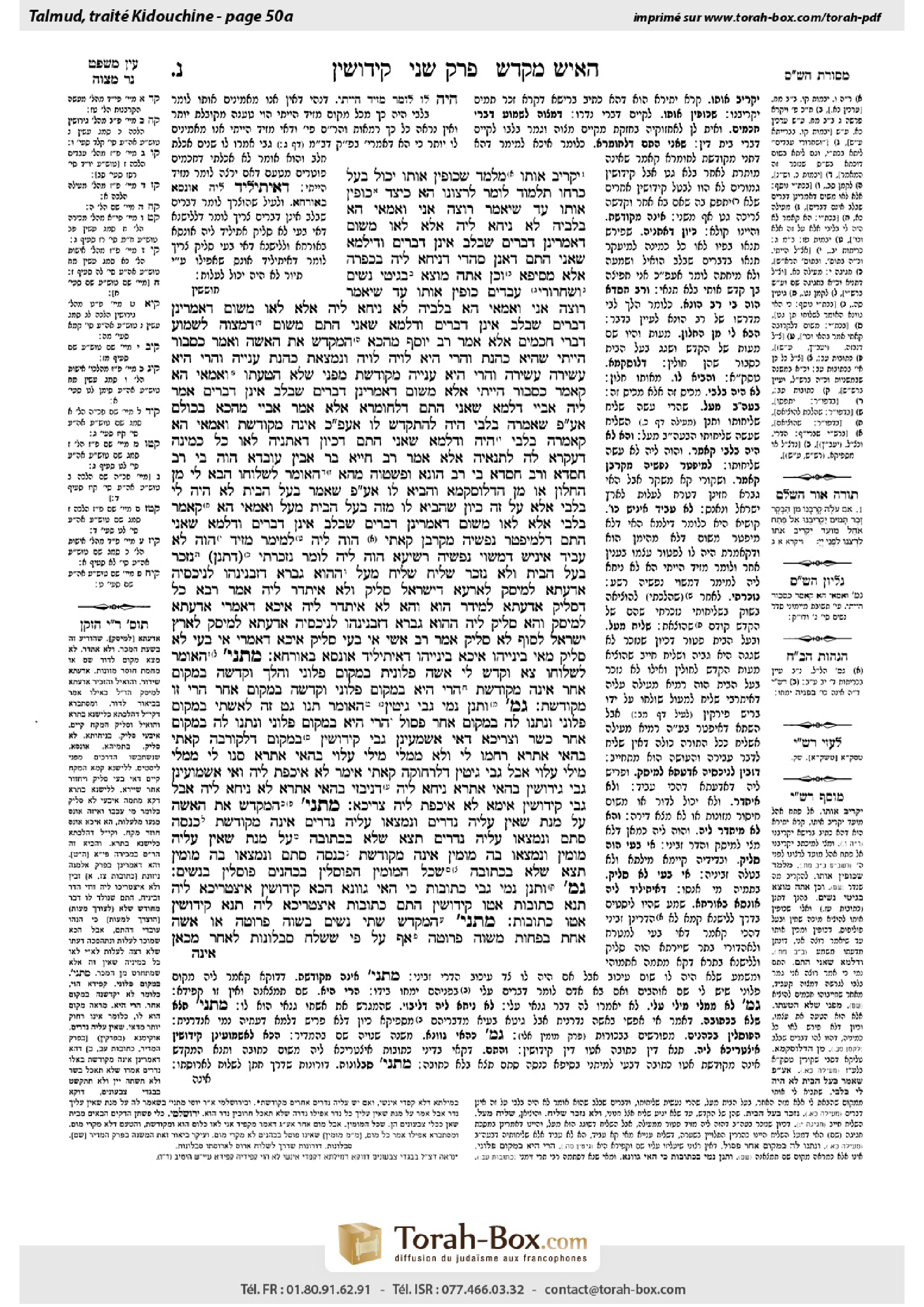
Kiddushin 50a: Talmud study for Daf Yomi
Daf Yomi is the daily study of one Talmud folio. Explore 37 tractates with scans, Hebrew text, Sefaria English and AI-generated French translations where annotated.
Passage selection and English or AI-generated French translation are available where the scan has annotations. Daf Study is independent of Torah-Box and Sefaria.
Browse Kiddushin · קידושין · All tractatesKiddushin 50a text and translations
This page of Kiddushin includes the Aramaic text, an English translation and an AI-generated French translation, alongside the scan above.
קידושין נ׳ א · Aramaic and Hebrew text
״יַקְרִיב אֹתוֹ״ – מְלַמֵּד שֶׁכּוֹפִין אוֹתוֹ. יָכוֹל בְּעַל כׇּרְחוֹ – תַּלְמוּד לוֹמַר: ״לִרְצֹנוֹ״.
הָא כֵּיצַד? – כּוֹפִין אוֹתוֹ עַד שֶׁיֹּאמַר: ״רוֹצֶה אֲנִי״. וְאַמַּאי? הָא בְּלִבֵּיהּ לָא נִיחָא לֵיהּ! אֶלָּא לָאו מִשּׁוּם דְּאָמְרִינַן: דְּבָרִים שֶׁבַּלֵּב אֵינָן דְּבָרִים? וְדִילְמָא שָׁאנֵי הָתָם, דַּאֲנַן סָהֲדִי דְּנִיחָא לֵיהּ בְּכַפָּרָה.
אֶלָּא מִסֵּיפָא: וְכֵן אַתָּה מוֹצֵא בְּגִיטֵּי נָשִׁים וְשִׁחְרוּרֵי עֲבָדִים, כּוֹפִין אוֹתוֹ עַד שֶׁיֹּאמַר: ״רוֹצֶה אֲנִי״. וְאַמַּאי? הָא בְּלִבֵּיהּ לָא נִיחָא לֵיהּ! אֶלָּא לָאו מִשּׁוּם דְּאָמְרִינַן דְּבָרִים שֶׁבַּלֵּב אֵינָן דְּבָרִים? וְדִילְמָא שָׁאנֵי הָתָם, מִשּׁוּם דְּמִצְוָה לִשְׁמוֹעַ דִּבְרֵי חֲכָמִים.
אֶלָּא אָמַר רַב יוֹסֵף, מֵהָכָא: הַמְקַדֵּשׁ אֶת הָאִשָּׁה וְאָמַר: כְּסָבוּר הָיִיתִי שֶׁהִיא כֹּהֶנֶת וַהֲרֵי הִיא לְוִיָּה, לְוִיָּה וְנִמְצֵאת כֹּהֶנֶת, עֲנִיָּיה וַהֲרֵי הִיא עֲשִׁירָה, עֲשִׁירָה וַהֲרֵי הִיא עֲנִיָּיה – מְקוּדֶּשֶׁת, מִפְּנֵי שֶׁלֹּא הִטְעַתּוּ. וְאַמַּאי? הָא קָאָמַר כְּסָבוּר הָיִיתִי! אֶלָּא מִשּׁוּם דְּאָמְרִינַן דְּבָרִים שֶׁבַּלֵּב אֵינָן דְּבָרִים. אֲמַר לֵיהּ אַבָּיֵי: דִּלְמָא שָׁאנֵי הָתָם, דִּלְחוּמְרָא.
אֶלָּא אָמַר אַבָּיֵי, מֵהָכָא: בְּכוּלָּם, אַף עַל פִּי שֶׁאָמְרָה ״בְּלִבִּי הָיָה לְהִתְקַדֵּשׁ לוֹ״ – אַף עַל פִּי כֵן אֵינָהּ מְקוּדֶּשֶׁת. וְאַמַּאי? הָא קָאָמְרָה ״בְּלִבִּי הָיָה״! וְדִילְמָא שָׁאנֵי הָתָם, דְּכֵיוָן דְּאַתְנִיה לָאו כֹּל כְּמִינַּהּ דְּעָקְרָא לֵהּ לִתְנָאֵיהּ.
אֶלָּא אָמַר רַב חִיָּיא בַּר אָבִין: עוֹבָדָא הֲוָה בֵּי רַב חִסְדָּא, וְרַב חִסְדָּא בֵּי רַב הוּנָא, וּפַשְׁטוּהָ מֵהָא: הָאוֹמֵר לִשְׁלוּחוֹ: ״הָבֵא לִי מִן הַחַלּוֹן אוֹ מִן הַדְּלוֹסְקָמָא״, וְהֵבִיא לוֹ. אַף עַל פִּי שֶׁאָמַר בַּעַל הַבַּיִת: ״לֹא הָיָה לִי בְּלִבִּי אֶלָּא עַל זֶה״, כֵּיוָן שֶׁהֵבִיא לוֹ מִזֶּה – בַּעַל הַבַּיִת מָעַל. וְאַמַּאי? הָא קָאָמַר ״בְּלִבִּי״! אֶלָּא לָאו מִשּׁוּם דְּאָמְרִינַן דְּבָרִים שֶׁבַּלֵּב אֵינָן דְּבָרִים?
וְדִלְמָא שָׁאנֵי הָתָם, דִּלְמִיפְטַר נַפְשֵׁיהּ מִקׇּרְבָּן קָאָתֵי.
הֲוָה לֵיהּ לְמֵימַר מֵזִיד הֲוָה! לָא עֲבִיד אִינִישׁ דִּמְשַׁוֵּי נַפְשֵׁיהּ רַשִּׁיעָא.
הֲוָה לֵיהּ לוֹמַר ״נִזְכַּרְתִּי״, דִּתְנַן: נִזְכַּר בַּעַל הַבַּיִת, וְלֹא נִזְכַּר שָׁלִיחַ – שָׁלִיחַ מָעַל.
הָהוּא גַּבְרָא דְּזַבְּנִינְהוּ לְנִיכְסֵיהּ אַדַּעְתָּא לְמִיסַּק לְאַרְעָא דְיִשְׂרָאֵל. סְלֵיק וְלָא אִיתְּדַר לֵיהּ. אָמַר רָבָא: כֹּל דְּסָלֵיק – אַדַּעְתָּא לְמֵידַר הוּא, וְהָא לָא אִיתְּדַר לֵיהּ. אִיכָּא דְאָמְרִי: אַדַּעְתָּא לְמִיסַּק, וְהָא סְלֵיק לֵיהּ.
הָהוּא גַּבְרָא דְּזַבְּנִינְהוּ לְנִיכְסֵיהּ אַדַּעְתָּא לְמִיסַּק לְאֶרֶץ יִשְׂרָאֵל, לְסוֹף לָא סְלֵיק. אָמַר רַב אָשֵׁי: אִי בָּעֵי, סָלֵיק. אִיכָּא דְּאָמְרִי: אִי בָּעֵי, לָא סָלֵיק? מַאי בֵּינַיְיהוּ? אִיכָּא בֵּינַיְיהוּ, דְּאִיתְיְלִיד אוּנְסָא בְּאוֹרְחָא.
מַתְנִי׳ הָאוֹמֵר לִשְׁלוּחוֹ: ״צֵא וְקַדֵּשׁ לִי אִשָּׁה פְּלוֹנִית בְּמָקוֹם פְּלוֹנִי״ וְהָלַךְ וְקִדְּשָׁהּ בְּמָקוֹם אַחֵר – אֵינָהּ מְקוּדֶּשֶׁת. ״הֲרֵי הִיא בְּמָקוֹם פְּלוֹנִי״ וְקִדְּשָׁהּ בְּמָקוֹם אַחֵר – הֲרֵי זוֹ מְקוּדֶּשֶׁת.
גְּמָ׳ וּתְנַן נָמֵי גַּבֵּי גִיטִּין: הָאוֹמֵר ״תְּנוּ גֵּט זֶה לְאִשְׁתִּי בְּמָקוֹם פְּלוֹנִי״ וּנְתָנוֹ לָהּ בְּמָקוֹם אַחֵר – פָּסוּל, ״הֲרֵי הִיא בְּמָקוֹם פְּלוֹנִי״ וּנְתָנוֹ לָהּ בְּמָקוֹם אַחֵר – כָּשֵׁר.
וּצְרִיכָא. דְּאִי אַשְׁמְעִינַן גַּבֵּי קִידּוּשִׁין – מִשּׁוּם דִּלְקָרוֹבַהּ קָאָתֵי, בְּהַאי אַתְרָא רָחֲמוּ לִי וְלָא מְמַלְּ[לִ]י מִילֵּי עִלָּוַי, בְּהַאי אַתְרָא סָנוּ לִי מְמַלְּ[לִ]י מִילֵּי עִלָּוַי. אֲבָל גַּבֵּי גִּיטִּין, דִּלְרַחוֹקַהּ קָאָתֵי, אֵימַר לָא אִיכְפַּת לֵיהּ.
וְאִי אַשְׁמוֹעִינַן גַּבֵּי גֵירוּשִׁין, בְּהַאי אַתְרָא נִיחָא לֵיהּ דְּנִיבַּזֵּי, בְּהַאי אַתְרָא לָא נִיחָא לֵיהּ, אֲבָל גַּבֵּי קִידּוּשִׁין – אֵימָא לָא אִיכְפַּת לֵיהּ, צְרִיכָא.
מַתְנִי׳ הַמְקַדֵּשׁ אֶת הָאִשָּׁה עַל מְנָת שֶׁאֵין עָלֶיהָ נְדָרִים, וְנִמְצְאוּ עָלֶיהָ נְדָרִים – אֵינָהּ מְקוּדֶּשֶׁת. כְּנָסָהּ סְתָם וְנִמְצְאוּ עָלֶיהָ נְדָרִים – תֵּצֵא שֶׁלֹּא בִּכְתוּבָּה.
עַל מְנָת שֶׁאֵין עָלֶיהָ מוּמִין וְנִמְצְאוּ בָּהּ מוּמִין – אֵינָהּ מְקוּדֶּשֶׁת. כְּנָסָהּ סְתָם וְנִמְצְאוּ בָּהּ מוּמִין – תֵּצֵא שֶׁלֹּא בִּכְתוּבָּה. שֶׁכׇּל הַמּוּמִין הַפּוֹסְלִין בַּכֹּהֲנִים פּוֹסְלִין בַּנָּשִׁים.
גְּמָ׳ וּתְנַן נָמֵי גַּבֵּי כְתוּבּוֹת כִּי הַאי גַוְונָא! הָכָא, קִידּוּשִׁין אִיצְטְרִיכָא לֵיהּ, תְּנָא כְּתוּבּוֹת אַטּוּ קִידּוּשִׁין, הָתָם, כְּתוּבּוֹת אִיצְטְרִיכָא לֵיהּ, תְּנָא קִידּוּשִׁין אַטּוּ כְּתוּבּוֹת.
מַתְנִי׳ הַמְקַדֵּשׁ שְׁתֵּי נָשִׁים בְּשָׁוֶה פְּרוּטָה, אוֹ אִשָּׁה אַחַת בְּפָחוֹת מִשָּׁוֶה פְּרוּטָה, אַף עַל פִּי שֶׁשָּׁלַח סִבְלוֹנוֹת לְאַחַר מִכָּאן
Kiddushin 50a · English translation
With regard to one who pledges to bring a burnt-offering, the verse states: “If his offering be a burnt-offering of the herd, he shall offer it a male without blemish; he shall bring it to the door of the Tent of Meeting, according to his will, before the Lord” (Leviticus 1:3). The seemingly superfluous words “he shall offer it” teaches that they coerce him to bring the offering. I might have thought that it can be offered entirely against his will, by taking it from his possession and sacrificing it; therefore, the verse states: “According to his will.”
How can these texts be reconciled? They coerce him until he says: I want to bring the offering. The Gemara asks: But why should this be effective; but in his heart it is not satisfactory for him to bring the offering, and it is not according to his will. Rather, is it not because we say: Unspoken matters that remain in the heart are not significant matters, and his intention is rendered irrelevant by his explicit statement? The Gemara rejects this: But perhaps there it is different, since it is clear to us that it is satisfactory for him to achieve atonement, despite his earlier statement to the contrary.
Rather, the Gemara derives a proof from the latter clause of that same baraita: And similarly, you find with bills of divorce of women and bills of manumission of slaves that when the court rules that a man must divorce his wife or free his slave and he does not want to, they coerce him until he says: I want to divorce my wife, or: I want to free my slave. But why should this be effective; but in his heart it is not satisfactory for him to divorce her or to free him. Rather, is it not because we say that unspoken matters that remain in the heart are not significant matters? The Gemara rejects this proof as well: But perhaps there it is different, because it is a mitzva to listen to the statements of the Sages, and the assumption is that when he is required to divorce his wife or free his slave, his true desire is to perform the mitzva.
Rather, Rav Yosef says: The proof is from here (64a): In the case of one who betroths a woman and he said: I thought that she was the daughter of a priest, and she is in fact the daughter of a Levite; or I thought she was the daughter of a Levite, and she is found to be the daughter of a priest; I thought she was poor, and she is wealthy; or I thought she was wealthy, and she is poor, she is betrothed despite his mistaken assumption, because she did not mislead him. But why is she betrothed; but he said: I thought that she had a different characteristic, and he betrothed her with that in mind? Rather, it is because we say that unspoken matters that remain in the heart are not significant matters. Abaye said to him: Perhaps it is different there, since the ruling there is that she requires a bill of divorce only as a stringency, and they are not definitively betrothed.
Rather, Abaye said that the proof is from here, from the mishna: And in all these cases, despite the fact that she later stated: I intended to become betrothed to him nevertheless, she is not betrothed. But why should her betrothal not take effect at all; but she said: I intended to become betrothed? This clause of the mishna teaches that unspoken matters that remain in the heart are not significant. The Gemara rejects this proof: But perhaps it is different there, as, since he stipulated explicitly that a certain condition was true, it is not in her power to uproot his condition through thoughts alone.
Rather, Rav Ḥiyya bar Avin says: There was an incident of this kind in Rav Ḥisda’s study hall, and Rav Ḥisda brought the case to Rav Huna’s study hall, and they resolved it from this mishna (Me’ila 21a): In the case of one who says to his agent: Bring me such and such an item from the window ledge or from the box [hadeluskema], forgetting that the item in question was consecrated property and any use of it would constitute misuse of consecrated property, and the agent brought it to him, then although at that point the owner said: My intention was that you bring the item only from this other place, once he brought the item to him from that place that he had mentioned, once the agent uses it the owner is liable for having misused consecrated property. But why should he be responsible; but he said: My intention was for the other place, so the agent did not fulfill his mission. Rather, is it not because we say that unspoken matters that remain in the heart are not significant matters?
The Gemara rejects this: But perhaps it is different there, since it is suspected that he is coming to exempt himself from bringing an offering for his misuse by claiming that he intended a different item. Since there is cause to question the truth of his statement that he had intended that the agent bring the item from the other place, his claim is not accepted. This cannot serve as a proof that in general, unspoken matters that remain in the heart are not significant.
The Gemara responds: If all he wanted to do was exempt himself from the obligation to bring an offering, he could have said that the misuse was intentional, as one who misuses consecrated property intentionally is not obligated to bring an offering. Therefore, there is no cause to question the truth of his statement that he had intended that the agent bring the item from the other place. The Gemara counters: It is not common for a person to place himself in the category of a wicked person by claiming to have committed a transgression intentionally. Therefore, once again, there is cause to question the truth of his statement that he had intended that the agent bring the item from the other place.
The Gemara continues to ask: To exempt himself from the obligation to bring an offering, he could have said: After the agent left I remembered that it was consecrated property. Such a claim would also have rendered him exempt, as we learned in that same mishna (Me’ila 21a): If one sent an agent to bring a particular item, and the owner remembered that it was consecrated and the agent did not remember but proceeded to fulfill his agency, it is the agent who has misused consecrated property and is liable to bring an offering, not the one who designated him, since the latter remembered and canceled the agency. There is no cause to question the truth of his statement that he had intended that the agent bring the item from the other place. Therefore, the fact that this statement is not accepted can serve as a proof that in general, unspoken matters that remain in the heart are not significant.
The Gemara relates: There was a certain man who sold his property with the intention of ascending to Eretz Yisrael and explicitly stated this intention to the buyer. He ascended to Eretz Yisrael but he was not able to settle there. Upon his return to Babylonia, he sought to nullify the sale. Rava said: Whoever ascends to Eretz Yisrael does so with the intention of settling there, and as he was not able to settle there he can nullify the sale. There are those who say a different version, that Rava said the opposite: He intended to ascend to Eretz Yisrael, and he ascended, so he cannot nullify the sale.
The Gemara relates a similar incident: There was a certain man who sold his property with the intention of ascending to Eretz Yisrael, but ultimately he did not ascend there. Rav Ashi said: If he had wanted to do so, he could have ascended. Since the matter depended upon him, there are no grounds for nullifying the sale. There are those who say Rav Ashi said as follows: If he had wanted to do so, couldn’t he have ascended? Since nothing prevented him from leaving, the sale is not nullified. The Gemara asks: What is the difference between the two versions of Rav Ashi’s statement? The Gemara answers: There is a difference between them in a case when circumstances beyond his control occurred along the way, preventing him from going. According to the first version of the statement of Rav Ashi, the sale is upheld; but according to the second version, where Rav Ashi responded in the form of a question, the implication is that if there actually had been something that prevented him from ascending, the sale would be nullified.
MISHNA: In the case of one who says to his agent: Go and betroth for me so-and-so in such and such a place, and the agent went and betrothed her in a different place, she is not betrothed, since he instructed that the betrothal take place in a particular location. But if he said: Go and betroth the woman for me, she is in such and such a place; and the agent betrothed her in a different place, she is betrothed, since he did not mean that the agent should betroth her specifically there, but was merely telling him where to find her.
GEMARA: The Gemara comments: And we also learned in a mishna with regard to bills of divorce (Gittin 65a): With regard to one who says to his agents: Give this bill of divorce to my wife in such and such a place, and they gave it to her in another place, the divorce is invalid. If he said to them: She is in such and such a place, and they gave it to her in another place, it is valid.
The Gemara comments: And it is necessary to state this halakha with regard to both betrothal and divorce, because had the tanna taught us only with regard to betrothal, you might say: In a case when he is coming to draw her near to him through betrothal, he thinks: They love me in this place and will not say negative remarks about me, but they hate me in that place and will say negative remarks about me. Therefore, he told the agent to perform the betrothal in a certain place and is particular that it take place only there. But with regard to bills of divorce, when he is coming to distance her from him, you might say he does not care where the divorce itself is performed. The tanna therefore informs us that this is not the case.
And conversely, if the tanna had taught us only with regard to divorce, I would have said that he is particular only in the case of divorce, because in this place it is acceptable for him to degrade himself through divorce, whereas in that place it is not acceptable for him to do so; but with regard to betrothal, which involves no degradation, you might say he does not care where he betroths her. Therefore, it is necessary to state the halakha in both cases.
MISHNA: In the case of one who betroths a woman on the condition that there are no vows incumbent upon her to fulfill, and it was found that there were vows incumbent upon her to fulfill, she is not betrothed, since his condition was not fulfilled. If he married her without specification, and it was found that there were vows incumbent upon her to fulfill, the marriage takes effect. Nevertheless, he has the right to divorce her, and she is divorced without receiving payment of her marriage contract, as it is assumed that he would not have married her had he known that she was limited by her vows.
Similarly, if he betrothed her on the condition that there are no blemishes upon her, and she was discovered to have blemishes, she is not betrothed. In a case where he married her without specification and she was discovered to have blemishes, he has the right to divorce her, and she is divorced without receiving payment of her marriage contract. As to what is defined as a blemish, the rule is that all the blemishes that disqualify priests from performing the Temple service, as detailed in tractate Bekhorot, also disqualify women from receiving their marriage contract in case of divorce.
GEMARA: The Gemara comments: And we also learned a mishna like this with regard to the halakhot of marriage contracts, as the same mishna appears in tractate Ketubot (72b). The Gemara explains: Here it was necessary for the tanna to mention this halakha with regard to betrothal, and he taught the halakha of marriage contracts due to teaching the halakha of betrothal; there it was necessary for the tanna to mention this halakha with regard to marriage contracts, and he taught the halakha of betrothal due to teaching the halakha of marriage contracts.
MISHNA: In the case of one who betroths two women together with an item worth one peruta, so that the value of each woman’s share was not worth one peruta, or who betroths one woman with an item worth less than one peruta, despite the fact that he later sent the traditional gifts [sivlonot] of a groom to the bride,
Kiddushin 50a · Traduction française (IA)
À propos de celui qui s’engage à apporter un holocauste, le verset dit : « Si son offrande est un holocauste pris du gros bétail, il offrira un mâle sans défaut ; il l’amènera à l’entrée de la Tente d’assignation, selon sa volonté, devant l’Éternel » (Lévitique 1,3). Les mots apparemment superflus « il l’offrira » enseignent qu’on le contraint à apporter l’offrande. J’aurais pu penser qu’on peut l’offrir entièrement contre sa volonté, en prenant l’animal dans ses biens et en le sacrifiant ; le verset précise donc : « Selon sa volonté. »
Comment concilier ces textes ? On le contraint jusqu’à ce qu’il dise : « Je veux apporter l’offrande. » La Guemara demande : Mais pourquoi cela serait-il efficace ? Au fond de lui, il ne souhaite pas apporter l’offrande, et cela ne se fait donc pas selon sa volonté. N’est-ce pas plutôt parce que nous disons que les pensées inexprimées qui restent dans le cœur ne comptent pas, et que son intention est rendue sans effet par sa déclaration explicite ? La Guemara rejette cette explication : Mais peut-être est-ce différent dans ce cas, puisqu’il est évident pour nous qu’il souhaite obtenir l’expiation, malgré sa déclaration antérieure en sens contraire.
La Guemara tire plutôt une preuve de la dernière clause de cette même baraïta : De même, on trouve ce principe à propos des actes de divorce des femmes et des actes d’affranchissement des esclaves : lorsque le tribunal décide qu’un homme doit divorcer de sa femme ou affranchir son esclave et qu’il ne le veut pas, on le contraint jusqu’à ce qu’il dise : « Je veux divorcer de ma femme » ou : « Je veux affranchir mon esclave. » Mais pourquoi cela serait-il efficace ? Au fond de lui, il ne souhaite ni divorcer d’elle ni l’affranchir. N’est-ce pas plutôt parce que nous disons que les pensées inexprimées qui restent dans le cœur ne comptent pas ? La Guemara rejette également cette preuve : Mais peut-être est-ce différent dans ce cas, car il y a une mitsva d’obéir aux paroles des Sages, et l’on présume que, lorsqu’il est tenu de divorcer de sa femme ou d’affranchir son esclave, son véritable désir est d’accomplir la mitsva.
Rav Yosef dit plutôt : La preuve vient d’ici (64a) : Dans le cas de celui qui fiance une femme et dit : « Je pensais qu’elle était fille de prêtre », alors qu’elle est en réalité fille de lévite ; ou : « Je pensais qu’elle était fille de lévite », alors qu’elle se révèle être fille de prêtre ; « Je pensais qu’elle était pauvre », alors qu’elle est riche ; ou : « Je pensais qu’elle était riche », alors qu’elle est pauvre, elle est fiancée malgré son erreur, car elle ne l’a pas induit en erreur. Mais pourquoi est-elle fiancée ? Il a dit qu’il pensait qu’elle avait une autre caractéristique et l’a fiancée en tenant compte de cela. C’est plutôt parce que nous disons que les pensées inexprimées qui restent dans le cœur ne comptent pas. Abaye lui répondit : Peut-être est-ce différent dans ce cas, puisque, selon la décision, elle n’a besoin d’un acte de divorce que par mesure de rigueur et ils ne sont pas définitivement fiancés.
Abaye dit plutôt que la preuve vient d’ici, de la Michna : Dans tous ces cas, bien qu’elle déclare par la suite : « J’avais néanmoins l’intention d’être fiancée à lui », elle n’est pas fiancée. Mais pourquoi ses fiançailles ne prendraient-elles pas effet ? Elle a dit qu’elle avait l’intention d’être fiancée. Cette clause de la Michna enseigne que les pensées inexprimées qui restent dans le cœur ne comptent pas. La Guemara rejette cette preuve : Mais peut-être est-ce différent dans ce cas, car, puisqu’il a explicitement posé comme condition qu’un certain fait soit vrai, elle ne peut pas annuler cette condition par de simples pensées.
Rav Ḥiyya bar Avin dit plutôt : Un cas de ce genre s’est produit au beit midrash de Rav Ḥisda. Rav Ḥisda a soumis le cas au beit midrash de Rav Huna, où ils l’ont résolu à partir de cette Michna (Meïla 21a) : Si quelqu’un dit à son agent : « Apporte-moi tel objet qui se trouve sur le rebord de la fenêtre ou dans la boîte [hadeluskema] », en ayant oublié que l’objet en question était un bien consacré et que toute utilisation de celui-ci constituerait un détournement de bien consacré, et que l’agent le lui apporte, alors, même si le propriétaire dit à ce moment-là : « Je voulais que tu apportes l’objet uniquement de cet autre endroit », dès lors que l’agent le lui a apporté de l’endroit qu’il avait mentionné, le propriétaire est responsable du détournement de bien consacré si l’agent l’utilise. Mais pourquoi en serait-il responsable ? Il a dit qu’il voulait l’objet de l’autre endroit ; l’agent n’a donc pas exécuté sa mission. N’est-ce pas plutôt parce que nous disons que les pensées inexprimées qui restent dans le cœur ne comptent pas ?
La Guemara rejette cette preuve : Mais peut-être est-ce différent dans ce cas, puisqu’on peut soupçonner qu’il cherche à se soustraire à l’obligation d’apporter une offrande pour son détournement en prétendant qu’il voulait un autre objet. Puisqu’il y a lieu de mettre en doute la véracité de sa déclaration selon laquelle il voulait que l’agent apporte l’objet de l’autre endroit, sa prétention n’est pas acceptée. Cela ne peut pas prouver que, de façon générale, les pensées inexprimées qui restent dans le cœur ne comptent pas.
La Guemara répond : S’il avait seulement voulu se soustraire à l’obligation d’apporter une offrande, il aurait pu dire que le détournement était intentionnel, car celui qui détourne intentionnellement un bien consacré n’est pas tenu d’apporter une offrande. Il n’y a donc pas lieu de mettre en doute la véracité de sa déclaration selon laquelle il voulait que l’agent apporte l’objet de l’autre endroit. La Guemara objecte : Il n’est pas courant qu’une personne se classe elle-même parmi les méchants en prétendant avoir commis une transgression intentionnellement. Il y a donc, une fois encore, lieu de mettre en doute la véracité de sa déclaration selon laquelle il voulait que l’agent apporte l’objet de l’autre endroit.
La Guemara poursuit son objection : Pour se soustraire à l’obligation d’apporter une offrande, il aurait pu dire : « Après le départ de l’agent, je me suis souvenu que c’était un bien consacré. » Cette affirmation l’aurait également exonéré, comme nous l’avons appris dans cette même Michna (Meïla 21a) : Si quelqu’un envoie un agent chercher un objet précis, puis que le propriétaire se souvient qu’il s’agit d’un bien consacré, tandis que l’agent ne s’en souvient pas et exécute néanmoins sa mission, c’est l’agent qui a détourné le bien consacré et qui est tenu d’apporter une offrande, et non celui qui l’a envoyé, puisque ce dernier s’en est souvenu et a annulé la mission. Il n’y a pas lieu de mettre en doute la véracité de sa déclaration selon laquelle il voulait que l’agent apporte l’objet de l’autre endroit. Par conséquent, le fait que cette déclaration ne soit pas acceptée peut prouver que, de façon générale, les pensées inexprimées qui restent dans le cœur ne comptent pas.
La Guemara rapporte : Un homme vendit ses biens dans l’intention de monter en Eretz Israël et déclara explicitement cette intention à l’acheteur. Il monta en Eretz Israël, mais ne put s’y établir. À son retour en Babylonie, il chercha à annuler la vente. Rava dit : Quiconque monte en Eretz Israël le fait dans l’intention de s’y établir ; puisqu’il n’a pas pu s’y établir, il peut annuler la vente. Selon une autre version, Rava dit le contraire : Il avait l’intention de monter en Eretz Israël et il y est monté ; il ne peut donc pas annuler la vente.
La Guemara rapporte un incident semblable : Un homme vendit ses biens dans l’intention de monter en Eretz Israël, mais finalement il n’y monta pas. Rav Ashi dit : S’il l’avait voulu, il aurait pu y monter. Puisque cela dépendait de lui, rien ne justifie l’annulation de la vente. Selon une autre version, Rav Ashi dit : S’il l’avait voulu, n’aurait-il pas pu y monter ? Puisque rien ne l’empêchait de partir, la vente n’est pas annulée. La Guemara demande : Quelle différence y a-t-il entre les deux versions de la déclaration de Rav Ashi ? La Guemara répond : Elles diffèrent dans le cas où des circonstances indépendantes de sa volonté se sont produites en chemin et l’ont empêché de partir. Selon la première version de la déclaration de Rav Ashi, la vente est maintenue ; selon la deuxième version, où Rav Ashi répond sous forme de question, il ressort que, s’il avait effectivement été empêché de monter, la vente aurait été annulée.
MICHNA : Dans le cas de celui qui dit à son agent : « Va et fiance pour moi telle femme, à tel endroit », et que l’agent va la fiancer à un autre endroit, elle n’est pas fiancée, puisqu’il a ordonné que les fiançailles aient lieu en un lieu précis. Mais s’il dit : « Va et fiance pour moi la femme ; elle se trouve à tel endroit », et que l’agent la fiance à un autre endroit, elle est fiancée, car il ne voulait pas que l’agent la fiance précisément là ; il lui indiquait seulement où la trouver.
GUEMARA : La Guemara fait remarquer : Nous avons également appris dans une Michna concernant les actes de divorce (Guittin 65a) : Si quelqu’un dit à ses agents : « Remettez cet acte de divorce à ma femme à tel endroit », et qu’ils le lui remettent à un autre endroit, le divorce est invalide. S’il leur dit : « Elle se trouve à tel endroit », et qu’ils le lui remettent à un autre endroit, le divorce est valide.
La Guemara fait remarquer qu’il est nécessaire d’énoncer cette halakha aussi bien pour les fiançailles que pour le divorce, car si le tanna nous avait enseigné cette règle uniquement à propos des fiançailles, on aurait pu dire : Lorsqu’il cherche à la rapprocher de lui par les fiançailles, il se dit : « Ici, les gens m’aiment et ne diront pas de choses négatives à mon sujet, tandis que là, ils me détestent et diront des choses négatives à mon sujet. » C’est pourquoi il a demandé à l’agent de procéder aux fiançailles à un endroit précis et tient à ce qu’elles aient lieu uniquement là. Mais à propos des actes de divorce, puisqu’il cherche à l’éloigner de lui, on aurait pu dire qu’il lui importe peu où le divorce lui-même est prononcé. Le tanna nous apprend donc que ce n’est pas le cas.
Inversement, si le tanna nous avait enseigné cette règle uniquement à propos du divorce, j’aurais dit qu’il tient à ce que le divorce ait lieu à un endroit précis parce qu’ici, il lui convient de se déshonorer par le divorce, tandis que là, cela ne lui convient pas. Mais à propos des fiançailles, qui n’impliquent aucun déshonneur, on aurait pu dire qu’il lui importe peu où il la fiance. Il est donc nécessaire d’énoncer la halakha dans les deux cas.
MICHNA : Dans le cas de celui qui fiance une femme à la condition qu’aucun vœu ne lui incombe, et qu’il s’avère qu’elle est tenue par des vœux, elle n’est pas fiancée, car la condition qu’il a posée n’est pas remplie. S’il l’a épousée sans poser de condition et qu’il s’avère qu’elle est tenue par des vœux, le mariage prend effet. Néanmoins, il a le droit de divorcer d’elle, et elle est divorcée sans recevoir le paiement de sa ketouba, car on présume qu’il ne l’aurait pas épousée s’il avait su qu’elle était tenue par ces vœux.
De même, s’il l’a fiancée à la condition qu’elle n’ait aucun défaut et qu’il s’avère qu’elle en a, elle n’est pas fiancée. S’il l’a épousée sans poser de condition et qu’il s’avère qu’elle a des défauts, il a le droit de divorcer d’elle, et elle est divorcée sans recevoir le paiement de sa ketouba. Pour définir ce qui constitue un défaut, la règle est que tous les défauts qui empêchent les prêtres d’accomplir le service du Temple, comme il est détaillé dans le traité Bekhorot, empêchent également les femmes de recevoir le paiement de leur ketouba en cas de divorce.
GUEMARA : La Guemara fait remarquer que nous avons également appris une Michna semblable concernant les halakhot des contrats de mariage, puisque la même Michna figure dans le traité Ketoubot (72b). La Guemara explique : Ici, le tanna devait mentionner cette halakha à propos des fiançailles ; il a donc enseigné la halakha relative aux contrats de mariage en même temps que celle des fiançailles. Là-bas, le tanna devait mentionner cette halakha à propos des contrats de mariage ; il a donc enseigné la halakha relative aux fiançailles en même temps que celle des contrats de mariage.
MICHNA : Dans le cas de celui qui fiance deux femmes ensemble au moyen d’un objet valant une pérouta, de sorte que la part de chacune ne vaut pas une pérouta, ou qui fiance une femme au moyen d’un objet valant moins d’une pérouta, même s’il lui a ensuite envoyé les présents traditionnels que le marié offre à la mariée [sivlonot],
Traduction française générée par IA à partir de l’édition anglaise de Sefaria. Vérifie toujours un passage avec le texte source.
Text from Sefaria: William Davidson Edition - Vocalized Aramaic (CC BY NC); William Davidson Edition - English (CC BY NC).