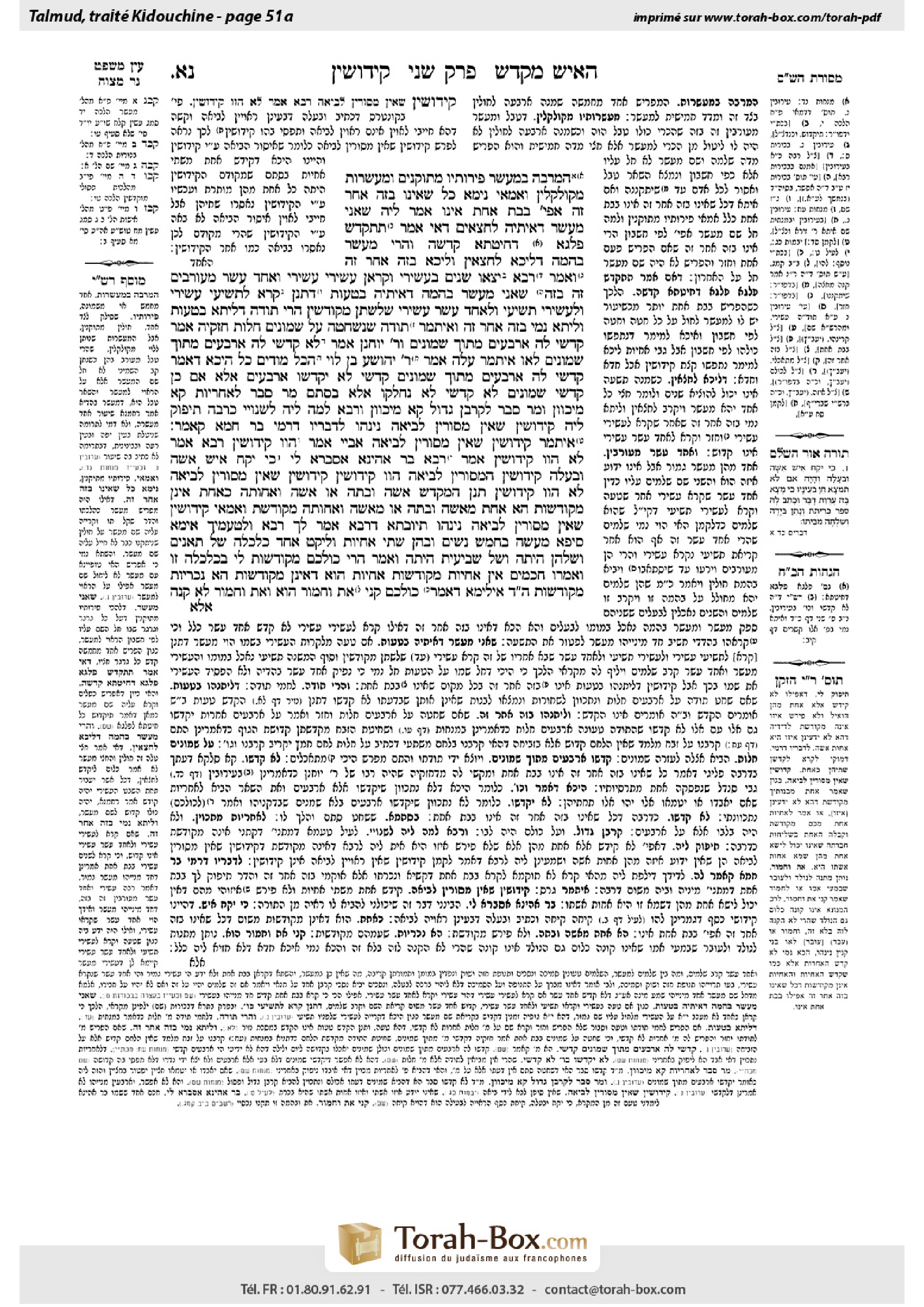
Kiddushin 51a: Talmud study for Daf Yomi
Daf Yomi is the daily study of one Talmud folio. Explore 37 tractates with scans, Hebrew text, Sefaria English and AI-generated French translations where annotated.
Passage selection and English or AI-generated French translation are available where the scan has annotations. Daf Study is independent of Torah-Box and Sefaria.
Browse Kiddushin · קידושין · All tractatesKiddushin 51a text and translations
This page of Kiddushin includes the Aramaic text, an English translation and an AI-generated French translation, alongside the scan above.
קידושין נ״א א · Aramaic and Hebrew text
הַמַּרְבֶּה בַּמַּעֲשֵׂר – פֵּירוֹתָיו מְתוּקָּנִים וּמַעְשְׂרוֹתָיו מְקוּלְקָלִין. וְאַמַּאי? נֵימָא: כֹּל שֶׁאֵינוֹ בְּזֶה אַחַר זֶה אֲפִילּוּ בְּבַת אַחַת אֵינוֹ.
אֲמַר לֵיהּ: שָׁאנֵי מַעֲשֵׂר, דְּאִיתֵיהּ לַחֲצָאִים, דְּאִי אָמַר: ״תִּיקְדּוֹשׁ פַּלְגָא דְחִיטְּתָא״ – קָדְשָׁה.
וַהֲרֵי מַעְשַׂר בְּהֵמָה, דְּלֵיכָּא לַחֲצָאִין, וְלֵיכָּא בְּזֶה אַחַר זֶה. וְאָמַר רָבָא: יָצְאוּ שְׁנַיִם בַּעֲשִׂירִי, וּקְרָאָן ״עֲשִׂירִי״ – עֲשִׂירִי וְאַחַד עָשָׂר מְעוֹרָבִים זֶה בָּזֶה.
שָׁאנֵי מַעְשַׂר בְּהֵמָה, דְּאִיתֵיהּ בְּטָעוּת. דִּתְנַן: קָרָא לַתְּשִׁיעִי ״עֲשִׂירִי״, וְלָעֲשִׂירִי ״תְּשִׁיעִי״, וְלָאַחַד עָשָׂר ״עֲשִׂירִי״ – שְׁלָשְׁתָּן מְקוּדָּשִׁין.
הֲרֵי תּוֹדָה, דְּלֵיתַהּ בְּטָעוּת, וְלֵיתַהּ נָמֵי בְּזֶה אַחַר זֶה, וְאִיתְּמַר: תּוֹדָה שֶׁנִּשְׁחֲטָה עַל שְׁמוֹנִים חַלּוֹת, חִזְקִיָּה אָמַר: קָדְשִׁי לַהּ אַרְבָּעִים מִתּוֹךְ שְׁמוֹנִים. וְרַבִּי יוֹחָנָן אָמַר: לָא קָדְשִׁי לַהּ אַרְבָּעִים מִתּוֹךְ שְׁמוֹנִים.
לָאו אִיתְּמַר עֲלַהּ, אָמַר רַבִּי יְהוֹשֻׁעַ בֶּן לֵוִי: הַכֹּל מוֹדִים כֹּל הֵיכָא דְּאָמַר: ״קָדְשִׁי לַהּ אַרְבָּעִים מִתּוֹךְ שְׁמוֹנִים״ – קָדְשִׁי, ״לֹא יִקְדְּשׁוּ אַרְבָּעִים אֶלָּא אִם כֵּן קָדְשִׁי שְׁמוֹנִים״ – לָא קָדְשִׁי.
לֹא נֶחְלְקוּ אֶלָּא בִּסְתָם, מָר סָבַר: לְאַחְרָיוּת קָא מִיכַּוַּון. וּמָר סָבַר: לְקׇרְבָּן גָּדוֹל קָא מִיכַּוַּון.
וְרָבָא, לְמָה לֵיהּ לְשַׁנּוֹיֵי כְּרַבָּה? תִּיפּוֹק לֵיהּ קִידּוּשִׁין שֶׁאֵין מְסוּרִין לְבִיאָה נִינְהוּ.
לִדְבָרָיו דְּרָמֵי בַּר חָמָא קָאָמַר.
אִיתְּמַר: קִידּוּשִׁין שֶׁאֵין מְסוּרִין לְבִיאָה, אַבָּיֵי אָמַר: הָווּ קִידּוּשִׁין. רָבָא אָמַר: לָא הָווּ קִידּוּשִׁין. אָמַר רָבָא: בַּר אֲהִינָא אַסְבְּרַהּ לִי: ״כִּי יִקַּח אִישׁ אִשָּׁה וּבְעָלָהּ״, קִידּוּשִׁין הַמְסוּרִין לְבִיאָה – הָווּ קִידּוּשִׁין, קִידּוּשִׁין שֶׁאֵין מְסוּרִין לְבִיאָה – לָא הָווּ קִידּוּשִׁין.
תְּנַן: הַמְקַדֵּשׁ אִשָּׁה וּבִתָּהּ אוֹ אִשָּׁה וַאֲחוֹתָהּ כְּאַחַת – אֵינָן מְקוּדָּשׁוֹת. הָא אַחַת מֵאִשָּׁה וּבִתָּהּ אוֹ מֵאִשָּׁה וַאֲחוֹתָהּ – מְקוּדֶּשֶׁת. וְאַמַּאי? קִידּוּשִׁין שֶׁאֵין מְסוּרִין לְבִיאָה נִינְהוּ! תְּיוּבְתָּא דְּרָבָא!
אָמַר לָךְ רָבָא: וּלְטַעְמָיךְ, אֵימָא סֵיפָא: מַעֲשֶׂה בְּחָמֵשׁ נָשִׁים וּבָהֶן שְׁתֵּי אֲחָיוֹת, וְלִיקֵּט אֶחָד כַּלְכַּלָּה שֶׁל תְּאֵנִים, וְשֶׁלָּהֶן הָיְתָה, וְשֶׁל שְׁבִיעִית הָיְתָה, וְאָמַר: ״הֲרֵי כּוּלְּכֶם מְקוּדָּשׁוֹת לִי בְּכַלְכַּלָּה זוֹ״. וְאָמְרוּ חֲכָמִים: אֵין אֲחָיוֹת מְקוּדָּשׁוֹת. אֲחָיוֹת הוּא דְּאֵינָן מְקוּדָּשׁוֹת, הָא נָכְרִיּוֹת – מְקוּדָּשׁוֹת.
הֵיכִי דָמֵי? אִילֵימָא דְּאָמַר ״כּוּלְּכֶם״ – ״קְנִי אַתְּ וַחֲמוֹר״ הוּא, וְ״אַתְּ וַחֲמוֹר״ לֹא קָנָה.
Kiddushin 51a · English translation
In the case of one who increases tithes, i.e., he tithes two-tenths instead of one-tenth of his produce, the remainder of his produce is rendered fit for consumption, as he tithed it properly, but the tithes are ruined, as the additional tithe is neither a tithe nor tithed produce. Since it is unclear which of the two-tenths is the actual tithe and which is not, the entire two-tenths may be treated neither as a tithe nor as tithed produce. But according to Rabba’s opinion, why is this produce rendered fit for consumption? Let us say that any matters that cannot be accomplished sequentially cannot be accomplished even if one performs them simultaneously. Since one cannot designate a tithe of two-tenths sequentially, one-tenth followed by a second tenth, he should be precluded from simultaneously designating two-tenths of his produce as a tithe. Accordingly, it should be considered as though he had not designated any tithe at all, and his produce should not be regarded as tithed.
Rabba said to him: The case of tithe is different, as tithe status takes effect partially, i.e., on less than a unit of produce. As, if one said: Let half of each grain of wheat be designated as tithe, he has designated it. Just as one can designate an entire grain of wheat as a tithe, he can likewise designate a half a grain. In this case too, when one tithes two-tenths of the produce, the ruling is not that one-tenth is the actual tithe and the other tenth is untithed produce. Instead, half of each grain of the designated portion is tithe, while the other half of each grain is not. Accordingly, the remainder of the produce is tithed, as one-tenth of the total has been designated as first tithe. The portion designated as the tithe is ruined, because it is impossible to identify which part of each grain is designated.
The Gemara raises another objection to Rabba’s opinion: But isn’t there the case of animal tithe, which does not take effect partially, as one cannot consecrate half an animal for his tithe. And likewise there is no possibility to separate animals sequentially, as once one has designated one animal as animal tithe he cannot designate another animal for the same purpose. And Rava says: If two animals emerged from the enclosure together as the tenth, and he called them both the tenth, the tenth and eleventh animals are intermingled with each other. One is consecrated with the sanctity of animal tithe while the other remains a peace-offering, but there is no way to determine which is which. The question arises: If the principle that any matters that cannot be accomplished sequentially cannot be accomplished even if one performs them simultaneously is correct, neither animal is consecrated, as one cannot designate both the tenth and the eleventh animals as animal tithe, one after the other.
The Gemara rejects this: Animal tithe is different, as two animals can be designated as animal tithe one after the other in the case of an error. Although one cannot designate the tenth and eleventh animals as the animal tithe ab initio, if he did so in error they are both consecrated. As we learned in a mishna (Bekhorot 60a): If one erred and called the ninth animal the tenth, and erred again and called the tenth animal the ninth and the eleventh animal the tenth, all three animals are consecrated. The first is consecrated because it was designated as the tenth, the second because it actually is the tenth, and the third because it was designated as the tenth. Apparently, more than one animal can be consecrated as the animal tithe, if designated in error. In Rava’s example as well, a modicum of sanctity applies to the two animals that emerged together and were together designated as the tenth.
The Gemara raises another objection to Rabba’s principle. There is the case of the forty loaves that accompany a thanks-offering, which are not consecrated if they were designated in error, and are also not consecrated if two sets of loaves were designated for the same offering sequentially. And yet it was stated that amora’im disagreed with regard to a thanks-offering that was slaughtered accompanied by eighty loaves, twice the required amount. Ḥizkiyya said: Forty of the eighty loaves are consecrated, even though their identity cannot be determined. And Rabbi Yoḥanan said: Not even forty of the eighty loaves are consecrated. It would appear that these amora’im disagree with regard to whether or not sanctity that cannot take effect in sequence can take effect simultaneously.
The Gemara rejects this contention: Wasn’t it stated with regard to this dispute that Rabbi Yehoshua ben Levi said: All, both Ḥizkiyya and Rabbi Yoḥanan, concede that anywhere that the one bringing the thanks-offering said: Let forty of the eighty loaves be consecrated, the forty are consecrated; and in a case where he said: Forty loaves should not be consecrated unless all eighty are consecrated, everyone agrees that they are not consecrated.
They disagree only with regard to a case where the one bringing the thanks-offering designates eighty loaves without specification of how many loaves he wants consecrated. One Sage, Ḥizkiyya, holds: Although he designated eighty loaves, he wants to consecrate only forty, and when he sets aside eighty loaves, he merely intends to ensure that he will have forty. He therefore brought the extra loaves so that if the first forty loaves are lost or become ritually impure the second forty will be consecrated in their place. Consequently, the first forty loaves are consecrated. And one Sage, Rabbi Yoḥanan, holds: He intends to bring a large offering of eighty loaves, and therefore none of the loaves are consecrated. Rabbi Yehoshua ben Levi’s explanation of the dispute accords with Rabba’s opinion.
The Gemara turns from its analysis of Rabba’s opinion to the original issue: And why does Rava explain the mishna in accordance with the opinion of Rabba? Let him derive the halakha in accordance with a principle of his own, as elsewhere (9a) he establishes that betrothal that is not given to consummation is not betrothal at all, and all of these cases are in this category. Any betrothal in which it is prohibited for the couple to engage in sexual intercourse is not considered betrothal at all. Following this principle, the ruling of the mishna can be explained as follows: Since both women would be forbidden to the man in the event that they were both betrothed to him, as each would be the relative of his betrothed, the betrothals are not given to consummation. Therefore, they do not take effect at all.
The Gemara answers: Rava could have explained the mishna this way, but he stated his explanation in accordance with the statement of Rami bar Ḥama. Rava should be understood as saying: Your opinion that the ruling of the mishna is derived from a verse is incorrect, as the verse is referring only to one who betroths the two sisters or the mother and daughter sequentially. Instead, you should explain the mishna as referring to one who betroths them at the same time, with the reason being that any matters that cannot be accomplished sequentially cannot be accomplished even if one performs them simultaneously.
§ It was stated that amora’im had a dispute: With regard to betrothal that is not given to consummation, Abaye says it is betrothal, since the prohibition against engaging in sexual intercourse does not affect the betrothal itself. Rava says: It is not betrothal. Rava says: The Sage bar Ahina explained to me that this halakha is derived from the verse: “When a man takes a woman and engages in sexual intercourse with her” (Deuteronomy 24:1), as it indicates that betrothal that is given to permitted consummation is betrothal, whereas betrothal that is not given to consummation is not betrothal.
The Gemara proceeds to analyze these two opinions. We learned in the mishna: In the case of one who betroths a woman and her daughter or a woman and her sister in one act of betrothal neither of them is betrothed. The Gemara analyzes this: But if he said he is betrothing only one of this pair, i.e., the woman or her daughter, or one of that pair, i.e., the woman or her sister, without specifying which of them, she is betrothed. Nevertheless, in practice it is prohibited for him to engage in intercourse with either of them, as it cannot be determined which woman he betrothed and which woman is the relative of his betrothed. But why should the betrothal take effect? These are each a betrothal that is not given to consummation, and should not be valid according to Rava. Shall we say this is a conclusive refutation to the opinion of Rava?
The Gemara answers: Rava could have said to you in response: And according to your reasoning that a betrothal that is not given to consummation is still betrothal, say the latter clause of the mishna: An incident occurred involving five women, and among them were two sisters. And one man gathered a basket of figs that were from their field, and the fruit was of the Sabbatical Year. And he said: You are hereby all betrothed to me with this basket, and one of them accepted it on behalf of all of them. And the Sages said: The sisters are not betrothed. This indicates that it is the sisters who are not betrothed, but the unrelated women, the other three women who are not related to each other, are betrothed.
The Gemara continues to explain what Rava could have said. What are the circumstances? If we say that he said: You are all betrothed to me, this is comparable to one who gives something to another and says: Let you and the donkey acquire this item. And in a situation where someone would say: Let you and the donkey acquire it, the recipient has not acquired the item. Since the donkey cannot acquire items the person does not acquire it either, because the owner linked the two acquisitions. Here too, since he tried to give the item of the betrothal to all of the women, some of whom, the sisters, he cannot betroth together, the betrothal should not take effect even with the other women despite the fact that they are suitable for him.
Kiddushin 51a · Traduction française (IA)
Dans le cas d'une personne qui augmente les dîmes, c'est-à-dire qui prélève deux dixièmes au lieu d'un dixième de ses produits, le reste de ses produits est rendu apte à la consommation, car il les a dîmés correctement, mais les dîmes sont gâchées, car la dîme supplémentaire n'est ni une dîme ni des produits dîmés. Étant donné qu'il est incertain lequel des deux dixièmes est la dîme réelle et lequel ne l'est pas, l'ensemble des deux dixièmes peut être traité ni comme une dîme ni comme des produits dîmés. Mais selon l'opinion de Rabba, pourquoi ces produits sont-ils rendus aptes à la consommation ? Disons que toute affaire qui ne peut pas être accomplie séquentiellement ne peut pas non plus être accomplie si l'on l'effectue simultanément. Puisqu'on ne peut pas désigner séquentiellement une dîme de deux dixièmes, un dixième suivi d'un second dixième, il devrait être interdit de désigner simultanément deux dixièmes de ses produits comme dîme. En conséquence, cela devrait être considéré comme s'il n'avait pas désigné de dîme du tout, et ses produits ne devraient pas être considérés comme dîmés.
Rabba lui dit : Le cas de la dîme est différent, car le statut de dîme prend effet partiellement, c'est-à-dire sur moins d'une unité de produit. Car, si l'on dit : Que la moitié de chaque grain de blé soit désignée comme dîme, il l'a désignée. Tout comme on peut désigner un grain de blé entier comme dîme, on peut de même désigner la moitié d'un grain. Dans ce cas également, lorsqu'une personne dîme deux dixièmes des produits, la décision n'est pas qu'un dixième est la dîme réelle et l'autre dixième des produits non dîmés. Au contraire, la moitié de chaque grain de la portion désignée est dîme, tandis que l'autre moitié de chaque grain ne l'est pas. En conséquence, le reste des produits est dîmé, car un dixième du total a été désigné comme première dîme. La portion désignée comme dîme est gâchée, car il est impossible d'identifier quelle partie de chaque grain est désignée.
La Guemara soulève une autre objection à l'opinion de Rabba : N'y a-t-il pas le cas de la dîme des animaux, qui ne prend pas effet partiellement, car on ne peut pas consacrer la moitié d'un animal pour sa dîme ? De même, il n'est pas possible de séparer les animaux séquentiellement, car une fois qu'une personne a désigné un animal comme dîme des animaux, elle ne peut pas désigner un autre animal pour le même but. Or, Rava dit : Si deux animaux sont sortis de l'enclos ensemble en tant que dixième, et qu'il les a tous deux appelés le dixième, le dixième et le onzième animaux sont mélangés l'un à l'autre. L'un est consacré avec la sainteté de la dîme des animaux tandis que l'autre reste un sacrifice de communion, mais il n'y a aucun moyen de déterminer lequel est lequel. La question se pose : Si le principe selon lequel toute affaire qui ne peut pas être accomplie séquentiellement ne peut pas non plus être accomplie si l'on l'effectue simultanément est correct, aucun des deux animaux n'est consacré, car on ne peut pas désigner à la fois le dixième et le onzième animaux comme dîme des animaux, l'un après l'autre.
La Guemara rejette cette objection : La dîme des animaux est différente, car deux animaux peuvent être désignés comme dîme des animaux l'un après l'autre en cas d'erreur. Bien qu'on ne puisse pas désigner le dixième et le onzième animaux comme la dîme des animaux ab initio, s'il l'a fait par erreur, ils sont tous deux consacrés. Comme nous l'avons appris dans une Michna (Béhorot 60a) : Si une personne s'est trompée et a appelé le neuvième animal le dixième, et s'est trompée à nouveau en appelant le dixième animal le neuvième et le onzième animal le dixième, les trois animaux sont consacrés. Le premier est consacré parce qu'il a été désigné comme le dixième, le second parce qu'il est réellement le dixième, et le troisième parce qu'il a été désigné comme le dixième. Apparemment, plus d'un animal peut être consacré comme dîme des animaux, s'il est désigné par erreur. Dans l'exemple de Rava également, une part de sainteté s'applique aux deux animaux qui sont sortis ensemble et qui ont été désignés ensemble comme le dixième.
La Guemara soulève une autre objection au principe de Rabba. Il y a le cas des quarante pains qui accompagnent un sacrifice d'actions de grâces, qui ne sont pas consacrés s'ils ont été désignés par erreur, et ne sont pas non plus consacrés si deux ensembles de pains ont été désignés successivement pour le même sacrifice. Et pourtant, il a été dit que des Amoraim ont émis des avis divergents à l'égard d'un sacrifice d'actions de grâces qui a été immolé accompagné de quatre-vingts pains, le double de la quantité requise. Ḥizkiyya a dit : Quarante des quatre-vingts pains sont consacrés, bien que leur identité ne puisse pas être déterminée. Et Rabbi Yoḥanan a dit : Même quarante des quatre-vingts pains ne sont pas consacrés. Il semblerait que ces Amoraim divergent sur la question de savoir si la sainteté qui ne peut pas prendre effet successivement peut prendre effet simultanément.
La Guemara rejette cette thèse : N'a-t-il pas été dit à propos de ce désaccord que Rabbi Yehoshua ben Levi a dit : Tous, tant Ḥizkiyya que Rabbi Yoḥanan, conviennent que partout où celui qui apporte le sacrifice d'actions de grâces a dit : Que quarante des quatre-vingts pains soient consacrés, les quarante sont consacrés ; et dans un cas où il a dit : Quarante pains ne doivent pas être consacrés à moins que les quatre-vingts ne soient consacrés, tout le monde convient qu'ils ne sont pas consacrés.
Ils ne divergent que sur le cas où celui qui apporte le sacrifice d'actions de grâces désigne quatre-vingts pains sans préciser combien de pains il souhaite consacrer. Un Sage, Ḥizkiyya, soutient : Bien qu'il ait désigné quatre-vingts pains, il ne veut consacrer que quarante, et lorsqu'il met de côté quatre-vingts pains, il a simplement l'intention de s'assurer d'en avoir quarante. Il a donc apporté les pains supplémentaires afin que, si les premiers quarante pains sont perdus ou deviennent rituellement impurs, les seconds quarante soient consacrés à leur place. En conséquence, les premiers quarante pains sont consacrés. Et un Sage, Rabbi Yoḥanan, soutient : Il a l'intention d'apporter une grande offrande de quatre-vingts pains, et par conséquent aucun des pains n'est consacré. L'explication de Rabbi Yehoshua ben Levi du désaccord est conforme à l'opinion de Rabba.
La Guemara passe de l'analyse de l'opinion de Rabba à la question initiale : Et pourquoi Rava explique-t-il la Michna conformément à l'opinion de Rabba ? Qu'il déduise la halakha conformément à un principe de sa propre autorité, comme ailleurs (9a) il établit qu'un kiddouchine qui n'est pas destiné à la consommation n'est pas du tout un kiddouchine, et tous ces cas relèvent de cette catégorie. Tout kiddouchine dans lequel il est interdit au couple d'avoir des rapports sexuels n'est pas considéré comme un kiddouchine du tout. Conformément à ce principe, la décision de la Michna peut être expliquée comme suit : Puisque les deux femmes seraient interdites à l'homme dans l'éventualité où elles seraient toutes deux fiancées à lui, car chacune serait la parente de sa fiancée, les fiançailles ne sont pas destinées à la consommation. Par conséquent, elles n'ont aucun effet.
La Guemara répond : Rava aurait pu expliquer la Michna de cette manière, mais il a formulé son explication conformément à l'enseignement de Rami bar Ḥama. Il faut comprendre Rava comme disant : Votre opinion, selon laquelle la décision de la Michna est déduite d'un verset, est incorrecte, car le verset ne fait référence qu'à celui qui fiance les deux sœurs, ou la mère et la fille, successivement. Au contraire, vous devriez expliquer la Michna comme faisant référence à celui qui les fiance en même temps, la raison en étant que toute affaire qui ne peut pas être accomplie successivement ne peut pas non plus être accomplie si on l'effectue simultanément.
§ Il a été rapporté que les amoraïm étaient en désaccord : En ce qui concerne un kiddouchine qui n'est pas destiné à la consommation, Abaye dit que c'est un kiddouchine, car l'interdiction d'avoir des rapports sexuels n'affecte pas le kiddouchine lui-même. Rava dit : Ce n'est pas un kiddouchine. Rava dit : Le Sage bar Ahina m'a expliqué que cette halakha est déduite du verset : « Quand un homme prend une femme et a des rapports sexuels avec elle » (Deutéronome 24:1), car cela indique qu'un kiddouchine qui est destiné à une consommation permise est un kiddouchine, tandis qu'un kiddouchine qui n'est pas destiné à la consommation n'est pas un kiddouchine.
La Guemara procède à l'analyse de ces deux opinions. Nous avons appris dans la Michna : Dans le cas d'un homme qui marie une femme et sa fille, ou une femme et sa sœur, dans un seul acte de mariage, aucune d'elles n'est mariée. La Guemara analyse ceci : Mais s'il a dit qu'il mariait seulement l'une de ce duo, c'est-à-dire la femme ou sa fille, ou l'une de ce duo, c'est-à-dire la femme ou sa sœur, sans préciser laquelle d'entre elles, elle est mariée. Néanmoins, en pratique, il lui est interdit d'avoir des rapports avec l'une d'elles, car il ne peut pas être déterminé laquelle des femmes il a mariée et laquelle est la parente de sa femme. Mais pourquoi le mariage devrait-il prendre effet ? Ce sont chacun un mariage qui n'est pas destiné à la consommation, et ne devrait pas être valide selon Rava. Devrions-nous dire que c'est une réfutation concluante de l'opinion de Rava ?
La Guemara répond : Rava aurait pu vous dire en réponse : Et selon votre raisonnement qu'un mariage qui n'est pas destiné à la consommation est toujours un mariage, dites la dernière clause de la Michna : Un incident s'est produit impliquant cinq femmes, et parmi elles se trouvaient deux sœurs. Et un homme a rassemblé un panier de figues qui venaient de leur champ, et le fruit était de l'année sabbatique. Et il a dit : Vous êtes toutes par là mariées à moi avec ce panier, et l'une d'elles l'a accepté au nom de toutes les autres. Et les Sages ont dit : Les sœurs ne sont pas mariées. Cela indique que ce sont les sœurs qui ne sont pas mariées, mais les femmes non apparentées, les trois autres femmes qui ne sont pas apparentées entre elles, sont mariées.
La Guemara continue d'expliquer ce que Rava aurait pu dire. Quelles sont les circonstances ? Si nous disons qu'il a dit : « Vous êtes toutes fiancées à moi », cela est comparable à celui qui donne quelque chose à un autre et dit : « Que vous et l'âne acquériez cet objet ». Or, dans une situation où quelqu'un dirait : « Que vous et l'âne l'acquiriez », le destinataire n'a pas acquis l'objet. Puisque l'âne ne peut pas acquérir d'objets, la personne ne l'acquiert pas non plus, parce que le propriétaire a lié les deux acquisitions. Ici aussi, puisqu'il a essayé de donner l'objet de la fiançailles à toutes les femmes, dont certaines, les sœurs, qu'il ne peut pas fiancer ensemble, la fiançailles ne devrait pas prendre effet même avec les autres femmes, malgré le fait qu'elles soient convenables pour lui.
Traduction française générée par IA à partir de l’édition anglaise de Sefaria. Vérifie toujours un passage avec le texte source.
Text from Sefaria: William Davidson Edition - Vocalized Aramaic (CC BY NC); William Davidson Edition - English (CC BY NC).