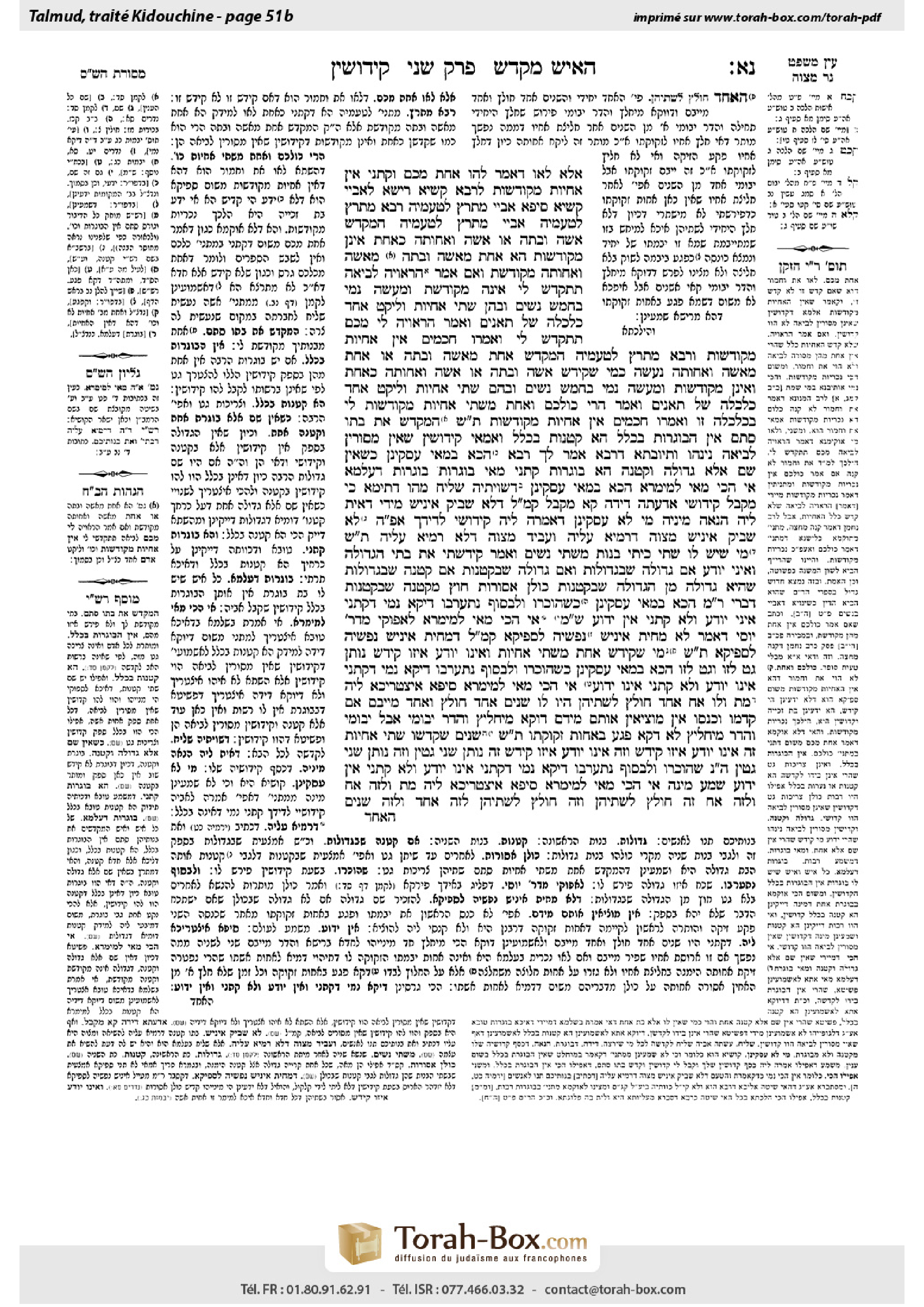
Kiddushin 51b: Talmud study for Daf Yomi
Daf Yomi is the daily study of one Talmud folio. Explore 37 tractates with scans, Hebrew text, Sefaria English and AI-generated French translations where annotated.
Passage selection and English or AI-generated French translation are available where the scan has annotations. Daf Study is independent of Torah-Box and Sefaria.
Browse Kiddushin · קידושין · All tractatesKiddushin 51b text and translations
This page of Kiddushin includes the Aramaic text, an English translation and an AI-generated French translation, alongside the scan above.
קידושין נ״א ב · Aramaic and Hebrew text
אֶלָּא לָאו דַּאֲמַר לְהוּ: ״אַחַת מִכֶּם״ וְקָתָנֵי: אֵין אֲחָיוֹת מְקוּדָּשׁוֹת? לְרָבָא קַשְׁיָא רֵישָׁא, לְאַבָּיֵי קַשְׁיָא סֵיפָא. אַבָּיֵי מְתָרֵץ לְטַעְמֵיהּ, רָבָא מְתָרֵץ לְטַעְמֵיהּ.
אַבָּיֵי מְתָרֵץ לְטַעְמֵיהּ: הַמְקַדֵּשׁ אִשָּׁה וּבִתָּהּ, אוֹ אִשָּׁה וַאֲחוֹתָהּ כְּאַחַת – אֵינָן מְקוּדָּשׁוֹת. הָא אַחַת מֵאִשָּׁה וּבִתָּהּ, מֵאִשָּׁה וַאֲחוֹתָהּ – מְקוּדֶּשֶׁת.
וְאִם אָמַר: ״הָרְאוּיָה לְבִיאָה תִּתְקַדֵּשׁ לִי״ – אֵינָהּ מְקוּדֶּשֶׁת. וּמַעֲשֶׂה נָמֵי בְּחָמֵשׁ נָשִׁים וּבָהֶן שְׁתֵּי אֲחָיוֹת, וְלִיקֵּט אֶחָד כַּלְכַּלָּה שֶׁל תְּאֵנִים וְאָמַר: ״הָרְאוּיָה לִי מִכֶּם תִּתְקַדֵּשׁ לִי״, וְאָמְרוּ חֲכָמִים: אֵין אֲחָיוֹת מְקוּדָּשׁוֹת.
וְרָבָא מְתָרֵץ לְטַעְמֵיהּ: הַמְקַדֵּשׁ אַחַת מֵאִשָּׁה וּבִתָּהּ אוֹ אַחַת מֵאִשָּׁה וַאֲחוֹתָהּ – נַעֲשָׂה כְּמִי שֶׁקִּידֵּשׁ אִשָּׁה וּבִתָּהּ, אוֹ אִשָּׁה וַאֲחוֹתָהּ כְּאַחַת, וְאֵינָן מְקוּדָּשׁוֹת. וּמַעֲשֶׂה נָמֵי בְּחָמֵשׁ נָשִׁים וּבָהֶם שְׁתֵּי אֲחָיוֹת, וְלִיקֵּט אֶחָד כַּלְכַּלָּה שֶׁל תְּאֵנִים וְאָמַר: הֲרֵי כּוּלְּכֶם וְאַחַת מִשְׁתֵּי אֲחָיוֹת מְקוּדָּשׁוֹת לִי בְּכַלְכַּלָּה זוֹ, וְאָמְרוּ חֲכָמִים: אֵין אֲחָיוֹת מְקוּדָּשׁוֹת.
תָּא שְׁמַע: הַמְקַדֵּשׁ אֶת בִּתּוֹ סְתָם – אֵין הַבּוֹגְרוֹת בַּכְּלָל. הָא קְטַנּוֹת בַּכְּלָל. וְאַמַּאי? קִידּוּשִׁין שֶׁאֵין מְסוּרִין לְבִיאָה נִינְהוּ, וּתְיוּבְתָּא דְּרָבָא!
אָמַר לָךְ רָבָא: הָכָא בְּמַאי עָסְקִינַן, כְּשֶׁאֵין שָׁם אֶלָּא גְּדוֹלָה וּקְטַנָּה.
הָא בּוֹגְרוֹת קָתָנֵי! מַאי בּוֹגְרוֹת – בּוֹגְרוֹת דְּעָלְמָא. אִי הָכִי מַאי לְמֵימְרָא?
הָכָא בְּמַאי עָסְקִינַן, דְּשַׁוִּיתֵיהּ שָׁלִיחַ. מַהוּ דְּתֵימָא כִּי מְקַבֵּל קִידּוּשֵׁי – אַדַּעְתַּהּ דִּידַהּ קָא מְקַבֵּל, קָא מַשְׁמַע לַן דְּלָא שָׁבֵיק אִינִישׁ מִידֵּי דְּאִית לֵיהּ הֲנָאָה מִינֵּיהּ.
מִי לָא עָסְקִינַן דְּאָמְרָה לֵיהּ ״קִידּוּשַׁי לְדִידָךְ״? אֲפִילּוּ הָכִי, לָא שָׁבֵיק אִינִישׁ מִצְוָה דְּרַמְיָא עֲלֵיהּ וְעָבֵיד מִצְוָה דְּלָא רַמְיָא עֲלֵיהּ.
תָּא שְׁמַע: מִי שֶׁיֵּשׁ לוֹ שְׁתֵּי כִּתֵּי בָנוֹת מִשְׁתֵּי נָשִׁים, וְאָמַר: ״קִידַּשְׁתִּי אֶת בִּתִּי הַגְּדוֹלָה, וְאֵינִי יוֹדֵעַ אִם גְּדוֹלָה שֶׁבַּגְּדוֹלוֹת וְאִם גְּדוֹלָה שֶׁבַּקְּטַנּוֹת, אִם קְטַנָּה שֶׁבַּגְּדוֹלוֹת שֶׁהִיא גְּדוֹלָה מִן הַגְּדוֹלָה שֶׁבַּקְּטַנּוֹת״ – כּוּלָּן אֲסוּרוֹת, חוּץ מִקְּטַנָּה שֶׁבַּקְּטַנּוֹת, דִּבְרֵי רַבִּי מֵאִיר.
הָכָא בְּמַאי עָסְקִינַן, כְּשֶׁהוּכְּרוּ וּלְבַסּוֹף נִתְעָרְבוּ. דַּיְקָא נָמֵי דְּקָתָנֵי: ״אֵינִי יוֹדֵעַ״, וְלָא קָתָנֵי ״אֵין יָדוּעַ״, שְׁמַע מִינַּהּ.
אִי הָכִי מַאי לְמֵימְרָא? לְאַפּוֹקֵי מִדְּרַבִּי יוֹסֵי, דְּאָמַר: לָא מַחֵית אִינִישׁ נַפְשֵׁיהּ לִסְפֵיקָא. קָא מַשְׁמַע לַן דְּמַחֵית אִינִישׁ נַפְשֵׁיהּ לִסְפֵיקָא.
תָּא שְׁמַע: מִי שֶׁקִּידֵּשׁ אַחַת מִשְׁתֵּי אֲחָיוֹת וְאֵינוֹ יוֹדֵעַ אֵיזוֹ קִידֵּשׁ – נוֹתֵן גֵּט לָזוֹ וְגֵט לָזוֹ. הָכָא בְּמַאי עָסְקִינַן, כְּשֶׁהוּכְּרוּ וּלְבַסּוֹף נִתְעָרְבוּ. דַּיְקָא נָמֵי, דְּקָתָנֵי: ״אֵינוֹ יוֹדֵעַ״, וְלָא קָתָנֵי: ״אֵינוֹ יָדוּעַ״.
אִי הָכִי מַאי לְמֵימְרָא? סֵיפָא אִיצְטְרִיכָא לֵיהּ: מֵת וְלוֹ אָח אֶחָד, חוֹלֵץ לִשְׁתֵּיהֶן. הָיוּ לוֹ שְׁנַיִם – אֶחָד חוֹלֵץ וְאֶחָד מְיַיבֵּם. אִם קָדְמוּ וְכָנְסוּ, אֵין מוֹצִיאִין אוֹתָם מִיָּדָם.
דַּוְקָא מִיחְלָץ וַהֲדַר יַבּוֹמֵי, אֲבָל יַבּוֹמֵי וַהֲדַר מִיחְלָץ – לָא, דְּקָא פָּגַע בַּאֲחוֹת זְקוּקָתוֹ.
תָּא שְׁמַע: שְׁנַיִם שֶׁקִּדְּשׁוּ שְׁתֵּי אֲחָיוֹת, זֶה אֵינוֹ יוֹדֵעַ אֵיזוֹ קִידֵּשׁ וְזֶה אֵינוֹ יוֹדֵעַ אֵיזוֹ קִידֵּשׁ – זֶה נוֹתֵן שְׁנֵי גִטִּין, וְזֶה נוֹתֵן שְׁנֵי גִטִּין! הָכָא נָמֵי, שֶׁהוּכְּרוּ וּלְבַסּוֹף נִתְעָרְבוּ. דַּיְקָא נָמֵי דְּקָתָנֵי: ״אֵינוֹ יוֹדֵעַ״, וְלָא קָתָנֵי: ״אֵין יָדוּעַ״, שְׁמַע מִינַּהּ.
אִי הָכִי, מַאי לְמֵימְרָא? סֵיפָא אִיצְטְרִיכָא לֵיהּ: מֵת, וְלָזֶה אָח וְלָזֶה אָח – זֶה חוֹלֵץ לִשְׁתֵּיהֶן וְזֶה חוֹלֵץ לִשְׁתֵּיהֶן. לָזֶה אֶחָד וְלָזֶה שְׁנַיִם –
Kiddushin 51b · English translation
Rather, is it not referring to a case where he said to them: One of you is betrothed, and it teaches that the sisters are not betrothed, because with regard to the sisters the betrothal is not given to consummation? The Gemara comments: If so, the first clause of the mishna is difficult for Rava, while the last clause is difficult for Abaye. The Gemara presents a resolution: Abaye explains the last clause according to his line of reasoning, and Rava explains the first clause according to his line of reasoning.
Abaye explains it according to his line of reasoning, as follows: In the case of one who betroths a woman and her daughter or a woman and her sister in one act of betrothal neither of them is betrothed. But if he betrothed one of a pair consisting of a woman and her daughter or a woman and her sister by saying: One of you is betrothed to me, each of them is betrothed as a matter of uncertainty and requires a bill of divorce, despite the fact that the betrothal is not given to consummation, in case he is in fact betrothed to the other one.
The Gemara continues Abaye’s explanation: And if he explicitly said: The one of you fit for sexual intercourse shall be betrothed to me, neither of them is betrothed, as he cannot engage in intercourse with either, not knowing which of them is his betrothed and which is his betrothed’s relative. And an incident also occurred involving five women, and among them were two sisters. And one man gathered a basket of figs and said: The one among you fit for intercourse with me shall be betrothed to me with this basket, and the Sages said: The sisters are not betrothed.
And Rava explains according to his line of reasoning: In the case of one who betroths one of a pair consisting of a woman and her daughter or one of a pair consisting of a woman and her sister it becomes as one who simultaneously betrothed a woman and her daughter or a woman and her sister, and they are not betrothed, since betrothal that is not given to consummation is not considered betrothal. And an incident also occurred involving five women, and among them were two sisters. And one man gathered a basket of figs and said: All of you, and one of the two sisters, are hereby betrothed to me with this basket. And the Sages said: The sisters are not betrothed. Since the mishna can be read in either of these two ways, nothing can be proven from it with regard to the issue of betrothal that is not given to consummation.
The Gemara suggests: Come and hear a proof from a mishna (64b): In the case of one who betroths his daughter to a man without specification, i.e., without specifying which daughter he meant, the grown women are not included among those who might be betrothed, since he does not have the right to betroth them. The Gemara analyzes this: One can infer that the minor daughters are included, and each is betrothed as a matter of uncertainty. But why are the minor daughters betrothed? Each of these betrothals is a betrothal that is not given to consummation, since he did not specify which of his minor daughters he had in mind. Therefore, according to Rava betrothal should not take effect with regard to any of them, and this is a conclusive refutation of the opinion of Rava.
The Gemara answers: Rava could have said to you: With what are we dealing here? It is when there is only one adult daughter and one minor daughter. Consequently, once the adult daughter is removed from consideration, it is clear that the father has betrothed the minor daughter, and the betrothal is given to consummation.
The Gemara questions this explanation: But that mishna teaches: Grown women, in the plural. The Gemara answers: What is the meaning of grown women? Grown women in general. In other words, whenever people betroth their daughters without further specification, only the minor daughters, and not the adult daughters, are included. The Gemara asks: If so, that there are only two daughters, what is the purpose of stating this; what novel halakha does it teach?
The Gemara answers: With what are we dealing here? It is a situation where his adult daughter designated him as her agent to betroth her. Lest you say that when he accepts betrothal from someone on behalf of his daughter without further specification he accepts it with her in mind, and he intended to betroth her rather than his minor daughter, the mishna therefore teaches us that a person does not set aside something from which he has benefit, e.g., the betrothal of his minor daughter, where he keeps the betrothal money, in favor of something from which he has no benefit, e.g., the betrothal of his adult daughter, where she keeps the betrothal money.
The Gemara raises a difficulty: Aren’t we also dealing with a case where the adult daughter said to him: When you betroth me, my betrothal money is for you? Accordingly, he derives benefit from her betrothal as well. The Gemara explains: Even so, the father would not have intended to betroth his adult daughter, since a person does not set aside a mitzva that is incumbent upon him, e.g., the betrothal of his minor daughter, and perform a mitzva that is not incumbent upon him, e.g., the betrothal of his adult daughter.
The Gemara further suggests: Come and hear a proof from a mishna (64b): With regard to one who has two groups of daughters from two women, e.g., he has multiple daughters from his first wife, and after his first wife died he remarried and had multiple daughters with his second wife, and he said: I betrothed my elder daughter to someone, but I do not know if it was the eldest of the older group of daughters or if it was the eldest of the younger group of daughters, or if it was the youngest of the older group, who is nevertheless older than the eldest of the younger group; all the daughters are prohibited from marrying someone else without first receiving a bill of divorce, except for the youngest of the younger group, who is certainly not betrothed. This is the statement of Rabbi Meir. This betrothal is not given to consummation, since each daughter could be the sister of his actual betrothed, and yet the betrothal is considered valid, as otherwise they would all be permitted to marry without requiring a bill of divorce.
The Gemara rejects this: With what are we dealing here? It is a situation where they were identified and later intermingled. In other words, this mishna is not dealing with one who betrothed a daughter without specifying which one; rather, he initially stated which daughter he intended to betroth but subsequently forgot. The actual betrothal is given to consummation, so the daughters are betrothed due to the uncertainty. The Gemara comments: The language of the mishna is also precise, as it teaches that he said: I do not know, in the first person and in the present tense, indicating that he did know who it was at one point but does not know now, and it does not teach that he said: It is not known. The Gemara affirms: Learn from the language of the mishna that we are indeed dealing with a case where the daughters were intermingled after they were identified.
The Gemara asks: If so, what is the purpose of stating this; what novel halakha does it teach? The Gemara answers: The mishna serves to exclude the opinion of Rabbi Yosei, who says: A person does not place himself into a situation of uncertainty, and when he said elder daughter he must have meant the eldest of the older group, who is the absolute eldest. Rabbi Meir teaches us that a person does place himself into a situation of uncertainty, and the uncertainty applies to each of his daughters, except for the youngest of the younger group.
The Gemara further suggests: Come and hear a proof from a mishna (Yevamot 23b): In the case of one who betrothed one of two sisters and he does not know which one he betrothed, he must give a bill of divorce to this one and a bill of divorce to that one, due to the uncertainty. This betrothal is not given to consummation, so why do they require bills of divorce? The Gemara answers: With what are we dealing here? It is when they were identified and later intermingled. The actual betrothal was given to consummation, so the sisters are betrothed due to the uncertainty. The Gemara comments: The language of the mishna is also precise, as it teaches the phrase: He does not know, indicating that he did know who it was at one point but now does not know, and it does not teach the phrase: It is not known.
The Gemara poses a question: If so, what is the purpose of stating this; what novel halakha does it teach? The Gemara answers: It was necessary to teach the latter clause of that mishna: If this man died and he had one brother, the brother performs ḥalitza with both of the sisters, but he cannot perform levirate marriage with either because one of them is the sister of his yevama, who is forbidden to him by rabbinic law. If he had two brothers, one of them performs ḥalitza with one of the sisters but may not take her in levirate marriage, due to the possibility that she is the sister of a woman with whom he has a levirate bond. And then one takes the other in levirate marriage if he so desires. If both brothers married the sisters before consulting the court, the court does not remove them from their marriage and they are permitted to remain married. Although the first couple should have performed ḥalitza, the court does not force them to divorce.
The Gemara explains the novelty of the latter clause: This is effective specifically if one brother first performs ḥalitza and afterward the second brother performs levirate marriage, but if one brother first performs levirate marriage and afterward the other brother performs ḥalitza, the levirate marriage would not take effect, as he is possibly encountering the sister of the woman bound to him by ties of levirate marriage. Until the yevama is released through ḥalitza, her sister is considered, to a certain extent, the sister of his wife, due to the ties of levirate marriage. The one who performs levirate marriage might have chosen the sister of the woman betrothed by the dead brother.
The Gemara further suggests: Come and hear a proof from the continuation of that mishna: In the case of two unrelated men who betrothed two sisters, where this one does not know which sister he betrothed and that one does not know which sister he betrothed, this one gives two bills of divorce, one to each of the women, and that one gives two bills of divorce. Their betrothal is not given to consummation, so according to Rava why do they require a bill of divorce? The Gemara answers: Here too, it is discussing a case where they were identified and later intermingled. The actual betrothal was given to consummation, so the sisters are betrothed due to the uncertainty. The Gemara comments: The language of the mishna is also precise, as it teaches using the phrase: Does not know, indicating that at one point he did know who it was but now does not know, and it does not teach: It is not known. The Gemara affirms: Learn from it that we are indeed dealing with a case where the sisters were identified and later intermingled.
The Gemara asks: If so, what is the purpose of stating this; what novel halakha does it teach? The Gemara answers: It was necessary to teach the latter clause of that mishna: If each man died before he divorced, and this one had a brother and that one had a brother, then this brother performs ḥalitza with both of them, and that brother performs ḥalitza with both of them. Neither man may perform levirate marriage, lest he perform levirate marriage with the sister of his yevama. If this one had one brother and that one had two brothers,
Kiddushin 51b · Traduction française (IA)
Plutôt, ne s'agit-il pas d'un cas où il leur a dit : L'une d'entre vous est fiancée, et cela enseigne-t-il que les sœurs ne sont pas fiancées, car en ce qui concerne les sœurs, la fiançailles ne mène pas à la consommation ? La Guemara commente : Si tel est le cas, la première clause de la Michna pose une difficulté pour Rava, tandis que la dernière clause pose une difficulté pour Abaye. La Guemara présente une résolution : Abaye explique la dernière clause selon sa ligne de raisonnement, et Rava explique la première clause selon sa ligne de raisonnement.
Abaye l'explique selon sa ligne de raisonnement, comme suit : Dans le cas d'un homme qui fiance une femme et sa fille ou une femme et sa sœur dans un seul acte de fiançailles, aucune d'elles n'est fiancée. Mais s'il a fiancé l'une d'un duo composé d'une femme et de sa fille ou d'une femme et de sa sœur en disant : L'une d'entre vous est fiancée à moi, chacune d'elles est fiancée en raison d'une incertitude et a besoin d'un acte de divorce, malgré le fait que la fiançailles ne mène pas à la consommation, au cas où il serait en réalité fiancé à l'autre.
La Guemara poursuit l'explication d'Abaye : Et s'il a dit explicitement : Celle d'entre vous qui est apte à la relation sexuelle sera fiancée à moi, aucune d'elles n'est fiancée, car il ne peut avoir de relations avec aucune d'elles, ne sachant laquelle d'entre elles est sa fiancée et laquelle est la parente de sa fiancée. Et un incident s'est également produit impliquant cinq femmes, et parmi elles se trouvaient deux sœurs. Et un homme a rassemblé un panier de figues et a dit : Celle d'entre vous qui est apte à la relation avec moi sera fiancée à moi avec ce panier, et les Sages ont dit : Les sœurs ne sont pas fiancées.
Et Rava explique selon sa ligne de raisonnement : Dans le cas d'un homme qui marie l'une d'un duo composé d'une femme et de sa fille, ou l'une d'un duo composé d'une femme et de sa sœur, cela équivaut à un homme qui a marié simultanément une femme et sa fille, ou une femme et sa sœur, et elles ne sont pas mariées, car un mariage qui ne mène pas à la consommation n'est pas considéré comme un mariage. Et un incident s'est également produit impliquant cinq femmes, et parmi elles se trouvaient deux sœurs. Et un homme a rassemblé un panier de figues et a dit : Vous toutes, et l'une des deux sœurs, êtes par là mariées à moi avec ce panier. Et les Sages ont dit : Les sœurs ne sont pas mariées. Puisque la Michna peut être lue de l'une ou l'autre de ces deux manières, rien ne peut en être démontré en ce qui concerne la question du mariage qui ne mène pas à la consommation.
La Guemara suggère : Venez entendre une preuve d'une Michna (64b) : Dans le cas d'un homme qui marie sa fille à un homme sans spécification, c'est-à-dire sans préciser laquelle de ses filles il visait, les femmes adultes ne sont pas incluses parmi celles qui pourraient être mariées, car il n'a pas le droit de les marier. La Guemara analyse ceci : On peut en déduire que les filles mineures sont incluses, et chacune est mariée en raison d'une incertitude. Mais pourquoi les filles mineures sont-elles mariées ? Chacun de ces mariages est un mariage qui ne mène pas à la consommation, car il n'a pas précisé laquelle de ses filles mineures il avait en tête. Par conséquent, selon Rava, le mariage ne devrait pas prendre effet en ce qui concerne aucune d'entre elles, et cela constitue une réfutation concluante de l'opinion de Rava.
La Guemara répond : Rava aurait pu vous dire : Avec quoi avons-nous affaire ici ? Il s'agit d'un cas où il n'y a qu'une seule fille adulte et une seule fille mineure. Par conséquent, une fois que la fille adulte est écartée de la considération, il est clair que le père a marié la fille mineure, et le mariage mène à la consommation.
La Guemara met en question cette explication : Or, cette Michna enseigne : « Les femmes adultes », au pluriel. La Guemara répond : Quel est le sens de « femmes adultes » ? Les femmes adultes en général. En d'autres termes, chaque fois que des gens fiancent leurs filles sans autre précision, seules les filles mineures, et non les filles adultes, sont incluses. La Guemara demande : Si tel est le cas, qu'il n'y a que deux filles, quel est le but d'énoncer cela ; quelle halakha nouvelle enseigne-t-elle ?
La Guemara répond : Avec quoi avons-nous affaire ici ? Il s'agit d'une situation où sa fille adulte l'a désigné comme son agent pour la fiancer. De peur que vous ne disiez que lorsqu'il accepte une fiançailles de la part de quelqu'un au nom de sa fille sans autre précision, il l'accepte en pensant à elle, et qu'il avait l'intention de la fiancer plutôt que sa fille mineure, la Michna nous enseigne donc qu'une personne n'écarte pas quelque chose dont il tire un avantage, par exemple la fiançailles de sa fille mineure, où il conserve l'argent de la fiançailles, au profit de quelque chose dont il ne tire aucun avantage, par exemple la fiançailles de sa fille adulte, où elle conserve l'argent de la fiançailles.
La Guemara soulève une difficulté : N'avons-nous pas également affaire à un cas où la fille adulte lui a dit : « Lorsque tu me fianceras, mon argent de fiançailles est pour toi » ? En conséquence, il tire un avantage de sa fiançailles également. La Guemara explique : Même ainsi, le père n'aurait pas eu l'intention de fiancer sa fille adulte, car une personne n'écarte pas une mitsva qui lui incombe, par exemple la fiançailles de sa fille mineure, pour accomplir une mitsva qui ne lui incombe pas, par exemple la fiançailles de sa fille adulte.
La Guemara propose en outre : Écoutez une preuve tirée d'une Michna (64b) : S'agissant d'un homme qui a deux groupes de filles issues de deux femmes, par exemple s'il a eu plusieurs filles de sa première épouse, et qu'après le décès de celle-ci il s'est remarié et a eu plusieurs filles avec sa seconde épouse, et s'il a déclaré : J'ai fiancé ma fille aînée à quelqu'un, mais je ne sais pas s'il s'agit de l'aînée du groupe des filles aînées ou de l'aînée du groupe des filles cadettes, ou encore de la cadette du groupe aîné, qui est néanmoins plus âgée que l'aînée du groupe cadet ; toutes les filles sont interdites de se marier avec un autre sans recevoir d'abord un acte de divorce, à l'exception de la cadette du groupe cadet, qui n'est certainement pas fiancée. C'est l'avis de Rabbi Meïr. Cette fiançaille n'est pas considérée comme valable jusqu'à la consommation, car chaque fille pourrait être la sœur de celle qui est réellement fiancée, et pourtant la fiançaille est considérée comme valide, car sinon elles seraient toutes autorisées à se marier sans avoir besoin d'un acte de divorce.
La Guemara rejette cette argumentation : De quoi s'agit-il ici ? Il s'agit d'une situation où elles ont été identifiées puis mélangées par la suite. Autrement dit, cette Michna ne traite pas d'un homme qui a fiancé une fille sans préciser laquelle ; plutôt, il a d'abord déclaré laquelle il intended de fiancer, mais il l'a oubliée par la suite. La fiançaille réelle est considérée comme valable jusqu'à la consommation, de sorte que les filles sont fiancées en raison de l'incertitude. La Guemara commente : La formulation de la Michna est également précise, car elle enseigne qu'il a dit : Je ne sais pas, à la première personne et au présent, indiquant qu'il savait à un moment donné de qui il s'agissait mais ne le sait plus maintenant, et elle n'enseigne pas qu'il a dit : On ne sait pas. La Guemara confirme : Apprenez de la formulation de la Michna que nous traitons bien d'un cas où les filles ont été mélangées après avoir été identifiées.
La Guemara demande : Si c'est le cas, quel est le but d'énoncer cela ; quelle halakha nouvelle enseigne-t-elle ? La Guemara répond : La Michna sert à exclure l'avis de Rabbi Yosse, qui dit : Une personne ne se met pas dans une situation d'incertitude, et lorsqu'il a dit « fille aînée », il a dû vouloir dire l'aînée du groupe des aînées, qui est l'aînée absolue. Rabbi Meïr nous enseigne qu'une personne se met bien dans une situation d'incertitude, et que l'incertitude s'applique à chacune de ses filles, à l'exception de la cadette du groupe des cadettes.
La Guemara propose en outre : Écoutez une preuve tirée d'une Michna (Yevamot 23b) : Dans le cas d'un homme qui a fiancé l'une de deux sœurs et qui ne sait pas laquelle il a fiancée, il doit donner un acte de divorce à celle-ci et un acte de divorce à celle-là, en raison de l'incertitude. Cette fiançaille n'est pas donnée à la consommation, alors pourquoi ont-elles besoin d'actes de divorce ? La Guemara répond : De quoi s'agit-il ici ? Il s'agit d'un cas où elles ont été identifiées puis mélangées par la suite. La fiançaille réelle était donnée à la consommation, de sorte que les sœurs sont fiancées en raison de l'incertitude. La Guemara commente : La formulation de la Michna est également précise, car elle enseigne la phrase : « Il ne sait pas », indiquant qu'il savait à un moment donné de qui il s'agissait mais ne le sait plus maintenant, et elle n'enseigne pas la phrase : « On ne sait pas ».
La Guemara pose une question : Si c'est le cas, quel est le but d'énoncer cela ; quelle halakha nouvelle enseigne-t-elle ? La Guemara répond : Il était nécessaire d'enseigner la dernière clause de cette Michna : Si cet homme est mort et qu'il avait un frère, le frère effectue la ḥalitza avec les deux sœurs, mais il ne peut pas contracter le mariage lévirat avec l'une d'elles, car l'une d'entre elles est la sœur de sa yevama, qui lui est interdite par la loi rabbinique. S'il avait deux frères, l'un d'eux effectue la ḥalitza avec l'une des sœurs mais ne peut pas l'épouser en mariage lévirat, en raison de la possibilité qu'elle soit la sœur d'une femme avec laquelle il a un lien lévirat. Et puis l'autre frère peut épouser l'autre sœur en mariage lévirat s'il le souhaite. Si les deux frères ont épousé les sœurs avant de consulter le tribunal, le tribunal ne les sépare pas de leur mariage et ils sont autorisés à rester mariés. Bien que le premier couple aurait dû effectuer la ḥalitza, le tribunal ne les force pas à divorcer.
La Guemara explique la nouveauté de la dernière clause : Cela est valable spécifiquement si un frère effectue d'abord la ḥalitza et que par la suite le second frère effectue le mariage lévirat, mais si un frère effectue d'abord le mariage lévirat et que par la suite l'autre frère effectue la ḥalitza, le mariage lévirat n'aurait pas d'effet, car il pourrait rencontrer la sœur de la femme liée à lui par les liens du mariage lévirat. Jusqu'à ce que la yevama soit libérée par la ḥalitza, sa sœur est considérée, dans une certaine mesure, comme la sœur de sa femme, en raison des liens du mariage lévirat. Celui qui contracte le mariage lévirat a peut-être choisi la sœur de la femme fiancée par le frère défunt.
La Guemara propose en outre : Écoutez une preuve tirée de la suite de cette Michna : Dans le cas de deux hommes sans lien de parenté qui ont fiancé deux sœurs, où l'un ne sait pas laquelle des sœurs il a fiancée et l'autre ne sait pas laquelle des sœurs il a fiancée, l'un donne deux actes de divorce, un à chacune des femmes, et l'autre donne deux actes de divorce. Leur fiançaille n'est pas considérée comme valable jusqu'à la consommation, alors pourquoi, selon Rava, ont-elles besoin d'un acte de divorce ? La Guemara répond : Ici aussi, il s'agit d'un cas où elles ont été identifiées puis mélangées par la suite. La fiançaille réelle était considérée comme valable jusqu'à la consommation, de sorte que les sœurs sont fiancées en raison de l'incertitude. La Guemara commente : La formulation de la Michna est également précise, car elle enseigne en utilisant la phrase : « Ne sait pas », indiquant qu'à un moment donné il savait de qui il s'agissait mais ne le sait plus maintenant, et elle n'enseigne pas : « On ne sait pas ». La Guemara confirme : Apprenez-en que nous traitons bien d'un cas où les sœurs ont été identifiées puis mélangées par la suite.
La Guemara demande : Si c'est ainsi, quel est le but de cette formulation ; quelle halakha nouvelle enseigne-t-elle ? La Guemara répond : Il était nécessaire d'enseigner la dernière clause de cette Michna : Si chacun des deux hommes est mort avant d'avoir divorcé, et que l'un d'eux avait un frère et l'autre avait un frère, alors ce frère effectue la ḥalitza avec les deux, et l'autre frère effectue la ḥalitza avec les deux. Aucun des deux hommes ne peut contracter un mariage lévirat, de peur qu'il ne contracte un mariage lévirat avec la sœur de sa yevama. Si l'un d'eux avait un frère et l'autre en avait deux,
Traduction française générée par IA à partir de l’édition anglaise de Sefaria. Vérifie toujours un passage avec le texte source.
Text from Sefaria: William Davidson Edition - Vocalized Aramaic (CC BY NC); William Davidson Edition - English (CC BY NC).