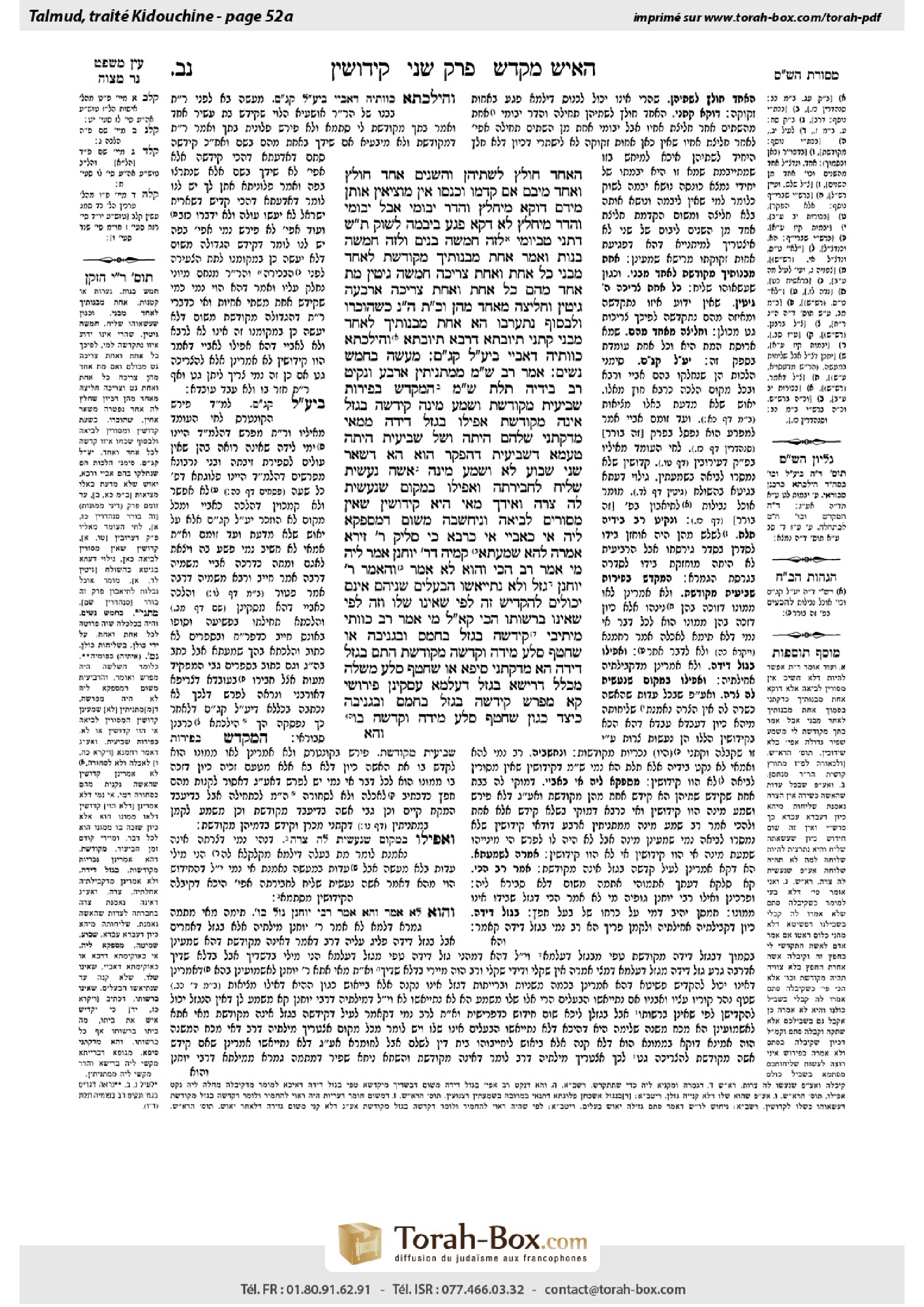
Kiddushin 52a: Talmud study for Daf Yomi
Daf Yomi is the daily study of one Talmud folio. Explore 37 tractates with scans, Hebrew text, Sefaria English and AI-generated French translations where annotated.
Passage selection and English or AI-generated French translation are available where the scan has annotations. Daf Study is independent of Torah-Box and Sefaria.
Browse Kiddushin · קידושין · All tractatesKiddushin 52a text and translations
This page of Kiddushin includes the Aramaic text, an English translation and an AI-generated French translation, alongside the scan above.
קידושין נ״ב א · Aramaic and Hebrew text
הָאֶחָד חוֹלֵץ לִשְׁתֵּיהֶן, וְהַשְּׁנַיִם – אֶחָד חוֹלֵץ וְאֶחָד מְיַבֵּם. אִם קָדְמוּ וְכָנְסוּ – אֵין מוֹצִיאִין אוֹתָן מִיָּדָם.
דַּוְקָא מִיחְלָץ וַהֲדַר יַבּוֹמֵי, אֲבָל יַבּוֹמֵי וַהֲדַר מִיחְלָץ – לָא, דְּקָא פָּגַע בִּיבָמָה לַשּׁוּק.
תָּא שְׁמַע, דְּתָנֵי טָבְיוֹמֵי: לְזֶה חֲמִשָּׁה בָּנִים וּלְזֶה חֲמִשָּׁה בָּנוֹת, וְאָמַר: ״אַחַת מִבְּנוֹתֶיךָ מְקוּדֶּשֶׁת לְאֶחָד מִבָּנַי״ – כׇּל אַחַת וְאַחַת צְרִיכָה חֲמִשָּׁה גִּיטִּין. מֵת אֶחָד מֵהֶם – כׇּל אַחַת וְאַחַת צְרִיכָה אַרְבָּעָה גִּיטִּין, וַחֲלִיצָה מֵאֶחָד מֵהֶן.
וְכִי תֵּימָא: הָכִי נָמֵי כְּשֶׁהוּכְּרוּ וּלְבַסּוֹף נִתְעָרְבוּ, הָא ״אַחַת מִבְּנוֹתֶיךָ לְאֶחָד מִבָּנַי״ קָתָנֵי, תְּיוּבְתָּא דְרָבָא, תְּיוּבְתָּא. וְהִילְכְתָא כְּווֹתֵיהּ דְּאַבָּיֵי בְּיַעַ״ל קַגַ״ם.
מַעֲשֶׂה בְּחָמֵשׁ נָשִׁים. אָמַר רַב: שְׁמַע מִינַּהּ מִמַּתְנִיתִין אַרְבַּע, וְנָקֵיט רַב בִּידֵיהּ תְּלָת.
שְׁמַע מִינַּהּ: הַמְקַדֵּשׁ בְּפֵירוֹת שְׁבִיעִית – מְקוּדֶּשֶׁת, וּשְׁמַע מִינַּהּ: קִידְּשָׁהּ בְּגָזֵל – אֵינָהּ מְקוּדֶּשֶׁת, אֲפִילּוּ בְּגָזֵל דִּידַהּ. מִמַּאי? מִדְּקָתָנֵי: שֶׁלָּהֶם הָיְתָה וְשֶׁל שְׁבִיעִית הָיְתָה – טַעְמָא דִּשְׁבִיעִית, דְּהֶפְקֵר הוּא, הָא דִּשְׁאָר שְׁנֵי שָׁבוּעַ – לָא.
וּשְׁמַע מִינַּהּ: אִשָּׁה נַעֲשֵׂית שָׁלִיחַ לַחֲבֶירְתָּהּ, וַאֲפִילּוּ בִּמְקוֹם שֶׁנַּעֲשֵׂית לָהּ צָרָה.
וְאִידַּךְ מַאי הִיא? קִידּוּשִׁין שֶׁאֵין מְסוּרִים לְבִיאָה. וְנִיחְשְׁבַהּ! מִשּׁוּם דִּמְסַפְּקָא לֵיהּ אִי כְּאַבָּיֵי אִי כְּרָבָא.
כִּי סְלֵיק רַבִּי זֵירָא אַמְרַהּ לְהָא שְׁמַעְתָּא קַמֵּיהּ דְּרַבִּי יוֹחָנָן. אֲמַר לֵיהּ: מִי אָמַר רַב הָכִי? וְהוּא לָא אֲמַר?! וְהָאָמַר רַבִּי יוֹחָנָן: גָּזַל וְלֹא נִתְיָיאֲשׁוּ הַבְּעָלִים – שְׁנֵיהֶם אֵינָם יְכוֹלִים לְהַקְדִּישׁ, זֶה לְפִי שֶׁאֵינוֹ שֶׁלּוֹ, וְזֶה לְפִי שֶׁאֵינוֹ בִּרְשׁוּתוֹ. הָכִי קָאָמַר לֵיהּ: מִי אָמַר רַב כְּווֹתִי?
מֵיתִיבִי: קִידְּשָׁהּ בְּגָזֵל, בְּחָמָס, וּבִגְנֵיבָה, אוֹ שֶׁחָטַף סֶלַע מִיָּדָהּ וְקִדְּשָׁהּ – מְקוּדֶּשֶׁת! הָתָם בְּגָזֵל דִּידַהּ.
הָא מִדְּקָתָנֵי סֵיפָא: אוֹ שֶׁחָטַף סֶלַע מִשֶּׁלָּהּ – מִכְּלָל דְּרֵישָׁא בְּגָזֵל דְּעָלְמָא עָסְקִינַן! פָּירוּשֵׁי קָא מְפָרֵשׁ: קִידְּשָׁהּ בְּגָזֵל, בְּחָמָס, וּבִגְנֵיבָה כֵּיצַד? כְּגוֹן שֶׁחָטַף סֶלַע מִיָּדָהּ וְקִדְּשָׁהּ בּוֹ.
Kiddushin 52a · English translation
the one brother performs ḥalitza with both of them, and of the two brothers, one performs ḥalitza with one of the sisters and one, if he so desires, performs levirate marriage with the other sister. If they married the widows before consulting the court, the court does not remove them from the marriage, and they are permitted to remain married.
The Gemara explains the novelty of the latter clause: This is effective specifically if one of the two brothers first performs ḥalitza and afterward the other brother performs levirate marriage, but if one of the two brothers first performs levirate marriage and afterward the other brother performs ḥalitza, the levirate marriage would not take effect, as he is possibly encountering a yevama getting married to a member of the public. This is because it is possible that the woman he married was not his yevama but someone else’s yevama, and until the other man’s brother performs ḥalitza with her it is still prohibited for her to marry other men.
The Gemara derives a proof: Come and hear, as the Sage Tavyumei taught the following baraita: If this man had five sons and that man had five daughters, and the first man said: One of your daughters is betrothed to one of my sons, each and every one of the daughters requires five bills of divorce, one from each of the sons, due to the uncertainty of who is betrothed to whom. If one of the sons died before giving his bill of divorce, each and every one of the daughters requires four bills of divorce, one from each of the surviving brothers, and ḥalitza from one of them, in case she was betrothed to the deceased son. The ḥalitza of one of the brothers suffices to release her from her levirate bond. According to Rava this betrothal should not be valid, as it is not given to consummation. Why, then, do they each require bills of divorce?
And if you would say that here too it is referring to a case where they were identified and later intermingled, that cannot be. This is as the baraita teaches: One of your daughters to one of my sons, indicating that the betrothal could never have been given to consummation, and yet it is a valid betrothal. The Gemara concludes: The refutation of the opinion of Rava is a conclusive refutation. The Gemara further notes: And the halakha is in accordance with the opinion of Abaye when he has a dispute with Rava with regard to six halakhot, as represented by the mnemonic yod, ayin, lamed, kuf, gimmel, mem: Despair that is not conscious [yeush shelo mida’at], conspiring witnesses [eidim] who are disqualified retroactively, a side post [leḥi] standing alone, betrothal [kiddushin] that is not given to consummation, revealing intent with a bill of divorce [get], and an apostate [mumar] who sins rebelliously. Although the halakha generally is in accordance with the opinion of Rava in his disputes with Abaye, in these six cases the halakha is in accordance with the opinion of Abaye.
§ The mishna teaches: An incident occurred involving five women, and among them were two sisters. And one person gathered a basket of figs that were from their field, and the fruit was of the Sabbatical Year. And he said: You are hereby all betrothed to me with this basket, and one of them accepted it on behalf of all of them. And the Sages said: The sisters are not betrothed. Rav says: One can learn four halakhot from the mishna. The Gemara adds: And Rav held three of them in his hand, i.e., knew what they were, but he was uncertain about the fourth.
Rav clarifies: Learn from it that with regard to one who betroths a woman with produce of the Sabbatical Year, she is betrothed, and you do not say that this produce can be used only for eating and not for any other purpose. And learn from it that if one betroths a woman with a stolen item, even if it was her stolen item, she is not betrothed. You do not say that her accepting from him an item that he stole from her indicates that she released him from his obligation to return it, rendering it his to use in order to betroth her. From where can these two halakhot be deduced? It is from the fact that it teaches that the produce was from their field, and was of the Sabbatical Year, which indicates: The reason it could be used for betrothal is that the produce was of the Sabbatical Year, which causes the figs to be ownerless property. But if it was one of the other years of the seven-year Sabbatical cycle, the betrothal would not take effect with stolen property, even if she accepted it for her betrothal.
And learn from it: A woman can become an agent to accept a betrothal for another woman, and this is so even in a situation where she thereby becomes the rival wife of the other, as in the case of the mishna.
The Gemara asks: And what is the other halakha, the fourth one mentioned by Rav? It is the halakha of betrothal that is not given to consummation. The Gemara suggests: And let Rav also count this halakha. The Gemara explains: He does not do so, because he is uncertain whether the correct interpretation of the mishna is in accordance with the explanation of Abaye, who maintains that such a betrothal is valid, or whether the correct interpretation of the mishna is in accordance with the explanation of Rava, which would mean it is not betrothal.
The Gemara relates: When Rabbi Zeira ascended to Eretz Yisrael he stated this halakha before Rabbi Yoḥanan, who said to him: Did Rav actually say so? This indicates that Rabbi Yoḥanan disagreed with the statement of Rav that these halakhot can be learned from the mishna, which leads the Gemara to ask: But didn’t he himself say so? And didn’t Rabbi Yoḥanan say: If one robbed another of an item and its owner has not despaired of recovering it, neither of them can consecrate the stolen item? This one, the robber, cannot consecrate it because it is not his, and that one, the owner, cannot consecrate it because it is not in his possession. By the same logic, one should not be able to betroth a woman with stolen property, as it is not his. The Gemara answers that Rabbi Yoḥanan was not objecting to Rav’s opinion, but this is what he said to him: Did Rav actually say in accordance with my opinion?
The Gemara raises an objection against Rav’s opinion that one cannot betroth a woman with stolen property, from a baraita (Tosefta 4:5): If one betrothed her with an item taken in robbery, in a forced transaction, or in theft, or if he grabbed a sela from her hand and betrothed her with it, she is betrothed. This indicates that one can betroth a woman with stolen property. The Gemara answers: There it is referring to her stolen property, and by accepting it from him as betrothal, she indicates that she has released him from his obligation to return it.
The Gemara asks: But from the fact that the last clause of the baraita teaches: Or if he grabbed a sela of hers, it may be inferred that in the first clause we are dealing with property stolen from others. The Gemara explains: These are not two separate cases. Instead, the tanna is explaining his earlier statement: If one betrothed a woman with an item taken in robbery, in a forced transaction, or in theft; how so? For example, if he grabbed a sela from her hand and betrothed her with it.
Kiddushin 52a · Traduction française (IA)
L’un des frères accomplit la ḥalitsa avec chacune des deux femmes, et, parmi les deux frères, l’un accomplit la ḥalitsa avec l’une des sœurs tandis que l’autre, s’il le souhaite, contracte un mariage léviratique avec l’autre sœur. S’ils ont épousé les veuves avant de consulter le tribunal, celui-ci ne les sépare pas et ils peuvent rester mariés.
La Guemara explique la nouveauté de la dernière clause : cela est valable précisément si l’un des deux frères accomplit d’abord la ḥalitsa, puis l’autre frère contracte un mariage léviratique. Mais si l’un des deux frères contracte d’abord un mariage léviratique, puis que l’autre frère accomplit la ḥalitsa, le mariage léviratique ne prendrait pas effet, car il pourrait épouser une yevama qui n’est pas la sienne et qui épouse ainsi un homme extérieur à la famille. En effet, il est possible que la femme qu’il a épousée ne soit pas sa yevama, mais celle d’un autre homme ; tant que le frère de cet autre homme n’a pas accompli la ḥalitsa avec elle, il lui est encore interdit d’épouser d’autres hommes.
La Guemara apporte une preuve : Viens et entends, car le Sage Tavyumei a enseigné la baraïta suivante : Si cet homme avait cinq fils et cet autre homme cinq filles, et que le premier homme avait dit : « L’une de tes filles est fiancée à l’un de mes fils », chacune des filles doit recevoir cinq actes de divorce, un de chacun des fils, en raison de l’incertitude quant à savoir qui est fiancé à qui. Si l’un des fils est mort avant de lui remettre son acte de divorce, chacune des filles doit recevoir quatre actes de divorce, un de chacun des frères survivants, ainsi que la ḥalitsa de l’un d’eux, au cas où elle aurait été fiancée au fils décédé. La ḥalitsa accomplie par l’un des frères suffit à la libérer de son lien léviratique. Selon Rava, ces fiançailles ne devraient pas être valables, puisqu’elles ne peuvent pas être menées à leur accomplissement. Pourquoi, alors, chacune doit-elle recevoir des actes de divorce ?
Et si tu dis qu’ici aussi, il s’agit d’un cas où elles avaient été identifiées, puis mélangées, cela ne peut pas être. En effet, la baraïta enseigne : « L’une de tes filles à l’un de mes fils », ce qui indique que ces fiançailles ne pouvaient jamais être menées à leur accomplissement, et pourtant elles sont valables. La Guemara conclut : La réfutation de l’opinion de Rava est définitive. La Guemara ajoute : La halakha suit l’opinion d’Abaye lorsqu’il est en désaccord avec Rava au sujet de six halakhot, désignées par le moyen mnémotechnique yod, ayin, lamed, kuf, gimmel, mem : le désespoir dont on n’a pas conscience [yeush shelo mida’at], les témoins conspirateurs [eidim] dont la disqualification est rétroactive, une traverse latérale [leḥi] isolée, des fiançailles [kiddushin] qui ne peuvent pas être menées à leur accomplissement, la révélation d’une intention au moyen d’un acte de divorce [get], et un apostat [mumar] qui pèche par rébellion. Bien que, de manière générale, la halakha suive l’opinion de Rava dans ses désaccords avec Abaye, dans ces six cas, elle suit l’opinion d’Abaye.
§ La Michna enseigne : Un incident s’est produit concernant cinq femmes, parmi lesquelles se trouvaient deux sœurs. Un homme prit une corbeille de figues provenant de leur champ, des fruits de l’année sabbatique, et dit : « Vous êtes toutes fiancées à moi par cette corbeille », et l’une d’elles l’accepta au nom de toutes. Les Sages dirent : Les sœurs ne sont pas fiancées. Rav dit : On peut déduire de la Michna quatre halakhot. La Guemara ajoute que Rav en tenait trois pour acquises, c’est-à-dire qu’il les connaissait, mais qu’il avait un doute concernant la quatrième.
Rav précise : Déduis-en que, lorsqu’un homme fiance une femme avec des produits de l’année sabbatique, elle est fiancée, et qu’il ne faut pas dire que ces produits ne peuvent servir qu’à être mangés, à l’exclusion de tout autre usage. Déduis-en également que si quelqu’un fiance une femme avec un objet volé, même si cet objet lui avait été volé à elle, elle n’est pas fiancée. Il ne faut pas dire que le fait qu’elle accepte de lui un objet qu’il lui a volé indique qu’elle l’a libéré de son obligation de le lui rendre, de sorte que l’objet lui appartient et qu’il peut l’utiliser pour la fiancer. D’où peut-on déduire ces deux halakhot ? Du fait que la Michna enseigne que les produits provenaient de leur champ et étaient ceux de l’année sabbatique. Cela indique que la raison pour laquelle ils pouvaient servir aux fiançailles est qu’ils étaient des produits de l’année sabbatique, qui rend les figues sans propriétaire. Mais s’il s’était agi de l’une des autres années du cycle sabbatique de sept ans, les fiançailles n’auraient pas pris effet au moyen d’un bien volé, même si elle l’avait accepté pour ses fiançailles.
Déduis-en également qu’une femme peut être mandataire pour accepter les fiançailles au nom d’une autre femme, même dans une situation où elle devient ainsi l’épouse rivale de l’autre, comme dans le cas de la Michna.
La Guemara demande : Et quelle est l’autre halakha, la quatrième mentionnée par Rav ? C’est la halakha des fiançailles qui ne peuvent pas être menées à leur accomplissement. La Guemara suggère : Rav aurait dû compter également cette halakha. La Guemara explique : Il ne le fait pas, car il ne sait pas avec certitude si l’interprétation correcte de la Michna est celle d’Abaye, qui soutient que de telles fiançailles sont valables, ou celle de Rava, selon laquelle il ne s’agit pas de fiançailles valables.
La Guemara rapporte : Lorsque Rabbi Zeira monta en Eretz Israël, il exposa cette halakha devant Rabbi Yoḥanan, qui lui dit : « Rav a-t-il réellement dit cela ? » Cela indique que Rabbi Yoḥanan était en désaccord avec l’affirmation de Rav selon laquelle on peut déduire ces halakhot de la Michna, ce qui amène la Guemara à demander : Mais ne l’a-t-il pas dit lui-même ? Rabbi Yoḥanan n’a-t-il pas dit : Si quelqu’un a volé un objet à autrui et que son propriétaire n’a pas renoncé à le récupérer, aucun des deux ne peut consacrer l’objet volé ? Le voleur ne peut pas le consacrer, car il ne lui appartient pas, et le propriétaire ne peut pas le consacrer, car il n’est pas en sa possession. Selon la même logique, on ne devrait pas pouvoir fiancer une femme avec un bien volé, puisqu’il ne lui appartient pas. La Guemara répond que Rabbi Yoḥanan ne s’opposait pas à l’opinion de Rav ; voici plutôt ce qu’il lui a dit : « Rav a-t-il réellement dit cela conformément à mon opinion ? »
La Guemara soulève une objection contre l’opinion de Rav selon laquelle on ne peut pas fiancer une femme avec un bien volé, à partir d’une baraïta (Tosefta 4:5) : Si quelqu’un l’a fiancée avec un objet obtenu par vol, par extorsion ou par larcin, ou s’il lui a arraché un sela de la main et l’a fiancée avec celui-ci, elle est fiancée. Cela indique qu’on peut fiancer une femme avec un bien volé. La Guemara répond : Il s’agit là d’un bien qui lui avait été volé à elle et, en l’acceptant de lui comme paiement de ses fiançailles, elle indique qu’elle l’a libéré de son obligation de le lui rendre.
La Guemara demande : Mais puisque la dernière clause de la baraïta enseigne : « Ou s’il lui a arraché un sela », on peut en déduire que, dans la première clause, il s’agit de biens volés à d’autres personnes. La Guemara explique : Il ne s’agit pas de deux cas distincts. Le tanna explicite plutôt son propos antérieur : « Si quelqu’un a fiancé une femme avec un objet obtenu par vol, par extorsion ou par larcin » ; comment cela ? Par exemple, s’il lui a arraché un sela de la main et l’a fiancée avec celui-ci.
Traduction française générée par IA à partir de l’édition anglaise de Sefaria. Vérifie toujours un passage avec le texte source.
Text from Sefaria: William Davidson Edition - Vocalized Aramaic (CC BY NC); William Davidson Edition - English (CC BY NC).