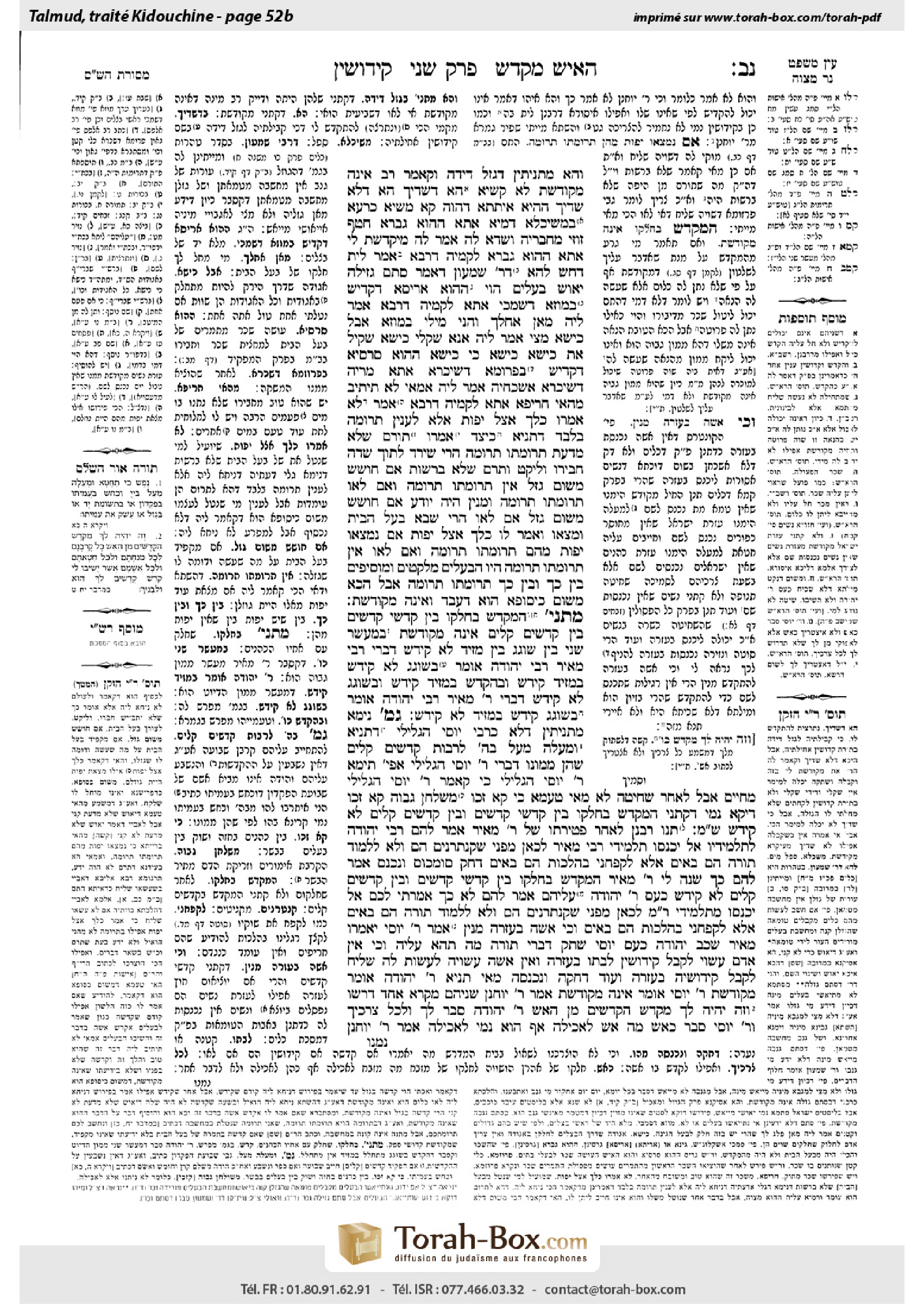
Kiddushin 52b: Talmud study for Daf Yomi
Daf Yomi is the daily study of one Talmud folio. Explore 37 tractates with scans, Hebrew text, Sefaria English and AI-generated French translations where annotated.
Passage selection and English or AI-generated French translation are available where the scan has annotations. Daf Study is independent of Torah-Box and Sefaria.
Browse Kiddushin · קידושין · All tractatesKiddushin 52b text and translations
This page of Kiddushin includes the Aramaic text, an English translation and an AI-generated French translation, alongside the scan above.
קידושין נ״ב ב · Aramaic and Hebrew text
וְהָא מַתְנִיתִין, דְּגָזֵל דִּידַהּ, וְקָאָמַר רַב: אֵינָהּ מְקוּדֶּשֶׁת! לָא קַשְׁיָא: הָא – דְּשַׁדֵּיךְ, הָא – דְּלָא שַׁדֵּיךְ.
הָהִיא אִיתְּתָא דַּהֲוָה קָא מָשְׁיָא כַּרְעַאּ בִּמְשִׁיכְלָא דְמַיָּא, אֲתָא הָהוּא גַּבְרָא, חֲטַף זוּזֵי מֵחַבְרֵיהּ וּשְׁדָא לַהּ. אֲמַר לַהּ: מִיקַּדְּשַׁתְּ לִי. אֲתָא הָהוּא גַּבְרָא לְקַמֵּיהּ דְּרָבָא. אֲמַר: לֵית דְּחָשׁ לְהָא דְּרַבִּי שִׁמְעוֹן, דְּאָמַר: סְתַם גְּזֵילָה – יֵאוּשׁ בְּעָלִים הָוֵי.
הָהוּא אֲרִיסָא דְּקַדֵּישׁ בְּמוֹזָא דְשַׁמְכֵי, אֲתָא לְקַמֵּיהּ דְּרָבָא. אֲמַר לֵיהּ: מַאן אַחֲלָךְ? וְהָנֵי מִילֵּי בְּמוֹזָא, אֲבָל כִּישָׁא, מָצֵי אֲמַר לֵיהּ: אֲנָא שְׁקַלִי כִּישָׁא, שְׁקֵיל אַתְּ כִּישָׁא, כִּישָׁא כִּי כִישָׁא.
הָהוּא סְרָסְיָא דְּקַדֵּישׁ בִּפְרוּמָא דְשִׁיכְרָא. אֲתָא מָרֵיהּ דְּשִׁיכְרָא אַשְׁכְּחֵיהּ. אֲמַר לֵיהּ: אַמַּאי לָא תִּיתֵּיב מֵהַאי חָרִיפָא? אֲתָא לְקַמֵּיהּ דְּרָבָא. אֲמַר: לֹא אָמְרוּ ״כְּלָךְ אֵצֶל יָפוֹת״, אֶלָּא לְעִנְיַן תְּרוּמָה בִּלְבָד.
דְּתַנְיָא: כֵּיצַד אָמְרוּ: תּוֹרֵם שֶׁלֹּא מִדַּעַת תְּרוּמָתוֹ תְּרוּמָה? הֲרֵי שֶׁיָּרַד לְתוֹךְ שְׂדֵה חֲבֵירוֹ וְלִיקֵּט וְתָרַם שֶׁלֹּא בִּרְשׁוּת, אִם חוֹשֵׁשׁ מִשּׁוּם גָּזֵל – אֵין תְּרוּמָתוֹ תְּרוּמָה, וְאִם לָאו – תְּרוּמָתוֹ תְּרוּמָה.
וּמִנַּיִן הָיָה יוֹדֵעַ אִם חוֹשֵׁשׁ מִשּׁוּם גָּזֵל אִם לָאו? הֲרֵי שֶׁבָּא בַּעַל הַבַּיִת וּמְצָאוֹ וְאָמַר לוֹ: ״כְּלָךְ אֵצֶל יָפוֹת״ אִם נִמְצְאוּ יָפוֹת מֵהֶם – תְּרוּמָתוֹ תְּרוּמָה, וְאִם לָאו – אֵין תְּרוּמָתוֹ תְּרוּמָה. הָיוּ הַבְּעָלִים מְלַקְּטִים וּמוֹסִיפִים, בֵּין כָּךְ וּבֵין כָּךְ – תְּרוּמָתוֹ תְּרוּמָה.
אֲבָל הָכָא, מִשּׁוּם כִּיסּוּפָא הוּא דַּעֲבַד, וְאֵינָהּ מְקוּדֶּשֶׁת.
מַתְנִי׳ הַמְקַדֵּשׁ בְּחֶלְקוֹ, בֵּין קׇדְשֵׁי קֳדָשִׁים, בֵּין קֳדָשִׁים קַלִּים – אֵינָהּ מְקוּדֶּשֶׁת. בְּמַעֲשֵׂר שֵׁנִי, בֵּין שׁוֹגֵג בֵּין מֵזִיד – לֹא קִידֵּשׁ, דִּבְרֵי רַבִּי מֵאִיר. רַבִּי יְהוּדָה אוֹמֵר: בְּשׁוֹגֵג – לֹא קִידֵּשׁ, בְּמֵזִיד – קִידֵּשׁ.
וּבַהֶקְדֵּשׁ, בְּמֵזִיד – קִידֵּשׁ, וּבְשׁוֹגֵג – לֹא קִידֵּשׁ, דִּבְרֵי רַבִּי מֵאִיר. רַבִּי יְהוּדָה אוֹמֵר: בְּשׁוֹגֵג – קִידֵּשׁ, בְּמֵזִיד – לֹא קִידֵּשׁ.
גְּמָ׳ נֵימָא מַתְנִיתִין דְּלָא כְּרַבִּי יוֹסֵי הַגְּלִילִי, דְּתַנְיָא: ״וּמָעֲלָה מַעַל בַּה׳״ – לְרַבּוֹת קֳדָשִׁים קַלִּים שֶׁהֵן מָמוֹנוֹ, דִּבְרֵי רַבִּי יוֹסֵי הַגְּלִילִי.
אֲפִילּוּ תֵּימָא רַבִּי יוֹסֵי הַגְּלִילִי, כִּי קָאָמַר רַבִּי יוֹסֵי הַגְּלִילִי – מֵחַיִּים, אֲבָל לְאַחַר שְׁחִיטָה – לָא. מַאי טַעְמָא? כִּי קָא זָכוּ – מִשֻּׁלְחַן גָּבוֹהַּ קָא זָכוּ.
דַּיְקָא נָמֵי, דְּקָתָנֵי: הַמְקַדֵּשׁ בְּחֶלְקוֹ, בֵּין קׇדְשֵׁי קֳדָשִׁים וּבֵין קֳדָשִׁים קַלִּים – לֹא קִידֵּשׁ. שְׁמַע מִינַּהּ.
תָּנוּ רַבָּנַן: לְאַחַר פְּטִירָתוֹ שֶׁל רַבִּי מֵאִיר אָמַר לָהֶם רַבִּי יְהוּדָה לְתַלְמִידָיו: אַל יִכָּנְסוּ תַּלְמִידֵי רַבִּי מֵאִיר לְכָאן, מִפְּנֵי שֶׁקַּנְתְּרָנִים הֵם, וְלֹא לִלְמוֹד תּוֹרָה הֵם בָּאִים אֶלָּא לְקַפְּחֵנִי בַּהֲלָכוֹת הֵם בָּאִים. דָּחַק סוֹמְכוֹס וְנִכְנַס. אָמַר לָהֶם: כָּךְ שָׁנָה לִי רַבִּי מֵאִיר: הַמְקַדֵּשׁ בְּחֶלְקוֹ, בֵּין קׇדְשֵׁי קֳדָשִׁים וּבֵין קֳדָשִׁים קַלִּים – לֹא קִידֵּשׁ.
כָּעַס רַבִּי יְהוּדָה (עֲלֵיהֶם). אָמַר לָהֶם: לֹא כָּךְ אָמַרְתִּי לָכֶם: אַל יִכָּנְסוּ מִתַּלְמִידֵי רַבִּי מֵאִיר לְכָאן מִפְּנֵי שֶׁקַּנְתְּרָנִים הֵם, וְלֹא לִלְמוֹד תּוֹרָה הֵם בָּאִים אֶלָּא לְקַפְּחֵנִי בַּהֲלָכוֹת הֵם בָּאִים. וְכִי אִשָּׁה בַּעֲזָרָה מִנַּיִן?!
אָמַר רַבִּי יוֹסֵי: יֹאמְרוּ: מֵאִיר שָׁכַב, יְהוּדָה כָּעַס, יוֹסֵי שָׁתַק – (דִּבְרֵי) תוֹרָה מָה תְּהֵא עָלֶיהָ? וְכִי אֵין אָדָם עָשׂוּי לְקַבֵּל קִידּוּשִׁין לְבִתּוֹ בַּעֲזָרָה? וְאֵין אִשָּׁה עֲשׂוּיָה לַעֲשׂוֹת לָהּ שָׁלִיחַ לְקַבֵּל קִידּוּשֶׁיהָ בַּעֲזָרָה? וְעוֹד: דָּחֲקָה וְנִכְנְסָה מַאי?
תַּנְיָא, רַבִּי יְהוּדָה אוֹמֵר: מְקוּדֶּשֶׁת, רַבִּי יוֹסֵי אוֹמֵר: אֵינָהּ מְקוּדֶּשֶׁת. אָמַר רַבִּי יוֹחָנָן: שְׁנֵיהֶם מִקְרָא אֶחָד דָּרְשׁוּ: ״זֶה יִהְיֶה לְךָ מִקֹּדֶשׁ הַקֳּדָשִׁים מִן הָאֵשׁ״. רַבִּי יְהוּדָה סָבַר: ״לְךָ״ – וּלְכׇל צְרָכֶיךָ. וְרַבִּי יוֹסֵי סָבַר: כְּאֵשׁ. מָה אֵשׁ לַאֲכִילָה, אַף הוּא נָמֵי לַאֲכִילָה.
אָמַר רַבִּי יוֹחָנָן:
Kiddushin 52b · English translation
The Gemara questions this analysis: But doesn’t the mishna deal with a case where the stolen item is hers, and yet Rav says she is not betrothed. The Gemara answers: This is not difficult; this case, in the baraita, is referring to a situation where he had arranged to betroth her beforehand, which indicates that she has released him from his obligation to return it, but that case, in the mishna, is referring to a situation where he had not arranged his marriage with her, so it is stolen property and she is not betrothed.
The Gemara relates: There was a certain woman who was washing her feet in a vessel of water. A certain man came along, grabbed a few dinars from another person, and threw them to her, and said to her: You are betrothed to me. That man subsequently came before Rava, to inquire as to the status of the woman. Rava said: There is not anyone who is concerned for this opinion of Rabbi Shimon, who said: In an ordinary case of robbery the owner has despaired of recovering the stolen item, and it belongs to the robber. Rather, the assumption is that the owner has not despaired of recovering the stolen item. In this case, since the stolen dinars do not belong to the man, his betrothal is of no effect.
The Gemara relates another incident: The was a certain sharecropper who betrothed a woman with a handful [bemoza] of onions [deshamkhei] taken from the field where he worked. He came before Rava to ask about the status of the woman. Rava said to him: Who relinquished these onions to you? Since the owner did not allow you to take them, they are stolen property, and the woman is not betrothed. The Gemara comments: And this matter applies only to a handful, but if he took a bundle of onions and betrothed a woman with them, the sharecropper can say to the owner: I took a bundle, you take a bundle; one bundle for another bundle. Since in any case they divide the crop between them, it is not considered theft.
The Gemara relates another incident: There was a certain brewer [sarseya] who was making date beer for someone, who betrothed a woman with sediment [bifruma] from the beer. The owner of the beer came and found him. The owner said to him: Why don’t you give her the betrothal from this, the sharp sediments that are of better quality than the kind you chose? The brewer came before Rava to ask whether the owner’s comment indicated that he had relinquished his rights to the sediment, which would mean the woman is betrothed. Rava said to him: The Sages said that if the owner discovers that someone has taken something of his without permission and says: Go to and take the item of better quality, that it is a sign he agrees with the man’s action only with regard to teruma alone, and you did not have the right to use the sediment.
The Gemara explains the previous statement: As it is taught in a baraita (Tosefta, Terumot 1:5): When did they say that in the case where one separates teruma without the owner’s consent, his teruma is considered teruma? The baraita clarifies: In a case where there was someone who entered another’s field and gathered produce from it, and separated teruma without the owner’s permission, if the owner is concerned about his actions and view it as robbery, his teruma is not teruma, but if he is not concerned, his teruma is teruma.
The baraita continues: And from where would the gatherer know whether he should be concerned that the owner objects and views it as robbery or not? If the owner came and found him separating teruma and said to him: Go to take the produce of better quality and separate teruma from that, then if produce of better quality than the produce he had separated is found, his teruma is considered teruma, since the owner is assumed to have been sincere and pleased that the other has separated teruma from his produce. But if not, his teruma is not teruma, as it may be assumed that the owner was angry at him and was speaking sarcastically. The baraita adds: If the owners were gathering and adding to the teruma he had separated, indicating that they agree to his act of separation, either way, whether or not better-quality produce was found, his teruma is considered teruma.
Rava concludes the explanation of his ruling: This halakha applies only to teruma, which is a mitzva that the owner must in any case perform. But here, in the case of the brewer who betrothed a woman with sediment from the beer, the owner acts because of embarrassment, and while he does not feel comfortable protesting, he did not in fact relinquish his rights to the sediment, and she is not betrothed.
MISHNA: With regard to a priest who betroths a woman with his portion of offerings, whether he did so with offerings of the most sacred order or whether he did so with offerings of lesser sanctity, she is not betrothed. One who betroths a woman with second tithe, whether unwittingly or intentionally, has not betrothed her; this is the statement of Rabbi Meir. Rabbi Yehuda says: If he did so unwittingly he has not betrothed her, but if he did so intentionally he has betrothed her.
And with regard to one who betroths a woman with consecrated property belonging to the Temple treasury, if he does so intentionally he has betrothed her, and if he does so unwittingly he has not betrothed her; this is the statement of Rabbi Meir. Rabbi Yehuda says the opposite: If he does so unwittingly he has betrothed her, but if he does so intentionally he has not betrothed her.
GEMARA: The Gemara suggests: Shall we say that the mishna is not in accordance with the opinion of Rabbi Yosei HaGelili? As it is taught in a baraita that the verse states with regard to the obligation to bring an offering for taking a false oath concerning unlawful possession of the property of another: “If any one sin, and he commits a trespass against the Lord, and deal falsely with his neighbor in a matter of deposit, or of pledge, or of robbery, or have oppressed his neighbor” (Leviticus 5:21). As the verse is discussing property belonging to another, the phrase “a trespass against the Lord” serves to include in the obligation of an offering a false oath with regard to possession of offerings of lesser sanctity of another person, which are the property of the owner; this is the statement of Rabbi Yosei HaGelili. According to Rabbi Yosei HaGelili, the portion of an offering of lesser sanctity that the priest receives belongs to him, so he should be able to betroth a woman with it.
The Gemara rejects this: You can even say that the mishna is in accordance with the opinion of Rabbi Yosei HaGelili, as Rabbi Yosei HaGelili says that an offering of lesser sanctity belongs to its owner only while the animal is still alive, but after its slaughter it does not belong to the priest who receives portions from it. What is the reason for this? When the priests receive their portion after the animal has been slaughtered they receive their portion from the table of the Most High, and do not own the portion itself.
The Gemara adds: The language of the mishna is also precise, as it teaches: With regard to a priest who betroths a woman with his portion of offerings, whether he did so with offerings of the most sacred order or whether he used offerings of lesser sanctity, has not betrothed her. The mishna does not speak of a priest who betroths a woman with a living offering of lesser sanctity but of one who betroths with the portion of the slaughtered animal he has received. The Gemara concludes: Learn from it that it is only in this case that she is not betrothed.
The Sages taught: After the death of Rabbi Meir, Rabbi Yehuda said to his students: Do not let the students of Rabbi Meir enter here into our house of study, because they are vexatious [kanteranim]. And they do not come to study Torah, but rather they come to overwhelm me with halakhot. Sumakhos, a student of Rabbi Meir, pushed and entered anyway. He said to them: This is what Rabbi Meir taught me: With regard to a priest who betroths a woman with his portion of the offerings, whether he did so with offerings of the most sacred order or whether he used offerings of lesser sanctity, he has not betrothed her.
Upon hearing this, Rabbi Yehuda became angry with his students. He said to them: Didn’t I say this to you: Do not let the students of Rabbi Meir enter here into our house of study, because they are vexatious? And they do not come to study Torah, but rather they come to overwhelm me with halakhot. Rabbi Yehuda explained his objection to the statement of Rabbi Meir: This halakha is not relevant, as from where would a woman appear in the Temple courtyard? Women may not enter the area of the Temple courtyard where the priests eat the offerings of the most sacred order, so there is no reason to address an impossible scenario.
Rabbi Yosei, who was present, said: They will say: Meir died, Yehuda grew angry, and Yosei remained silent; what will become of the words of Torah? He said: In fact, this halakha is relevant; but isn’t it common for a man to accept betrothal for his daughter in the Temple courtyard? There is no need to give the betrothal item directly to the woman; it can be given to her father. And additionally, isn’t it common for a woman to designate an agent for herself to accept her betrothal in the courtyard? And furthermore: What would be the halakha if the woman pushed and entered? Since it is possible for her to do so, the halakha in such a case must be determined.
It is taught in a baraita that the Sages discussed the issue of a priest who betroths a woman with his portion of offerings of the most sacred order: Rabbi Yehuda says she is betrothed, and Rabbi Yosei says she is not betrothed. Rabbi Yoḥanan says: Both of them derived their opinions from one verse, which states that the priests have a right to a portion of offerings of the most sacred order, but they explained it in different ways. The verse states: “This shall be yours of the most holy things, reserved from the fire” (Numbers 18:9). Rabbi Yehuda holds that the term “yours” indicates that the portion the priest receives is intended for you, i.e., a priest, and for all your needs, including betrothing a woman. And Rabbi Yosei holds that the verse compares the priest’s portion to the fire on the altar: Just as the portion burned on the fire is for the fire’s consumption, so too, the priest’s portion is also for consumption alone, and not for any other purpose.
Rabbi Yoḥanan says:
Kiddushin 52b · Traduction française (IA)
La Guemara conteste cette analyse : Mais la Michna ne traite-t-elle pas d’un cas où l’objet volé lui appartient, et pourtant Rav dit qu’elle n’est pas fiancée ? La Guemara répond : Il n’y a pas de difficulté. Le cas de la baraïta concerne une situation où il avait pris des dispositions pour l’épouser à l’avance, ce qui indique qu’elle l’a libéré de son obligation de restituer l’objet ; tandis que le cas de la Michna concerne une situation où il n’avait pas pris de dispositions en vue de l’épouser. Il s’agit donc d’un bien volé, et elle n’est pas fiancée.
La Guemara rapporte : Une femme se lavait les pieds dans un récipient rempli d’eau. Un homme arriva, prit quelques dinars à quelqu’un d’autre, les lui jeta et lui dit : « Tu m’es fiancée. » Cet homme se présenta ensuite devant Rava pour s’enquérir du statut de la femme. Rava dit : Personne ne tient compte de l’opinion de Rabbi Chimon, selon qui, dans un cas ordinaire de vol, le propriétaire a renoncé à récupérer l’objet volé, qui appartient alors au voleur. On présume plutôt que le propriétaire n’a pas renoncé à récupérer l’objet volé. Dans ce cas, puisque les dinars volés n’appartiennent pas à l’homme, ses fiançailles sont sans effet.
La Guemara rapporte un autre incident : Un métayer avait fiancé une femme avec une poignée [bemoza] d’oignons [deshamkhei] prélevés dans le champ qu’il cultivait. Il se présenta devant Rava pour lui demander quel était le statut de la femme. Rava lui dit : Qui t’a cédé ces oignons ? Puisque le propriétaire ne t’a pas autorisé à les prendre, il s’agit d’un bien volé et la femme n’est pas fiancée. La Guemara précise : Cela ne s’applique qu’à une poignée ; mais s’il avait pris une botte d’oignons et fiancé une femme avec, le métayer peut dire au propriétaire : « J’ai pris une botte, prends-en une toi aussi ; une botte pour une botte. » Puisqu’ils se partagent de toute façon la récolte, cela n’est pas considéré comme un vol.
La Guemara rapporte un autre incident : Un brasseur [sarseya], qui préparait de la bière de dattes pour quelqu’un, avait fiancé une femme avec le dépôt [bifruma] de la bière. Le propriétaire de la bière arriva et le surprit. Il lui dit : « Pourquoi ne lui donnes-tu pas, pour la fiancer, ce dépôt-ci, le dépôt piquant, de meilleure qualité que celui que tu as choisi ? » Le brasseur se présenta devant Rava pour lui demander si la remarque du propriétaire indiquait qu’il lui avait cédé ses droits sur le dépôt, auquel cas la femme serait fiancée. Rava lui dit : Les Sages ont enseigné que si le propriétaire découvre que quelqu’un a pris un de ses biens sans autorisation et lui dit : « Va prendre l’objet de meilleure qualité », cela montre qu’il approuve l’acte de cet homme uniquement dans le cas de la terouma ; or, tu n’avais pas le droit d’utiliser le dépôt.
La Guemara explique l’affirmation précédente : Comme il est enseigné dans une baraïta (Tossefta, Teroumot 1:5) : Dans quel cas a-t-on dit que si quelqu’un prélève la terouma sans l’accord du propriétaire, son prélèvement est considéré comme valide ? La baraïta précise : Si quelqu’un est entré dans le champ d’autrui, en a récolté des produits et a prélevé la terouma sans l’autorisation du propriétaire, si celui-ci s’oppose à son acte et le considère comme un vol, le prélèvement n’est pas valide ; mais s’il ne s’y oppose pas, le prélèvement est valide.
La baraïta poursuit : Comment celui qui a récolté les produits saura-t-il si le propriétaire s’oppose à son acte et le considère comme un vol ? Si le propriétaire arrive, le trouve en train de prélever la terouma et lui dit : « Va prendre les produits de meilleure qualité et prélève la terouma sur ceux-ci », alors, s’il existe des produits de meilleure qualité que ceux sur lesquels il avait prélevé la terouma, son prélèvement est valide, car on présume que le propriétaire était sincère et se réjouissait que l’autre ait prélevé la terouma sur ses produits. Mais si ce n’est pas le cas, son prélèvement n’est pas valide, car on peut supposer que le propriétaire était en colère contre lui et parlait avec ironie. La baraïta ajoute : Si les propriétaires rassemblent des produits et les ajoutent à la terouma qu’il a prélevée, montrant ainsi qu’ils approuvent son prélèvement, alors, dans les deux cas, que l’on ait trouvé ou non des produits de meilleure qualité, son prélèvement est valide.
Rava conclut l’explication de sa décision : Cette halakha ne s’applique qu’à la terouma, qui est une mitsva que le propriétaire doit de toute façon accomplir. Mais ici, dans le cas du brasseur qui a fiancé une femme avec le dépôt de la bière, le propriétaire agit par gêne ; même s’il n’ose pas protester, il n’a en réalité pas cédé ses droits sur le dépôt, et la femme n’est pas fiancée.
MICHNA : Un prêtre qui fiance une femme avec sa part des offrandes, qu’il s’agisse d’offrandes de très haute sainteté ou d’offrandes de moindre sainteté, ne l’a pas fiancée. Celui qui fiance une femme avec la seconde dîme, que ce soit par inadvertance ou intentionnellement, ne l’a pas fiancée ; telle est la déclaration de Rabbi Meïr. Rabbi Yehouda dit : S’il l’a fait par inadvertance, il ne l’a pas fiancée, mais s’il l’a fait intentionnellement, il l’a fiancée.
Quant à celui qui fiance une femme avec des biens consacrés appartenant au trésor du Temple, s’il le fait intentionnellement, il l’a fiancée, et s’il le fait par inadvertance, il ne l’a pas fiancée ; telle est la déclaration de Rabbi Meïr. Rabbi Yehouda soutient l’inverse : s’il le fait par inadvertance, il l’a fiancée, mais s’il le fait intentionnellement, il ne l’a pas fiancée.
GUEMARA : La Guemara propose : Faut-il en conclure que la Michna n’est pas conforme à l’opinion de Rabbi Yossi HaGelili ? En effet, il est enseigné dans une baraïta que le verset dit, au sujet de l’obligation d’apporter une offrande après avoir prêté un faux serment concernant la possession illicite du bien d’autrui : « Si quelqu’un commet une faute et se rend coupable d’infidélité envers l’Éternel en trompant son prochain au sujet d’un dépôt, d’un gage ou d’un vol, ou en faisant tort à son prochain » (Lévitique 5:21). Puisque le verset parle du bien d’autrui, l’expression « infidélité envers l’Éternel » inclut dans l’obligation d’apporter une offrande le faux serment concernant la possession des offrandes de moindre sainteté d’autrui, qui appartiennent à leur propriétaire ; telle est l’opinion de Rabbi Yossi HaGelili. Selon Rabbi Yossi HaGelili, la part d’une offrande de moindre sainteté que reçoit le prêtre lui appartient ; il devrait donc pouvoir fiancer une femme avec.
La Guemara rejette cette conclusion : On peut même dire que la Michna est conforme à l’opinion de Rabbi Yossi HaGelili, car, selon lui, une offrande de moindre sainteté appartient à son propriétaire uniquement tant que l’animal est vivant ; après son abattage, elle n’appartient pas au prêtre qui en reçoit une part. Pour quelle raison ? Lorsque les prêtres reçoivent leur part après l’abattage de l’animal, ils la reçoivent de la table du Très-Haut et ne sont pas propriétaires de cette part.
La Guemara ajoute : La formulation de la Michna est également précise, car elle enseigne : Un prêtre qui fiance une femme avec sa part des offrandes, qu’il s’agisse d’offrandes de très haute sainteté ou d’offrandes de moindre sainteté, ne l’a pas fiancée. La Michna ne parle pas d’un prêtre qui fiance une femme avec une offrande de moindre sainteté alors que l’animal est vivant, mais de celui qui la fiance avec la part reçue après l’abattage de l’animal. La Guemara conclut : Apprends-en que c’est uniquement dans ce cas qu’elle n’est pas fiancée.
Les Sages ont enseigné : Après la mort de Rabbi Meïr, Rabbi Yehouda dit à ses disciples : « Ne laissez pas les disciples de Rabbi Meïr entrer ici, dans notre maison d’étude, car ils sont querelleurs [kanteranim]. Ils ne viennent pas étudier la Torah ; ils viennent plutôt me submerger de halakhot. » Soumakhos, un disciple de Rabbi Meïr, se fraya malgré tout un passage et entra. Il leur dit : « Voici ce que Rabbi Meïr m’a enseigné : Un prêtre qui fiance une femme avec sa part des offrandes, qu’il s’agisse d’offrandes de très haute sainteté ou d’offrandes de moindre sainteté, ne l’a pas fiancée. »
En entendant cela, Rabbi Yehouda se mit en colère contre ses disciples. Il leur dit : « Ne vous avais-je pas dit de ne pas laisser les disciples de Rabbi Meïr entrer ici, dans notre maison d’étude, car ils sont querelleurs ? Ils ne viennent pas étudier la Torah ; ils viennent plutôt me submerger de halakhot. » Rabbi Yehouda expliqua son objection à la déclaration de Rabbi Meïr : Cette halakha n’a pas lieu d’être, car comment une femme se trouverait-elle dans le parvis du Temple ? Les femmes ne peuvent pas entrer dans la partie du parvis du Temple où les prêtres mangent les offrandes de très haute sainteté ; il n’y a donc aucune raison d’examiner un scénario impossible.
Rabbi Yossi, qui était présent, dit : « On dira : Meïr est mort, Yehouda s’est mis en colère et Yossi est resté silencieux ; qu’adviendra-t-il des paroles de Torah ? » Il dit : « En réalité, cette halakha a lieu d’être. Un homme n’accepte-t-il pas couramment les fiançailles au nom de sa fille dans le parvis du Temple ? Il n’est pas nécessaire de remettre l’objet des fiançailles directement à la femme ; on peut le donner à son père. En outre, une femme ne désigne-t-elle pas couramment un mandataire chargé d’accepter ses fiançailles dans le parvis ? Et de plus, quelle serait la halakha si la femme s’y introduisait de force ? Puisqu’il lui est possible de le faire, il faut déterminer la halakha dans un tel cas. »
Il est enseigné dans une baraïta que les Sages ont discuté du cas d’un prêtre qui fiance une femme avec sa part des offrandes de très haute sainteté : Rabbi Yehouda dit qu’elle est fiancée, tandis que Rabbi Yossi dit qu’elle ne l’est pas. Rabbi Yo’hanan dit : Tous deux ont déduit leurs opinions d’un même verset, qui stipule que les prêtres ont droit à une part des offrandes de très haute sainteté, mais ils l’ont interprété différemment. Le verset dit : « Ceci sera à toi parmi les choses les plus saintes, réservées au feu » (Nombres 18:9). Rabbi Yehouda considère que le terme « à toi » indique que la part reçue par le prêtre est destinée à toi, c’est-à-dire au prêtre, et à tous tes besoins, y compris les fiançailles d’une femme. Rabbi Yossi considère que le verset compare la part du prêtre au feu de l’autel : de même que la part consumée par le feu est destinée à être consumée par lui, la part du prêtre est elle aussi destinée uniquement à être consommée, et non à un autre usage.
Rabbi Yo’hanan dit :
Traduction française générée par IA à partir de l’édition anglaise de Sefaria. Vérifie toujours un passage avec le texte source.
Text from Sefaria: William Davidson Edition - Vocalized Aramaic (CC BY NC); William Davidson Edition - English (CC BY NC).