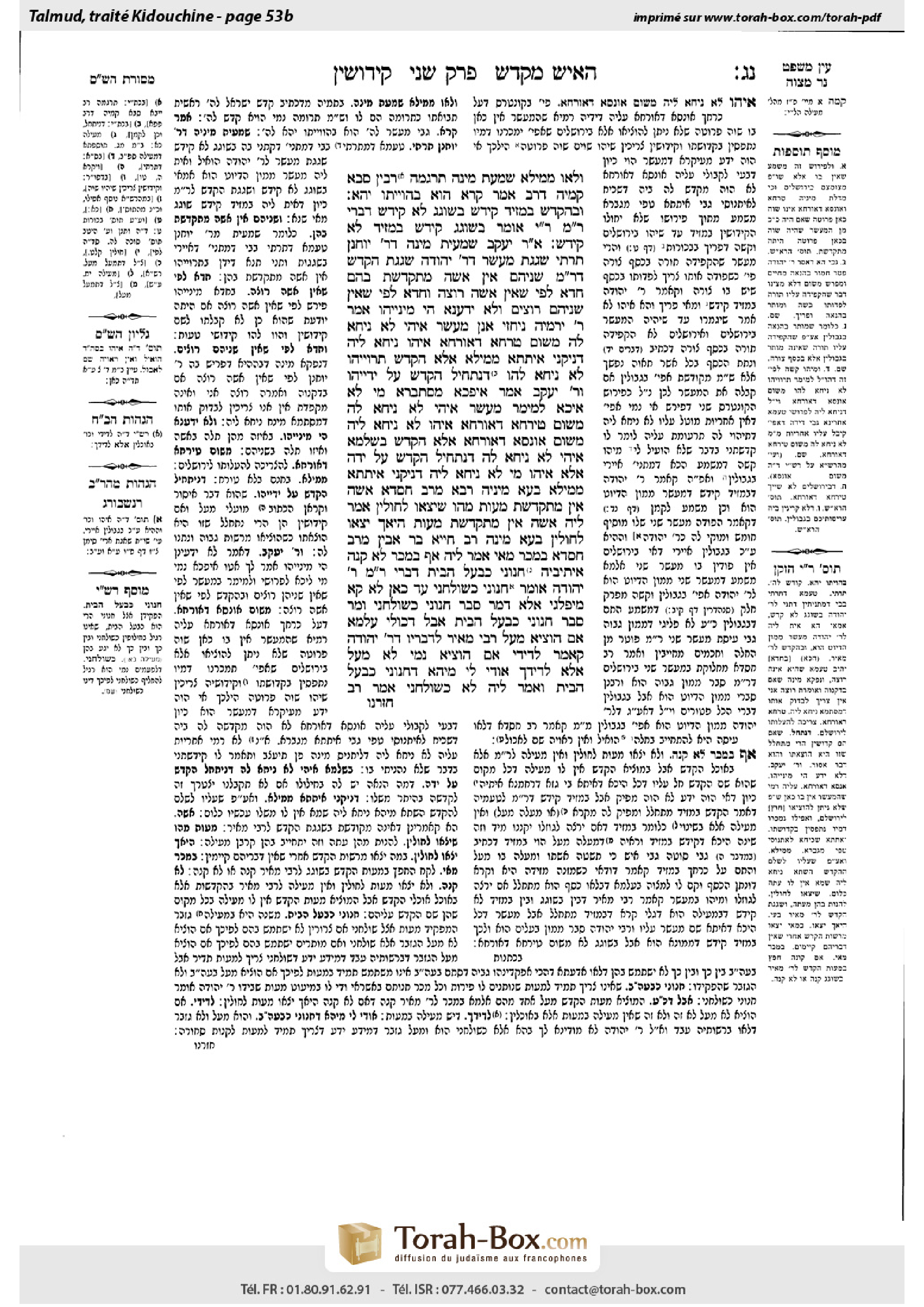
Kiddushin 53b: Talmud study for Daf Yomi
Daf Yomi is the daily study of one Talmud folio. Explore 37 tractates with scans, Hebrew text, Sefaria English and AI-generated French translations where annotated.
Passage selection and English or AI-generated French translation are available where the scan has annotations. Daf Study is independent of Torah-Box and Sefaria.
Browse Kiddushin · קידושין · All tractatesKiddushin 53b text and translations
This page of Kiddushin includes the Aramaic text, an English translation and an AI-generated French translation, alongside the scan above.
קידושין נ״ג ב · Aramaic and Hebrew text
וְלָאו מִמֵּילָא שָׁמְעַתְּ מִינַּהּ? תַּרְגְּמַהּ רָבִין סָבָא קַמֵּיהּ דְּרַב: אָמַר קְרָא: ״הוּא״ – בַּהֲוָיָיתוֹ יְהֵא.
וּבַהֶקְדֵּשׁ, בְּמֵזִיד – קִידֵּשׁ, בְּשׁוֹגֵג – לֹא קִידֵּשׁ, דִּבְרֵי רַבִּי מֵאִיר. רַבִּי יְהוּדָה אוֹמֵר: בְּשׁוֹגֵג – קִידֵּשׁ, בְּמֵזִיד – לֹא קִידֵּשׁ. אָמַר רַבִּי יַעֲקֹב: שְׁמַעִית מִינֵּהּ דְּרַבִּי יוֹחָנָן תַּרְתֵּי: שִׁגְגַת מַעֲשֵׂר דְּרַבִּי יְהוּדָה, שִׁגְגַת הֶקְדֵּשׁ דְּרַבִּי מֵאִיר – שְׁנֵיהֶם אֵין אִשָּׁה מִתְקַדֶּשֶׁת בָּהֶם.
חֲדָא – לְפִי שֶׁאֵין אִשָּׁה רוֹצָה, וַחֲדָא – לְפִי שֶׁאֵין שְׁנֵיהֶם רוֹצִים, וְלָא יָדַעְנָא הֵי מִינַּיְיהוּ. אָמַר רַבִּי יִרְמְיָה: נִיחְזֵי אֲנַן: מַעֲשֵׂר – אִיהִי לָא נִיחָא לַהּ מִשּׁוּם טִרְחָא דְאוֹרְחָא, אִיהוּ נִיחָא לֵיהּ דְּנִיקְנֵי אִיתְּתָא מִמֵּילָא. אֶלָּא הֶקְדֵּשׁ – תַּרְוַיְיהוּ לָא נִיחָא לְהוּ דְּנִתַּחִיל הֶקְדֵּשׁ עַל יְדַיְיהוּ.
וְרַבִּי יַעֲקֹב אָמַר: אִיפְּכָא מִסְתַּבְּרָא, מִי לָא אִיכָּא לְמֵימַר: מַעֲשֵׂר, אִיהִי לָא נִיחָא לַהּ מִשּׁוּם טִירְחָא דְאוֹרְחָא, אִיהוּ לָא נִיחָא לֵיהּ מִשּׁוּם אוּנְסָא דְאוֹרְחָא?! אֶלָּא הֶקְדֵּשׁ, בִּשְׁלָמָא אִיהִי לָא נִיחָא לַהּ דְּנִתַּחִיל הֶקְדֵּשׁ עַל יְדַהּ, אֶלָּא אִיהוּ מִי לָא נִיחָא לֵיהּ דְּנִיקְנֵי אִיתְּתָא מִמֵּילָא?
בְּעָא מִינֵּיהּ רָבָא מֵרַב חִסְדָּא: אִשָּׁה אֵין מִתְקַדֶּשֶׁת, מָעוֹת מַהוּ שֶׁיֵּצְאוּ לְחוּלִּין? אֲמַר לֵיהּ: אִשָּׁה אֵין מִתְקַדֶּשֶׁת – מָעוֹת הֵיאַךְ יֵצְאוּ לְחוּלִּין?
בְּעָא מִינֵּהּ רַב חִיָּיא בַּר אָבִין מֵרַב חִסְדָּא: בְּמֶכֶר מַאי? אֲמַר לֵיהּ: אַף בְּמֶכֶר לֹא קָנָה.
אֵיתִיבֵיהּ: חֶנְוָנִי כְּבַעַל הַבַּיִת, דִּבְרֵי רַבִּי מֵאִיר. רַבִּי יְהוּדָה אוֹמֵר: חֶנְוָנִי כְּשׁוּלְחָנִי.
עַד כָּאן לָא קָא מִיפַּלְגִי אֶלָּא דְּמָר סָבַר: חֶנְוָנִי כְּשׁוּלְחָנִי, וּמָר סָבַר חֶנְוָנִי כְּבַעַל הַבַּיִת. אֲבָל דְּכוּלֵּי עָלְמָא: אִם הוֹצִיא – מָעַל! רַבִּי מֵאִיר לִדְבָרָיו דְּרַבִּי יְהוּדָה קָאָמַר: לְדִידִי, אִם הוֹצִיא נָמֵי לֹא מָעַל, אֶלָּא לְדִידָךְ, אוֹדִי לִי מִיהָא דְּחֶנְוָנִי כְּבַעַל הַבַּיִת! וַאֲמַר לֵיהּ: לָא, כְּשׁוּלְחָנִי.
אָמַר רַב:
Kiddushin 53b · English translation
The Gemara asks: But don’t you understand it by itself from this verse? Since the verse compares the Jewish people to teruma, the categorization of “holy” evidently applies to teruma as well. Ravin the Elder interpreted it before Rav: The difference is that with regard to tithe the verse states: “It is for the Lord,” which indicates: As it is, it should be, as consecrated.
§ The mishna teaches: And if he betrothed a woman with consecrated property belonging to the Temple treasury, if he does so intentionally he has betrothed her, and if he does so unwittingly he has not betrothed her; this is the statement of Rabbi Meir. Rabbi Yehuda says the opposite: If he did so unwittingly he has betrothed her, but if he does so intentionally he has not betrothed her. Rabbi Ya’akov said: I learned two halakhot from Rabbi Yoḥanan, the halakha of an unwitting error involving tithe according to the opinion of Rabbi Yehuda and the halakha of an unwitting error involving consecrated items according to the opinion of Rabbi Meir. In both of these cases the woman is not betrothed with the items.
He proceeds to explain. One of these halakhot is because the woman does not want to become betrothed with the item, and the reason for the other is because neither the man nor the woman wants it. He adds: And I do not know which of them is due to the woman alone, and which is due to both parties. Rabbi Yirmeya said: Let us see which reason is applicable to which case. It must be that with regard to second tithe, which may be eaten only in Jerusalem, it is not satisfactory for her to be betrothed with it due to the trouble of transporting it all the way to Jerusalem to enjoy it, whereas it is satisfactory for him to betroth her with it, since he acquires a woman by itself, i.e., by the tithe alone, without having to spend additional money of his own. But in the case of consecrated items, it is not satisfactory for the two of them that consecrated property be desacralized by their using it for betrothal.
And Rabbi Ya’akov said the opposite is more reasonable. Couldn’t it be said that in the case of second tithe it is not satisfactory for her to be betrothed with it due to the trouble of transporting it all the way, and it is not satisfactory for him to betroth her with it due to the danger of an accident along the way. If the second tithe gets lost on the way to Jerusalem, she will not have derived any benefit from it. It will cause her distress to think she received nothing for her betrothal, and he does not want to cause her distress. But in the case of consecrated items, granted that with regard to her, it is not satisfactory for her that consecrated property be desacralized through her, but why wouldn’t it be satisfactory for him to acquire a woman by itself, without the expenditure of redeeming a consecrated item? Therefore, the reasons for Rabbi Yoḥanan’s statement cannot be determined by logic alone.
Rava inquired of Rav Ḥisda: According to Rabbi Meir, a woman cannot be betrothed by receiving consecrated money, but what is the halakha with regard to the money he gives her for betrothal: Does the money become desacralized as a result of the act of betrothal, as is usually the case when one uses a consecrated item for his own benefit? Rav Ḥisda said to him: If the woman is not betrothed, how can the money become desacralized? Since the money has not actually been used, nothing has changed with regard to its status.
Rav Ḥiyya bar Avin inquired of Rav Ḥisda: What is the halakha with regard to a sale: If one unwittingly uses consecrated money to purchase an item, does the sale take effect? Rav Ḥisda said to him: Even with regard to a sale he does not acquire the item.
Rav Ḥiyya bar Avin raised an objection to him: The halakha is that if a man deposited a bundle of money with a money changer, the latter may not use the money. If the money changer untied the bundle and used the money, and it turned out that it was consecrated, the money changer is liable to bring an offering for the misuse of consecrated property, since he acted without the permission of the depositor. If the money was not in a bundle, the money changer has the right to use it, since the depositor knows that a money changer frequently distributes money. Consequently, in this case, if the money was consecrated, it is the depositor who is liable to bring an offering for the misuse of consecrated property, since the money changer is considered to have acted with his awareness. If one deposited the money with a homeowner, i.e., not a money changer, the latter may not use it in either case, and he is liable to bring an offering for the misuse of consecrated property if he does. With regard to a storekeeper, the tanna’im disagree: The same halakha applies to a storekeeper as to a homeowner; this is the statement of Rabbi Meir. But Rabbi Yehuda says: The same halakha applies to a storekeeper as to a money changer.
The Gemara analyzes this: They disagree only with regard to that issue: As one Sage, Rabbi Yehuda, holds that the same halakha applies to a storekeeper as to a money changer, and one Sage, Rabbi Meir, holds that the same halakha applies to a storekeeper as to a homeowner. But everyone agrees that if the storekeeper did spend the money, he has misused consecrated property. This indicates that even according to the opinion of Rabbi Meir, whatever transaction he performed did take effect. The Gemara rejects this: Rabbi Meir stated his opinion in accordance with the statement of Rabbi Yehuda, as follows: According to me, if he spent the money he has also not misused consecrated property, but according to you, at least concede to me that the same halakha applies to a storekeeper as to a homeowner. And Rabbi Yehuda said to him: No, I do not concede to you even with regard to this point, as I hold that the same halakha applies to a storekeeper as to a money changer.
The Gemara records a discussion as to the reasons for the rulings of Rabbi Meir and Rabbi Yehuda. Rav says:
Kiddushin 53b · Traduction française (IA)
La Guemara demande : Mais ne le comprend-on pas déjà de ce verset lui-même ? Puisque le verset compare le peuple juif à la terouma, la qualification de « saint » s’applique manifestement aussi à la terouma. Ravin l’Ancien expliqua devant Rav : La différence tient au fait qu’au sujet de la dîme, le verset dit : « Elle est pour le Seigneur », ce qui indique qu’elle doit rester telle quelle, consacrée.
§ La Michna enseigne : Et s’il a fiancé une femme au moyen de biens consacrés appartenant au Trésor du Temple, s’il l’a fait intentionnellement, elle est fiancée, et s’il l’a fait par inadvertance, elle n’est pas fiancée ; telle est l’opinion de Rabbi Meïr. Rabbi Yehouda dit le contraire : s’il l’a fait par inadvertance, elle est fiancée, mais s’il l’a fait intentionnellement, elle n’est pas fiancée. Rabbi Yaakov dit : J’ai appris de Rabbi Yoḥanan deux halakhot : celle d’une erreur commise par inadvertance concernant la dîme, selon l’opinion de Rabbi Yehouda, et celle d’une erreur commise par inadvertance concernant des biens consacrés, selon l’opinion de Rabbi Meïr. Dans les deux cas, la femme n’est pas fiancée au moyen de ces biens.
Il poursuit son explication. Dans l’un de ces cas, la raison est que la femme ne souhaite pas être fiancée au moyen de cet objet, et dans l’autre, ni l’homme ni la femme ne le souhaitent. Il ajoute : Et je ne sais pas dans lequel des deux cas la raison tient à la femme seule, et dans lequel elle tient aux deux parties. Rabbi Yirmeya dit : Voyons quelle raison s’applique à chaque cas. Il faut que, s’agissant de la seconde dîme, qui ne peut être consommée qu’à Jérusalem, elle ne soit pas satisfaite d’être fiancée au moyen de celle-ci, à cause de la peine que représente son transport jusqu’à Jérusalem pour en profiter, tandis que lui est satisfait de la fiancer au moyen de celle-ci, puisqu’il acquiert une femme par elle seule, c’est-à-dire au moyen de la seule dîme, sans avoir à dépenser d’argent supplémentaire de sa poche. Mais dans le cas de biens consacrés, ni l’un ni l’autre ne souhaite que des biens consacrés soient désacralisés en les utilisant pour les fiançailles.
Et Rabbi Yaakov dit que le raisonnement inverse est plus plausible. Ne pourrait-on pas dire que, dans le cas de la seconde dîme, elle n’est pas satisfaite d’être fiancée au moyen de celle-ci, à cause de la peine que représente son transport jusqu’à Jérusalem, et que lui non plus n’est pas satisfait de la fiancer au moyen de celle-ci, à cause du risque d’un accident en chemin ? Si la seconde dîme se perd en route vers Jérusalem, elle n’en aura tiré aucun avantage. Elle sera contrariée à l’idée de n’avoir rien reçu en échange de ses fiançailles, et lui ne veut pas la contrarier. Mais dans le cas de biens consacrés, certes, elle ne souhaite pas que des biens consacrés soient désacralisés par son intermédiaire ; mais pourquoi lui ne serait-il pas satisfait d’acquérir une femme par eux seuls, sans avoir à dépenser d’argent pour racheter un bien consacré ? Par conséquent, on ne peut pas déterminer par le seul raisonnement les motifs de la déclaration de Rabbi Yoḥanan.
Rava demanda à Rav Ḥisda : Selon Rabbi Meïr, une femme ne peut pas être fiancée en recevant de l’argent consacré ; mais quelle est la halakha concernant l’argent qu’il lui remet pour les fiançailles ? Est-il désacralisé du fait de l’acte de fiançailles, comme c’est habituellement le cas lorsqu’on utilise un bien consacré à son propre profit ? Rav Ḥisda lui répondit : Si la femme n’est pas fiancée, comment l’argent pourrait-il être désacralisé ? Puisque l’argent n’a pas été effectivement utilisé, son statut n’a pas changé.
Rav Ḥiyya bar Avin demanda à Rav Ḥisda : Quelle est la halakha concernant une vente ? Si quelqu’un utilise par inadvertance de l’argent consacré pour acheter un objet, la vente prend-elle effet ? Rav Ḥisda lui répondit : Même dans le cas d’une vente, il n’acquiert pas l’objet.
Rav Ḥiyya bar Avin lui objecta : La halakha est que, si un homme a déposé un paquet d’argent chez un changeur, celui-ci ne peut pas utiliser l’argent. Si le changeur a dénoué le paquet et utilisé l’argent, et qu’il s’avère que celui-ci était consacré, le changeur est tenu d’apporter un sacrifice pour l’usage illicite de biens consacrés, car il a agi sans l’autorisation du déposant. Si l’argent n’était pas en paquet, le changeur a le droit de l’utiliser, puisque le déposant sait qu’un changeur distribue fréquemment de l’argent. Par conséquent, dans ce cas, si l’argent était consacré, c’est le déposant qui est tenu d’apporter un sacrifice pour l’usage illicite de biens consacrés, car le changeur est considéré comme ayant agi avec son assentiment. Si quelqu’un a déposé l’argent chez un particulier, c’est-à-dire chez quelqu’un qui n’est pas changeur, celui-ci ne peut l’utiliser dans aucun des deux cas, et s’il le fait, il est tenu d’apporter un sacrifice pour l’usage illicite de biens consacrés. Au sujet du commerçant, les tannaïm sont en désaccord : la même halakha s’applique au commerçant qu’au particulier ; telle est l’opinion de Rabbi Meïr. Mais Rabbi Yehouda dit : la même halakha s’applique au commerçant qu’au changeur.
La Guemara analyse cette baraïta : ils ne sont en désaccord que sur ce point. Un Sage, Rabbi Yehouda, estime que la même halakha s’applique au commerçant qu’au changeur, tandis qu’un autre Sage, Rabbi Meïr, estime que la même halakha s’applique au commerçant qu’au particulier. Mais tous conviennent que si le commerçant a effectivement dépensé l’argent, il a fait un usage illicite de biens consacrés. Cela indique que, même selon l’opinion de Rabbi Meïr, la transaction qu’il a effectuée a pris effet. La Guemara rejette cette interprétation : Rabbi Meïr a formulé son opinion en réponse à la déclaration de Rabbi Yehouda, comme suit : « Selon moi, s’il a dépensé l’argent, il n’a pas non plus fait un usage illicite de biens consacrés ; mais, selon toi, concède-moi au moins que la même halakha s’applique au commerçant qu’au particulier. » Et Rabbi Yehouda lui répondit : « Non, je ne te concède même pas ce point, car j’estime que la même halakha s’applique au commerçant qu’au changeur. »
La Guemara rapporte une discussion sur les raisons des décisions de Rabbi Meïr et de Rabbi Yehouda. Rav dit :
Traduction française générée par IA à partir de l’édition anglaise de Sefaria. Vérifie toujours un passage avec le texte source.
Text from Sefaria: William Davidson Edition - Vocalized Aramaic (CC BY NC); William Davidson Edition - English (CC BY NC).