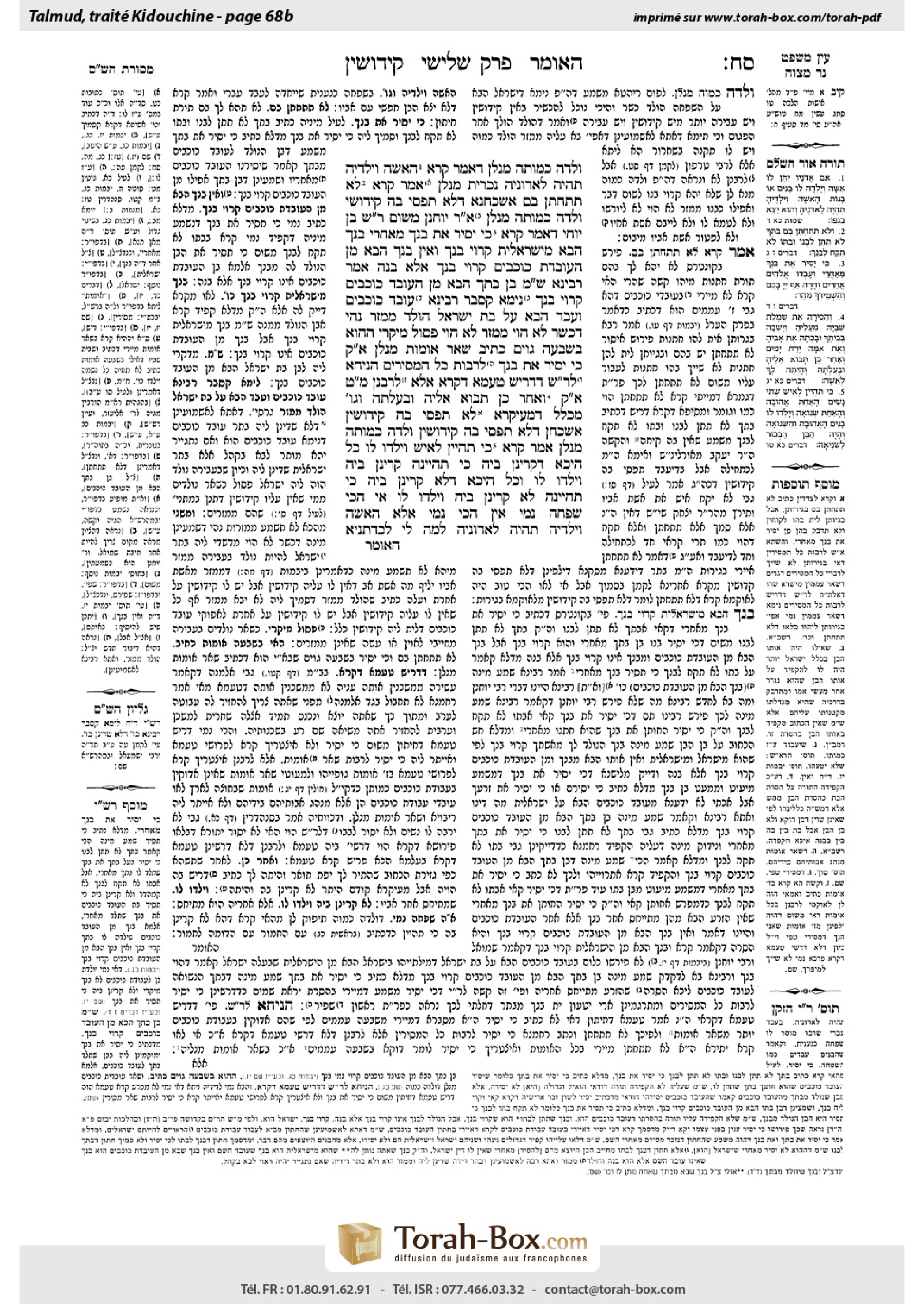
Kiddushin 68b: Talmud study for Daf Yomi
Daf Yomi is the daily study of one Talmud folio. Explore 37 tractates with scans, Hebrew text, Sefaria English and AI-generated French translations where annotated.
Passage selection and English or AI-generated French translation are available where the scan has annotations. Daf Study is independent of Torah-Box and Sefaria.
Browse Kiddushin · קידושין · All tractatesKiddushin 68b text and translations
This page of Kiddushin includes the Aramaic text, an English translation and an AI-generated French translation, alongside the scan above.
קידושין ס״ח ב · Aramaic and Hebrew text
וְלָדָהּ כְּמוֹתָהּ מְנָלַן? דְּאָמַר קְרָא: ״הָאִשָּׁה וִילָדֶיהָ תִּהְיֶה לַאדֹנֶיהָ״.
נׇכְרִית מְנָלַן? אָמַר קְרָא: ״לֹא תִתְחַתֵּן בָּם״. אַשְׁכַּחְנָא דְּלָא תָּפְסִי בַּהּ קִידּוּשֵׁי, וְלָדָהּ כְּמוֹתָהּ מְנָלַן?
אָמַר רַבִּי יוֹחָנָן מִשּׁוּם רַבִּי שִׁמְעוֹן בֶּן יוֹחַי: דְּאָמַר קְרָא: ״כִּי יָסִיר אֶת בִּנְךָ מֵאַחֲרַי״ – בִּנְךָ הַבָּא מִיִּשְׂרְאֵלִית קָרוּי בִּנְךָ, וְאֵין בִּנְךָ הַבָּא מִן הַנׇּכְרִית קָרוּי בִּנְךָ, אֶלָּא בְּנָהּ.
אָמַר רָבִינָא: שְׁמַע מִינַּהּ: בֶּן בִּתְּךָ הַבָּא מִן הַנׇּכְרִי – קָרוּי בִּנְךָ. נֵימָא קָסָבַר רָבִינָא נׇכְרִי וְעֶבֶד הַבָּא עַל בַּת יִשְׂרָאֵל – הַוָּלָד מַמְזֵר?
נְהִי דְּכָשֵׁר לָא הָוֵי, מַמְזֵר לָא הָוֵי, פָּסוּל מִיקְּרֵי.
הָהוּא בְּשִׁבְעָה גּוֹיִם כְּתִיב, שְׁאָר אוּמּוֹת מְנָלַן? אָמַר קְרָא: ״כִּי יָסִיר אֶת בִּנְךָ״ – לְרַבּוֹת כׇּל הַמְּסִירִים.
הָנִיחָא לְרַבִּי שִׁמְעוֹן, דְּדָרֵישׁ טַעְמָא דִּקְרָא. אֶלָּא לְרַבָּנַן, מַאי טַעְמָא?
אָמַר קְרָא: ״וְאַחַר כֵּן תָּבוֹא אֵלֶיהָ וּבְעַלְתָּהּ וְגוֹ׳״ – מִכְּלָל דְּמֵעִיקָּרָא לָא תָּפְסִי בַּהּ קִידּוּשִׁין.
אַשְׁכְּחַן דְּלָא תָּפְסִי בַּהּ קִידּוּשִׁין, וְלָדָהּ כְּמוֹתָהּ מְנָלַן? אָמַר קְרָא: ״כִּי תִהְיֶיןָ לְאִישׁ... וְיָלְדוּ לוֹ״ – כֹּל הֵיכָא דְּקָרֵינַן בֵּיהּ ״כִּי תִּהְיֶינָה״, קָרֵינַן בֵּיהּ ״וְיָלְדוּ לוֹ״. וְכֹל הֵיכָא דְּלָא קָרֵינַן בֵּיהּ ״כִּי תִּהְיֶינָה״ – לָא קָרֵינַן בֵּיהּ ״וְיָלְדוּ לוֹ״.
אִי הָכִי, שִׁפְחָה נָמֵי! אִין הָכִי נָמֵי. אֶלָּא ״הָאִשָּׁה וִילָדֶיהָ תִּהְיֶה לַאדֹנֶיהָ״ לְמָה לִי? לְכִדְתַנְיָא:
Kiddushin 68b · English translation
from where do we derive that her offspring is like her? The Gemara answers: As the verse states with regard to a Hebrew slave who marries a Canaanite maidservant: “The wife and her children shall be her master’s” (Exodus 21:4). This indicates that the offspring of a Canaanite maidservant and a Hebrew slave are slaves, as she is.
§ The Gemara asks: From where do we derive that betrothal with a gentile woman is ineffective? The verse states: “Neither shall you make marriages with them” (Deuteronomy 7:3), which teaches that marrying gentile women is halakhically meaningless. The Gemara asks: We have found that betrothal is ineffective with her; from where do we derive that her offspring is like her?
Rabbi Yoḥanan says in the name of Rabbi Shimon ben Yoḥai: As the verse states with regard to the same issue: “Your daughter you shall not give to his son…for he will turn away your son from following Me” (Deuteronomy 7:3–4). Since the verse is concerned that after one’s daughter marries a gentile, the father will lead his children away from the service of God, this indicates that your son, i.e., your grandson, from a Jewish woman is called “your son” by the Torah, but your son from a gentile woman is not called your son, but her son.
Ravina said: Learn from it that the son of your daughter, born to a gentile, is called your son in all regards. The Gemara asks: Shall we say that Ravina holds that with regard to a gentile or a Canaanite slave who engaged in sexual intercourse with a Jewish woman, the offspring is a mamzer? One can infer from the fact that the offspring of this union is called “your son” that he is a Jew, and therefore the principle stated in the mishna should apply: If a woman cannot join in betrothal with someone, their child is a mamzer.
The Gemara rejects this suggestion: Although he is not a fit offspring, he is also not a mamzer. Rather, he is merely called disqualified. Since betrothal is inapplicable to a gentile, a gentile is not included in the category of someone with whom a Jewish woman cannot personally join in betrothal, as no Jewish women can be betrothed to him. Nevertheless, as their child’s birth is the result of a transgression, he is considered disqualified.
The Gemara asks a question with regard to Rabbi Yoḥanan’s statement. That verse: “Neither shall you make marriages with them” (Deuteronomy 7:3), is written with regard to the seven nations of Canaan. From where do we derive that betrothal does not take effect with the other nations? The Gemara answers: The verse states as a reason for prohibiting intermarriages: “For he will turn away your son from following Me,” which serves to include all those who might turn a child away, no matter from which nation.
The Gemara asks: This works out well according to the opinion of Rabbi Shimon, who expounds the reason for the mitzvot of the verse and rules accordingly. Since the reason is that the gentile might turn away the son’s heart, there should be no distinction between the Canaanite nations and other gentiles. But according to the opinion of the Rabbis, who do not expound the reason for the mitzvot of the verse and rule accordingly, since the verse mentions only the Canaanite nations, what is the reason, the source for the prohibition, with regard to the other nations?
The Gemara answers: The verse states with regard to a beautiful captive woman: “And after that you may go in to her and be her husband, and she shall be your wife” (Deuteronomy 21:13). One can derive from here by inference that at the outset, before she became a Jew, betrothal would not take effect with her, despite the fact that he had already brought her into his house, and according to some opinions, had even engaged in sexual intercourse with her.
The Gemara asks another question: We found a source for the halakha that betrothal is ineffective with her; from where do we derive that her child is like her? The Gemara answers that the verse states: “If a man has two wives, the one beloved and the one hated, and they have borne him children” (Deuteronomy 21:15), from which it is derived: Anywhere that we read: “If he has,” i.e., that a woman can be betrothed, we also read: “And they have borne him,” meaning that their children follow his lineage. And anywhere that we do not read: “If he has,” we likewise do not read: “And they have borne him,” as the offspring inherit their mother’s status.
The Gemara asks: If so, one should learn from here with regard to a Canaanite maidservant too, that her child is like her, which means that the earlier proof from the verse: “The wife and her children” (Exodus 21:4), is not necessary. The Gemara answers: Yes, it is indeed so; this source also teaches the halakha that the offspring of a maidservant is like her. The Gemara asks: But if so, why do I need the verse “The wife and her children shall be her master’s”? This verse apparently teaches nothing new with regard to the halakhot of lineage. The Gemara answers: It is required for that which is taught in a baraita:
Kiddushin 68b · Traduction française (IA)
D'où déduisons-nous que sa descendance est comme elle ? La Guemara répond : Comme l'indique le verset concernant un esclave hébreu qui épouse une servante cananéenne : « Sa femme et ses enfants appartiendront à son maître » (Exode 21:4). Cela indique que la descendance d'une servante cananéenne et d'un esclave hébreu est esclave, tout comme elle.
§ La Guemara demande : D'où déduisons-nous que le kiddouchine avec une femme non juive est sans effet ? Le verset énonce : « Vous ne contracterez pas de mariage avec elles » (Deutéronome 7:3), ce qui enseigne que le mariage avec des femmes non juives est sans valeur halakhique. La Guemara demande : Nous avons trouvé que le kiddouchine est sans effet avec elle ; d'où déduisons-nous que sa descendance est comme elle ?
Rabbi Yoḥanan dit au nom de Rabbi Shimon ben Yoḥai : Comme l'indique le verset concernant la même question : « Tu ne donneras pas ta fille à son fils… car il détournera ton fils de me suivre » (Deutéronome 7:3-4). Puisque le verset s'inquiète du fait qu'après que la fille d'un homme ait épousé un non-juif, le père détournera ses enfants du service de Dieu, cela indique que ton fils, c'est-à-dire ton petit-fils, issu d'une femme juive, est appelé « ton fils » par la Torah, mais ton fils issu d'une femme non juive n'est pas appelé ton fils, mais son fils.
Ravina a dit : Apprenons-en que le fils de ta fille, né d'un non-juif, est appelé ton fils en tous points. La Guemara demande : Devons-nous dire que Ravina soutient qu'en ce qui concerne un non-juif ou un esclave cananéen qui a eu des relations sexuelles avec une femme juive, la descendance est un mamzer ? On peut déduire du fait que la descendance de cette union est appelée « ton fils » qu'il est juif, et par conséquent le principe énoncé dans la Michna devrait s'appliquer : Si une femme ne peut pas contracter de kiddouchine avec quelqu'un, leur enfant est un mamzer.
La Guemara rejette cette suggestion : Bien qu'il ne soit pas une descendance valide, il n'est pas non plus un mamzer. Plutôt, il est simplement appelé inapte. Puisque le kiddouchine ne s'applique pas à un non-juif, un non-juif n'est pas inclus dans la catégorie de ceux avec qui une femme juive ne peut personnellement contracter de kiddouchine, car aucune femme juive ne peut être fiancée à lui. Néanmoins, comme la naissance de leur enfant est le résultat d'une transgression, il est considéré comme inapte.
La Guemara pose une question concernant l'énoncé de Rabbi Yoḥanan. Ce verset : « Vous ne contracterez pas de mariage avec elles » (Deutéronome 7:3), est écrit concernant les sept nations de Canaan. D'où déduisons-nous que le kiddouchine n'a pas d'effet avec les autres nations ? La Guemara répond : Le verset énonce comme raison de l'interdiction des mariages mixtes : « Car il détournera ton fils de me suivre », ce qui sert à inclure tous ceux qui pourraient détourner un enfant, quelle que soit leur nation.
La Guemara demande : Cela fonctionne bien selon l'opinion de Rabbi Shimon, qui interprète la raison des mitsvot du verset et tranche en conséquence. Puisque la raison est que le non-juif pourrait détourner le cœur du fils, il ne devrait y avoir aucune distinction entre les nations cananéennes et les autres non-juifs. Mais selon l'opinion des Sages, qui n'interprètent pas la raison des mitsvot du verset et ne tranchent pas en conséquence, puisque le verset ne mentionne que les nations cananéennes, quelle est la raison, la source de l'interdiction, en ce qui concerne les autres nations ?
La Guemara répond : Le verset énonce concernant une captive belle : « Et après cela, tu iras vers elle et tu seras son mari, et elle sera ta femme » (Deutéronome 21:13). On peut déduire d'ici par inférence qu'au début, avant qu'elle ne devienne juive, le kiddouchine n'aurait pas d'effet avec elle, malgré le fait qu'il l'ait déjà amenée dans sa maison, et selon certaines opinions, qu'il ait même eu des relations sexuelles avec elle.
La Guemara pose une autre question : Nous avons trouvé une source pour la halakha que le kiddouchine est sans effet avec elle ; d'où déduisons-nous que son enfant est comme elle ? La Guemara répond que le verset énonce : « Si un homme a deux femmes, l'une aimée et l'autre détestée, et qu'elles lui ont donné des enfants » (Deutéronome 21:15), d'où il est déduit : Partout où nous lisons : « S'il a », c'est-à-dire qu'une femme peut être fiancée, nous lisons également : « Et qu'elles lui ont donné », signifiant que leurs enfants suivent sa lignée. Et partout où nous ne lisons pas : « S'il a », nous ne lisons pas non plus : « Et qu'elles lui ont donné », car la descendance hérite du statut de sa mère.
La Guemara demande : Si c'est le cas, on devrait en tirer d'ici, également pour une servante cananéenne, que son enfant est comme elle, ce qui signifierait que la preuve antérieure tirée du verset : « Sa femme et ses enfants » (Exode 21:4), n'est pas nécessaire. La Guemara répond : Oui, c'est bien ainsi ; cette source enseigne également la halakha selon laquelle la descendance d'une servante est comme elle. La Guemara demande : Mais si c'est le cas, pourquoi ai-je besoin du verset « Sa femme et ses enfants appartiendront à son maître » ? Ce verset n'enseigne apparemment rien de nouveau en ce qui concerne les halakhot de la lignée. La Guemara répond : Il est nécessaire pour ce qui est enseigné dans une baraïta :
Traduction française générée par IA à partir de l’édition anglaise de Sefaria. Vérifie toujours un passage avec le texte source.
Text from Sefaria: William Davidson Edition - Vocalized Aramaic (CC BY NC); William Davidson Edition - English (CC BY NC).