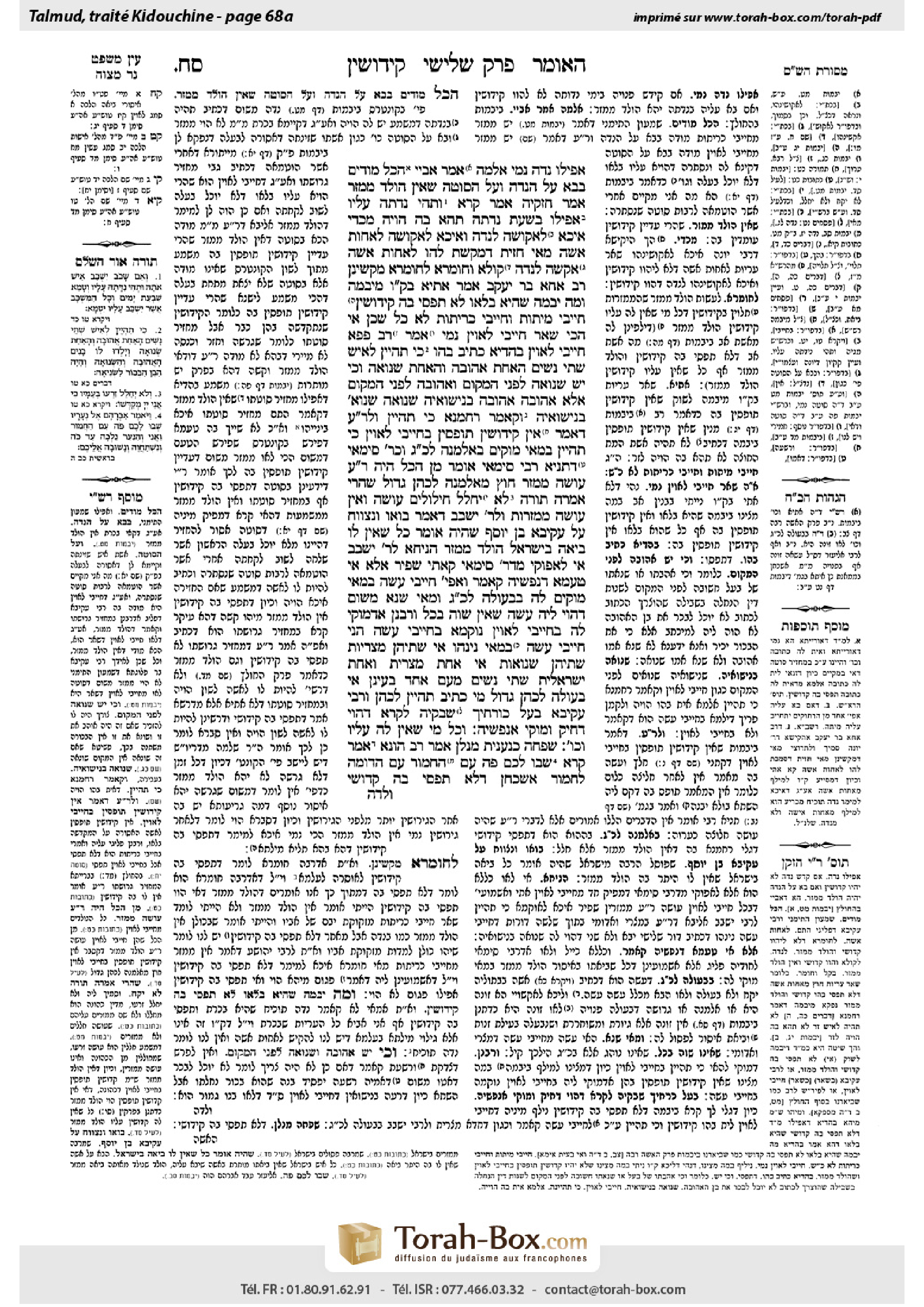
Kiddushin 68a: Talmud study for Daf Yomi
Daf Yomi is the daily study of one Talmud folio. Explore 37 tractates with scans, Hebrew text, Sefaria English and AI-generated French translations where annotated.
Passage selection and English or AI-generated French translation are available where the scan has annotations. Daf Study is independent of Torah-Box and Sefaria.
Browse Kiddushin · קידושין · All tractatesKiddushin 68a text and translations
This page of Kiddushin includes the Aramaic text, an English translation and an AI-generated French translation, alongside the scan above.
קידושין ס״ח א · Aramaic and Hebrew text
אֲפִילּוּ נִדָּה נָמֵי! אַלְּמָה אָמַר אַבָּיֵי: הַכֹּל מוֹדִים בְּבָא עַל הַנִּדָּה וְעַל הַסּוֹטָה, שֶׁאֵין הַוָּלָד מַמְזֵר? אָמַר חִזְקִיָּה: אָמַר קְרָא ״וּתְהִי נִדָּתָהּ עָלָיו״, אֲפִילּוּ בִּשְׁעַת נִדָּתָהּ – תְּהֵא בָּהּ הֲוָיָה.
מִכְּדֵי אִיכָּא לְאַקּוֹשַׁהּ לְנִדָּה, וְאִיכָּא לְאַקּוֹשַׁהּ לַאֲחוֹת אִשָּׁה, מַאי חָזֵית דְּמַקְּשַׁתְּ לְהוּ לַאֲחוֹת אִשָּׁה? אַקְּשַׁהּ לְנִדָּה! קוּלָּא וְחוּמְרָא – לְחוּמְרָא מַקְּשִׁינַן.
רַב אַחָא בַּר יַעֲקֹב אָמַר: אָתְיָא בְּקַל וָחוֹמֶר מִיבָמָה: וּמָה יְבָמָה, שֶׁהִיא בְּלָאו – לָא תָּפְסִי בָּהּ קִידּוּשִׁין, חַיָּיבֵי מִיתוֹת וְחַיָּיבֵי כָרֵיתוֹת לֹא כׇּל שֶׁכֵּן? אִי הָכִי, שְׁאָר חַיָּיבֵי לָאוִין נָמֵי!
אָמַר רַב פָּפָּא: חַיָּיבֵי לָאוִין בְּהֶדְיָא כְּתִיב בְּהוּ – ״כִּי תִהְיֶיןָ לְאִישׁ שְׁתֵּי נָשִׁים הָאַחַת אֲהוּבָה וְהָאַחַת שְׂנוּאָה״, וְכִי יֵשׁ שְׂנוּאָה לִפְנֵי הַמָּקוֹם וַאֲהוּבָה לִפְנֵי הַמָּקוֹם? אֶלָּא: ״אֲהוּבָה״ – אֲהוּבָה בְּנִישּׂוּאֶיהָ, ״שְׂנוּאָה״ – שְׂנוּאָה בְּנִישּׂוּאֶיהָ. וְקָאָמַר רַחֲמָנָא: ״כִּי תִהְיֶיןָ״.
וּלְרַבִּי עֲקִיבָא דְּאָמַר: אֵין קִידּוּשִׁין תּוֹפְסִין בְּחַיָּיבֵי לָאוִין, ״כִּי תִהְיֶיןָ״ בְּמַאי מוֹקֵים? בְּאַלְמָנָה לְכֹהֵן גָּדוֹל, וּכְרַבִּי סִימַאי.
דְּתַנְיָא, רַבִּי סִימַאי אוֹמֵר: מִן הַכֹּל הָיָה רַבִּי עֲקִיבָא עוֹשֶׂה מַמְזֵר חוּץ מֵאַלְמָנָה לְכֹהֵן גָּדוֹל, שֶׁהֲרֵי אָמְרָה תּוֹרָה: ״לֹא יְחַלֵּל״ – חִילּוּלִים עוֹשֶׂה, וְאֵין עוֹשֶׂה מַמְזֵרוּת.
וּלְרַבִּי יְשֵׁבָב, דְּאָמַר: בּוֹאוּ וְנִצְוַוח עַל עֲקִיבָא בֶּן יוֹסֵף שֶׁהָיָה אוֹמֵר: כֹּל שֶׁאֵין לוֹ בִּיאָה בְּיִשְׂרָאֵל – הַוָּלָד מַמְזֵר? הָנִיחָא לְרַבִּי יְשֵׁבָב אִי לְאַפּוֹקֵי מִדְּרַבִּי סִימַאי קָאָתֵי – שַׁפִּיר.
אֶלָּא אִי טַעְמָא דְנַפְשֵׁיהּ קָאָמַר, וַאֲפִילּוּ חַיָּיבֵי עֲשֵׂה, בְּמַאי מוֹקֵים לַהּ?
בִּבְעוּלָה לְכֹהֵן גָּדוֹל. וּמַאי שְׁנָא? מִשּׁוּם דְּהָוֵי לֵיהּ עֲשֵׂה שֶׁאֵין שָׁוֶה בַּכֹּל.
וְרַבָּנַן, אַדְּמוֹקֵי לַהּ בְּחַיָּיבֵי לָאוִין, נוֹקְמַהּ בְּחַיָּיבֵי עֲשֵׂה!
הָנֵי חַיָּיבֵי עֲשֵׂה, בְּמַאי נִינְהוּ? אִי שְׁתֵּיהֶן מִצְרִיּוֹת – שְׁתֵּיהֶן שְׂנוּאוֹת, אִי אַחַת מִצְרִית וְאַחַת יִשְׂרְאֵלִית – שְׁתֵּי נָשִׁים מֵעַם אֶחָד בָּעֵינַן, אִי בְּעוּלָה לְכֹהֵן גָּדוֹל – מִי כְּתִיב ״תִּהְיֶיןָ לְכֹהֵן״?
וְרַבִּי עֲקִיבָא? בְּעַל כּוּרְחֵיךְ שִׁבְקֵיהּ לִקְרָא דְּהָוֵי דָּחֵיק, וּמוֹקֵי אַנַּפְשֵׁיהּ.
וְכׇל מִי שֶׁאֵין לָהּ עָלָיו וְכוּ׳. שִׁפְחָה כְּנַעֲנִית מְנָלַן? אָמַר רַב הוּנָא: אָמַר קְרָא: ״שְׁבוּ לָכֶם פֹּה עִם הַחֲמוֹר״ – עַם הַדּוֹמֶה לַחֲמוֹר. אַשְׁכְּחַן דְּלָא תָּפְסִי בַּהּ קִדּוּשֵׁי,
Kiddushin 68a · English translation
then even if he betrothed a menstruating woman as well, his betrothal should not be effective and the offspring should be a mamzer, as a menstruating woman is included in the list in that chapter of those with whom sexual intercourse is forbidden. If so, why did Abaye say: All concede with regard to one who engages in intercourse with a menstruating woman or with a sota, a woman forbidden to her husband on suspicion of being unfaithful to him, that the offspring is not a mamzer? Ḥizkiyya said: In the case of a menstruating woman, the verse states: “And her impurity be [ut’hi] upon him” (Leviticus 15:24), from which it is derived that even at the time of her impurity, the type of becoming [havaya] stated with regard to betrothal (see Deuteronomy 24:2) should apply to her. The Gemara is interpreting the connection between the words ut’hi and havaya, as both share the same Hebrew root.
The Gemara asks: After all, there is the possibility of juxtaposing all other forbidden relatives to a menstruating woman, and there is also the possibility of juxtaposing them to a wife’s sister. What did you see that you juxtaposed them to a wife’s sister? Why not juxtapose them instead to a menstruating woman? The Gemara answers: When there is an option of juxtaposing a case in a manner that leads to a leniency, or juxtaposing it to a halakha that entails a stringency, we juxtapose it in a fashion that leads to a stringency.
Rav Aḥa bar Ya’akov said that there is a different source for the halakha that betrothal is ineffective with forbidden relatives: This principle is derived by means of an a fortiori inference from the case of a yevama: Just as a yevama, before she is released from the yavam through ḥalitza, is forbidden by a mere prohibition, which entails lashes, and yet betrothal is not effective with her, with regard to those people with whom sexual intercourse renders one liable to receive the death penalty or liable to be punished with karet, is it not all the more so the case that betrothal should not be effective in these cases? The Gemara asks: If so, meaning that this is the source, one should also derive that betrothal is ineffective with any other people with whom one is only liable for violating a prohibition of engaging in intercourse, by means of the same analogy.
Rav Pappa says: It is written explicitly in the Torah that a man can betroth women with whom he is liable for violating ordinary prohibitions of intercourse. The Torah states in a different context: “If a man has two wives, the one beloved and the one hated” (Deuteronomy 21:15). Rav Pappa asks rhetorically: But is there one who is hated before the Omnipresent and one who is beloved before the Omnipresent? Rather, “beloved” means beloved in her marriage, i.e., her marriage is permitted; “hated” means hated in her marriage, i.e., her marriage involves the violation of a prohibition. And despite the fact that the latter marriage is between a man and a woman who are forbidden to one another, their union still has the status of a marriage, as the Merciful One states: “If a man has two wives,” i.e., he is married to both of them.
The Gemara asks: And according to the opinion of Rabbi Akiva, who says: Betrothal does not take effect even with those women with whom one is only liable for violating a prohibition of engaging in intercourse, with regard to what case does he establish the verse: “If a man has two wives”? The Gemara answers: He explains that this verse is referring to a widow married to a High Priest, and this is in accordance with the opinion of Rabbi Simai.
As it is taught in a baraita that Rabbi Simai says: From all relationships that involve prohibitions, Rabbi Akiva would render the offspring a mamzer, except for the marriage of a widow to a High Priest, as the Torah said: “And he shall not profane [yeḥallel]” (Leviticus 21:15), which teaches that he renders them profane [ḥillulim], i.e., his children from this marriage are ḥalalim, but he does not render them labeled with mamzer status.
The Gemara asks: And what can be said according to the opinion of Rabbi Yeshevav, who says: Come, let us shout at Akiva ben Yosef, who would say: In every case where a Jew may not engage in intercourse with a particular woman, and he does so, the offspring that results from this union is a mamzer, even the child of a widow and a High Priest? This works out well even according to the opinion of Rabbi Yeshevav if he comes to exclude the reason of Rabbi Simai, i.e., if he means to take issue with the ruling of Rabbi Akiva in the specific case mentioned by Rabbi Simai, that of a widow married to a High Priest, then Rabbi Yeshevav too concedes that according to the opinion of Rabbi Akiva, betrothal does take effect in a case where a positive mitzva is violated by the betrothal. Accordingly, one can establish the phrase “and the one hated” (Deuteronomy 21:15) as referring to those whose marriage entailed the violation of a positive mitzva.
But if he states a reasoning of his own, i.e., he states an independent statement critical of Rabbi Akiva’s ruling that the child of any illicit union is a mamzer, and it is a categorical statement that applies to all illicit unions, even those liable for violating a positive mitzva, i.e., Rabbi Akiva holds that even the offspring of this relationship is a mamzer, with regard to what case does he interpret the “hated” woman of the above verse?
The Gemara answers: Rabbi Yeshevav would say that the verse is referring to a non-virgin married to a High Priest, as there is a positive mitzva that a High Priest should marry a virgin. The Gemara asks: And in what way is this case different from the previous ones? If Rabbi Yeshevav holds that a child born of any act of intercourse prohibited by a positive mitzva is a mamzer, the marriage of a non-virgin to a High Priest likewise involves the violation of a positive mitzva. The Gemara answers: Because it is a positive mitzva that is not equally applicable to all, and since this command applies only to a High Priest and not to other Jews, its violation is considered less severe than that of other positive mitzvot.
The Gemara asks: And with regard to the Rabbis, who disagree with Rabbi Akiva’s opinion, rather than establishing the verse: “If a man has two wives, the one beloved and the one hated” (Deuteronomy 21:15), as referring to those who are liable for violating prohibitions, let them establish it as referring to those liable for violating a positive mitzva. In other words, betrothal should not be effective if it involves the violation of a prohibition. And as for the “hated” woman whose marriage is nevertheless valid, mentioned in that verse, this is referring to one whose engaging in sexual intercourse violates a positive mitzva.
The Gemara responds: These cases where they are liable for violating a positive mitzva, what are they? If you say that both wives are Egyptian converts, they are both hated, as both marriages are prohibited. If you claim that one is an Egyptian woman and the other a Jewish woman of unflawed lineage, this cannot be the case, as we require “two wives” from the same nation, since the Torah equates the two women. If the hated one is a non-virgin married to a High Priest, this too is problematic, as, is it written: If a priest has two wives? The verse merely says: “If a man has two wives.” Consequently, the verse cannot be interpreted as referring to those who are liable for violating a positive mitzva.
The Gemara asks: But according to the opinion of Rabbi Akiva, that betrothal that involves a prohibition does not take effect, this verse can be referring only to a non-virgin who marries a High Priest, or marriage to a female Egyptian convert, which involve the violation of positive mitzvot. Can the verse really be interpreted as concerning such unlikely cases? The Gemara answers: You are forced to leave this verse aside, as it establishes itself as dealing with a difficult case. In other words, as Rabbi Akiva claims that betrothal is ineffective if any prohibition is involved, he has no choice but to explain the verse that says: “If a man has two wives,” in this forced manner.
§ The mishna teaches: And in any case where a woman cannot join in betrothal with him or with others, the offspring is like her. This ruling refers specifically to a Canaanite maidservant or a gentile woman. The Gemara asks: From where do we derive that betrothal with a Canaanite maidservant is ineffective? Rav Huna says: The verse states that Abraham commanded his slaves: “You abide here with [im] the donkey” (Genesis 22:5), which alludes to the fact that his slaves belong to a nation [am] similar to a donkey; just as betrothal is ineffective with animals, it is likewise ineffective with Canaanite maidservants. The Gemara comments: We have found that betrothal is ineffective with a Canaanite maidservant;
Kiddushin 68a · Traduction française (IA)
Alors, même s’il avait également fiancé une femme menstruée, ses fiançailles ne devraient pas prendre effet et l’enfant devrait être un mamzer, puisqu’une femme menstruée figure dans la liste de ce chapitre des femmes avec lesquelles les relations sexuelles sont interdites. Si tel est le cas, pourquoi Abayé a-t-il dit : « Tous reconnaissent que celui qui a des relations avec une femme menstruée ou avec une sota, une femme à qui son mari interdit les relations parce qu’il la soupçonne d’infidélité, n’a pas d’enfant mamzer » ? Ḥizkiyya a dit : À propos d’une femme menstruée, le verset dit : « Et son impureté sera [ut’hi] sur lui » (Lévitique 15,24), d’où l’on déduit que même au temps de son impureté, le type de devenir [havaya] mentionné à propos des fiançailles (voir Deutéronome 24,2) s’applique à elle. La Guemara interprète le lien entre les mots ut’hi et havaya, qui ont tous deux la même racine hébraïque.
La Guemara demande : Après tout, il est possible de rapprocher toutes les autres parentes interdites d’une femme menstruée, et il est également possible de les rapprocher de la sœur d’une épouse. Pourquoi les avoir rapprochées de la sœur d’une épouse ? Pourquoi ne pas plutôt les rapprocher d’une femme menstruée ? La Guemara répond : Lorsqu’il est possible de rapprocher un cas d’un autre d’une manière qui conduit à une indulgence, ou de le rapprocher d’une halakha qui entraîne une rigueur, on le rapproche de la manière qui conduit à une rigueur.
Rav Aḥa bar Ya’akov a dit qu’il existe une autre source pour la halakha selon laquelle les fiançailles ne prennent pas effet avec les parentes interdites : ce principe se déduit par un raisonnement a fortiori du cas d’une yevama. De même qu’une yevama, avant d’être libérée du yavam par la ḥalitsa, est soumise à une simple interdiction, passible de flagellation, et que pourtant les fiançailles ne prennent pas effet avec elle, à plus forte raison les fiançailles ne devraient-elles pas prendre effet avec les femmes avec lesquelles les relations sexuelles rendent passible de la peine de mort ou de karet. La Guemara demande : Si tel est le cas, c’est-à-dire si telle est la source, ne devrait-on pas également déduire, par la même analogie, que les fiançailles ne prennent pas effet avec toute autre femme avec laquelle on est seulement passible d’une peine pour avoir transgressé une interdiction relative aux relations sexuelles ?
Rav Pappa dit : La Torah affirme explicitement qu’un homme peut fiancer des femmes avec lesquelles il est passible d’une peine pour avoir transgressé une interdiction ordinaire relative aux relations sexuelles. Dans un autre contexte, la Torah dit : « Si un homme a deux femmes, l’une aimée et l’autre détestée » (Deutéronome 21,15). Rav Pappa demande de façon rhétorique : Mais peut-il y avoir une femme détestée par le Tout-Puissant et une autre aimée par le Tout-Puissant ? « Aimée » signifie plutôt aimée dans son mariage, c’est-à-dire que son mariage est permis ; « détestée » signifie détestée dans son mariage, c’est-à-dire que son mariage implique la transgression d’une interdiction. Bien que ce dernier mariage unisse un homme et une femme qui sont interdits l’un à l’autre, leur union conserve le statut de mariage, car le Miséricordieux dit : « Si un homme a deux femmes », c’est-à-dire qu’il est marié aux deux.
La Guemara demande : Et selon l’opinion de Rabbi Akiva, qui dit que les fiançailles ne prennent pas effet même avec les femmes avec lesquelles on est seulement passible d’une peine pour avoir transgressé une interdiction relative aux relations sexuelles, à quel cas applique-t-il le verset : « Si un homme a deux femmes » ? La Guemara répond : Il explique que ce verset parle d’une veuve mariée à un grand prêtre, conformément à l’opinion de Rabbi Simai.
Comme il est enseigné dans une baraïta, Rabbi Simai dit : Parmi toutes les unions interdites, Rabbi Akiva déclarerait l’enfant mamzer, à l’exception du mariage d’une veuve avec un grand prêtre, car la Torah dit : « Et il ne profanera pas [yeḥallel] » (Lévitique 21,15), ce qui enseigne qu’il les rend profanes [ḥillulim], c’est-à-dire que les enfants issus de ce mariage sont des ḥalalim, mais qu’il ne leur attribue pas le statut de mamzer.
La Guemara demande : Et que peut-on répondre selon l’opinion de Rabbi Yeshevav, qui dit : « Venez, crions contre Akiva ben Yosef », lequel disait : « Dans tous les cas où un Juif ne peut pas avoir de relations avec une femme en particulier, s’il le fait, l’enfant issu de cette union est un mamzer », même s’il s’agit de l’enfant d’une veuve et d’un grand prêtre ? Cela convient même selon l’opinion de Rabbi Yeshevav, s’il entend écarter le motif de Rabbi Simai, c’est-à-dire s’il conteste la décision de Rabbi Akiva dans le cas précis mentionné par Rabbi Simai, celui d’une veuve mariée à un grand prêtre. Rabbi Yeshevav admet alors lui aussi que, selon Rabbi Akiva, les fiançailles prennent effet dans un cas où elles impliquent la transgression d’une mitsva positive. On peut donc expliquer que l’expression « et l’autre détestée » (Deutéronome 21,15) désigne les femmes dont le mariage impliquait la transgression d’une mitsva positive.
Mais s’il avance son propre raisonnement, c’est-à-dire s’il formule une déclaration indépendante critiquant la décision de Rabbi Akiva selon laquelle l’enfant issu de toute union illicite est un mamzer, et s’il s’agit d’une affirmation catégorique qui s’applique à toutes les unions illicites, même celles qui impliquent la transgression d’une mitsva positive — Rabbi Akiva considérant que même l’enfant issu de cette relation est un mamzer —, à quel cas applique-t-il alors l’expression « détestée » dans le verset cité plus haut ?
La Guemara répond : Rabbi Yeshevav dirait que le verset parle d’une non-vierge mariée à un grand prêtre, puisque celui-ci a pour mitsva positive d’épouser une vierge. La Guemara demande : En quoi ce cas diffère-t-il des précédents ? Si Rabbi Yeshevav estime que l’enfant issu de toute relation interdite par une mitsva positive est un mamzer, le mariage d’un grand prêtre avec une non-vierge implique lui aussi la transgression d’une mitsva positive. La Guemara répond : Parce qu’il s’agit d’une mitsva positive qui ne s’applique pas également à tous ; comme ce commandement ne concerne que le grand prêtre et non les autres Juifs, sa transgression est considérée comme moins grave que celle d’autres mitsvot positives.
La Guemara demande : Et les Sages, qui sont en désaccord avec Rabbi Akiva, pourquoi, au lieu d’appliquer le verset « Si un homme a deux femmes, l’une aimée et l’autre détestée » (Deutéronome 21,15) aux femmes avec lesquelles on est passible d’une peine pour avoir transgressé des interdictions, ne l’appliqueraient-ils pas aux femmes avec lesquelles on est passible d’une peine pour avoir transgressé une mitsva positive ? En d’autres termes, les fiançailles ne devraient pas prendre effet si elles impliquent la transgression d’une interdiction. Quant à la femme « détestée », dont le mariage reste néanmoins valide et qui est mentionnée dans ce verset, elle désignerait une femme avec laquelle les relations sexuelles impliquent la transgression d’une mitsva positive.
La Guemara répond : Quels sont ces cas où l’on est passible d’une peine pour avoir transgressé une mitsva positive ? Si tu dis que les deux épouses sont des converties égyptiennes, elles sont toutes deux détestées, car les deux mariages sont interdits. Si tu prétends que l’une est une Égyptienne et l’autre une Juive de lignage sans défaut, cela ne peut pas être le cas, car nous exigeons que les « deux femmes » soient de la même nation, puisque la Torah assimile les deux femmes. Si la femme détestée est une non-vierge mariée à un grand prêtre, cela pose également problème : le verset dit-il « Si un prêtre a deux femmes » ? Le verset dit simplement : « Si un homme a deux femmes. » Par conséquent, le verset ne peut pas être interprété comme désignant les femmes avec lesquelles on est passible d’une peine pour avoir transgressé une mitsva positive.
La Guemara demande : Mais selon l’opinion de Rabbi Akiva, d’après laquelle les fiançailles impliquant une interdiction ne prennent pas effet, ce verset ne peut concerner qu’une non-vierge qui épouse un grand prêtre, ou une convertie égyptienne qui se marie, cas qui impliquent la transgression de mitsvot positives. Le verset peut-il vraiment être interprété comme portant sur des cas aussi improbables ? La Guemara répond : Il faut laisser ce verset de côté, car il traite manifestement d’un cas difficile. En d’autres termes, puisque Rabbi Akiva soutient que les fiançailles ne prennent pas effet si une quelconque interdiction est en jeu, il n’a d’autre choix que d’expliquer ainsi le verset qui dit : « Si un homme a deux femmes ».
§ La Michna enseigne : Et dans tous les cas où une femme ne peut être fiancée ni à lui ni à d’autres, l’enfant est comme elle. Cette règle concerne précisément une servante cananéenne ou une non-Juive. La Guemara demande : D’où déduisons-nous que les fiançailles avec une servante cananéenne ne prennent pas effet ? Rav Houna dit : Le verset rapporte qu’Abraham ordonna à ses serviteurs : « Restez ici avec [im] l’âne » (Genèse 22,5), ce qui fait allusion au fait que ses serviteurs appartiennent à un peuple [am] semblable à un âne ; de même que les fiançailles ne prennent pas effet avec des animaux, elles ne prennent pas non plus effet avec des servantes cananéennes. La Guemara commente : Nous avons établi que les fiançailles ne prennent pas effet avec une servante cananéenne ;
Traduction française générée par IA à partir de l’édition anglaise de Sefaria. Vérifie toujours un passage avec le texte source.
Text from Sefaria: William Davidson Edition - Vocalized Aramaic (CC BY NC); William Davidson Edition - English (CC BY NC).