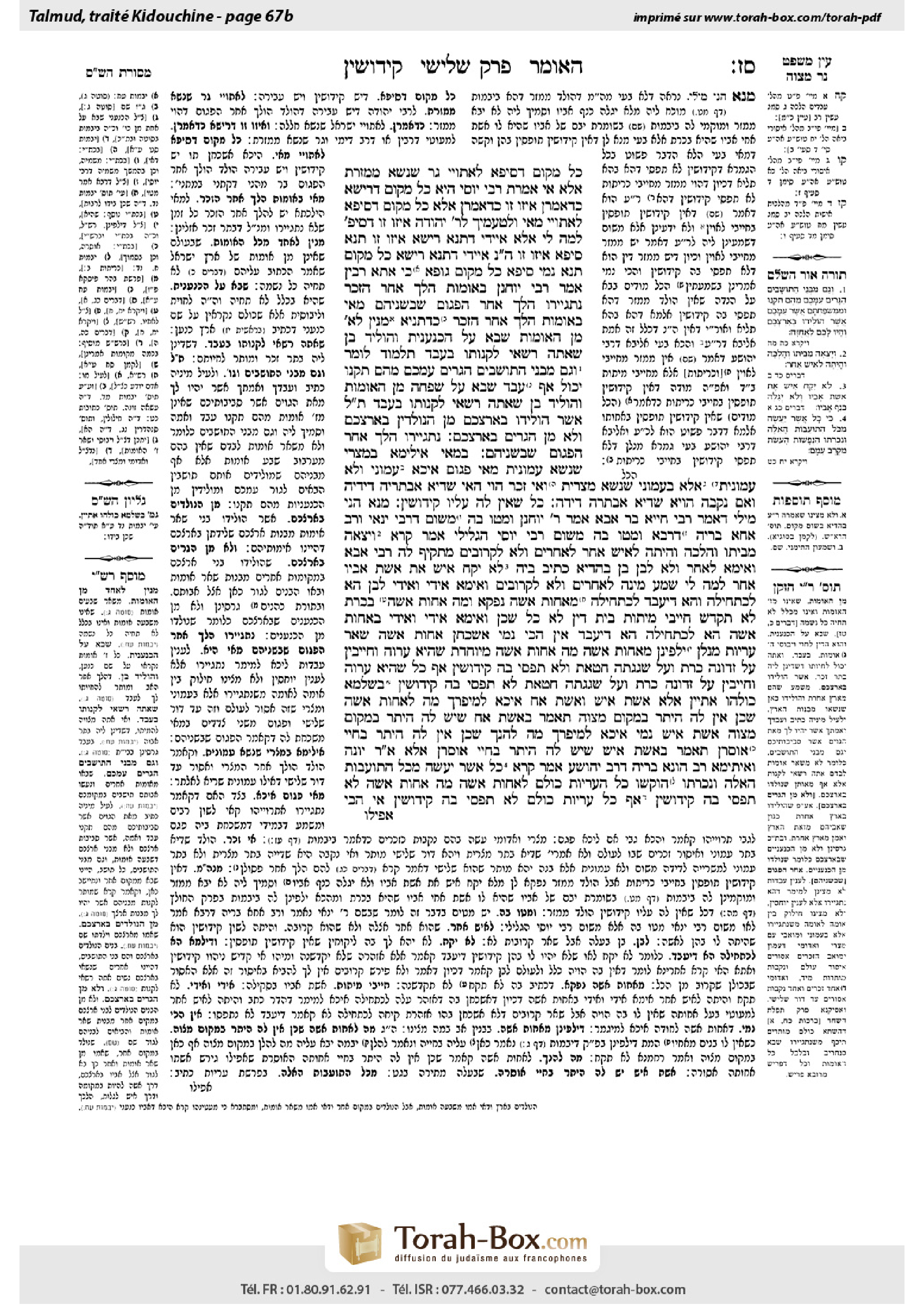
Kiddushin 67b: Talmud study for Daf Yomi
Daf Yomi is the daily study of one Talmud folio. Explore 37 tractates with scans, Hebrew text, Sefaria English and AI-generated French translations where annotated.
Passage selection and English or AI-generated French translation are available where the scan has annotations. Daf Study is independent of Torah-Box and Sefaria.
Browse Kiddushin · קידושין · All tractatesKiddushin 67b text and translations
This page of Kiddushin includes the Aramaic text, an English translation and an AI-generated French translation, alongside the scan above.
קידושין ס״ז ב · Aramaic and Hebrew text
״כׇּל מָקוֹם״ דְּסֵיפָא – לְאֵתוֹיֵי גֵּר שֶׁנָּשָׂא מַמְזֶרֶת. אֶלָּא אִי אָמְרַתְּ רַבִּי יוֹסֵי הִיא, ״כׇּל מָקוֹם״ דְּרֵישָׁא – כְּדַאֲמַרַן, ״אֵיזוֹ זוֹ״ – כְּדַאֲמַרַן, אֶלָּא ״כׇּל מָקוֹם״ דְּסֵיפָא לְאֵתוֹיֵי מַאי?
וּלְטַעְמָיךְ, לְרַבִּי יְהוּדָה ״אֵיזוֹ זוֹ״ דְּסֵיפָא לְמָה לִי? אֶלָּא: אַיְּידֵי דִּתְנָא רֵישָׁא ״אֵיזוֹ זוֹ״, תְּנָא סֵיפָא ״אֵיזוֹ זוֹ״. הָכִי נָמֵי אַיְּידֵי דִּתְנָא רֵישָׁא ״כׇּל מָקוֹם״, תְּנָא נָמֵי סֵיפָא ״כׇּל מָקוֹם״.
גּוּפָא: כִּי אֲתָא רָבִין, אָמַר רַבִּי יוֹחָנָן: בָּאוּמּוֹת – הַלֵּךְ אַחַר הַזָּכָר. נִתְגַּיְּירוּ – הַלֵּךְ אַחַר הַפָּגוּם שֶׁבִּשְׁנֵיהֶם.
מַאי ״בָּאוּמּוֹת הַלֵּךְ אַחַר הַזָּכָר״? כִּדְתַנְיָא: מִנַּיִן לְאֶחָד מִן הָאוּמּוֹת שֶׁבָּא עַל הַכְּנַעֲנִית וְהוֹלִיד בֵּן שֶׁאַתָּה רַשַּׁאי לִקְנוֹתוֹ בְּעֶבֶד?
תַּלְמוּד לוֹמַר: ״וְגַם מִבְּנֵי הַתּוֹשָׁבִים הַגָּרִים עִמָּכֶם מֵהֶם תִּקְנוּ״. יָכוֹל אַף עֶבֶד שֶׁבָּא עַל שִׁפְחָה מִן הָאוּמּוֹת וְהוֹלִיד בֵּן שֶׁאַתָּה רַשַּׁאי לִקְנוֹתוֹ בְּעֶבֶד? תַּלְמוּד לוֹמַר: ״אֲשֶׁר הוֹלִידוּ בְּאַרְצְכֶם״ – מִן הַנּוֹלָדִין בְּאַרְצְכֶם, וְלֹא מִן הַגָּרִים בְּאַרְצְכֶם.
״נִתְגַּיְּירוּ הַלֵּךְ אַחַר הַפָּגוּם שֶׁבִּשְׁנֵיהֶם״ – בְּמַאי? אִילֵימָא בְּמִצְרִי שֶׁנָּשָׂא עַמּוֹנִית, מַאי פָּגוּם אִיכָּא, ״עַמּוֹנִי״ – וְלֹא עַמּוֹנִית!
אֶלָּא בְּעַמּוֹנִי שֶׁנָּשָׂא מִצְרִית, וְאִי זָכָר הָוֵי – הַאי שִׁדְיֵהּ אַבָּתְרֵיהּ דִּידֵיהּ, וְאִם נְקֵבָה הָוְיָא – שִׁדְיַהּ אַבָּתְרַהּ דִּידַהּ.
כֹּל שֶׁאֵין לָהּ עָלָיו קִידּוּשִׁין. מְנָא הָנֵי מִילֵּי? דְּאָמַר רַבִּי חִיָּיא בַּר אַבָּא אָמַר רַבִּי יוֹחָנָן וּמָטוּ בָּהּ מִשּׁוּם דְּרַבִּי יַנַּאי, וְרַב אַחָא בְּרֵיהּ דְּרָבָא וּמָטוּ בָּהּ מִשּׁוּם רַבִּי יוֹסֵי הַגְּלִילִי: אָמַר קְרָא: ״וְיָצְאָה מִבֵּיתוֹ וְהָלְכָה וְהָיְתָה לְאִישׁ אַחֵר״ – לַאֲחֵרִים וְלֹא לִקְרוֹבִים.
מַתְקֵיף לַהּ רַבִּי אַבָּא: וְאֵימָא ״לְאַחֵר״ וְלֹא לְבֵן! בֵּן בְּהֶדְיָא כְּתִיב בֵּיהּ: ״לֹא יִקַּח אִישׁ אֶת אֵשֶׁת אָבִיו״, ״אַחֵר״ לְמָה לִי? שְׁמַע מִינַּהּ לַאֲחֵרִים וְלֹא לִקְרוֹבִים.
וְאֵימָא: אִידֵּי וְאִידֵּי לְבֵן, הָא – לְכַתְּחִילָּה, וְהָא – דִּיעֲבַד.
לְכַתְּחִילָּה מֵאֲחוֹת אִשָּׁה נָפְקָא: וּמָה אֲחוֹת אִשָּׁה, בְּכָרֵת לָא תָּפְסִי בַּהּ קִידּוּשִׁין, חַיָּיבֵי מִיתוֹת בֵּית דִּין לֹא כׇּל שֶׁכֵּן?
וְאֵימָא: אִידֵּי וְאִידֵּי בַּאֲחוֹת אִשָּׁה, הָא – לְכַתְּחִילָּה, הָא – דִיעֲבַד! אִין הָכִי נָמֵי.
אַשְׁכְּחַן אֲחוֹת אִשָּׁה, שְׁאָר עֲרָיוֹת מְנָלַן? יָלְפִינַן מֵאֲחוֹת אִשָּׁה: מָה אֲחוֹת אִשָּׁה מְיוּחֶדֶת, שֶׁהִיא עֶרְוָה וְחַיָּיבִין עַל זְדוֹנָהּ כָּרֵת וְעַל שִׁגְגָתָהּ חַטָּאת – וְלָא תָּפְסִי בָּהּ קִידּוּשִׁין, אַף כֹּל שֶׁהִיא עֶרְוָה וְחַיָּיבִין עַל זְדוֹנָהּ כָּרֵת וְעַל שִׁגְגָתָהּ חַטָּאת – לָא תָּפְסִי בָּהּ קִידּוּשִׁין.
בִּשְׁלָמָא כּוּלְּהוּ אָתְיָין, אֶלָּא אֵשֶׁת אִישׁ וְאֵשֶׁת אָח – אִיכָּא לְמִיפְרַךְ: מָה לַאֲחוֹת אִשָּׁה, שֶׁכֵּן אֵין לָהּ הֶיתֵּר בִּמְקוֹם מִצְוָה – תֹּאמַר בְּאֵשֶׁת אָח שֶׁיֵּשׁ לָהּ הֶיתֵּר בִּמְקוֹם מִצְוָה.
אֵשֶׁת אִישׁ נָמֵי אִיכָּא לְמִיפְרַךְ: מָה לְהָנָךְ, שֶׁכֵּן אֵין לָהּ הֶיתֵּר בְּחַיֵּי אוֹסְרָן – תֹּאמַר בְּאֵשֶׁת אִישׁ שֶׁיֵּשׁ לָהּ הֶיתֵּר בְּחַיֵּי אוֹסְרָן!
אֶלָּא אָמַר רַבִּי יוֹנָה וְאִיתֵּימָא רַב הוּנָא בְּרֵיהּ דְּרַב יְהוֹשֻׁעַ: אָמַר קְרָא: ״כׇּל אֲשֶׁר יַעֲשֶׂה מִכֹּל הַתּוֹעֵבֹת הָאֵלֶּה וְנִכְרְתוּ״, הוּקְשׁוּ כׇּל הָעֲרָיוֹת כּוּלָּם לַאֲחוֹת אִשָּׁה, מָה אֲחוֹת אִשָּׁה לֹא תָּפְסִי בָּהּ קִידּוּשִׁין – אַף כׇּל עֲרָיוֹת כּוּלָּם לֹא תָּפְסִי בָּהּ קִידּוּשִׁין.
אִי הָכִי,
Kiddushin 67b · English translation
And the phrase: Any case, of the latter clause, which is referring to betrothal with a transgression, serves to include a convert who married a mamzeret. But if you say that the mishna is in accordance with the opinion of Rabbi Yosei, then granted the phrase: Any case where there is betrothal and no transgression, of the first clause, is as we said, i.e., it includes an Israelite who married a ḥalala; and the phrase: In which case is this applicable, is as we said, i.e., to the exclusion of Ravin or Rav Dimi, and the case of a convert who married a mamzeret. But what does the phrase: Any case, of the latter clause, serve to add?
The Gemara responds: And according to your reasoning, the same question applies to Rabbi Yehuda as well: Why do I need the phrase: In which case is this applicable, of the latter clause? Rather, you must say: Since the mishna taught its first clause using the phrase: In which case is this applicable, it also taught its latter clause using the phrase: In which case is this applicable, merely for the sake of stylistic consistency. So too here, with regard to Rabbi Yosei’s opinion, one can say: Since the mishna taught the first clause with the expression: Any case, it also taught its latter clause with: Any case.
§ The Gemara discusses the aforementioned matter itself: When Ravin came from Eretz Yisrael, he said that Rabbi Yoḥanan says: With regard to the nations, if members of two different nations married when they were gentiles, follow the male to determine the status of their child. If they converted before marriage, follow the flawed lineage of the two.
The Gemara analyzes this statement: What is the meaning of: With regard to the nations, follow the male? As it is taught in a baraita: From where is it derived with regard to one member of the nations outside Eretz Yisrael who engaged in intercourse with a Canaanite woman and fathered a son from her, that you are permitted to purchase the son as a slave, and he is not considered a member of the Canaanite nations, who are not allowed to live in Eretz Yisrael?
The verse states: “And also of the children of the residents who sojourn with you, of them you may buy” (Leviticus 25:45), which indicates that there is a way in which one may purchase slaves from the inhabitants of Canaan. One might have thought that even with regard to a Canaanite slave who engaged in intercourse with a maidservant from the other nations and fathered a son, that you are permitted to buy the son as a slave. Therefore, the verse states: “Which they have begotten in your land” (Leviticus 25:45). This means that one may purchase from those who are merely begotten in your land, whose fathers are not from the Canaanite nations, but not from those who reside in your land, i.e., whose fathers are from the seven Canaanite nations.
The Gemara discusses the second clause of Rabbi Yoḥanan’s statement: If they converted, follow the flawed lineage of the two. To which case does this refer? If we say that it is referring to an Egyptian man who married an Ammonite woman, what flawed lineage is there here? The lineage of an Ammonite woman who converts is not flawed at all, as the Sages expounded that the verse: “An Ammonite…shall not enter into the assembly of the Lord” (Deuteronomy 23:4) is referring to an Ammonite man but not an Ammonite woman, which means that she can marry a Jew of unflawed lineage.
Rather, it must be referring to an Ammonite man who married an Egyptian woman, and in that case if the child is a male, cast him after his father, and render him permanently prohibited from entering the congregation as an Ammonite male. And if the child born to them is a female, cast her after the mother, so that she is considered a second-generation Egyptian, who may not marry a Jew of unflawed lineage.
§ The mishna teaches that in any case where a woman cannot join in betrothal with him, but she can join in betrothal with others, the offspring is a mamzer. The Gemara explains: From where are these matters derived? As Rabbi Ḥiyya bar Abba says that Rabbi Yoḥanan says, and some determined that it was said in the name of Rabbi Yannai; and Rav Aḥa, son of Rava, determined that it was said in the name of Rabbi Yosei HaGelili: The verse states with regard to a divorced woman: “And she departs out of his house, and goes and becomes another man’s wife” (Deuteronomy 24:2). This teaches that she can become the wife of others, but not of relatives, i.e., betrothal to forbidden relatives does not take effect.
Rabbi Abba objects to this: But one can say and explain that the term “another” in the verse indicates: But not to her husband’s son, i.e., betrothal is ineffective only in the case of a prohibition that warrants court-imposed capital punishment, not one that warrants karet. The Gemara rejects this suggestion: With regard to a son it is explicitly written: “A man shall not take his father’s wife” (Deuteronomy 23:1), which means that betrothal is ineffective in this situation. If so, why do I need the emphasis of the term “another”? Learn from this term that she may marry others but not relatives.
The Gemara challenges this explanation: But one can say that both this verse and that verse are referring to a son and yet both are necessary, as this verse: “Shall not take,” is referring to the halakha ab initio. It does not mean that betrothal is ineffective, but merely that one may not marry his father’s wife. And that verse: “And becomes another man’s wife,” teaches that even after the fact, if the son attempted to betroth his father’s wife, his act is of no consequence.
The Gemara responds: One learns that betrothal is ineffective in this case ab initio from a different source, as it is derived from the prohibition proscribing a wife’s sister by the following a fortiori inference: If, with regard to the prohibition proscribing a wife’s sister, whose transgression is punished with karet, she cannot be betrothed by her sister’s husband, in accordance with the verse: “And you shall not take a woman with her sister” (Leviticus 18:18), then with regard to cases that entail liability to receive court-imposed capital punishment, e.g., intercourse with one’s father’s wife, is it not all the more so the case that betrothal does not take effect?
The Gemara suggests another interpretation of the verses. But as the verse has already prohibited betrothal to a wife’s sister, one can say as follows: Both this verse: “You shall not take” (Leviticus 18:18), and that one: “Becomes another man’s wife” (Deuteronomy 24:2), are referring to a wife’s sister, as this one: “You shall not take,” prohibits this relationship ab initio, whereas that verse: “Another man’s wife,” teaches that this betrothal is of no effect even after the fact. The Gemara responds: Yes, it is indeed so. The verse should be interpreted in this manner.
The Gemara asks: We found a source for the prohibition proscribing a wife’s sister; from where do we derive that betrothal is also ineffective for the other forbidden relations? The Gemara answers: We derive it from the case of a wife’s sister, by means of the following analogy: Just as the prohibition with regard to a wife’s sister, which is specified by the Torah, is a prohibition of a forbidden relative that is punished with karet for its intentional transgression and requires a sin-offering for its unwitting transgression, and betrothal is ineffective in this case, so too, with regard to any prohibition that involves a forbidden relative whose intentional transgression is punished with karet and whose unwitting transgression renders one liable to bring a sin-offering, betrothal is likewise ineffective in those cases.
The Gemara asks: Granted, virtually all other forbidden relatives can be derived in this manner. But the cases of a married woman and a brother’s wife are exceptions, and the analogy in these cases can be refuted as follows. What is unique about a wife’s sister is that she is not permitted in the case of a mitzva, as even where the mitzva of levirate marriage would apply, one still may not marry one’s wife’s sister. Will you say the same with regard to a brother’s wife, who is permitted in the case of the mitzva of levirate marriage?
With regard to a married woman the interpretation can likewise be refuted: What is unique about these cases of a wife’s sister and a brother’s wife is that they cannot be permitted during the lives of those whose existence renders them prohibited, as neither a wife’s sister nor a brother’s wife can be permitted while the person who causes the prohibition is alive. This caveat is added because one’s wife’s sister does become permitted once his wife has died. Will you say the same with regard to a married woman, who can become permitted during the life of the one who renders her forbidden, by means of a divorce?
Rather, this halakha, that betrothal is ineffective for other forbidden relatives, is derived from a different source, as Rabbi Yona says, and some say this was taught by Rav Huna, son of Rav Yehoshua: The verse states explicitly in the chapter dealing with forbidden relatives: “Whoever shall do any of these abominations shall be cut off” (Leviticus 18:29). In this verse all those with whom relations are forbidden are juxtaposed to one another, and therefore also to a wife’s sister: Just as betrothal is not effective in the case of a wife’s sister, so too, betrothal is not effective with regard to all those with whom relations are forbidden.
The Gemara asks: If so, that this halakha is derived from here,
Kiddushin 67b · Traduction française (IA)
Et l’expression « dans tous les cas », dans la dernière partie, qui concerne des fiançailles entachées d’une transgression, sert à inclure le converti qui a épousé une mamzéret. Mais si tu dis que la Michna suit l’opinion de Rabbi Yosei, alors, certes, l’expression « dans tous les cas où il y a des fiançailles et aucune transgression », dans la première partie, s’explique comme nous l’avons dit : elle inclut un Israélite qui a épousé une ḥalala. De même, l’expression « dans quel cas cela s’applique-t-il ? » s’explique comme nous l’avons dit : elle exclut les cas évoqués par Ravin ou Rav Dimi, ainsi que celui du converti qui a épousé une mamzéret. Mais qu’ajoute l’expression « dans tous les cas », dans la dernière partie ?
La Guemara répond : Selon ton raisonnement, la même question se pose aussi au sujet de Rabbi Yehuda : pourquoi l’expression « dans quel cas cela s’applique-t-il ? », dans la dernière partie, est-elle nécessaire ? Il faut plutôt dire que, puisque la Michna a formulé la première partie avec l’expression « dans quel cas cela s’applique-t-il ? », elle a également formulé la dernière partie avec cette expression, simplement par souci de cohérence stylistique. De même ici, au sujet de l’opinion de Rabbi Yosei, on peut dire que, puisque la Michna a formulé la première partie avec l’expression « dans tous les cas », elle a également formulé la dernière partie avec cette expression.
§ La Guemara revient sur le sujet évoqué précédemment : lorsque Ravin revint d’Eretz Israël, il rapporta que Rabbi Yoḥanan disait : concernant les nations, si des membres de deux nations différentes se sont mariés alors qu’ils étaient non juifs, on suit le père pour déterminer le statut de leur enfant. S’ils se sont convertis avant de se marier, on suit la filiation présentant le défaut des deux.
La Guemara analyse cette déclaration : que signifie « concernant les nations, on suit le père » ? Comme il est enseigné dans une baraïta : d’où déduit-on qu’un membre des nations vivant hors d’Eretz Israël, qui a eu des rapports avec une femme cananéenne et a eu un fils d’elle, peut acheter ce fils comme esclave, et que celui-ci n’est pas considéré comme appartenant aux nations cananéennes, auxquelles il est interdit de résider en Eretz Israël ?
Le verset dit : « Et aussi des enfants des résidents qui séjournent avec vous, vous pourrez en acheter » (Lévitique 25:45), ce qui indique qu’il existe une manière d’acheter des esclaves parmi les habitants de Canaan. On aurait pu penser que l’on peut également acheter comme esclave le fils d’un esclave cananéen qui a eu des rapports avec une servante issue des autres nations. Le verset dit donc : « qu’ils auront engendrés dans votre pays » (Lévitique 25:45). Cela signifie qu’on peut acheter ceux qui sont simplement engendrés dans votre pays, dont les pères ne sont pas issus des nations cananéennes, mais non ceux qui résident dans votre pays, c’est-à-dire ceux dont les pères sont issus des sept nations cananéennes.
La Guemara examine la seconde partie de la déclaration de Rabbi Yoḥanan : s’ils se sont convertis, on suit la filiation présentant le défaut des deux. À quel cas cela se rapporte-t-il ? Si nous disons qu’il s’agit d’un homme égyptien qui a épousé une femme ammonite, quel défaut de filiation y a-t-il ici ? La filiation d’une femme ammonite qui se convertit n’est nullement défectueuse, car les Sages ont interprété le verset « Un Ammonite… n’entrera pas dans l’assemblée de l’Éternel » (Deutéronome 23:4) comme se rapportant à un homme ammonite, mais non à une femme ammonite ; elle peut donc épouser un Juif de filiation sans défaut.
Il faut plutôt parler d’un homme ammonite qui a épousé une femme égyptienne. Dans ce cas, si l’enfant est un garçon, fais-le suivre son père et rends-le définitivement interdit d’entrer dans l’assemblée en tant qu’homme ammonite. Si l’enfant qui leur est né est une fille, fais-la suivre sa mère, de sorte qu’elle soit considérée comme une Égyptienne de deuxième génération, qui ne peut épouser un Juif de filiation sans défaut.
§ La Michna enseigne que, dans tout cas où une femme ne peut pas être fiancée à cet homme, mais peut l’être à d’autres, l’enfant est un mamzer. La Guemara explique : d’où ces règles sont-elles déduites ? Rabbi Ḥiyya bar Abba dit au nom de Rabbi Yoḥanan — et certains établissent que cela a été transmis au nom de Rabbi Yannai —, tandis que Rav Aḥa, fils de Rava, établit que cela a été transmis au nom de Rabbi Yosei HaGelili : le verset dit, au sujet d’une femme divorcée : « Elle sortira de sa maison, s’en ira et deviendra la femme d’un autre homme » (Deutéronome 24:2). Cela enseigne qu’elle peut devenir l’épouse d’autres hommes, mais non de ses proches parents ; autrement dit, les fiançailles avec des proches parents interdits ne prennent pas effet.
Rabbi Abba objecte : Mais on pourrait dire et expliquer que le terme « autre » dans le verset signifie : mais pas avec le fils de son mari, c’est-à-dire que les fiançailles ne sont inefficaces que dans le cas d’une interdiction passible de la peine capitale infligée par un tribunal, mais non d’une interdiction passible de karet. La Guemara rejette cette proposition : au sujet d’un fils, il est écrit explicitement : « Un homme ne prendra pas la femme de son père » (Deutéronome 23:1), ce qui signifie que les fiançailles ne prennent pas effet dans cette situation. Si tel est le cas, pourquoi le terme « autre » est-il nécessaire ? Déduis-en qu’elle peut épouser d’autres hommes, mais non des proches parents.
La Guemara conteste cette explication : Mais on pourrait dire que les deux versets, celui-ci et celui-là, concernent le fils et sont tous deux nécessaires : le verset « ne prendra pas » concerne la halakha a priori. Il ne signifie pas que les fiançailles sont sans effet, mais seulement qu’un homme ne doit pas épouser la femme de son père. Et le verset « et deviendra la femme d’un autre homme » enseigne que même a posteriori, si le fils a tenté de fiancer la femme de son père, son acte est sans effet.
La Guemara répond : On apprend d’une autre source que les fiançailles ne prennent pas effet dans ce cas, même a priori. Cela se déduit de l’interdiction concernant la sœur de son épouse, au moyen du raisonnement a fortiori suivant : si, concernant l’interdiction de la sœur de son épouse, dont la transgression est passible de karet, celle-ci ne peut pas être fiancée par le mari de sa sœur, conformément au verset « Tu ne prendras pas une femme avec sa sœur » (Lévitique 18:18), alors, concernant les cas passibles de la peine capitale infligée par un tribunal, par exemple les rapports avec la femme de son père, n’est-il pas à plus forte raison vrai que les fiançailles ne prennent pas effet ?
La Guemara propose une autre interprétation des versets. Mais puisque le verset a déjà interdit les fiançailles avec la sœur de son épouse, on peut dire ceci : les deux versets, « Tu ne prendras pas » (Lévitique 18:18) et « deviendra la femme d’un autre homme » (Deutéronome 24:2), concernent la sœur de son épouse. En effet, le premier, « Tu ne prendras pas », interdit cette union a priori, tandis que le second, « la femme d’un autre homme », enseigne que ces fiançailles sont sans effet même a posteriori. La Guemara répond : Oui, c’est bien ainsi. Le verset doit être interprété de cette manière.
La Guemara demande : Nous avons trouvé une source pour l’interdiction concernant la sœur de son épouse ; d’où déduisons-nous que les fiançailles ne prennent pas effet non plus pour les autres unions interdites ? La Guemara répond : Nous le déduisons du cas de la sœur de son épouse, par l’analogie suivante : de même que l’interdiction concernant la sœur de son épouse, explicitée dans la Torah, est une interdiction visant une proche parente, dont la transgression intentionnelle est passible de karet et dont la transgression involontaire exige un sacrifice expiatoire, et que les fiançailles ne prennent pas effet dans ce cas, de même, pour toute interdiction visant une proche parente dont la transgression intentionnelle est passible de karet et dont la transgression involontaire rend passible d’apporter un sacrifice expiatoire, les fiançailles ne prennent pas effet non plus.
La Guemara demande : Certes, presque toutes les autres unions interdites peuvent être déduites de cette manière. Mais les cas d’une femme mariée et de la femme d’un frère font exception, et l’analogie pourrait être réfutée dans ces cas de la manière suivante. Qu’y a-t-il de particulier à la sœur de son épouse ? Elle n’est pas permise dans le cadre d’une mitsva, car même lorsque la mitsva du lévirat s’applique, on ne peut toujours pas épouser la sœur de son épouse. Pourrait-on dire la même chose au sujet de la femme d’un frère, qui est permise dans le cadre de la mitsva du lévirat ?
L’interprétation concernant une femme mariée peut pareillement être réfutée : qu’y a-t-il de particulier dans les cas de la sœur de son épouse et de la femme d’un frère ? Leur union ne peut être autorisée du vivant des personnes qui les rendent interdites, car ni la sœur de son épouse ni la femme d’un frère ne peuvent être épousées tant que la personne à l’origine de l’interdiction est en vie. Cette précision est ajoutée parce que la sœur de son épouse devient effectivement permise après la mort de l’épouse. Pourrait-on dire la même chose au sujet d’une femme mariée, qui peut devenir permise du vivant de celui qui la rend interdite, au moyen d’un divorce ?
Il faut plutôt déduire d’une autre source cette halakha, selon laquelle les fiançailles ne prennent pas effet pour les autres proches parentes interdites, comme le dit Rabbi Yona — et certains disent que Rav Huna, fils de Rav Yehoshua, l’a enseigné : le verset dit explicitement, dans le chapitre consacré aux proches parentes interdites : « Quiconque commet l’une de ces abominations sera retranché » (Lévitique 18:29). Dans ce verset, toutes les personnes avec lesquelles les rapports sont interdits sont juxtaposées les unes aux autres, et donc aussi à la sœur de son épouse. De même que les fiançailles ne prennent pas effet avec la sœur de son épouse, elles ne prennent pas non plus effet avec toutes les personnes avec lesquelles les rapports sont interdits.
La Guemara demande : Si tel est le cas, si cette halakha est déduite de ce verset,
Traduction française générée par IA à partir de l’édition anglaise de Sefaria. Vérifie toujours un passage avec le texte source.
Text from Sefaria: William Davidson Edition - Vocalized Aramaic (CC BY NC); William Davidson Edition - English (CC BY NC).