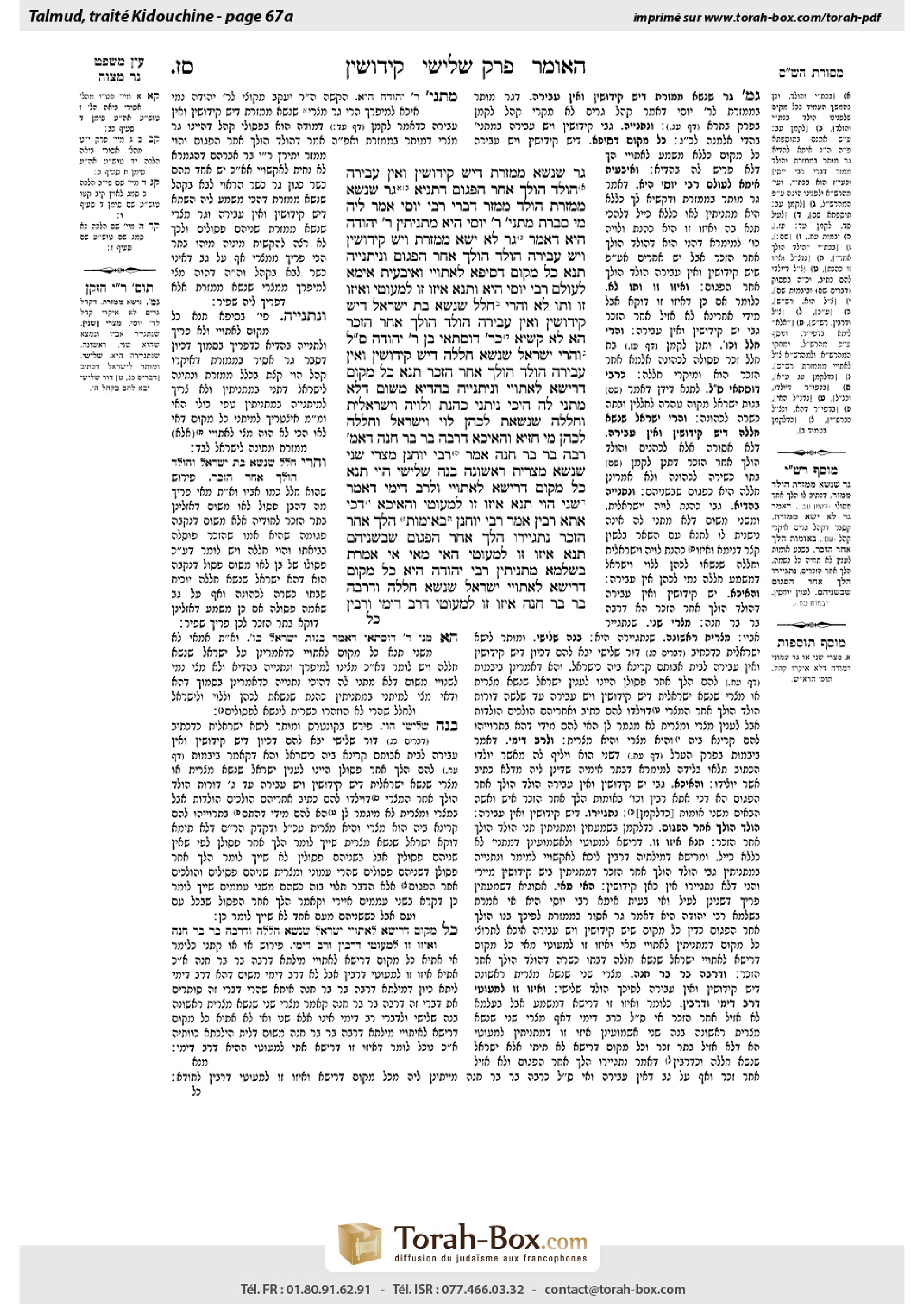
Kiddushin 67a: Talmud study for Daf Yomi
Daf Yomi is the daily study of one Talmud folio. Explore 37 tractates with scans, Hebrew text, Sefaria English and AI-generated French translations where annotated.
Passage selection and English or AI-generated French translation are available where the scan has annotations. Daf Study is independent of Torah-Box and Sefaria.
Browse Kiddushin · קידושין · All tractatesKiddushin 67a text and translations
This page of Kiddushin includes the Aramaic text, an English translation and an AI-generated French translation, alongside the scan above.
קידושין ס״ז א · Aramaic and Hebrew text
גֵּר שֶׁנָּשָׂא מַמְזֶרֶת, דְּיֵשׁ קִידּוּשִׁין וְאֵין עֲבֵירָה – הַוָּלָד הוֹלֵךְ אַחַר הַפָּגוּם, דְּתַנְיָא: גֵּר שֶׁנָּשָׂא מַמְזֶרֶת – הַוָּלָד מַמְזֵר, דִּבְרֵי רַבִּי יוֹסֵי! אֲמַר לֵיהּ: מִי סָבְרַתְּ מַתְנִיתִין רַבִּי יוֹסֵי הִיא? מַתְנִיתִין רַבִּי יְהוּדָה הִיא, דְּאָמַר: גֵּר לֹא יִשָּׂא מַמְזֶרֶת, וְיֵשׁ קִידּוּשִׁין וְיֵשׁ עֲבֵירָה – הַוָּלָד הוֹלֵךְ אַחַר הַפָּגוּם.
וְנִיתְנְיַיהּ! תְּנָא ״כׇּל מָקוֹם״ דְּסֵיפָא, לְאֵתוֹיֵי.
וְאִיבָּעֵית אֵימָא: לְעוֹלָם רַבִּי יוֹסֵי הִיא, וּתְנָא ״אֵיזוֹ זוֹ״ לְמַעוֹטֵי.
״וְאֵיזוֹ זוֹ״ וְתוּ לָא? וַהֲרֵי חָלָל שֶׁנָּשָׂא בַּת יִשְׂרָאֵל, דְּיֵשׁ קִידּוּשִׁין וְאֵין עֲבֵירָה – הַוָּלָד הוֹלֵךְ אַחַר הַזָּכָר! הָא לָא קַשְׁיָא, כְּרַבִּי דּוֹסְתַּאי בֶּן רַבִּי יְהוּדָה סְבִירָא לֵיהּ.
וַהֲרֵי יִשְׂרָאֵל שֶׁנָּשָׂא חֲלָלָה, דְּיֵשׁ קִידּוּשִׁין וְאֵין עֲבֵירָה – הַוָּלָד הוֹלֵךְ אַחַר הַזָּכָר! תְּנָא ״כׇּל מָקוֹם״ דְּרֵישָׁא, לְאֵתוֹיֵי.
וְנִיתְנְיַיהּ בְּהֶדְיָא! מִשּׁוּם דְּלָא מִתְּנֵי לֵהּ. הֵיכִי נִיתְנֵי? כֹּהֶנֶת וּלְוִיָּה וְיִשְׂרְאֵלִית וַחֲלָלָה שֶׁנִּשֵּׂאת לְכֹהֵן לֵוִי וְיִשְׂרָאֵל – וַחֲלָלָה לְכֹהֵן מִי חַזְיָא?
וְהָאִיכָּא דְּרַבָּה בַּר בַּר חָנָה, דְּאָמַר רַבָּה בַּר בַּר חָנָה אָמַר רַבִּי יוֹחָנָן: מִצְרִי שֵׁנִי שֶׁנָּשָׂא מִצְרִית רִאשׁוֹנָה – בְּנָהּ שְׁלִישִׁי הָוֵי!
תְּנָא ״כׇּל מָקוֹם״ דְּרֵישָׁא, לְאֵתוֹיֵי. וּלְרַב דִּימִי דְּאָמַר שֵׁנִי הָוֵי, תְּנָא ״אֵיזוֹ זוֹ״ לְמַעוֹטֵי.
וְהָאִיכָּא, דְּכִי אֲתָא רָבִין אָמַר רַבִּי יוֹחָנָן: בָּאוּמּוֹת – הַלֵּךְ אַחַר הַזָּכָר.
נִתְגַּיְּירוּ, הַלֵּךְ אַחַר הַפָּגוּם שֶׁבִּשְׁנֵיהֶם. תְּנָא ״אֵיזוֹ זוֹ״ לְמַעוֹטֵי.
הַאי מַאי? אִי אָמְרַתְּ בִּשְׁלָמָא מַתְנִיתִין רַבִּי יְהוּדָה הִיא, ״כׇּל מָקוֹם״ דְּרֵישָׁא – לְאֵתוֹיֵי יִשְׂרָאֵל שֶׁנָּשָׂא חֲלָלָה, וּדְרַבָּה בַּר בַּר חָנָה, ״אֵיזוֹ זוֹ״ – לְמַעוֹטֵי דְּרַב דִּימִי וְרָבִין!
Kiddushin 67a · English translation
there is the case of a convert who married a mamzeret, where there is a valid betrothal and there is no transgression, as they are permitted to marry each other, and yet the offspring follows the flawed lineage and is a mamzer. As it is taught in a baraita: With regard to a convert who married a mamzeret, the offspring is a mamzer. This is the statement of Rabbi Yosei. Rabbi Yoḥanan said to Rabbi Shimon: Do you maintain that the mishna is in accordance with the opinion of Rabbi Yosei? Not so; the mishna is in accordance with the opinion of Rabbi Yehuda, who says: A convert may not marry a mamzeret, and therefore in this case there is betrothal and there is a transgression, which is why the offspring follows the flawed lineage.
The Gemara asks: But if so, let the mishna teach this case as one of its examples. The Gemara answers: The mishna taught the principle: Any case where there is betrothal and a transgression, in the latter clause, precisely to include this kind of case. There is a guiding principle of the Gemara’s interpretation of the Mishna that a mishna does not include extraneous phrases. Every apparently superfluous phrase in the context of a principle serves to include or exclude a certain case from that principle. This is the basis of the discussion of the Gemara here and below.
And if you wish, say a different answer: Actually, the mishna is in accordance with the opinion of Rabbi Yosei, and it taught the phrase: In which case is this applicable, to exclude cases of betrothal without a transgression other than those listed in the mishna. The offspring follows the lineage of the father only in those cases specified by the mishna.
The Gemara asks: But does the list that follows the phrase: In which case is this applicable, include all applicable cases? And are there no more? But there is the example of a ḥalal who married an Israelite woman, where there is betrothal and there is no transgression, and yet the offspring follows the male, as he too is a ḥalal. The Gemara rejects this claim: This is not difficult, as one can say that the tanna of the mishna holds in accordance with the opinion of Rabbi Dostai ben Rabbi Yehuda, who maintains that the offspring of this union is entirely fit.
The Gemara asks: But there is the case of an Israelite who married a ḥalala, where there is betrothal and there is no transgression, and the offspring follows the male, and yet this case is not mentioned in the mishna. The Gemara responds: The mishna taught the principle: Any case where there is betrothal and no transgression, in the first clause, to include this situation.
The Gemara asks: But let the tanna of the mishna teach explicitly this example of an Israelite who married a ḥalala. The Gemara answers: He did not do so because he cannot teach it, i.e., the tanna cannot mention this halakha in brief as part of the list. The Gemara clarifies its answer: How can the tanna teach it? He cannot state: A daughter of a priest; and a daughter of a Levite; and a daughter of an Israelite; and a ḥalala, who married a priest, a Levite, or an Israelite, as, is a ḥalala fit for a priest? This marriage involves a transgression. Consequently, the sentence of the mishna cannot be constructed so as to include a ḥalala.
The Gemara asks: But there is also the halakha of Rabba bar bar Ḥana, as Rabba bar bar Ḥana says that Rabbi Yoḥanan says: With regard to a second-generation Egyptian man, i.e., the son of an Egyptian convert, who married a first-generation Egyptian woman, a woman who herself converted, her son is considered a third-generation Egyptian who may marry a Jew of unflawed lineage. This is an example of a betrothal without a transgression where the offspring follows the father.
The Gemara answers: The mishna taught the principle: Any case where there is betrothal and no transgression, in the first clause, to include this example. The Gemara adds: And according to the opinion of Rav Dimi, who said that this son is a second-generation Egyptian, the mishna taught: In which case is this applicable, at its beginning, with regard to betrothal that does not involve a transgression, to exclude this case. Rav Dimi maintains that this son may not marry a Jew of unflawed lineage.
The Gemara asks: But there is the following case, which apparently contradicts the principle of the mishna: As when Ravin came from Eretz Yisrael he said that Rabbi Yoḥanan says: With regard to the nations, i.e., if members of two different nations married when they were gentiles, follow the male to determine the status of their child. This is the case whether he is a regular gentile, who may marry a Jew of unflawed lineage as soon as he converts, or whether he is an Ammonite or an Egyptian, who may not marry a Jewish woman of unflawed lineage. In either case the child’s status follows that of the father.
If these members of two different nations converted, follow the flawed lineage of the two. These converts are permitted to marry one another and their betrothal is effective. If either the father or mother is Egyptian, the child follows the parent with the flawed lineage and would be Egyptian, whereas according to the principle stated in the mishna, one should follow the male. The Gemara answers: The mishna taught: In which case is this applicable, in the first clause, to exclude this case.
The Gemara returns to an earlier point: What is this claim, that the mishna is in accordance with the opinion of Rabbi Yosei? Granted, if you say that the mishna is in accordance with the opinion of Rabbi Yehuda, one can explain that the phrase: Any case, of the first clause, serves to include an Israelite who married a ḥalala, as the child follows the father in that case too, and also to include the ruling of Rabba bar bar Ḥana that the son of a second-generation Egyptian who married a first-generation Egyptian woman is a third-generation Egyptian. Furthermore, the expression: In which case is this applicable, serves to exclude the ruling of Rav Dimi that her son is a second-generation Egyptian, and the statement of Ravin citing Rabbi Yoḥanan.
Kiddushin 67a · Traduction française (IA)
Il y a le cas d’un converti qui a épousé une mamzeret : les kiddouchin sont valides et il n’y a pas de transgression, puisqu’ils ont le droit de se marier, et pourtant l’enfant suit la filiation entachée et est un mamzer. En effet, il est enseigné dans une baraïta : « Lorsqu’un converti a épousé une mamzeret, l’enfant est un mamzer. » Telle est l’opinion de Rabbi Yossei. Rabbi Yoḥanan dit à Rabbi Shimon : « Penses-tu que la Michna suit l’opinion de Rabbi Yossei ? Il n’en est rien : la Michna suit l’opinion de Rabbi Yehouda, qui dit qu’un converti ne peut pas épouser une mamzeret. Dans ce cas, les kiddouchin sont donc valides et il y a une transgression, raison pour laquelle l’enfant suit la filiation entachée. »
La Guemara demande : « Mais dans ce cas, que la Michna enseigne cet exemple parmi les cas qu’elle énumère. » La Guemara répond : « Dans la clause finale, la Michna a enseigné le principe : “Tout cas où les kiddouchin sont valides et où il y a une transgression”, précisément pour inclure ce type de cas. » La Guemara suit un principe d’interprétation de la Michna : une Michna ne contient pas de formulations superflues. Toute formule qui paraît superflue dans l’énoncé d’un principe sert à inclure ou à exclure un cas donné de ce principe. C’est le fondement de la discussion de la Guemara ici et dans la suite.
Et si tu le souhaites, donne une autre réponse : en réalité, la Michna suit l’opinion de Rabbi Yossei, et elle a enseigné la formule : « Dans quel cas cela s’applique-t-il ? », afin d’exclure les cas de kiddouchin sans transgression autres que ceux énumérés dans la Michna. L’enfant ne suit la filiation du père que dans les cas précisés par la Michna.
La Guemara demande : « Mais la liste qui suit la formule “Dans quel cas cela s’applique-t-il ?” comprend-elle tous les cas possibles ? N’y en a-t-il pas d’autres ? Il y a le cas d’un ḥalal qui a épousé une Israélite : les kiddouchin sont valides et il n’y a pas de transgression, et pourtant l’enfant suit la filiation du père, car lui aussi est un ḥalal. » La Guemara rejette cette objection : « Ce n’est pas difficile, car on peut dire que le tanna de la Michna suit l’opinion de Rabbi Dostai, fils de Rabbi Yehouda, qui considère que l’enfant issu de cette union est entièrement apte. »
La Guemara demande : « Mais il y a le cas d’un Israélite qui a épousé une ḥalala : les kiddouchin sont valides et il n’y a pas de transgression, et l’enfant suit la filiation du père ; pourtant, ce cas n’est pas mentionné dans la Michna. » La Guemara répond : « Dans la clause initiale, la Michna a enseigné le principe : “Tout cas où les kiddouchin sont valides et où il n’y a pas de transgression”, afin d’inclure cette situation. »
La Guemara demande : « Mais que le tanna de la Michna enseigne explicitement l’exemple d’un Israélite qui a épousé une ḥalala. » La Guemara répond : « Il ne l’a pas fait parce qu’il ne peut pas le faire », c’est-à-dire que le tanna ne peut pas mentionner brièvement cette halakha dans le cadre de la liste. La Guemara précise sa réponse : « Comment le tanna pourrait-il l’enseigner ? Il ne peut pas dire : “Une fille de prêtre, une fille de lévite, une fille d’Israélite et une ḥalala, qui ont épousé un prêtre, un lévite ou un Israélite”, car une ḥalala est-elle apte à épouser un prêtre ? » Ce mariage comporte une transgression. Par conséquent, la phrase de la Michna ne peut pas être formulée de manière à inclure une ḥalala.
La Guemara demande : « Mais il y a aussi la halakha de Rabba bar bar Ḥana, car Rabba bar bar Ḥana dit au nom de Rabbi Yoḥanan : lorsqu’un Égyptien de deuxième génération, c’est-à-dire le fils d’un converti égyptien, épouse une Égyptienne de première génération, une femme qui s’est elle-même convertie, son fils est considéré comme un Égyptien de troisième génération, qui peut épouser une Juive de filiation non entachée. C’est un exemple de kiddouchin sans transgression, où l’enfant suit le père. »
La Guemara répond : « Dans la clause initiale, la Michna a enseigné le principe : “Tout cas où les kiddouchin sont valides et où il n’y a pas de transgression”, afin d’inclure cet exemple. » La Guemara ajoute : « Et selon l’opinion de Rav Dimi, qui dit que ce fils est un Égyptien de deuxième génération, la Michna a enseigné au début, à propos de kiddouchin qui ne comportent pas de transgression, la formule : “Dans quel cas cela s’applique-t-il ?”, afin d’exclure ce cas. » Rav Dimi considère que ce fils ne peut pas épouser une Juive de filiation non entachée.
La Guemara demande : « Mais il y a le cas suivant, qui semble contredire le principe de la Michna. En effet, lorsque Ravin est venu d’Erets Israël, il a dit au nom de Rabbi Yoḥanan : en ce qui concerne les nations, c’est-à-dire lorsque des membres de deux nations différentes se sont mariés alors qu’ils étaient non-Juifs, l’enfant suit le père pour déterminer son statut. Cela vaut qu’il soit un non-Juif ordinaire, qui peut épouser une Juive de filiation non entachée dès sa conversion, ou qu’il soit Ammonite ou Égyptien, qui ne peut pas épouser une Juive de filiation non entachée. Dans les deux cas, le statut de l’enfant suit celui du père. »
Si ces membres de deux nations différentes se sont convertis, l’enfant suit la filiation entachée de l’un des deux. Ces convertis ont le droit de se marier entre eux et leurs kiddouchin sont valides. Si le père ou la mère est Égyptien, l’enfant suit le parent dont la filiation est entachée et serait donc Égyptien ; or, selon le principe énoncé dans la Michna, il devrait suivre le père. La Guemara répond : « Dans la clause initiale, la Michna a enseigné la formule “Dans quel cas cela s’applique-t-il ?” afin d’exclure ce cas. »
La Guemara revient à un point antérieur : « Que signifie cette affirmation selon laquelle la Michna suit l’opinion de Rabbi Yossei ? Il est compréhensible que, si tu dis que la Michna suit l’opinion de Rabbi Yehouda, on puisse expliquer que la formule “Tout cas”, dans la clause initiale, sert à inclure le cas d’un Israélite qui a épousé une ḥalala, puisque, dans ce cas aussi, l’enfant suit le père, ainsi que la décision de Rabba bar bar Ḥana selon laquelle le fils d’un Égyptien de deuxième génération qui a épousé une Égyptienne de première génération est un Égyptien de troisième génération. De plus, l’expression “Dans quel cas cela s’applique-t-il ?” sert à exclure la décision de Rav Dimi, selon laquelle son fils est un Égyptien de deuxième génération, ainsi que la déclaration de Ravin au nom de Rabbi Yoḥanan. »
Traduction française générée par IA à partir de l’édition anglaise de Sefaria. Vérifie toujours un passage avec le texte source.
Text from Sefaria: William Davidson Edition - Vocalized Aramaic (CC BY NC); William Davidson Edition - English (CC BY NC).