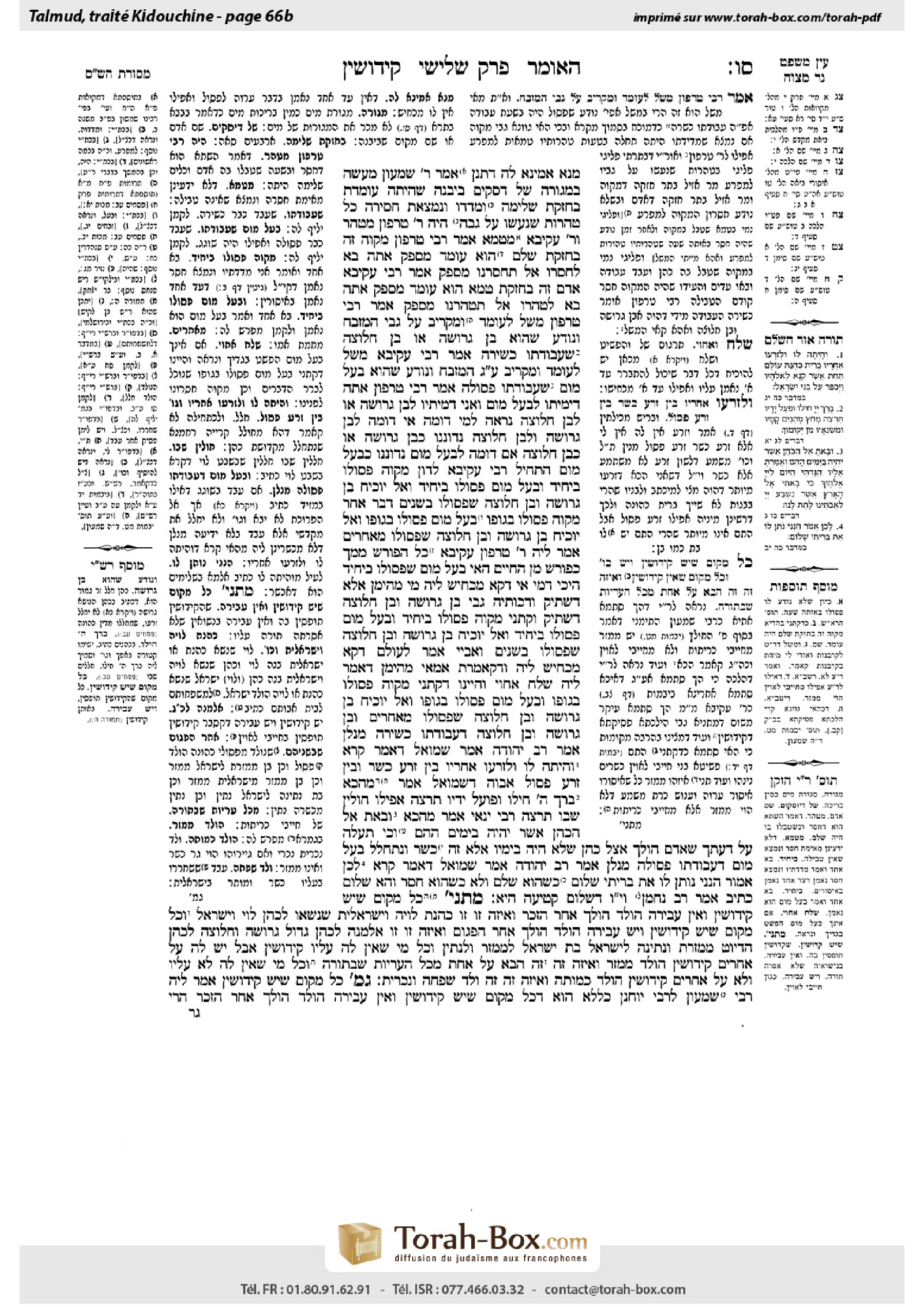
Kiddushin 66b: Talmud study for Daf Yomi
Daf Yomi is the daily study of one Talmud folio. Explore 37 tractates with scans, Hebrew text, Sefaria English and AI-generated French translations where annotated.
Passage selection and English or AI-generated French translation are available where the scan has annotations. Daf Study is independent of Torah-Box and Sefaria.
Browse Kiddushin · קידושין · All tractatesKiddushin 66b text and translations
This page of Kiddushin includes the Aramaic text, an English translation and an AI-generated French translation, alongside the scan above.
קידושין ס״ו ב · Aramaic and Hebrew text
מְנָא אָמֵינָא לַהּ, דִּתְנַן: אָמַר רַבִּי שִׁמְעוֹן: מַעֲשֶׂה בִּמְגוֹרָה שֶׁל דִּסְקִים בְּיַבְנֶה שֶׁהָיְתָה עוֹמֶדֶת בְּחֶזְקַת שְׁלֵימָה, וּמָדְדוּ וְנִמְצֵאת חֲסֵירָה –
כׇּל טְהָרוֹת שֶׁנַּעֲשׂוּ עַל גַּבָּהּ הָיָה רַבִּי טַרְפוֹן מְטַהֵר, וְרַבִּי עֲקִיבָא מְטַמֵּא. אָמַר רַבִּי טַרְפוֹן: מִקְוֶה זֶה בְּחֶזְקַת שָׁלֵם הוּא עוֹמֵד, מִסָּפֵק אַתָּה בָּא לְחַסְּרוֹ – אַל תְּחַסְּרֶנּוּ מִסָּפֵק. אָמַר רַבִּי עֲקִיבָא: אָדָם זֶה בְּחֶזְקַת טָמֵא הוּא עוֹמֵד, מִסָּפֵק אַתָּה בָּא לְטַהֲרוֹ – אַל תְּטַהֲרֶנּוּ מִסָּפֵק.
אָמַר רַבִּי טַרְפוֹן: מָשָׁל לְעוֹמֵד וּמַקְרִיב עַל גַּבֵּי הַמִּזְבֵּחַ, וְנוֹדַע שֶׁהוּא בֶּן גְּרוּשָׁה אוֹ בֶּן חֲלוּצָה, שֶׁעֲבוֹדָתוֹ כְּשֵׁירָה. אָמַר רַבִּי עֲקִיבָא: מָשָׁל לְעוֹמֵד וּמַקְרִיב עַל גַּבֵּי הַמִּזְבֵּחַ וְנוֹדַע שֶׁהוּא בַּעַל מוּם, שֶׁעֲבוֹדָתוֹ פְּסוּלָה.
אָמַר רַבִּי טַרְפוֹן: אַתָּה דִּימִּיתוֹ לְבַעַל מוּם, וַאֲנִי דִּמִּיתִיו לְבֶן גְּרוּשָׁה אוֹ לְבֶן חֲלוּצָה, נִרְאֶה לְמִי דּוֹמֶה. אִי דּוֹמֶה לְבֶן גְּרוּשָׁה וּלְבֶן חֲלוּצָה – נְדוּנֶנּוּ כְּבֶן גְּרוּשָׁה אוֹ כְּבֶן חֲלוּצָה, אִם דּוֹמֶה לְבַעַל מוּם – נְדוּנֶנּוּ כְּבַעַל מוּם.
הִתְחִיל רַבִּי עֲקִיבָא לָדוּן: מִקְוֶה פְּסוּלוֹ בְּיָחִיד, וּבַעַל מוּם פְּסוּלוֹ בְּיָחִיד, וְאַל יוֹכִיחַ בֶּן גְּרוּשָׁה וּבֶן חֲלוּצָה שֶׁפְּסוּלוֹ בִּשְׁנַיִם.
דָּבָר אַחֵר: מִקְוֶה פְּסוּלוֹ בְּגוּפוֹ, בַּעַל מוּם פְּסוּלוֹ בְּגוּפוֹ, וְאַל יוֹכִיחַ בֶּן גְּרוּשָׁה וּבֶן חֲלוּצָה שֶׁפְּסוּלוֹ מֵאֲחֵרִים. אֲמַר לֵיהּ רַבִּי טַרְפוֹן: עֲקִיבָא! כׇּל הַפּוֹרֵשׁ מִמְּךָ כְּפוֹרֵשׁ מִן הַחַיִּים.
הַאי בַּעַל מוּם שֶׁפְּסוּלוֹ בְּיָחִיד הֵיכִי דָמֵי? אִי דְּקָא מַכְחֵישׁ לֵיהּ, מִי מְהֵימַן? אֶלָּא דְּשָׁתֵיק,
וְדִכְוָתֵיהּ גַּבֵּי בֶּן גְּרוּשָׁה וּבֶן חֲלוּצָה דְּשָׁתֵיק, וְקָתָנֵי: מִקְוֶה פְּסוּלוֹ בְּיָחִיד וּבַעַל מוּם פְּסוּלוֹ בְּיָחִיד, וְאַל יוֹכִיחַ בֶּן גְּרוּשָׁה וּבֶן חֲלוּצָה שֶׁפְּסוּלוֹ בִּשְׁנַיִם.
וְאַבָּיֵי אָמַר: לְעוֹלָם דְּקָא מַכְחֵישׁ לֵיהּ, וּדְקָאָמְרַתְּ: ׳אַמַּאי מְהֵימַן׳ – דְּאָמַר לֵיהּ: שְׁלַח אַחְוִי. וְהַיְינוּ דְּקָתָנֵי: מִקְוֶה פְּסוּלוֹ בְּגוּפוֹ וּבַעַל מוּם פְּסוּלוֹ בְּגוּפוֹ, וְאַל יוֹכִיחַ בֶּן גְּרוּשָׁה וּבֶן חֲלוּצָה שֶׁפְּסוּלוֹ מֵאֲחֵרִים.
וּבֶן גְּרוּשָׁה וּבֶן חֲלוּצָה דַּעֲבוֹדָתוֹ כְּשֵׁירָה, מְנָלַן? אָמַר רַב יְהוּדָה אָמַר שְׁמוּאֵל: דְּאָמַר קְרָא: ״וְהָיְתָה לּוֹ וּלְזַרְעוֹ אַחֲרָיו״ – בֵּין זֶרַע כָּשֵׁר וּבֵין זֶרַע פָּסוּל.
אֲבוּהּ דִּשְׁמוּאֵל אָמַר: מֵהָכָא: ״בָּרֵךְ ה׳ חֵילוֹ וּפֹעַל יָדָיו תִּרְצֶה״ – אֲפִילּוּ חוּלִּין שֶׁבּוֹ תִּרְצֶה.
רַבִּי יַנַּאי אָמַר: מֵהָכָא: ״וּבָאתָ אֶל הַכֹּהֵן אֲשֶׁר יִהְיֶה בַּיָּמִים הָהֵם״, וְכִי תַּעֲלֶה עַל דַּעְתְּךָ שֶׁאָדָם הוֹלֵךְ אֵצֶל כֹּהֵן שֶׁלֹּא הָיָה בְּיָמָיו? אֶלָּא זֶה כָּשֵׁר וְנִתְחַלֵּל.
בַּעַל מוּם דַּעֲבוֹדָתוֹ פְּסוּלָה, מְנָלַן? אָמַר רַב יְהוּדָה אָמַר שְׁמוּאֵל: דְּאָמַר קְרָא: ״לָכֵן אֱמֹר הִנְנִי נֹתֵן לוֹ אֶת בְּרִיתִי שָׁלוֹם״ – כְּשֶׁהוּא שָׁלֵם וְלֹא כְּשֶׁהוּא חָסֵר. וְהָא ״שָׁלוֹם״ כְּתִיב! אָמַר רַב נַחְמָן: וָיו דְּשָׁלוֹם קְטִיעָה הִיא.
מַתְנִי׳ כׇּל מָקוֹם שֶׁיֵּשׁ קִידּוּשִׁין וְאֵין עֲבֵירָה – הַוָּלָד הוֹלֵךְ אַחַר הַזָּכָר. וְאֵיזֶה זוֹ – זוֹ כֹּהֶנֶת, לְוִיָּה, וְיִשְׂרְאֵלִית שֶׁנִּשְּׂאוּ לְכֹהֵן, לֵוִי, וְיִשְׂרָאֵל.
וְכׇל מָקוֹם שֶׁיֵּשׁ קִידּוּשִׁין וְיֵשׁ עֲבֵירָה – הַוָּלָד הוֹלֵךְ אַחַר הַפָּגוּם. וְאֵיזֶה זוֹ – זוֹ אַלְמָנָה לְכֹהֵן גָּדוֹל, גְּרוּשָׁה וַחֲלוּצָה לְכֹהֵן הֶדְיוֹט, מַמְזֶרֶת וּנְתִינָה לְיִשְׂרָאֵל, בַּת יִשְׂרָאֵל לְמַמְזֵר וּלְנָתִין.
וְכׇל מִי שֶׁאֵין לָהּ עָלָיו קִידּוּשִׁין, אֲבָל יֵשׁ לָהּ עַל אֲחֵרִים קִידּוּשִׁין – הַוָּלָד מַמְזֵר. וְאֵיזֶה זֶה – זֶה הַבָּא עַל אַחַת מִכׇּל הָעֲרָיוֹת שֶׁבַּתּוֹרָה. וְכׇל מִי שֶׁאֵין לָהּ לֹא עָלָיו וְלֹא עַל אֲחֵרִים קִידּוּשִׁין – הַוָּלָד כְּמוֹתָהּ. וְאֵיזֶה זֶה – זֶה וְלַד שִׁפְחָה וְנׇכְרִית.
גְּמָ׳ כׇּל מָקוֹם שֶׁיֵּשׁ קִידּוּשִׁין. אֲמַר לֵיהּ רַבִּי שִׁמְעוֹן לְרַבִּי יוֹחָנָן: כְּלָלָא הוּא דְּכׇל מָקוֹם שֶׁיֵּשׁ קִידּוּשִׁין וְאֵין עֲבֵירָה הַוָּלָד הוֹלֵךְ אַחַר הַזָּכָר? הֲרֵי
Kiddushin 66b · English translation
From where do I say my claim that one does not rely on a lone witness in matters of forbidden relations? As we learned in a baraita: Rabbi Shimon said: An incident occurred with regard to a water reservoir of Diskim in Yavne, which had the presumptive status of being complete, i.e., they thought it contained forty se’a, the requisite amount for a ritual bath, and they measured it after a time and it was found to be deficient, as it contained less than that amount.
With regard to all immersions of ritual purification performed in the reservoir before it was measured, Rabbi Tarfon would render them ritually pure, and Rabbi Akiva would render them ritually impure. The two Sages discussed the matter. Rabbi Tarfon said: This ritual bath retained the presumptive status of being whole throughout this period, and you are coming to declare it deficient in the past out of uncertainty. Do not deem it deficient out of uncertainty. Rabbi Akiva said in response: This person who immersed himself in that ritual bath retained the presumptive status of being ritually impure before he immersed. You are coming to purify him out of uncertainty. Do not deem him ritually pure out of uncertainty.
Rabbi Tarfon said in response: There is a parable that illustrates this. A priest was standing and sacrificing offerings on the altar, and it became known that he is the son of a divorced woman or the son of a ḥalutza. The halakha is that his earlier service before this discovery remains valid. Rabbi Akiva said: A more accurate parable is that of a priest who was standing and sacrificing on the altar, and it became known that he is blemished. In this case, the halakha is that his earlier service is disqualified.
Rabbi Tarfon said: You compared the case of a ritual bath found to be deficient to that of a blemished priest, whereas I compared it to the case of the son of a divorced woman or the son of a ḥalutza. Let us see to which case it is similar. If this case is similar to that of the son of a divorced woman or the son of a ḥalutza, let us treat it like the case of the son of a divorced woman or the son of a ḥalutza; if it is similar to the case of a blemished priest, let us treat it like that of a blemished priest.
Rabbi Akiva began to analyze the matter: The disqualification of a ritual bath is by the testimony of an individual, as witnesses are not required to establish that a ritual bath is deficient, and likewise the disqualification of a blemished priest with regard to performing the Temple service is by the testimony of an individual. And do not let the halakha of the son of a divorced woman or the son of a ḥalutza prove otherwise, as his disqualification is by the testimony of two witnesses. Two witnesses are required to testify about one’s mother to disqualify him from performing the Temple service; one is insufficient.
Alternatively, one can say: The disqualification of a ritual bath is due to the bath itself, and similarly, the disqualification of a blemished priest is due to the priest himself. And do not let the halakha of the son of a divorced woman or the son of a ḥalutza prove otherwise, as his disqualification is due to others, i.e., through his mother. Rabbi Tarfon said to him: Akiva, anyone who separates from you, it is as though he has separated from life itself. Rabbi Tarfon was impressed by Rabbi Akiva’s explanation and accepted it. This concludes the baraita.
The Gemara returns to the topic at hand: What are the circumstances with regard to this blemished priest whose disqualification is by means of an individual witness? If the priest denies his claim, maintaining that he is not blemished, is a lone witness deemed credible? Rather, it must be that the priest remains silent and therefore is considered to have admitted to the accusation.
And similarly with regard to the son of a divorced woman or the son of a ḥalutza, it must also be referring to one who is silent, and yet the baraita teaches: The disqualification of a ritual bath is by the testimony of an individual, and likewise the disqualification of a blemished priest with regard to performing the Temple service is by the testimony of an individual. And do not let the halakha of the son of a divorced woman or the son of a ḥalutza prove otherwise, as his disqualification is by the testimony of two witnesses. This indicates that if the person under scrutiny himself remains silent, one witness is insufficient to disqualify him.
And Abaye could have said in response to this proof: Actually, both cases deal with an individual who denies the witness’s testimony, and that which you said: Why is the witness deemed credible when he says that this priest is blemished, it is referring to a case where the witness said to him: Remove your clothes and show us that you are not blemished. Since this is a matter that can be investigated, the witness is deemed credible, because if he were lying the priest could prove it. And this explanation is consistent with that which the baraita teaches: The disqualification of a ritual bath is due to the bath itself, and similarly, the disqualification of a blemished priest is due to the priest himself, as he himself can be examined. And do not let the halakha of the son of a divorced woman or the son of a ḥalutza prove otherwise, as his disqualification is due to others.
The Gemara asks a question with regard to the halakha of the baraita: And from where do we derive that the service of the son of a divorced woman or the son of a ḥalutza is valid after the fact? Rav Yehuda says that Shmuel says: As the verse states with regard to Pinehas the priest: “And it shall be for him and his seed after him the covenant of an everlasting priesthood” (Numbers 25:13), which includes both fit seed and unfit seed. This teaches that the service of a priest is valid after the fact even if he was disqualified.
Shmuel’s father said that the proof text is from here: It states in the blessing of the tribe of Levi: “Bless, Lord, his substance [ḥeilo], and accept the work of his hands” (Deuteronomy 33:11). The word ḥeilo is expounded as including even the service of his profane ones [ḥullin], which God will accept after the fact.
Rabbi Yannai said: The source is from here, a verse stated with regard to first fruits: “And you shall come to the priest who shall be in those days” (Deuteronomy 26:3). But can it enter your mind that a person can come to a priest who is not alive in his days? What then is the meaning of the phrase “in those days”? Rather, this is referring to a fit priest who later became established as a ḥalal. All his previous days of service are considered those of a fit priest.
The Gemara continues its analysis of the baraita. From where do we derive that the service of a blemished priest is retroactively invalid? Rav Yehuda says that Shmuel says: As the verse states with regard to Pinehas: “Wherefore say: Behold, I give to him My covenant of peace [shalom]” (Numbers 25:12), which means that he receives the covenant when he is whole [shalem], but not when he is blemished and lacking a limb. The Gemara comments: But shalom is written, rather than shalem. Rav Naḥman says: The letter vav in the word shalom is severed. According to tradition, this letter is written with a break in it, and therefore the word can be read as though the vav were missing.
MISHNA: There is a principle with regard to the halakhot of lineage: Any case where there is betrothal, i.e., where the betrothal takes effect, and the marriage involves no transgression by Torah law, the lineage of the offspring follows the male, his father. And in which case is this applicable? For example, this is the case with regard to the daughter of a priest; or the daughter of a Levite; or the daughter of an Israelite, who married a priest, a Levite, or an Israelite. In all these cases the child’s lineage is established by his father’s family.
And any case where there is a valid betrothal and yet there is a transgression, the offspring follows the flawed parent. And in which case is this applicable? For example, this is the case of a widow who is married to a High Priest, or a divorced woman or a ḥalutza who is married to a common priest, or a mamzeret or a Gibeonite woman who is married to an Israelite, or an Israelite woman who is married to a mamzer or to a Gibeonite. In these situations the child inherits the status of the blemished parent.
And in any case where a woman cannot join in betrothal with a particular man, as the betrothal does not take effect, but she can join in betrothal with others, i.e., the woman is considered a member of the Jewish people and can marry other Jews, in these cases the offspring is a mamzer. And in which case is this applicable? This is one who engages in intercourse with any one of those with whom relations are forbidden that are written in the Torah. And in any case where a woman cannot join in betrothal with him or with others, the offspring is like her. He is not considered his father’s son at all, but has the same status as his mother. And in which case is this applicable? This is the offspring of a Canaanite maidservant or a gentile woman, as her child is a slave or a gentile like her. If he converts, he is not a mamzer.
GEMARA: The mishna teaches that any case where there is betrothal and the marriage involves no transgression, the lineage of the offspring follows the male. Rabbi Shimon said to Rabbi Yoḥanan: Is it an established principle that any case where there is betrothal and there is no transgression the offspring invariably follows the male? But
Kiddushin 66b · Traduction française (IA)
D’où tiré-je l’affirmation selon laquelle on ne s’appuie pas sur le témoignage d’un seul témoin en matière d’interdits sexuels ? Comme nous l’avons appris dans une baraïta : Rabbi Shimon a dit : Un incident s’est produit au sujet d’un réservoir d’eau de Diskim, à Yavné, qui avait la présomption d’être plein, c’est-à-dire que l’on pensait qu’il contenait quarante séa, la quantité requise pour un bain rituel. On le mesura quelque temps plus tard et l’on constata qu’il était insuffisant, car il contenait moins que cette quantité.
Pour toutes les immersions de purification rituelle effectuées dans ce réservoir avant qu’il ne soit mesuré, Rabbi Tarfon les déclarait rituellement valides, tandis que Rabbi Akiva les déclarait rituellement invalides. Les deux Sages discutèrent de la question. Rabbi Tarfon dit : Ce bain rituel a conservé pendant toute cette période la présomption d’être complet, et tu viens le déclarer insuffisant rétroactivement, sur la base d’un doute. Ne le considère pas comme insuffisant sur la base d’un doute. Rabbi Akiva répondit : Cet homme qui s’est immergé dans ce bain rituel avait conservé la présomption d’être rituellement impur avant son immersion. Tu viens le déclarer pur sur la base d’un doute. Ne le considère pas comme rituellement pur sur la base d’un doute.
Rabbi Tarfon répondit : Une parabole illustre cela. Un prêtre se tenait là et offrait des sacrifices sur l’autel, puis l’on apprit qu’il était le fils d’une femme divorcée ou le fils d’une ḥaloutsa. La halakha est que son service antérieur à cette découverte demeure valide. Rabbi Akiva dit : Une parabole plus juste serait celle d’un prêtre qui se tenait là et offrait des sacrifices sur l’autel, puis l’on apprit qu’il était atteint d’un défaut physique. Dans ce cas, la halakha est que son service antérieur est invalidé.
Rabbi Tarfon dit : Tu as comparé le cas d’un bain rituel trouvé insuffisant à celui d’un prêtre atteint d’un défaut physique, tandis que moi, je l’ai comparé au cas du fils d’une femme divorcée ou du fils d’une ḥaloutsa. Voyons à quel cas il ressemble. S’il ressemble au cas du fils d’une femme divorcée ou du fils d’une ḥaloutsa, traitons-le comme ce cas ; s’il ressemble au cas d’un prêtre atteint d’un défaut physique, traitons-le comme ce cas.
Rabbi Akiva commença à analyser la question : L’invalidité d’un bain rituel s’établit par le témoignage d’une seule personne, car il n’est pas nécessaire d’avoir des témoins pour établir qu’un bain rituel est insuffisant ; de même, l’invalidité d’un prêtre atteint d’un défaut physique pour accomplir le service du Temple s’établit par le témoignage d’une seule personne. Et que le cas du fils d’une femme divorcée ou du fils d’une ḥaloutsa ne te serve pas de preuve contraire, car son invalidité s’établit par le témoignage de deux témoins. Deux témoins sont nécessaires pour témoigner au sujet de sa mère afin de le disqualifier du service du Temple ; un seul ne suffit pas.
On peut aussi dire : L’invalidité d’un bain rituel tient au bain lui-même, et de même, l’invalidité d’un prêtre atteint d’un défaut physique tient au prêtre lui-même. Et que le cas du fils d’une femme divorcée ou du fils d’une ḥaloutsa ne te serve pas de preuve contraire, car son invalidité tient à autrui, c’est-à-dire à sa mère. Rabbi Tarfon lui dit : Akiva, quiconque se sépare de toi, c’est comme s’il se séparait de la vie elle-même. Rabbi Tarfon fut impressionné par l’explication de Rabbi Akiva et l’accepta. La baraïta s’achève ici.
La Guemara revient au sujet en question : Dans quelles circonstances s’agit-il de ce prêtre atteint d’un défaut physique, dont l’invalidité s’établit par le témoignage d’une seule personne ? Si le prêtre conteste l’accusation et affirme qu’il n’est pas atteint d’un défaut physique, le témoignage d’un seul témoin est-il jugé crédible ? Il faut plutôt comprendre que le prêtre garde le silence et qu’il est donc considéré comme ayant reconnu l’accusation.
De même, pour le fils d’une femme divorcée ou le fils d’une ḥaloutsa, il doit aussi s’agir d’un homme qui garde le silence. Pourtant, la baraïta enseigne que l’invalidité d’un bain rituel s’établit par le témoignage d’une seule personne et que, de même, l’invalidité d’un prêtre atteint d’un défaut physique pour accomplir le service du Temple s’établit par le témoignage d’une seule personne. Et que le cas du fils d’une femme divorcée ou du fils d’une ḥaloutsa ne te serve pas de preuve contraire, car son invalidité s’établit par le témoignage de deux témoins. Cela indique que si la personne examinée elle-même garde le silence, un seul témoin ne suffit pas à la disqualifier.
Abayé aurait pu répondre à cette preuve : En réalité, les deux cas concernent une personne qui conteste le témoignage du témoin. Quant à ta question — pourquoi le témoin est-il jugé crédible lorsqu’il dit que ce prêtre est atteint d’un défaut physique ? —, il s’agit d’un cas où le témoin lui a dit : « Enlève tes vêtements et montre-nous que tu n’es pas atteint d’un défaut physique. » Puisque la chose peut être vérifiée, le témoin est jugé crédible, car si son affirmation était mensongère, le prêtre pourrait le démontrer. Cette explication concorde avec l’enseignement de la baraïta : l’invalidité d’un bain rituel tient au bain lui-même et, de même, celle d’un prêtre atteint d’un défaut physique tient au prêtre lui-même, puisqu’il peut être examiné. Et que le cas du fils d’une femme divorcée ou du fils d’une ḥaloutsa ne te serve pas de preuve contraire, car son invalidité tient à autrui.
La Guemara pose une question au sujet de la halakha de la baraïta : D’où déduisons-nous que le service du fils d’une femme divorcée ou du fils d’une ḥaloutsa reste valide a posteriori ? Rav Yehouda dit au nom de Shmuel : Le verset dit au sujet de Pin’has le prêtre : « Et ce sera pour lui et pour sa descendance après lui une alliance de prêtrise perpétuelle » (Nombres 25, 13). Cette expression inclut aussi bien une descendance apte qu’une descendance inapte. Cela enseigne que le service d’un prêtre reste valide a posteriori, même s’il était disqualifié.
Le père de Shmuel dit que le texte à l’appui se trouve ici : Dans la bénédiction de la tribu de Lévi, il est dit : « Bénis, Seigneur, ses biens [ḥeilo], et agrée l’œuvre de ses mains » (Deutéronome 33, 11). Le mot ḥeilo est interprété comme incluant même le service de ceux qui sont profanes [ḥullin], que Dieu agrée a posteriori.
Rabbi Yannai dit : La source se trouve ici, dans un verset relatif aux prémices : « Tu iras trouver le prêtre qui sera en fonction en ces jours-là » (Deutéronome 26, 3). Mais peut-on concevoir qu’un homme puisse aller trouver un prêtre qui ne serait pas vivant à son époque ? Que signifie donc l’expression « en ces jours-là » ? Il s’agit plutôt d’un prêtre apte qui fut par la suite établi comme ḥalal. Tous ses jours de service antérieurs sont considérés comme ceux d’un prêtre apte.
La Guemara poursuit l’analyse de la baraïta. D’où déduisons-nous que le service d’un prêtre atteint d’un défaut physique est invalide rétroactivement ? Rav Yehouda dit au nom de Shmuel : Le verset dit au sujet de Pin’has : « C’est pourquoi, dis : Voici, je lui accorde mon alliance de paix [shalom] » (Nombres 25, 12). Cela signifie qu’il reçoit l’alliance lorsqu’il est entier [shalem], mais pas lorsqu’il est atteint d’un défaut physique et qu’il lui manque un membre. La Guemara fait remarquer : Or, le mot écrit est shalom, et non shalem. Rav Naḥman dit : La lettre vav du mot shalom est coupée. Selon la tradition, cette lettre est écrite avec une interruption ; le mot peut donc se lire comme si le vav manquait.
MICHNA : Il existe un principe concernant les règles de filiation : chaque fois que les fiançailles prennent effet et que le mariage n’implique aucune transgression au regard de la Torah, la filiation de l’enfant suit celle du père. Dans quels cas cela s’applique-t-il ? Par exemple, lorsqu’une fille de prêtre, une fille de Lévite ou une fille d’Israélite épouse un prêtre, un Lévite ou un Israélite. Dans tous ces cas, la filiation de l’enfant est déterminée par la famille de son père.
Et chaque fois que les fiançailles sont valides, mais que le mariage implique néanmoins une transgression, l’enfant suit le parent dont le statut est entaché. Dans quels cas cela s’applique-t-il ? Par exemple, lorsqu’une veuve épouse un Grand Prêtre, lorsqu’une femme divorcée ou une ḥaloutsa épouse un prêtre ordinaire, lorsqu’une mamzérète ou une Guivonite épouse un Israélite, ou lorsqu’une Israélite épouse un mamzer ou un Guivonite. Dans ces situations, l’enfant hérite du statut du parent dont le statut est entaché.
Et dans tous les cas où une femme ne peut pas se fiancer avec un homme en particulier, parce que les fiançailles ne prennent pas effet, mais peut se fiancer avec d’autres hommes — c’est-à-dire qu’elle est considérée comme membre du peuple juif et peut épouser d’autres Juifs —, l’enfant est un mamzer. Dans quels cas cela s’applique-t-il ? Lorsqu’un homme a des relations avec l’une des personnes avec lesquelles les relations sont interdites par la Torah. Et dans tous les cas où une femme ne peut se fiancer ni avec lui ni avec d’autres, l’enfant est comme elle. Il n’est absolument pas considéré comme le fils de son père, mais a le même statut que sa mère. Dans quels cas cela s’applique-t-il ? À l’enfant d’une servante cananéenne ou d’une non-Juive, puisque son enfant est un esclave ou un non-Juif comme elle. S’il se convertit, il n’est pas un mamzer.
GUEMARA : La Michna enseigne que chaque fois que les fiançailles prennent effet et que le mariage n’implique aucune transgression, la filiation de l’enfant suit celle du père. Rabbi Shimon dit à Rabbi Yoḥanan : Est-il établi que chaque fois que les fiançailles prennent effet et qu’il n’y a aucune transgression, l’enfant suit invariablement la filiation paternelle ? Mais
Traduction française générée par IA à partir de l’édition anglaise de Sefaria. Vérifie toujours un passage avec le texte source.
Text from Sefaria: William Davidson Edition - Vocalized Aramaic (CC BY NC); William Davidson Edition - English (CC BY NC).