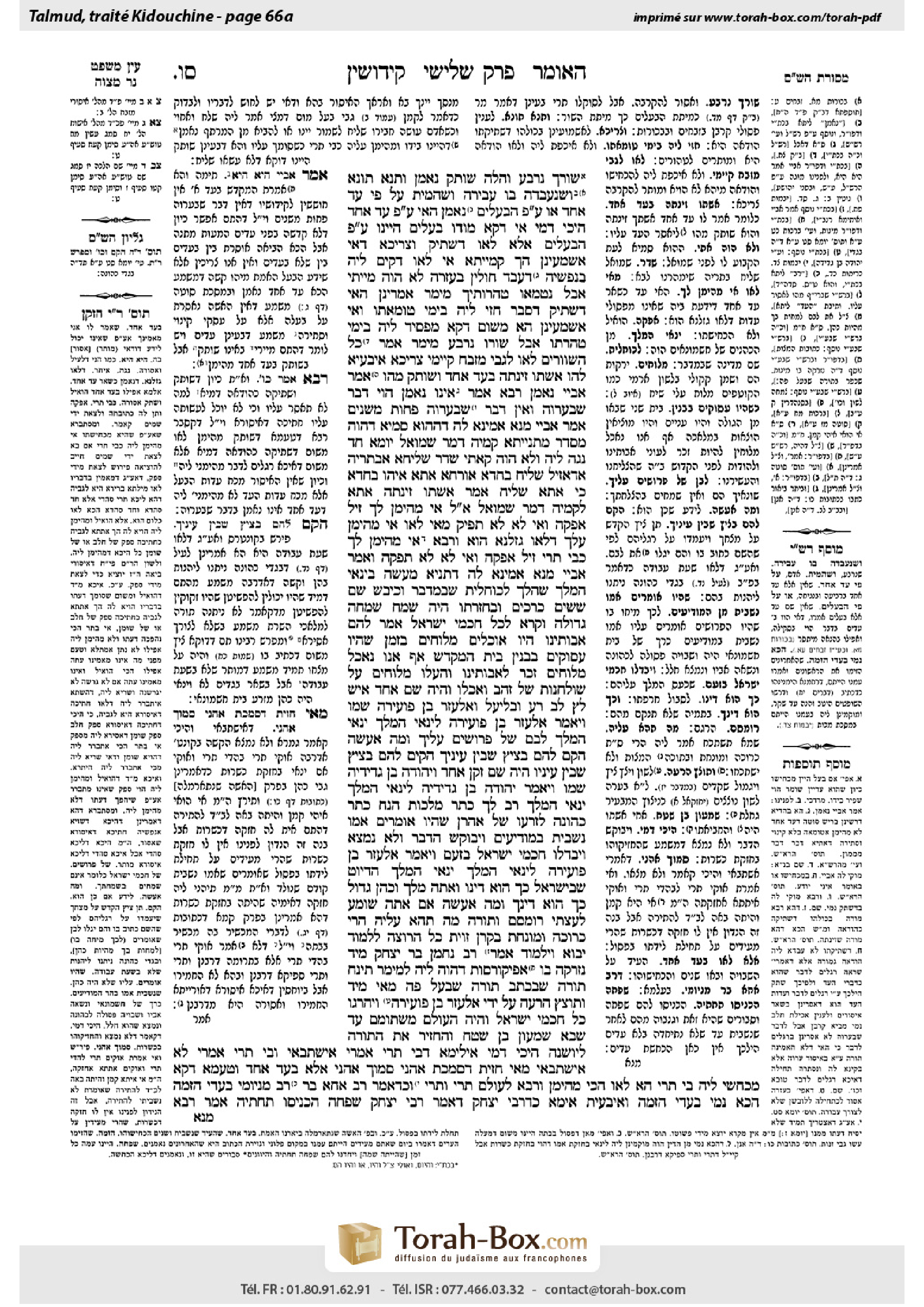
Kiddushin 66a: Talmud study for Daf Yomi
Daf Yomi is the daily study of one Talmud folio. Explore 37 tractates with scans, Hebrew text, Sefaria English and AI-generated French translations where annotated.
Passage selection and English or AI-generated French translation are available where the scan has annotations. Daf Study is independent of Torah-Box and Sefaria.
Browse Kiddushin · קידושין · All tractatesKiddushin 66a text and translations
This page of Kiddushin includes the Aramaic text, an English translation and an AI-generated French translation, alongside the scan above.
קידושין ס״ו א · Aramaic and Hebrew text
״שׁוֹרְךָ נִרְבַּע״ וְהַלָּה שׁוֹתֵק – נֶאֱמָן, וְתַנָּא תּוּנָא: וְשֶׁנֶּעֶבְדָה בּוֹ עֲבֵירָה, וְשֶׁהֵמִית עַל פִּי עֵד אֶחָד אוֹ עַל פִּי הַבְּעָלִים – נֶאֱמָן. הַאי ״עַל פִּי עֵד אֶחָד״, הֵיכִי דָמֵי? אִי דְּקָא מוֹדוּ בְּעָלִים, הַיְינוּ ״עַל פִּי הַבְּעָלִים״, אֶלָּא לָאו דְּשָׁתֵיק?
וּצְרִיכָא, דְּאִי אַשְׁמְעִינַן הָךְ קַמַּיְיתָא, אִי לָאו דְּקִים לֵיהּ בְּנַפְשֵׁיהּ דַּעֲבַד – חוּלִּין בַּעֲזָרָה לָא הֲוָה מַיְיתֵי.
אֲבָל ״נִטְמְאוּ טׇהֳרוֹתֶיךָ״ – מֵימָר אָמְרִינַן: הַאי דְּשָׁתֵיק – דְּסָבַר, חֲזֵי לֵיהּ בִּימֵי טוּמְאָתוֹ.
וְאִי אַשְׁמְעִינַן הָא, מִשּׁוּם דְּקָא מַפְסֵיד לֵיהּ בִּימֵי טׇהֳרָתוֹ, אֲבָל ״שׁוֹרוֹ נִרְבַּע״ מֵימָר אָמַר: כֹּל השְׁווֹרִים לָאו לְגַבֵּי מִזְבֵּחַ קָיְימִי, צְרִיכָא.
אִיבַּעְיָא לְהוּ: אִשְׁתּוֹ זִינְּתָה בְּעַד אֶחָד וְשׁוֹתֵק, מַהוּ? אָמַר אַבָּיֵי: נֶאֱמָן. רָבָא אָמַר: אֵינוֹ נֶאֱמָן. הָוֵי דָּבָר שֶׁבְּעֶרְוָה, וְאֵין דָּבָר שֶׁבְּעֶרְוָה פָּחוֹת מִשְּׁנַיִם.
אָמַר אַבָּיֵי: מְנָא אָמֵינָא לַהּ, דְּהָהוּא סַמְיָא דַּהֲוָה מְסַדַּר מַתְנְיָיתָא קַמֵּיהּ דְּמָר שְׁמוּאֵל. יוֹמָא חַד נְגַהּ לֵיהּ וְלָא הֲוָה קָאָתֵי. שַׁדַּר שְׁלִיחָא אַבָּתְרֵיהּ. אַדְּאָזֵיל שְׁלִיחַ בַּחֲדָא אוֹרְחָא, אֲתָא אִיהוּ בַּחֲדָא. כִּי אֲתָא שָׁלִיחַ, אָמַר: אִשְׁתּוֹ זִינְּתָה. אֲתָא לְקַמֵּיהּ דְּמָר שְׁמוּאֵל, אֲמַר לֵיהּ: אִי מְהֵימַן לָךְ – זִיל אַפְּקַהּ, וְאִי לָא – לָא תַּפֵּיק.
מַאי לָאו אִי מְהֵימַן עֲלָךְ דְּלָאו גַּזְלָנָא הוּא? וְרָבָא: אִי מְהֵימַן לָךְ כְּבֵי תְרֵי – זִיל אַפְּקַהּ, וְאִי לָא – לָא תַּפְּקַהּ.
וְאָמַר אַבָּיֵי: מְנָא אָמֵינָא לַהּ, דְּתַנְיָא: מַעֲשֶׂה בִּינַאי הַמֶּלֶךְ שֶׁהָלַךְ לְכוּחְלִית שֶׁבַּמִּדְבָּר, וְכִיבֵּשׁ שָׁם שִׁשִּׁים כְּרַכִּים, וּבַחֲזָרָתוֹ הָיָה שָׂמֵחַ שִׂמְחָה גְּדוֹלָה. וְקָרָא לְכׇל חַכְמֵי יִשְׂרָאֵל, אָמַר לָהֶם: אֲבוֹתֵינוּ הָיוּ אוֹכְלִים מְלוּחִים בִּזְמַן שֶׁהָיוּ עֲסוּקִים בְּבִנְיַן בֵּית הַמִּקְדָּשׁ, אַף אָנוּ נֹאכַל מְלוּחִים זֵכֶר לַאֲבוֹתֵינוּ. וְהֶעֱלוּ מְלוּחִים עַל שׁוּלְחָנוֹת שֶׁל זָהָב, וְאָכְלוּ.
וְהָיָה שָׁם אֶחָד, אִישׁ לֵץ לֵב רַע וּבְלִיַּעַל, וְאֶלְעָזָר בֶּן פּוֹעֵירָה שְׁמוֹ. וַיֹּאמֶר אֶלְעָזָר בֶּן פּוֹעֵירָה לְיַנַּאי הַמֶּלֶךְ: יַנַּאי הַמֶּלֶךְ, לִבָּם שֶׁל פְּרוּשִׁים עָלֶיךָ. וּמָה אֶעֱשֶׂה? הָקֵם לָהֶם בַּצִּיץ שֶׁבֵּין עֵינֶיךָ. הֵקִים לָהֶם בַּצִּיץ שֶׁבֵּין עֵינָיו.
הָיָה שָׁם זָקֵן אֶחָד וִיהוּדָה בֶּן גְּדִידְיָה שְׁמוֹ, וַיֹּאמֶר יְהוּדָה בֶּן גְּדִידְיָה לְיַנַּאי הַמֶּלֶךְ: יַנַּאי הַמֶּלֶךְ! רַב לְךָ כֶּתֶר מַלְכוּת, הַנַּח כֶּתֶר כְּהוּנָּה לְזַרְעוֹ שֶׁל אַהֲרֹן. שֶׁהָיוּ אוֹמְרִים: אִמּוֹ נִשְׁבֵּית בְּמוֹדִיעִים. וַיְבוּקַּשׁ הַדָּבָר וְלֹא נִמְצָא. וַיִּבָּדְלוּ חַכְמֵי יִשְׂרָאֵל בְּזַעַם.
וַיֹּאמֶר אֶלְעָזָר בֶּן פּוֹעֵירָה לְיַנַּאי הַמֶּלֶךְ: יַנַּאי הַמֶּלֶךְ, הֶדְיוֹט שֶׁבְּיִשְׂרָאֵל כָּךְ הוּא דִּינוֹ, וְאַתָּה מֶלֶךְ וְכֹהֵן גָּדוֹל כָּךְ הוּא דִּינָךְ? וּמָה אֶעֱשֶׂה? אִם אַתָּה שׁוֹמֵעַ לַעֲצָתִי: רוֹמְסֵם. וְתוֹרָה מָה תְּהֵא עָלֶיהָ? הֲרֵי כְּרוּכָה וּמוּנַּחַת בְּקֶרֶן זָוִית, כָּל הָרוֹצֶה לִלְמוֹד יָבוֹא וְיִלְמוֹד.
אָמַר רַב נַחְמָן בַּר יִצְחָק: מִיָּד נִזְרְקָה בּוֹ מִינוּת, דַּהֲוָה לֵיהּ לְמֵימַר: תִּינַח תּוֹרָה שֶׁבִּכְתָב, תּוֹרָה שֶׁבְּעַל פֶּה מַאי? מִיָּד: וַתּוּצַץ הָרָעָה עַל יְדֵי אֶלְעָזָר בֶּן פּוֹעֵירָה, וַיֵּהָרְגוּ כׇּל חַכְמֵי יִשְׂרָאֵל, וְהָיָה הָעוֹלָם מִשְׁתּוֹמֵם, עַד שֶׁבָּא שִׁמְעוֹן בֶּן שָׁטַח וְהֶחְזִיר אֶת הַתּוֹרָה לְיוֹשְׁנָהּ.
הֵיכִי דָמֵי? אִילֵּימָא דְּבֵי תְרֵי אָמְרִי: ״אִישְׁתְּבַאי״ וּבֵי תְרֵי אָמְרִי: ״לָא אִישְׁתְּבַאי״ – מַאי חָזֵית דְּסָמְכַתְּ אַהָנֵי, סְמוֹךְ אַהָנֵי!
אֶלָּא בְּעֵד אֶחָד, וְטַעְמָא דְּקָא מַכְחֲשִׁי לֵיהּ בֵּי תְרֵי, הָא לָאו הָכִי מְהֵימַן.
וְרָבָא: לְעוֹלָם תְּרֵי וּתְרֵי, וְכִדְאָמַר רַב אַחָא בַּר רַב מִנְיוֹמֵי: בְּעֵדֵי הֲזָמָה. הָכָא נָמֵי, בְּעֵדֵי הֲזָמָה.
וְאִיבָּעֵית אֵימָא כִּדְרַבִּי יִצְחָק, דְּאָמַר רַבִּי יִצְחָק: שִׁפְחָה הִכְנִיסוּ תַּחְתֶּיהָ.
אָמַר רָבָא:
Kiddushin 66a · English translation
Your ox was used by a man for an act of bestiality and is therefore unfit for an offering, and the other, the owner of the ox, is silent, the witness is deemed credible. And the tanna of the mishna also taught (Bekhorot 41a): And with regard to an animal that was used for a transgression or that killed, if this is attested to by one witness or by the owner, he is deemed credible. The Gemara clarifies this case: What are the circumstances of this case of the mishna, where the knowledge is established by one witness? If the owner admits to the claim, this is the same as: By the owner. Rather, is it not referring to a case where the owner remains silent?
The Gemara comments: And each of these statements of Abaye is necessary. As, had he taught us only that first case, where the witness said someone ate forbidden fat, one might have said that he is deemed credible for the following reason: Were it not for the fact that he himself was convinced that he had committed a transgression, he would not commit the transgression of bringing a non-sacred animal to the Temple courtyard on the basis of the testimony of one witness. Consequently, his silence is evidently an admission.
But if the witness said: Your ritually pure foods were rendered ritually impure, and the accused was silent, we would say: The reason that he is silent and refrains from denying the claim is that he thinks he is not suffering any significant loss, as the food is fit for him to eat on his days of ritual impurity, because he is not required to destroy ritually impure foods.
And had Abaye taught us only the case of: Your ritually pure food was rendered ritually impure, one might have said that the reason this witness is deemed credible is that he causes him a loss on his days of ritual purity, and therefore his silence is tantamount to a confession. But in the case of: His ox was used by a man for an act of bestiality, the owner of the ox can say with regard to his animal: Not all the oxen stand ready to be sacrificed as an offering on the altar. Perhaps one would think that the owner does not bother denying the claim because he merely forfeits the possibility of sacrificing his ox as an offering, which he considers an inconsequential matter. It is only if there were two witnesses to the act that the animal is put to death, whereas here there was only one witness. It is therefore necessary for Abaye to specify all these cases.
§ A dilemma was raised before the Sages: If a husband is told by one witness that his wife committed adultery, and the husband remains silent, what is the halakha? Abaye said: The witness is deemed credible. Rava said: He is not deemed credible. Why not? Because it is a matter involving forbidden relations, and there is no matter of testimony for forbidden sexual relations that can be attested to by fewer than two witnesses.
Abaye said: From where do I say this claim of mine? It happened that there was a certain blind man who would review mishnayot before Mar Shmuel. One day the blind man was late for him and was not arriving. Mar Shmuel sent a messenger after him to assist him. While the messenger was going to the blind man’s house by one way, the blind man arrived at the house of study by a different route, and therefore the messenger missed him and reached his house. When the messenger came back, he said that he had been to the blind man’s house and saw that his wife committed adultery. The blind man came before Mar Shmuel to inquire whether he must pay heed to this testimony. Mar Shmuel said to him: If this messenger is trusted by you, go and divorce her, but if not, do not divorce her.
Abaye comments: What, is it not correct to say that this means that if he is trusted by you that he is not a thief but is a valid witness, you must rely on him? This would prove that a single witness can testify in a case of this kind. And Rava explains that Mar Shmuel meant: If he is trusted by you like two witnesses, go and divorce her, but if not, do not divorce her. Consequently, Rava maintains that this episode affords no proof.
And Abaye said: From where do I say this claim of mine? As it is taught in a baraita: An incident occurred with King Yannai, who went to the region of Koḥalit in the desert and conquered sixty cities there. And upon his return he rejoiced with a great happiness over his victory. And he subsequently summoned all the Sages of the Jewish people and said to them: Our ancestors in their poverty would eat salty foods when they were busy with the building of the Temple; we too shall eat salty foods in memory of our ancestors. And they brought salty food on tables of gold, and ate.
And there was one person present, a scoffer, a man of an evil heart and a scoundrel called Elazar ben Po’ira. And Elazar ben Po’ira said to King Yannai: King Yannai, the hearts of the Pharisees, the Sages, are against you. In other words, they harbor secret resentment against you and do not like you. The king replied: And what shall I do to clarify this matter? Elazar responded: Have them stand by wearing the frontplate between your eyes. Since the frontplate bears the Divine Name, they should stand in its honor. Yannai, who was a member of the priestly Hasmonean family, also served as High Priest, who wears the frontplate. He had the Pharisees stand by wearing the frontplate between his eyes.
Now there was a certain elder present called Yehuda ben Gedidya, and Yehuda ben Gedidya said to King Yannai: King Yannai, the crown of the monarchy suffices for you, i.e., you should be satisfied that you are king. Leave the crown of the priesthood for the descendants of Aaron. The Gemara explains this last comment: As they would say that Yannai’s mother was taken captive in Modi’in, and she was therefore disqualified from marrying into the priesthood, which meant that Yannai was a ḥalal. And the matter was investigated and was not discovered, i.e., they sought witnesses for that event but none were found. And the Sages of Israel were expelled in the king’s rage, due to this rumor.
And Elazar ben Po’ira said to King Yannai: King Yannai, such is the judgment of a common person in Israel. In other words, merely expelling a slanderer is appropriate if the subject of the slander is a commoner. But you are a king and a High Priest. Is this your judgment as well? Yannai replied: And what should I do? Elazar responded: If you listen to my advice, crush them. Yannai countered: But what will become of the Torah? He retorted: Behold, it is wrapped and placed in the corner. Anyone who wishes to study can come and study. We have no need for the Sages.
The Gemara interjects: Rav Naḥman bar Yitzḥak says: Immediately, heresy was injected into Yannai, as he should have said to Elazar ben Po’ira: This works out well with regard to the Written Torah, as it can be studied by all on their own, but what will become of the Oral Torah? The Oral Torah is transmitted only by the Sages. The baraita continues: Immediately, the evil arose and caught fire through Elazar ben Po’ira, and all the Sages of the Jewish people were killed. And the world was desolate of Torah until Shimon ben Shataḥ came and restored the Torah to its former glory. This completes the baraita.
Abaye asks: What are the circumstances of this case? How did those who conducted the investigation refute the rumor that Yannai’s mother had been taken captive? If we say that two witnesses said that she was taken captive, and two others said that she was not taken captive, what did you see that you rely on these who said that she was not taken captive? Instead, rely on these who said that she was taken captive. In such a scenario, one cannot say definitively that the matter was investigated and found to be false.
Rather, it must be referring to one witness who testified she was taken captive, and two testified that she was not taken captive. And the reason that the lone witness is not deemed credible is only that he is contradicted by the other two, from which it may be inferred that if not for that fact, he would be deemed credible. This supports Abaye’s claim that an uncontested lone witness is deemed credible in a case of this kind.
And Rava could reply that this incident affords no proof, for the following reason: Actually, one can say that there were two witnesses who testified that she was captured and two who testified that she was not, and the case was decided in accordance with that which Rav Aḥa bar Rav Minyumi says in a different context, that it is referring to conspiring witnesses. The second pair of witnesses did not contradict the testimony of the first pair but established them as liars by stating that the first pair were not there to witness the event. This serves to disqualify the testimony of the first pair altogether. Here too, it is referring to witnesses who rendered the first set conspiring witnesses.
And if you wish, say that this is in accordance with the version of the story stated by Rabbi Yitzḥak, as Rabbi Yitzḥak says: They replaced Yannai’s mother with a maidservant. The first witnesses saw that Yannai’s mother was about to be taken captive, but the second pair revealed that she had actually been replaced with a maidservant, thereby negating the testimony of the first set.
Rava says:
Kiddushin 66a · Traduction française (IA)
Ton bœuf a été utilisé par un homme pour un acte de bestialité et est donc inapte à être offert en sacrifice, et l'autre, le propriétaire du bœuf, se tait, le témoin est considéré comme crédible. Et le tanna de la Michna a également enseigné (Béhorot 41a) : Et concernant un animal qui a été utilisé pour une transgression ou qui a tué, si cela est attesté par un seul témoin ou par le propriétaire, il est considéré comme crédible. La Guemara clarifie ce cas : Quelles sont les circonstances de ce cas de la Michna, où la connaissance est établie par un seul témoin ? Si le propriétaire admet la réclamation, cela revient à dire : Par le propriétaire. Plutôt, ne fait-il pas référence à un cas où le propriétaire reste silencieux ?
La Guemara commente : Et chacune de ces déclarations d'Abaye est nécessaire. Car, s'il ne nous avait enseigné que ce premier cas, où le témoin a dit que quelqu'un a mangé de la graisse interdite, on aurait pu dire qu'il est considéré comme crédible pour la raison suivante : N'était le fait qu'il était lui-même convaincu d'avoir commis une transgression, il n'aurait pas commis la transgression d'amener un animal non sacré dans la cour du Temple sur la base du témoignage d'un seul témoin. En conséquence, son silence est manifestement une admission.
Mais si le témoin a dit : Vos aliments rituellement purs ont été rendus rituellement impurs, et l'accusé est resté silencieux, nous dirions : La raison pour laquelle il se tait et s'abstient de nier la réclamation est qu'il pense ne subir aucune perte significative, car l'aliment est apte à être mangé par lui pendant ses jours de rituelle impureté, car il n'est pas tenu de détruire les aliments rituellement impurs.
Et si Abaye ne nous avait enseigné que le cas de : « Votre aliment rituellement pur a été rendu rituellement impur », on aurait pu dire que la raison pour laquelle ce témoin est considéré comme crédible est qu'il lui cause une perte pendant ses jours de pureté rituelle, et par conséquent son silence équivaut à une confession. Mais dans le cas de : « Son bœuf a été utilisé par un homme pour un acte de bestialité », le propriétaire du bœuf peut dire à propos de son animal : « Tous les bœufs ne sont pas prêts à être sacrifiés en offrande sur l'autel. » Peut-être pourrait-on penser que le propriétaire ne se donne pas la peine de nier la réclamation parce qu'il perd simplement la possibilité de sacrifier son bœuf en offrande, ce qu'il considère comme une affaire mineure. Ce n'est que s'il y avait deux témoins de l'acte que l'animal serait mis à mort, alors qu'ici il n'y avait qu'un seul témoin. Il est donc nécessaire qu'Abaye précise tous ces cas.
§ Un dilemme a été soulevé devant les Sages : Si un mari est informé par un seul témoin que sa femme a commis l'adultère, et que le mari reste silencieux, quelle est la halakha ? Abaye a dit : Le témoin est considéré comme crédible. Rava a dit : Il n'est pas considéré comme crédible. Pourquoi pas ? Parce qu'il s'agit d'une affaire impliquant des relations interdites, et il n'y a pas d'affaire de témoignage pour les relations sexuelles interdites qui puisse être attestée par moins de deux témoins.
Abaye a dit : D'où tire-je cette affirmation ? Il est arrivé qu'un certain homme aveugle révisait des Michna devant Mar Shmuel. Un jour, l'homme aveugle était en retard et ne se présentait pas. Mar Shmuel envoya un messager à sa rencontre pour l'assister. Pendant que le messager se rendait à la maison de l'homme aveugle par un chemin, l'homme aveugle arriva à la maison d'étude par une autre route, si bien que le messager ne le croisa pas et atteignit sa maison. Lorsque le messager revint, il déclara qu'il s'était rendu à la maison de l'homme aveugle et avait vu sa femme commettre l'adultère. L'homme aveugle se présenta devant Mar Shmuel pour demander s'il devait tenir compte de ce témoignage. Mar Shmuel lui dit : Si ce messager est digne de confiance à tes yeux, va et divorce-la ; mais si ce n'est pas le cas, ne la divorce pas.
Abaye commente : Quoi, n'est-il pas correct de dire que cela signifie que s'il est digne de confiance à tes yeux en ce qu'il n'est pas un voleur mais un témoin valide, tu dois t'appuyer sur lui ? Cela prouverait qu'un seul témoin peut témoigner dans un cas de ce genre. Et Rava explique que Mar Shmuel voulait dire : S'il est digne de confiance à tes yeux comme deux témoins, va et divorce-la ; mais si ce n'est pas le cas, ne la divorce pas. En conséquence, Rava soutient que cet épisode ne fournit aucune preuve.
Et Abaye a dit : D'où tire-je cette affirmation ? Comme il est enseigné dans une baraïta : Un incident s'est produit avec le roi Yannai, qui s'était rendu dans la région de Koḥalit dans le désert et y avait conquis soixante villes. Et à son retour, il se réjouit d'une grande joie de sa victoire. Et il convoqua ensuite tous les Sages du peuple juif et leur dit : Nos ancêtres, dans leur pauvreté, mangeaient des aliments salés lorsqu'ils étaient occupés à la construction du Temple ; nous aussi, mangerons des aliments salés en mémoire de nos ancêtres. Et ils apportèrent des aliments salés sur des tables d'or, et mangèrent.
Et il y avait une personne présente, un moqueur, un homme au cœur mauvais et un scélérat appelé Elazar ben Po’ira. Et Elazar ben Po’ira a dit au roi Yannai : « Roi Yannai, les cœurs des Pharisiens, les Sages, sont contre toi. En d'autres termes, ils nourrissent une rancune secrète contre toi et ne t'aiment pas. » Le roi a répondu : « Et que dois-je faire pour clarifier cette affaire ? » Elazar a répondu : « Fais-les se tenir debout en portant le pectoral entre tes yeux. Puisque le pectoral porte le Nom Divin, ils devraient se tenir debout en son honneur. » Yannai, qui était un membre de la famille sacerdotale hasmonéenne, servait également comme Grand Prêtre, qui porte le pectoral. Il a fait se tenir les Pharisiens debout en portant le pectoral entre ses yeux.
Or, il y avait un certain doyen présent appelé Yehuda ben Gedidya, et Yehuda ben Gedidya a dit au roi Yannai : « Roi Yannai, la couronne de la monarchie te suffit, c'est-à-dire, tu devrais être satisfait d'être roi. Laisse la couronne du sacerdoce aux descendants d'Aaron. » La Guemara explique ce dernier commentaire : Comme ils disaient que la mère de Yannai avait été prise captive à Modi'in, et qu'elle était donc disqualifiée pour se marier dans le sacerdoce, ce qui signifiait que Yannai était un ḥalal. Et l'affaire a été investiguée et n'a pas été découverte, c'est-à-dire, ils ont cherché des témoins pour cet événement mais aucun n'a été trouvé. Et les Sages d'Israël ont été expulsés dans la colère du roi, à cause de ce bruit.
Et Elazar ben Po’ira a dit au roi Yannai : « Roi Yannai, tel est le jugement rendu à l'égard d'un simple particulier en Israël. Autrement dit, il est approprié de simplement expulser un calomniateur si la personne calomniée est un simple particulier. Mais vous êtes roi et Grand Prêtre. Est-ce aussi votre jugement ? » Yannai a répondu : « Et que devrais-je faire ? » Elazar a répliqué : « Si vous écoutez mon conseil, écrasez-les. » Yannai a objecté : « Mais que deviendra la Torah ? » Il a rétorqué : « Voici, elle est enveloppée et placée dans un coin. Quiconque souhaite l'étudier peut venir l'étudier. Nous n'avons pas besoin des Sages. »
La Guemara interrompt : Rav Naḥman bar Yitzḥak dit : Immédiatement, l'hérésie fut injectée en Yannai, car il aurait dû dire à Elazar ben Po'ira : « Cela fonctionne bien pour la Torah écrite, car elle peut être étudiée par tous par leurs propres moyens, mais que deviendra la Torah orale ? La Torah orale n'est transmise que par les Sages. » La baraïta continue : « Immédiatement, le mal s'éleva et prit feu par l'intermédiaire d'Elazar ben Po'ira, et tous les Sages du peuple juif furent tués. Et le monde fut désolé de Torah jusqu'à ce que Shimon ben Shataḥ vienne et restaure la Torah à sa gloire d'antan. » Cela complète la baraïta.
Abaye demande : Quelles sont les circonstances de cette affaire ? Comment ceux qui ont mené l'enquête ont-ils réfuté le bruit selon lequel la mère de Yannai avait été prise captive ? Si nous disons que deux témoins ont dit qu'elle avait été prise captive, et que deux autres ont dit qu'elle ne l'avait pas été, que voyez-vous qui vous amène à vous fier à ceux qui ont dit qu'elle n'avait pas été prise captive ? Au contraire, fiez-vous à ceux qui ont dit qu'elle avait été prise captive. Dans un tel scénario, on ne peut pas affirmer catégoriquement que l'affaire a été enquêtée et jugée fausse.
Plutôt, il doit s'agir d'un seul témoin qui a témoigné qu'elle avait été prise captive, et de deux qui ont témoigné qu'elle ne l'avait pas été. Et la raison pour laquelle le témoin isolé n'est pas considéré comme crédible est uniquement qu'il est contredit par les deux autres, d'où l'on peut déduire que, sans ce fait, il serait considéré comme crédible. Cela soutient l'affirmation d'Abaye selon laquelle un témoin isolé non contesté est considéré comme crédible dans une affaire de ce type.
Et Rava pourrait répondre que cet incident ne constitue aucune preuve, pour la raison suivante : En réalité, on peut dire qu'il y avait deux témoins qui ont témoigné qu'elle avait été capturée et deux qui ont témoigné qu'elle ne l'avait pas été, et que l'affaire a été tranchée conformément à ce que Rav Aḥa bar Rav Minyumi dit dans un autre contexte, à savoir qu'il s'agit de témoins conspirateurs. La seconde paire de témoins n'a pas contredit le témoignage de la première paire, mais les a établis comme menteurs en déclarant que la première paire n'était pas présente pour assister à l'événement. Cela sert à disqualifier entièrement le témoignage de la première paire. Ici aussi, il s'agit de témoins qui ont rendu la première série de témoins conspirateurs.
Et si vous le souhaitez, dites que c'est conformément à la version de l'histoire rapportée par Rabbi Yitzḥak, car Rabbi Yitzḥak dit : « Ils ont remplacé la mère de Yannai par une servante. » Les premiers témoins ont vu que la mère de Yannai allait être prise captive, mais la seconde paire a révélé qu'elle avait en réalité été remplacée par une servante, annulant ainsi le témoignage de la première série.
Rava dit :
Traduction française générée par IA à partir de l’édition anglaise de Sefaria. Vérifie toujours un passage avec le texte source.
Text from Sefaria: William Davidson Edition - Vocalized Aramaic (CC BY NC); William Davidson Edition - English (CC BY NC).