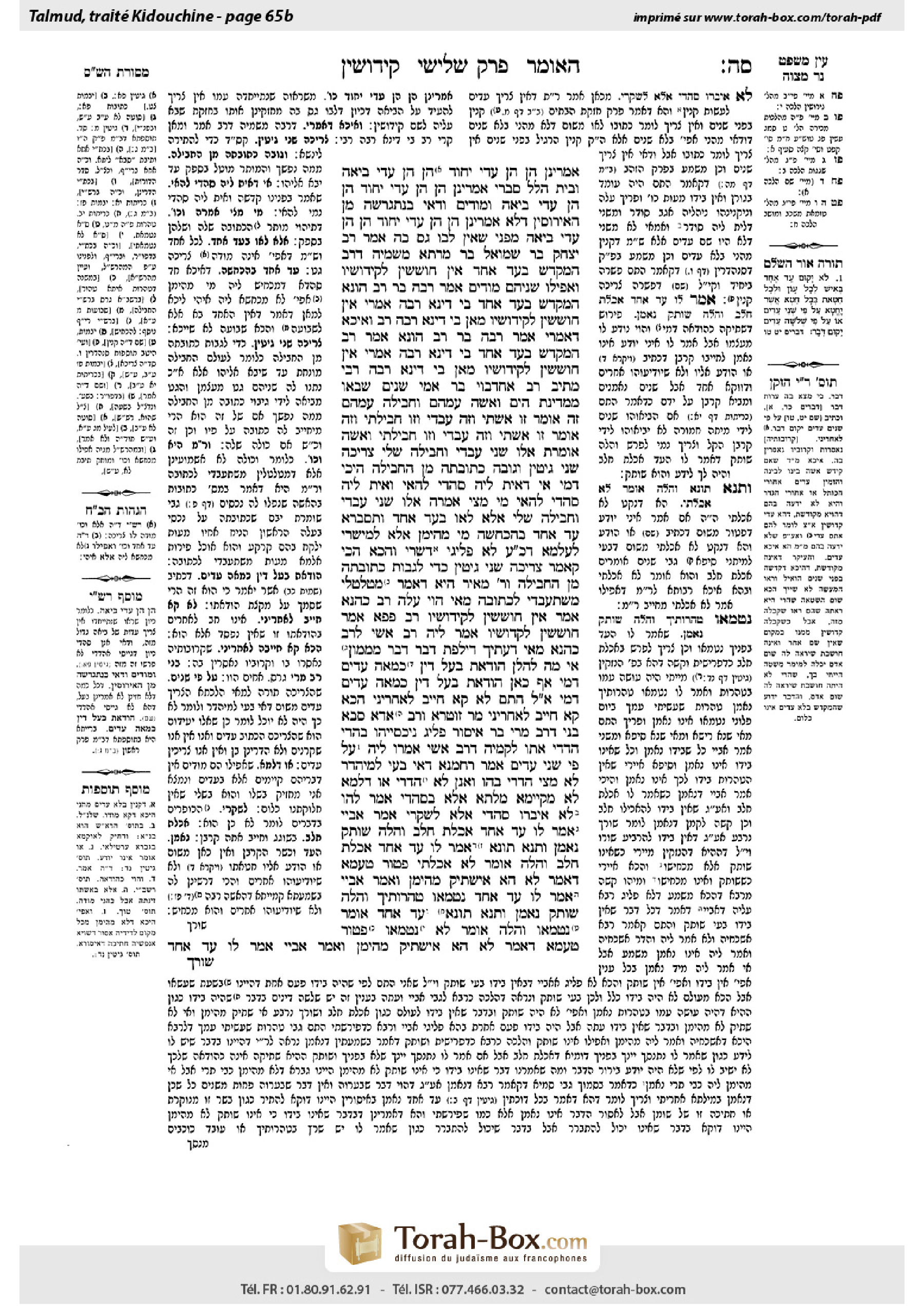
Kiddushin 65b: Talmud study for Daf Yomi
Daf Yomi is the daily study of one Talmud folio. Explore 37 tractates with scans, Hebrew text, Sefaria English and AI-generated French translations where annotated.
Passage selection and English or AI-generated French translation are available where the scan has annotations. Daf Study is independent of Torah-Box and Sefaria.
Browse Kiddushin · קידושין · All tractatesKiddushin 65b text and translations
This page of Kiddushin includes the Aramaic text, an English translation and an AI-generated French translation, alongside the scan above.
קידושין ס״ה ב · Aramaic and Hebrew text
אָמְרִינַן הֵן הֵן עֵדֵי יִחוּד, הֵן הֵן עֵדֵי בִיאָה. וּבֵית הִלֵּל סָבְרִי: אָמְרִינַן הֵן הֵן עֵדֵי יִחוּד, הֵן הֵן עֵדֵי בִיאָה. וּמוֹדִים וַדַּאי בְּנִתְגָּרְשָׁה מִן הָאֵירוּסִין, דְּלָא אָמְרִינַן הֵן הֵן עֵדֵי יִחוּד הֵן הֵן עֵדֵי בִיאָה, מִפְּנֵי שֶׁאֵין לִבּוֹ גַּס בָּהּ.
אָמַר רַב יִצְחָק בַּר שְׁמוּאֵל בַּר מָרְתָא מִשְּׁמֵיהּ דְרַב: הַמְקַדֵּשׁ בְּעֵד אֶחָד – אֵין חוֹשְׁשִׁין לְקִידּוּשָׁיו, וַאֲפִילּוּ שְׁנֵיהֶם מוֹדִים. אָמַר רַבָּה בַּר רַב הוּנָא: הַמְקַדֵּשׁ בְּעֵד אֶחָד, בֵּי דִינָא רַבָּה אָמְרִי: אֵין חוֹשְׁשִׁין לְקִידּוּשָׁיו. מַאן בֵּי דִינָא רַבָּה? רַב. וְאִיכָּא דְּאָמְרִי: אָמַר רַבָּה בַּר רַב הוּנָא אָמַר רַב. הַמְקַדֵּשׁ בְּעֵד אֶחָד, בֵּי דִינָא רַבָּה אָמְרִי: אֵין חוֹשְׁשִׁין לְקִידּוּשָׁיו. מַאן בֵּי דִינָא רַבָּה – רַבִּי.
מֵתִיב רַב אַחָדְבוּי בַּר אַמֵּי: שְׁנַיִם שֶׁבָּאוּ מִמְּדִינַת הַיָּם וְאִשָּׁה עִמָּהֶם וַחֲבִילָה עִמָּהֶם, זֶה אוֹמֵר: זוֹ אִשְׁתִּי, וְזֶה עַבְדִּי, וְזוֹ חֲבִילָתִי, וְזֶה אוֹמֵר: זוֹ אִשְׁתִּי, וְזֶה עַבְדִּי, וְזוֹ חֲבִילָתִי. וְאִשָּׁה אוֹמֶרֶת: אֵלּוּ שְׁנֵי עֲבָדַי, וַחֲבִילָה שֶׁלִּי – צְרִיכָה שְׁנֵי גִיטִּין, וְגוֹבָה כְּתוּבָּתָהּ מִן הַחֲבִילָה.
הֵיכִי דָמֵי? אִי דְּאִית לֵיהּ סָהֲדֵי לְהַאי וְאִית לֵיהּ סָהֲדֵי לְהַאי, מִי מָצְיָ[א] אַמְרַהּ: אֵלּוּ שְׁנֵי עֲבָדַי וַחֲבִילָה שֶׁלִּי? אֶלָּא לָאו בְּעֵד אֶחָד!
וְתִסְבְּרַאּ? עֵד אֶחָד בְּהַכְחָשָׁה מִי מְהֵימַן? אֶלָּא: לְמִישְׁרֵי לְעָלְמָא, דְּכוּלֵּי עָלְמָא לָא פְּלִיגִי דִּשְׁרֵי,
וְהָכָא הָכִי קָאָמַר: צְרִיכָה שְׁנֵי גִיטִּין – כְּדֵי לִגְבּוֹת כְּתוּבָּתָהּ מִן הַחֲבִילָה. וְרַבִּי מֵאִיר הִיא, דְּאָמַר מִטַּלְטְלֵי מִשְׁתַּעְבְּדִי לִכְתוּבָּה.
מַאי הָוֵי עֲלַהּ? רַב כָּהֲנָא אָמַר: אֵין חוֹשְׁשִׁין לְקִידּוּשָׁיו. רַב פָּפָּא אָמַר: חוֹשְׁשִׁין לְקִדּוּשָׁיו. אֲמַר לֵיהּ רַב אָשֵׁי לְרַב כָּהֲנָא: מַאי דַּעְתָּיךְ – דְּיָלְפַתְּ ״דָּבָר״ ״דָּבָר״ מִמָּמוֹן?
אִי מָה לְהַלָּן הוֹדָאַת בַּעַל דִּין כְּמֵאָה עֵדִים דָּמֵי, אַף כָּאן הוֹדָאַת בַּעַל דִּין כְּמֵאָה עֵדִים דָּמֵי. אֲמַר לֵיהּ: הָתָם לָא קָא חָיֵיב לְאַחֲרִינֵי, הָכָא קָא חָיֵיב לְאַחֲרִינֵי.
מָר זוּטְרָא וְרַב אַדָּא סָבָא בְּנֵי דְּרַב מָרִי בַּר אִיסּוּר פְּלוּג נִיכְסַיְיהוּ בַּהֲדֵי הֲדָדֵי. אֲתוֹ לְקַמֵּיהּ דְּרַב אָשֵׁי, אֲמַרוּ לֵיהּ: ״עַל פִּי שְׁנֵי עֵדִים״ אָמַר רַחֲמָנָא, דְּאִי בָּעֵי לְמִיהְדַּר לָא מָצוּ הָדְרִי בְּהוּ, וַאֲנַן לָא הָדְרִי,
אוֹ דִלְמָא לָא מִקַּיְימָא מִלְּתָא אֶלָּא בְּסָהֲדֵי? אֲמַר לְהוּ: לָא אִיבְּרוֹ סָהֲדֵי אֶלָּא לְשַׁקָּרֵי.
אָמַר אַבָּיֵי: אָמַר לוֹ עֵד אֶחָד ״אָכַלְתָּ חֵלֶב״, וְהַלָּה שׁוֹתֵק – נֶאֱמָן. וְתַנָּא תּוּנָא: אָמַר לוֹ עֵד אֶחָד ״אָכַלְתָּ חֵלֶב״ וְהַלָּה אוֹמֵר ״לֹא אָכַלְתִּי״ – פָּטוּר. טַעְמָא דְּאָמַר ״לֹא״, הָא אִישְׁתִּיק – מְהֵימַן.
וְאָמַר אַבָּיֵי: אָמַר לוֹ עֵד אֶחָד ״נִטְמְאוּ טׇהֳרוֹתֶיךָ״, וְהַלָּה שׁוֹתֵק – נֶאֱמָן. וְתַנָּא תּוּנָא: עֵד אֶחָד אוֹמֵר ״נִטְמְאוּ״ וְהַלָּה אוֹמֵר ״לֹא נִטְמְאוּ״ – פָּטוּר. טַעְמָא דְּאָמַר לֹא, הָא אִישְׁתִּיק – מְהֵימַן.
וְאָמַר אַבָּיֵי: אָמַר לוֹ עֵד אֶחָד
Kiddushin 65b · English translation
say: These are the witnesses of seclusion, these are the witnesses of intercourse. According to Beit Shammai, although there are witnesses that they were secluded, this is not considered to be tantamount to testimony that they engaged in intercourse. And Beit Hillel hold: We do say that these are the witnesses of seclusion, these are the witnesses of intercourse. Since it is assumed that they engaged in intercourse, she is required to obtain a second bill of divorce from him. And Beit Hillel concede to Beit Shammai that certainly in the case of a woman divorced from betrothal, that we do not say that these are the witnesses of seclusion, these are the witnesses of intercourse, because he is not accustomed to her.
Rav Yitzḥak bar Shmuel bar Marta says in the name of Rav: With regard to one who betroths a woman with one witness, one need not be concerned that his betrothal has taken effect, and this is the halakha even if the man and woman both concede that there was a betrothal. Rabba bar Rav Huna says: With regard to one who betroths a woman with one witness, the Great Court says that one need not be concerned that his betrothal has taken effect. The Gemara asks: Who is the Great Court? Rav. And there are those who say a different version of this discussion. Rabba bar Rav Huna said that Rav said: With regard to one who betroths a woman with one witness, the Great Court says that one need not be concerned that his betrothal has taken effect. Who is the Great Court? Rabbi Yehuda HaNasi.
Rav Aḥadvoi bar Ami raises an objection from the following baraita: There were two men who came from overseas and a woman was with them, and they had a bundle with them. This man says: This is my wife, and this other man is my slave, and this is my bundle. And this second man says: This is my wife, and this other man is my slave, and this is my bundle. And the woman says: These are my two slaves and this is my bundle. In this case she requires two bills of divorce, as with each of them there is uncertainty concerning whether she is married to him, and she collects payment of her marriage contract from the bundle. Even according to their claims that she is married to one of them, now that they have each divorced her she is at least entitled to payment of her marriage contract from the bundle.
Rav Aḥadvoi’s objection is as follows: What are the circumstances of this case? If the baraita is referring to a case where this man has two witnesses supporting his claim and that man has two witnesses supporting his claim, can the woman say: These are my two slaves, and this is my bundle? After all, there are two witnesses that one of the men is her husband. Rather, is it not referring to a case where each of the men has only one witness? This proves that a betrothal performed in the presence of a single witness is effective, as she requires a bill of divorce from each of them.
The Gemara rejects this opinion: And how can you understand it that way? In a situation involving one witness in the face of contradicting testimony, as in the case here, where another witness claims she is betrothed to the second man, is a single witness deemed credible at all? Rather, one must understand this case as follows: Everyone agrees that with regard to permitting her to marry all other people, she is permitted even without a bill of divorce.
And here, this is what the baraita is saying: She requires two bills of divorce in order to collect payment of her marriage contract from the bundle. And this ruling is in accordance with the opinion of Rabbi Meir, who says: Even movable property, not only land, is subject to a lien for payment of a marriage contract. Consequently, to collect from this bundle, which has three claimants, the woman must receive a bill of divorce from both men, thereby obligating them to give her payment of a marriage contract.
The Gemara asks: What conclusion was reached about the case of one who betroths another in the presence of one witness? Rav Kahana said: One need not be concerned that his betrothal has taken effect. Rav Pappa said: One need be concerned that his betrothal has taken effect. Rav Ashi said to Rav Kahana: What is your opinion that leads you to claim that there is no concern that his betrothal has taken effect? It must be that you derive it by means of a verbal analogy from the word “matter” written with regard to forbidden sexual intercourse and the word matter written with regard to monetary matters. The Torah states concerning one who desires to divorce his wife: “Because he has found some unseemly matter in her” (Deuteronomy 24:1), a reference to adulterous intercourse, and with regard to monetary matters it states: “At the mouths of two witnesses, or at the mouths of three witnesses, shall a matter be established” (Deuteronomy 19:15).
Rav Ashi asks: But if so, just as there, with regard to monetary matters, the legal status of the admission of a litigant is similar to that of one hundred witnesses and it renders him liable, so too here, the admission of a litigant should be similar to that of one hundred witnesses. This would mean that if the man and woman both admit to the betrothal, they should be liable to bear the consequences of this claim. Rav Kahana said to him: There is a difference between the two cases. There, with regard to one who admits that he owes money, he does not act to the detriment of another, whereas here, he acts to the detriment of another, as their confessions render them forbidden to each other’s relatives, which means that their claims affect others as well.
The Gemara relates: Mar Zutra and Rav Adda the Elder, the sons of Rav Mari bar Issur, divided their shared property between them. They came before Rav Ashi and said to him that they had the following dilemma. The Merciful One states: “At the mouths of two witnesses, or at the mouths of three witnesses, shall a matter be established” (Deuteronomy 19:15). Why do we say that two witnesses are required? So that if the parties involved wish to retract from their agreement and say that it never happened, they cannot retract from their agreement. And as we will not retract from our agreement, we do not require witnesses to establish our division of the property.
Or perhaps the matter is established only through witnesses. In other words, perhaps the witnesses do not merely provide proof that the division occurred, but they are a constitutive factor in its establishment from a legal perspective. Rav Ashi said to them: Witnesses were created only for liars, and they are not needed to establish the matter. If no one denies the transaction, it remains in effect.
§ With regard to a related issue, Abaye says: If one witness says to someone: You ate forbidden fat, and that one, the subject of the testimony, remains silent and does not deny it, the witness is deemed credible and the person in question must bring a sin-offering for his sin. And the tanna of the mishna also taught (Karetot 11b): If one witness said to someone: You ate forbidden fat, and that person says: I did not eat it, he is exempt from bringing an offering. One can infer from this that the reason he is exempt is only because he said definitively: I did not eat, which indicates that if he was silent, the witness is deemed credible.
And Abaye says that if one witness says to someone: Your ritually pure food was rendered impure, and that person remained silent, the witness is deemed credible. And the tanna of the mishna also taught (Karetot 12a): If one witness said to someone: Your ritually pure food was rendered impure, and that person says: It was not rendered impure, he is exempt. The reason he is exempt is only because he said definitively that his food was not rendered ritually impure, which indicates that if he was silent, the witness is deemed credible.
And Abaye further says that if one witness says to someone:
Kiddushin 65b · Traduction française (IA)
On peut dire : « Ceux-ci sont les témoins de l’isolement, ceux-ci sont les témoins de la relation sexuelle. » Selon Beit Shammaï, bien qu’il y ait des témoins qu’ils se sont isolés, cela n’équivaut pas à un témoignage attestant qu’ils ont eu une relation sexuelle. Beit Hillel, eux, soutiennent que l’on peut bien dire : « Ceux-ci sont les témoins de l’isolement, ceux-ci sont les témoins de la relation sexuelle. » Puisqu’on présume qu’ils ont eu une relation sexuelle, elle doit obtenir de lui un second acte de divorce. Beit Hillel concède à Beit Shammaï que, dans le cas d’une femme divorcée après ses fiançailles, on ne peut certainement pas dire : « Ceux-ci sont les témoins de l’isolement, ceux-ci sont les témoins de la relation sexuelle », car il n’a pas l’habitude d’être avec elle.
Rav Yitzḥak bar Shmuel bar Marta dit au nom de Rav : Celui qui fiance une femme en présence d’un seul témoin n’a pas à craindre que ses fiançailles aient pris effet ; telle est la halakha même si l’homme et la femme reconnaissent tous deux qu’il y a eu fiançailles. Rabba bar Rav Huna dit : À propos de celui qui fiance une femme en présence d’un seul témoin, la Grande Cour dit qu’il n’y a pas à craindre que ses fiançailles aient pris effet. La Guemara demande : Qui est la Grande Cour ? Rav. Certains rapportent une version différente de cette discussion. Rabba bar Rav Huna a dit au nom de Rav : À propos de celui qui fiance une femme en présence d’un seul témoin, la Grande Cour dit qu’il n’y a pas à craindre que ses fiançailles aient pris effet. Qui est la Grande Cour ? Rabbi Yehouda HaNassi.
Rav Aḥadvoi bar Ami soulève une objection à partir de la baraïta suivante : Deux hommes arrivèrent d’outre-mer avec une femme et un paquet. Le premier dit : « Voici ma femme, cet autre homme est mon esclave et voici mon paquet. » Le second dit : « Voici ma femme, cet autre homme est mon esclave et voici mon paquet. » La femme dit : « Ce sont mes deux esclaves et voici mon paquet. » Dans ce cas, elle a besoin de deux actes de divorce, car il y a, pour chacun des deux hommes, une incertitude quant au fait qu’elle soit mariée à lui ; et elle perçoit le paiement de sa ketouba sur le paquet. Même selon leurs affirmations, puisqu’elle est mariée à l’un d’eux et qu’à présent chacun l’a divorcée, elle a au moins droit au paiement de sa ketouba sur le paquet.
L’objection de Rav Aḥadvoi est la suivante : Dans quelles circonstances se présente ce cas ? Si la baraïta parle d’un cas où cet homme a deux témoins à l’appui de son affirmation et l’autre homme en a deux à l’appui de la sienne, la femme peut-elle dire : « Ce sont mes deux esclaves et voici mon paquet » ? Après tout, deux témoins attestent que l’un des hommes est son mari. Ne s’agit-il pas plutôt d’un cas où chacun des hommes n’a qu’un seul témoin ? Cela prouve que des fiançailles célébrées en présence d’un seul témoin prennent effet, puisqu’elle doit obtenir un acte de divorce de chacun d’eux.
La Guemara rejette cette opinion : Comment peux-tu comprendre les choses ainsi ? Dans une situation où un témoin est contredit par un témoignage contraire, comme dans le cas présent, où un autre témoin affirme qu’elle est fiancée au second homme, un témoin unique est-il seulement considéré comme crédible ? Il faut plutôt comprendre ce cas ainsi : tous conviennent que, pour lui permettre d’épouser toute autre personne, elle est libre même sans acte de divorce.
Et voici ce que dit la baraïta : elle a besoin de deux actes de divorce pour percevoir le paiement de sa ketouba sur le paquet. Cette décision suit l’opinion de Rabbi Meïr, qui dit que les biens mobiliers, et pas seulement les terres, sont grevés d’un privilège garantissant le paiement de la ketouba. Par conséquent, pour percevoir sa créance sur ce paquet, qui fait l’objet de trois revendications, la femme doit recevoir un acte de divorce des deux hommes, ce qui les oblige à lui verser le paiement de sa ketouba.
La Guemara demande : Quelle conclusion a-t-on tirée à propos de celui qui fiance une femme en présence d’un seul témoin ? Rav Kahana dit : Il n’y a pas à craindre que ses fiançailles aient pris effet. Rav Pappa dit : Il faut craindre que ses fiançailles aient pris effet. Rav Ashi dit à Rav Kahana : Quelle est l’opinion qui te conduit à affirmer qu’il n’y a pas lieu de craindre que ses fiançailles aient pris effet ? Tu dois la déduire par une analogie verbale entre le mot « chose », écrit à propos des relations sexuelles interdites, et le mot « chose », écrit à propos des affaires financières. La Torah dit au sujet de celui qui veut divorcer de sa femme : « Parce qu’il a trouvé en elle quelque chose d’inconvenant » (Deutéronome 24,1), ce qui fait référence à une relation adultère ; et, à propos des affaires financières, elle dit : « Une chose sera établie sur la déclaration de deux témoins ou sur la déclaration de trois témoins » (Deutéronome 19,15).
Rav Ashi demande : Mais si tel est le cas, de même que là-bas, dans les affaires financières, l’aveu d’un plaideur a le même statut que celui de cent témoins et le rend passible de paiement, ici aussi, l’aveu d’un plaideur devrait avoir le même statut que celui de cent témoins. Cela signifierait que si l’homme et la femme reconnaissent tous deux les fiançailles, ils devraient en subir les conséquences. Rav Kahana lui dit : Il y a une différence entre les deux cas. Là-bas, celui qui reconnaît devoir de l’argent ne porte pas préjudice à autrui, tandis qu’ici, il porte préjudice à autrui, car leurs aveux leur interdisent les proches parents l’un de l’autre, ce qui signifie que leurs affirmations affectent aussi d’autres personnes.
La Guemara rapporte : Mar Zutra et Rav Adda l’Ancien, fils de Rav Mari bar Issur, partagèrent entre eux les biens qu’ils détenaient en commun. Ils se présentèrent devant Rav Ashi et lui exposèrent leur dilemme : Le Miséricordieux dit : « Une chose sera établie sur la déclaration de deux témoins ou sur la déclaration de trois témoins » (Deutéronome 19,15). Pourquoi dit-on que deux témoins sont nécessaires ? Pour que, si les parties concernées veulent revenir sur leur accord et affirmer que cela n’a jamais eu lieu, elles ne puissent pas revenir sur leur accord. Or, puisque nous ne reviendrons pas sur notre accord, nous n’avons pas besoin de témoins pour établir le partage des biens.
Ou peut-être la chose n’est-elle établie que par des témoins. Autrement dit, peut-être les témoins ne servent-ils pas simplement à prouver que le partage a eu lieu, mais constituent-ils un élément nécessaire à son établissement du point de vue juridique. Rav Ashi leur dit : Les témoins n’ont été institués que pour les menteurs ; ils ne sont pas nécessaires pour établir la chose. Si personne ne nie la transaction, celle-ci reste en vigueur.
§ À propos d’une question connexe, Abayé dit : Si un témoin dit à quelqu’un : « Tu as mangé du suif interdit », et que celui-ci, l’objet du témoignage, garde le silence et ne le nie pas, le témoin est considéré comme crédible et la personne en question doit apporter un sacrifice expiatoire pour sa faute. Le tanna de la Michna a également enseigné (Karetot 11b) : Si un témoin dit à quelqu’un : « Tu as mangé du suif interdit », et que cette personne répond : « Je n’en ai pas mangé », elle est dispensée d’apporter un sacrifice. On peut en déduire que la seule raison de son exemption est qu’elle a déclaré catégoriquement : « Je n’en ai pas mangé », ce qui indique que, si elle était restée silencieuse, le témoin aurait été considéré comme crédible.
Abayé dit aussi que si un témoin dit à quelqu’un : « Tes aliments rituellement purs ont été rendus impurs », et que cette personne garde le silence, le témoin est considéré comme crédible. Le tanna de la Michna a également enseigné (Karetot 12a) : Si un témoin dit à quelqu’un : « Tes aliments rituellement purs ont été rendus impurs », et que cette personne répond : « Ils n’ont pas été rendus impurs », elle est dispensée. La seule raison de son exemption est qu’elle a affirmé catégoriquement que ses aliments n’avaient pas été rendus impurs rituellement, ce qui indique que, si elle était restée silencieuse, le témoin aurait été considéré comme crédible.
Abayé dit encore que si un témoin dit à quelqu’un :
Traduction française générée par IA à partir de l’édition anglaise de Sefaria. Vérifie toujours un passage avec le texte source.
Text from Sefaria: William Davidson Edition - Vocalized Aramaic (CC BY NC); William Davidson Edition - English (CC BY NC).