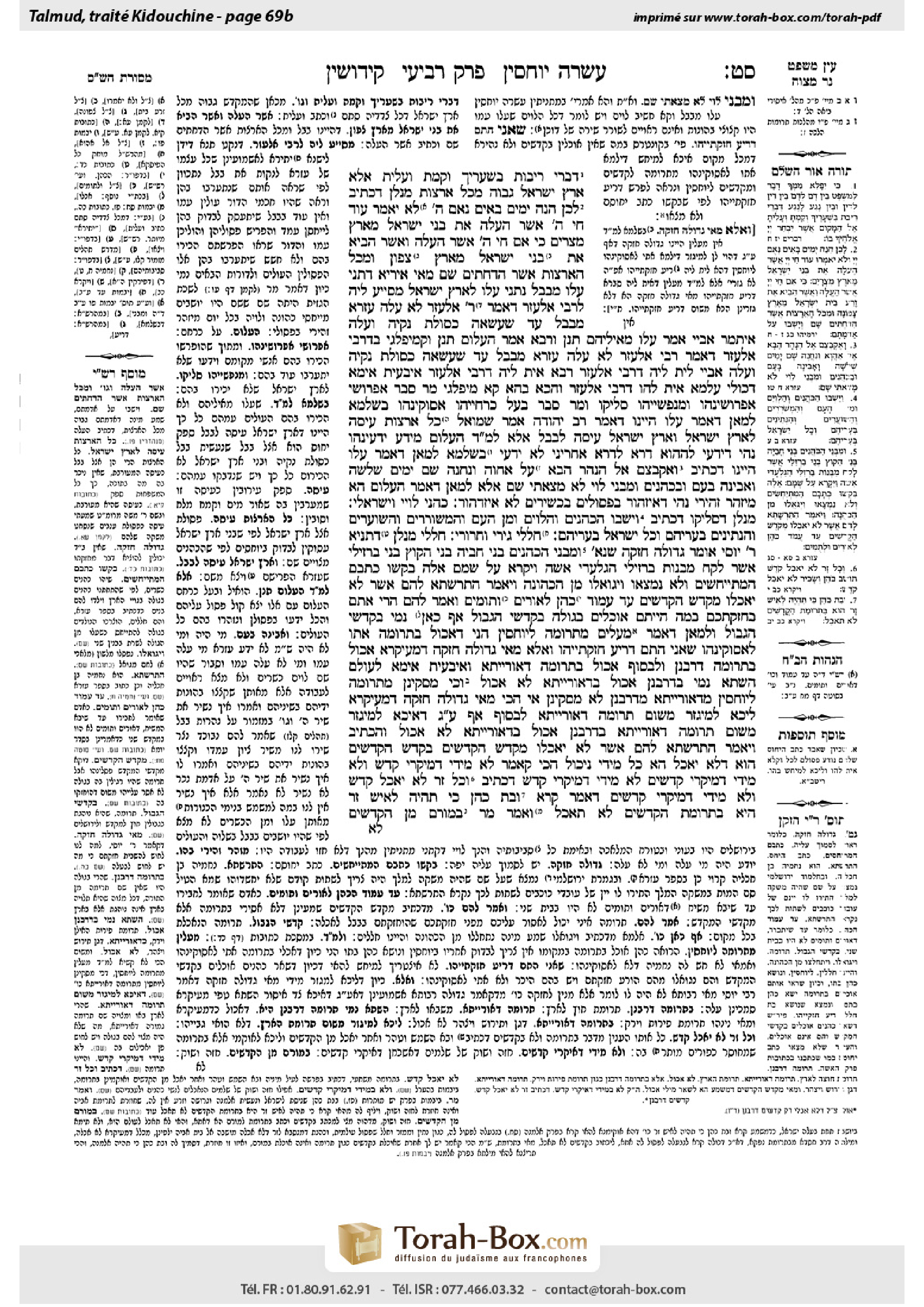
Kiddushin 69b: Talmud study for Daf Yomi
Daf Yomi is the daily study of one Talmud folio. Explore 37 tractates with scans, Hebrew text, Sefaria English and AI-generated French translations where annotated.
Passage selection and English or AI-generated French translation are available where the scan has annotations. Daf Study is independent of Torah-Box and Sefaria.
Browse Kiddushin · קידושין · All tractatesKiddushin 69b text and translations
This page of Kiddushin includes the Aramaic text, an English translation and an AI-generated French translation, alongside the scan above.
קידושין ס״ט ב · Aramaic and Hebrew text
״דִּבְרֵי רִיבֹת בִּשְׁעָרֶיךָ וְקַמְתָּ וְעָלִיתָ״, אֶלָּא אֶרֶץ יִשְׂרָאֵל גְּבוֹהָה מִכׇּל אֲרָצוֹת מְנָלַן? דִּכְתִיב: ״לָכֵן הִנֵּה יָמִים בָּאִים נְאֻם ה׳ וְלֹא יֹאמְרוּ עוֹד חַי ה׳ אֲשֶׁר הֶעֱלָה אֶת בְּנֵי יִשְׂרָאֵל מֵאֶרֶץ מִצְרַיִם. כִּי אִם חַי ה׳ אֲשֶׁר הֶעֱלָה וַאֲשֶׁר הֵבִיא אֶת זֶרַע בֵּית יִשְׂרָאֵל מֵאֶרֶץ צָפוֹנָה וּמִכֹּל הָאֲרָצוֹת אֲשֶׁר הִדַּחְתִּים שָׁם״.
מַאי אִירְיָא דְּתָנֵי ״עָלוּ מִבָּבֶל״? נִתְנֵי ״עָלוּ לְאֶרֶץ יִשְׂרָאֵל״! מְסַיַּיע לֵיהּ לְרַבִּי אֶלְעָזָר, דְּאָמַר רַבִּי אֶלְעָזָר: לֹא עָלָה עֶזְרָא מִבָּבֶל עַד שֶׁעֲשָׂאָהּ כְּסוֹלֶת נְקִיָּה וְעָלָה.
אִיתְּמַר אַבָּיֵי אָמַר: ״עָלוּ״ – מֵאֵילֵיהֶם, תְּנַן. וְרָבָא אָמַר: ״הֶעֱלוּם״ תְּנַן. וְקָמִיפַּלְגִי בִּדְרַבִּי אֶלְעָזָר, דְּאָמַר רַבִּי אֶלְעָזָר: לֹא עָלָה עֶזְרָא מִבָּבֶל עַד שֶׁעֲשָׂאָהּ כְּסוֹלֶת נְקִיָּה וְעָלָה.
אַבָּיֵי – לֵית לֵיהּ דְּרַבִּי אֶלְעָזָר. רָבָא – אִית לֵיהּ דְּרַבִּי אֶלְעָזָר. אִיבָּעֵית אֵימָא: דְּכוּלֵּי עָלְמָא אִית לְהוּ דְּרַבִּי אֶלְעָזָר, וְהָכָא בְּהָא קָא מִיפַּלְגִי: מָר סָבַר: אַפְרוֹשֵׁי אַפְרוֹשִׁינְהוּ וּמִנַּפְשַׁיְיהוּ סְלִיקוּ, וּמָר סָבַר: בְּעַל כֻּרְחַיְיהוּ אַסּוֹקִינְהוּ.
בִּשְׁלָמָא לְמַאן דְּאָמַר: ״עָלוּ״, הַיְינוּ דְּאָמַר רַב יְהוּדָה אָמַר שְׁמוּאֵל: כֹּל אֲרָצוֹת עִיסָּה לְאֶרֶץ יִשְׂרָאֵל, וְאֶרֶץ יִשְׂרָאֵל עִיסָּה לְבָבֶל. אֶלָּא לְמַאן דְּאָמַר: ״הֶעֱלוּם״, מִידָּע יַדְעִינְהוּ! נְהִי דְּיָדְעִי לְהָהוּא דָּרָא, לְדָרָא אַחֲרִינֵי לָא יָדְעִי.
בִּשְׁלָמָא לְמַאן דְּאָמַר ״עָלוּ״, הַיְינוּ דִּכְתִיב: ״וָאֶקְבְּצֵם אֶל הַנָּהָר הַבָּא עַל אַחֲוָה וַנַּחֲנֶה שָׁם יָמִים שְׁלֹשָׁה וָאָבִינָה בָעָם וּבַכֹּהֲנִים וּמִבְּנֵי לֵוִי לֹא מָצָאתִי שָׁם״.
אֶלָּא לְמַאן דְּאָמַר ״הֶעֱלוּם״, הָא מִיזְהָר זְהִירִי? נְהִי דְּאִיזְּהוּר בִּפְסוּלִים, בִּכְשֵׁירִים לָא אִיזְדְּהוּר.
כָּהֲנֵי לְוִיֵּי וְיִשְׂרְאֵלֵי. מְנָלַן דִּסְלִיקוּ? דִּכְתִיב: ״וַיֵּשְׁבוּ הַכֹּהֲנִים וְהַלְוִיִּם וּמִן הָעָם וְהַמְשֹׁרְרִים וְהַשּׁוֹעֲרִים וְהַנְּתִינִים בְּעָרֵיהֶם וְכׇל יִשְׂרָאֵל בְּעָרֵיהֶם״.
חֲלָלֵי גֵּירֵי וַחֲרוֹרֵי. חֲלָלֵי מְנָלַן? דְּתַנְיָא, רַבִּי יוֹסֵי אוֹמֵר: גְּדוֹלָה חֲזָקָה, שֶׁנֶּאֱמַר: ״וּמִבְּנֵי הַכֹּהֲנִים בְּנֵי חֳבַיָּה בְּנֵי הַקּוֹץ בְּנֵי בַרְזִלַּי אֲשֶׁר לָקַח מִבְּנוֹת בַּרְזִלַּי הַגִּלְעָדִי אִשָּׁה וַיִּקָּרֵא עַל שְׁמָם. אֵלֶּה בִּקְשׁוּ כְתָבָם הַמִּתְיַחְשִׂים וְלֹא נִמְצָאוּ וַיְגֹאֲלוּ מִן הַכְּהֻנָּה. וַיֹּאמֶר הַתִּרְשָׁתָא לָהֶם אֲשֶׁר לֹא יֹאכְלוּ מִקֹּדֶשׁ הַקֳּדָשִׁים עַד עֲמֹד כֹּהֵן לְאוּרִים וּלְתֻמִּים״.
וְאָמַר לָהֶם: הֲרֵי אַתֶּם בְּחֶזְקַתְכֶם. בַּמֶּה הֱיִיתֶם אוֹכְלִים בַּגּוֹלָה, בְּקׇדְשֵׁי הַגְּבוּל? אַף כָּאן נָמֵי, בְּקׇדְשֵׁי הַגְּבוּל.
וּלְמַאן דְּאָמַר: מַעֲלִים מִתְּרוּמָה לְיוּחֲסִין? הָנֵי דַּאֲכוּל בִּתְרוּמָה אָתוּ לְאַסּוֹקִינְהוּ! שָׁאנֵי הָתָם, דְּרִיעַ חֶזְקָתַיְיהוּ.
וְאֶלָּא מַאי גְּדוֹלָה חֲזָקָה? דְּמֵעִיקָּרָא אֲכוּל בִּתְרוּמָה דְרַבָּנַן, וּלְבַסּוֹף אֲכוּל בִּתְרוּמָה דְאוֹרָיְיתָא.
וְאִיבָּעֵית אֵימָא: לְעוֹלָם הַשְׁתָּא נָמֵי בִּדְרַבָּנַן – אֲכוּל, בִּדְאוֹרָיְיתָא – לָא אֲכוּל, וְכִי מַסְּקִינַן מִתְּרוּמָה לְיוּחֲסִין – מִדְּאוֹרָיְיתָא, מִדְּרַבָּנַן לָא מַסְּקִינַן.
אִי הָכִי, מַאי גְּדוֹלָה חֲזָקָה? דְּמֵעִיקָּרָא לֵיכָּא לְמִיגְזַר מִשּׁוּם תְּרוּמָה דְאוֹרָיְיתָא, לְבַסּוֹף – אַף עַל גַּב דְּאִיכָּא לְמִיגְזַר מִשּׁוּם תְּרוּמָה דְאוֹרָיְיתָא, בִּדְרַבָּנַן – אֲכוּל, בִּדְאוֹרָיְיתָא – לָא אֲכוּל.
וְהָכְתִיב ״וַיֹּאמֶר הַתִּרְשָׁתָא לָהֶם אֲשֶׁר לֹא יֹאכְלוּ מִקֹּדֶשׁ הַקֳּדָשִׁים״ – בְּקֹדֶשׁ הַקָּדָשִׁים הוּא דְּלֹא יֹאכְל[וּ], הָא כֹּל מִידֵּי נֵיכוֹל!
הָכִי קָאָמַר: לָא מִידֵּי דְּמִיקְּרֵי קֹדֶשׁ, וְלָא מִידֵּי דְּמִיקְּרֵי קָדָשִׁים. לָא מִידֵּי דְּמִיקְּרֵי קֹדֶשׁ – דִּכְתִיב: ״וְכׇל זָר לֹא יֹאכַל קֹדֶשׁ״, וְלָא מִידֵּי דְּמִיקְּרֵי קָדָשִׁים, דְּאָמַר קְרָא ״וּבַת כֹּהֵן כִּי תִהְיֶה לְאִישׁ זָר הִיא בִּתְרוּמַת הַקֳּדָשִׁים לֹא תֹאכֵל״, וְאָמַר מָר: ״בַּמּוּרָם מִן הַקֳּדָשִׁים
Kiddushin 69b · English translation
“Matters of controversy within your gates, and you shall arise and go up to the place that the Lord, your God, shall choose” (Deuteronomy 17:8), indicating that the Temple, the place that God chose, is higher than all other cities in Eretz Yisrael. But from where do we derive the claim that Eretz Yisrael is higher than all other lands? The Gemara answers: As it is written: “Therefore behold, the days are coming, says the Lord, when they shall no more say: As the Lord lives, Who brought up the children of Israel out of the land of Egypt, but: As the Lord lives, Who brought up and Who led the seed of the house of Israel out of the north country, and from all the countries where I had driven them” (Jeremiah 23:7–8). The phrase “Who brought up” indicates that Eretz Yisrael is higher than all the other lands from where God will bring the Jewish people.
The Gemara asks: If that is what the mishna wants to teach, why does the tanna specifically teach: Ascended from Babylonia? Let him teach: Ascended to Eretz Yisrael. The Gemara answers that the wording of the mishna supports the opinion of Rabbi Elazar, as Rabbi Elazar says: Ezra did not ascend from Babylonia until he made it like fine flour, free of bran, i.e., he ensured that the lineage of those remaining was unsullied, and selected all of those in Babylonia who were of questionable lineage, and then he ascended with them to Eretz Yisrael.
§ It was stated that amora’im had a dispute with regard to this matter. Abaye said: We learned in the mishna that there were ten categories of lineage among the Jews who ascended, meaning that they ascended of their own accord. And Rava said: We learned: Ezra brought them up, against their will. The Gemara explains: And they disagree about the statement of Rabbi Elazar, as Rabbi Elazar says: Ezra did not ascend from Babylonia until he made it like fine flour, and only then he ascended.
Abaye does not accept the statement of Rabbi Elazar, since he maintains that they ascended of their own free will, whereas Rava does accept the statement of Rabbi Elazar. Or, if you wish, say that everyone accepts the statement of Rabbi Elazar, and here they disagree with regard to this: One Sage, Abaye, holds that Ezra first separated the members of the community with flawed lineage, and they subsequently ascended to Eretz Yisrael out of their own desire. And one Sage, Rava, holds that he brought them up against their will.
The Gemara asks: Granted, according to the one who says that the mishna means that they ascended of their own accord, without any distinction between the types of people who came, this is the reason that Rav Yehuda says that Shmuel says: The lineage of residents of all lands is muddled compared to that of Eretz Yisrael, and the lineage of residents of Eretz Yisrael is muddled compared to that of Babylonia. As the people came of their own accord, there was a lack of oversight concerning who married whom. But according to the one who says that he brought them up, and Ezra identified and selected all those who came with him, the Sages of the time knew the lineage of all who came and would have been careful not to allow any forbidden marriages, so why is the lineage of residents of Eretz Yisrael considered to be muddled compared to that of Babylonia? The Gemara answers: Though the status of those who came was known to that generation, it was not known to other later generations.
The Gemara asks another question: Granted, according to the one who says that they ascended of their own accord, this is the meaning of the verse that is written in the book of Ezra: “And I gathered them together to the river that runs to Ahava, and we camped there for three days; and I viewed the people and the priests, and found there none of the sons of Levi” (Ezra 8:15), as it was necessary for Ezra to clarify the identity of the people traveling to Eretz Yisrael.
But according to the one who says that he brought them up, they were careful to classify the lineage of the people before they left for Eretz Yisrael, so why was it necessary for him to clarify the matter by the riverside? The Gemara answers: Though they were careful with regard to people of flawed lineage before they left for Eretz Yisrael, with regard to people of unflawed lineage they were not careful to clarify the precise lineage of each of them earlier, and they did this by the riverside.
§ The mishna included in its list of types of lineage priests, Levites, and Israelites. The Gemara asks: From where do we derive that they ascended? The Gemara answers: As it is written: “So the priests, and the Levites, and some of the people, and the singers, and the gatekeepers, and the Gibeonites dwelt in their cities, and all of Israel in their cities” (Ezra 2:70). The verse specifies priests, Levites, and all of Israel.
The mishna further states that ḥalalim, converts, and emancipated slaves ascended from Babylonia. The Gemara clarifies: From where do we derive that ḥalalim ascended? The Gemara answers: As it is taught in a baraita that Rabbi Yosei says: Great is the importance of a presumptive status, as it is stated: “And of the children of the priests: The children of Habaiah, the children of Hakkoz, the children of Barzillai, who took a wife of the daughters of Barzillai the Gileadite, and was called after their name. These sought the registry of their genealogy, but it was not found. Therefore, they were deemed polluted and put out from the priesthood. And the Tirshatha said to them that they should not eat of the offerings of the most sacred order until there arose a priest with the Urim VeTummim” (Ezra 2:61–63).
The baraita continues: This shows that there was uncertainty whether specific descendants of priests were fit for the priesthood or were ḥalalim, and Ezra said to them: You have retained your presumptive status. In other words, despite their failure to provide proof that they were fit priests, they maintained their prior status. Ezra said: Of what priestly gifts did you partake when you were in exile? You partook only of the consecrated gifts of the boundaries, i.e., from teruma, which may be eaten anywhere. Here too, in Eretz Yisrael, you may partake only of the consecrated gifts of the boundaries. You may not, however, partake of anything that must be eaten inside Jerusalem, as indicated by the verse “They should not eat of the offerings of the most sacred order.” In any event, since the verse writes that they were “put out from the priesthood,” it can be seen that there were ḥalalim who came with Ezra to Eretz Yisrael.
The Gemara asks: And according to the one who says that one elevates a priest to lineage, i.e., one attributes the lineage of a priest to an individual on the basis of observing him partaking of teruma, how could they be allowed to partake of teruma? Those who partake of teruma will subsequently be elevated to the full status of priests. The Gemara answers: There it is different, as their presumptive status had been weakened. Since they did not partake of offerings, as did all other priests, all knew that they were not regular priests.
The Gemara asks: But if so, what is the meaning of Rabbi Yosei’s claim that great is a presumptive status? They received nothing extra by virtue of this presumption. The Gemara responds: They have gained in that initially they would partake of teruma only of Babylonian produce, which is teruma by rabbinic law, and afterward they would partake of produce that is teruma by Torah law. The separation of teruma in Eretz Yisrael is a Torah obligation, and the produce is fully consecrated.
The Gemara offers an additional defense of the opinion that one elevates a priest to lineage based on observing him partake of teruma: And if you wish, say: Actually, now also, in Eretz Yisrael, they would partake only of produce that is teruma by rabbinic law, such as vegetables, while they would not partake of produce that is teruma by Torah law, such as grains. And when we elevate a priest to lineage on the basis of observing him partake of teruma, that is only when he was observed partaking of produce that is teruma by Torah law, but if someone partakes of produce that is teruma by rabbinic law, we do not elevate him. Therefore, they could continue partaking of teruma based on their presumptive status, and there is no concern that they might be elevated to the status of full-fledged priests.
The Gemara asks: If so, the question remains: What is meant by the phrase: Great is a presumptive status? The Gemara answers: It means that initially, there was no reason to decree and prohibit them from partaking of produce that was teruma by rabbinic law due to the possibility that they may partake of produce that is teruma by Torah law, as there was no produce that was teruma by Torah law in Babylonia. Afterward, when they came to Eretz Yisrael, although there was reason to decree and prohibit them from partaking of produce that was teruma by rabbinic law due to the possibility that they may partake of produce that was teruma by Torah law, as that kind of teruma was also present, their presumptive status was nevertheless strong enough to allow them to continue to partake of produce that was teruma by rabbinic law, although they could not eat produce that is teruma by Torah law.
The Gemara asks: But isn’t it written: “And the Tirshatha said to them that they should not eat of the offerings of the most sacred order [kodesh hakodashim]” (Ezra 2:63)? This indicates that it is from the offerings of the most sacred order that they may not eat, but anything else, i.e., offerings not of the most sacred order, they may eat, including produce that is teruma by Torah law.
The Gemara answers: This is what the Tirshatha is saying: They may not partake of anything that is called sacred [kodesh], nor anything that is called most sacred [kodashim]. The Gemara clarifies. The words not anything that is called sacred are referring to teruma, as it is written with regard to teruma: “No non-priest may eat of the sacred” (Leviticus 22:10). And the words nor anything that is called most sacred are referring to offerings, as the verse states: “And a daughter of a priest, if she is married to a non-priest, she may not eat of that which is set apart from the sacred things” (Leviticus 22:12). And the Master says: What is the meaning of “that which is set apart from the sacred things”? It means from the portions separated from the offerings, i.e., the breast and thigh of a peace-offering,
Kiddushin 69b · Traduction française (IA)
« S’il s’élève entre tes portes une affaire litigieuse, tu te lèveras et tu monteras au lieu que le Seigneur, ton Dieu, choisira » (Deutéronome 17:8). Cela indique que le Temple, le lieu choisi par Dieu, est situé plus haut que toutes les autres villes d’Eretz Israël. Mais d’où déduisons-nous qu’Eretz Israël est située plus haut que tous les autres pays ? La Guemara répond : comme il est écrit : « C’est pourquoi, voici, des jours viennent, dit le Seigneur, où l’on ne dira plus : “Le Seigneur est vivant, Lui qui a fait monter les enfants d’Israël du pays d’Égypte”, mais : “Le Seigneur est vivant, Lui qui a fait monter et a ramené la descendance de la maison d’Israël du pays du nord et de tous les pays où je les avais dispersés” » (Jérémie 23:7-8). L’expression « a fait monter » indique qu’Eretz Israël est située plus haut que tous les autres pays d’où Dieu ramènera le peuple juif.
La Guemara demande : si c’est là ce que la Michna veut enseigner, pourquoi le tanna enseigne-t-il précisément : « Ils sont montés de Babylonie » ? Qu’il enseigne plutôt : « Ils sont montés en Eretz Israël ». La Guemara répond que la formulation de la Michna appuie l’opinion de Rabbi Elazar. En effet, Rabbi Elazar dit : Ezra n’est pas monté de Babylonie avant d’avoir rendu celle-ci semblable à de la farine fine, débarrassée du son ; autrement dit, il s’assura que la lignée de ceux qui restaient était sans défaut et sélectionna tous ceux de Babylonie dont la lignée était douteuse, puis il monta avec eux en Eretz Israël.
§ Il a été rapporté que des amoraïm sont en désaccord sur cette question. Abayé dit : Nous avons appris dans la Michna qu’il y avait dix catégories de lignées parmi les Juifs qui sont montés, c’est-à-dire qu’ils sont montés de leur propre gré. Rava dit : Nous avons appris qu’Ezra les a fait monter contre leur volonté. La Guemara explique qu’ils sont en désaccord au sujet de la déclaration de Rabbi Elazar, car Rabbi Elazar dit : Ezra n’est pas monté de Babylonie avant de l’avoir rendue semblable à de la farine fine ; il n’est monté qu’ensuite.
Abayé n’accepte pas la déclaration de Rabbi Elazar, puisqu’il estime qu’ils sont montés de leur plein gré, tandis que Rava l’accepte. Ou, si tu veux, dis que tous acceptent la déclaration de Rabbi Elazar et qu’ils sont en désaccord sur le point suivant : un Sage, Abayé, estime qu’Ezra a d’abord séparé les membres de la communauté dont la lignée était entachée, puis que ceux-ci sont montés en Eretz Israël de leur propre gré. Un autre Sage, Rava, estime qu’il les a fait monter contre leur volonté.
La Guemara demande : il est compréhensible que, selon celui qui dit que la Michna signifie qu’ils sont montés de leur propre gré, sans distinction entre les catégories de personnes qui sont venues, Rav Yehouda dit au nom de Shmouel : « La lignée des habitants de tous les pays est mêlée par rapport à celle des habitants d’Eretz Israël, et la lignée des habitants d’Eretz Israël est mêlée par rapport à celle des habitants de Babylonie. » Puisque les gens sont venus de leur propre gré, il n’y avait pas de surveillance quant aux personnes qui épousaient les unes les autres. Mais selon celui qui dit qu’Ezra les a fait monter et qu’il a identifié et sélectionné tous ceux qui sont venus avec lui, les Sages de l’époque connaissaient la lignée de tous ceux qui venaient et auraient veillé à empêcher toute union interdite. Pourquoi, alors, la lignée des habitants d’Eretz Israël est-elle considérée comme mêlée par rapport à celle des habitants de Babylonie ? La Guemara répond : même si le statut de ceux qui étaient venus était connu de cette génération, il ne l’était pas des générations suivantes.
La Guemara pose une autre question : il est compréhensible que, selon celui qui dit qu’ils sont montés de leur propre gré, tel est le sens du verset écrit dans le livre d’Ezra : « Je les rassemblai près du fleuve qui coule vers Ahava, et nous campâmes là trois jours ; j’examinai le peuple et les prêtres, et je n’y trouvai aucun des fils de Lévi » (Ezra 8:15), car Ezra devait établir l’identité des personnes qui voyageaient vers Eretz Israël.
Mais selon celui qui dit qu’Ezra les a fait monter, ils ont soigneusement vérifié la lignée des gens avant leur départ pour Eretz Israël. Pourquoi était-il donc nécessaire pour lui d’éclaircir la question au bord du fleuve ? La Guemara répond : bien qu’ils aient vérifié la lignée des personnes dont la lignée était entachée avant leur départ pour Eretz Israël, ils n’avaient pas pris soin d’établir auparavant la lignée précise de chacune des personnes dont la lignée était sans défaut ; ils l’ont fait au bord du fleuve.
§ La Michna comptait parmi les catégories de lignées les prêtres, les Lévites et les Israélites. La Guemara demande : d’où déduisons-nous qu’ils sont montés ? La Guemara répond : comme il est écrit : « Les prêtres, les Lévites, une partie du peuple, les chantres, les portiers et les Néthinim habitèrent dans leurs villes, et tout Israël dans ses villes » (Ezra 2:70). Le verset mentionne les prêtres, les Lévites et tout Israël.
La Michna indique aussi que des ḥalalim, des convertis et des esclaves affranchis sont montés de Babylonie. La Guemara précise : d’où déduisons-nous que des ḥalalim sont montés ? La Guemara répond : comme il est enseigné dans une baraïta que Rabbi Yossi dit : « Grande est l’importance d’un statut présumé », ainsi qu’il est dit : « Parmi les fils des prêtres : les fils de Habaïa, les fils de Hakkoz, les fils de Barzillaï, qui avait pris une femme parmi les filles de Barzillaï le Galaadite et avait été appelé de leur nom. Ceux-ci recherchèrent le registre généalogique, mais ne le trouvèrent pas. Ils furent donc considérés comme souillés et exclus de la prêtrise. Le Tirshata leur dit de ne pas manger des offrandes du plus haut degré de sainteté jusqu’à ce qu’un prêtre se lève avec l’Ourim et le Toumim » (Ezra 2:61-63).
La baraïta poursuit : cela montre qu’il y avait une incertitude quant au fait que certains descendants de prêtres soient aptes à la prêtrise ou soient des ḥalalim, et Ezra leur dit : « Vous avez conservé votre statut présumé. » Autrement dit, bien qu’ils n’aient pas pu prouver qu’ils étaient des prêtres aptes, ils ont conservé leur statut antérieur. Ezra dit : « De quels dons sacerdotaux vous nourrissiez-vous lorsque vous étiez en exil ? Vous ne mangiez que des dons consacrés des limites, c’est-à-dire de la terouma, qui peut être consommée partout. Ici aussi, en Eretz Israël, vous ne pouvez manger que des dons consacrés des limites. Vous ne pouvez toutefois manger aucun aliment qui doit être consommé à l’intérieur de Jérusalem, comme l’indique le verset : “Ils ne mangeront pas des offrandes du plus haut degré de sainteté.” » Quoi qu’il en soit, puisque le verset dit qu’ils furent « exclus de la prêtrise », on voit que des ḥalalim vinrent avec Ezra en Eretz Israël.
La Guemara demande : et selon celui qui dit qu’on élève quelqu’un au rang sacerdotal quant à sa lignée, c’est-à-dire qu’on lui attribue une ascendance sacerdotale parce qu’on l’a vu consommer de la terouma, comment a-t-on pu les autoriser à consommer de la terouma ? Ceux qui en consomment seront ensuite élevés au rang de prêtres à part entière. La Guemara répond : ici, c’est différent, car leur statut présumé avait été affaibli. Puisqu’ils ne consommaient pas d’offrandes, contrairement aux autres prêtres, tout le monde savait qu’ils n’étaient pas des prêtres ordinaires.
La Guemara demande : mais, dans ce cas, que signifie l’affirmation de Rabbi Yossi selon laquelle un statut présumé a une grande importance ? Cette présomption ne leur a rien apporté de plus. La Guemara répond : ils y ont gagné ceci : auparavant, ils ne consommaient que de la terouma provenant de produits de Babylonie, dont le statut de terouma relevait de la loi rabbinique ; ensuite, ils ont consommé des produits qui avaient le statut de terouma en vertu de la Torah. En Eretz Israël, le prélèvement de la terouma est une obligation de la Torah, et les produits sont pleinement consacrés.
La Guemara apporte une autre réponse pour défendre l’opinion selon laquelle on élève quelqu’un au rang sacerdotal quant à sa lignée si on l’a vu consommer de la terouma. Et si tu veux, dis : en réalité, même alors, en Eretz Israël, ils ne consommaient que des produits dont le statut de terouma relevait de la loi rabbinique, comme les légumes ; ils ne consommaient pas de produits dont le statut de terouma relevait de la Torah, comme les céréales. Or, on n’élève quelqu’un au rang sacerdotal quant à sa lignée parce qu’on l’a vu consommer de la terouma que si on l’a vu consommer des produits dont le statut de terouma relève de la Torah. Mais si quelqu’un consomme des produits dont le statut de terouma relève de la loi rabbinique, on ne l’élève pas à ce rang. Ils pouvaient donc continuer à consommer de la terouma en vertu de leur statut présumé, sans craindre d’être élevés au rang de prêtres à part entière.
La Guemara demande : dans ce cas, la question demeure : que signifie l’expression « grande est l’importance d’un statut présumé » ? La Guemara répond : cela signifie qu’au départ, il n’y avait aucune raison de décréter et d’interdire qu’ils consomment des produits dont le statut de terouma relevait de la loi rabbinique, par crainte qu’ils ne consomment des produits dont le statut de terouma relève de la Torah, puisqu’il n’y avait pas en Babylonie de produits dont le statut de terouma relevait de la Torah. Ensuite, lorsqu’ils sont arrivés en Eretz Israël, bien qu’il y eût une raison de décréter et d’interdire qu’ils consomment des produits dont le statut de terouma relevait de la loi rabbinique, par crainte qu’ils ne consomment des produits dont le statut de terouma relève de la Torah, puisque cette catégorie de terouma y existait aussi, leur statut présumé était néanmoins assez solide pour leur permettre de continuer à consommer des produits dont le statut de terouma relevait de la loi rabbinique, même s’ils ne pouvaient pas manger de produits dont le statut de terouma relève de la Torah.
La Guemara demande : mais n’est-il pas écrit : « Le Tirshata leur dit de ne pas manger des offrandes du plus haut degré de sainteté [kodesh hakodashim] » (Ezra 2:63) ? Cela indique que c’est des offrandes du plus haut degré de sainteté qu’ils ne peuvent pas manger, mais qu’ils peuvent manger tout le reste, c’est-à-dire les offrandes qui ne relèvent pas du plus haut degré de sainteté, y compris des produits dont le statut de terouma relève de la Torah.
La Guemara répond : voici ce que dit le Tirshata : ils ne peuvent consommer quoi que ce soit appelé saint [kodesh], ni quoi que ce soit appelé très saint [kodashim]. La Guemara précise : les mots « quoi que ce soit appelé saint » font référence à la terouma, car il est écrit au sujet de la terouma : « Aucun non-prêtre ne mangera de ce qui est saint » (Lévitique 22:10). Et les mots « ni quoi que ce soit appelé très saint » font référence aux offrandes, comme le dit le verset : « La fille d’un prêtre, si elle est mariée à un non-prêtre, ne mangera pas de ce qui est prélevé sur les choses saintes » (Lévitique 22:12). Et le Maître enseigne : que signifie « ce qui est prélevé sur les choses saintes » ? Cela désigne les parts prélevées sur les offrandes, c’est-à-dire la poitrine et la cuisse d’un sacrifice de paix,
Traduction française générée par IA à partir de l’édition anglaise de Sefaria. Vérifie toujours un passage avec le texte source.
Text from Sefaria: William Davidson Edition - Vocalized Aramaic (CC BY NC); William Davidson Edition - English (CC BY NC).