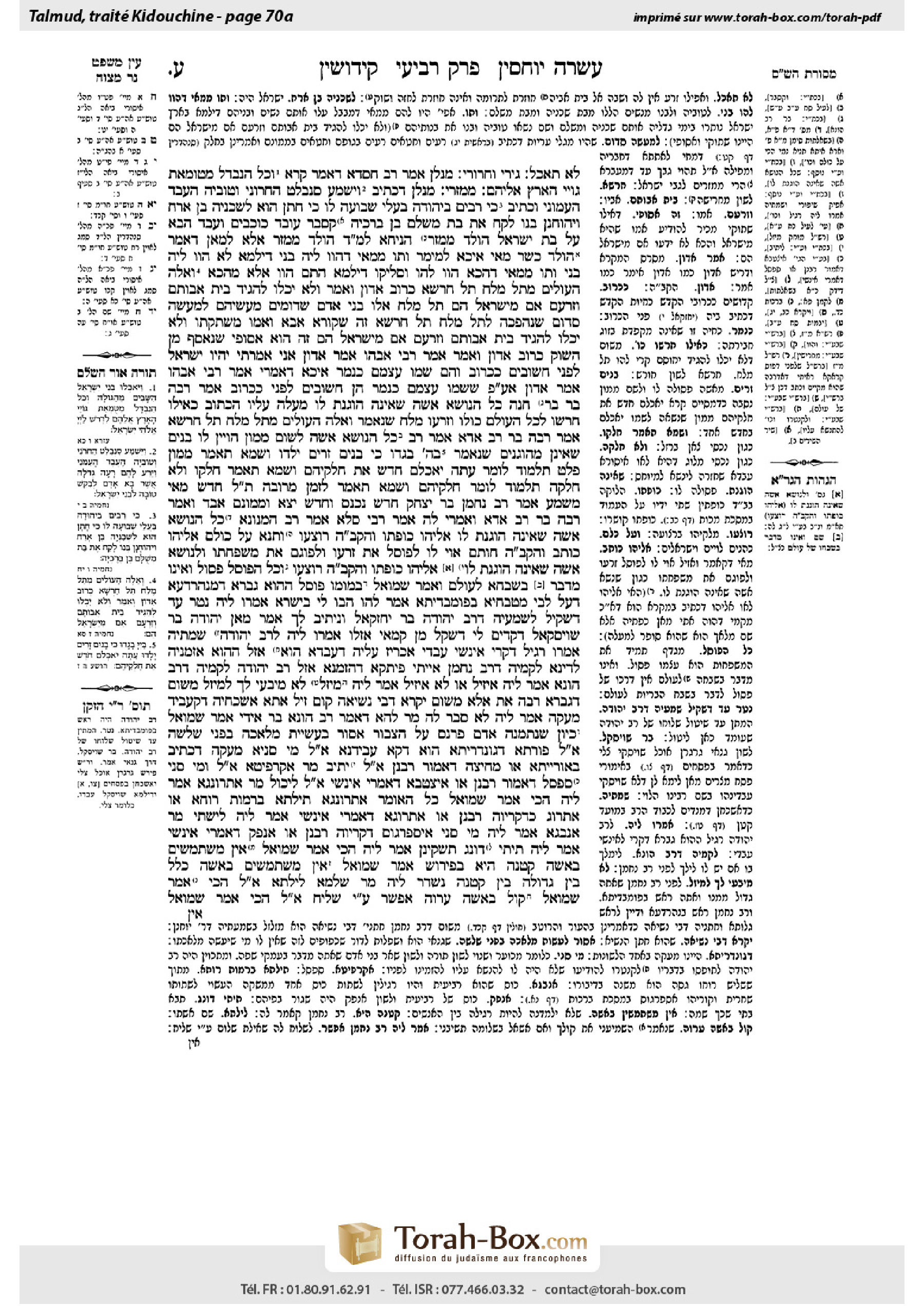
Kiddushin 70a: Talmud study for Daf Yomi
Daf Yomi is the daily study of one Talmud folio. Explore 37 tractates with scans, Hebrew text, Sefaria English and AI-generated French translations where annotated.
Passage selection and English or AI-generated French translation are available where the scan has annotations. Daf Study is independent of Torah-Box and Sefaria.
Browse Kiddushin · קידושין · All tractatesKiddushin 70a text and translations
This page of Kiddushin includes the Aramaic text, an English translation and an AI-generated French translation, alongside the scan above.
קידושין ע׳ א · Aramaic and Hebrew text
לֹא תֹאכֵל״.
״גֵּירֵי וַחֲרוֹרֵי״. מְנָלַן? אָמַר רַב חִסְדָּא, דְּאָמַר קְרָא: ״וְכׇל הַנִּבְדָּל מִטֻּמְאַת גּוֹיֵי הָאָרֶץ אֲלֵהֶם״.
מַמְזֵרֵי. מְנָלַן? דִּכְתִיב ״וַיִּשְׁמַע סַנְבַלַּט הַחֹרֹנִי וְטֹבִיָּה הָעֶבֶד הָעַמּוֹנִי״, וּכְתִיב: ״כִּי רַבִּים בִּיהוּדָה בַּעֲלֵי שְׁבוּעָה לוֹ כִּי חָתָן הוּא לִשְׁכַנְיָה בֶן אָרַח וִיהוֹחָנָן בְּנוֹ לָקַח אֶת בַּת מְשֻׁלָּם בֶּן בֶּרֶכְיָה״, קָסָבַר נׇכְרִי וְעֶבֶד הַבָּא עַל בַּת יִשְׂרָאֵל – הַוָּלָד מַמְזֵר.
הָנִיחָא לְמַאן דְּאָמַר: הַוָּלָד מַמְזֵר, אֶלָּא לְמַאן דְּאָמַר: הַוָּלָד כָּשֵׁר, מַאי אִיכָּא לְמֵימַר? וְתוּ: מִמַּאי דַּהֲווֹ לֵיהּ בְּנֵי? דִּילְמָא לָא הֲווֹ לֵיהּ בְּנֵי! וְתוּ: מִמַּאי דְּהָכָא הֲווֹ לְהוּ וּסְלִיקוּ? דִּילְמָא הָתָם הֲווֹ!
אֶלָּא מֵהָכָא: ״וְאֵלֶּה הָעוֹלִים מִתֵּל מֶלַח תֵּל חַרְשָׁא כְּרוּב אַדּוֹן וְאִמֵּר, וְלֹא יָכְלוּ לְהַגִּיד בֵּית אֲבֹתָם וְזַרְעָם אִם מִיִּשְׂרָאֵל הֵם״, ״תֵּל מֶלַח״ – אֵלּוּ בְּנֵי אָדָם שֶׁדּוֹמִים מַעֲשֵׂיהֶם לְמַעֲשֵׂה סְדוֹם שֶׁנֶּהֶפְכָה לְתֵל מֶלַח. ״תֵּל חַרְשָׁא״ – זֶה שֶׁקּוֹרֵא ״אַבָּא״ וְאִמּוֹ מְשַׁתַּקְתּוֹ.
״וְלֹא יָכְלוּ לְהַגִּיד בֵּית אֲבֹתָם וְזַרְעָם אִם מִיִּשְׂרָאֵל הֵם״ – זֶה הוּא אֲסוּפִי שֶׁנֶּאֱסַף מִן הַשּׁוּק. ״כְּרוּב אַדּוֹן וְאִמֵּר״ – אָמַר רַבִּי אֲבָהוּ: אָמַר אָדוֹן: אֲנִי אָמַרְתִּי יִהְיוּ יִשְׂרָאֵל לְפָנַי חֲשׁוּבִים כִּכְרוּב וְהֵם שָׂמוּ עַצְמָם כְּנָמֵר. אִיכָּא דְּאָמְרִי אָמַר רַבִּי אֲבָהוּ: אָמַר אָדוֹן: אַף עַל פִּי שֶׁשָּׂמוּ עַצְמָם כְּנָמֵר – הֵן חֲשׁוּבִים לְפָנַי כִּכְרוּב.
אָמַר רַבָּה בַּר בַּר חָנָה: כׇּל הַנּוֹשֵׂא אִשָּׁה שֶׁאֵינָהּ הוֹגֶנֶת לוֹ, מַעֲלֶה עָלָיו הַכָּתוּב כְּאִילּוּ חֲרָשׁוֹ לְכׇל הָעוֹלָם כּוּלּוֹ וּזְרָעוֹ מֶלַח, שֶׁנֶּאֱמַר: ״וְאֵלֶּה הָעוֹלִים מִתֵּל מֶלַח תֵּל חַרְשָׁא״.
אָמַר רַבָּה בַּר רַב אַדָּא אָמַר רַב: כׇּל הַנּוֹשֵׂא אִשָּׁה לְשׁוּם מָמוֹן – הָוַיִין לוֹ בָּנִים שֶׁאֵינָן מְהוּגָּנִים, שֶׁנֶּאֱמַר: ״בַּה׳ בָּגָדוּ כִּי בָנִים זָרִים יָלָדוּ״.
וְשֶׁמָּא תֹּאמַר מָמוֹן פָּלֵט, תַּלְמוּד לוֹמַר: ״עַתָּה יֹאכְלֵם חֹדֶשׁ אֶת חֶלְקֵיהֶם״. וְשֶׁמָּא תֹּאמַר: ״חֶלְקוֹ״ – וְלֹא חֶלְקָהּ, תַּלְמוּד לוֹמַר: ״חֶלְקֵיהֶם״. וְשֶׁמָּא תֹּאמַר לִזְמַן מְרוּבֶּה – תַּלְמוּד לוֹמַר: ״חֹדֶשׁ״. מַאי מַשְׁמַע? אָמַר רַב נַחְמָן בַּר יִצְחָק: חֹדֶשׁ נִכְנַס וְחֹדֶשׁ יָצָא וּמָמוֹנָם אָבַד.
וְאָמַר רַבָּה בַּר רַב אַדָּא וְאָמְרִי לַהּ אָמַר רַבִּי סַלָּא אָמַר רַב הַמְנוּנָא: כׇּל הַנּוֹשֵׂא אִשָּׁה שֶׁאֵינָהּ הוֹגֶנֶת לוֹ אֵלִיָּהוּ כּוֹפְתוֹ וְהַקָּדוֹשׁ בָּרוּךְ הוּא רוֹצְעוֹ. וְתָנָא: עַל כּוּלָּם אֵלִיָּהוּ כּוֹתֵב וְהַקָּדוֹשׁ בָּרוּךְ הוּא חוֹתֵם: אוֹי לוֹ לַפּוֹסֵל אֶת זַרְעוֹ, וְלַפּוֹגֵם אֶת מִשְׁפַּחְתּוֹ, וְלַנּוֹשֵׂא אִשָּׁה שֶׁאֵינָהּ הוֹגֶנֶת לוֹ, אֵלִיָּהוּ כּוֹפְתוֹ וְהַקָּדוֹשׁ בָּרוּךְ הוּא רוֹצְעוֹ.
וְכׇל הַפּוֹסֵל – פָּסוּל. וְאֵינוֹ מְדַבֵּר בִּשְׁבָחָא לְעוֹלָם, וְאָמַר שְׁמוּאֵל: בְּמוּמוֹ פּוֹסֵל.
הָהוּא גַּבְרָא דְּמִנְּהַרְדְּעָא דְּעָל לְבֵי מַטְבְּחַיָּא בְּפוּמְבְּדִיתָא. אֲמַר לְהוּ: הַבוּ לִי בִּישְׂרָא. אֲמַרוּ לֵיהּ: נְטַר עַד דְּשָׁקֵיל (לְ)שַׁמָּעֵיהּ דְּרַב יְהוּדָה בַּר יְחֶזְקֵאל וְנִיתֵּיב לָךְ. אֲמַר: מַאן יְהוּדָה בַּר שְׁוִיסְקֵאל דְּקָדֵים לִי, דְּשָׁקֵל מִן קַמַּאי?! אֲזַלוּ אֲמַרוּ לֵיהּ לְרַב יְהוּדָה. שַׁמְּתֵיהּ. אֲמַרוּ: רְגִיל דְּקָרֵי אִינָשֵׁי ״עַבְדֵי״. אַכְרֵיז עֲלֵיהּ דְּעַבְדָּא הוּא.
אֲזַל הָהוּא אַזְמְנֵיהּ לְדִינָא לְקַמֵּיהּ דְּרַב נַחְמָן. אַיְיתִי פִּיתְקָא דְהַזְמָנָא. אֲזַל רַב יְהוּדָה לְקַמֵּיהּ דְּרַב הוּנָא. אֲמַר לֵיהּ: אֵיזִיל אוֹ לָא אֵיזִיל? אֲמַר לֵיהּ: מֵיזָל לָא מִיבְּעֵי לָךְ לְמֵיזַל, מִשּׁוּם דְּגַבְרָא רַבָּה אַתְּ, אֶלָּא מִשּׁוּם יְקָרָא דְּבֵי נְשִׂיאָה קוּם זִיל.
אֲתָא אַשְׁכְּחֵיהּ דְּקָעָבֵיד מַעֲקֶה. אֲמַר לֵיהּ: לָא סָבַר לַהּ מָר לְהָא דְּאָמַר רַב הוּנָא בַּר אִידִי אָמַר שְׁמוּאֵל: כֵּיוָן שֶׁנִּתְמַנָּה אָדָם פַּרְנָס עַל הַצִּבּוּר אָסוּר בַּעֲשִׂיַּית מְלָאכָה בִּפְנֵי שְׁלֹשָׁה? אֲמַר לֵיהּ: פּוּרְתָּא דְגוּנְדְּרִיתָא הוּא דְּקָא עָבֵידְנָא. אֲמַר לֵיהּ: מִי סְנֵיא ״מַעֲקֶה״ דִּכְתִיב בְּאוֹרָיְיתָא, אוֹ ״מְחִיצָה״ דַּאֲמוּר רַבָּנַן?
אֲמַר לֵיהּ: יֵתִיב מָר אַקַּרְפִּיטָא. אֲמַר לֵיהּ: וּמִי סְנֵי ״סַפְסָל״ דַּאֲמוּר רַבָּנַן, אוֹ ״אִיצְטְבָא״ דְּאָמְרִי אִינָשֵׁי? אֲמַר לֵיהּ: לֵיכוֹל מָר אֶתְרוּנְגָּא. אֲמַר לֵיהּ, הָכִי אָמַר שְׁמוּאֵל: כׇּל הָאוֹמֵר ״אֶתְרוּנְגָּא״ תִּילְתָּא בְּרָמוּת רוּחָא – אוֹ ״אֶתְרוֹג״ כִּדְקַרְיוּהּ רַבָּנַן, אוֹ ״אֶתְרוֹגָא״ דְּאָמְרִי אִינָשֵׁי. אֲמַר לֵיהּ: לִישְׁתֵּי מָר אַנְבָּגָא. אֲמַר לֵיהּ: מִי סְנֵי ״אִיסְפָּרָגוֹס״ דְּקַרְיוּהּ רַבָּנַן אוֹ ״אַנְפַּק״ דְּאָמְרִי אִינָשֵׁי?
אֲמַר לֵיהּ: תֵּיתֵי דּוֹנַג תַּשְׁקֵינַן. אֲמַר לֵיהּ: הָכִי אָמַר שְׁמוּאֵל: אֵין מִשְׁתַּמְּשִׁים בְּאִשָּׁה. קְטַנָּה הִיא. בְּפֵירוּשׁ אָמַר שְׁמוּאֵל: אֵין מִשְׁתַּמְּשִׁים בְּאִשָּׁה כְּלָל, בֵּין גְּדוֹלָה בֵּין קְטַנָּה.
נְשַׁדַּר לֵיהּ מָר שְׁלָמָא לְיַלְתָּא. אֲמַר לֵיהּ: הָכִי אָמַר שְׁמוּאֵל: קוֹל בָּאִשָּׁה עֶרְוָה. אֶפְשָׁר עַל יְדֵי שָׁלִיחַ. אֲמַר לֵיהּ: הָכִי אָמַר שְׁמוּאֵל:
Kiddushin 70a · English translation
she may not eat.
§ The mishna teaches that converts and emancipated slaves ascended from Babylonia. The Gemara asks: From where do we derive this? Rav Ḥisda says: As the verse states with regard to the eating of the Paschal offering upon the return to Eretz Yisrael: “And the children of Israel who had come back from the exile ate, and all such as had separated themselves to them from the impurity of the nations of the land to seek the Lord, the God of Israel, did eat” (Ezra 6:21), indicating that converts and emancipated slaves who had abandoned “the impurity of the nations of the land,” i.e., idolatry, joined Ezra.
The mishna taught that mamzerim were among those who ascended from Babylonia. The Gemara asks: From where do we derive this? The Gemara answers: As it is written: “And Sanballat the Horonite and Tobiah the servant, the Ammonite, heard” (Nehemiah 2:19), and elsewhere it is written with regard to Tobiah the Ammonite: “For there were many in Judah sworn to him because he was the son-in-law of Shecaniah the son of Arah; and his son Jehohanan had taken the daughter of Meshullam the son of Berechiah” (Nehemiah 6:18). The Gemara proceeds to explain: This tanna holds that in the case of a gentile or a slave who engaged in sexual intercourse with a Jewish woman, the offspring is a mamzer. Since Tobiah the Ammonite, a gentile, married a Jewish woman, as did his son, there were clearly mamzerim among those who ascended.
The Gemara asks: This works out well according to the one who says that in that case the offspring is a mamzer. But according to the one who says that the lineage of the offspring is unflawed and has the status of the mother, what can be said? And furthermore, from where is it clear that Jehohanan had offspring from this wife? Perhaps he did not have offspring, and it is possible that there were no mamzerim. And furthermore, even if they did have offspring, from where is it clear that they had offspring here, in Babylonia, who then ascended to Eretz Yisrael? Perhaps they were there, in Eretz Yisrael, all the time, as they may have been one of the families that was not exiled to Babylonia, and therefore they cannot be used as the proof that mamzerim ascended from Babylonia.
Rather, the proof that mamzerim were among those who ascended from Babylonia is from here: “And these were they that ascended from Tel Melah, Tel Harsha, Cherub, Addon, and Immer; but they could not tell their fathers’ houses, nor their offspring, whether they were of Israel” (Nehemiah 7:61). The Gemara explains that these names are to be interpreted as follows: “Tel Melah”; these are people whose licentious actions were similar to the act of Sodom, which was turned into a mound of salt [tel melaḥ]. “Tel Harsha”; this is referring to one who calls a man father, and his mother silences him, as the word ḥarsha is similar to maḥarishto, meaning: Silences him. In any event, the statement that there were those who acted licentiously, as did the people of Sodom, means that there were mamzerim among them.
The Gemara continues with its explication of the verse: “But they could not tell their fathers’ houses, nor their offspring, whether they were of Israel”; this is referring to a foundling who is gathered from the marketplace. Such a person does not even know if he is Jewish, as he has no knowledge of his parents. With regard to the names “Cherub, Addon, and Immer,” Rabbi Abbahu says that these terms should be expounded as follows: The Master [Adon], God, said: I said that the Jewish people shall be as important before Me as a cherub, but they made themselves impudent as a leopard [namer]. There are those who say a different version: Rabbi Abbahu said: The Master [Adon] said that although they made themselves as a leopard [namer], they are as important before Me as a cherub.
§ Explicating the same verse, Rabba bar bar Ḥana says: In the case of anyone who marries a woman who is not suited for him to marry due to her lineage, the verse ascribes him blame as though he plowed [ḥarash] all of the entire world and sowed it with salt [melaḥ], as it is stated with regard to those of flawed lineage who ascended from Babylonia: “And these were they that ascended from Tel Melah, Tel Harsha.”
Rabba bar Rav Adda says that Rav says: In the case of anyone who marries a woman of flawed lineage only for the sake of money, he will have offspring who will act inappropriately, as it is stated: “They have dealt treacherously against the Lord, for they have begotten strange children; now shall the new moon devour them with their portions” (Hosea 5:7).
Rabba bar Rav Adda explains the verse: And lest you say that at least the money that they received as dowry was spared, although they suffer from the acts of their offspring, the verse states: “Now shall the new moon devour them with their portions,” meaning their property shall be consumed in a single month. And lest you say his portion will be lost but not the portion of his wife, the verse states “their portions” in the plural. And lest you say this will occur after a long time, but in the interim he will benefit from the money, the verse states: “The new moon.” The Gemara asks: From where may it be inferred that their money will be lost immediately? Rav Naḥman bar Yitzḥak said: A month comes and a month goes, and their money is already lost. In any event, the fact that the punishment they receive is the loss of their portions indicates that the sin in this case was marrying for the sake of money.
And Rabba bar Rav Adda says, and some say Rabbi Salla says that Rav Hamnuna says: In the case of anyone who marries a woman who is not suited for him to marry due to her lineage, Elijah binds him in the manner that those liable to receive lashes are bound, and the Holy One, Blessed be He, straps him. And a Sage taught: Concerning all of them, Elijah writes and the Holy One, Blessed be He, signs the following: Woe to he who disqualifies his offspring, and who brings a flaw to his family lineage, and who marries a woman who is not halakhically suited for him to marry. Elijah binds him and the Holy One, Blessed be He, straps him.
He further said: And anyone who disqualifies others by stating that their lineage is flawed, that is a sign that he himself is of flawed lineage. Another indication that one’s lineage is flawed is that he never speaks in praise of others. And Shmuel says: If one habitually claims that others are flawed, he disqualifies himself with his own flaw. The flaw he accuses them of having is in fact the one that he has.
§ The Gemara recounts a related incident: There was a certain man from Neharde’a who entered a butcher shop in Pumbedita. He said to them: Give me meat. They said to him: Wait until the servant of Rav Yehuda bar Yeḥezkel has taken his meat, and then we will give it to you. The man said to them in anger: Who is this Yehuda bar Sheviske’el, a derogatory name for a glutton for meat, that he should precede me, that he should take before me? They went and told Rav Yehuda what the man had said. Rav Yehuda excommunicated him, in accordance with the halakha of one who disparages a Torah scholar. They also said to him that the same man was in the habit of calling people slaves. Rav Yehuda proclaimed about him that he is a slave and may not marry a Jew.
The Gemara continues the story: That man went and summoned Rav Yehuda to judgment before Rav Naḥman, who was a judge in Neharde’a. When the summons arrived in Pumbedita, Rav Yehuda went before Rav Huna to seek his council. Rav Yehuda said to him: Should I go or should I not go? Rav Huna said to him: As for the obligation to go, you are not required to go, since you are a great man and therefore are not under the jurisdiction of Rav Naḥman’s court. But due to the honor of the Exilarch’s house, as Rav Naḥman was the son-in-law of the Exilarch, get up and go.
Rav Yehuda arrived in Neharde’a and found Rav Naḥman constructing a parapet. Rav Yehuda said to Rav Naḥman: Does the Master not hold in accordance with that halakha that Rav Huna bar Idi says that Shmuel says: Once a person has been appointed a leader of the community, he is prohibited from performing labor before three people, so that he not belittle the honor of his position? Rav Naḥman said to him: It is merely a little fence [gundarita] that I am constructing. Rav Yehuda said to him: Is the term ma’akeh, which is written in the Torah, or the corresponding term meḥitza, which the Sages said, distasteful to you? Why do you use a term that is used by neither the Torah nor the Sages?
During their meeting, Rav Naḥman said to him: Let the Master sit on the bench [karfita]. Rav Yehuda said to him: Is the term safsal, which the Sages said, or the word itzteva, which common people say, distasteful to you? Why are you using uncommon terms? Rav Naḥman then said to him: Let the Master eat a citron [etronga]. Rav Yehuda said to him: This is what Shmuel said: Anyone who says etronga demonstrates one-third of a haughtiness of spirit. Why? He should either say etrog, as the Sages called it, or etroga, as common people say in Aramaic. Saying etronga is a sign of snobbery, as it was employed by the aristocratic class. He subsequently said to him: Let the Master drink a cup [anbaga] of wine. Rav Yehuda said to him: Is the term ispargus, as the Sages called it, or anpak, as common people say, distasteful to you?
Later on, Rav Naḥman said to him: Let my daughter Donag come and pour us drinks. Rav Yehuda said to him: This is what Shmuel says: One may not make use of a woman for a service such as this. Rav Naḥman replied: She is a minor. Rav Yehuda retorted: Shmuel explicitly says: One may not make use of a woman at all, whether she is an adult or a minor.
Later on, Rav Naḥman suggested: Let the Master send greetings of peace to my wife Yalta. Rav Yehuda said to him: This is what Shmuel says: A woman’s voice is considered nakedness, and one may not speak with her. Rav Naḥman responded: It is possible to send your regards with a messenger. Rav Yehuda said to him: This is what Shmuel says:
Kiddushin 70a · Traduction française (IA)
elle ne peut pas en manger.
§ La Michna enseigne que des convertis et des esclaves affranchis sont montés de Babylonie. La Guemara demande : d’où le déduisons-nous ? Rav Ḥisda dit : le verset dit, au sujet de la consommation de l’offrande pascale lors du retour en Eretz Israël : « Les enfants d’Israël qui étaient revenus de l’exil en mangèrent, ainsi que tous ceux qui s’étaient séparés de l’impureté des nations du pays pour se joindre à eux afin de rechercher le Seigneur, le Dieu d’Israël » (Esdras 6:21). Cela indique que des convertis et des esclaves affranchis, qui avaient abandonné « l’impureté des nations du pays », c’est-à-dire l’idolâtrie, s’étaient joints à Ezra.
La Michna enseigne que des mamzerim figuraient parmi ceux qui étaient montés de Babylonie. La Guemara demande : d’où le déduisons-nous ? La Guemara répond : le verset dit : « Sanballat le Horonite et Tobiah, le serviteur ammonite, l’apprirent » (Néhémie 2:19), et il est écrit ailleurs au sujet de Tobiah l’Ammonite : « Car beaucoup en Juda lui étaient liés par serment, parce qu’il était le gendre de Shecaniah, fils d’Arah ; et son fils Jehohanan avait épousé la fille de Meshullam, fils de Berechiah » (Néhémie 6:18). La Guemara explique : ce tanna considère que, lorsqu’un non-Juif ou un esclave a des relations sexuelles avec une femme juive, l’enfant est un mamzer. Puisque Tobiah l’Ammonite, un non-Juif, avait épousé une femme juive, tout comme son fils, il y avait manifestement des mamzerim parmi ceux qui étaient montés.
La Guemara demande : cela s’explique bien selon celui qui dit que, dans ce cas, l’enfant est un mamzer. Mais que peut-on répondre selon celui qui dit que la filiation de l’enfant n’est pas entachée et qu’il a le statut de sa mère ? De plus, d’où sait-on que Jehohanan a eu des enfants de cette épouse ? Peut-être n’en a-t-il pas eu, et il se peut donc qu’il n’y ait pas eu de mamzerim. En outre, même s’ils ont eu des enfants, d’où sait-on qu’ils en ont eu ici, en Babylonie, et qu’ils sont ensuite montés en Eretz Israël ? Peut-être étaient-ils depuis toujours là-bas, en Eretz Israël, car ils faisaient peut-être partie des familles qui n’avaient pas été exilées en Babylonie ; ils ne peuvent donc servir de preuve que des mamzerim sont montés de Babylonie.
La preuve que des mamzerim figuraient parmi ceux qui étaient montés de Babylonie vient plutôt de ce verset : « Voici ceux qui montèrent de Tel Melah, Tel Harsha, Cherub, Addon et Immer ; mais ils ne purent établir leurs maisons paternelles ni leur descendance, ni dire s’ils étaient d’Israël » (Néhémie 7:61). La Guemara explique comment interpréter ces noms : « Tel Melah » désigne ceux dont les actes de débauche ressemblaient à l’acte des habitants de Sodome, dont la ville fut transformée en amas de sel [tel melaḥ]. « Tel Harsha » désigne celui qui appelle un homme « père » et dont la mère le fait taire, car le mot ḥarsha ressemble à maḥarishto, qui signifie : « elle le fait taire ». Quoi qu’il en soit, la mention de ceux qui se conduisaient de manière licencieuse, comme les habitants de Sodome, signifie qu’il y avait des mamzerim parmi eux.
La Guemara poursuit son explication du verset : « Mais ils ne purent établir leurs maisons paternelles ni leur descendance, ni dire s’ils étaient d’Israël » ; cela désigne un enfant trouvé recueilli sur la place du marché. Une telle personne ne sait même pas si elle est juive, puisqu’elle ne connaît pas ses parents. Au sujet des noms « Cherub, Addon et Immer », Rabbi Abbahu dit qu’il faut les expliquer ainsi : Le Maître [Adon], Dieu, dit : « J’avais dit que le peuple juif serait aussi important à Mes yeux qu’un chérubin, mais ses membres se sont rendus insolents comme un léopard [namer]. » Certains transmettent une autre version : Rabbi Abbahu dit : Le Maître [Adon] a dit : « Bien qu’ils se soient rendus semblables à un léopard [namer], ils sont aussi importants à Mes yeux qu’un chérubin. »
§ En expliquant le même verset, Rabba bar bar Ḥana dit : Le verset impute une faute à quiconque épouse une femme qu’il ne convient pas d’épouser en raison de sa filiation, comme s’il avait labouré [ḥarash] le monde entier et l’avait ensemencé de sel [melaḥ], comme il est dit au sujet de ceux dont la filiation était entachée et qui étaient montés de Babylonie : « Voici ceux qui montèrent de Tel Melah, Tel Harsha. »
Rabba bar Rav Adda dit au nom de Rav : Quiconque épouse une femme dont la filiation est entachée uniquement pour son argent aura des enfants qui se conduiront de manière inconvenante, comme il est dit : « Ils ont été infidèles au Seigneur, car ils ont engendré des enfants étrangers ; maintenant, la nouvelle lune les dévorera avec leurs parts » (Osée 5:7).
Rabba bar Rav Adda explique le verset : de peur que tu ne dises qu’au moins l’argent reçu en dot a été épargné, bien qu’ils souffrent du comportement de leurs enfants, le verset dit : « Maintenant, la nouvelle lune les dévorera avec leurs parts », ce qui signifie que leurs biens seront engloutis en un seul mois. Et de peur que tu ne dises que sa part sera perdue, mais pas celle de son épouse, le verset dit « leurs parts », au pluriel. Et de peur que tu ne dises que cela se produira après longtemps, mais qu’entre-temps il profitera de l’argent, le verset dit : « la nouvelle lune ». La Guemara demande : d’où peut-on déduire que leur argent sera perdu immédiatement ? Rav Naḥman bar Yitzḥak dit : un mois vient, un mois passe, et leur argent est déjà perdu. Quoi qu’il en soit, le fait que la punition qu’ils reçoivent soit la perte de leurs parts indique que, dans ce cas, la faute était d’épouser une femme pour son argent.
Rabba bar Rav Adda dit également — certains disent que c’est Rabbi Salla qui rapporte ces paroles au nom de Rav Hamnuna : Quiconque épouse une femme qu’il ne convient pas d’épouser en raison de sa filiation, Élie le ligote comme on ligote ceux qui sont passibles de flagellation, et le Saint, béni soit-Il, le fouette. Un Sage a enseigné : À leur sujet à tous, Élie écrit et le Saint, béni soit-Il, signe ce qui suit : « Malheur à celui qui disqualifie sa descendance, qui introduit une tare dans la filiation de sa famille et qui épouse une femme qu’il ne convient pas, selon la halakha, d’épouser. » Élie le ligote et le Saint, béni soit-Il, le fouette.
Il dit encore : Quiconque disqualifie autrui en affirmant que sa filiation est entachée donne ainsi le signe que la sienne l’est. Un autre indice d’une filiation entachée est que la personne ne parle jamais en bien d’autrui. Et Shmuel dit : si quelqu’un prétend régulièrement que les autres ont une filiation entachée, il se disqualifie lui-même par sa propre tare. La tare qu’il leur reproche est en réalité la sienne.
§ La Guemara rapporte un incident lié à ce sujet : un homme de Neharde’a entra dans une boucherie de Pumbedita. Il leur dit : « Donnez-moi de la viande. » Ils lui répondirent : « Attendez que le serviteur de Rav Yehuda bar Yeḥezkel ait pris sa viande, et ensuite nous vous en donnerons. » L’homme leur dit avec colère : « Qui est ce Yehuda bar Sheviske’el, ce surnom méprisant donné à un glouton, pour passer avant moi, pour prendre avant moi ? » Ils allèrent raconter à Rav Yehuda ce que l’homme avait dit. Rav Yehuda le mit au ḥérem, conformément à la halakha concernant celui qui dénigre un Sage de Torah. Ils lui dirent également que cet homme avait l’habitude de traiter les gens d’esclaves. Rav Yehuda proclama qu’il était lui-même esclave et ne pouvait pas épouser une Juive.
La Guemara poursuit le récit : cet homme alla citer Rav Yehuda en justice devant Rav Naḥman, qui était juge à Neharde’a. Lorsque la citation à comparaître arriva à Pumbedita, Rav Yehuda se rendit auprès de Rav Huna pour lui demander conseil. Rav Yehuda lui dit : « Dois-je y aller ou non ? » Rav Huna lui répondit : « Quant à l’obligation de comparaître, tu n’es pas tenu d’y aller, puisque tu es un grand homme et que tu ne relèves donc pas de la juridiction du tribunal de Rav Naḥman. Mais, par égard pour la maison de l’Exilarque, puisque Rav Naḥman est le gendre de l’Exilarque, lève-toi et va. »
Rav Yehuda arriva à Neharde’a et trouva Rav Naḥman en train de construire un parapet. Rav Yehuda dit à Rav Naḥman : « Le Maître ne suit-il pas cette halakha, énoncée par Rav Huna bar Idi au nom de Shmuel : dès qu’une personne a été nommée dirigeant de la communauté, il lui est interdit d’effectuer un travail devant trois personnes, afin de ne pas rabaisser l’honneur de sa fonction ? » Rav Naḥman lui répondit : « Je ne construis qu’une petite clôture [gundarita]. » Rav Yehuda lui dit : « Le terme ma’akeh, écrit dans la Torah écrite, ou le terme correspondant meḥitza, employé par les Sages, te déplaît-il ? Pourquoi utilises-tu un terme employé ni par la Torah écrite ni par les Sages ? »
Au cours de leur rencontre, Rav Naḥman lui dit : « Que le Maître s’assoie sur le banc [karfita]. » Rav Yehuda lui dit : « Le terme safsal, employé par les Sages, ou le mot itzteva, utilisé par les gens du peuple, te déplaît-il ? Pourquoi emploies-tu des termes peu courants ? » Rav Naḥman lui dit ensuite : « Que le Maître mange un cédrat [etronga]. » Rav Yehuda lui répondit : « Voici ce que Shmuel a dit : quiconque dit etronga manifeste un tiers d’arrogance. Pourquoi ? Il devrait dire soit etrog, comme l’appellent les Sages, soit etroga, comme le disent les gens du peuple en araméen. Dire etronga est un signe de snobisme, car ce terme était employé par la classe aristocratique. » Il lui dit ensuite : « Que le Maître boive une coupe [anbaga] de vin. » Rav Yehuda lui répondit : « Le terme ispargus, employé par les Sages, ou anpak, utilisé par les gens du peuple, te déplaît-il ? »
Plus tard, Rav Naḥman lui dit : « Que ma fille Donag vienne nous servir à boire. » Rav Yehuda lui répondit : « Voici ce que Shmuel dit : on ne doit pas faire appel à une femme pour un service de ce genre. » Rav Naḥman répliqua : « Elle est mineure. » Rav Yehuda rétorqua : « Shmuel dit explicitement qu’on ne doit faire appel à aucune femme, qu’elle soit adulte ou mineure. »
Plus tard, Rav Naḥman lui proposa : « Que le Maître adresse des salutations de paix à mon épouse Yalta. » Rav Yehuda lui dit : « Voici ce que Shmuel dit : la voix d’une femme est considérée comme une nudité, et l’on ne doit pas lui parler. » Rav Naḥman répondit : « Il est possible de lui transmettre tes salutations par l’intermédiaire d’un messager. » Rav Yehuda lui dit : « Voici ce que Shmuel dit :
Traduction française générée par IA à partir de l’édition anglaise de Sefaria. Vérifie toujours un passage avec le texte source.
Text from Sefaria: William Davidson Edition - Vocalized Aramaic (CC BY NC); William Davidson Edition - English (CC BY NC).