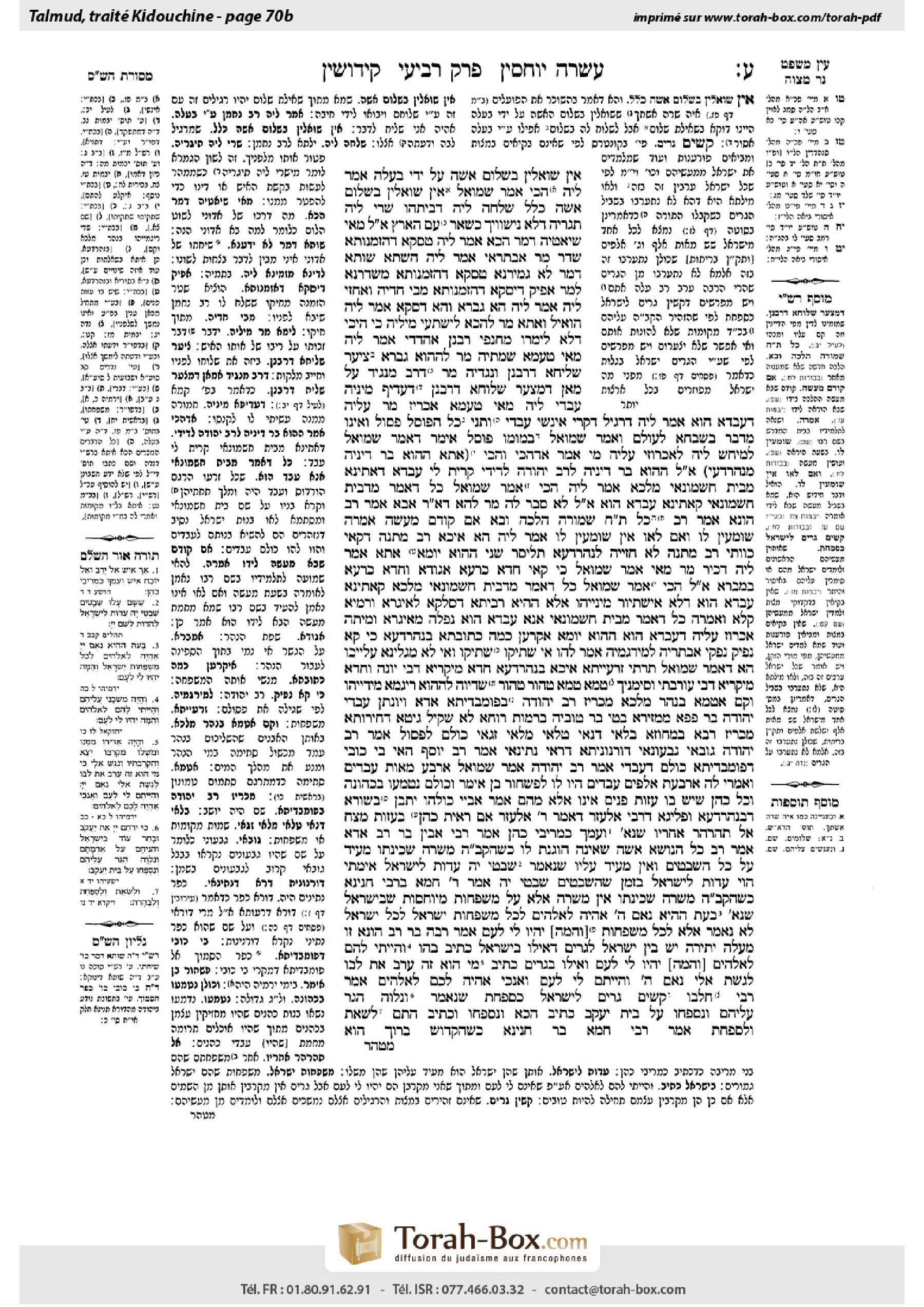
Kiddushin 70b: Talmud study for Daf Yomi
Daf Yomi is the daily study of one Talmud folio. Explore 37 tractates with scans, Hebrew text, Sefaria English and AI-generated French translations where annotated.
Passage selection and English or AI-generated French translation are available where the scan has annotations. Daf Study is independent of Torah-Box and Sefaria.
Browse Kiddushin · קידושין · All tractatesKiddushin 70b text and translations
This page of Kiddushin includes the Aramaic text, an English translation and an AI-generated French translation, alongside the scan above.
קידושין ע׳ ב · Aramaic and Hebrew text
אֵין שׁוֹאֲלִין בִּשְׁלוֹם אִשָּׁה. עַל יְדֵי בַּעְלָהּ! אֲמַר לֵיהּ: הָכִי אָמַר שְׁמוּאֵל: אֵין שׁוֹאֲלִין בִּשְׁלוֹם אִשָּׁה כְּלָל. שְׁלַחָה לֵיהּ דְּבֵיתְהוּ: שְׁרִי לֵיהּ תִּגְרֵיהּ דְּלָא נִישַׁוְּויָךְ כִּשְׁאָר עַם הָאָרֶץ.
אֲמַר לֵיהּ: מַאי שְׁיָאטֵיהּ דְּמָר הָכָא? אֲמַר לֵיהּ: טַסְקָא דְהַזְמָנוּתָא שַׁדַּר מָר אַבָּתְרַאי. אֲמַר לֵיהּ: הַשְׁתָּא שׁוּתָא דְמָר לָא גְּמִירְנָא, טַסְקָא דְהַזְמָנוּתָא מְשַׁדַּרְנָא לְמָר?! אַפֵּיק דִּיסְקָא דְהַזְמָנוּתָא מִבֵּי חָדֵיהּ וְאַחְזִי לֵיהּ, אֲמַר לֵיהּ: הָא גַּבְרָא וְהָא דִּסְקָא. אֲמַר לֵיהּ: הוֹאִיל וַאֲתָא מָר לְהָכָא לִישְׁתַּעֵי מִילֵּיהּ כִּי הֵיכִי דְּלָא לֵימְרוּ מְחַנְּפִי רַבָּנַן אַהֲדָדֵי.
אֲמַר לֵיהּ: מַאי טַעְמָא שַׁמְּתֵיהּ מָר לְהָהוּא גַּבְרָא? – צַיעַר שְׁלִיחָא דְרַבָּנַן. וְנַגְּדֵיהּ מָר, דְּרַב מְנַגֵּיד עַל מַאן דִּמְצַעַר שְׁלוּחָא דְרַבָּנַן. דַּעֲדִיף מִינֵּיהּ עֲבַדִי לֵיהּ.
מַאי טַעְמָא אַכְרֵיז מָר עֲלֵיהּ דְּעַבְדָּא הוּא? אֲמַר לֵיהּ: דִּרְגִיל דְּקָרֵי אִינָשֵׁי ״עַבְדֵי״, וְתָנֵי: כׇּל הַפּוֹסֵל – פָּסוּל, וְאֵינוֹ מְדַבֵּר בִּשְׁבָחָא לְעוֹלָם. וְאָמַר שְׁמוּאֵל: בְּמוּמוֹ פּוֹסֵל. אֵימַר דְּאָמַר שְׁמוּאֵל לְמֵיחַשׁ לֵיהּ, לְאַכְרוֹזֵי עֲלֵיהּ מִי אָמַר?
אַדְּהָכִי וְהָכִי (אֲתָא הַהוּא בַּר דִּינֵיהּ מִנְּהַרְדָּעֵי). אֲמַר לֵיהּ הָהוּא בַּר דִּינֵיהּ לְרַב יְהוּדָה: לְדִידִי קָרֵית לִי ״עַבְדָּא״, דְּאָתֵינָא מִבֵּית חַשְׁמוֹנַאי מַלְכָּא?! אֲמַר לֵיהּ: הָכִי אָמַר שְׁמוּאֵל: כֹּל דְּאָמַר מִדְּבֵית חַשְׁמוֹנַאי קָאָתֵינָא – עַבְדָּא הוּא.
אֲמַר לֵיהּ: לָא סָבַר לַהּ מָר לְהָא דְּאָמַר רַבִּי אַבָּא אָמַר רַב הוּנָא אָמַר רַב: כׇּל תַּלְמִיד חָכָם שֶׁמּוֹרֶה הֲלָכָה וּבָא, אִם קוֹדֶם מַעֲשֶׂה אֲמָרָהּ – שׁוֹמְעִין לוֹ, וְאִם לָאו – אֵין שׁוֹמְעִין לוֹ? אֲמַר לֵיהּ: הָא אִיכָּא רַב מַתְנָה דְּקָאֵי כְּווֹתִי.
רַב מַתְנָה לָא חַזְיַיהּ לִנְהַרְדְּעָא תְּלֵיסַר שְׁנֵי. הָהוּא יוֹמָא אֲתָא. אֲמַר לֵיהּ: דְּכִיר מָר מַאי אֲמַר שְׁמוּאֵל כִּי קָאֵי חֲדָא כַּרְעָא אַגּוּדָּא וַחֲדָא כַּרְעָא בְּמַבָּרָא? אֲמַר לֵיהּ: הָכִי אָמַר שְׁמוּאֵל: כֹּל דְּאָמַר מִדְּבֵית חַשְׁמוֹנַאי מַלְכָּא קָאָתֵינָא – עַבְדָּא הוּא, דְּלָא אִישְׁתְּיוּר מִינַּיְיהוּ אֶלָּא הַהִיא רְבִיתָא דְּסָלְקָא לְאִיגָּרָא וְרָמְיָא קָלָא וְאָמְרָה: כֹּל דְּאָמַר מִבֵּית חַשְׁמוֹנַאי אֲנָא – עַבְדָּא הוּא.
נְפַלָה מֵאִיגָּרָא וּמִיתָה. אַכְרוּז עֲלֵיהּ דְּעַבְדָּא הוּא.
הָהוּא יוֹמָא אִקַּרְעָן כַּמָּה כְּתוּבָּתָא בִּנְהַרְדְּעָא. כִּי קָא נָפֵיק, נָפְקִי אַבָּתְרֵיהּ לְמִירְגְּמֵיהּ. אֲמַר לְהוּ: אִי (שְׁתִיקוּ) [שָׁתְקִיתוּ] – שְׁתִיקוּ, וְאִי לָא מְגַלֵּינָא עֲלַיְיכוּ הָא דְּאָמַר שְׁמוּאֵל תַּרְתֵּי זַרְעֲיָיתָא אִיכָּא בִּנְהַרְדְּעָא: חֲדָא מִיקַּרְיָא דְּבֵי יוֹנָה, וַחֲדָא מִיקַּרְיָא דְּבֵי עוֹרַבְתִּי. וְסִימָנָיךְ: טָמֵא – טָמֵא, טָהוֹר – טָהוֹר. שַׁדְיוּהּ לְהָהוּא רִיגְמָא מִידַיְיהוּ וְקָם אַטְמָא בִּנְהַר מַלְכָּא.
מַכְרִיז רַב יְהוּדָה בְּפוּמְבְּדִיתָא: אַדָּא וְיוֹנָתָן – עַבְדֵי. יְהוּדָה בַּר פָּפָּא – מַמְזֵירָא, בָּטִי בַּר טוֹבִיָּה בְּרָמוּת רוּחָא לָא שָׁקֵיל גִּיטָּא דְחֵירוּתָא. מַכְרֵיז רָבָא בְּמָחוֹזָא: בַּלָּאֵי, דַּנָּאֵי, טַלָּאֵי, מַלָּאֵי, זַגָּאֵי – כּוּלָּם לִפְסוּל. אָמַר רַב יְהוּדָה: גּוֹבָאֵי – גִּבְעוֹנָאֵי, דּוּרְנוּנִיתָא – דָּרָאֵי נְתִינָאֵי. אָמַר רַב יוֹסֵף: הַאי בֵּי כוּבֵּי דְפוּמְבְּדִיתָא – כּוּלָּם דְּעַבְדֵי.
אָמַר רַב יְהוּדָה אָמַר שְׁמוּאֵל: אַרְבַּע מֵאוֹת עֲבָדִים, וְאָמְרִי לַהּ אַרְבַּעַת אֲלָפִים עֲבָדִים הָיוּ לוֹ לְפַשְׁחוּר בֶּן אִימֵּר, וְכוּלָּם נִטְמְעוּ בַּכְּהוּנָּה. וְכׇל כֹּהֵן שֶׁיֵּשׁ בּוֹ עַזּוּת פָּנִים אֵינוֹ אֶלָּא מֵהֶם. אָמַר אַבָּיֵי: כּוּלְּהוּ יָתְבָן בְּשׁוּרָא דְבִנְהַרְדְּעָא. וּפְלִיגָא דְּרַבִּי אֶלְעָזָר, דְּאָמַר רַבִּי אֶלְעָזָר: אִם רָאִיתָ כֹּהֵן בְּעַזּוּת מֵצַח – אַל תְּהַרְהֵר אַחֲרָיו, שֶׁנֶּאֱמַר: ״וְעַמְּךָ כִּמְרִיבֵי כֹהֵן״.
אָמַר רַבִּי אָבִין בַּר רַב אַדָּא אָמַר רַב: כׇּל הַנּוֹשֵׂא אִשָּׁה שֶׁאֵינָהּ הוֹגֶנֶת לוֹ, כְּשֶׁהַקָּדוֹשׁ בָּרוּךְ הוּא מַשְׁרֶה שְׁכִינָתוֹ מֵעִיד עַל כׇּל הַשְּׁבָטִים וְאֵין מֵעִיד עָלָיו, שֶׁנֶּאֱמַר: ״שִׁבְטֵי יָהּ עֵדוּת לְיִשְׂרָאֵל״, אֵימָתַי הָוֵי עֵדוּת לְיִשְׂרָאֵל – בִּזְמַן שֶׁהַשְּׁבָטִים שִׁבְטֵי יָהּ.
אָמַר רַבִּי חָמָא בְּרַבִּי חֲנִינָא: כְּשֶׁהַקָּדוֹשׁ בָּרוּךְ הוּא מַשְׁרֶה שְׁכִינָתוֹ – אֵין מַשְׁרֶה אֶלָּא עַל מִשְׁפָּחוֹת מְיוּחָסוֹת שֶׁבְּיִשְׂרָאֵל, שֶׁנֶּאֱמַר: ״בָּעֵת הַהִיא נְאֻם ה׳ אֶהְיֶה לֵאלֹהִים לְכֹל מִשְׁפְּחוֹת יִשְׂרָאֵל״, ״לְכׇל יִשְׂרָאֵל״ לֹא נֶאֱמַר, אֶלָּא ״לְכֹל מִשְׁפְּחוֹת״.
״[וְהֵמָּה] יִהְיוּ לִי לְעָם״, אָמַר רַבָּה בַּר רַב הוּנָא: זוֹ מַעֲלָה יְתֵירָה יֵשׁ בֵּין יִשְׂרָאֵל לְגֵרִים. דְּאִילּוּ בְּיִשְׂרָאֵל כְּתִיב בְּהוּ: ״וְהָיִיתִי לָהֶם לֵאלֹהִים וְהֵמָּה יִהְיוּ לִי לְעָם״, וְאִילּוּ בְּגֵרִים כְּתִיב: ״מִי הוּא זֶה עָרַב אֶת לִבּוֹ לָגֶשֶׁת אֵלַי נְאֻם ה׳. וִהְיִיתֶם לִי לְעָם וְאָנֹכִי אֶהְיֶה לָכֶם לֵאלֹהִים״.
אָמַר רַבִּי חֶלְבּוֹ: קָשִׁים גֵּרִים לְיִשְׂרָאֵל כְּסַפַּחַת, שֶׁנֶּאֱמַר: ״וְנִלְוָה הַגֵּר עֲלֵיהֶם וְנִסְפְּחוּ עַל בֵּית יַעֲקֹב״ – כְּתִיב הָכָא ״וְנִסְפְּחוּ״, וּכְתִיב הָתָם ״לַשְּׂאֵת וְלַסַּפַּחַת״.
אָמַר רַבִּי חָמָא בַּר חֲנִינָא: כְּשֶׁהַקָּדוֹשׁ בָּרוּךְ הוּא
Kiddushin 70b · English translation
One may not send greetings to a woman even with a messenger, as this may cause the messenger and the woman to relate to each other inappropriately. Rav Naḥman countered by suggesting that he send his greetings with her husband, which would remove all concerns. Rav Yehuda said to him: This is what Shmuel says: One may not send greetings to a woman at all. Yalta, his wife, who overheard that Rav Yehuda was getting the better of the exchange, sent a message to him: Release him and conclude your business with him, so that he not equate you with another ignoramus.
Desiring to release Rav Yehuda, Rav Naḥman said to him: What is the reason that the Master is here? Rav Yehuda said to him: The Master sent me a summons. Rav Naḥman said to him: Now that I have not even learned the Master’s form of speech, as you have demonstrated your superiority to me by reproving me even over such matters, could I have sent a summons to the Master? Rav Yehuda removed the summons from his bosom and showed it to him. While doing so, Rav Yehuda said to him: Here is the man and here is the document. Rav Naḥman said to him: Since the Master has come here, let him present his statement, in order that people should not say: The Sages flatter one another and do not judge each other according to the letter of the law.
Rav Naḥman commenced the deliberation, and said to him: What is the reason that the Master excommunicated that man? Rav Yehuda replied: He caused discomfort to an agent of one of the Sages, and therefore he deserved the punishment of one who causes discomfort to a Torah scholar. Rav Naḥman challenged this answer: If so, let the Master flog him, as Rav would flog one who causes discomfort to an agent of the Sages. Rav Yehuda responded: I punished him more severely than that. Rabbi Yehuda held that excommunication is a more severe punishment than flogging.
Rav Naḥman further inquired: What is the reason that the Master proclaimed about him that he is a slave? Rav Yehuda said to him: Because he is in the habit of calling people slaves, and it is taught: Anyone who disqualifies others by stating that their lineage is flawed, that is a sign that he himself is of flawed lineage. Another indication of his lineage being flawed is that he never speaks in praise of others. And Shmuel said: He disqualifies with his own flaw. Rav Naḥman retorted: You can say that Shmuel said this halakha only to the degree that one should suspect him of being of flawed lineage. But did he actually say this to the extent that one could proclaim about him that he is of flawed lineage?
The Gemara continues the story: Meanwhile, that litigant arrived from Neharde’a. That litigant said to Rav Yehuda: You call me a slave? I, who come from the house of the Hasmonean kings? Rav Yehuda said to him: This is what Shmuel says: Anyone who says: I come from the house of the Hasmonean kings, is a slave. As will be explained, only slaves remained of their descendants.
Rav Naḥman, who heard this exchange, said to Rav Yehuda: Does the Master not hold in accordance with this halakha that Rabbi Abba says that Rav Huna says that Rav says: With regard to any Torah scholar who proceeds to teach a ruling of halakha with regard to a particular issue, if he said it before an action that concerns himself occurred, they should listen to him, and his ruling is accepted. But if not, if he quoted the halakha only after he was involved in an incident related to the halakha he is quoting, they do not listen to him, due to his personal involvement? Your testimony with regard to what Shmuel ruled should be ignored, as you stated it only after the incident. Rav Yehuda said to Rav Naḥman: There is Rav Mattana, who stands by my report, since he has also heard this ruling of Shmuel.
The Gemara continues: Rav Mattana had not seen the city of Neharde’a for thirteen years. That very day he arrived. Rav Yehuda said to him: Does the Master remember what Shmuel said when he was standing with one foot on the bank and one foot on the ferry? Rav Mattana said to him: This is what Shmuel said at that time: Anyone who says: I come from the house of the Hasmonean kings, is a slave, as none remained of them except for that young girl who ascended to the roof and raised her voice and said: From now on, anyone who says: I come from the house of the Hasmonean kings, is a slave. Other than this girl, the only members of the family who remained were descendants of Herod, and he was an Edomite slave.
The girl then fell from the roof and died, leaving only slaves from the Hasmoneans. With the confirmation of the report of the statement of Shmuel, they also publicized in Neharde’a about him, i.e., that man who claimed to come from the Hasmonean kings, that he was a slave.
The Gemara relates: On that day, several marriage contracts were torn up in Neharde’a, as many had their marriages annulled after having discovered that they had married slaves. When Rav Yehuda was leaving Neharde’a, they pursued him, seeking to stone him, as because of him it was publicized that their lineage was flawed. Rav Yehuda said to them: If you are silent, remain silent. And if you will not remain silent, I will reveal about you this statement that Shmuel said: There are two lines of offspring in Neharde’a. One is called the dove’s house, and one is called the raven’s house. And your mnemonic with regard to lineage is: The impure bird, the raven, is impure, meaning flawed, and the pure one, the dove, is pure, meaning unflawed. Upon hearing this, they threw all those stones that they were intending to stone him with from their hands, as they did not want him to reveal who had a flawed lineage. And as a result of all of the stones thrown into the river, a dam arose in the Malka River.
§ The Gemara continues the discussion of those with a flawed lineage: Rav Yehuda proclaimed in Pumbedita: Adda and Yonatan, known residents of that town, are slaves; Yehuda bar Pappa is a mamzer; Bati bar Tuviyya, in his arrogance, did not accept a bill of manumission and is still a slave. Rava proclaimed in his city of Meḥoza: Balla’ai, Danna’ai, Talla’ai, Malla’ai, Zagga’ai: All these families are of flawed lineage. Rav Yehuda likewise says: Gova’ai, the inhabitants of a place called Gova, are in fact Gibeonites, and their name has been corrupted. Similarly, those people known as Dorenunita are from the village of Gibeonites, and they may not marry Jews with unflawed lineage. Rav Yosef says: With regard to this place called Bei Kuvei of Pumbedita, its residents are all descendants of slaves.
Rav Yehuda says that Shmuel says: Four hundred slaves, and some say four thousand slaves, were owned by Pashḥur ben Immer, a priest in the time of Jeremiah, and due to their greatness they were assimilated into the priesthood and became known as priests. And any priest who has the trait of insolence is only from them. Abaye said: They all sit in the rows of honor that are in the city of Neharde’a. The Gemara comments: And this statement disagrees with the statement of Rabbi Elazar, as Rabbi Elazar says: If you see an insolent priest, do not speculate about him that he may be of flawed lineage, since it is stated: “For your people are as those who strive with a priest” (Hosea 4:4), which indicates that priests had a reputation for being cantankerous.
§ The Gemara discusses an idea raised earlier. Rabbi Avin bar Rav Adda says that Rav says: Concerning anyone who marries a woman who is not suited for him to marry, when the Holy One, Blessed be He, rests His Divine Presence upon the Jewish people, He testifies with regard to all the tribes that they are His people, but He does not testify with regard to he who married improperly, as it is stated: “The tribes of the Lord, as a testimony to Israel” (Psalms 122:4). When is it a testimony to Israel? When the tribes are the tribes of the Lord, but not when their lineage is flawed.
Rabbi Ḥama, son of Rabbi Ḥanina, says: When the Holy One, Blessed be He, rests His Divine Presence, He rests it only upon families of unflawed lineage among Israel, as it is stated: “At that time, says the Lord, will I be the God of all the families of Israel” (Jeremiah 30:25). Of all Israel, is not stated, but “of all the families,” which includes only those of unflawed lineage, the renowned families of Israel.
The verse from Jeremiah ends with the words “And they shall be my people.” Rabba bar Rav Huna says: This is a higher standard that differentiates between those born as Jews and converts, as with regard to those born as Jews it is written about them: “And I will be their God, and they shall be My people” (Ezekiel 37:27), whereas with regard to converts it is written: “For who is he that has pledged his heart to approach unto Me? says the Lord. And you shall be My people, and I will be your God” (Jeremiah 30:21–22). This teaches that converts are not drawn close to God, as indicated by the words “And I will be your God,” until they first draw themselves near to God, as indicated by the subsequent phrase “And you shall be my people.”
Rabbi Ḥelbo says: Converts are as difficult for the Jewish people as a scab. The proof is that it is stated: “And the convert shall join himself with them, and they shall cleave [venispeḥu] to the house of Jacob” (Isaiah 14:1). It is written here “venispeḥu,” and it is written there, among the types of leprosy: “And for a sore and for a scab [sappaḥat]” (Leviticus 14:56). The use of a term with a similar root indicates that converts are like a scab for the Jewish people.
Rabbi Ḥama bar Ḥanina says: When the Holy One, Blessed be He,
Kiddushin 70b · Traduction française (IA)
On ne doit pas adresser ses salutations à une femme, même par l’intermédiaire d’un messager, car cela pourrait conduire le messager et la femme à entretenir des relations inconvenantes. Rav Naḥman rétorqua en suggérant d’envoyer ses salutations par l’intermédiaire de son mari, ce qui écarterait toute inquiétude. Rav Yehuda lui dit : Voici ce que dit Shmuel : On ne doit jamais adresser ses salutations à une femme. Yalta, son épouse, qui avait entendu que Rav Yehuda prenait le dessus dans l’échange, lui fit transmettre ce message : « Laisse-le partir et règle ton affaire avec lui, afin qu’il ne te mette pas au même rang qu’un autre ignorant. »
Désireux de laisser Rav Yehuda partir, Rav Naḥman lui dit : Pour quelle raison le Maître est-il ici ? Rav Yehuda lui répondit : Le Maître m’a envoyé une convocation. Rav Naḥman lui dit : Puisque je ne connais même pas la manière de parler du Maître, comme tu viens de le démontrer en me reprenant jusque sur de telles questions, aurais-je pu envoyer une convocation au Maître ? Rav Yehuda sortit la convocation de son sein et la lui montra. Ce faisant, Rav Yehuda lui dit : Voici l’homme et voici le document. Rav Naḥman lui dit : Puisque le Maître est venu ici, qu’il présente sa requête, afin que les gens ne disent pas : « Les Sages se flattent mutuellement et ne se jugent pas selon la lettre de la loi. »
Rav Naḥman ouvrit la délibération et lui dit : Pour quelle raison le Maître a-t-il mis cet homme au ban ? Rav Yehuda répondit : Il a causé du tort à un émissaire de l’un des Sages ; il méritait donc la peine infligée à celui qui cause du tort à un érudit en Torah. Rav Naḥman contesta cette réponse : Dans ce cas, que le Maître le flagelle, comme Rav flagellait celui qui causait du tort à un émissaire des Sages. Rav Yehuda répondit : Je l’ai puni plus sévèrement que cela. Rav Yehuda considérait que la mise au ban était une peine plus sévère que la flagellation.
Rav Naḥman demanda en outre : Pour quelle raison le Maître a-t-il proclamé qu’il était esclave ? Rav Yehuda lui répondit : Parce qu’il a l’habitude de traiter les gens d’esclaves, et il est enseigné : Quiconque déclare que la lignée d’autrui est entachée révèle par là que sa propre lignée est entachée. Un autre indice de sa lignée entachée est qu’il ne fait jamais l’éloge d’autrui. Et Shmuel a dit : Il attribue à autrui le défaut qui est le sien. Rav Naḥman rétorqua : Tu peux dire que Shmuel a enseigné cette halakha seulement dans la mesure où l’on doit le soupçonner d’avoir une lignée entachée. Mais a-t-il réellement dit cela au point qu’on puisse proclamer qu’il a une lignée entachée ?
La Guemara poursuit le récit : Entre-temps, le plaideur arriva de Neharde’a. Il dit à Rav Yehuda : « Tu me traites d’esclave ? Moi, qui descends de la maison des rois hasmonéens ? » Rav Yehuda lui répondit : Voici ce que dit Shmuel : Quiconque dit : « Je descends de la maison des rois hasmonéens » est un esclave. Comme on l’expliquera, seuls des esclaves subsistaient parmi leurs descendants.
Rav Naḥman, qui avait entendu cet échange, dit à Rav Yehuda : Le Maître ne se conforme-t-il pas à cette halakha que Rabbi Abba rapporte au nom de Rav Huna, qui la rapporte au nom de Rav : S’agissant de tout érudit en Torah qui s’apprête à enseigner une décision de halakha sur une question particulière, s’il l’a énoncée avant qu’un cas le concernant ne se produise, on doit l’écouter et sa décision est acceptée. Mais dans le cas contraire, s’il n’a cité cette halakha qu’après avoir été impliqué dans un incident relevant de la halakha qu’il cite, on ne l’écoute pas, en raison de son intérêt personnel. Il faut donc écarter ton témoignage concernant la décision de Shmuel, puisque tu ne l’as rapportée qu’après l’incident. Rav Yehuda dit à Rav Naḥman : Rav Mattana peut confirmer mon témoignage, car lui aussi a entendu cette décision de Shmuel.
La Guemara poursuit : Rav Mattana n’avait pas vu la ville de Neharde’a depuis treize ans. Ce jour-là même, il y arriva. Rav Yehuda lui dit : Le Maître se souvient-il de ce que Shmuel a dit alors qu’il se tenait un pied sur la rive et l’autre sur le bac ? Rav Mattana lui répondit : Voici ce que Shmuel a dit à ce moment-là : Quiconque dit : « Je descends de la maison des rois hasmonéens » est un esclave, car aucun d’eux n’avait survécu, à l’exception de cette jeune fille qui monta sur le toit, éleva la voix et dit : « Désormais, quiconque dit : “Je descends de la maison des rois hasmonéens” est un esclave. » À part cette jeune fille, les seuls membres de la famille qui subsistaient étaient les descendants d’Hérode, qui était un esclave iduméen.
La jeune fille tomba ensuite du toit et mourut ; seuls des esclaves subsistèrent donc parmi les Hasmonéens. Une fois le témoignage confirmant la déclaration de Shmuel établi, on proclama également à Neharde’a que cet homme, celui qui prétendait descendre des rois hasmonéens, était un esclave.
La Guemara rapporte : Ce jour-là, plusieurs contrats de mariage furent déchirés à Neharde’a, car beaucoup firent annuler leur mariage après avoir découvert qu’ils avaient épousé des esclaves. Quand Rav Yehuda quitta Neharde’a, on le poursuivit pour le lapider, car c’était à cause de lui qu’on avait révélé que leur lignée était entachée. Rav Yehuda leur dit : « Si vous vous taisez, taisez-vous. Mais si vous ne vous taisez pas, je révélerai à votre sujet cette déclaration de Shmuel : Il y a deux lignées à Neharde’a. L’une est appelée la maison de la colombe, et l’autre la maison du corbeau. Et voici le moyen mnémotechnique concernant la lignée : l’oiseau impur, le corbeau, est impur, c’est-à-dire que sa lignée est entachée, tandis que l’oiseau pur, la colombe, est pur, c’est-à-dire que sa lignée n’est pas entachée. » À ces mots, ils jetèrent à terre toutes les pierres avec lesquelles ils s’apprêtaient à le lapider, car ils ne voulaient pas qu’il révèle qui avait une lignée entachée. Toutes les pierres ainsi jetées dans le fleuve formèrent une digue dans le fleuve Malka.
§ La Guemara poursuit la discussion sur ceux dont la lignée est entachée : Rav Yehuda proclama à Pumbedita : Adda et Yonatan, habitants connus de cette ville, sont des esclaves ; Yehuda bar Pappa est un mamzer ; Bati bar Tuviyya, dans son arrogance, n’a pas accepté d’acte d’affranchissement et demeure donc esclave. Rava proclama dans sa ville, Meḥoza : Balla’ai, Danna’ai, Talla’ai, Malla’ai, Zagga’ai : toutes ces familles ont une lignée entachée. Rav Yehuda dit également : les Gova’ai, habitants d’un lieu appelé Gova, sont en réalité des Guivéonites, et leur nom a été déformé. De même, ceux que l’on appelle les Dorenunita viennent du village des Guivéonites et ne peuvent pas épouser des Juifs dont la lignée n’est pas entachée. Rav Yosef dit : Dans ce lieu appelé Bei Kuvei, à Pumbedita, tous les habitants descendent d’esclaves.
Rav Yehuda dit au nom de Shmuel : Pashḥur ben Immer, un prêtre du temps de Jérémie, possédait quatre cents esclaves — et certains disent quatre mille — qui, en raison de leur importance, furent intégrés au sacerdoce et devinrent connus comme prêtres. Tout prêtre qui manifeste de l’insolence ne peut provenir que d’eux. Abaye dit : Ils siègent tous sur les rangées d’honneur de la ville de Neharde’a. La Guemara fait remarquer que cette déclaration est en désaccord avec celle de Rabbi Elazar, car Rabbi Elazar dit : Si tu vois un prêtre insolent, ne conjecture pas qu’il pourrait avoir une lignée entachée, car il est dit : « Car ton peuple est comme ceux qui contestent avec le prêtre » (Osée 4, 4), ce qui indique que les prêtres avaient la réputation d’être querelleurs.
§ La Guemara examine une idée évoquée précédemment. Rabbi Avin bar Rav Adda dit au nom de Rav : Quiconque épouse une femme qu’il ne convient pas d’épouser, lorsque le Saint, béni soit-Il, fait résider Sa Présence divine sur le peuple juif, Dieu témoigne que toutes les tribus sont Son peuple, mais Il ne témoigne pas en faveur de celui qui a épousé une femme de manière inappropriée, comme il est dit : « Les tribus du Seigneur, témoignage pour Israël » (Psaumes 122, 4). Quand cela constitue-t-il un témoignage pour Israël ? Lorsque les tribus sont les tribus du Seigneur, mais pas lorsque leur lignée est entachée.
Rabbi Ḥama, fils de Rabbi Ḥanina, dit : Lorsque le Saint, béni soit-Il, fait résider Sa Présence divine, Il ne la fait résider que sur les familles de lignée non entachée parmi Israël, comme il est dit : « En ce temps-là, dit le Seigneur, Je serai le Dieu de toutes les familles d’Israël » (Jérémie 30, 25). Il n’est pas dit « de tout Israël », mais « de toutes les familles », ce qui ne désigne que celles dont la lignée n’est pas entachée, les familles renommées d’Israël.
Le verset de Jérémie se termine par les mots : « Et ils seront Mon peuple. » Rabba bar Rav Huna dit : Cela établit une norme plus élevée qui distingue ceux qui sont nés juifs des convertis. À propos de ceux qui sont nés juifs, il est écrit : « Je serai leur Dieu, et ils seront Mon peuple » (Ézéchiel 37, 27), tandis qu’à propos des convertis, il est écrit : « Car qui est celui qui a engagé son cœur à s’approcher de Moi ? dit le Seigneur. Vous serez Mon peuple, et Je serai votre Dieu » (Jérémie 30, 21-22). Cela enseigne que les convertis ne sont rapprochés de Dieu, comme l’indiquent les mots « Je serai votre Dieu », qu’après s’être eux-mêmes rapprochés de Lui, comme l’indique la phrase suivante : « Vous serez Mon peuple. »
Rabbi Ḥelbo dit : Les convertis sont aussi difficiles pour le peuple juif qu’une croûte. La preuve en est qu’il est dit : « Le converti se joindra à eux, et ils s’attacheront [venispeḥu] à la maison de Jacob » (Isaïe 14, 1). Ici, il est écrit « venispeḥu », et ailleurs, parmi les formes de lèpre, il est écrit : « et pour une plaie et pour une croûte [sappaḥat] » (Lévitique 14, 56). L’emploi de termes issus de racines semblables indique que les convertis sont comme une croûte pour le peuple juif.
Rabbi Ḥama bar Ḥanina dit : Lorsque le Saint, béni soit-Il,
Traduction française générée par IA à partir de l’édition anglaise de Sefaria. Vérifie toujours un passage avec le texte source.
Text from Sefaria: William Davidson Edition - Vocalized Aramaic (CC BY NC); William Davidson Edition - English (CC BY NC).