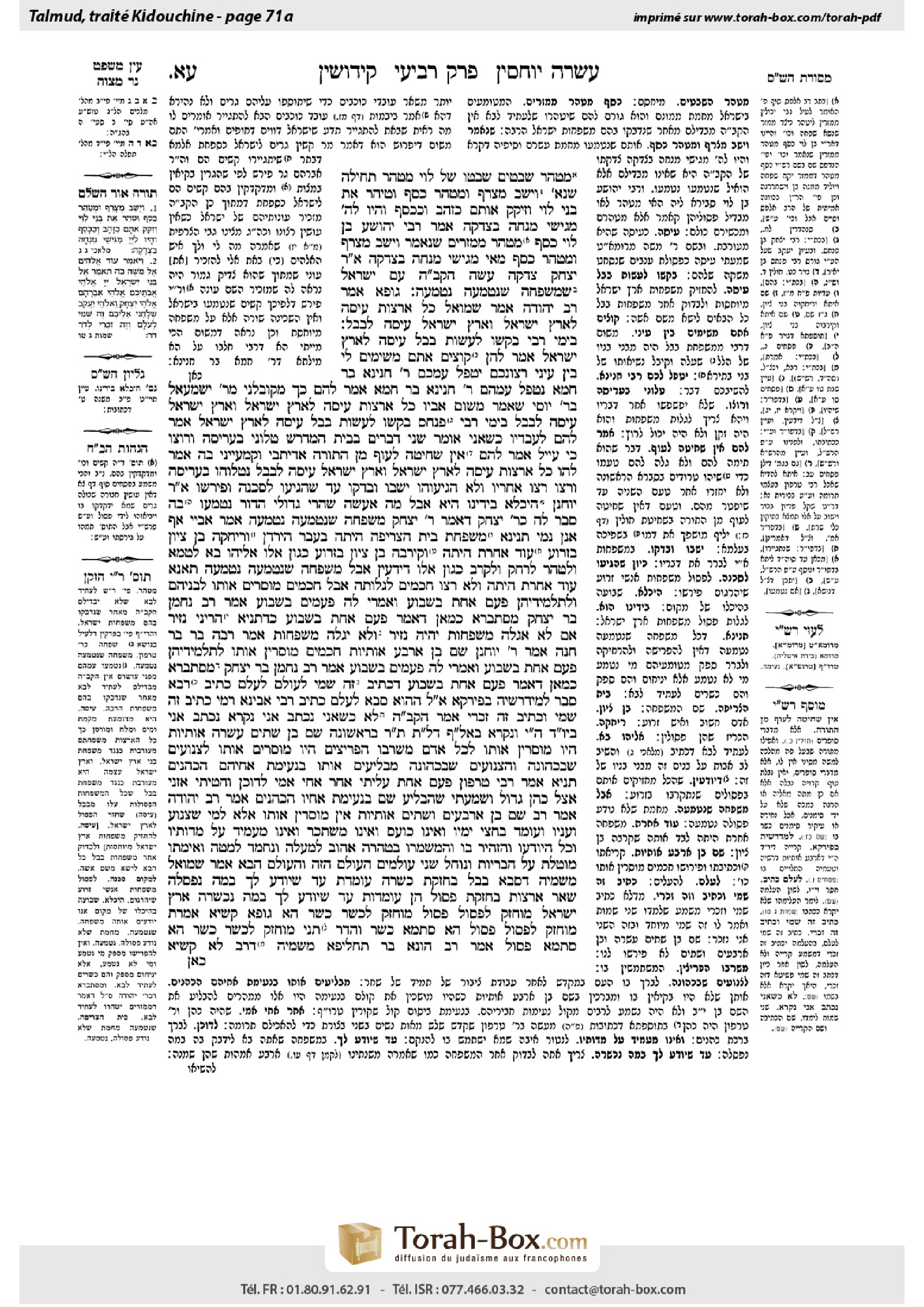
Kiddushin 71a: Talmud study for Daf Yomi
Daf Yomi is the daily study of one Talmud folio. Explore 37 tractates with scans, Hebrew text, Sefaria English and AI-generated French translations where annotated.
Passage selection and English or AI-generated French translation are available where the scan has annotations. Daf Study is independent of Torah-Box and Sefaria.
Browse Kiddushin · קידושין · All tractatesKiddushin 71a text and translations
This page of Kiddushin includes the Aramaic text, an English translation and an AI-generated French translation, alongside the scan above.
קידושין ע״א א · Aramaic and Hebrew text
מְטַהֵר שְׁבָטִים, שִׁבְטוֹ שֶׁל לֵוִי מְטַהֵר תְּחִילָּה, שֶׁנֶּאֱמַר: ״וַיֵּשֶׁב מְצָרֵף וּמְטַהֵר כֶּסֶף וְטִהַר אֶת בְּנֵי לֵוִי וְזִקַּק אֹתָם כַּזָּהָב וְכַכָּסֶף וְהָיוּ לַה׳ מַגִּישֵׁי מִנְחָה בִּצְדָקָה״.
אָמַר רַבִּי יְהוֹשֻׁעַ בֶּן לֵוִי: כֶּסֶף מְטַהֵר מַמְזֵרִים, שֶׁנֶּאֱמַר: ״וַיֵּשֶׁב מְצָרֵף וּמְטַהֵר כֶּסֶף״. מַאי ״מַגִּישֵׁי מִנְחָה בִּצְדָקָה״? אָמַר רַבִּי יִצְחָק: צְדָקָה עָשָׂה הַקָּדוֹשׁ בָּרוּךְ הוּא עִם יִשְׂרָאֵל, שֶׁמִּשְׁפָּחָה שֶׁנִּטְמְעָה – נִטְמְעָה.
גּוּפָא, אָמַר רַב יְהוּדָה אָמַר שְׁמוּאֵל: כׇּל אֲרָצוֹת עִיסָּה לְאֶרֶץ יִשְׂרָאֵל, וְאֶרֶץ יִשְׂרָאֵל עִיסָּה לְבָבֶל. בִּימֵי רַבִּי בִּקְּשׁוּ לַעֲשׂוֹת בָּבֶל עִיסָּה לְאֶרֶץ יִשְׂרָאֵל. אָמַר לָהֶן: קוֹצִים אַתֶּם מְשִׂימִים לִי בֵּין עֵינַי? רְצוֹנְכֶם, יִטָּפֵל עִמָּכֶם רַבִּי חֲנִינָא בַּר חָמָא.
נִטְפַּל עִמָּהֶם רַבִּי חֲנִינָא בַּר חָמָא, אָמַר לָהֶם: כָּךְ מְקוּבְּלַנִי מֵרַבִּי יִשְׁמָעֵאל בְּרַבִּי יוֹסֵי שֶׁאָמַר מִשּׁוּם אָבִיו: כׇּל אֲרָצוֹת עִיסָּה לְאֶרֶץ יִשְׂרָאֵל וְאֶרֶץ יִשְׂרָאֵל עִיסָּה לְבָבֶל.
בִּימֵי רַבִּי פִּנְחָס בִּקְּשׁוּ לַעֲשׂוֹת בָּבֶל עִיסָּה לְאֶרֶץ יִשְׂרָאֵל. אָמַר לָהֶם לַעֲבָדָיו: כְּשֶׁאֲנִי אוֹמֵר שְׁנֵי דְבָרִים בְּבֵית הַמִּדְרָשׁ טְלוּנִי בַּעֲרִיסָה וְרוּצוּ. כִּי עָיֵיל אָמַר לָהֶם: אֵין שְׁחִיטָה לָעוֹף מִן הַתּוֹרָה.
אַדְּיָתְבִי וְקָמְעַיְּינִי בַּהּ, אֲמַר לְהוּ: כׇּל אֲרָצוֹת עִיסָּה לְאֶרֶץ יִשְׂרָאֵל, וְאֶרֶץ יִשְׂרָאֵל עִיסָּה לְבָבֶל. נְטָלוּהוּ בַּעֲרִיסָה וְרָצוּ. רָצוּ אַחֲרָיו וְלֹא הִגִּיעוּהוּ. יָשְׁבוּ וּבָדְקוּ עַד שֶׁהִגִּיעוּ לְסַכָּנָה וּפֵירְשׁוּ.
אָמַר רַבִּי יוֹחָנָן: הֵיכְלָא, בְּיָדֵינוּ הִיא, אֲבָל מָה אֶעֱשֶׂה שֶׁהֲרֵי גְּדוֹלֵי הַדּוֹר נִטְמְעוּ בָּהּ. סָבַר לַהּ כְּרַבִּי יִצְחָק, דְּאָמַר רַבִּי יִצְחָק: מִשְׁפָּחָה שֶׁנִּטְמְעָה – נִטְמְעָה.
אָמַר אַבָּיֵי: אַף אֲנַן נָמֵי תְּנֵינָא: מִשְׁפַּחַת בֵּית הַצְּרִיפָה הָיְתָה בְּעֵבֶר הַיַּרְדֵּן וְרִיחֲקָהּ בֶּן צִיּוֹן בִּזְרוֹעַ. עוֹד אַחֶרֶת הָיְתָה וְקֵירְבָהּ בֶּן צִיּוֹן בִּזְרוֹעַ. כְּגוֹן אֵלּוּ – אֵלִיָּהוּ בָּא לְטַמֵּא וּלְטַהֵר, לְרַחֵק וּלְקָרֵב – כְּגוֹן אֵלּוּ דְּיָדְעִין, אֲבָל מִשְׁפָּחָה שֶׁנִּטְמְעָה – נִטְמְעָה.
תָּאנָא: עוֹד אַחֶרֶת הָיְתָה, וְלֹא רָצוּ חֲכָמִים לְגַלּוֹתָהּ. אֲבָל חֲכָמִים מוֹסְרִים אוֹתוֹ לִבְנֵיהֶם וּלְתַלְמִידֵיהֶן פַּעַם אַחַת בְּשָׁבוּעַ, וְאָמְרִי לַהּ פַּעֲמַיִם בְּשָׁבוּעַ. אָמַר רַב נַחְמָן בַּר יִצְחָק: מִסְתַּבְּרָא כְּמַאן דְּאָמַר פַּעַם אַחַת בְּשָׁבוּעַ. כִּדְתַנְיָא: ״הֲרֵינִי נָזִיר אִם לֹא אֲגַלֶּה מִשְׁפָּחוֹת״ – יִהְיֶה נָזִיר, וְלֹא יְגַלֶּה מִשְׁפָּחוֹת.
אָמַר רַבָּה בַּר בַּר חָנָה, אָמַר רַבִּי יוֹחָנָן: שֵׁם בֶּן אַרְבַּע אוֹתִיּוֹת חֲכָמִים מוֹסְרִין אוֹתוֹ לְתַלְמִידֵיהֶן פַּעַם אַחַת בְּשָׁבוּעַ, וְאָמְרִי לַהּ פַּעֲמַיִם בְּשָׁבוּעַ. אָמַר רַב נַחְמָן בַּר יִצְחָק: מִסְתַּבְּרָא כְּמַאן דְּאָמַר פַּעַם אַחַת בְּשָׁבוּעַ, דִּכְתִיב: ״זֶה שְּׁמִי לְעֹלָם״, ״לְעַלֵּם״ כְּתִיב. רָבָא סָבַר לְמִידְרְשֵׁיהּ בְּפִירְקָא. אֲמַר לֵיהּ הָהוּא סָבָא: ״לְעַלֵּם״ כְּתִיב.
רַבִּי אֲבִינָא רָמֵי: כְּתִיב ״זֶה שְּׁמִי״, וּכְתִיב ״זֶה זִכְרִי״. אָמַר הַקָּדוֹשׁ בָּרוּךְ הוּא: לֹא כְּשֶׁאֲנִי נִכְתָּב אֲנִי נִקְרָא, נִכְתָּב אֲנִי בְּיוֹד הֵי וְנִקְרָא בְּאָלֶף דָּלֶית.
תָּנוּ רַבָּנַן: בָּרִאשׁוֹנָה, שֵׁם בֶּן שְׁתֵּים עֶשְׂרֵה אוֹתִיּוֹת הָיוּ מוֹסְרִין אוֹתוֹ לְכׇל אָדָם, מִשֶּׁרַבּוּ הַפָּרִיצִים – הָיוּ מוֹסְרִים אוֹתוֹ לִצְנוּעִים שֶׁבַּכְּהוּנָּה, וְהַצְּנוּעִים שֶׁבַּכְּהוּנָּה מַבְלִיעִים אוֹתוֹ בִּנְעִימַת אֲחֵיהֶם הַכֹּהֲנִים. תַּנְיָא אָמַר רַבִּי טַרְפוֹן: פַּעַם אַחַת עָלִיתִי אַחַר אֲחִי אִמִּי לַדּוּכָן, וְהִטֵּיתִי אָזְנִי אֵצֶל כֹּהֵן גָּדוֹל וְשָׁמַעְתִּי שֶׁהִבְלִיעַ שֵׁם בִּנְעִימַת אֶחָיו הַכֹּהֲנִים.
אָמַר רַב יְהוּדָה אָמַר רַב: שֵׁם בֶּן אַרְבָּעִים וּשְׁתַּיִם אוֹתִיּוֹת אֵין מוֹסְרִין אוֹתוֹ אֶלָּא לְמִי שֶׁצָּנוּעַ וְעָנָיו, וְעוֹמֵד בַּחֲצִי יָמָיו, וְאֵינוֹ כּוֹעֵס, וְאֵינוֹ מִשְׁתַּכֵּר, וְאֵינוֹ מַעֲמִיד עַל מִדּוֹתָיו. וְכׇל הַיּוֹדְעוֹ, וְהַזָּהִיר בּוֹ וְהַמְשַׁמְּרוֹ בְּטׇהֳרָה – אָהוּב לְמַעְלָה, וְנֶחְמָד לְמַטָּה, וְאֵימָתוֹ מוּטֶּלֶת עַל הַבְּרִיּוֹת, וְנוֹחֵל שְׁנֵי עוֹלָמִים – הָעוֹלָם הַזֶּה וְהָעוֹלָם הַבָּא.
אָמַר שְׁמוּאֵל מִשְּׁמֵיהּ דְּסָבָא: בָּבֶל בְּחֶזְקַת כְּשֵׁרָה עוֹמֶדֶת, עַד שֶׁיִּוָּדַע לָךְ בַּמֶּה נִפְסְלָה. שְׁאָר אֲרָצוֹת – בְּחֶזְקַת פְּסוּל הֵן עוֹמְדוֹת, עַד שֶׁיִּוָּדַע לָךְ בַּמֶּה נִכְשְׁרָה. אֶרֶץ יִשְׂרָאֵל מוּחְזָק לְפָסוּל – פָּסוּל, מוּחְזָק לְכָשֵׁר – כָּשֵׁר.
הָא גוּפַאּ קַשְׁיָא: אָמְרַתְּ מוּחְזָק לְפָסוּל – פָּסוּל. הָא סְתָמָא – כָּשֵׁר. וַהֲדַר תָּנֵי: מוּחְזָק לְכָשֵׁר – כָּשֵׁר. הָא סְתָמָא – פָּסוּל! אָמַר רַב הוּנָא בַּר תַּחְלִיפָא מִשְּׁמֵיהּ דְּרַב: לָא קַשְׁיָא,
Kiddushin 71a · English translation
purifies the tribes, i.e., clarifies their lineage, He will purify that of the tribe of Levi first, as it is stated with regard to the angel sent forth by God: “And he shall sit as a refiner and purifier of silver; and he shall purify the sons of Levi, and purge them as gold and silver; and there shall be they that shall offer to the Lord offerings in righteousness” (Malachi 3:3).
Rabbi Yehoshua ben Levi says: Money purifies mamzerim. Money causes rich mamzerim to become assimilated with Jews of unflawed lineage, since other families marry them despite their flawed lineage. In the future, God will not single them out as mamzerim, as it is stated: “And he shall sit as a refiner and purifier of silver,” which teaches that money, i.e., silver, purifies them. What, then, is the connection to the next part of the verse: “They that shall offer to the Lord offerings in righteousness”? Rabbi Yitzḥak says: The Holy One, Blessed be He, performed an act of righteousness with the Jewish people by establishing that a family that has become assimilated with Jews of unflawed lineage remains assimilated. They are not removed from their tribe despite their flawed lineage.
§ With regard to the matter itself that was discussed earlier, the lineage of the Jews in various lands, Rav Yehuda says that Shmuel says: The lineage of residents of all lands is muddled compared to that of the residents of Eretz Yisrael, and the lineage of residents of Eretz Yisrael is muddled compared to that of Babylonia. The Gemara relates: In the days of Rabbi Yehuda HaNasi, they sought to establish the lineage of the Jews in Babylonia as muddled relative to that of Eretz Yisrael. In other words, the people of Eretz Yisrael wanted their lineage to be considered superior to that of the residents of Babylonia, so that if people from Eretz Yisrael would wish to marry Babylonians, they would have to investigate the lineage of the Babylonians. Rabbi Yehuda HaNasi was descended from Hillel, a Babylonian, so he said to those who put forth this suggestion: Are you placing thorns between my eyes? Do you wish to insult me? If you wish, Rabbi Ḥanina bar Ḥama will join you and explain it to you.
Rabbi Ḥanina bar Ḥama joined them and said to them: This is the tradition that I received from Rabbi Yishmael, son of Rabbi Yosei, who says in the name of his father, who was from Eretz Yisrael: The lineage of residents of all lands is muddled compared to that of Eretz Yisrael, and the lineage of residents of Eretz Yisrael is muddled compared to that of Babylonia.
The Gemara further relates with regard to the same issue: In the days of Rabbi Pineḥas, they sought to establish the lineage of Babylonia as muddled relative to that of Eretz Yisrael. He said to his servants: When I have said two statements in the house of study, pick me up on a stretcher and run, so that I will not be attacked for my statements. When he entered the house of study he said to those studying there: Slaughter of a bird is not obligatory by Torah law.
While they were sitting and scrutinizing this novel halakha, he said to them: The lineage of residents of all lands is muddled compared to that of Eretz Yisrael, and the lineage of residents of Eretz Yisrael is muddled compared to that of Babylonia. His servants picked him up on a stretcher and ran. Those that were in the house of study pursued him but could not catch him. Nevertheless, they sat and examined the lineage of various families in order to determine whether in fact the lineage of the residents of Eretz Yisrael was problematic, until they reached powerful families. It was dangerous to accuse them of flaws due to their power, and they withdrew from their inspections.
Rabbi Yoḥanan says as an oath: By the Sanctuary! It is in our power to reveal the identity of a family that has a flawed lineage, but what can I do, as the greatest of the generation are assimilated into it? Consequently, I will not reveal its name. The Gemara comments: Rabbi Yoḥanan holds in accordance with the opinion of Rabbi Yitzḥak, as Rabbi Yitzḥak says: A family that has become assimilated remains assimilated, and one should not reveal their flawed status.
Abaye said: We too learn in the mishna (Eduyyot 8:7): There was a family known as Beit HaTzerifa in Transjordan, and a person called ben Tziyyon forcefully distanced it and proclaimed that its lineage was flawed, although its lineage was unflawed. There was another one that ben Tziyyon forcefully drew near, although its lineage was flawed. The mishna adds: Known families such as these, Elijah comes to declare impure and to declare pure, to distance and to draw near. Abaye continues: When the mishna states: Such as these, it means those whose status we know. But a family that has become assimilated, whose flawed lineage is unknown to the public, has already become assimilated, and not even Elijah will publicize its flaw.
The Sage taught (Tosefta, Eduyyot 3:4): There was another family with flawed lineage, but the Sages did not want to reveal its identity to all. But the Sages transmit its name to their children and to their students once every seven years, and some say twice every seven years, to prevent them from marrying into their family. Rav Naḥman bar Yitzḥak says: It stands to reason in accordance with the one who says that they transmit it once every seven years, as it is taught in a baraita (Tosefta, Nazir 1:2): One who says: I am hereby a nazirite if I do not reveal the names of families of flawed lineage among the Jewish people, he should be a nazirite and not reveal the identity of such families. This shows that such information should be kept secret as much as possible.
§ The above statement, concerning a matter that the Sages transmitted privately and infrequently, leads the Gemara to teach a similar halakha: Rabba bar bar Ḥana says that Rabbi Yoḥanan says: The Sages transmit the correct pronunciation of the four-letter name of God to their students once every seven years, and some say twice every seven years. Rav Naḥman bar Yitzḥak says: It stands to reason in accordance with the one who says that they transmit it once every seven years, as it is written: “This is My name forever [le’olam]” (Exodus 3:15), which is written so that it can be read le’alem, to hide. This indicates that the Divine Name must remain hidden. The Gemara relates: Rava planned to expound and explain the proper way to say the name in a public discourse. A certain elder said to him: It is written so that it can be read le’alem, indicating that it must stay hidden.
Rabbi Avina raised a contradiction: It is written: “This is My name,” indicating that the name as written is that of God; and it is written: “This is My remembrance” (Exodus 3:15), which indicates that it is not God’s actual name but merely a way of remembering His name. The explanation is as follows: The Holy One, Blessed be He, said: Not as I am written am I pronounced. I am written with the letters yod, heh, vav, heh, while My name is pronounced with the letters alef, dalet, nun, yod.
The Sages taught: Initially, the Sages would transmit the twelve-letter name of God to any person. When the uninhibited ones who used the name disrespectfully increased, they would transmit it only to discreet members of the priesthood, and the discreet members of the priesthood would pronounce the name during the Priestly Benediction. They would conceal it by saying it during the sweet melody of their priestly brothers, so that it would not become publicly known. It is taught in a baraita: Rabbi Tarfon, who was himself a priest, said: On one occasion I ascended after my mother’s brother to the platform to give the Priestly Benediction, and I inclined my ear near the High Priest, and I heard him conceal the name during the sweet melody of his priestly brothers.
Rav Yehuda says that Rav says: The forty-two-letter name of God may be transmitted only to one who is discreet, and humble, and stands at at least half his life, and does not get angry, and does not get drunk, and does not insist upon his rights but is willing to yield. There is no concern that such a person might reveal the name in a fit of anger or drunkenness. And anyone who knows this name and is careful with it and guards it in purity is beloved above and treasured below; and fear of him is cast upon the creatures; and he inherits two worlds, this world and the World-to-Come.
§ The Gemara returns to the issue of lineage: Shmuel says in the name of a certain elder: A family in Babylonia has a presumptive status of unflawed lineage until it becomes known to you in what way it was rendered of flawed lineage. Conversely, a family from other lands has a presumptive status of flawed lineage until it becomes known to you in what way it was rendered unflawed. As for families in Eretz Yisrael, one who has a presumptive status of flawed lineage is of flawed lineage, whereas one who has presumptive status of unflawed lineage is of unflawed lineage.
The Gemara is puzzled by this last statement: This matter itself is difficult: First, you said that a family that has a presumptive status of flawed lineage is of flawed lineage, indicating that a family with unspecified status is of unflawed lineage. And then you teach: A family that has a presumptive status of unflawed lineage is of unflawed lineage, indicating that a family with unspecified status is of flawed lineage. Rav Huna bar Taḥalifa said in the name of Rav: This is not difficult.
Kiddushin 71a · Traduction française (IA)
Il purifie les tribus, c’est-à-dire qu’il clarifie leur ascendance ; il purifiera d’abord celle de la tribu de Lévi, comme il est dit au sujet de l’ange envoyé par Dieu : « Il siégera comme celui qui affine et purifie l’argent ; il purifiera les fils de Lévi et les épurera comme l’or et l’argent ; alors ils offriront au Seigneur des offrandes avec justice » (Malachie 3, 3).
Rabbi Yehoshua ben Levi dit : L’argent purifie les mamzerim. L’argent permet aux mamzerim riches de se mêler aux Juifs d’ascendance irréprochable, puisque d’autres familles les épousent malgré leur ascendance défectueuse. À l’avenir, Dieu ne les désignera pas comme mamzerim, comme il est dit : « Il siégera comme celui qui affine et purifie l’argent », ce qui enseigne que l’argent, c’est-à-dire le métal argent, les purifie. Quel est donc le lien avec la suite du verset : « Ils offriront au Seigneur des offrandes avec justice » ? Rabbi Yitzḥak dit : Le Saint, béni soit-Il, a accompli un acte de justice envers le peuple juif en établissant qu’une famille qui s’est mêlée aux Juifs d’ascendance irréprochable demeure mêlée. On ne la retranche pas de sa tribu malgré son ascendance défectueuse.
§ À propos de la question même débattue précédemment, celle de l’ascendance des Juifs dans les différents pays, Rav Yehuda dit au nom de Shmuel : L’ascendance des habitants de tous les pays est mêlée par comparaison avec celle des habitants d’Eretz Yisrael, et celle des habitants d’Eretz Yisrael est mêlée par comparaison avec celle des habitants de Babylonie. La Guemara rapporte : À l’époque de Rabbi Yehuda HaNasi, on voulut établir que l’ascendance des Juifs de Babylonie était mêlée par rapport à celle des habitants d’Eretz Yisrael. Autrement dit, les habitants d’Eretz Yisrael voulaient que leur ascendance soit considérée comme supérieure à celle des habitants de Babylonie, de sorte que, si des gens d’Eretz Yisrael souhaitaient épouser des Babyloniens, ils devraient vérifier l’ascendance de ces derniers. Rabbi Yehuda HaNasi descendait de Hillel, un Babylonien ; il dit donc à ceux qui avaient proposé cette idée : « Me mettez-vous des épines entre les yeux ? Voulez-vous m’insulter ? Si vous le souhaitez, Rabbi Ḥanina bar Ḥama se joindra à vous et vous l’expliquera. »
Rabbi Ḥanina bar Ḥama se joignit à eux et leur dit : Voici la tradition que j’ai reçue de Rabbi Yishmael, fils de Rabbi Yosei, qui la rapporte au nom de son père, originaire d’Eretz Yisrael : L’ascendance des habitants de tous les pays est mêlée par comparaison avec celle des habitants d’Eretz Yisrael, et celle des habitants d’Eretz Yisrael est mêlée par comparaison avec celle des habitants de Babylonie.
La Guemara rapporte encore, à propos de la même question : À l’époque de Rabbi Pineḥas, on voulut établir que l’ascendance des habitants de Babylonie était mêlée par rapport à celle des habitants d’Eretz Yisrael. Il dit à ses serviteurs : « Quand j’aurai prononcé deux déclarations à la maison d’étude, soulevez-moi sur une civière et courez, afin que je ne sois pas attaqué à cause de mes propos. » Lorsqu’il entra dans la maison d’étude, il dit à ceux qui y étudiaient : « L’abattage rituel d’un oiseau n’est pas une obligation selon la Torah. »
Tandis qu’ils étaient assis et examinaient cette halakha novatrice, il leur dit : « L’ascendance des habitants de tous les pays est mêlée par comparaison avec celle des habitants d’Eretz Yisrael, et celle des habitants d’Eretz Yisrael est mêlée par comparaison avec celle des habitants de Babylonie. » Ses serviteurs le soulevèrent sur une civière et s’enfuirent en courant. Ceux qui se trouvaient dans la maison d’étude le poursuivirent, mais ne parvinrent pas à le rattraper. Ils s’assirent néanmoins et examinèrent l’ascendance de diverses familles afin de déterminer si celle des habitants d’Eretz Yisrael posait effectivement problème, jusqu’à ce qu’ils arrivent aux familles puissantes. Il était dangereux de les accuser d’avoir une ascendance défectueuse en raison de leur puissance, et ils renoncèrent à poursuivre leurs recherches.
Rabbi Yoḥanan dit sous serment : « Par le Sanctuaire ! Nous avons le pouvoir de révéler l’identité d’une famille dont l’ascendance est défectueuse ; mais que puis-je faire, puisque les plus grands de la génération se sont mêlés à elle ? » Par conséquent, je n’en révélerai pas le nom. La Guemara commente : Rabbi Yoḥanan suit l’opinion de Rabbi Yitzḥak, car Rabbi Yitzḥak dit : Une famille qui s’est mêlée demeure mêlée, et il ne faut pas révéler son statut défectueux.
Abaye dit : Nous aussi, nous l’apprenons dans la Michna (Eduyyot 8, 7) : Il y avait une famille appelée Beit HaTzerifa, en Transjordanie, et un homme nommé ben Tziyyon l’écarta de force et proclama que son ascendance était défectueuse, alors qu’elle était irréprochable. Il y avait une autre famille que ben Tziyyon rapprocha de force, alors que son ascendance était défectueuse. La Michna ajoute : « Pour de telles familles connues, Élie vient déclarer lesquelles sont impures et lesquelles sont pures, éloigner les unes et rapprocher les autres. » Abaye poursuit : Lorsque la Michna dit « de telles familles », elle désigne celles dont nous connaissons le statut. Mais une famille qui s’est mêlée, dont l’ascendance défectueuse est inconnue du public, demeure déjà mêlée, et même Élie ne révélera pas son défaut.
Le Sage enseigna (Tosefta, Eduyyot 3, 4) : Il y avait une autre famille d’ascendance défectueuse, mais les Sages ne voulaient pas en révéler l’identité à tous. Toutefois, ils transmettaient son nom à leurs enfants et à leurs élèves une fois tous les sept ans, et certains disent deux fois tous les sept ans, afin qu’ils ne se marient pas dans cette famille. Rav Naḥman bar Yitzḥak dit : Il est logique de suivre celui qui dit qu’ils transmettaient son nom une fois tous les sept ans, comme l’enseigne une baraïta (Tosefta, Nazir 1, 2) : Celui qui dit : « Je serai nazir si je ne révèle pas les noms des familles d’ascendance défectueuse parmi le peuple juif » doit devenir nazir et ne pas révéler l’identité de ces familles. Cela montre que ces informations doivent rester aussi secrètes que possible.
§ La déclaration précédente, concernant une information que les Sages transmettaient en privé et peu fréquemment, amène la Guemara à enseigner une halakha semblable : Rabba bar bar Ḥana dit au nom de Rabbi Yoḥanan : Les Sages transmettent à leurs élèves la prononciation correcte du nom de Dieu en quatre lettres une fois tous les sept ans, et certains disent deux fois tous les sept ans. Rav Naḥman bar Yitzḥak dit : Il est logique de suivre celui qui dit qu’ils le transmettent une fois tous les sept ans, car il est écrit : « Tel est mon nom pour toujours [le’olam] » (Exode 3, 15), écrit de manière à pouvoir se lire le’alem, « cacher ». Cela indique que le Nom divin doit rester caché. La Guemara rapporte : Rava avait l’intention d’exposer et d’expliquer la prononciation correcte du Nom lors d’un discours public. Un certain ancien lui dit : « Il est écrit de manière à pouvoir se lire le’alem », ce qui indique qu’il doit rester caché.
Rabbi Avina souleva une contradiction : Il est écrit : « Tel est mon nom », ce qui indique que le nom tel qu’il est écrit est celui de Dieu ; et il est écrit : « Tel est mon souvenir » (Exode 3, 15), ce qui indique qu’il ne s’agit pas du nom véritable de Dieu, mais seulement d’une manière de se souvenir de Son nom. Voici l’explication : Le Saint, béni soit-Il, dit : « Je ne suis pas prononcé comme je suis écrit. Je suis écrit avec les lettres yod, heh, vav, heh, tandis que mon nom est prononcé avec les lettres alef, dalet, nun, yod. »
Les Sages enseignèrent : Au début, les Sages transmettaient le nom de Dieu en douze lettres à n’importe qui. Lorsque les effrontés, qui employaient le Nom de manière irrespectueuse, se multiplièrent, ils ne le transmirent plus qu’à des membres discrets de la prêtrise ; ceux-ci prononçaient le Nom pendant la bénédiction sacerdotale. Ils le dissimulaient en le prononçant pendant le chant mélodieux de leurs frères prêtres, afin qu’il ne soit pas connu du public. Il est enseigné dans une baraïta : Rabbi Tarfon, qui était lui-même prêtre, dit : « Un jour, je suis monté derrière le frère de ma mère sur l’estrade pour donner la bénédiction sacerdotale ; j’ai approché mon oreille du grand prêtre et je l’ai entendu dissimuler le Nom pendant le chant mélodieux de ses frères prêtres. »
Rav Yehuda dit au nom de Rav : Le nom de Dieu en quarante-deux lettres ne peut être transmis qu’à une personne discrète et humble, qui a vécu au moins la moitié de sa vie, qui ne se met pas en colère, ne s’enivre pas et ne revendique pas avec insistance ses droits, mais accepte de céder. On ne craint pas qu’une telle personne révèle le Nom sous le coup de la colère ou de l’ivresse. Quiconque connaît ce Nom, le traite avec précaution et le garde dans la pureté est aimé dans les hauteurs et estimé ici-bas ; la crainte qu’il inspire s’étend aux créatures ; et il hérite de deux mondes : celui-ci et le Monde à venir.
§ La Guemara revient à la question de l’ascendance : Shmuel dit au nom d’un certain ancien : Une famille de Babylonie est présumée d’ascendance irréprochable jusqu’à ce que l’on sache de quelle manière son ascendance a été rendue défectueuse. À l’inverse, une famille des autres pays est présumée d’ascendance défectueuse jusqu’à ce que l’on sache de quelle manière son ascendance a été rendue irréprochable. Quant aux familles d’Eretz Yisrael, celle qui est présumée d’ascendance défectueuse a une ascendance défectueuse, tandis que celle qui est présumée d’ascendance irréprochable a une ascendance irréprochable.
La Guemara s’interroge sur cette dernière déclaration : cette affirmation même est difficile. D’abord, tu as dit qu’une famille présumée d’ascendance défectueuse a une ascendance défectueuse, ce qui implique qu’une famille dont le statut n’est pas précisé a une ascendance irréprochable. Puis tu enseignes qu’une famille présumée d’ascendance irréprochable a une ascendance irréprochable, ce qui implique qu’une famille dont le statut n’est pas précisé a une ascendance défectueuse. Rav Huna bar Taḥalifa dit au nom de Rav : Cela ne pose pas de difficulté.
Traduction française générée par IA à partir de l’édition anglaise de Sefaria. Vérifie toujours un passage avec le texte source.
Text from Sefaria: William Davidson Edition - Vocalized Aramaic (CC BY NC); William Davidson Edition - English (CC BY NC).