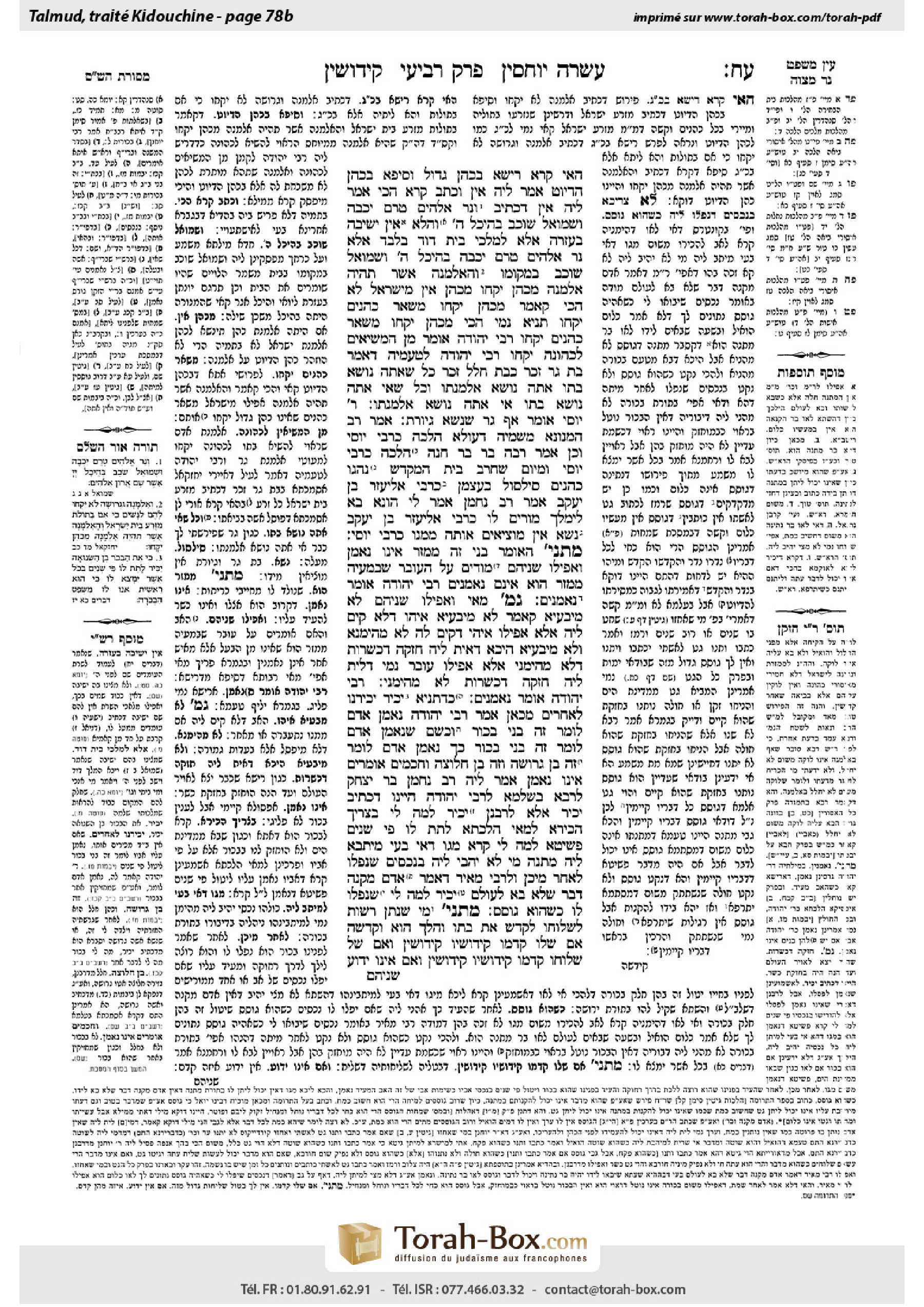
Kiddushin 78b: Talmud study for Daf Yomi
Daf Yomi is the daily study of one Talmud folio. Explore 37 tractates with scans, Hebrew text, Sefaria English and AI-generated French translations where annotated.
Passage selection and English or AI-generated French translation are available where the scan has annotations. Daf Study is independent of Torah-Box and Sefaria.
Browse Kiddushin · קידושין · All tractatesKiddushin 78b text and translations
This page of Kiddushin includes the Aramaic text, an English translation and an AI-generated French translation, alongside the scan above.
קידושין ע״ח ב · Aramaic and Hebrew text
הַאי קְרָא, רֵישָׁא בְּכֹהֵן גָּדוֹל וְסֵיפָא בְּכֹהֵן הֶדְיוֹט?! אֲמַר לֵיהּ: אִין.
וּכְתַב קְרָא הָכִי? אֲמַר לֵיהּ: אִין, דִּכְתִיב: ״וְנֵר אֱלֹהִים טֶרֶם יִכְבֶּה וּשְׁמוּאֵל שֹׁכֵב בְּהֵיכַל ה׳״ – וַהֲלֹא אֵין יְשִׁיבָה בַּעֲזָרָה אֶלָּא לְמַלְכֵי בֵית דָּוִד בִּלְבַד! אֶלָּא: ״נֵר אֱלֹהִים טֶרֶם יִכְבֶּה״ – בְּהֵיכַל ה׳, ״וּשְׁמוּאֵל שֹׁכֵב״ – בִּמְקוֹמוֹ.
״וְהָאַלְמָנָה אֲשֶׁר תִּהְיֶה אַלְמָנָה מִכֹּהֵן יִקָּחוּ״ – ״מִכֹּהֵן״ – אִין, מִיִּשְׂרָאֵל לָא?! הָכִי קָאָמַר: ״מִכֹּהֵן יִקָּחוּ״ – מִשְּׁאָר כֹּהֲנִים יִקָּחוּ. תַּנְיָא נָמֵי הָכִי: ״מִכֹּהֵן יִקָּחוּ״ – מִשְּׁאָר כֹּהֲנִים יִקָּחוּ.
רַבִּי יְהוּדָה אוֹמֵר: מִן הַמַּשִּׂיאִים לַכְּהוּנָּה יִקָּחוּ. רַבִּי יְהוּדָה לְטַעְמֵיהּ, דְּאָמַר: בַּת גֵּר זָכָר כְּבַת חָלָל זָכָר, כֹּל שֶׁאַתָּה נוֹשֵׂא בִּתּוֹ – אַתָּה נוֹשֵׂא אַלְמְנָתוֹ, וְכֹל שֶׁאִי אַתָּה נוֹשֵׂא בִּתּוֹ – אִי אַתָּה נוֹשֵׂא אַלְמְנָתוֹ.
רַבִּי יוֹסֵי אוֹמֵר: אַף גֵּר שֶׁנָּשָׂא גִּיּוֹרֶת. אָמַר רַב הַמְנוּנָא מִשְּׁמֵיהּ דְּעוּלָּא: הֲלָכָה כְּרַבִּי יוֹסֵי. וְכֵן אָמַר רַבָּה בַּר בַּר חָנָה: הֲלָכָה כְּרַבִּי יוֹסֵי. וּמִיּוֹם שֶׁחָרַב בֵּית הַמִּקְדָּשׁ נָהֲגוּ כֹּהֲנִים סִילְסוּל בְּעַצְמָן כְּרַבִּי אֱלִיעֶזֶר בֶּן יַעֲקֹב.
אָמַר רַב נַחְמָן, אָמַר לִי הוּנָא: בָּא לִימָּלֵךְ – מוֹרִים לוֹ כְּרַבִּי אֱלִיעֶזֶר בֶּן יַעֲקֹב, נָשָׂא – אֵין מוֹצִיאִים אוֹתָהּ מִמֶּנּוּ, כְּרַבִּי יוֹסֵי.
מַתְנִי׳ הָאוֹמֵר ״בְּנִי זֶה מַמְזֵר״ – אֵינוֹ נֶאֱמָן. וַאֲפִילּוּ שְׁנֵיהֶם מוֹדִים עַל הָעוּבָּר שֶׁבְּמֵעֶיהָ מַמְזֵר הוּא – אֵינָם נֶאֱמָנִים. רַבִּי יְהוּדָה אוֹמֵר: נֶאֱמָנִים.
גְּמָ׳ מַאי ״וַאֲפִילּוּ שְׁנֵיהֶם״? לָא מִיבַּעְיָא קָאָמַר: לָא מִיבַּעְיָא אִיהוּ, דְּלָא קִים לֵיהּ, אֶלָּא אֲפִילּוּ אִיהִי דְּקִים לַהּ – לָא מְהֵימְנָא. וְלָא מִיבַּעְיָא הֵיכָא דְּאִית לֵיהּ חֲזָקָה דְכַשְׁרוּת, דְּלָא מְהֵימְנִי, אֶלָּא אֲפִילּוּ עוּבָּר נָמֵי, דְּלֵית לֵיהּ חֲזָקָה דְכַשְׁרוּת לָא מְהֵימְנִי.
רַבִּי יְהוּדָה אוֹמֵר נֶאֱמָנִים. כִּדְתַנְיָא: ״יַכִּיר״ – יַכִּירֶנּוּ לַאֲחֵרִים. מִכָּאן אָמַר רַבִּי יְהוּדָה: נֶאֱמָן אָדָם לוֹמַר: ״זֶה בְּנִי בְּכוֹר״. וּכְשֵׁם שֶׁנֶּאֱמָן אָדָם לוֹמַר: ״זֶה בְּנִי בְּכוֹר״, כָּךְ נֶאֱמָן אָדָם לוֹמַר ״זֶה בֶּן גְּרוּשָׁה״ וְ״זֶה בֶּן חֲלוּצָה״. וַחֲכָמִים אוֹמְרִים: אֵינוֹ נֶאֱמָן.
אֲמַר לֵיהּ רַב נַחְמָן בַּר יִצְחָק לְרָבָא: בִּשְׁלָמָא לְרַבִּי יְהוּדָה – הַיְינוּ דִּכְתִיב ״יַכִּיר״, אֶלָּא לְרַבָּנַן, ״יַכִּיר״ לְמָה לִי?
בִּצְרִיךְ הֶכֵּירָא. לְמַאי הִלְכְתָא? לָתֶת לוֹ פִּי שְׁנַיִם? פְּשִׁיטָא, לְמָה לִי קְרָא? מִיגּוֹ דְּאִי בָּעֵי מִיתְּבַהּ לֵיהּ מַתָּנָה, מִי לָא יָהֲבִי לֵיהּ?
בִּנְכָסִים שֶׁנָּפְלוּ לְאַחַר מִיכֵּן.
וּלְרַבִּי מֵאִיר, דְּאָמַר אָדָם מַקְנֶה דָּבָר שֶׁלֹּא בָּא לָעוֹלָם, ״יַכִּיר״ לְמָה לִי? שֶׁנָּפְלוּ לוֹ כְּשֶׁהוּא גּוֹסֵס.
מַתְנִי׳ מִי שֶׁנָּתַן רְשׁוּת לִשְׁלוּחוֹ לְקַדֵּשׁ אֶת בִּתּוֹ, וְהָלַךְ הוּא וְקִדְּשָׁהּ, אִם שֶׁלּוֹ קָדְמוּ – קִידּוּשָׁיו קִידּוּשִׁין, וְאִם שֶׁל שְׁלוּחוֹ קָדְמוּ – קִידּוּשָׁיו קִידּוּשִׁין, וְאִם אֵינוֹ יָדוּעַ
Kiddushin 78b · English translation
Concerning this verse from Ezekiel, the first clause addresses a case with a High Priest, as it states that he may not marry a widow, and the latter clause addresses a case with a common priest, as it states that he may marry a widow. Is that a reasonable manner in which to interpret a verse? Rava said to him: Yes, that is the correct interpretation of the verse.
Rav Naḥman proceeded to ask: But can a verse be written in this way, addressing two different subjects without any demarcation? Rava said to him: Yes, and there is a similar case, as it is written: “And the lamp of God was not yet gone out, and Samuel was laid down to sleep in the Temple of the Lord” (I Samuel 3:3). If read literally, this verse is puzzling. It apparently states that Samuel was lying in the Sanctuary, but there is a right to sit in the courtyard of the Temple only for the kings of the house of David alone. How then could Samuel be laid down to sleep in the Temple? Rather, the verse should be understood as follows: “And the lamp of God was not yet gone out” in the Temple of the Lord, “and Samuel was laid down” in his place outside the Temple.
Since the Gemara quoted the verse in Ezekiel, it proceeds to discuss it further. The continuation of that verse states: “And a widow who is the widow of a priest, they may take” (Ezekiel 44:22). Does this mean that a priest may marry the widow of a priest, yes, but the widow of an Israelite he may not marry? This is counter to the halakha that allows a priest to marry any widow. Rather, this is what the verse is saying: “And a widow who is the widow of a priest they may take,” meaning that of the rest of the priests, they may take. In other words, it is permitted for all other priests, i.e., common priests, to marry widows, and only the High Priest may not marry them. That is also taught in a baraita: “Of a priest they may take” means of the rest of the priests, they may take.
Rabbi Yehuda states a different explanation of the verse: A widow who is the widow of one whose daughters are fit to marry into the priesthood, they may take. The Gemara clarifies: Rabbi Yehuda conforms to his line of reasoning above, as he says: The daughter of a male convert is like the daughter of a male ḥalal, and he ruled that anyone whose daughter you may marry, you may likewise marry his widow; anyone whose daughter you may not marry, e.g., a male convert, you may not marry his widow either. The verse therefore states that a priest may marry the widow only of one whose daughter is permitted to marry into the priesthood.
§ The mishna teaches that Rabbi Yosei says: Even if there was a male convert who married a female convert, his daughter is fit to marry into the priesthood. Rav Hamnuna says in the name of Ulla: The halakha is in accordance with the opinion of Rabbi Yosei, and similarly, Rabba bar bar Ḥana says: The halakha is in accordance with the opinion of Rabbi Yosei. And from the day the Temple was destroyed, the priests were accustomed to act with a higher standard for themselves, in accordance with the opinion of Rabbi Eliezer ben Ya’akov, and they would marry the daughter of a convert only if one parent was born Jewish.
Rav Naḥman says: Rav Huna said to me: If a priest comes to consult with us as to whether or not he should marry the daughter of two converts, we instruct him not to, in accordance with the opinion of Rabbi Eliezer ben Ya’akov. But if he married her, we do not remove her from him, in accordance with the opinion of Rabbi Yosei, as the halakha follows his opinion, as stated above.
MISHNA: One who says: This son of mine is a mamzer, e.g., if he claims that the son was born to one forbidden to him by a prohibition that carries the punishment of karet, he is not deemed credible to render him a mamzer. And even if both of them, the father and the mother, admit that a fetus in her womb is a mamzer, they are not deemed credible. Rabbi Yehuda says: They are deemed credible.
GEMARA: What is the added novelty indicated by the phrase: And even if both of them? What is taught there that is not stated in the clause that taught that a father is not deemed credible to state that his son is a mamzer? The Gemara answers: The tanna is speaking utilizing the style of: It is not necessary. It is not necessary to state this halakha with regard to his claim, when it is not clear to him, i.e., a father can never be sure that a child is his. Rather, the halakha is the same even with regard to her, when it is clear to her who the father is, and yet she is nevertheless not deemed credible. And additionally, it is not necessary to state when the child has a presumption of unflawed lineage, as he was assumed to be of unflawed lineage before his parents came to testify, that they are not deemed credible. Rather, even in the case of a fetus, who does not have a presumption of unflawed lineage, as he has no status with regard to lineage until he is born, the parents are likewise not deemed credible.
The mishna teaches that Rabbi Yehuda says: They are deemed credible. This is as it is taught in a baraita: Expounding the verse: “He shall acknowledge the firstborn” (Deuteronomy 21:17), the Sages said: He, the father, shall acknowledge him to others. In other words, he is deemed credible to tell others that this is his firstborn. From here, Rabbi Yehuda said that a person is deemed credible to say: This is my firstborn son. And just as a person is deemed credible to say: This is my firstborn son, so too, a person is deemed credible to say about his son: This is a son of a divorced woman, or: This is a son of a ḥalutza. And the Rabbis say: As far as these latter claims are concerned, he is not deemed credible. He is deemed credible only to state which son is his firstborn.
Rav Naḥman bar Yitzḥak said to Rava: Granted, according to Rabbi Yehuda, this is the meaning of that which is written: “He shall acknowledge,” as he derives from these words that a father is deemed credible to attest to the identity of his sons. But according to the Rabbis in the mishna, why do I need the phrase “he shall acknowledge”?
The Gemara answers: It is necessary for a case when he requires identification, if the identity of the firstborn is unknown. In such a situation the verse teaches that the father is deemed credible. The Gemara asks: With regard to what halakha is this relevant? Does it refer to the requirement: “By giving him a double portion” (Deuteronomy 21:17), i.e., that the firstborn receives a double share of the inheritance? Isn’t it obvious that he is deemed credible with regard to this halakha? Why do I need a verse to teach this? His claim is supported by the fact that he could have made a more advantageous claim [miggo]: If he desired to give him a double portion as a gift while he was alive, would the court not give it to him? Since the father could have given a double portion to the firstborn without having to testify that he is his firstborn, it cannot be that the verse is teaching us that he is deemed credible with regard to the halakha that a firstborn receives a double portion of inheritance.
The Gemara answers: The verse is referring to property that came into his possession at a later point, which he was unable to give to his son at the time that he came to testify. The verse teaches that the son whom the father states is the firstborn will receive a double portion even of that property.
The Gemara asks: And according to Rabbi Meir, who says that a person can transfer an entity that has not yet come into the world, which would mean that a person can give away his property even before it enters his possession, why do I need the verse: “He shall acknowledge”? The Gemara answers: It is referring to a case where property came into the father’s possession when he was moribund, at which point he cannot transfer ownership of any of his property to others. It is with regard to such property that the verse states: “He shall acknowledge,” to teach that the son whom the father states is the firstborn will receive a double portion even of that property.
MISHNA: In a case of one who authorized his agent to betroth his daughter to a man that the agent would deem fit, and the father went and betrothed her to someone else, if his betrothal preceded that of the agent, his betrothal is a valid betrothal; and if the betrothal of his agent preceded his own, the betrothal of the agent is a valid betrothal. And if it is not known whose betrothal came first,
Kiddushin 78b · Traduction française (IA)
À propos de ce verset d’Ézéchiel, la première partie concerne le grand prêtre, puisqu’elle dit qu’il ne peut pas épouser une veuve, tandis que la dernière partie concerne un prêtre ordinaire, puisqu’elle dit qu’il peut épouser une veuve. Est-ce une manière raisonnable d’interpréter un verset ? Rava lui répondit : Oui, c’est bien ainsi qu’il faut interpréter le verset.
Rav Naḥman poursuivit : Mais un verset peut-il être écrit de cette manière, en traitant de deux sujets différents sans aucune démarcation ? Rava lui répondit : Oui, et il existe un cas semblable, comme il est écrit : « La lampe de Dieu ne s’était pas encore éteinte, et Samuel était couché pour dormir dans le Temple de l’Éternel » (I Samuel 3:3). Pris au sens littéral, ce verset est énigmatique. Il semble dire que Samuel était couché dans le Sanctuaire, mais seuls les rois de la maison de David ont le droit de s’asseoir dans la cour du Temple. Comment Samuel aurait-il donc pu être couché pour dormir dans le Temple ? Il faut plutôt comprendre le verset ainsi : « La lampe de Dieu ne s’était pas encore éteinte » dans le Temple de l’Éternel, « et Samuel était couché » à l’endroit où il se trouvait, à l’extérieur du Temple.
Puisque la Guemara a cité le verset d’Ézéchiel, elle poursuit son examen. La suite de ce verset dit : « Et une veuve qui est la veuve d’un prêtre, ils peuvent la prendre » (Ézéchiel 44:22). Cela signifie-t-il qu’un prêtre peut épouser la veuve d’un prêtre, mais pas celle d’un Israélite ? Cela contredit la halakha qui autorise un prêtre à épouser toute veuve. Il faut plutôt comprendre le verset ainsi : « Et une veuve qui est la veuve d’un prêtre, ils peuvent la prendre », c’est-à-dire qu’ils peuvent prendre celle des autres prêtres. Autrement dit, tous les autres prêtres, c’est-à-dire les prêtres ordinaires, peuvent épouser des veuves ; seul le grand prêtre ne le peut pas. Une baraïta enseigne également : « D’un prêtre, ils peuvent prendre » signifie qu’ils peuvent prendre celle des autres prêtres.
Rabbi Yehuda donne une autre explication du verset : « Une veuve qui est la veuve d’un homme dont les filles sont aptes à épouser un prêtre, ils peuvent la prendre. » La Guemara précise : Rabbi Yehuda reste fidèle à son raisonnement précédent, car il dit que la fille d’un converti est comme la fille d’un ḥalal. Il a statué que si l’on peut épouser la fille d’un homme, on peut également épouser sa veuve ; mais si l’on ne peut pas épouser sa fille, comme dans le cas d’un converti, on ne peut pas non plus épouser sa veuve. Le verset enseigne donc qu’un prêtre ne peut épouser que la veuve d’un homme dont la fille est autorisée à épouser un prêtre.
§ La Michna enseigne que Rabbi Yosei dit : Même si un converti a épousé une convertie, leur fille est apte à épouser un prêtre. Rav Hamnuna dit au nom d’Oula : La halakha suit l’opinion de Rabbi Yosei. De même, Rabba bar bar Ḥana dit : La halakha suit l’opinion de Rabbi Yosei. Depuis la destruction du Temple, les prêtres ont pris l’habitude de s’imposer une exigence plus stricte, conformément à l’opinion de Rabbi Eliezer ben Ya’akov : ils n’épousaient la fille d’un converti que si l’un de ses parents était né juif.
Rav Naḥman dit : Rav Huna m’a dit que si un prêtre vient nous consulter pour savoir s’il doit épouser la fille de deux convertis, nous lui conseillons de ne pas le faire, conformément à l’opinion de Rabbi Eliezer ben Ya’akov. Mais s’il l’a épousée, nous ne la lui retirons pas, conformément à l’opinion de Rabbi Yosei, puisque la halakha suit son opinion, comme indiqué plus haut.
MICHNA : Celui qui dit : « Ce fils est un mamzer », par exemple s’il affirme que le fils est né d’une femme avec laquelle il lui était interdit d’avoir des relations sous peine de karet, n’est pas considéré comme digne de foi pour le déclarer mamzer. Même si tous deux, le père et la mère, reconnaissent qu’un fœtus dans le ventre de la mère est un mamzer, ils ne sont pas considérés comme dignes de foi. Rabbi Yehuda dit : Ils sont considérés comme dignes de foi.
GUEMARA : Quelle nouveauté supplémentaire l’expression « même si tous deux » indique-t-elle ? Qu’enseigne-t-elle qui ne soit pas déjà dit dans la clause selon laquelle un père n’est pas considéré comme digne de foi lorsqu’il affirme que son fils est un mamzer ? La Guemara répond : Le tanna s’exprime selon la formulation « il n’est pas nécessaire ». Il n’est pas nécessaire d’énoncer cette halakha au sujet de la déclaration du père, puisqu’il ne peut pas en être certain, c’est-à-dire qu’un père ne peut jamais être sûr qu’un enfant est le sien. La halakha s’applique pourtant aussi à la mère, alors qu’elle sait clairement qui est le père, et néanmoins elle n’est pas considérée comme digne de foi. En outre, il n’est pas nécessaire de préciser que les parents ne sont pas considérés comme dignes de foi lorsque l’enfant bénéficie d’une présomption de filiation non entachée, puisqu’on le présumait de filiation non entachée avant que ses parents ne viennent témoigner. La halakha s’applique même au fœtus, qui ne bénéficie pas d’une présomption de filiation non entachée, car son statut en matière de filiation n’est établi qu’à sa naissance ; les parents ne sont pas davantage considérés comme dignes de foi dans ce cas.
La Michna enseigne que Rabbi Yehuda dit : Ils sont considérés comme dignes de foi. C’est ce qu’enseigne une baraïta : À propos du verset « Il reconnaîtra le premier-né » (Deutéronome 21:17), les Sages ont dit : Le père le fera connaître aux autres. Autrement dit, il est considéré comme digne de foi lorsqu’il dit aux autres que celui-ci est son premier-né. Rabbi Yehuda en déduit qu’une personne est considérée comme digne de foi lorsqu’elle dit : « Celui-ci est mon fils premier-né. » Et de même qu’une personne est considérée comme digne de foi lorsqu’elle dit : « Celui-ci est mon fils premier-né », elle l’est également lorsqu’elle dit de son fils : « Celui-ci est le fils d’une femme divorcée » ou « Celui-ci est le fils d’une femme ayant subi la ḥalitsa ». Les Sages disent : Pour ces dernières déclarations, il n’est pas considéré comme digne de foi. Il l’est uniquement pour indiquer lequel de ses fils est son premier-né.
Rav Naḥman bar Yitzḥak dit à Rava : Certes, selon Rabbi Yehuda, voici le sens de ce qui est écrit : « Il reconnaîtra », car il déduit de ces mots qu’un père est considéré comme digne de foi pour attester l’identité de ses fils. Mais selon les Sages de la Michna, pourquoi l’expression « il reconnaîtra » est-elle nécessaire ?
La Guemara répond : Elle est nécessaire dans le cas où il faut identifier le premier-né, lorsque son identité est inconnue. Dans une telle situation, le verset enseigne que le père est considéré comme digne de foi. La Guemara demande : Pour quelle halakha cela est-il pertinent ? S’agit-il de l’obligation de « lui donner une double part » (Deutéronome 21:17), c’est-à-dire du fait que le premier-né reçoit une double part de l’héritage ? N’est-il pas évident qu’il est considéré comme digne de foi à cet égard ? Pourquoi un verset serait-il nécessaire pour l’enseigner ? Sa déclaration est étayée par le fait qu’il aurait pu avancer une prétention plus avantageuse [miggo] : s’il avait voulu lui donner une double part en cadeau de son vivant, le tribunal ne l’aurait-il pas fait ? Puisque le père aurait pu donner une double part au premier-né sans avoir à témoigner qu’il était son premier-né, le verset ne peut pas enseigner qu’il est considéré comme digne de foi au regard de la halakha selon laquelle le premier-né reçoit une double part de l’héritage.
La Guemara répond : Le verset concerne des biens entrés en sa possession ultérieurement, qu’il ne pouvait pas donner à son fils au moment où il est venu témoigner. Le verset enseigne que le fils que le père désigne comme premier-né recevra une double part même de ces biens.
La Guemara demande : Et selon Rabbi Meir, qui dit qu’une personne peut transférer un bien qui n’est pas encore venu au monde, ce qui signifie qu’elle peut donner ses biens avant même qu’ils ne soient entrés en sa possession, pourquoi l’expression « Il reconnaîtra » est-elle nécessaire ? La Guemara répond : Le verset concerne le cas où des biens sont entrés en possession du père alors qu’il était à l’article de la mort, moment où il ne peut transférer la propriété d’aucun de ses biens à autrui. C’est à propos de tels biens que le verset dit : « Il reconnaîtra », pour enseigner que le fils que le père désigne comme premier-né recevra une double part même de ces biens.
MICHNA : Lorsqu’un homme a autorisé son agent à fiancer sa fille à l’homme que celui-ci jugerait convenable, puis que le père est allé la fiancer à quelqu’un d’autre, si les fiançailles du père ont précédé celles de l’agent, elles sont valides ; si les fiançailles de son agent ont précédé les siennes, celles de l’agent sont valides. Et si l’on ignore quelles fiançailles ont eu lieu en premier,
Traduction française générée par IA à partir de l’édition anglaise de Sefaria. Vérifie toujours un passage avec le texte source.
Text from Sefaria: William Davidson Edition - Vocalized Aramaic (CC BY NC); William Davidson Edition - English (CC BY NC).