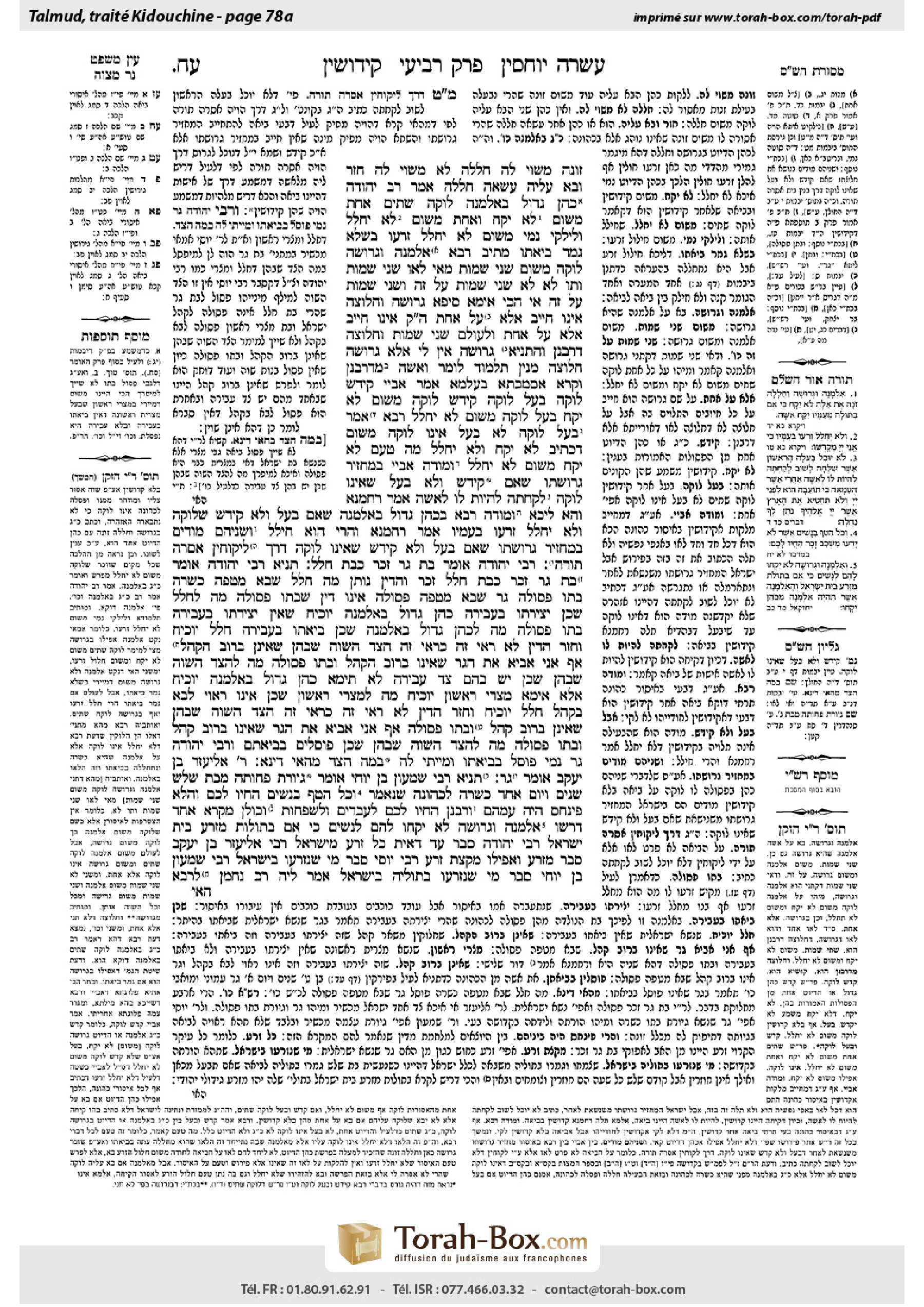
Kiddushin 78a: Talmud study for Daf Yomi
Daf Yomi is the daily study of one Talmud folio. Explore 37 tractates with scans, Hebrew text, Sefaria English and AI-generated French translations where annotated.
Passage selection and English or AI-generated French translation are available where the scan has annotations. Daf Study is independent of Torah-Box and Sefaria.
Browse Kiddushin · קידושין · All tractatesKiddushin 78a text and translations
This page of Kiddushin includes the Aramaic text, an English translation and an AI-generated French translation, alongside the scan above.
קידושין ע״ח א · Aramaic and Hebrew text
– זוֹנָה מְשַׁוֵּי לַהּ, חֲלָלָה לָא מְשַׁוֵּי לַהּ. חָזַר וּבָא עָלֶיהָ – עֲשָׂאָהּ חֲלָלָה.
אָמַר רַב יְהוּדָה: כֹּהֵן גָּדוֹל בְּאַלְמָנָה לוֹקֶה שְׁתַּיִם, אַחַת מִשּׁוּם ״לֹא יִקָּח״, וְאַחַת מִשּׁוּם ״לֹא יְחַלֵּל״. וְלִילְקֵי נָמֵי מִשּׁוּם ״לֹא יְחַלֵּל זַרְעוֹ״! בְּשֶׁלֹּא גָּמַר בִּיאָתוֹ.
מֵתִיב רָבָא: אַלְמָנָה וּגְרוּשָׁה לוֹקֶה מִשּׁוּם שְׁנֵי שֵׁמוֹת, מַאי לָאו שְׁנֵי שֵׁמוֹת וְתוּ לָא?
לָא, שְׁנֵי שֵׁמוֹת עַל זֶה וּשְׁנֵי שֵׁמוֹת עַל זֶה.
אִי הָכִי אֵימָא סֵיפָא: גְּרוּשָׁה וַחֲלוּצָה – אֵינוֹ חַיָּיב אֶלָּא עַל אַחַת! הָכִי קָאָמַר: אֵינוֹ חַיָּיב אֶלָּא עַל אַחַת, וּלְעוֹלָם שְׁנֵי שֵׁמוֹת.
וַחֲלוּצָה דְּרַבָּנַן? וְהָתַנְיָא: גְּרוּשָׁה – אֵין לִי אֶלָּא גְּרוּשָׁה, חֲלוּצָה מִנַּיִן? תַּלְמוּד לוֹמַר: ״וְאִשָּׁה״! מִדְּרַבָּנַן, וּקְרָא אַסְמַכְתָּא בְּעָלְמָא.
אָמַר אַבָּיֵי: קִידֵּשׁ – לוֹקֶה, בָּעַל – לוֹקֶה. קִידֵּשׁ לוֹקֶה מִשּׁוּם ״לֹא יִקָּח״. בָּעַל לוֹקֶה מִשּׁוּם ״לֹא יְחַלֵּל״. רָבָא אָמַר: בָּעַל – לוֹקֶה, לֹא בָּעַל – אֵינוֹ לוֹקֶה, מִשּׁוּם דִּכְתִיב: ״לֹא יִקַּח... וְלֹא יְחַלֵּל״ מָה טַעַם ״לֹא יִקַּח״? מִשּׁוּם ״לֹא יְחַלֵּל״.
וּמוֹדֶה אַבָּיֵי בְּמַחֲזִיר גְּרוּשָׁתוֹ, שֶׁאִם קִידֵּשׁ וְלֹא בָּעַל – שֶׁאֵינוֹ לוֹקֶה. ״לְקַחְתָּהּ לִהְיוֹת לוֹ לְאִשָּׁה״ אָמַר רַחֲמָנָא, וְהָא לֵיכָּא.
וּמוֹדֶה רָבָא בְּכֹהֵן גָּדוֹל בְּאַלְמָנָה, שֶׁאִם בָּעַל וְלֹא קִידֵּשׁ – שֶׁלּוֹקֶה. ״וְלֹא יְחַלֵּל זַרְעוֹ בְּעַמָּיו״ אָמַר רַחֲמָנָא, וַהֲרֵי הוּא חִילֵּל. וּשְׁנֵיהֶם מוֹדִים בְּמַחְזִיר גְּרוּשָׁתוֹ, שֶׁאִם בָּעַל וְלֹא קִידֵּשׁ – שֶׁאֵינוֹ לוֹקֶה, דֶּרֶךְ לִיקּוּחִין אָסְרָה תּוֹרָה.
רַבִּי יְהוּדָה אוֹמֵר: בַּת גֵּר זָכָר כְּבַת חָלָל. תַּנְיָא, רַבִּי יְהוּדָה אוֹמֵר: בַּת גֵּר זָכָר כְּבַת חָלָל זָכָר. וְהַדִּין נוֹתֵן: מָה חָלָל, שֶׁבָּא מִטִּפָּה כְּשֵׁרָה – בִּתּוֹ פְּסוּלָה, גֵּר, שֶׁבָּא מִטִּפָּה פְּסוּלָה – אֵינוֹ דִּין שֶׁבִּתּוֹ פְּסוּלָה?
מָה לְחָלָל, שֶׁכֵּן יְצִירָתוֹ בַּעֲבֵירָה. כֹּהֵן גָּדוֹל בְּאַלְמָנָה יוֹכִיחַ, שֶׁאֵין יְצִירָתוֹ בַּעֲבֵירָה, בִּתּוֹ פְּסוּלָה.
מָה לְכֹהֵן גָּדוֹל בְּאַלְמָנָה, שֶׁכֵּן בִּיאָתוֹ בַּעֲבֵירָה! חָלָל יוֹכִיחַ.
וְחָזַר הַדִּין, לֹא רְאִי זֶה כִּרְאִי זֶה, הַצַּד הַשָּׁוֶה שֶׁבָּהֶן – שֶׁאֵינָן בְּרוֹב הַקָּהָל, אַף אֲנִי אָבִיא אֶת הַגֵּר שֶׁאֵינוֹ בְּרוֹב הַקָּהָל וּבִתּוֹ פְּסוּלָה.
מָה לְהַצַּד הַשָּׁוֶה שֶׁבָּהֶן, שֶׁכֵּן יֵשׁ בָּהֶם צַד עֲבֵירָה!
לָא תֵּימָא כֹּהֵן גָּדוֹל בְּאַלְמָנָה יוֹכִיחַ, אֶלָּא אֵימָא: מִצְרִי רִאשׁוֹן יוֹכִיחַ.
מָה לְמִצְרִי רִאשׁוֹן, שֶׁכֵּן אֵינוֹ רָאוּי לָבֹא בַּקָּהָל. חָלָל יוֹכִיחַ.
וְחָזַר הַדִּין. לֹא רְאִי זֶה כִּרְאִי זֶה, הַצַּד הַשָּׁוֶה שֶׁבָּהֶן – שֶׁאֵינָן בְּרוֹב קָהָל, וּבִתּוֹ פְּסוּלָה. אַף אֲנִי אָבִיא אֶת הַגֵּר, שֶׁאֵינוֹ בְּרוֹב קָהָל וּבִתּוֹ פְּסוּלָה.
מָה לְהַצַּד הַשָּׁוֶה שֶׁבָּהֶן, שֶׁכֵּן פּוֹסְלִים בְּבִיאָתָם. וְרַבִּי יְהוּדָה: גֵּר נָמֵי פּוֹסֵל בְּבִיאָתוֹ, וּמַיְיתֵי לַהּ בַּמָּה הַצַּד מֵהַאי דִּינָא.
רַבִּי אֱלִיעֶזֶר בֶּן יַעֲקֹב אוֹמֵר גֵּר. תַּנְיָא, רַבִּי שִׁמְעוֹן בֶּן יוֹחַי אוֹמֵר: גִּיּוֹרֶת פְּחוּתָה מִבַּת שָׁלֹשׁ שָׁנִים וְיוֹם אֶחָד – כְּשֵׁרָה לַכְּהוּנָּה, שֶׁנֶּאֱמַר: ״וְכֹל הַטַּף בַּנָּשִׁים... הַחֲיוּ לָכֶם״, וַהֲלֹא פִּינְחָס הָיָה עִמָּהֶם! וְרַבָּנַן? ״הַחֲיוּ לָכֶם״ – לַעֲבָדִים וְלִשְׁפָחוֹת.
וְכוּלָּן מִקְרָא אֶחָד דָּרְשׁוּ: ״אַלְמָנָה וּגְרוּשָׁה לֹא יִקְחוּ לָהֶם לְנָשִׁים כִּי אִם בְּתוּלֹת מִזֶּרַע בֵּית יִשְׂרָאֵל״, רַבִּי יְהוּדָה סָבַר: עַד דְּאִית כׇּל זֶרַע מִיִּשְׂרָאֵל. רַבִּי אֱלִיעֶזֶר בֶּן יַעֲקֹב סָבַר: ״מִזֶּרַע״, וַאֲפִילּוּ מִקְצָת זֶרַע.
רַבִּי יוֹסֵי סָבַר: מִי שֶׁנִּזְרְעוּ בְּיִשְׂרָאֵל. רַבִּי שִׁמְעוֹן בֶּן יוֹחַי סָבַר: מִי שֶׁנִּזְרְעוּ בְּתוּלֶיהָ בְּיִשְׂרָאֵל.
אֲמַר לֵיהּ רַב נַחְמָן לְרָבָא:
Kiddushin 78a · English translation
renders her a zona, as he was forbidden to her, but he does not render her a ḥalala, since her status as a zona does not result from a prohibition specific to the priesthood, but due to the prohibition of a forbidden relative. If her brother, or any other priest, again engaged in intercourse with her, he thereby makes her a ḥalala, in accordance with the halakha pertaining to a priest who engages in intercourse with a zona.
§ Rav Yehuda says: A High Priest who engages in sexual intercourse with a widow is flogged two sets of lashes, one set due to transgressing the prohibition of: “A widow, or one divorced, or a ḥalala, or a zona, these shall he not take” (Leviticus 21:14), and one set due to transgressing the prohibition of: “And he shall not profane” (Leviticus 21:15), since he profanes the woman with whom he engages in intercourse. The Gemara asks: And let him also be flogged with a third set of lashes due to the complete phrase: “He shall not profane his offspring,” because the offspring resulting from that act of intercourse is a ḥalal. The Gemara answers: It is referring to a situation where he did not complete his act of sexual intercourse. Since this act does not lead to pregnancy, he is not flogged for profaning his offspring.
Rava raises an objection against Rav Yehuda’s statement from a mishna (Makkot 13a): A High Priest who engages in sexual intercourse with a widow who was previously a divorcée is flogged due to two labels of prohibitions. What, is it not stating that he is flogged due to two labels and no more? This indicates that he receives only one flogging for each prohibition, and not two as Rav Yehuda taught.
The Gemara rejects this: No; it means due to two labels for this, i.e., he is flogged two sets of lashes for engaging in intercourse with a widow, one for transgressing: “Shall he not take,” and one for transgressing: “He shall not profane,” and two labels for that, i.e., engaging in intercourse with a divorcée.
The Gemara asks: If so, say the latter clause of that same mishna: If a priest engages in sexual intercourse with a divorcée who was also a yevama who performed ḥalitza [ḥalutza], he is liable to receive lashes due to only one transgression, since a ḥalutza is not forbidden to a priest by Torah law. This is contrary to the opinion of Rav Yehuda, that he should receive two sets of lashes for engaging in intercourse with a divorcée. The Gemara answers: This is what the mishna is saying: He is liable to receive lashes due to only one act, that of engaging in intercourse with a divorcée, but actually he is liable to receive two sets of lashes for his act of intercourse with a divorcée, since she is forbidden due to two labels. He does not receive an additional set of lashes on account of her being a ḥalutza, as this prohibition is by rabbinic law.
The Gemara asks: And is a ḥalutza forbidden to a priest only by rabbinic law? But isn’t it taught in a baraita: It states in the Torah that a priest may not marry a divorcée. I have derived only a divorcée; from where do I derive that a ḥalutza is also forbidden? The verse states: “And a woman divorced” (Leviticus 21:7), with the additional conjunction of “and” serving to include a ḥalutza, that she is also considered to be a type of divorced woman. The Gemara rejects this: Even so, this prohibition is only by rabbinic law, and the verse is a mere support, but it is not the true source of the halakha.
Abaye says: A priest who betrothed a woman forbidden to him is flogged; if he engaged in sexual intercourse with her he is flogged additional lashes. The Gemara clarifies this: If he betrothed, he is flogged due to transgressing the prohibition of: “Shall he not take.” If he also engaged in intercourse, he is flogged due to transgressing the prohibition of: “He shall not profane.” Rava says: If he engaged in intercourse he is flogged; if he did not engage in intercourse, he is not flogged at all, because it is written: “Shall he not take…and he shall not profane,” which Rava understands to mean: For what reason is he commanded not to take? It is so that he not profane. Rava holds that he is not liable for taking, i.e., betrothing, the woman, but only for engaging in intercourse with her, as this leads to profanation.
The Gemara notes: And although Abaye holds that the act of betrothal itself is forbidden, he concedes in the case of an Israelite who remarries his divorcée after she had been married to someone else in the interim, that if he betrothed her without engaging in intercourse, he is not flogged. Why not? It is as the Merciful One states in the Torah with regard to this prohibition: “Take her again to be his wife” (Deuteronomy 24:4), which indicates that the act of betrothal is forbidden only if it leads to the intimacy of marriage, and there is no such intimacy here since he has not engaged in intercourse with her.
And conversely, Rava concedes in the case of a High Priest with a widow, that if he engaged in sexual intercourse without betrothing her, he is flogged for the act of intercourse, as the Merciful One states in the Torah: “And he shall not profane his offspring among his people” (Leviticus 21:15), and he has profaned her with his act of intercourse. And they both concede in the case of the prohibition with regard to one who remarries his divorcée that if he engaged in intercourse with her without betrothing her he is not flogged, because the Torah forbade them to reestablish their union only through the manner of taking, i.e., betrothal, but it did not prohibit the act of intercourse on its own.
§ The mishna teaches that Rabbi Yehuda says: The daughter of a male convert is like the daughter of a male ḥalal, and is prohibited from marrying into the priesthood. It is taught in a baraita that Rabbi Yehuda says: The daughter of a male convert is like the daughter of a male ḥalal, and is prohibited from marrying into the priesthood. And logic dictates that this is so: Just as in the case of a ḥalal, who comes from a fit drop of semen, as both his parents are Jewish, his daughter is nevertheless unfit to marry into the priesthood, in the case of a convert, who comes from an unfit drop, as he was born a gentile, is it not logical that his daughter should be unfit to marry into the priesthood?
The Gemara counters this derivation: What is notable about a ḥalal? He is notable in that he is formed through a transgression, whereas the gentile parents of a convert were permitted to engage in sexual intercourse with each other. Therefore, the halakha of the daughter of a ḥalal might be more stringent than the halakha of the daughter of a convert. The Gemara responds: The case of a High Priest who engages in intercourse with a widow shall prove that this aspect is not germane to the fitness of the offspring, since the formation of the High Priest was not through a transgression, and yet his daughter is unfit to marry into the priesthood, indicating that being formed through a transgression does not play a role in this matter.
The Gemara counters again: What is notable about a High Priest who engages in intercourse with a widow? He is notable in that his act of intercourse is a transgression. This aspect is what leads to the stringent halakha that his daughter is unfit to marry into the priesthood. The Gemara responds: The case of a ḥalal will prove that this aspect is not germane to the fitness of the offspring, as his daughter is unfit despite the fact that his act of intercourse does not involve a transgression.
And the derivation has reverted to its starting point. The aspect of this person, a ḥalal, is not like the aspect of that person, a High Priest, as with regard to each of them there is a unique reason for the halakha to be stringent. Despite this, their common denominator is that they are unlike most of the congregation, in that they both differ from Jews of unflawed lineage, either because their formation or their act of sexual intercourse involved a transgression, and their daughters are therefore unfit to marry into the priesthood. I will also bring the case of the convert, who is unlike most of the congregation, and therefore his daughter is also unfit to marry into the priesthood.
This is rejected: What is notable about their common denominator is that the reason they are not like most of the congregation includes an aspect of a transgression, either with regard to their formation or to their act of intercourse. Therefore, the halakha of the daughter of a convert cannot be derived from them.
The Gemara modifies the proof: Do not say that a High Priest who engages in sexual intercourse with a widow will prove it; rather, say that a first-generation male Egyptian convert who married a first-generation female Egyptian convert will prove it. Although their intercourse does not involve a transgression, their offspring are nevertheless unfit to marry into the priesthood, as Egyptians may enter into the congregation only after three generations.
This proof is also rejected: What is notable about a first-generation Egyptian? He is notable in that he is not fit to enter into the congregation at all, and that is why his offspring may not marry into the priesthood. The Gemara responds that a ḥalal will prove that this aspect is not germane to the fitness of the offspring, since his daughter is unfit to marry into the priesthood although his offspring may enter into the congregation.
And the derivation has reverted to its starting point, as the halakha of the daughter of a convert cannot be derived from the case of the Egyptian alone or from the case of the ḥalal alone. The aspect of this person, an Egyptian convert, is not like the aspect of that person, a ḥalal, as with regard to each of them there is a unique reason for the halakha to be stringent. Despite this, their common denominator is that they are unlike most of the congregation, in that they both differ from Jews of unflawed lineage and their daughters are consequently unfit to marry into the priesthood. I will also bring the case of the convert, who is unlike most of the congregation, and therefore his daughter is also unfit to marry into the priesthood.
The Gemara rejects this: What is notable about their common denominator is that they disqualify the daughter of a priest from marrying a priest through their act of intercourse, which is not the case with a convert. The Gemara explains: And Rabbi Yehuda holds that a convert also disqualifies the daughter of a priest from marrying a priest through his act of intercourse, and he derives the halakha that the daughter of a convert is unfit to marry into the priesthood by means of an analogy derived from the common factor of two sources, i.e., from this halakha of a ḥalal and of an Egyptian.
§ The mishna states that Rabbi Eliezer ben Ya’akov says that the daughter of a convert and a Jewish woman is fit to marry into the priesthood. It is taught in a baraita: Rabbi Shimon ben Yoḥai says: A female who converts at less than three years and one day old is fit to marry into the priesthood, as it is stated after the war with Midian: “But all the female children who have not known a man by lying with him, keep alive for yourselves” (Numbers 31:18), i.e., you may marry them. But wasn’t Pinehas the priest with them, and yet the Torah permitted these women to all of them, which indicates that girls who are not of age when they convert are permitted even to priests. And how do the Rabbis, who hold that even a girl who converts at less than three years and one day old is unfit to marry into the priesthood, interpret this verse? In their opinion, “keep alive for yourselves” means as slaves and as maidservants, but not for marriage.
The Gemara comments: And all of the tanna’im who have a dispute with regard to the fitness of the daughter of a convert for marrying into the priesthood expounded a single verse. It states with regard to priests: “Neither shall they take as their wives a widow, nor her that divorced; but they shall take virgins of the seed of the house of Israel” (Ezekiel 44:22). Rabbi Yehuda holds: A priest may marry a woman only if the entire seed is from those born to the Jewish people, but not if one of the parents is a convert. Rabbi Eliezer ben Ya’akov holds: “Of the seed of the house of Israel” indicates that not all of the seed must come from the house of Israel, and even if part of the seed is from the house of Israel, that is sufficient to allow her to marry a priest.
Rabbi Yosei, who holds that even the daughter of two converts is permitted to marry into the priesthood, holds that “of the seed of the house of Israel” means one who was seeded, i.e., conceived, in Israel, and the children of converts were conceived by Jewish parents. And Rabbi Shimon ben Yoḥai, who permits a female who converted at less than three years and one day old to marry into the priesthood, holds that the phrase “virgins of the seed of the house of Israel” is referring to one whose hymen was formed as a Jew, i.e., a woman who was already Jewish when her hymen completed its formation, which occurs at the age of three.
Rav Naḥman said to Rava:
Kiddushin 78a · Traduction française (IA)
la rend zona, car il lui était interdit, mais il ne la rend pas ḥalala, car son statut de zona ne résulte pas d'une interdiction spécifique au sacerdoce, mais de l'interdiction d'une parente interdite. Si son frère, ou tout autre prêtre, a de nouveau eu des rapports sexuels avec elle, il la rend alors ḥalala, conformément à la halakha concernant un prêtre qui a des rapports sexuels avec une zona.
§ Rav Yehuda dit : Un Grand Prêtre qui a des rapports sexuels avec une veuve reçoit deux séries de coups de fouet, une série pour avoir transgressé l'interdiction : « Une veuve, ou une divorcée, ou une ḥalala, ou une zona, il ne doit pas les prendre » (Lévitique 21:14), et une série pour avoir transgressé l'interdiction : « Et il ne doit pas profaner » (Lévitique 21:15), car il profane la femme avec laquelle il a des rapports. La Guemara demande : Et qu'il reçoive aussi une troisième série de coups de fouet pour la phrase complète : « Il ne doit pas profaner sa descendance », car la descendance résultant de cet acte de rapport est un ḥalal. La Guemara répond : Il s'agit d'une situation où il n'a pas achevé son acte sexuel. Puisque cet acte ne conduit pas à une grossesse, il n'est pas fouetté pour avoir profané sa descendance.
Rava soulève une objection contre l'énoncé de Rav Yehuda à partir d'une Michna (Makkot 13a) : Un Grand Prêtre qui a des rapports sexuels avec une veuve qui était auparavant divorcée est fouetté en raison de deux catégories d'interdiction. Quoi, n'est-ce pas dire qu'il est fouetté en raison de deux catégories et pas davantage ? Cela indique qu'il ne reçoit qu'un seul fouettement pour chaque interdiction, et non deux comme l'a enseigné Rav Yehuda.
La Guemara rejette cette explication : Non ; cela signifie qu'il est passible de deux séries de coups de fouet en raison de deux désignations pour cet acte, c'est-à-dire qu'il reçoit une série de coups pour avoir eu des rapports avec une veuve, en transgressant l'interdit : « Il ne doit pas prendre », et une autre série pour avoir transgressé l'interdit : « Il ne doit pas profaner » ; et il est passible de deux séries de coups en raison de deux désignations pour cet autre acte, c'est-à-dire d'avoir eu des rapports avec une divorcée.
La Guemara demande : Si c'est ainsi, que dit la dernière clause de cette même Michna : Si un prêtre a des rapports sexuels avec une divorcée qui était aussi une yevama ayant effectué la ḥalitza [ḥalutza], il est passible de coups de fouet en raison d'une seule transgression, car une ḥalutza n'est pas interdite à un prêtre par la Torah écrite. Cela est contraire à l'opinion de Rav Yehuda, selon laquelle il devrait recevoir deux séries de coups de fouet pour avoir eu des rapports avec une divorcée. La Guemara répond : C'est ce que dit la Michna : Il est passible de coups de fouet en raison d'un seul acte, celui d'avoir eu des rapports avec une divorcée, mais en réalité, il est passible de deux séries de coups de fouet pour cet acte de rapports avec une divorcée, car elle est interdite en raison de deux désignations. Il ne reçoit pas une série supplémentaire de coups de fouet en raison du fait qu'elle est une ḥalutza, car cette interdiction est d'origine rabbinique.
La Guemara demande : Et une ḥalutza est-elle interdite à un prêtre uniquement par la loi rabbinique ? Mais n'est-il pas enseigné dans une baraïta : Il est écrit dans la Torah qu'un prêtre ne peut pas épouser une divorcée. J'ai déduit uniquement le cas d'une divorcée ; d'où déduis-je qu'une ḥalutza est également interdite ? Le verset dit : « Et une femme divorcée » (Lévitique 21:7), la conjonction supplémentaire « et » servant à inclure une ḥalutza, en ce qu'elle est également considérée comme un type de femme divorcée. La Guemara rejette cela : Même ainsi, cette interdiction est d'origine rabbinique, et le verset n'est qu'un appui, mais ce n'est pas la véritable source de la halakha.
Abaye déclare : Un prêtre qui a fiancé une femme qui lui est interdite est fouetté ; s'il a eu des rapports sexuels avec elle, il reçoit des coups de fouet supplémentaires. La Guemara précise : S'il a fiancé, il est fouetté pour avoir transgressé l'interdiction : « Il ne doit pas prendre ». S'il a également eu des rapports, il est fouetté pour avoir transgressé l'interdiction : « Il ne doit pas profaner ». Rava déclare : S'il a eu des rapports, il est fouetté ; s'il n'a pas eu de rapports, il n'est pas fouetté du tout, car il est écrit : « Il ne doit pas prendre… et il ne doit pas profaner », ce que Rava comprend comme signifiant : Pour quelle raison lui est-il commandé de ne pas prendre ? C'est afin qu'il ne profane pas. Rava soutient qu'il n'est pas responsable de la prise, c'est-à-dire des fiançailles, de la femme, mais uniquement d'avoir eu des rapports avec elle, car cela conduit à la profanation.
La Guemara note : Et bien qu'Abaye soutienne que l'acte de fiançailles lui-même est interdit, il concède dans le cas d'un Israélite qui remarie sa divorcée après qu'elle a été mariée à quelqu'un d'autre entre-temps, que s'il l'a fiancée sans avoir de rapports, il n'est pas fouetté. Pourquoi pas ? C'est comme le Saint, béni soit-Il, l'état dans la Torah concernant cette interdiction : « Prends-la de nouveau pour qu'elle soit sa femme » (Deutéronome 24:4), ce qui indique que l'acte de fiançailles est interdit uniquement s'il conduit à l'intimité du mariage, et qu'il n'y a pas d'intimité ici puisqu'il n'a pas eu de rapports avec elle.
Et réciproquement, Rava concède, dans le cas d'un Grand Prêtre avec une veuve, que s'il a eu des rapports sexuels sans l'avoir fiancée, il est fouetté pour l'acte de rapport, car le Saint, béni soit-Il, déclare dans la Torah : « Et il ne doit pas profaner sa descendance parmi son peuple » (Lévitique 21:15), et il l'a profanée par son acte de rapport. Et tous deux concèdent, dans le cas de l'interdiction concernant celui qui remarie sa divorcée, que s'il a eu des rapports avec elle sans l'avoir fiancée, il n'est pas fouetté, car la Torah leur a interdit de rétablir leur union uniquement par la manière de prendre, c'est-à-dire les fiançailles, mais elle n'a pas interdit l'acte de rapport en soi.
§ La Michna enseigne que Rabbi Yehuda dit : La fille d'un converti masculin est comme la fille d'un ḥalal masculin, et elle est interdite au mariage avec le sacerdoce. Il est enseigné dans une baraïta que Rabbi Yehuda dit : La fille d'un converti masculin est comme la fille d'un ḥalal masculin, et elle est interdite au mariage avec le sacerdoce. Et la logique dicte que c'est ainsi : Tout comme dans le cas d'un ḥalal, qui provient d'une goutte de semence valide, car ses deux parents sont juifs, sa fille n'est néanmoins pas apte à épouser un prêtre, dans le cas d'un converti, qui provient d'une goutte de semence non valide, car il est né païen, n'est-il pas logique que sa fille ne soit pas apte à épouser un prêtre ?
La Guemara objecte à cette déduction : Qu'est-ce qui est remarquable chez un ḥalal ? Il est remarquable en ce qu'il est issu d'une transgression, alors que les parents non juifs d'un converti étaient autorisés à avoir des rapports sexuels entre eux. Par conséquent, la halakha concernant la fille d'un ḥalal pourrait être plus stricte que la halakha concernant la fille d'un converti. La Guemara répond : Le cas d'un Grand Prêtre qui a des rapports sexuels avec une veuve prouve que cet aspect n'est pas pertinent pour l'aptitude de la descendance, car la formation du Grand Prêtre n'a pas eu lieu par une transgression, et pourtant sa fille n'est pas apte à épouser un prêtre, ce qui indique que le fait d'être issu d'une transgression ne joue aucun rôle dans cette affaire.
La Guemara objecte à nouveau : Qu'est-ce qui est remarquable chez un Grand Prêtre qui a des rapports sexuels avec une veuve ? Il est remarquable en ce que son acte de rapport sexuel constitue une transgression. C'est cet aspect qui conduit à la halakha stricte selon laquelle sa fille n'est pas apte à épouser un prêtre. La Guemara répond : Le cas d'un ḥalal prouve que cet aspect n'est pas pertinent pour l'aptitude de la descendance, car sa fille n'est pas apte à épouser un prêtre, malgré le fait que son acte de rapport sexuel n'implique pas de transgression.
Et la déduction est revenue à son point de départ. L'aspect de cette personne, un ḥalal, n'est pas comme l'aspect de cette autre personne, un Grand Prêtre, car pour chacun d'eux il y a une raison unique pour que la halakha soit stricte. Malgré cela, leur dénominateur commun est qu'ils ne sont pas comme la majorité de la communauté, en ce qu'ils diffèrent tous deux des Juifs de lignée irréprochable, soit parce que leur formation, soit parce que leur acte de rapport sexuel impliquait une transgression, et leurs filles sont donc inaptes à épouser un prêtre. J'apporterai également le cas du converti, qui n'est pas comme la majorité de la communauté, et par conséquent sa fille est également inapte à épouser un prêtre.
Cela est rejeté : Ce qui est remarquable dans leur point commun, c'est que la raison pour laquelle ils ne sont pas assimilés à la majorité de la communauté comporte un aspect de transgression, soit quant à leur formation, soit quant à leur acte de rapport sexuel. Par conséquent, la halakha concernant la fille d'un converti ne peut pas être déduite d'eux.
La Guemara modifie la preuve : Ne dis pas qu'un Grand Prêtre qui a des rapports sexuels avec une veuve le prouvera ; plutôt, dis qu'un converti égyptien de première génération qui a épousé une convertie égyptienne de première génération le prouvera. Bien que leurs rapports n'impliquent pas de transgression, leur descendance n'est néanmoins pas apte à entrer dans le mariage avec un prêtre, car les Égyptiens ne peuvent entrer dans la communauté qu'après trois générations.
Cette preuve est également rejetée : Qu'est-ce qui est remarquable chez un Égyptien de première génération ? Il est remarquable en ce qu'il n'est pas apte à entrer dans la communauté du tout, et c'est pourquoi sa descendance ne peut pas entrer dans le mariage avec un prêtre. La Guemara répond qu'un ḥalal prouvera que cet aspect n'est pas pertinent pour l'aptitude de la descendance, car sa fille n'est pas apte à entrer dans le mariage avec un prêtre bien que sa descendance puisse entrer dans la communauté.
Et la déduction est revenue à son point de départ, car la halakha concernant la fille d'un converti ne peut être déduite du cas de l'Égyptien seul ni du cas du ḥalal seul. La situation de cette personne, un converti d'Égypte, n'est pas comparable à celle de l'autre, un ḥalal, car pour chacun d'eux, il existe une raison unique qui justifie la rigueur de la halakha. Malgré cela, leur dénominateur commun est qu'ils ne sont pas comme la majorité de la communauté, en ce qu'ils diffèrent tous deux des Juifs de lignée irréprochable, et leurs filles sont par conséquent inaptes à épouser un prêtre. J'inclurai également le cas du converti, qui n'est pas comme la majorité de la communauté, et par conséquent sa fille est également inapte à épouser un prêtre.
La Guemara rejette cet argument : Ce qui est notable dans leur dénominateur commun, c'est qu'ils disqualifient la fille d'un prêtre pour le mariage avec un prêtre par leur acte de rapport sexuel, ce qui n'est pas le cas d'un converti. La Guemara explique : Et Rabbi Yehuda soutient qu'un converti disqualifie également la fille d'un prêtre pour le mariage avec un prêtre par son acte de rapport sexuel, et il déduit la halakha selon laquelle la fille d'un converti est inapte à épouser un prêtre au moyen d'une analogie dérivée du facteur commun de deux sources, c'est-à-dire de cette halakha concernant un ḥalal et un Égyptien.
§ La Michna énonce que Rabbi Eliezer ben Ya’akov dit que la fille d’un converti et d’une femme juive est apte à épouser un prêtre. Il est enseigné dans une baraïta : Rabbi Shimon ben Yoḥai dit : Une femme qui se convertit à moins de trois ans et un jour est apte à épouser un prêtre, car il est dit après la guerre avec Midian : « Mais toutes les filles qui n’ont pas connu un homme par le rapport sexuel, gardez-les en vie pour vous » (Nombres 31:18), c’est-à-dire, vous pouvez les épouser. Mais n’était-ce pas Pinḥas le prêtre qui était avec elles, et pourtant la Torah a permis ces femmes à tous, ce qui indique que les filles qui ne sont pas en âge de se marier lorsqu’elles se convertissent sont permises même aux prêtres. Et comment les Sages, qui soutiennent qu’une fille qui se convertit à moins de trois ans et un jour n’est pas apte à épouser un prêtre, interprètent-ils ce verset ? Selon leur opinion, « gardez-les en vie pour vous » signifie comme esclaves et comme servantes, mais pas pour le mariage.
La Guemara commente : Et tous les tannaïm qui sont en désaccord quant à l’aptitude de la fille d’un converti à épouser un prêtre ont exégétisé un seul verset. Il est dit à propos des prêtres : « Ils ne prendront pas pour femme une veuve, ni une répudiée ; mais ils prendront des vierges de la semence de la maison d’Israël » (Ézéchiel 44:22). Rabbi Yehuda soutient : Un prêtre ne peut épouser une femme que si toute la semence provient de ceux nés du peuple juif, mais non si l’un des parents est un converti. Rabbi Eliezer ben Ya’akov soutient : « De la semence de la maison d’Israël » indique que toute la semence n’a pas besoin de provenir de la maison d’Israël, et même si une partie de la semence provient de la maison d’Israël, cela suffit pour lui permettre d’épouser un prêtre.
Rabbi Yosei, qui soutient que même la fille de deux convertis est autorisée à épouser un prêtre, estime que « de la semence de la maison d'Israël » signifie celle qui a été semée, c'est-à-dire conçue, en Israël, et les enfants de convertis ont été conçus par des parents juifs. Et Rabbi Shimon ben Yoḥai, qui autorise une femme convertie avant l'âge de trois ans et un jour à épouser un prêtre, estime que l'expression « vierges de la semence de la maison d'Israël » fait référence à celle dont l'hymen s'est formé en tant que juive, c'est-à-dire une femme qui était déjà juive lorsque son hymen a achevé sa formation, ce qui se produit à l'âge de trois ans.
Rav Naḥman dit à Rava :
Traduction française générée par IA à partir de l’édition anglaise de Sefaria. Vérifie toujours un passage avec le texte source.
Text from Sefaria: William Davidson Edition - Vocalized Aramaic (CC BY NC); William Davidson Edition - English (CC BY NC).