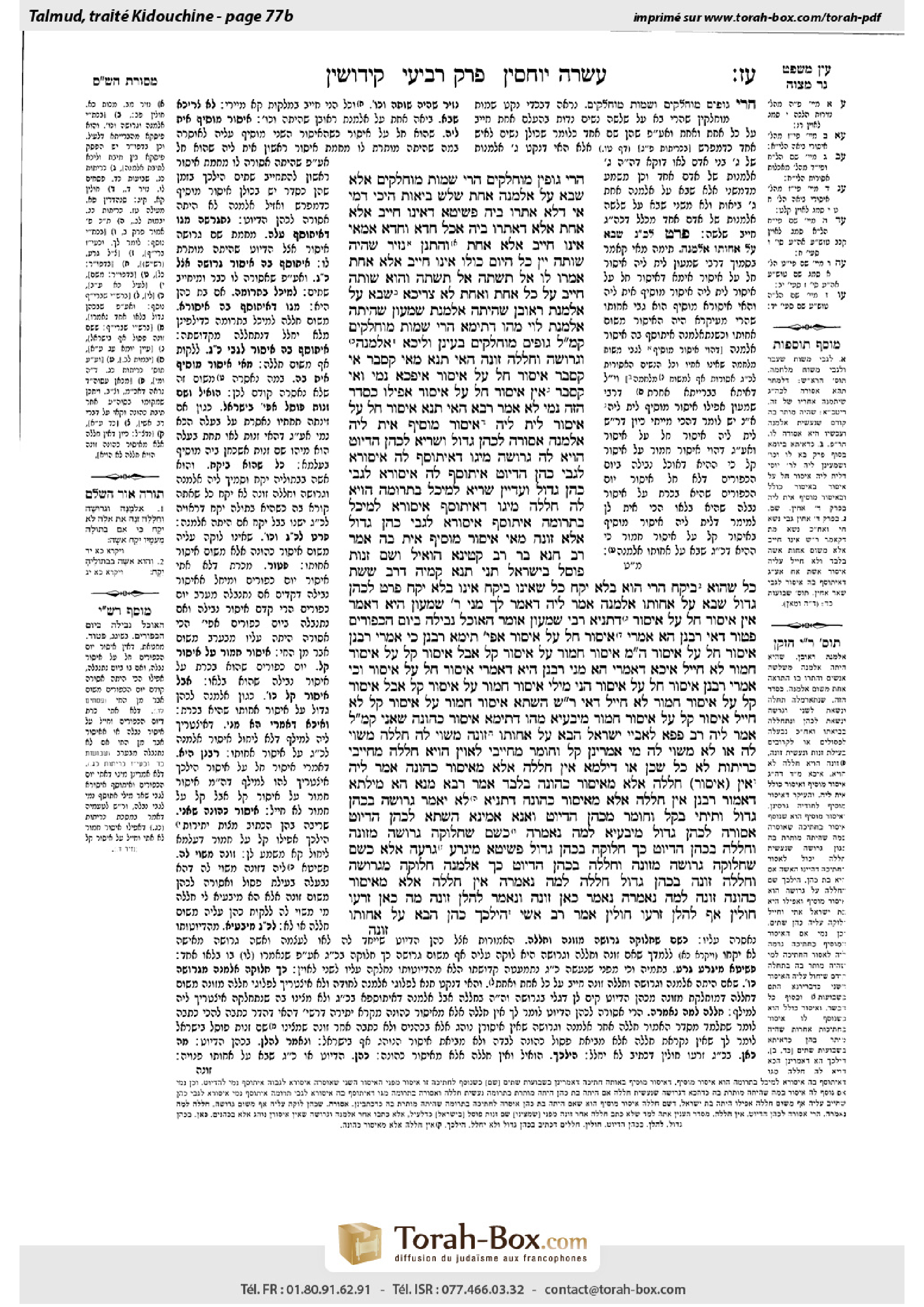
Kiddushin 77b: Talmud study for Daf Yomi
Daf Yomi is the daily study of one Talmud folio. Explore 37 tractates with scans, Hebrew text, Sefaria English and AI-generated French translations where annotated.
Passage selection and English or AI-generated French translation are available where the scan has annotations. Daf Study is independent of Torah-Box and Sefaria.
Browse Kiddushin · קידושין · All tractatesKiddushin 77b text and translations
This page of Kiddushin includes the Aramaic text, an English translation and an AI-generated French translation, alongside the scan above.
קידושין ע״ז ב · Aramaic and Hebrew text
הֲרֵי גּוּפִין מוּחְלָקִים, הֲרֵי שֵׁמוֹת מוּחְלָקִים!
אֶלָּא שֶׁבָּא עַל אַלְמָנָה אַחַת שָׁלֹשׁ בִּיאוֹת. הֵיכִי דָמֵי? אִי דְּלָא אַתְרוֹ בֵּיהּ – פְּשִׁיטָא דְּאֵינוֹ חַיָּיב אֶלָּא אַחַת.
אֶלָּא דְּאַתְרוֹ בֵּיהּ אַכֹּל חֲדָא וַחֲדָא – אַמַּאי אֵינוֹ חַיָּיב אֶלָּא אַחַת? וְהָתְנַן: נָזִיר שֶׁהָיָה שׁוֹתֶה יַיִן כׇּל הַיּוֹם כּוּלּוֹ – אֵינוֹ חַיָּיב אֶלָּא אַחַת. אָמְרוּ לוֹ: ״אַל תִּשְׁתֶּה״ ״אַל תִּשְׁתֶּה״ וְהוּא שׁוֹתֶה – חַיָּיב עַל כׇּל אַחַת וְאַחַת!
לָא צְרִיכָא, שֶׁבָּא עַל אַלְמְנַת רְאוּבֵן שֶׁהָיְתָה אַלְמְנַת שִׁמְעוֹן שֶׁהָיְתָה אַלְמְנַת לֵוִי. מַהוּ דְּתֵימָא הֲרֵי שֵׁמוֹת מוּחְלָקִים – קָא מַשְׁמַע לַן גּוּפִים מוּחְלָקִים בָּעֵינַן, וְלֵיכָּא.
״אַלְמָנָה וּגְרוּשָׁה וַחֲלָלָה זֹנָה״. הַאי תַּנָּא מַאי קָסָבַר? אִי קָסָבַר אִיסּוּר חָל עַל אִיסּוּר – אִיפְּכָא נָמֵי! וְאִי קָסָבַר אֵין אִיסּוּר חָל עַל אִיסּוּר – אֲפִילּוּ כַּסֵּדֶר הַזֶּה נָמֵי לָא!
אָמַר רָבָא: הַאי תַּנָּא אִיסּוּר חָל עַל אִיסּוּר לֵית לֵיהּ, אִיסּוּר מוֹסִיף אִית לֵיהּ.
אַלְמָנָה אֲסוּרָה לְכֹהֵן גָּדוֹל וְשַׁרְיָא לְכֹהֵן הֶדְיוֹט. הָוְיָא לַהּ גְּרוּשָׁה, מִיגּוֹ דְּאִיתּוֹסַף לַהּ אִיסּוּרָא לְגַבֵּי כֹּהֵן הֶדְיוֹט – אִיתּוֹסַף לַהּ אִיסּוּרָא לְגַבֵּי כֹּהֵן גָּדוֹל, וַעֲדַיִין שַׁרְיָא לְמֵיכַל בִּתְרוּמָה. הָוְיָא לַהּ חֲלָלָה, מִיגּוֹ דְּאִיתּוֹסַף אִיסּוּרָא לְמֵיכַל בִּתְרוּמָה – אִיתּוֹסַף אִיסּוּרָא לְגַבֵּי כֹּהֵן גָּדוֹל.
אֶלָּא זוֹנָה – מַאי אִיסּוּר מוֹסִיף אִית בַּהּ? אָמַר רַב חָנָא בַּר רַב קַטִּינָא: הוֹאִיל וְשֵׁם זְנוּת פּוֹסֵל בְּיִשְׂרָאֵל.
תָּנֵי תַּנָּא קַמֵּיהּ דְּרַב שֵׁשֶׁת: כׇּל שֶׁהוּא בְּ״יִקָּח״, הֲרֵי הוּא בְּ״לֹא יִקָּח״. כֹּל שֶׁאֵינוֹ בְּ״יִקָּח״ אֵינוֹ בְּ״לֹא יִקָּח״ – פְּרָט לְכֹהֵן גָּדוֹל שֶׁבָּא עַל אֲחוֹתוֹ אַלְמָנָה.
אֲמַר לֵיהּ: דַּאֲמַר לָךְ, מַנִּי – רַבִּי שִׁמְעוֹן הִיא, דְּאָמַר: אֵין אִיסּוּר חָל עַל אִיסּוּר. דְּתַנְיָא: רַבִּי שִׁמְעוֹן אוֹמֵר: הָאוֹכֵל נְבֵילָה בְּיוֹם הַכִּפּוּרִים – פָּטוּר. דְּאִי רַבָּנַן, הָא אָמְרִי: אִיסּוּר חָל עַל אִיסּוּר.
אֲפִילּוּ תֵּימָא רַבָּנַן, כִּי אָמְרִי רַבָּנַן אִיסּוּר חָל עַל אִיסּוּר – הָנֵי מִילֵּי אִיסּוּר חָמוּר עַל אִיסּוּר קַל, אֲבָל אִיסּוּר קַל עַל אִיסּוּר חָמוּר – לָא חָיֵיל.
אִיכָּא דְאָמְרִי: הָא מַנִּי – רַבָּנַן הִיא, דְּאָמְרִי: אִיסּוּר חָל עַל אִיסּוּר, וְכִי אָמְרִי רַבָּנַן אִיסּוּר חָל עַל אִיסּוּר, הָנֵי מִילֵּי אִיסּוּר חָמוּר עַל אִיסּוּר קַל, אֲבָל אִיסּוּר קַל עַל אִיסּוּר חָמוּר – לָא חָיֵיל. דְּאִי רַבִּי שִׁמְעוֹן, הַשְׁתָּא אִיסּוּר חָמוּר עַל אִיסּוּר קַל לָא חָיֵיל, אִיסּוּר קַל עַל אִיסּוּר חָמוּר מִיבַּעְיָא?
מַהוּ דְּתֵימָא: אִיסּוּר כְּהוּנָּה שָׁאנֵי, קָא מַשְׁמַע לַן.
אֲמַר לֵיהּ רַב פָּפָּא לְאַבָּיֵי: יִשְׂרָאֵל הַבָּא עַל אֲחוֹתוֹ – זוֹנָה מְשַׁוֵּי לַהּ. חֲלָלָה, מְשַׁוֵּי לַהּ אוֹ לָא מְשַׁוֵּי לַהּ?
מִי אָמְרִינַן קַל וָחוֹמֶר: מֵחַיָּיבֵי לָאוִין הָוְיָא חֲלָלָה, מֵחַיָּיבֵי כָרֵיתוֹת לֹא כׇּל שֶׁכֵּן? אוֹ דִילְמָא אֵין חֲלָלָה אֶלָּא מֵאִיסּוּר כְּהוּנָּה? אֲמַר לֵיהּ: אֵין (אִיסּוּר) חֲלָלָה אֶלָּא מֵאִיסּוּר כְּהוּנָּה בִּלְבַד.
אָמַר רָבָא: מְנָא הָא מִילְּתָא דַּאֲמוּר רַבָּנַן ״אֵין חֲלָלָה אֶלָּא מֵאִיסּוּר כְּהוּנָּה״? דְּתַנְיָא: לֹא יֵאָמֵר גְּרוּשָׁה בְּכֹהֵן גָּדוֹל וְתֵיתֵי בְּקַל וָחוֹמֶר מִכֹּהֵן הֶדְיוֹט, וַאֲנָא אָמֵינָא: הַשְׁתָּא לְכֹהֵן הֶדְיוֹט אֲסוּרָה, לְכֹהֵן גָּדוֹל מִיבַּעְיָא? לָמָּה נֶאֶמְרָה: כְּשֵׁם שֶׁחֲלוּקָה גְּרוּשָׁה מִזּוֹנָה וַחֲלָלָה בְּכֹהֵן הֶדְיוֹט, כָּךְ חֲלוּקָה בְּכֹהֵן גָּדוֹל.
פְּשִׁיטָא, מִיגְרָע גָּרְעָה? אֶלָּא: כְּשֵׁם שֶׁחֲלוּקָה גְּרוּשָׁה מִזּוֹנָה וַחֲלָלָה בְּכֹהֵן הֶדְיוֹט – כָּךְ אַלְמָנָה חֲלוּקָה מִגְּרוּשָׁה וַחֲלָלָה זוֹנָה בְּכֹהֵן גָּדוֹל.
חֲלָלָה לָמָּה נֶאֶמְרָה? אֵין חֲלָלָה אֶלָּא מֵאִיסּוּר כְּהוּנָּה. זוֹנָה לָמָּה נֶאֶמְרָה? נֶאֱמַר כָּאן ״זוֹנָה״, וְנֶאֱמַר לְהַלָּן ״זוֹנָה״, מָה כָּאן זַרְעוֹ חוּלִּין, אַף לְהַלָּן זַרְעוֹ חוּלִּין.
אָמַר רַב אָשֵׁי: הִילְכָּךְ, כֹּהֵן הַבָּא עַל אֲחוֹתוֹ
Kiddushin 77b · English translation
Aren’t they separate bodies, i.e., three different people? Aren’t they labels [shemot] of separate [muḥlakim] prohibitions, since each one is forbidden in her own right? It is therefore clear that he should receive lashes for each act.
Rather, perhaps it means that he engaged in three acts of intercourse with one widow. The Gemara analyzes this possibility: What are the circumstances? If they did not forewarn him between each act, it is obvious that he is liable to receive only one set of lashes, for one must be forewarned in order to be liable to receive lashes, and here he was forewarned only once for the three acts. There would be no need to state this halakha.
Rather, perhaps the case is that they forewarned him for each and every one of his acts of intercourse. But if that were the case, why is he liable to receive only one set of lashes? But didn’t we learn in a mishna (Nazir 42a): A nazirite who was drinking wine in violation of his naziriteship the entire day is liable to receive only one set of lashes. If they said to him: Do not drink, do not drink, i.e., he was forewarned several times, and he nevertheless drinks, he is liable to receive lashes for each and every time he was forewarned and proceeded to drink.
The Gemara answers: No, it is necessary for a case where he engaged in sexual intercourse one time with Reuven’s widow, who was previously Shimon’s widow, who was previously Levi’s widow. Lest you say they are separate labels of prohibitions and he should be liable to receive three sets of lashes, since she was widowed from three different people, the baraita therefore teaches us that we require separate bodies for him to receive separate punishments, and as that is not the case here, he is liable to receive only one set of lashes.
The baraita teaches that if a High Priest engages in sexual intercourse with a woman who was a widow, and then was a divorcée, and then was a ḥalala, and then was a zona, if the changes to her status occurred in that order he is liable to receive lashes for each of them. The Gemara asks: What does this tanna hold? If he holds that a prohibition takes effect where another prohibition already exists, i.e., if an item or a person is rendered forbidden by a prohibition then another prohibition can take effect in addition to the first one, the reverse should also be the case, i.e., if she was initially a zona and subsequently became a ḥalala, the same two prohibitions should apply to her. And if he holds that a prohibition does not take effect where another prohibition already exists, he should likewise not be liable to receive more than one set of lashes even if they occurred in this order.
Rava said: In general, this tanna does not accept the principle that a prohibition takes effect where another prohibition already exists, but he holds that it does take effect in the case of an expanded prohibition. If the second prohibition adds people to the category of those to whom the item is forbidden, then it takes effect in addition to the previous prohibition, which had a more limited range.
In this case, a widow is forbidden to a High Priest but is permitted to a common priest. Once she becomes a divorcée, since a prohibition has been added to her with regard to a common priest, as a common priest is prohibited from marrying a divorcée, the prohibition is also added to her with regard to a High Priest. And at this stage, she is still permitted to partake of teruma if she is the daughter of a priest. When she becomes a ḥalala by engaging in sexual intercourse with a priest, since a prohibition for her to eat teruma has been added, the prohibition with regard to a ḥalala is also added with regard to a High Priest who engages in intercourse with her, in addition to the prohibitions of a widow and a divorcée. It is only if they occurred in this order that each prohibition adds to the previous one, but not if they happened in the reverse order.
Yet, one could ask: But in the case of a zona, what expanded prohibition is there with regard to her? There is no additional prohibition with a zona beyond what is prohibited with regard to a ḥalala. Rav Ḥana bar Rav Ketina said: Since the label of zenut disqualifies her in Israel, it is viewed as an expanded prohibition. Although a zona as precisely defined in this context, i.e., a woman who engages in sexual intercourse with one who is unfit for her, is prohibited only to priests and does not add any prohibition beyond that of a ḥalala, the label of a zona in its broader sense, such as a married woman who commits adultery, does disqualify her to an Israelite, namely her husband. Therefore, there is a prohibition with regard to a zona that has a greater scope than the prohibition with regard to a ḥalala.
A tanna taught a baraita before Rav Sheshet: The command addressed to the High Priest states: “A widow, or one divorced, or a ḥalala, or a zona, these shall he not take; but a virgin of his own people shall he take to wife” (Leviticus 21:14). Any woman who is included in the mitzva: “Shall he take” is included in the prohibition: “Shall he not take” if she becomes a widow or a divorcée. And any woman who is not included in the mitzva: “Shall he take” is not included in the prohibition: “Shall he not take.” This excludes the case of a High Priest who engaged in intercourse with his widowed sister. As his sister, she is forbidden to him even when she is a virgin, so the mitzva: “Shall he take” does not refer to her. Therefore, he does not transgress the prohibition: “Shall he not take” if he engages in intercourse with her after she had been widowed or divorced.
Rav Sheshet said to him: He who said this to you, in accordance with whose opinion did he teach it? It is in accordance with the opinion of Rabbi Shimon, who says as a principle: A prohibition does not take effect where another prohibition already exists. Therefore, his sister, who was already forbidden to him by virtue of being his sister, is not forbidden due to the additional prohibition: “Shall he not take.” As it is taught in a baraita: Rabbi Shimon says: One who eats an unslaughtered animal carcass on Yom Kippur is exempt from karet for eating on the fast day, since the prohibition against eating an animal carcass applied to it beforehand. As, if you say this baraita follows the opinion of the Rabbis, don’t they say: A prohibition takes effect where another prohibition already exists?
The Gemara rejects this: You can even say that the baraita is in accordance with the opinion of the Rabbis, as when the Rabbis say that a prohibition takes effect where another prohibition already exists, that statement applies only when the second prohibition is a more severe prohibition, e.g., eating on Yom Kippur, which takes effect in addition to a light prohibition, in this case, eating an unslaughtered animal carcass. But a light prohibition does not take effect in addition to a severe prohibition. In this case, the prohibition of engaging in intercourse with one’s sister, which is punishable by karet, is more severe than that of: “A widow or one divorced, or a ḥalala, or a zona, these shall he not take,” which is punishable by flogging.
There are those who say that Rav Sheshet said to the tanna as follows: In accordance with whose opinion is this? It is in accordance with the opinion of the Rabbis, who say: A prohibition takes effect where another prohibition already exists. And when the Rabbis say that a prohibition takes effect where another prohibition already exists, that statement applies when the second prohibition is a more severe prohibition, which takes effect in addition to a light prohibition, but a light prohibition does not take effect in addition to a severe prohibition. As, if it is in accordance with the opinion of Rabbi Shimon, now that he holds that even a severe prohibition does not take effect in addition to a light prohibition, is it necessary to say that a light prohibition does not take effect in addition to a severe prohibition? There would be no novelty in this ruling of the baraita.
The Gemara rejects this: It is necessary, lest you say that a prohibition involving the priesthood is different. You might say that since there are many stringencies that apply only to priests, then with regard to prohibitions of the priesthood, a second prohibition should take effect in addition to a first one. He therefore teaches us that Rabbi Shimon holds that the second prohibition does not take effect even when it is one addressed to members of the priesthood.
§ Rav Pappa said to Abaye: In the case of an Israelite who engages in intercourse with his sister, this makes her a zona and she is forbidden to a priest. But does he also make her a ḥalala so that a priest who engages in intercourse with her is also liable for violating the prohibition of engaging in intercourse with a ḥalala, or perhaps he does not make her a ḥalala?
The two sides of the question are as follows: Do we say that this is an a fortiori inference: If she becomes a ḥalala by engaging in sexual intercourse for which she is liable for violating only an ordinary prohibition, should she not all the more so be considered a ḥalala by engaging in intercourse for which she is liable to be punished by karet? Or perhaps the status of ḥalala results only from a prohibition addressed specifically to the priesthood? Abaye said to him: A prohibition with regard to a ḥalala results only from a prohibition addressed specifically to the priesthood and from that alone.
Rava says: From where is this matter that the Sages state, that a ḥalala results only from a prohibition addressed specifically to the priesthood, derived? As it is taught in a baraita: The verse need not explicitly state that a divorcée is forbidden to a High Priest, and one could derive it by means of an a fortiori inference from the halakha of a common priest. As I can state the following argument: Now that a divorcée is forbidden to a common priest, is it necessary to state that she is forbidden to a High Priest? But if it is not necessary to mention it, why is the prohibition with regard to a divorcée to a High Priest stated? It is in order to teach the following: Just as the prohibition with regard to a divorcée is distinct from that of a zona and a ḥalala in the case of a common priest, as a divorcée is forbidden by a separate prohibition for which he is liable to be flogged, so too, the prohibition with regard to a divorcée is distinct in the case of a High Priest, and he will be liable to receive lashes for a separate prohibition if she was a ḥalala as well.
The Gemara questions this statement: This is obvious; is the status of a High Priest any lower than that of a common priest? Since this halakha applied to him when he was a common priest, it certainly applies to him when he becomes a High Priest. His restrictions as a priest are not lessened when he becomes a High Priest. Rather, teach as follows: Just as the prohibition with regard to a divorcée is distinct from that of a zona and a ḥalala in the case of a common priest, since he is liable to receive lashes for each of the prohibitions, so too, a widow is distinct from a divorcée, and a ḥalala, and a zona in the case of a High Priest, and he is liable to receive lashes for each prohibition, despite the fact that they are stated in the same verse (see Leviticus 21:14).
The baraita further asks: Why is the prohibition with regard to a ḥalala stated with regard to a High Priest, as she is forbidden to him even when he is a common priest? This repetition serves to teach that a ḥalala results only from a prohibition addressed specifically to the priesthood. Why is the prohibition with regard to a zona stated with regard to a High Priest, as she is forbidden to him even when he is a common priest? It is stated here: “Zona” (Leviticus 21:14), with regard to a High Priest, and it is stated there: “Zona” (Leviticus 21:7), with regard to a common priest. Just as here, in the case of a High Priest who engages in sexual intercourse with a zona, his offspring are profaned, in accordance with the verse: “And he shall not profane his offspring” (Leviticus 21:15), so too there, in the case of a common priest who engages in intercourse with a zona, his offspring are profaned.
Rav Ashi says: Consequently, a priest who engages in intercourse with his sister
Kiddushin 77b · Traduction française (IA)
Ne s’agit-il pas de corps distincts, c’est-à-dire de trois personnes différentes ? Ne s’agit-il pas de désignations [shemot] d’interdictions distinctes [muḥlakim], puisque chacune est interdite en elle-même ? Il est donc clair qu’il doit recevoir des coups de fouet pour chaque acte.
Mais peut-être s’agit-il plutôt d’un cas où il a eu trois rapports sexuels avec une seule veuve. La Guemara examine cette possibilité : dans quelles circonstances ? S’il n’a pas été averti entre chaque acte, il est évident qu’il n’est passible que d’une seule série de coups de fouet, car il faut avoir été averti pour être passible de coups de fouet, et ici il n’a été averti qu’une seule fois pour les trois actes. Il n’aurait pas été nécessaire d’énoncer cette halakha.
Mais peut-être s’agit-il plutôt d’un cas où on l’a averti pour chacun de ses rapports sexuels. Mais si tel était le cas, pourquoi n’est-il passible que d’une seule série de coups de fouet ? N’avons-nous pas appris dans une Michna (Nazir 42a) : un nazir qui a bu du vin en violation de son naziréat pendant toute la journée n’est passible que d’une seule série de coups de fouet. Si on lui a dit : « Ne bois pas, ne bois pas », c’est-à-dire qu’il a été averti plusieurs fois, et qu’il boit malgré tout, il est passible de coups de fouet chaque fois qu’il a été averti puis a bu.
La Guemara répond : Non, cette règle est nécessaire dans le cas où il a eu un seul rapport sexuel avec la veuve de Réouven, qui avait auparavant été la veuve de Chimon, qui avait auparavant été la veuve de Lévi. De peur que tu ne dises qu’il s’agit de désignations distinctes d’interdictions et qu’il doit recevoir trois séries de coups de fouet, puisqu’elle est devenue veuve de trois hommes différents, la baraïta nous enseigne qu’il faut des personnes distinctes pour qu’il reçoive des peines distinctes ; or, ce n’est pas le cas ici, et il n’est donc passible que d’une seule série de coups de fouet.
La baraïta enseigne que si un grand prêtre a un rapport sexuel avec une femme qui a été veuve, puis divorcée, puis ḥalala, puis zona, et que ces changements de statut se sont produits dans cet ordre, il est passible de coups de fouet pour chacun d’eux. La Guemara demande : Quelle est la position de ce tanna ? S’il estime qu’une interdiction prend effet alors qu’une autre interdiction existe déjà, c’est-à-dire que si une chose ou une personne est rendue interdite par une interdiction, une autre interdiction peut s’ajouter à la première, alors l’inverse devrait également être vrai : si elle était d’abord zona puis est devenue ḥalala, les mêmes deux interdictions devraient s’appliquer à elle. Et s’il estime qu’une interdiction ne prend pas effet alors qu’une autre interdiction existe déjà, il ne devrait pas non plus être passible de plus d’une série de coups de fouet, même si les changements se sont produits dans cet ordre.
Rava dit : En général, ce tanna n’admet pas le principe selon lequel une interdiction prend effet alors qu’une autre interdiction existe déjà, mais il estime que c’est le cas lorsqu’il s’agit d’une interdiction élargie. Si la seconde interdiction ajoute des personnes à la catégorie de celles auxquelles la chose est interdite, elle prend effet en plus de l’interdiction précédente, dont la portée était plus limitée.
Dans ce cas, une veuve est interdite à un grand prêtre, mais autorisée à un prêtre ordinaire. Lorsqu’elle devient divorcée, une interdiction s’ajoute à son égard pour le prêtre ordinaire, puisque celui-ci n’a pas le droit d’épouser une divorcée ; l’interdiction s’ajoute donc aussi à son égard pour un grand prêtre. À ce stade, elle est encore autorisée à consommer la terouma si elle est fille de prêtre. Lorsqu’elle devient ḥalala en ayant un rapport sexuel avec un prêtre, une interdiction de consommer la terouma s’ajoute à son égard ; l’interdiction liée au statut de ḥalala s’ajoute donc aussi pour le grand prêtre qui a un rapport avec elle, en plus des interdictions liées aux statuts de veuve et de divorcée. C’est uniquement si les changements se produisent dans cet ordre que chaque interdiction s’ajoute à la précédente, mais pas s’ils se produisent dans l’ordre inverse.
On peut toutefois demander : mais dans le cas d’une zona, quelle interdiction élargie existe à son égard ? Une zona n’est soumise à aucune interdiction supplémentaire par rapport à une ḥalala. Rav Ḥana bar Rav Ketina dit : Puisque la désignation de zenut la disqualifie aux yeux d’un Israélite, elle est considérée comme une interdiction élargie. Bien qu’une zona, au sens précis que ce terme a dans ce contexte, c’est-à-dire une femme qui a un rapport sexuel avec un homme qui ne lui est pas permis, ne soit interdite qu’aux prêtres et n’ajoute aucune interdiction à celle de ḥalala, la désignation de zona au sens large, par exemple une femme mariée qui commet l’adultère, la disqualifie aux yeux d’un Israélite, à savoir son mari. Il existe donc une interdiction liée au statut de zona dont la portée dépasse celle de l’interdiction liée au statut de ḥalala.
Un tanna enseigna une baraïta devant Rav Sheshet : le commandement adressé au grand prêtre énonce : « Il ne prendra ni veuve, ni femme répudiée, ni ḥalala, ni zona ; mais il prendra pour femme une vierge de son peuple » (Lévitique 21:14). Toute femme visée par le commandement « Il prendra » est également visée par l’interdiction « Il ne prendra pas » si elle devient veuve ou divorcée. Et toute femme qui n’est pas visée par le commandement « Il prendra » n’est pas visée par l’interdiction « Il ne prendra pas ». Cela exclut le cas d’un grand prêtre qui a eu un rapport sexuel avec sa sœur veuve. Puisqu’elle est sa sœur, elle lui est interdite même lorsqu’elle est vierge ; le commandement « Il prendra » ne la concerne donc pas. Par conséquent, il ne transgresse pas l’interdiction « Il ne prendra pas » s’il a un rapport sexuel avec elle après qu’elle est devenue veuve ou divorcée.
Rav Sheshet lui dit : Celui qui t’a dit cela, selon l’opinion de qui l’a-t-il enseigné ? Selon celle de Rabbi Shimon, qui pose en principe qu’une interdiction ne prend pas effet alors qu’une autre interdiction existe déjà. Ainsi, sa sœur, qui lui était déjà interdite du fait qu’elle est sa sœur, n’est pas frappée par l’interdiction supplémentaire « Il ne prendra pas ». Car il est enseigné dans une baraïta : Rabbi Shimon dit : Celui qui mange la carcasse d’un animal non abattu rituellement à Yom Kippour est exempt de la peine de retranchement pour avoir mangé lors du jour de jeûne, puisque l’interdiction de manger la carcasse s’appliquait déjà auparavant. En effet, si tu dis que cette baraïta suit l’opinion des Rabbins, ceux-ci ne disent-ils pas qu’une interdiction prend effet alors qu’une autre interdiction existe déjà ?
La Guemara rejette cette explication : tu peux même dire que la baraïta est conforme à l’opinion des Rabbins, car lorsqu’ils disent qu’une interdiction prend effet alors qu’une autre interdiction existe déjà, cela ne s’applique que lorsque la seconde interdiction est plus sévère, par exemple celle de manger à Yom Kippour, qui prend effet en plus d’une interdiction moins sévère, en l’occurrence celle de manger la carcasse d’un animal non abattu rituellement. Mais une interdiction moins sévère ne prend pas effet en plus d’une interdiction plus sévère. Dans ce cas, l’interdiction d’avoir un rapport sexuel avec sa sœur, qui est passible de retranchement, est plus sévère que celle-ci : « Il ne prendra ni veuve, ni femme répudiée, ni ḥalala, ni zona », qui est passible de coups de fouet.
Certains disent que Rav Sheshet s’adressa ainsi au tanna : Selon l’opinion de qui est-ce ? Selon celle des Rabbins, qui disent qu’une interdiction prend effet alors qu’une autre interdiction existe déjà. Et lorsque les Rabbins disent qu’une interdiction prend effet alors qu’une autre interdiction existe déjà, cela s’applique quand la seconde interdiction est plus sévère et prend effet en plus d’une interdiction moins sévère ; mais une interdiction moins sévère ne prend pas effet en plus d’une interdiction plus sévère. En effet, si cela suivait l’opinion de Rabbi Shimon, puisque celui-ci estime que même une interdiction plus sévère ne prend pas effet en plus d’une interdiction moins sévère, est-il nécessaire de préciser qu’une interdiction moins sévère ne prend pas effet en plus d’une interdiction plus sévère ? Cette décision de la baraïta ne présenterait alors aucune nouveauté.
La Guemara rejette cette explication : c’est nécessaire, de peur que tu ne dises qu’une interdiction relevant du sacerdoce est différente. Tu pourrais dire que, puisque de nombreuses rigueurs ne s’appliquent qu’aux prêtres, alors, s’agissant des interdictions propres au sacerdoce, une seconde interdiction prend effet en plus de la première. Il nous enseigne donc que, selon Rabbi Shimon, la seconde interdiction ne prend pas effet, même lorsqu’elle s’adresse aux membres du sacerdoce.
§ Rav Pappa dit à Abayé : Lorsqu’un Israélite a un rapport sexuel avec sa sœur, cela fait d’elle une zona et elle est interdite à un prêtre. Mais fait-il également d’elle une ḥalala, de sorte qu’un prêtre qui a un rapport sexuel avec elle soit aussi passible d’avoir transgressé l’interdiction d’avoir un rapport avec une ḥalala, ou bien n’en fait-il pas une ḥalala ?
Les deux aspects de la question sont les suivants : disons-nous qu’il s’agit d’un raisonnement a fortiori : si elle devient ḥalala en ayant un rapport sexuel pour lequel elle est passible d’avoir transgressé une simple interdiction, ne devrait-elle pas, à plus forte raison, être considérée comme une ḥalala lorsqu’elle a un rapport pour lequel elle est passible de la peine de retranchement ? Ou bien le statut de ḥalala résulte-t-il uniquement d’une interdiction adressée spécifiquement au sacerdoce ? Abayé lui dit : Le statut de ḥalala résulte uniquement d’une interdiction adressée spécifiquement au sacerdoce, et de rien d’autre.
Rava dit : D’où les Sages tirent-ils cette règle, selon laquelle le statut de ḥalala résulte uniquement d’une interdiction adressée spécifiquement au sacerdoce ? Car il est enseigné dans une baraïta : Le verset n’a pas besoin de préciser qu’une divorcée est interdite à un grand prêtre ; on pourrait le déduire par raisonnement a fortiori de la halakha concernant un prêtre ordinaire. Je peux en effet avancer l’argument suivant : puisque la divorcée est interdite à un prêtre ordinaire, faut-il préciser qu’elle est interdite à un grand prêtre ? Mais si cette précision n’est pas nécessaire, pourquoi l’interdiction concernant une divorcée à l’égard d’un grand prêtre est-elle énoncée ? C’est pour enseigner ceci : de même que, dans le cas d’un prêtre ordinaire, l’interdiction concernant une divorcée est distincte de celles concernant une zona et une ḥalala, puisqu’une divorcée est interdite par une interdiction distincte, pour laquelle il est passible de coups de fouet, de même, dans le cas d’un grand prêtre, l’interdiction concernant une divorcée est distincte, et il sera passible de coups de fouet pour une interdiction distincte si elle est également ḥalala.
La Guemara met cette affirmation en question : cela va de soi ; le statut d’un grand prêtre est-il inférieur à celui d’un prêtre ordinaire ? Puisque cette halakha s’appliquait à lui lorsqu’il était prêtre ordinaire, elle s’applique à plus forte raison lorsqu’il devient grand prêtre. Ses restrictions en tant que prêtre ne diminuent pas lorsqu’il devient grand prêtre. Il faut plutôt enseigner ceci : de même que, dans le cas d’un prêtre ordinaire, l’interdiction concernant une divorcée est distincte de celles concernant une zona et une ḥalala, puisqu’il est passible de coups de fouet pour chacune de ces interdictions, de même, dans le cas d’un grand prêtre, une veuve est distincte d’une divorcée, d’une ḥalala et d’une zona, et il est passible de coups de fouet pour chaque interdiction, bien qu’elles soient énoncées dans le même verset (voir Lévitique 21:14).
La baraïta demande en outre : pourquoi l’interdiction concernant une ḥalala est-elle énoncée à propos d’un grand prêtre, puisqu’elle lui est interdite même lorsqu’il est prêtre ordinaire ? Cette répétition enseigne que le statut de ḥalala résulte uniquement d’une interdiction adressée spécifiquement au sacerdoce. Pourquoi l’interdiction concernant une zona est-elle énoncée à propos d’un grand prêtre, puisqu’elle lui est interdite même lorsqu’il est prêtre ordinaire ? Le terme « zona » est énoncé ici (Lévitique 21:14), à propos d’un grand prêtre, et il est énoncé là (Lévitique 21:7), à propos d’un prêtre ordinaire. De même qu’ici, dans le cas d’un grand prêtre qui a un rapport sexuel avec une zona, sa descendance est profanée, conformément au verset : « Il ne profanera pas sa descendance » (Lévitique 21:15), de même là, dans le cas d’un prêtre ordinaire qui a un rapport sexuel avec une zona, sa descendance est profanée.
Rav Ashi dit : Par conséquent, un prêtre qui a un rapport sexuel avec sa sœur
Traduction française générée par IA à partir de l’édition anglaise de Sefaria. Vérifie toujours un passage avec le texte source.
Text from Sefaria: William Davidson Edition - Vocalized Aramaic (CC BY NC); William Davidson Edition - English (CC BY NC).