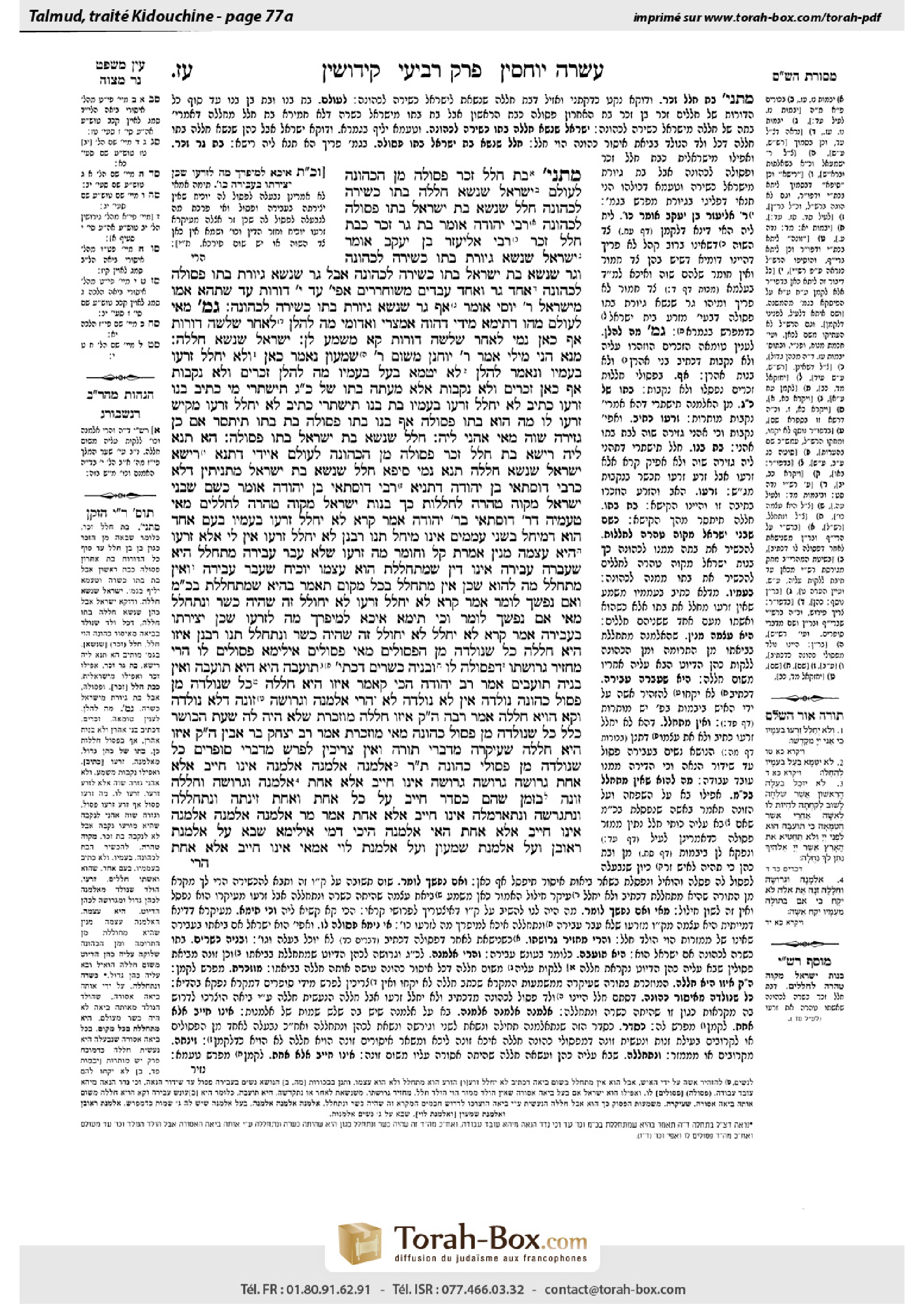
Kiddushin 77a: Talmud study for Daf Yomi
Daf Yomi is the daily study of one Talmud folio. Explore 37 tractates with scans, Hebrew text, Sefaria English and AI-generated French translations where annotated.
Passage selection and English or AI-generated French translation are available where the scan has annotations. Daf Study is independent of Torah-Box and Sefaria.
Browse Kiddushin · קידושין · All tractatesKiddushin 77a text and translations
This page of Kiddushin includes the Aramaic text, an English translation and an AI-generated French translation, alongside the scan above.
קידושין ע״ז א · Aramaic and Hebrew text
מַתְנִי׳ בַּת חָלָל זָכָר – פְּסוּלָה מִן הַכְּהוּנָּה לְעוֹלָם. יִשְׂרָאֵל שֶׁנָּשָׂא חֲלָלָה – בִּתּוֹ כְּשֵׁירָה לַכְּהוּנָּה. חָלָל שֶׁנָּשָׂא בַּת יִשְׂרָאֵל – בִּתּוֹ פְּסוּלָה לַכְּהוּנָּה. רַבִּי יְהוּדָה אוֹמֵר: בַּת גֵּר זָכָר כְּבַת חָלָל זָכָר.
רַבִּי אֱלִיעֶזֶר בֶּן יַעֲקֹב אוֹמֵר: יִשְׂרָאֵל שֶׁנָּשָׂא גִּיּוֹרֶת – בִּתּוֹ כְּשֵׁירָה לַכְּהוּנָּה, וְגֵר שֶׁנָּשָׂא בַּת יִשְׂרָאֵל – בִּתּוֹ כְּשֵׁירָה לַכְּהוּנָּה, אֲבָל גֵּר שֶׁנָּשָׂא גִּיּוֹרֶת – בִּתּוֹ פְּסוּלָה לַכְּהוּנָּה. אֶחָד גֵּר וְאֶחָד עֲבָדִים מְשׁוּחְרָרִים אֲפִילּוּ עַד עֲשָׂרָה דּוֹרוֹת, עַד שֶׁתְּהֵא אִמּוֹ מִיִּשְׂרָאֵל. רַבִּי יוֹסֵי אוֹמֵר: אַף גֵּר שֶׁנָּשָׂא גִּיּוֹרֶת בִּתּוֹ כְּשֵׁירָה לַכְּהוּנָּה.
גְּמָ׳ מַאי לְעוֹלָם? מַהוּ דְּתֵימָא: מִידֵּי דַּהֲוָה אַמִּצְרִי וַאֲדוֹמִי, מָה לְהַלָּן לְאַחַר שְׁלֹשָׁה דּוֹרוֹת, אַף כָּאן נָמֵי לְאַחַר שְׁלֹשָׁה דּוֹרוֹת, קָא מַשְׁמַע לַן.
יִשְׂרָאֵל שֶׁנָּשָׂא חֲלָלָה. מְנָא הָנֵי מִילֵּי? אָמַר רַבִּי יוֹחָנָן מִשּׁוּם רַבִּי שִׁמְעוֹן: נֶאֱמַר כָּאן: ״וְלֹא יְחַלֵּל זַרְעוֹ בְּעַמָּיו״, וְנֶאֱמַר לְהַלָּן: ״לֹא יִטַּמָּא בַּעַל בְּעַמָּיו״. מָה לְהַלָּן זְכָרִים וְלֹא נְקֵבוֹת, אַף כָּאן זְכָרִים וְלֹא נְקֵבוֹת.
אֶלָּא מֵעַתָּה, בִּתּוֹ שֶׁל כֹּהֵן גָּדוֹל תִּישְׁתְּרֵי! מִי כְּתִיב בְּנוֹ? ״זַרְעוֹ״ כְּתִיב, ״לֹא יְחַלֵּל זַרְעוֹ בְּעַמָּיו״.
בַּת בְּנוֹ תִּישְׁתְּרֵי! כְּתִיב ״לֹא יְחַלֵּל זַרְעוֹ״, מַקִּישׁ זַרְעוֹ לוֹ, מָה הוּא – בִּתּוֹ פְּסוּלָה, אַף בְּנוֹ – בִּתּוֹ פְּסוּלָה. בַּת בִּתּוֹ תִּיתְּסַר! אִם כֵּן, גְּזֵירָה שָׁוָה מַאי אַהֲנִי לֵיהּ?
חָלָל שֶׁנָּשָׂא בַּת יִשְׂרָאֵל – בִּתּוֹ פְּסוּלָה. הָא תְּנָא לֵיהּ רֵישָׁא: ״בַּת חָלָל זָכָר פְּסוּלָה מִן הַכְּהוּנָּה לְעוֹלָם״! אַיְּידֵי דִּתְנָא רֵישָׁא יִשְׂרָאֵל שֶׁנָּשָׂא חֲלָלָה, תְּנָא נָמֵי סֵיפָא חָלָל שֶׁנָּשָׂא בַּת יִשְׂרָאֵל.
מַתְנִיתִין דְּלָא כְּרַבִּי דּוֹסְתַּאי בֶּן יְהוּדָה, דְּתַנְיָא: רַבִּי דּוֹסְתַּאי בֶּן יְהוּדָה אוֹמֵר: כְּשֵׁם שֶׁבְּנֵי יִשְׂרָאֵל מִקְוֵה טׇהֳרָה לַחֲלָלוֹת, כָּךְ בְּנוֹת יִשְׂרָאֵל מִקְוֵה טׇהֳרָה לַחֲלָלִים. מַאי טַעְמֵיהּ דְּרַבִּי דּוֹסְתַּאי בְּרַבִּי יְהוּדָה? אָמַר קְרָא: ״לֹא יְחַלֵּל זַרְעוֹ בְּעַמָּיו״ – בְּעִם אֶחָד הוּא דְּמֵיחֵל, בִּשְׁנֵי עֲמָמִים אֵינוֹ מֵיחֵל.
תָּנוּ רַבָּנַן: ״לֹא יְחַלֵּל זַרְעוֹ״ – אֵין לִי אֶלָּא זַרְעוֹ, הִיא עַצְמָהּ, מִנַּיִן? אָמַרְתָּ: קַל וָחוֹמֶר, מָה זַרְעוֹ שֶׁלֹּא עָבַר עֲבֵירָה – מִתְחַלֵּל, הִיא שֶׁעָבְרָה עֲבֵירָה – אֵינוֹ דִּין שֶׁמִּתְחַלֶּלֶת?
הוּא, עַצְמוֹ יוֹכִיחַ, שֶׁעָבַר עֲבֵירָה וְאֵין מִתְחַלֵּל! מָה לְהוּא, שֶׁכֵּן אֵין מִתְחַלֵּל בְּכׇל מָקוֹם, תֹּאמַר בְּהִיא, שֶׁמִּתְחַלֶּלֶת בְּכׇל מָקוֹם.
וְאִם נַפְשְׁךָ לוֹמַר: אָמַר קְרָא ״לֹא יְחַלֵּל זַרְעוֹ״ – לֹא יְחוּלַּל, זֶה שֶׁהָיָה כָּשֵׁר וְנִתְחַלֵּל.
מַאי ״אִם נַפְשְׁךָ לוֹמַר״? וְכִי תֵּימָא אִיכָּא לְמִיפְרַךְ: מָה לְזַרְעוֹ – שֶׁכֵּן יְצִירָתוֹ בַּעֲבֵירָה, אָמַר קְרָא: ״לֹא יְחַלֵּל״, לֹא יְחוֹלֵל – זֶה שֶׁהָיָה כָּשֵׁר וְנִתְחַלֵּל.
תָּנוּ רַבָּנַן: אֵיזוֹ הִיא חֲלָלָה – כֹּל שֶׁנּוֹלְדָה מִן הַפְּסוּלִים. מַאי ״פְּסוּלִים״? אִילֵימָא פְּסוּלִים לוֹ, הֲרֵי מַחֲזִיר גְּרוּשָׁתוֹ דִּפְסוּלָה לוֹ וּבָנֶיהָ כְּשֵׁרִים, דִּכְתִיב ״תּוֹעֵבָה הִיא״ – הִיא תּוֹעֵבָה, וְאֵין בָּנֶיהָ תּוֹעֲבִים!
אָמַר רַב יְהוּדָה: הָכִי קָאָמַר: אֵיזוֹ הִיא חֲלָלָה – כֹּל שֶׁנּוֹלְדָה מִן פְּסוּל כְּהוּנָּה. נוֹלְדָה – אִין, לֹא נוֹלְדָה – לָא? הֲרֵי אַלְמָנָה, וּגְרוּשָׁה, זוֹנָה, דְּלֹא נוֹלְדָה, וְקָא הָוְיָא חֲלָלָה!
אָמַר רַבָּה: הָכִי קָאָמַר: אֵיזוֹ חֲלָלָה מוּזְכֶּרֶת שֶׁלֹּא הָיָה לָהּ שְׁעַת הַכּוֹשֶׁר כְּלָל? כֹּל שֶׁנּוֹלְדָה מִן פְּסוּל כְּהוּנָּה. מַאי ״מוּזְכֶּרֶת״? אָמַר רַב יִצְחָק בַּר אָבִין: הָכִי קָאָמַר: אֵיזוֹ הִיא חֲלָלָה שֶׁעִיקָּרָהּ מִדִּבְרֵי תוֹרָה וְאֵין צְרִיכִין לְפָרֵשׁ מִדִּבְרֵי סוֹפְרִים – כֹּל שֶׁנּוֹלְדָה מִן פְּסוּלֵי כְּהוּנָּה.
תָּנוּ רַבָּנַן: אַלְמָנָה אַלְמָנָה אַלְמָנָה – אֵינוֹ חַיָּיב אֶלָּא אַחַת. גְּרוּשָׁה גְּרוּשָׁה גְּרוּשָׁה – אֵינוֹ חַיָּיב אֶלָּא אַחַת.
אַלְמָנָה וּגְרוּשָׁה וַחֲלָלָה זוֹנָה, בִּזְמַן שֶׁהֵם כַּסֵּדֶר – חַיָּיב עַל כׇּל אַחַת וְאַחַת. זִינְּתָה וְנִתְחַלְּלָה וְנִתְגָּרְשָׁה וְנִתְאַרְמְלָה – אֵינוֹ חַיָּיב אֶלָּא אַחַת.
אָמַר מָר: אַלְמָנָה אַלְמָנָה אַלְמָנָה – אֵינוֹ חַיָּיב אֶלָּא אַחַת. הַאי אַלְמָנָה הֵיכִי דָמֵי? אִילֵּימָא שֶׁבָּא עַל אַלְמְנַת רְאוּבֵן וְעַל אַלְמְנַת שִׁמְעוֹן וְעַל אַלְמְנַת לֵוִי, אַמַּאי אֵינוֹ חַיָּיב אֶלָּא אַחַת?
Kiddushin 77a · English translation
MISHNA: The daughter of a male ḥalal is unfit to marry into the priesthood forever. In other words, all daughters of male descendants of a ḥalal are prohibited from marrying priests, as they have the status of ḥalalot. If there was an Israelite who married a ḥalala, his daughter is fit to marry into the priesthood, whereas if there was a ḥalal who married a Jewish woman, his daughter is unfit to marry into the priesthood. Rabbi Yehuda says: The daughter of a male convert is like the daughter of a male ḥalal, and she is also prohibited from marrying into the priesthood.
Rabbi Eliezer ben Ya’akov disagrees and says: If there was an Israelite who married a female convert, his daughter is fit to marry into the priesthood, and similarly if there was a convert who married a Jewish woman, his daughter is fit to marry into the priesthood. But if there was a male convert who married a female convert, his daughter is unfit to marry into the priesthood. With regard to both converts and emancipated Canaanite slaves, their daughters are unfit to marry into the priesthood even up to ten generations. This halakha applies to the offspring until his mother is born Jewish. Rabbi Yosei says: Even if there was a male convert who married a female convert, his daughter is fit to marry into the priesthood.
GEMARA: What is the meaning of the statement that the daughter of a ḥalal is unfit forever? The Gemara explains: It is necessary lest you say that the halakha should be just as it is in the case of an Egyptian convert and an Edomite convert, and that just as there, with regard to an Egyptian and an Edomite, their descendants are permitted to enter into the congregation after three generations, so too here, the daughter of a descendant of a ḥalal should also be allowed to marry into the priesthood after three generations. The mishna therefore teaches us that this prohibition is permanent.
The mishna teaches that in the case of an Israelite who married a ḥalala, his daughter is fit to marry into the priesthood. The Gemara asks: From where are these matters derived? Rabbi Yoḥanan says in the name of Rabbi Shimon that it is stated here: “And he shall not profane his offspring among his people” (Leviticus 21:15), and it is stated there: “He shall not defile himself, being a chief man among his people” (Leviticus 21:4): Just as there the prohibition against a priest contracting ritual impurity from a corpse applies to males but not females; so too here, with regard to the profanation of his offspring, where the term “among his people” is also employed, it is males who are rendered unfit and who render their daughters unfit to marry into the priesthood when they are ḥalalim, but not females.
The Gemara asks: If that is so, that profanation applies only to males, the daughter of a High Priest and a widow should be permitted to marry into the priesthood, and there should be no status of a ḥalala. The Gemara rejects this: Is it written that his son is profaned? It is written: “His offspring,” which includes his daughter, as the verse reads: “He shall not profane his offspring among his people.” Nevertheless, the daughter of his ḥalala daughter, who is already the third generation, is permitted as a result of the verbal analogy.
The Gemara asks: If so, that the granddaughter is permitted as a result of the verbal analogy, the daughter of his son should also be permitted. The Gemara answers: It is written: “He shall not profane his offspring,” by which the Torah links his offspring to him: Just as for him, his daughter is unfit; so too for his son, the son of a High Priest, his daughter is unfit. The Gemara asks: In that case, the daughter of his daughter from an Israelite should be prohibited, just as his own daughter is unfit. The Gemara answers: If so, that his daughter’s daughter is also unfit, of what use is the verbal analogy of: “He shall not defile himself, being a chief man among his people”? It must teach that his daughter’s daughter is fit.
§ The mishna teaches that if there was a ḥalal who married a Jewish woman, his daughter is unfit to marry into the priesthood. The Gemara questions this ruling: Wasn’t this already taught in the first clause: The daughter of a male ḥalal is unfit to marry into the priesthood forever? The Gemara answers: Since it taught in the first clause about an Israelite who married a ḥalala, it also taught in the latter clause about a ḥalal who married a Jewish woman, to present the complete ruling.
The Gemara comments: The mishna is not in accordance with the opinion of Rabbi Dostai ben Yehuda, as it is taught in a baraita: Rabbi Dostai ben Yehuda says: Just as the sons of Israel are a ritual bath of purity for ḥalalot, i.e., the daughter of a ḥalala who marries an Israelite does not transmit her status of a ḥalala, and their daughters may marry priests, so the daughters of Israel are a ritual bath of purity for ḥalalim, and their daughters may marry priests. The Gemara asks: What is the reason of Rabbi Dostai, son of Rabbi Yehuda? The Gemara explains that the verse states: “He shall not profane his offspring among his people” (Leviticus 21:15), which teaches: It is among one people that he profanes, i.e., the offspring is a ḥalal only when he and his wife are both profaned, i.e., ḥalalim, but among two peoples he does not profane. If the mother is of a different people, i.e., not a ḥalala, the offspring is of unflawed lineage.
The Sages taught: The verse states that a priest may not engage in intercourse with a woman who is forbidden to him, so that “he shall not profane his offspring.” I have derived only that his offspring resulting from a union with a woman forbidden to him is profaned, i.e., has the status of a ḥalal; from where do I derive that she herself, i.e., the woman who engaged in forbidden intercourse with the priest, is also disqualified from marrying into the priesthood? You can say it is an a fortiori inference: If his offspring, who did not commit a transgression, is profaned, is it not logical that she, who did commit a transgression, is similarly profaned?
The Gemara responds: He, the priest himself, shall prove otherwise, as he committed a transgression but he is not profaned. Although he may not serve in the Temple while he remains married to her, he regains his status of a fit priest once he divorces her. The Gemara rejects this: What is notable about the priest? He is notable in that he is a male, and in no case is a male priest profaned by engaging in forbidden intercourse. Will you say the same with regard to her, a woman, who is disqualified from marrying a priest in all cases? For example, if she engages in intercourse with a man of flawed lineage, she assumes the status of a zona and is permanently disqualified from marrying into the priesthood.
And if it is your wish to say that this reasoning is faulty, there is a different proof: The verse states: “He shall not profane his offspring,” which means that the priest may not engage in intercourse with a woman who is forbidden to him so that someone shall not become profaned. The verse is referring to this woman who was at one time fit and then became profaned. In other words, the term profanation does not apply to his offspring, as they were never fit to begin with. Rather, it is referring to the woman with whom he engaged in intercourse, as, since she was initially fit to marry into the priesthood, she can be described as becoming profaned.
The Gemara asks: What is the meaning of: If it is your wish to say that this reasoning is faulty, in what way is it faulty? The Gemara explains the counterargument: And if you would say that the a fortiori argument can be refuted as follows: What is notable about his offspring? He is notable in that he is formed through a transgression. Since the woman was not formed through a transgression, one cannot derive the halakha pertaining to her from that of the offspring. The Gemara therefore continues that even if one were to state that counterargument, the verse nevertheless states: “He shall not profane his offspring,” which means that the priest may not engage in intercourse with a woman who is forbidden to him so that someone shall not become profaned. The verse is referring to this woman who was at one time fit and then became profaned.
§ The Sages taught: Who is a ḥalala? The term is referring to any woman born from people of flawed lineage. The Gemara asks: What is the meaning of people of flawed lineage? If we say it means she was born from someone unfit for him, i.e., a woman forbidden to this particular man due to a family relationship or for some other reason, isn’t there the case of one who remarries his divorcée after she had been married to someone else in the interim; she is unfit for him, and yet her children are fit. As it is written with regard to this case: “That is an abomination” (Deuteronomy 24:4), and this is interpreted to mean: That marriage is an abomination, but the children of that marriage are not an abomination and are entirely fit.
Rav Yehuda says: This is what the Sages are saying: Who is a ḥalala? The term is referring to any woman born from one unfit for the priesthood. The Gemara questions this: This implies that one who was born, yes, she is a ḥalala, but one who was not born from one unfit for the priesthood is not a ḥalala. Aren’t there the cases of a widow, or a divorced woman, or a zona who engaged in intercourse with a priest? They were not born from one who was unfit for the priesthood, and yet such a woman is a ḥalala.
Rabba said: This is what the Sages are saying: Who is the ḥalala mentioned that did not have a moment of fitness at all, but was unfit from birth? She is any woman born from one unfit for the priesthood. The Gemara asks: What is the meaning of the term: Mentioned? Where was she mentioned? Rav Yitzḥak bar Avin said: This is what the Sages are saying: Who is the ḥalala whose prohibition is rooted in the words of a verse in the Torah, and it is not necessary to clarify her prohibition further by the words of the Sages? She is any woman born from one unfit for the priesthood. With regard to such a woman the verse explicitly states: “He shall not profane his offspring.” By contrast, the halakha that a woman who engages in forbidden intercourse with a priest becomes a ḥalala is not explicit in the Torah, but is learned through an exposition of the Sages.
§ The Sages taught: If a High Priest engages in sexual intercourse with a widow, a widow, a widow, he is liable to receive only one set of lashes. Similarly, if a priest engages in intercourse with a divorcée, a divorcée, a divorcée, he is liable to receive only one set of lashes.
If a High Priest engages in sexual intercourse with a woman who was a widow, and then was a divorcée, and then was a ḥalala, and then was a zona, when the changes to her status occurred in that order, that she was first widowed, then remarried and was divorced, and subsequently engaged in intercourse with a priest, thereby becoming a ḥalala, and then she engaged in intercourse with a gentile or a forbidden relative, thereby becoming a zona, the High Priest is liable to receive lashes for each and every one of these transgressions each time he engages in intercourse with her. By contrast, if she first became a zona by engaging in intercourse with a gentile or a forbidden relative, and then became a ḥalala by engaging in intercourse with a priest, and subsequently she divorced, remarried, and was widowed, a High Priest who now engages in intercourse with her is liable to receive only one set of lashes.
The Gemara proceeds to clarify this baraita. The Master said in the baraita: If a High Priest engages in intercourse with a widow, a widow, a widow, he is liable to receive only one set of lashes. The Gemara asks: What are the circumstances of this widow? If we say that he engaged in sexual intercourse with three widows: With Reuven’s widow, and with Shimon’s widow, and with Levi’s widow, why is he liable to receive only one set of lashes?
Kiddushin 77a · Traduction française (IA)
MICHNA : La fille d’un ḥalal est inapte à épouser un prêtre pour toujours. Autrement dit, toutes les filles des descendants mâles d’un ḥalal sont interdites aux prêtres, car elles ont le statut de ḥalalot. Si un Israélite a épousé une ḥalala, sa fille peut épouser un prêtre, tandis que si un ḥalal a épousé une femme juive, sa fille ne peut pas épouser un prêtre. Rabbi Yehuda dit : La fille d’un converti est comme la fille d’un ḥalal, et elle aussi ne peut pas épouser un prêtre.
Rabbi Eliezer ben Ya’akov est en désaccord et dit : Si un Israélite a épousé une convertie, sa fille peut épouser un prêtre, et de même, si un converti a épousé une femme juive, sa fille peut épouser un prêtre. Mais si un converti a épousé une convertie, sa fille ne peut pas épouser un prêtre. Les filles des convertis comme celles des esclaves cananéens affranchis ne peuvent pas épouser un prêtre jusqu’à dix générations. Cette halakha s’applique à la descendance jusqu’à ce que sa mère soit née juive. Rabbi Yosei dit : Même si un converti a épousé une convertie, sa fille peut épouser un prêtre.
GUEMARA : Que signifie l’affirmation selon laquelle la fille d’un ḥalal est inapte pour toujours ? La Guemara explique : C’est nécessaire, de peur que tu ne dises que la halakha devrait être la même que dans le cas d’un converti égyptien et d’un converti édomite, et que, de même que là, pour l’Égyptien et l’Édomite, leurs descendants peuvent entrer dans l’assemblée après trois générations, de même ici, la fille d’un descendant d’un ḥalal devrait aussi être autorisée à épouser un prêtre après trois générations. La Michna nous enseigne donc que cette interdiction est permanente.
La Michna enseigne que, dans le cas d’un Israélite qui a épousé une ḥalala, sa fille peut épouser un prêtre. La Guemara demande : D’où ces éléments sont-ils déduits ? Rabbi Yoḥanan dit au nom de Rabbi Shimon qu’il est écrit ici : « Il ne profanera pas sa descendance parmi son peuple » (Lévitique 21:15), et qu’il est écrit là : « Il ne se rendra pas impur, étant un chef parmi son peuple » (Lévitique 21:4). De même que là, l’interdiction faite à un prêtre de contracter l’impureté rituelle au contact d’un mort s’applique aux hommes, mais non aux femmes, de même ici, concernant la profanation de sa descendance, où l’expression « parmi son peuple » est également employée, ce sont les hommes qui sont rendus inaptes et qui rendent leurs filles inaptes à épouser un prêtre lorsqu’ils sont des ḥalalim, mais non les femmes.
La Guemara demande : Si c’est ainsi, si la profanation ne s’applique qu’aux hommes, la fille d’un grand prêtre et d’une veuve devrait être autorisée à épouser un prêtre, et il ne devrait pas y avoir de statut de ḥalala. La Guemara rejette cette idée : Est-il écrit que son fils est profané ? Il est écrit : « Sa descendance », ce qui inclut sa fille, comme le dit le verset : « Il ne profanera pas sa descendance parmi son peuple. » Néanmoins, la fille de sa fille ḥalala, qui est déjà de la troisième génération, est autorisée en vertu de l’analogie verbale.
La Guemara demande : Si c’est ainsi, si la petite-fille est autorisée en vertu de l’analogie verbale, la fille de son fils devrait également être autorisée. La Guemara répond : Il est écrit : « Il ne profanera pas sa descendance », par quoi la Torah rattache sa descendance à lui : de même que sa propre fille est inapte, de même la fille de son fils, le fils d’un grand prêtre, est inapte. La Guemara demande : Dans ce cas, la fille de sa fille née d’un Israélite devrait être interdite, tout comme sa propre fille est inapte. La Guemara répond : Si la fille de sa fille était elle aussi inapte, à quoi servirait l’analogie verbale « Il ne se rendra pas impur, étant un chef parmi son peuple » ? Elle doit enseigner que la fille de sa fille est apte.
§ La Michna enseigne que si un ḥalal a épousé une femme juive, sa fille ne peut pas épouser un prêtre. La Guemara met cette règle en question : Cela n’a-t-il pas déjà été enseigné dans la première partie : la fille d’un ḥalal est inapte à épouser un prêtre pour toujours ? La Guemara répond : Puisque la première partie enseignait le cas d’un Israélite qui a épousé une ḥalala, la dernière partie enseignait également celui d’un ḥalal qui a épousé une femme juive, afin de présenter la règle dans son intégralité.
La Guemara fait remarquer que la Michna n’est pas conforme à l’opinion de Rabbi Dostai ben Yehuda, comme l’enseigne une baraïta : Rabbi Dostai ben Yehuda dit : De même que les fils d’Israël sont un mikvé de pureté pour les ḥalalot, c’est-à-dire que la fille d’une ḥalala qui épouse un Israélite ne transmet pas son statut de ḥalala et que leurs filles peuvent épouser des prêtres, de même les filles d’Israël sont un mikvé de pureté pour les ḥalalim, et leurs filles peuvent épouser des prêtres. La Guemara demande : Quelle est la raison de Rabbi Dostai, fils de Rabbi Yehuda ? La Guemara explique que le verset dit : « Il ne profanera pas sa descendance parmi son peuple » (Lévitique 21:15), ce qui enseigne qu’il ne profane qu’au sein d’un seul peuple, c’est-à-dire que la descendance n’est ḥalal que lorsque lui et sa femme sont tous deux profanés, c’est-à-dire ḥalalim ; mais il ne profane pas au sein de deux peuples. Si la mère appartient à un peuple différent, c’est-à-dire qu’elle n’est pas une ḥalala, la descendance est de lignée intacte.
Les Sages ont enseigné : Le verset indique qu’un prêtre ne doit pas avoir de relations avec une femme qui lui est interdite, afin qu’« il ne profane pas sa descendance ». J’ai seulement appris que sa descendance issue d’une union avec une femme qui lui est interdite est profanée, c’est-à-dire qu’elle a le statut de ḥalal ; d’où apprend-on qu’elle-même, c’est-à-dire la femme qui a eu des relations interdites avec le prêtre, est également disqualifiée pour épouser un prêtre ? On peut le déduire a fortiori : si sa descendance, qui n’a commis aucune transgression, est profanée, n’est-il pas logique qu’elle, qui a commis une transgression, soit de même profanée ?
La Guemara répond : Le prêtre lui-même prouve le contraire, car il a commis une transgression, mais il n’est pas profané. Bien qu’il ne puisse pas officier au Temple tant qu’il reste marié à elle, il retrouve son statut de prêtre apte dès qu’il divorce. La Guemara rejette cet argument : Qu’a-t-il de particulier, ce prêtre ? Il se distingue en ce qu’il est un homme, et un prêtre ne devient jamais profané pour avoir eu des relations interdites. Peut-on en dire autant d’elle, une femme, qui est disqualifiée pour épouser un prêtre dans tous les cas ? Par exemple, si elle a des relations avec un homme de lignée déficiente, elle acquiert le statut de zona et est définitivement disqualifiée pour épouser un prêtre.
Et si tu veux dire que ce raisonnement est erroné, il existe une autre preuve : le verset dit : « Il ne profanera pas sa descendance », ce qui signifie que le prêtre ne doit pas avoir de relations avec une femme qui lui est interdite, afin que personne ne soit profané. Le verset parle de cette femme qui, à un moment donné, était apte puis a été profanée. Autrement dit, le terme « profanation » ne s’applique pas à sa descendance, puisqu’elle n’a jamais été apte au départ. Il s’applique plutôt à la femme avec laquelle il a eu des relations, car, puisqu’elle était initialement apte à épouser un prêtre, on peut dire qu’elle est devenue profanée.
La Guemara demande : Que signifie « si tu veux dire que ce raisonnement est erroné » ? En quoi est-il erroné ? La Guemara expose le contre-argument : Et si tu disais que l’argument a fortiori peut être réfuté ainsi : qu’a de particulier sa descendance ? Elle se distingue en ce qu’elle est issue d’une transgression. Puisque la femme, elle, n’est pas issue d’une transgression, on ne peut pas déduire la halakha qui la concerne de celle qui porte sur la descendance. La Guemara poursuit donc : même si l’on avançait ce contre-argument, le verset dit néanmoins : « Il ne profanera pas sa descendance », ce qui signifie que le prêtre ne doit pas avoir de relations avec une femme qui lui est interdite, afin que personne ne soit profané. Le verset parle de cette femme qui, à un moment donné, était apte puis a été profanée.
§ Les Sages ont enseigné : Qui est une ḥalala ? Le terme désigne toute femme née de personnes de lignée déficiente. La Guemara demande : Que signifie « personnes de lignée déficiente » ? Si l’on dit que cela signifie qu’elle est née d’une personne qui n’était pas apte à l’épouser, c’est-à-dire d’une femme interdite à cet homme particulier en raison d’un lien de parenté ou pour une autre raison, n’y a-t-il pas le cas de celui qui reprend son ex-femme après qu’elle a été mariée à quelqu’un d’autre entre-temps ? Elle ne peut pas l’épouser, et pourtant leurs enfants sont aptes. Car il est écrit à ce sujet : « C’est une abomination » (Deutéronome 24:4), et cela s’interprète ainsi : ce mariage est une abomination, mais les enfants issus de ce mariage ne sont pas une abomination et sont tout à fait aptes.
Rav Yehuda dit : Voici ce que disent les Sages : Qui est une ḥalala ? Le terme désigne toute femme née d’une personne qui n’était pas apte à la prêtrise. La Guemara met cela en question : Cela implique que celle qui est née ainsi est bien une ḥalala, mais que celle qui n’est pas née d’une personne inapte à la prêtrise n’est pas une ḥalala. Pourtant, il y a les cas d’une veuve, d’une femme divorcée ou d’une zona qui a eu des relations avec un prêtre. Elles ne sont pas nées d’une personne inapte à la prêtrise, et pourtant une telle femme est une ḥalala.
Rabba dit : Voici ce que disent les Sages : Qui est la ḥalala mentionnée qui n’a jamais été apte, même un seul instant, mais qui était inapte dès sa naissance ? Toute femme née d’une personne qui n’était pas apte à la prêtrise. La Guemara demande : Que signifie le terme « mentionnée » ? Où a-t-elle été mentionnée ? Rav Yitzḥak bar Avin dit : Voici ce que disent les Sages : Qui est la ḥalala dont l’interdiction se fonde sur les termes d’un verset de la Torah et dont il n’est pas nécessaire de préciser davantage l’interdiction au moyen des paroles des Sages ? Toute femme née d’une personne qui n’était pas apte à la prêtrise. À son sujet, le verset dit explicitement : « Il ne profanera pas sa descendance. » En revanche, la halakha selon laquelle une femme qui a des relations interdites avec un prêtre devient une ḥalala n’est pas explicite dans la Torah, mais est déduite par une interprétation des Sages.
§ Les Sages ont enseigné : Si un grand prêtre a des relations avec une veuve, une veuve, une veuve, il n’encourt qu’une seule série de coups. De même, si un prêtre a des relations avec une divorcée, une divorcée, une divorcée, il n’encourt qu’une seule série de coups.
Si un grand prêtre a des relations avec une femme qui a été veuve, puis divorcée, puis ḥalala, puis zona, et que ces changements de statut se sont produits dans cet ordre — elle a d’abord été veuve, puis s’est remariée et a divorcé, ensuite a eu des relations avec un prêtre et est ainsi devenue ḥalala, puis a eu des relations avec un non-Juif ou un parent avec lequel les relations sont interdites et est ainsi devenue zona —, le grand prêtre encourt des coups pour chacune de ces transgressions, chaque fois qu’il a des relations avec elle. En revanche, si elle est d’abord devenue zona en ayant des relations avec un non-Juif ou un parent avec lequel les relations sont interdites, puis ḥalala en ayant des relations avec un prêtre, et qu’ensuite elle a divorcé, s’est remariée et est devenue veuve, un grand prêtre qui a maintenant des relations avec elle n’encourt qu’une seule série de coups.
La Guemara poursuit en expliquant cette baraïta. Le Maître a dit dans la baraïta : Si un grand prêtre a des relations avec une veuve, une veuve, une veuve, il n’encourt qu’une seule série de coups. La Guemara demande : Dans quelles circonstances s’agit-il de cette veuve ? Si l’on dit qu’il a eu des relations avec trois veuves — la veuve de Reuven, la veuve de Shimon et la veuve de Levi —, pourquoi n’encourt-il qu’une seule série de coups ?
Traduction française générée par IA à partir de l’édition anglaise de Sefaria. Vérifie toujours un passage avec le texte source.
Text from Sefaria: William Davidson Edition - Vocalized Aramaic (CC BY NC); William Davidson Edition - English (CC BY NC).