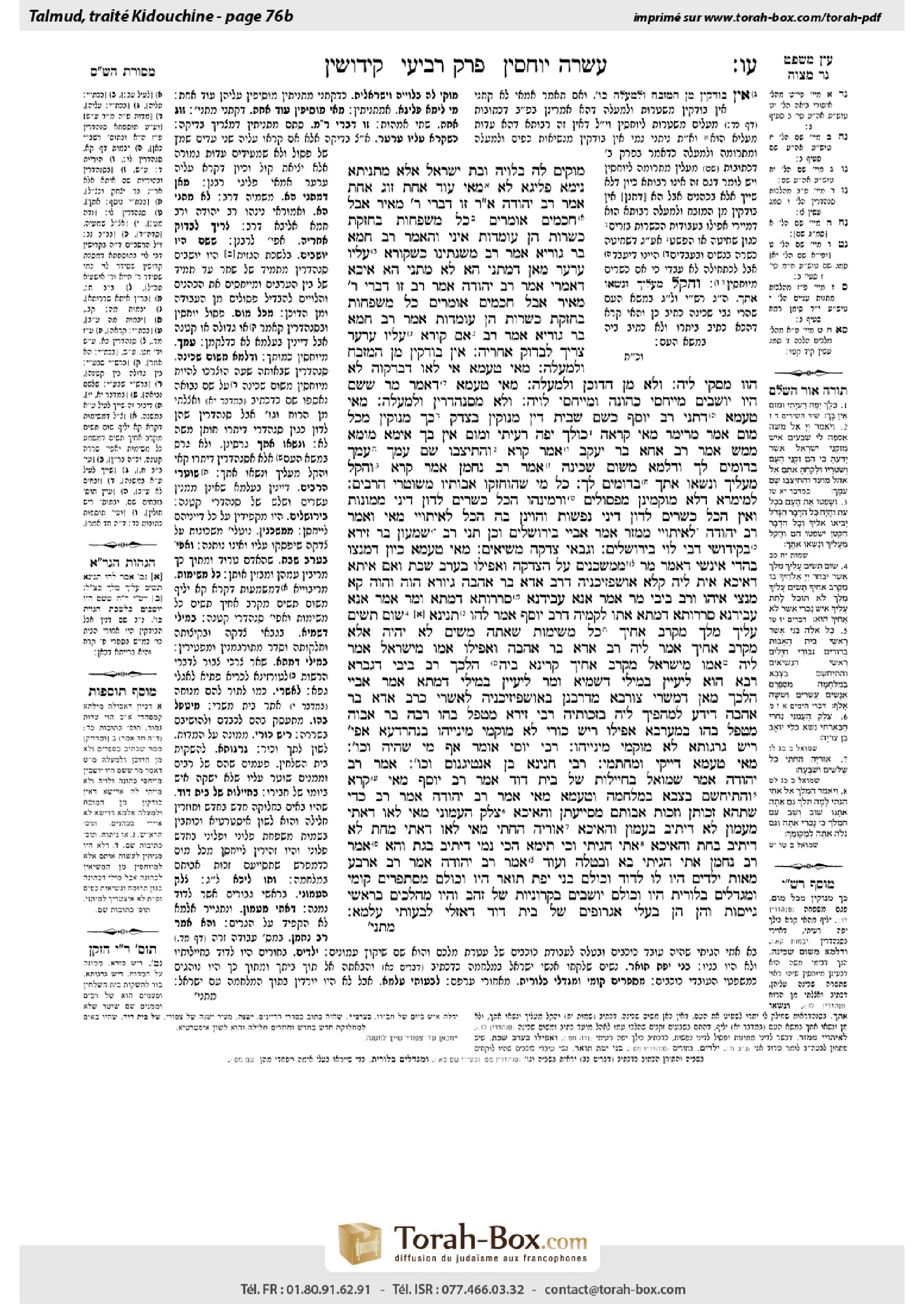
Kiddushin 76b: Talmud study for Daf Yomi
Daf Yomi is the daily study of one Talmud folio. Explore 37 tractates with scans, Hebrew text, Sefaria English and AI-generated French translations where annotated.
Passage selection and English or AI-generated French translation are available where the scan has annotations. Daf Study is independent of Torah-Box and Sefaria.
Browse Kiddushin · קידושין · All tractatesKiddushin 76b text and translations
This page of Kiddushin includes the Aramaic text, an English translation and an AI-generated French translation, alongside the scan above.
קידושין ע״ו ב · Aramaic and Hebrew text
מוֹקֵים לַהּ בִּלְוִיָּה וּבַת יִשְׂרָאֵל. אֶלָּא מַתְנִיתָא נֵימָא פְּלִיגָא? לָא, מַאי ״עוֹד אַחַת״ – זוּג אַחַת.
אָמַר רַב יְהוּדָה אָמַר רַב: זוֹ דִּבְרֵי רַבִּי מֵאִיר, אֲבָל חֲכָמִים אוֹמְרִים: כׇּל מִשְׁפָּחוֹת בְּחֶזְקַת כְּשֵׁרוֹת הֵן עוֹמְדוֹת. אִינִי? וְהָאָמַר רַב חָמָא בַּר גּוּרְיָא אָמַר רַב: מִשְׁנָתֵינוּ כְּשֶׁקּוֹרֵא עָלָיו עַרְעָר! מַאן דְּמַתְנֵי הָא – לָא מַתְנֵי הָא.
אִיכָּא דְּאָמְרִי אָמַר רַב יְהוּדָה אָמַר רַב: זוֹ דִּבְרֵי רַבִּי מֵאִיר, אֲבָל חֲכָמִים אוֹמְרִים: כׇּל מִשְׁפְּחוֹת בְּחֶזְקַת כְּשֵׁרוֹת הֵן עוֹמְדוֹת. אָמַר רַב חָמָא בַּר גּוּרְיָא אָמַר רַב: אִם קוֹרֵא עָלָיו עַרְעָר, צָרִיךְ לִבְדּוֹק אַחֲרֶיהָ.
אֵין בּוֹדְקִין מִן הַמִּזְבֵּחַ וּלְמַעְלָה. מַאי טַעְמָא? אִי לָאו דְּבַדְקוּהּ לָא הֲווֹ מַסְּקִי לֵיהּ. וְלֹא מִן הַדּוּכָן וּלְמַעְלָה. מַאי טַעְמָא? דְּאָמַר מָר: שֶׁשָּׁם הָיוּ יוֹשְׁבִים מְיַיחֲסֵי כְּהוּנָּה וּמְיַיחֲסֵי לְוִיָּה.
וְלֹא מִסַּנְהֶדְרִין וּלְמַעְלָה. מַאי טַעְמָא? דְּתָנֵי רַב יוֹסֵף: כְּשֵׁם שֶׁבֵּית דִּין מְנוּקִּין בְּצֶדֶק – כָּךְ מְנוּקִּין מִכׇּל מוּם. אָמַר מָרִימָר: מַאי קְרָאָה – ״כֻּלָּךְ יָפָה רַעְיָתִי וּמוּם אֵין בָּךְ״.
אֵימָא מוּמָא מַמָּשׁ! אָמַר רַב אַחָא בַּר יַעֲקֹב: אָמַר קְרָא: ״וְהִתְיַצְּבוּ שָׁם עִמָּךְ״, ״עִמָּךְ״ – בְּדוֹמִים לָךְ.
וְדִלְמָא מִשּׁוּם שְׁכִינָה? אָמַר רַב נַחְמָן, אָמַר קְרָא: ״וְהָקֵל מֵעָלֶיךָ וְנָשְׂאוּ אִתָּךְ״ – בְּדוֹמִים לָךְ.
כׇּל מִי שֶׁהוּחְזְקוּ אֲבוֹתָיו מִשּׁוֹטְרֵי הָרַבִּים. לְמֵימְרָא דְּלָא מוֹקְמִינַן מִפְּסוּלִים? וּרְמִינְהוּ: הַכֹּל כְּשֵׁרִים לָדוּן דִּינֵי מָמוֹנוֹת, וְאֵין הַכֹּל כְּשֵׁרִים לָדוּן דִּינֵי נְפָשׁוֹת. וְהָוֵינַן בָּהּ: ״הַכֹּל״ לְאֵיתוֹיֵי מַאי? וְאָמַר רַב יְהוּדָה: לְאֵיתוֹיֵי מַמְזֵר! אָמַר אַבָּיֵי: בִּירוּשָׁלַיִם. וְכֵן תָּנֵי רַב שִׁמְעוֹן בַּר זֵירָא בְּקִידּוּשֵׁי דְבֵי לֵוִי: בִּירוּשָׁלַיִם.
וְגַבָּאֵי צְדָקָה מַשִּׂיאִים. מַאי טַעְמָא? כֵּיוָן דְּמִנְּצוּ בַּהֲדֵי אִינָשֵׁי, דְּאָמַר מָר: מְמַשְׁכְּנִים עַל הַצְּדָקָה וַאֲפִילּוּ בְּעֶרֶב שַׁבָּת, וְאִם אִיתָא דְּאִיכָּא – אִית לֵיהּ קָלָא.
אוּשְׁפִּיזְכָּנֵיהּ דְּרַב אַדָּא בַּר אַהֲבָה גִּיּוֹרָא הֲוָה, וַהֲוָה קָא מִנְּצֵי אִיהוּ וְרַב בִּיבִי, מָר אָמַר: אֲנָא עָבֵידְנָא סְרָרוּתָא דְמָתָא, וּמַר אָמַר: אֲנָא עָבֵידְנָא סְרָרוּתָא דְמָתָא. אֲתוֹ לְקַמֵּיהּ דְּרַב יוֹסֵף אֲמַר לְהוּ: תְּנֵינָא: ״שׂוֹם תָּשִׂים עָלֶיךָ מֶלֶךְ... מִקֶּרֶב אַחֶיךָ״, כׇּל מְשִׂימוֹת שֶׁאַתָּה מֵשִׂים – לֹא יִהְיֶה אֶלָּא מִקֶּרֶב אַחֶיךָ.
אֲמַר לֵיהּ רַב אַדָּא בַּר אַהֲבָה: וַאֲפִילּוּ אִמּוֹ מִיִּשְׂרָאֵל? אֲמַר לֵיהּ: אִמּוֹ מִיִּשְׂרָאֵל מִקֶּרֶב אַחֶיךָ קָרֵינָא בֵּיהּ. הִלְכָּךְ רַב בִּיבִי דְּגַבְרָא רַבָּא הוּא – לִיעַיֵּין בְּמִילֵּי דִשְׁמַיָּא, וּמָר – לִיעַיֵּין בְּמִילֵּי דְמָתָא. אָמַר אַבָּיֵי הִלְכָּךְ מַאן דְּמַשְׁרֵי צוּרְבָּא מִדְּרַבָּנַן בְּאוּשְׁפִּיזְכָּנֵיהּ – לַאשְׁרֵי כְּרַב אַדָּא בַּר אַהֲבָה, (דְּיָדַע לִמְהַפֵּיךְ) [דִּמְהַפֵּיךְ] לֵיהּ בִּזְכוּתֵיהּ.
רַבִּי זֵירָא מִטַּפַּל בְּהוּ, רַבָּה בַּר אֲבוּהּ מִטַּפַּל בְּהוּ. בְּמַעְרְבָא אֲפִילּוּ רֵישׁ כּוֹרֵי לָא מוֹקְמִי מִינַּיְיהוּ. בִּנְהַרְדְּעָא אֲפִילּוּ רֵישׁ גַּרְגּוּתָא לָא מוֹקְמִי מִינַּיְיהוּ.
רַבִּי יוֹסֵי אוֹמֵר: אַף מִי שֶׁהָיָה וְכוּ׳. מַאי טַעְמָא? דָּיְיקִי וּמַחְתְּמִי.
רַבִּי חֲנִינָא בֶּן אַנְטִיגְנוֹס וְכוּ׳. אָמַר רַב יְהוּדָה אָמַר שְׁמוּאֵל: בַּחֲיָילוֹת שֶׁל בֵּית דָּוִד. אָמַר רַב יוֹסֵף: מַאי קְרָא? ״וְהִתְיַחְשָׂם בַּצָּבָא בַּמִּלְחָמָה״. וְטַעְמָא מַאי? אָמַר רַב יְהוּדָה אָמַר רַב: כְּדֵי שֶׁתְּהֵא זְכוּתָן וּזְכוּת אֲבוֹתָם מְסַיַּיעְתָּן.
וְהָאִיכָּא צֶלֶק הָעַמּוֹנִי, מַאי לָאו דְּאָתֵי מֵעַמּוֹן? לָא, דְּיָתֵיב בְּעַמּוֹן. וְהָאִיכָּא אוּרִיָּה הַחִתִּי, מַאי לָאו דְּאָתֵי מֵחֵת? לָא, דְּיָתֵיב בְּחֵת.
וְהָאִיכָּא אִתַּי הַגִּתִּי! וְכִי תֵּימָא הָכִי נָמֵי דְּיָתֵיב בְּגַת, וְהָא אָמַר רַב נַחְמָן: אִתַּי הַגִּיתִּי בָּא וּבִטְּלָהּ!
וְעוֹד אָמַר רַב יְהוּדָה אָמַר רַב: אַרְבַּע מֵאוֹת יְלָדִים הָיוּ לוֹ לְדָוִד, וְכוּלָּם בְּנֵי יְפַת תּוֹאַר הָיוּ, וְכוּלָּם מִסְתַּפְּרִים קוֹמֵי, וּמְגַדְּלִים בְּלוֹרִית הָיוּ, וְכוּלָּם יוֹשְׁבִים בִּקְרוֹנִיּוֹת שֶׁל זָהָב וְהָיוּ מְהַלְּכִים בְּרָאשֵׁי גְיָיסוֹת, וְהֵן הֵן בַּעֲלֵי אֶגְרוֹפִים שֶׁל בֵּית דָּוִד! דְּאָזְלִי לְבַעוֹתֵי עָלְמָא.
Kiddushin 76b · English translation
he interprets his statement as referring to a Levite woman or an Israelite woman, about whom the mishna states that one must investigate one additional generation. Therefore, Rav Adda bar Ahava’s ruling accords with that of the mishna. But shall we say the baraita disputes the mishna? The Gemara rejects this: No, what is the meaning of the mishna’s phrase: One additional? It means one pair, i.e., two more mothers on each side.
Rav Yehuda says that Rav says: This mishna presents the statement of Rabbi Meir, but the Rabbis say: All families retain a presumptive status of fitness, and do not require investigation. The Gemara asks: Is that so, did Rav really say this? But doesn’t Rav Ḥama bar Gurya say that Rav says: Our mishna is referring only to a case when an objection was registered about the family concerning its lineage, but if no objection was registered, everyone agrees that the family retains its presumptive status of fitness. The Gemara answers: The one who taught this statement in the name of Rav did not teach that other statement.
There are those who say that this discussion occurred as follows: Rav Yehuda says that Rav says: This mishna presents the statement of Rabbi Meir, but the Rabbis say: All families retain presumptive status of fitness. Rav Ḥama bar Gurya says that Rav says: When an objection is registered about a family concerning its lineage, everyone agrees that he must investigate it. According to this version, there is no contradiction between these two complementary statements.
§ The mishna teaches that one need not investigate from the altar and above. The Gemara asks: What is the reason for this? The Gemara answers: If the Sanhedrin had not examined his lineage they would not have allowed him to ascend to the altar and perform the sacrificial rites. The mishna further teaches: Nor must one investigate from the platform and above. The Gemara asks: What is the reason? The Gemara answers: It is as the Master said in his description of the Temple chambers (Tosefta, Ḥagiga 2:4): For there in the Hewn Chamber those of the priesthood with unflawed lineage and the Levites of unflawed lineage sat and examined the lineage of everyone who came to serve in the Temple.
The mishna also taught: Nor must one investigate from the Sanhedrin and above. What is the reason there is no need to investigate further? The Gemara answers: It is as Rav Yosef taught that just as the court is clean in justice, so too, it is clean of any blemish, i.e., it does not include anyone of flawed lineage. Mareimar said: What is the verse from which it is derived? It states: “You are all fair, my love; and there is no blemish in you” (Song of Songs 4:7).
The Gemara asks: But perhaps you should say that this is referring to an actual blemish, that one who has a physical blemish may not be appointed to the Sanhedrin. Rav Aḥa bar Ya’akov said: It is not necessary to derive the halakha that one who has a physical blemish may not be appointed to the Sanhedrin from this verse, as the verse states with regard to the transfer of the Divine Spirit from Moses to the Elders: “That they may stand there with you” (Numbers 11:16), and the phrase “with you” is explained to mean: With similarity to you, teaching that the members of the Sanhedrin must be whole in body like Moses.
The Gemara rejects this proof: But perhaps those who were with Moses had to be free of any blemish due to the Divine Presence, which rested upon them, but this is not a requirement for judges on the Sanhedrin. Rav Naḥman said that the verse states: “So shall they make it easier for you and bear the burden with you” (Exodus 18:22). The phrase “with you” is explained to mean: With similarity to you, i.e., without blemish. This verse is referring to the appointment of regular judges, upon whom the Divine Presence does not rest, and teaches that all members of the Sanhedrin must be whole in body. The verse from Song of Songs teaches that they must be of unflawed lineage as well.
§ The mishna teaches: Anyone whose ancestors held public posts may marry into the priesthood without investigation. The Gemara asks: Is this to say that we do not establish officers and other public appointees from people with flawed lineage? And the Gemara raises a contradiction from the following statement: All are fit to judge cases of monetary law, but not all are fit to judge cases of capital law. And we discussed it: What does the word: All, serve to include? And Rav Yehuda says: It serves to include a mamzer, that he may judge cases of monetary law. This indicates that even a mamzer may occupy a public position. Abaye said: The mishna is referring to public officials in Jerusalem, where they were particular that all their judges should be of unflawed lineage. And Rav Shimon bar Zeira similarly taught in the baraita of Kiddushin from the school of Levi: It is referring to public officials in Jerusalem.
The mishna teaches: And anyone whose ancestors were charity collectors may marry into the priesthood without investigation. The Gemara asks: What is the reason for this? The Gemara answers: It is due to the fact that they quarrel with people, as the Master said: Those appointed to collect charity may forcibly take collateral for charity from those who have not fulfilled their obligations even on the eve of Shabbat, when people are preoccupied and rushed, leading to quarrels. And if it is so that there is a flaw in the lineage of the collector’s family, it would generate publicity through the quarrels that are an unavoidable aspect of his job.
The Gemara relates: Rav Adda bar Ahava’s host was the son of a convert, and he and Rav Beivai were quarreling. One said: I will perform the service of the city, i.e., I will be appointed to a position of authority, and one said: I will perform the service of the city. They came before Rav Yosef to decide between them. Rav Yosef said to them: We learned: “You shall set him king over you, whom the Lord your God shall choose; one from among your brothers” (Deuteronomy 17:15). The repetition of the verb “set” in the verse [som tasim] indicates: All appointments that you appoint may be only from among your brothers. Therefore, a convert may not serve in any official position.
Rav Adda bar Ahava said to Rav Yosef: And does this halakha apply even if the mother of the person in question is born Jewish? In other words, does this apply to one whose father is a convert? Rav Yosef said to him: If his mother is born Jewish, the words: “From among your brothers” are said about him. Therefore, now that it has been determined that this person’s mother was born Jewish and that he is fit to serve a public role, Rav Beivai, who is a great man in Torah learning, should oversee the matters of Heaven, i.e., the public issues that involve the performance of mitzvot; and the Master, Rav Adda bar Ahava’s host, should oversee the other matters of the city. Abaye said, as a moral of the story: Therefore, if one has a Torah scholar as a guest, let him host a person such as Rav Adda bar Ahava, who knows how to plead in his favor, as it was the argument of Rav Adda bar Ahava that led to his host’s appointment.
The Gemara relates: Rabbi Zeira would deal with converts and assign them to positions of authority. Similarly, Rabba bar Avuh would deal with them. In the West, Eretz Yisrael, they would not establish even an appointee over measurements from them, as they extended the prohibition against appointing a convert as a king to include all positions of power. In Neharde’a, they would not establish even an appointee over irrigation of the city fields from them.
The mishna teaches that Rabbi Yosei says: Even the descendants of one who had signed as a witness in the Old Court of Tzippori does not need to have their lineage investigated. The Gemara explains: What is the reason for this? The Gemara answers: In that city, they would first examine witnesses and only afterward have them sign. Consequently, anyone who signed as a witness in Tzippori must certainly have been of unflawed lineage.
The mishna teaches that Rabbi Ḥanina ben Antigonus says: Even the descendants of one who was written in the army list of the Jewish king does not have their lineage investigated. Rav Yehuda says that Shmuel says: The reference is to one who was written in the list of the military troops of the House of David, who were all of pure lineage. Rav Yosef said: What is the verse from which it is derived? The phrase is: “Reckoned by lineage for service in war” (I Chronicles 7:40). The Gemara asks: And what is the reason for this requirement that they be of unflawed lineage? Rav Yehuda says that Rav says: It is in order that their merit and the merit of their ancestors will help them in battle.
The Gemara asks: But isn’t there Zelek the Ammonite, one of David’s warriors (II Samuel 23:37); what, is it not indicated that he was a convert who came from Ammon? The Gemara rejects this: No, his name indicates only that he dwelled in Ammon, but he was born a Jew. The Gemara asks: But isn’t there Uriah the Hittite (II Samuel 23:39); what, is it not indicated that he came from Heth? The Gemara rejects this: No, his name indicates only that he dwelled in Heth.
The Gemara further asks: But isn’t there Ittai the Gittite (II Samuel 15:19)? And if you would say that so too his name indicates that he dwelled in Gath but was born a Jew, but doesn’t Rav Naḥman say, to explain how David could make use of the crown of the idol of Ammon in apparent violation of the prohibition against deriving benefit from idolatry: Ittai the Gittite came and nullified its status of an idol. The halakha is that only a gentile can nullify an idol, by doing something degrading to it. This indicates that Ittai the Gittite must have been a gentile.
The Gemara again questions the statement that all of the soldiers in David’s army were of unflawed lineage. And further, Rav Yehuda says that Rav says: David had four hundred youths in his camp, all sons of beautiful women, i.e., born to women captured in war, who were therefore gentiles, all of whom had their hair cut in the komei style or who grew their hair in a gentile hairstyle [belorit] on the back of their heads, and all of them sat in gold carts [bikroniyyot] and would march at the head of troops in David’s army; and these very ones were the strong men of the House of David, i.e., David would rely on their strength. This states that David’s army included men of flawed lineage. The Gemara answers: These four hundred youths did not fight in the battles, but rather they would go forth in front of the troops in order to frighten everyone.
Kiddushin 76b · Traduction française (IA)
Il interprète sa déclaration comme se rapportant à une femme lévite ou à une femme israélite, au sujet desquelles la Michna enseigne qu’il faut examiner une génération supplémentaire. La décision de Rav Adda bar Ahava concorde donc avec celle de la Michna. Mais faut-il en conclure que la baraïta contredit la Michna ? La Guemara rejette cette hypothèse : non, que signifie l’expression « une génération supplémentaire » dans la Michna ? Elle désigne une paire, c’est-à-dire deux mères supplémentaires de chaque côté.
Rav Yehuda dit au nom de Rav : Cette Michna présente l’opinion de Rabbi Meir, mais les Sages disent que toutes les familles conservent une présomption d’aptitude et qu’il n’est pas nécessaire de les examiner. La Guemara demande : Est-ce vraiment le cas ? Rav a-t-il réellement dit cela ? Rav Ḥama bar Gurya ne dit-il pas au nom de Rav : Notre Michna ne concerne que le cas où une contestation a été soulevée au sujet de l’ascendance de la famille ; mais si aucune contestation n’a été soulevée, tous conviennent que la famille conserve sa présomption d’aptitude. La Guemara répond : Celui qui a transmis cette déclaration au nom de Rav n’a pas transmis l’autre déclaration.
Certains rapportent que cette discussion s’est déroulée ainsi : Rav Yehuda dit au nom de Rav : Cette Michna présente l’opinion de Rabbi Meir, mais les Sages disent que toutes les familles conservent une présomption d’aptitude. Rav Ḥama bar Gurya dit au nom de Rav : Lorsqu’une contestation est soulevée au sujet de l’ascendance d’une famille, tous conviennent qu’il faut l’examiner. Selon cette version, ces deux déclarations complémentaires ne se contredisent pas.
§ La Michna enseigne qu’il n’est pas nécessaire d’examiner l’ascendance au-delà de l’autel. La Guemara demande : Pour quelle raison ? Elle répond : Si le Sanhédrin n’avait pas vérifié son ascendance, il ne l’aurait pas laissé monter à l’autel pour accomplir les rites sacrificiels. La Michna enseigne en outre qu’il n’est pas nécessaire d’examiner l’ascendance au-delà de la tribune. La Guemara demande : Pour quelle raison ? Elle répond : Comme l’a enseigné le Maître dans sa description des chambres du Temple (Tossefta, Ḥagiga 2:4) : car là, dans la Chambre de la pierre taillée, siégeaient les prêtres d’ascendance irréprochable et les Lévites d’ascendance irréprochable ; ils examinaient l’ascendance de tous ceux qui venaient accomplir le service au Temple.
La Michna enseigne également qu’il n’est pas nécessaire d’examiner l’ascendance au-delà du Sanhédrin. Pour quelle raison n’est-il pas nécessaire de poursuivre l’examen ? La Guemara répond : Rav Yosef a enseigné que, tout comme le tribunal est irréprochable en matière de justice, il est également exempt de tout défaut, c’est-à-dire qu’il ne compte personne d’ascendance défectueuse. Mareimar dit : De quel verset cela est-il déduit ? Il est écrit : « Tu es toute belle, mon amie, et il n’y a en toi aucun défaut » (Cantique des Cantiques 4:7).
La Guemara demande : Mais peut-être faut-il comprendre qu’il s’agit d’un défaut physique, et qu’une personne atteinte d’un défaut physique ne peut être nommée au Sanhédrin. Rav Aḥa bar Ya’akov dit : Il n’est pas nécessaire de déduire de ce verset qu’une personne atteinte d’un défaut physique ne peut être nommée au Sanhédrin, car le verset dit, au sujet du transfert de l’Esprit divin de Moïse aux Anciens : « Afin qu’ils se tiennent là avec toi » (Nombres 11:16). L’expression « avec toi » s’interprète ainsi : semblables à toi. Cela enseigne que les membres du Sanhédrin doivent être physiquement intacts, comme Moïse.
La Guemara rejette cette preuve : Mais peut-être ceux qui étaient avec Moïse devaient-ils être exempts de tout défaut en raison de la Présence divine qui reposait sur eux, alors que cette exigence ne s’applique pas aux juges du Sanhédrin. Rav Naḥman dit que le verset affirme : « Ainsi ils te soulageront et porteront la charge avec toi » (Exode 18:22). L’expression « avec toi » s’interprète ainsi : semblables à toi, c’est-à-dire sans défaut. Ce verset concerne la nomination de juges ordinaires, sur lesquels la Présence divine ne repose pas, et enseigne que tous les membres du Sanhédrin doivent être physiquement intacts. Le verset du Cantique des Cantiques enseigne qu’ils doivent également être d’ascendance irréprochable.
§ La Michna enseigne : Quiconque a des ancêtres qui ont occupé des fonctions publiques peut se marier dans le sacerdoce sans examen de son ascendance. La Guemara demande : Faut-il en conclure que nous ne nommons pas à des fonctions publiques ni à d’autres postes des personnes d’ascendance défectueuse ? La Guemara soulève une contradiction à partir de l’enseignement suivant : Tous sont aptes à juger les affaires pécuniaires, mais tous ne sont pas aptes à juger les affaires criminelles passibles de la peine capitale. Et nous avons discuté de cette formulation : Que vient inclure le mot « tous » ? Rav Yehuda dit : Il vient inclure un mamzer, qui peut juger les affaires pécuniaires. Cela indique donc qu’un mamzer peut lui aussi occuper une fonction publique. Abaye dit : La Michna parle des fonctionnaires de Jérusalem, où l’on veillait à ce que tous les juges soient d’ascendance irréprochable. Rav Shimon bar Zeira a enseigné la même chose dans la baraïta de Kiddushin de l’école de Levi : il s’agit des fonctionnaires de Jérusalem.
La Michna enseigne : Quiconque a des ancêtres qui ont été collecteurs de tsédaka peut se marier dans le sacerdoce sans examen de son ascendance. La Guemara demande : Pour quelle raison ? Elle répond : Parce qu’ils se querellent avec les gens, comme l’a dit le Maître : les collecteurs de tsédaka peuvent prendre de force un gage pour la tsédaka à ceux qui ne se sont pas acquittés de leurs obligations, même la veille de Chabbat, lorsque les gens sont occupés et pressés, ce qui provoque des querelles. Si l’ascendance de la famille du collecteur était défectueuse, cela se saurait à cause des querelles inévitables dans son travail.
La Guemara rapporte : L’hôte de Rav Adda bar Ahava était le fils d’un converti, et lui et Rav Beivai se disputaient. L’un disait : « J’assurerai le service de la ville », c’est-à-dire que je serai nommé à une fonction d’autorité ; l’autre disait lui aussi : « J’assurerai le service de la ville. » Ils se présentèrent devant Rav Yosef pour qu’il les départage. Rav Yosef leur dit : Nous avons appris : « Tu établiras sur toi pour roi celui que l’Éternel ton Dieu choisira ; tu prendras un homme d’entre tes frères » (Deutéronome 17:15). La répétition du verbe « établir » dans le verset [som tasim] indique que toutes les nominations auxquelles vous procédez doivent concerner des personnes issues de vos frères. Par conséquent, un converti ne peut occuper aucune fonction officielle.
Rav Adda bar Ahava dit à Rav Yosef : Cette halakha s’applique-t-elle même si la mère de la personne concernée est née juive ? Autrement dit, s’applique-t-elle à celui dont le père est un converti ? Rav Yosef lui dit : Si sa mère est née juive, les mots « d’entre tes frères » s’appliquent à lui. À présent qu’il a été établi que la mère de cette personne est née juive et qu’il est apte à exercer une fonction publique, Rav Beivai, qui est un grand érudit en Torah, devra s’occuper des affaires du Ciel, c’est-à-dire des affaires publiques liées à l’accomplissement des mitsvot ; et le Maître, l’hôte de Rav Adda bar Ahava, devra s’occuper des autres affaires de la ville. Abaye tira cette leçon de l’épisode : si quelqu’un héberge un érudit en Torah, qu’il accueille quelqu’un comme Rav Adda bar Ahava, qui sait plaider en sa faveur, car c’est l’argument de Rav Adda bar Ahava qui a permis la nomination de son hôte.
La Guemara rapporte : Rabbi Zeira s’occupait des convertis et les nommait à des fonctions d’autorité. Rabba bar Avuh faisait de même. En Occident, c’est-à-dire en terre d’Israël, on ne nommait même pas parmi eux un responsable des mesures, car on étendait à toutes les fonctions de pouvoir l’interdiction de nommer un converti roi. À Nehardea, on ne nommait parmi eux même pas un responsable de l’irrigation des champs de la ville.
La Michna enseigne que Rabbi Yosei dit : Même les descendants de celui qui avait signé comme témoin à l’Ancien tribunal de Tsippori n’ont pas besoin de faire examiner leur ascendance. La Guemara explique : Pour quelle raison ? Elle répond que, dans cette ville, on examinait les témoins avant de les faire signer. Par conséquent, quiconque avait signé comme témoin à Tsippori était certainement d’ascendance irréprochable.
La Michna enseigne que Rabbi Ḥanina ben Antigonos dit : Même les descendants de celui qui était inscrit sur la liste de l’armée du roi juif n’ont pas besoin de faire examiner leur ascendance. Rav Yehuda dit au nom de Shmuel : Il s’agit de celui qui était inscrit sur la liste des soldats de l’armée de la maison de David, tous d’ascendance irréprochable. Rav Yosef dit : De quel verset cela est-il déduit ? De l’expression : « recensés selon leur ascendance pour le service de guerre » (I Chroniques 7:40). La Guemara demande : Pourquoi exige-t-on qu’ils soient d’ascendance irréprochable ? Rav Yehuda dit au nom de Rav : Afin que leur mérite et celui de leurs ancêtres les aident au combat.
La Guemara demande : Mais n’y avait-il pas Tsélek l’Ammonite parmi les guerriers de David (II Samuel 23:37) ? Cela n’indique-t-il pas qu’il était un converti venu d’Ammon ? La Guemara rejette cette hypothèse : non, son nom indique seulement qu’il résidait en Ammon, mais il était né juif. La Guemara demande : Mais n’y avait-il pas Ouria le Hittite (II Samuel 23:39) ? Cela n’indique-t-il pas qu’il était originaire de Ḥeth ? La Guemara rejette cette hypothèse : non, son nom indique seulement qu’il résidait en Ḥeth.
La Guemara demande en outre : Mais n’y avait-il pas Ittaï le Gittite (II Samuel 15:19) ? Et si tu dis que son nom indique lui aussi qu’il résidait à Gat, mais qu’il était né juif, Rav Naḥman ne dit-il pas, pour expliquer comment David pouvait se servir de la couronne de l’idole d’Ammon en apparente violation de l’interdiction de tirer profit de l’idolâtrie : Ittaï le Gittite vint et annula le statut d’idole de la couronne ? Selon la halakha, seul un non-Juif peut annuler le statut d’une idole, en lui faisant subir un traitement dégradant. Cela indique qu’Ittaï le Gittite devait être un non-Juif.
La Guemara remet à nouveau en question l’affirmation selon laquelle tous les soldats de l’armée de David étaient d’ascendance irréprochable. De plus, Rav Yehuda dit au nom de Rav : David avait dans son camp quatre cents jeunes gens, tous fils de belles femmes, c’est-à-dire nés de femmes capturées à la guerre et donc non juives. Tous avaient les cheveux coupés selon le style komei ou les laissaient pousser selon une coiffure non juive [belorit] à l’arrière de la tête. Ils étaient tous assis dans des chars d’or [bikroniyyot] et marchaient à la tête des troupes de l’armée de David ; c’étaient eux les hommes forts de la maison de David, c’est-à-dire que David comptait sur leur force. Cela indique que l’armée de David comprenait des hommes d’ascendance défectueuse. La Guemara répond : Ces quatre cents jeunes gens ne prenaient pas part aux batailles ; ils marchaient plutôt devant les troupes afin d’effrayer tout le monde.
Traduction française générée par IA à partir de l’édition anglaise de Sefaria. Vérifie toujours un passage avec le texte source.
Text from Sefaria: William Davidson Edition - Vocalized Aramaic (CC BY NC); William Davidson Edition - English (CC BY NC).