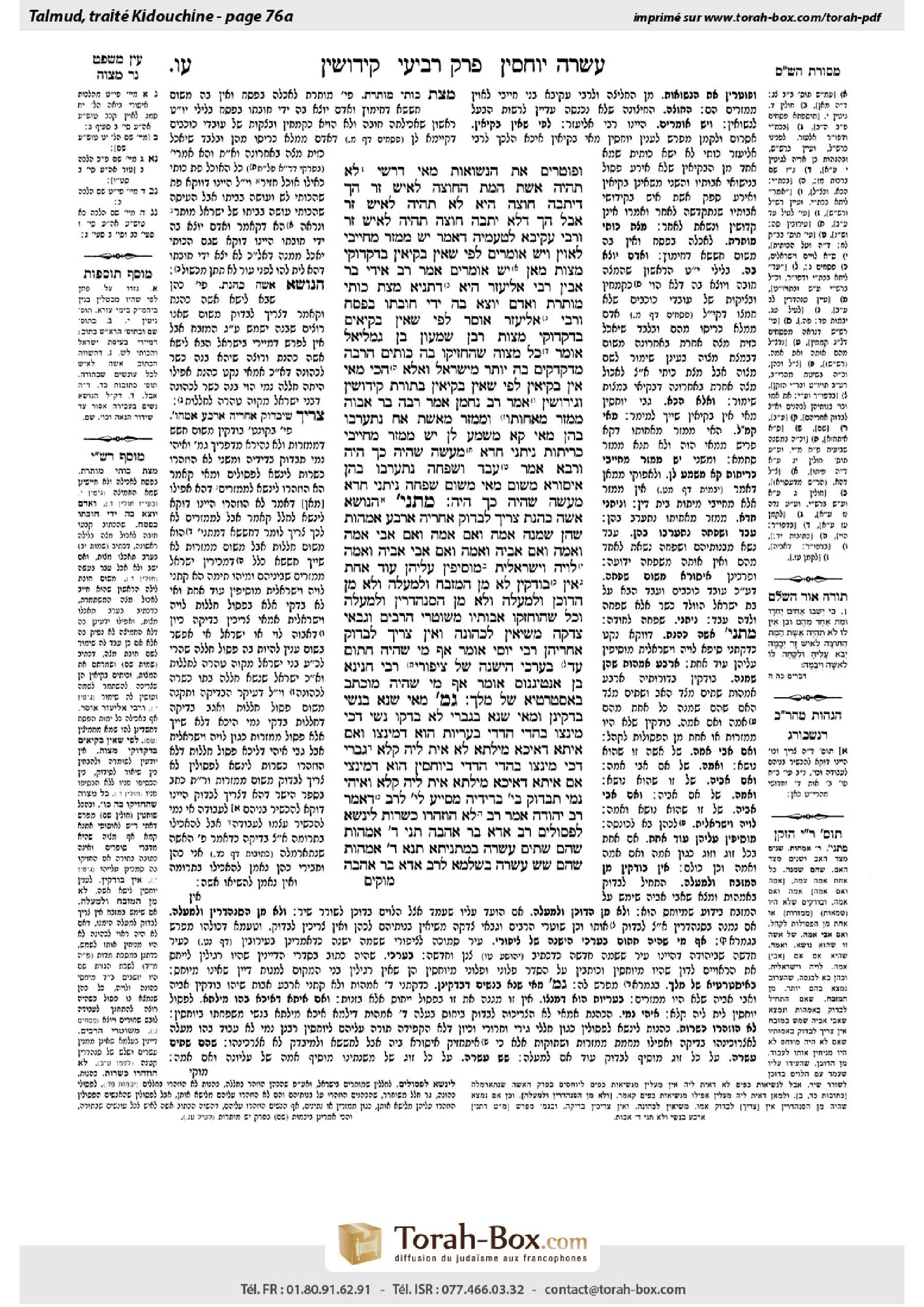
Kiddushin 76a: Talmud study for Daf Yomi
Daf Yomi is the daily study of one Talmud folio. Explore 37 tractates with scans, Hebrew text, Sefaria English and AI-generated French translations where annotated.
Passage selection and English or AI-generated French translation are available where the scan has annotations. Daf Study is independent of Torah-Box and Sefaria.
Browse Kiddushin · קידושין · All tractatesKiddushin 76a text and translations
This page of Kiddushin includes the Aramaic text, an English translation and an AI-generated French translation, alongside the scan above.
קידושין ע״ו א · Aramaic and Hebrew text
וּפוֹטְרִים אֶת הַנְּשׂוּאוֹת. מַאי דָּרְשִׁי? ״לֹא תִהְיֶה אֵשֶׁת הַמֵּת הַחוּצָה לְאִישׁ זָר״ – הָךְ דְּיָתְבָה חוּצָה, הִיא לֹא תִהְיֶה לְאִישׁ זָר, אֲבָל הָךְ דְּלָא יָתְבָה חוּצָה – תִּהְיֶה לְאִישׁ זָר.
וְרַבִּי עֲקִיבָא לְטַעְמֵיהּ דְּאָמַר: יֵשׁ מַמְזֵר מֵחַיָּיבֵי לָאוִין.
וְיֵשׁ אוֹמְרִים: לְפִי שֶׁאֵין בְּקִיאִין בְּדִקְדּוּקֵי מִצְוֹת. מַאן יֵשׁ אוֹמְרִים? אָמַר רַב אִידִי בַּר אָבִין: רַבִּי אֱלִיעֶזֶר הִיא. דְּתַנְיָא: מַצַּת כּוּתִי מוּתֶּרֶת וְאָדָם יוֹצֵא בָּהּ יְדֵי חוֹבָתוֹ בַּפֶּסַח, וְרַבִּי אֱלִיעֶזֶר אוֹסֵר, לְפִי שֶׁאֵין בְּקִיאִים בְּדִקְדּוּקֵי מִצְוֹת. רַבָּן שִׁמְעוֹן בֶּן גַּמְלִיאֵל אוֹמֵר: כׇּל מִצְוָה שֶׁהֶחֱזִיקוּ בָּהּ כּוּתִים – הַרְבֵּה מְדַקְדְּקִים בָּהּ, יוֹתֵר מִיִּשְׂרָאֵל.
וְאֶלָּא הָכִי, מַאי אֵין בְּקִיאִין? לְפִי שֶׁאֵין בְּקִיאִין בְּתוֹרַת קִידּוּשִׁין וְגֵירוּשִׁין.
אָמַר רַב נַחְמָן אָמַר רַבָּה בַּר אֲבוּהּ: מַמְזֵר מֵאֲחוֹתוֹ וּמַמְזֵר מֵאֵשֶׁת אָח נִתְעָרְבוּ בָּהֶן. מַאי קָא מַשְׁמַע לַן, יֵשׁ מַמְזֵר מֵחַיָּיבֵי כָרֵיתוֹת? נִיתְנֵי חֲדָא! מַעֲשֶׂה שֶׁהָיָה כָּךְ הָיָה.
וְרָבָא אָמַר: עֶבֶד וְשִׁפְחָה נִתְעָרְבוּ בָּהֶן. אִיסּוּרָא מִשּׁוּם מַאי, מִשּׁוּם שִׁפְחָה? נִיתְנֵי חֲדָא! מַעֲשֶׂה שֶׁהָיָה כָּךְ הָיָה.
מַתְנִי׳ הַנּוֹשֵׂא אִשָּׁה כֹּהֶנֶת – צָרִיךְ לִבְדּוֹק אַחֲרֶיהָ אַרְבַּע אִמָּהוֹת שֶׁהֵן שְׁמֹנֶה: אִמָּהּ, וְאֵם אִמָּהּ, וְאֵם אֲבִי אִמָּהּ, וְאִמָּהּ, וְאֵם אָבִיהָ וְאִמָּהּ, וְאֵם אֲבִי אָבִיהָ וְאִמָּהּ. לְוִיָּה וְיִשְׂרְאֵלִית מוֹסִיפִין עֲלֵיהֶן עוֹד אַחַת.
אֵין בּוֹדְקִין לֹא מִן הַמִּזְבֵּחַ וּלְמַעְלָה, וְלֹא מִן הַדּוּכָן וּלְמַעְלָה, וְלֹא מִן הַסַּנְהֶדְרִין וּלְמַעְלָה. וְכֹל שֶׁהוּחְזְקוּ אֲבוֹתָיו מִשּׁוֹטְרֵי הָרַבִּים וְגַבָּאֵי צְדָקָה – מַשִּׂיאִין לַכְּהוּנָּה וְאֵין צָרִיךְ לִבְדּוֹק אַחֲרֵיהֶן.
רַבִּי יוֹסֵי אוֹמֵר: אַף מִי שֶׁהָיָה חָתוּם עֵד בְּעַרְכֵי הַיְּשָׁנָה שֶׁל צִיפּוֹרִי. רַבִּי חֲנִינָא בֶּן אַנְטִיגְנוֹס אוֹמֵר: אַף מִי שֶׁהָיָה מוּכְתָּב בְּאִסְטְרַטְיָא שֶׁל מֶלֶךְ.
גְּמָ׳ מַאי שְׁנָא בִּנְשֵׁי בָּדְקִינַן וּמַאי שְׁנָא בְּגַבְרֵי דְּלָא בָּדְקִינַן? נְשֵׁי דְּכִי מִינְּצוּ בַּהֲדֵי הֲדָדֵי – בַּעֲרָיוֹת הוּא דְּמִינְּצוּ, וְאִם אִיתָא דְּאִיכָּא מִילְּתָא – לָא אִית לַיהּ קָלָא, גַּבְרֵי דְּכִי מִינְּצוּ בַּהֲדֵי הֲדָדֵי – בְּיוּחֲסִין הוּא דְּמִינְּצֵי, אִם אִיתָא דְּאִיכָּא מִילְּתָא – אִית לַיהּ קָלָא.
וְאִיהִי נָמֵי תִּבְדּוֹק בֵּיהּ בְּדִידֵיהּ? מְסַיַּיע לֵיהּ לְרַב, דְּאָמַר רַב יְהוּדָה אָמַר רַב: לֹא הוּזְהֲרוּ כְּשֵׁרוֹת לִינָּשֵׂא לִפְסוּלִים.
רַב אַדָּא בַּר אַהֲבָה תָּנֵי: אַרְבַּע אִמָּהוֹת שֶׁהֵם שְׁתֵּים עֶשְׂרֵה. בְּמַתְנִיתָא תָּנָא: אַרְבַּע אִמָּהוֹת שֶׁהֵם שֵׁשׁ עֶשְׂרֵה. בִּשְׁלָמָא לְרַב אַדָּא בַּר אַהֲבָה –
Kiddushin 76a · English translation
and they would exempt married women from ḥalitza and levirate marriage. The Gemara elaborates: In what way would they expound the verse to lead them to this conclusion? The verse states: “The wife of the dead man shall not be married outside of the family to one not of his kin; her brother-in-law will have intercourse with her and take her to him to be his wife, and consummate the levirate marriage” (Deuteronomy 25:5). They understood the word “outside” to be a description of the woman: She who sits outside, i.e., one who is only betrothed; she shall not be married to one not of his kin, and it is with her that the obligation of levirate marriage applies. But she who is not sitting outside, but who has already married, shall marry one not of his kin. Consequently, the concern with regard to the Samaritans is that their descendants include the children of a widow who unlawfully wed one who was not her brother-in-law.
After having explained which prohibition the Samaritans violated, the Gemara explains how this accounts for the prohibition with regard to marriage with Samaritans. And Rabbi Akiva conforms to his standard line of reasoning, as he says: The offspring of intercourse for which one is liable for violating a prohibition is a mamzer. Therefore, the descendants of a yevama who had transgressed the prohibition of: “The wife of the deceased shall not be married outside of the family to one not of his kin,” have the status of mamzerim.
And some say a third opinion as to why the Sages disqualified Samaritans for marriage: It is because they are not well versed in the details of mitzvot. The Gemara asks: Who is the one indicated by the phrase: Some say? Rav Idi bar Avin said: It is the opinion of Rabbi Eliezer. As it is taught in a baraita (Tosefta, Pesaḥim 2:2): The matza of a Samaritan is permitted to be eaten on Passover and is not considered to be leavened bread, and a person can fulfill his obligation to eat matza on the first night of Passover with it; but Rabbi Eliezer prohibits it, since Samaritans are not well versed in the details of mitzvot, and there is concern that their matza might be leavened. Rabban Shimon ben Gamliel says that this is not a concern, as with regard to any mitzva that Samaritans embraced and accepted, they are more exacting in its observance than are Jews.
The Gemara asks: But here, with regard to marriage, in what details are they not well versed? The Gemara answers: It is because they are not well versed with regard to the laws of betrothal and divorce. Consequently, it is possible that their bills of divorce were invalid, or that a betrothed woman was allowed to remarry without having received a bill of divorce, which would mean that her future children would be mamzerim.
Rav Naḥman says that Rabba bar Avuh says: Samaritans are of flawed lineage because a mamzer resulting from intercourse between a man and his sister and a mamzer resulting from intercourse between a man and his brother’s wife were assimilated among them, and they therefore all have the status of mamzerim due to the uncertainty as to the identity of those assimilated mamzerim. The Gemara asks: What is he teaching us by providing the details of how they are mamzerim due to uncertainty? If he intended to incidentally teach us the halakha that the offspring from intercourse for which one is liable to receive karet is a mamzer, let him teach one example, by mentioning the example of a mamzer from a sister. The Gemara answers: He did not mention these details to teach us a halakha, but rather the incident that took place, took place in this way, and that is why the Samaritans were considered to be of flawed lineage.
And Rava says: A Canaanite slave and a Canaanite maidservant were assimilated among them. The Gemara asks: In these cases, the prohibition is due to what? It is due to a Canaanite maidservant, whose children are slaves. But if so, let him teach one example; why also mention a Canaanite slave, whose child resulting from intercourse with a Jewish woman is of unflawed lineage? The Gemara again answers: The incident that took place, took place in this way.
MISHNA: A priest who marries a woman who is the daughter of a priest must investigate with regard to her background, i.e., he must check previous generations of her family tree from both the maternal and paternal sides, for four mothers, which are eight. How so? He investigates the lineage of her mother, and the mother of her mother, and the mother of her mother’s father, and her mother, i.e., the mother of her mother’s fathers’ mother. And he also investigates the lineage of the mother of her father, and her mother, i.e., the mother of her father’s mother, and the mother of her father’s father, and her mother i.e., the mother of her father’s father’s mother. If he seeks to marry a Levite woman or an Israelite woman, he adds to these an investigation of mothers of one additional generation.
With regard to these investigations, one need not investigate from the altar and above. If his ancestors included a priest who served at the altar, one checks no further, as the court would have investigated his lineage before allowing him to participate in the Temple service. Nor do they check from the platform, used by Levites for singing in the Temple, and above, nor from the Sanhedrin and above, since only one whose lineage has been examined and who was found to be fit can be appointed to the Sanhedrin. And similarly, anyone whose ancestors held public posts, and anyone whose ancestors were charity collectors, may marry into the priesthood, and there is no need to investigate their lineage, since no one of flawed lineage would be appointed to those positions.
Rabbi Yosei says: Even the descendants of one who had signed as a witness in the old court [ba’arki] of Tzippori do not need to have their lineage investigated. Rabbi Ḥanina ben Antigonus says: Even the descendants of one who was written in the army list [be’isteratya] of the Jewish king do not need to have their lineage investigated.
GEMARA: What is different about women that we investigate their lineage, and what is different about men that we do not investigate their lineage? Why shouldn’t we also examine the lineage of a bride’s male ancestors for any possible flaw, as we do her female ancestors? The Gemara answers: When women quarrel with each other, it is through accusations of engaging in forbidden sexual intercourse, i.e., licentiousness, that they quarrel. And if it is so that there is a matter of a flaw with regard to the lineage of the woman in question, it would not generate publicity. By contrast, when men quarrel with each other, it is through accusations of flawed lineage that they quarrel. Therefore, if it is so that there is a matter of a flaw with regard to her father’s lineage, it would generate publicity, even if no investigation is conducted.
The Gemara inquires: But she should also investigate his lineage; why is only the lineage of the woman investigated? The Gemara comments: This supports Rav, as Rav Yehuda says that Rav says: It was not prohibited for women of unflawed lineage, i.e., daughters of priests, to marry men of flawed lineage, such as ḥalalim, converts, or emancipated slaves. Therefore, women are not required to investigate the lineage of potential husbands.
Rav Adda bar Ahava taught that one needs to investigate four mothers who are twelve, adding an additional two generations of mothers of each of the woman’s parents. It was taught in a baraita: Four mothers who are sixteen. The Gemara asks: Granted, according to Rav Adda bar Ahava,
Kiddushin 76a · Traduction française (IA)
et ils exemptaient les femmes mariées de la ḥalitza et du mariage lévirat. La Guemara approfondit : De quelle manière interprétaient-ils le verset pour aboutir à cette conclusion ? Le verset énonce : « L'épouse de l'homme défunt ne se mariera pas en dehors de la famille avec un étranger à sa parenté ; son beau-frère aura des rapports avec elle et la prendra pour femme, et consommera le mariage lévirat » (Deutéronome 25:5). Ils comprenaient le mot « en dehors » comme une description de la femme : celle qui est assise en dehors, c'est-à-dire celle qui n'est que fiancée ; elle ne se mariera pas avec un étranger à sa parenté, et c'est à son égard que s'applique l'obligation du mariage lévirat. Mais celle qui n'est pas assise en dehors, mais qui est déjà mariée, se mariera avec un étranger à sa parenté. Par conséquent, la préoccupation concernant les Samaritains est que leurs descendants incluent les enfants d'une veuve qui a illégalement épousé quelqu'un qui n'était pas son beau-frère.
Après avoir expliqué quelle interdiction les Samaritains ont violée, la Guemara explique comment cela justifie l'interdiction concernant le mariage avec les Samaritains. Et Rabbi Akiva se conforme à sa ligne de raisonnement habituelle, car il dit : La descendance d'un rapport sexuel pour lequel on est passible de la violation d'une interdiction est un mamzer. Par conséquent, les descendants d'une yevama qui a transgressé l'interdiction : « L'épouse du défunt ne se mariera pas en dehors de la famille avec un étranger à sa parenté », ont le statut de mamzerim.
Et certains avancent un troisième avis quant à la raison pour laquelle les Sages ont disqualifié les Samaritains pour le mariage : c'est parce qu'ils ne sont pas bien versés dans les détails des mitsvot. La Guemara demande : Qui est celui que désigne l'expression : Certains disent ? Rav Idi bar Avin a dit : C'est l'avis de Rabbi Eliezer. Comme il est enseigné dans une baraïta (Tosefta, Pesaḥim 2:2) : La matza d'un Samaritain est permise à être mangée pendant Pessaḥ et n'est pas considérée comme du pain levain, et une personne peut accomplir son obligation de manger de la matza la première nuit de Pessaḥ avec celle-ci ; mais Rabbi Eliezer l'interdit, car les Samaritains ne sont pas bien versés dans les détails des mitsvot, et il y a une préoccupation que leur matza puisse être levée. Rabban Shimon ben Gamliel dit que ce n'est pas une préoccupation, car pour toute mitsva que les Samaritains ont embrassée et acceptée, ils sont plus rigoureux dans son observance que les Juifs.
La Guemara demande : Mais ici, concernant le mariage, dans quels détails ne sont-ils pas bien versés ? La Guemara répond : C'est parce qu'ils ne sont pas bien versés concernant les lois de la fiançailles et du divorce. Par conséquent, il est possible que leurs lettres de divorce aient été invalides, ou qu'une femme fiancée ait été autorisée à se remarier sans avoir reçu de lettre de divorce, ce qui signifierait que ses futurs enfants seraient des mamzerim.
Rav Naḥman dit que Rabba bar Avuh dit : Les Samaritains sont de lignée défectueuse, car un mamzer issu d'un rapport sexuel entre un homme et sa sœur, ainsi qu'un mamzer issu d'un rapport sexuel entre un homme et la femme de son frère, ont été assimilés parmi eux ; ils ont donc tous le statut de mamzerim en raison de l'incertitude quant à l'identité de ces mamzerim assimilés. La Guemara demande : Que nous enseigne-t-il en fournissant les détails de la manière dont ils sont mamzerim en raison de l'incertitude ? S'il avait l'intention de nous enseigner incidemment la halakha selon laquelle la descendance d'un rapport sexuel pour lequel on est passible de la karet est un mamzer, qu'il cite un seul exemple, en mentionnant le cas d'un mamzer issu d'une sœur. La Guemara répond : Il n'a pas mentionné ces détails pour nous enseigner une halakha, mais parce que l'incident qui s'est produit s'est déroulé de cette manière, et c'est pourquoi les Samaritains étaient considérés comme étant de lignée défectueuse.
Et Rava dit : Un esclave cananéen et une servante cananéenne ont été assimilés parmi eux. La Guemara demande : Dans ces cas, l'interdiction est-elle due à quoi ? Elle est due à la servante cananéenne, dont les enfants sont esclaves. Mais si c'est le cas, qu'il cite un seul exemple ; pourquoi mentionner aussi un esclave cananéen, dont l'enfant issu d'un rapport sexuel avec une femme juive est de lignée non défectueuse ? La Guemara répond à nouveau : L'incident qui s'est produit s'est déroulé de cette manière.
MICHNA : Un prêtre qui épouse la fille d'un prêtre doit s'enquérir de son origine, c'est-à-dire qu'il doit vérifier les générations précédentes de son arbre généalogique, tant du côté maternel que paternel, pour quatre mères, ce qui fait huit. Comment cela se passe-t-il ? Il enquête sur la lignée de sa mère, puis sur celle de la mère de sa mère, puis sur celle de la mère du père de sa mère, et enfin sur celle de sa mère, c'est-à-dire la mère de la mère des pères de sa mère. Il enquête également sur la lignée de la mère de son père, puis sur celle de sa mère, c'est-à-dire la mère de la mère de son père, puis sur celle de la mère du père de son père, et enfin sur celle de sa mère, c'est-à-dire la mère de la mère du père de son père. S'il souhaite épouser une femme lévi ou une femme israélite, il ajoute à cela une enquête sur les mères d'une génération supplémentaire.
Concernant ces enquêtes, on n'a pas besoin d'enquêter à partir de l'autel et au-delà. Si ses ancêtres comprenaient un prêtre qui servait à l'autel, on ne vérifie plus au-delà, car le tribunal aurait enquêté sur sa lignée avant de lui permettre de participer au service du Temple. On ne vérifie pas non plus à partir de la plateforme, utilisée par les Lévis pour chanter dans le Temple, et au-delà, ni à partir de la Sanhédrine et au-delà, car seul celui dont la lignée a été examinée et qui a été jugé apte peut être nommé à la Sanhédrine. De même, quiconque dont les ancêtres ont occupé des postes publics, et quiconque dont les ancêtres étaient collecteurs de charité, peut épouser dans le sacerdoce, et il n'y a pas besoin d'enquêter sur leur lignée, car personne de lignée défectueuse ne serait nommé à ces positions.
Rabbi Yosei dit : Même les descendants de celui qui avait signé comme témoin dans l'ancienne cour [ba’arki] de Tzippori n'ont pas besoin d'avoir leur lignée enquêtée. Rabbi Ḥanina ben Antigonus dit : Même les descendants de celui qui était inscrit dans la liste de l'armée [be’isteratya] du roi juif n'ont pas besoin d'avoir leur lignée enquêtée.
La Guemara demande : En quoi les femmes sont-elles différentes, de sorte que nous examinons leur lignée, et en quoi les hommes sont-ils différents, de sorte que nous n'examinons pas leur lignée ? Pourquoi ne devrions-nous pas également examiner la lignée des ancêtres mâles de la fiancée pour détecter un éventuel défaut, comme nous le faisons pour ses ancêtres femelles ? La Guemara répond : Lorsque les femmes se querellent entre elles, c'est par des accusations d'actes sexuels interdits, c'est-à-dire de débauche, qu'elles se querellent. Et s'il en est ainsi, s'il existe un problème de défaut concernant la lignée de la femme en question, cela ne susciterait pas de publicité. En revanche, lorsque les hommes se querellent entre eux, c'est par des accusations de lignée défectueuse qu'ils se querellent. Par conséquent, s'il en est ainsi, s'il existe un problème de défaut concernant la lignée de son père, cela susciterait de la publicité, même si aucune enquête n'est menée.
La Guemara s'interroge : Mais elle devrait également examiner sa lignée ; pourquoi seule la lignée de la femme est-elle examinée ? La Guemara commente : Cela soutient l'avis de Rav, car Rav Yehouda dit que Rav dit : Il n'était pas interdit aux femmes de lignée irréprochable, c'est-à-dire aux filles de prêtres, d'épouser des hommes de lignée défectueuse, tels que des ḥalalim, des convertis ou des esclaves affranchis. Par conséquent, les femmes ne sont pas tenues d'examiner la lignée de leurs maris potentiels.
Rav Adda bar Ahava a enseigné qu'il faut examiner quatre mères qui sont douze, en ajoutant deux générations supplémentaires de mères pour chacun des parents de la femme. Il a été enseigné dans une baraïta : Quatre mères qui sont seize. La Guemara demande : Admettons, selon Rav Adda bar Ahava,
Traduction française générée par IA à partir de l’édition anglaise de Sefaria. Vérifie toujours un passage avec le texte source.
Text from Sefaria: William Davidson Edition - Vocalized Aramaic (CC BY NC); William Davidson Edition - English (CC BY NC).