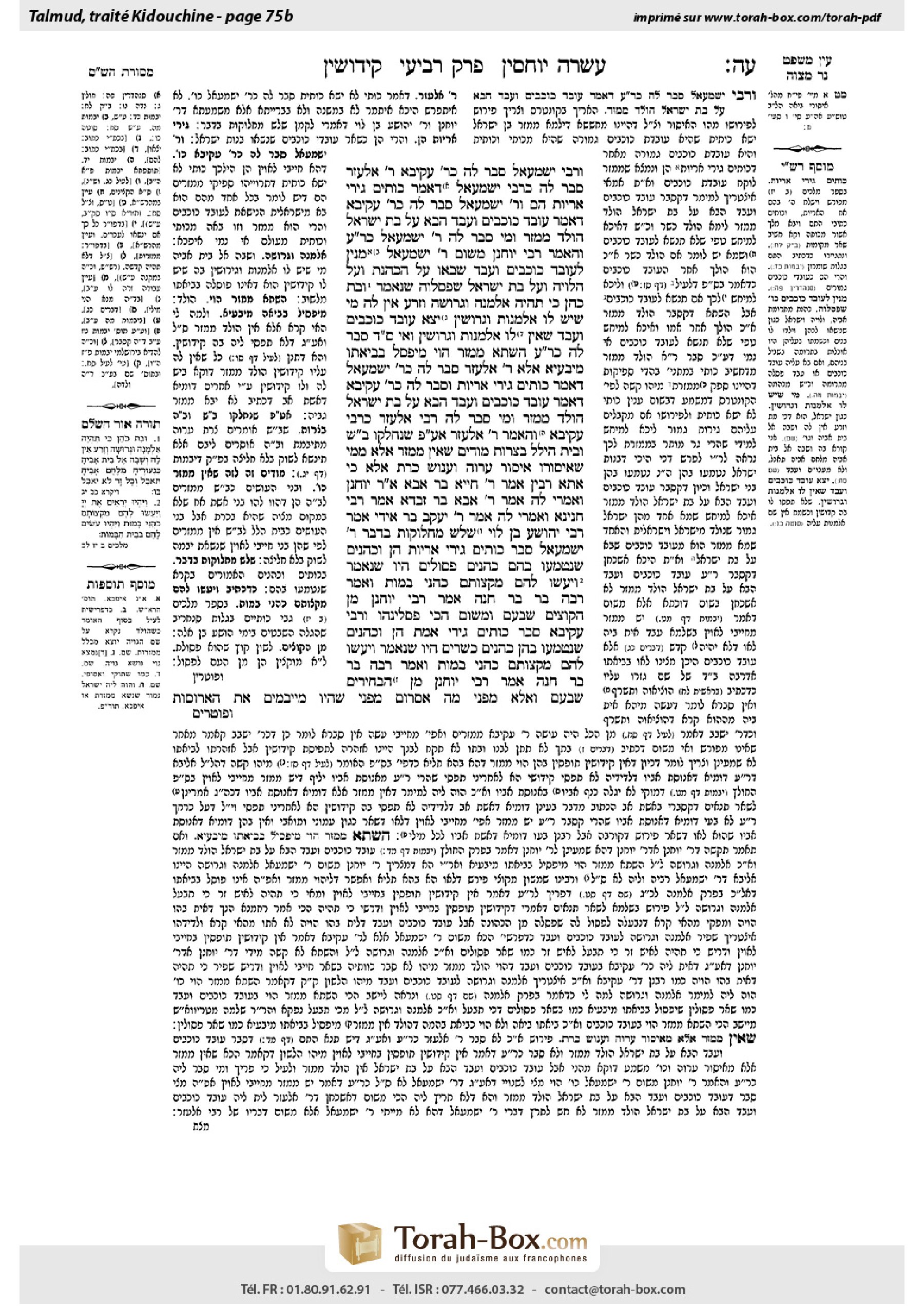
Kiddushin 75b: Talmud study for Daf Yomi
Daf Yomi is the daily study of one Talmud folio. Explore 37 tractates with scans, Hebrew text, Sefaria English and AI-generated French translations where annotated.
Passage selection and English or AI-generated French translation are available where the scan has annotations. Daf Study is independent of Torah-Box and Sefaria.
Browse Kiddushin · קידושין · All tractatesKiddushin 75b text and translations
This page of Kiddushin includes the Aramaic text, an English translation and an AI-generated French translation, alongside the scan above.
קידושין ע״ה ב · Aramaic and Hebrew text
וְרַבִּי יִשְׁמָעֵאל סָבַר לַהּ כְּרַבִּי עֲקִיבָא. רַבִּי אֶלְעָזָר סָבַר לַהּ כְּרַבִּי יִשְׁמָעֵאל, דְּאָמַר: כּוּתִים גֵּירֵי אֲרָיוֹת הֵם. וְרַבִּי יִשְׁמָעֵאל סָבַר לַהּ כְּרַבִּי עֲקִיבָא, דְּאָמַר: נׇכְרִי וְעֶבֶד הַבָּא עַל בַּת יִשְׂרָאֵל – הַוָּלָד מַמְזֵר.
וּמִי סָבַר לָהּ רַבִּי יִשְׁמָעֵאל כְּרַבִּי עֲקִיבָא? וְהָאָמַר רַבִּי יוֹחָנָן מִשּׁוּם רַבִּי יִשְׁמָעֵאל: מִנַּיִן לְנׇכְרִי וְעֶבֶד שֶׁבָּאוּ עַל הַכֹּהֶנֶת וְעַל הַלְוִיָּה וְעַל בַּת יִשְׂרָאֵל שֶׁפְּסָלוּהָ? שֶׁנֶּאֱמַר: ״וּבַת כֹּהֵן כִּי תִהְיֶה אַלְמָנָה וּגְרוּשָׁה וְזֶרַע אֵין לָהּ״
– מִי שֶׁיֵּשׁ לוֹ אַלְמְנוּת וְגֵרוּשִׁין, יָצָא נׇכְרִי וְעֶבֶד שֶׁאֵין לוֹ אַלְמְנוּת וְגֵרוּשִׁין.
וְאִי סָלְקָא דַּעְתָּךְ סָבַר לַהּ כְּרַבִּי עֲקִיבָא, הַשְׁתָּא מַמְזֵר הָוֵי, מִיפְסַל בְּבִיאָתוֹ מִיבַּעְיָא?!
אֶלָּא, רַבִּי אֶלְעָזָר סָבַר לַהּ כְּרַבִּי יִשְׁמָעֵאל, דְּאָמַר: כּוּתִים גֵּירֵי אֲרָיוֹת. וְסָבַר לַהּ כְּרַבִּי עֲקִיבָא דְּאָמַר: נׇכְרִי וְעֶבֶד הַבָּא עַל בַּת יִשְׂרָאֵל הַוָּלָד מַמְזֵר.
וּמִי סָבַר לַהּ רַבִּי אֶלְעָזָר כְּרַבִּי עֲקִיבָא? וְהָאָמַר רַבִּי אֶלְעָזָר: אַף עַל פִּי שֶׁנֶּחְלְקוּ בֵּית שַׁמַּאי וּבֵית הִילֵּל בְּצָרוֹת מוֹדִים שֶׁאֵין מַמְזֵר אֶלָּא מִמִּי שֶׁאִיסּוּרוֹ אִיסּוּר עֶרְוָה וְעָנוּשׁ כָּרֵת!
אֶלָּא, כִּי אֲתָא רָבִין אָמַר רַבִּי חִיָּיא בַּר אַבָּא אָמַר רַבִּי יוֹחָנָן, וְאָמְרִי לַהּ אָמַר רַבִּי אַבָּא בַּר זַבְדָּא אָמַר רַבִּי חֲנִינָא, וְאָמְרִי לָהּ אָמַר רַבִּי יַעֲקֹב בַּר אִידֵּי אָמַר רַבִּי יְהוֹשֻׁעַ בֶּן לֵוִי: שָׁלֹשׁ מַחְלוֹקוֹת בַּדָּבָר.
רַבִּי יִשְׁמָעֵאל סָבַר: כּוּתִים גֵּירֵי אֲרָיוֹת הֵן, וְכֹהֲנִים שֶׁנִּטְמְעוּ בָּהֶם – כֹּהֲנִים פְּסוּלִים הָיוּ, שֶׁנֶּאֱמַר: ״וְיַעֲשׂוּ לָהֶם מִקְצוֹתָם כֹּהֲנֵי בָמוֹת״, וְאָמַר רַבָּה בַּר בַּר חָנָה אָמַר רַבִּי יוֹחָנָן: מִן הַקּוֹצִים שֶׁבָּעָם. וּמִשּׁוּם הָכִי פַּסְלִינְהוּ.
וְרַבִּי עֲקִיבָא סָבַר: כּוּתִים גֵּירֵי אֱמֶת הֵן, וְכֹהֲנִים שֶׁנִּטְמְעוּ בָּהֶן – כֹּהֲנִים כְּשֵׁרִים הָיוּ, שֶׁנֶּאֱמַר: ״וְיַעֲשׂוּ לָהֶם מִקְצוֹתָם כֹּהֲנֵי בָמוֹת״, וְאָמַר רַבָּה בַּר בַּר חָנָה אָמַר רַבִּי יוֹחָנָן: מִן הַבְּחִירִים שֶׁבָּעָם. וְאֶלָּא מִפְּנֵי מָה אֲסָרוּם – מִפְּנֵי שֶׁהָיוּ מְיַיבְּמִים אֶת הָאֲרוּסוֹת
Kiddushin 75b · English translation
and Rabbi Yishmael holds in accordance with the opinion of Rabbi Akiva concerning a different halakha. The Gemara clarifies: Rabbi Elazar holds in accordance with the opinion of Rabbi Yishmael, who says: Samaritans are lion converts, i.e., they converted out of fear of being attacked by lions for worshipping idols in Eretz Yisrael. They were never converts for the sake of Heaven, but remained gentiles according to halakha. And Rabbi Yishmael holds in accordance with the opinion of Rabbi Akiva, who says: In the case of a gentile or a Canaanite slave who engaged in sexual intercourse with a Jewish woman, the offspring is a mamzer. Since over the generations Jews assimilated with Samaritans, who have the status of gentiles, the descendants of those Jews who married Samaritans have the status of uncertain mamzerim.
The Gemara asks: But does Rabbi Yishmael hold in accordance with the opinion of Rabbi Akiva in this matter? But doesn’t Rabbi Yoḥanan say in the name of Rabbi Yishmael: From where is it derived with regard to a gentile or a Canaanite slave who engaged in sexual intercourse with the daughter of a priest, or with the daughter of a Levite, or with the daughter of an Israelite, that they have disqualified her from marrying a priest? It is as it is stated: “But if a priest’s daughter is a widow, or divorced, and has no child, and is returned to her father’s house, as in her youth, she may eat of her father’s bread” (Leviticus 22:13).
He explains: It is only if she was married to one who has the halakhot of widowhood and divorce, meaning a Jew, that she can return to her father’s house and partake of teruma. This serves to exclude a gentile or a Canaanite slave, who do not have the halakhot of widowhood and divorce; if the daughter of a priest engages in intercourse with such a man, she may no longer partake of teruma.
And if it enters your mind that Rabbi Yishmael holds in accordance with the opinion of Rabbi Akiva that the offspring of a Jewish woman and a gentile or a slave is a mamzer, what need is there for this proof? Now that he holds that the offspring from a gentile is a mamzer, is it necessary to state that the gentile or slave disqualifies her from marrying a priest by engaging in intercourse with her?
Rather, the Gemara explains as follows: Rabbi Elazar holds in accordance with the opinion of Rabbi Yishmael, who says: Samaritans are lion converts, and Rabbi Elazar himself also holds in accordance with the opinion of Rabbi Akiva, who says: If a gentile or a Canaanite slave engaged in sexual intercourse with a Jewish woman, the offspring is a mamzer.
The Gemara asks: But does Rabbi Elazar hold in accordance with the opinion of Rabbi Akiva? But doesn’t Rabbi Elazar say: Although Beit Shammai and Beit Hillel disagreed with regard to the halakha of rival wives, as to whether the rival wife of a yevama who is a forbidden relative of the yavam is obligated in or exempt from levirate marriage, they concede that a mamzer is only the offspring born from one whose prohibition is a prohibition of forbidden relatives and punishable by karet. Since engaging in intercourse with a gentile or a Canaanite slave is not punishable by karet, Rabbi Elazar would agree that the child of such a union is not a mamzer.
Rather, when Rabin came from Eretz Yisrael to Babylonia, he reported that Rabbi Ḥiyya bar Abba says that Rabbi Yoḥanan says, and some say that it was Rabbi Abba bar Zavda who says that Rabbi Ḥanina says and some say it was Rabbi Ya’akov bar Idi who says that Rabbi Yehoshua ben Levi says: There are three divisions of opinions with regard to the matter.
Rabbi Yishmael holds that Samaritans are lion converts, and the priests who assimilated among them were unfit priests, as it is stated: “And made unto them from among themselves priests of the high places” (II Kings 17:32). And Rabba bar bar Ḥana says that Rabbi Yoḥanan says: What is the meaning of “from among themselves”? From the thorns that are among the Jewish people, meaning those of flawed lineage. And it was due to that reason that the Sages disqualified them, not due to the Samaritans themselves, who are gentiles, but due to the Jews of flawed lineage who are assimilated among them. When a Samaritan seeks to marry another Samaritan, it is possible that one of them is a Jew of flawed lineage.
And Rabbi Akiva holds: Samaritans are true converts, and the priests who assimilated among them were fit priests, as it is stated: “And made unto them from among themselves priests of the high places” (II Kings 17:32). And Rabba bar bar Ḥana says that Rabbi Yoḥanan says: “From among themselves” means from the chosen ones, the upper echelon of the Jewish people. And for what reason did the Sages prohibit them from entering into the congregation if there is no problem with regard to their conversion or with regard to the Jews who assimilated among them? It is because they did not act in accordance with the halakha, as they would perform levirate marriage with betrothed women. They would perform the mitzva of levirate marriage only with one who was widowed from a betrothal,
Kiddushin 75b · Traduction française (IA)
et Rabbi Yichmaël est d'accord avec l'opinion de Rabbi Akiva concernant une autre halakha. La Guemara précise : Rabbi Elazar est d'accord avec l'opinion de Rabbi Yichmaël, qui dit : les Samaritains sont des convertis par la peur des lions, c'est-à-dire qu'ils se sont convertis par peur d'être attaqués par des lions pour avoir adoré des idoles en Terre d'Israël. Ils n'ont jamais été des convertis pour l'amour du Ciel, mais sont restés des non-Juifs selon la halakha. Et Rabbi Yichmaël est d'accord avec l'opinion de Rabbi Akiva, qui dit : dans le cas d'un non-Juif ou d'un esclave cananéen qui a eu des relations sexuelles avec une femme juive, la descendance est un mamzer. Puisque, au fil des générations, les Juifs se sont assimilés aux Samaritains, qui ont le statut de non-Juifs, les descendants de ces Juifs qui ont épousé des Samaritains ont le statut de mamzerim incertains.
La Guemara demande : Mais Rabbi Yichmaël est-il d'accord avec l'opinion de Rabbi Akiva en cette matière ? Mais Rabbi Yoḥanan ne dit-il pas au nom de Rabbi Yichmaël : D'où déduit-on qu'un non-Juif ou un esclave cananéen qui a eu des relations sexuelles avec la fille d'un Cohen, ou avec la fille d'un Lévi, ou avec la fille d'un Israélite, l'a rendue inapte à épouser un Cohen ? C'est comme il est écrit : « Mais si la fille d'un Cohen est veuve ou divorcée, et qu'elle n'a pas d'enfant, et qu'elle retourne dans la maison de son père, comme dans sa jeunesse, elle peut manger du pain de son père » (Lévitique 22:13).
Il explique : Ce n'est que si elle a été mariée à quelqu'un qui a les halakhot du veuvage et du divorce, c'est-à-dire un Juif, qu'elle peut retourner dans la maison de son père et consommer de la terouma. Cela sert à exclure un non-Juif ou un esclave cananéen, qui n'ont pas les halakhot du veuvage et du divorce ; si la fille d'un Cohen a des relations sexuelles avec un tel homme, elle ne peut plus consommer de la terouma.
Et si vous pensez que Rabbi Yishmaël est d'accord avec l'opinion de Rabbi Akiva selon laquelle la descendance d'une femme juive et d'un non-Juif ou d'un esclave est un mamzer, quel est le besoin de cette preuve ? Maintenant qu'il est d'accord que la descendance d'un non-Juif est un mamzer, est-il nécessaire de dire que le non-Juif ou l'esclave la rend inapte à épouser un Cohen en ayant des relations sexuelles avec elle ?
Plutôt, la Guemara explique comme suit : Rabbi Elazar est d'accord avec l'opinion de Rabbi Yishmaël, qui dit : les Samaritains sont des convertis par la peur des lions, et Rabbi Elazar lui-même est aussi d'accord avec l'opinion de Rabbi Akiva, qui dit : Si un non-Juif ou un esclave cananéen a eu des relations sexuelles avec une femme juive, la descendance est un mamzer.
La Guemara demande : Mais Rabbi Elazar est-il d'accord avec l'opinion de Rabbi Akiva ? Mais Rabbi Elazar ne dit-il pas : Bien que la Maison de Chammaï et la Maison de Hillel aient désapprouvé concernant la halakha des épouses rivales, quant à savoir si l'épouse rivale d'une yevama qui est une parente interdite du yavam est obligée ou exemptée du mariage de levirat, ils conviennent qu'un mamzer n'est que la descendance née de celui dont l'interdiction est une interdiction de parents interdits et punie par la karet. Puisque les relations sexuelles avec un non-Juif ou un esclave cananéen ne sont pas punies par la karet, Rabbi Elazar conviendrait que l'enfant d'une telle union n'est pas un mamzer.
Plutôt, lorsque Rabin est venu de la Terre d'Israël en Bavière, il a rapporté que Rabbi Ḥiyya bar Abba dit que Rabbi Yoḥanan dit, et certains disent que c'était Rabbi Abba bar Zavda qui dit que Rabbi Ḥanina dit, et certains disent que c'était Rabbi Ya'akov bar Idi qui dit que Rabbi Yehoshua ben Lévi dit : Il y a trois divisions d'opinions concernant cette matière.
Rabbi Yishmaël est d'avis que les Samaritains sont des convertis par la peur des lions, et les prêtres qui se sont assimilés parmi eux étaient des prêtres inaptes, comme il est écrit : « Et ils se firent des prêtres des hauts lieux parmi eux » (II Rois 17:32). Et Rabba bar bar Ḥana dit que Rabbi Yoḥanan dit : Quelle est la signification de « parmi eux » ? Des épines qui sont parmi le peuple juif, c'est-à-dire ceux de lignée défectueuse. Et c'est pour cette raison que les Sages les ont déclarés inaptes, non à cause des Samaritains eux-mêmes, qui sont des non-Juifs, mais à cause des Juifs de lignée défectueuse qui sont assimilés parmi eux. Lorsqu'un Samaritain cherche à épouser un autre Samaritain, il est possible que l'un d'eux soit un Juif de lignée défectueuse.
Et Rabbi Akiva est d'avis : les Samaritains sont de vrais convertis, et les prêtres qui se sont assimilés parmi eux étaient des prêtres aptes, comme il est écrit : « Et ils se firent des prêtres des hauts lieux parmi eux » (II Rois 17:32). Et Rabba bar bar Ḥana dit que Rabbi Yoḥanan dit : « Parmi eux » signifie des élus, l'élite du peuple juif. Et pour quelle raison les Sages ont-ils interdit leur entrée dans la congrégation s'il n'y a pas de problème concernant leur conversion ou concernant les Juifs qui se sont assimilés parmi eux ? C'est parce qu'ils n'ont pas agi conformément à la halakha, car ils pratiquaient le mariage de levirat avec des femmes fiancées. Ils pratiquaient la mitsva du mariage de levirat seulement avec celle qui était veuve d'une fiancée,
Traduction française générée par IA à partir de l’édition anglaise de Sefaria. Vérifie toujours un passage avec le texte source.
Text from Sefaria: William Davidson Edition - Vocalized Aramaic (CC BY NC); William Davidson Edition - English (CC BY NC).