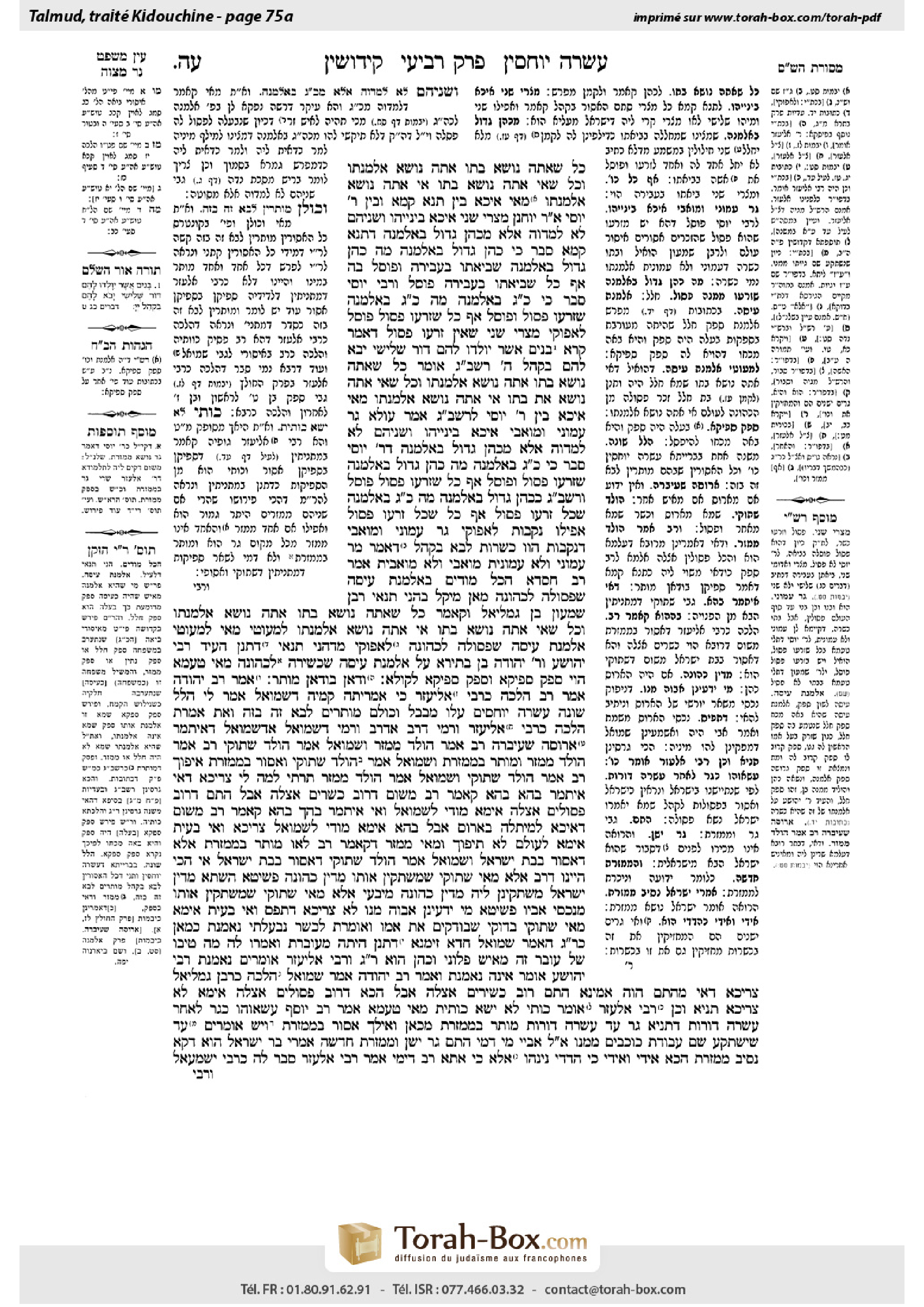
Kiddushin 75a: Talmud study for Daf Yomi
Daf Yomi is the daily study of one Talmud folio. Explore 37 tractates with scans, Hebrew text, Sefaria English and AI-generated French translations where annotated.
Passage selection and English or AI-generated French translation are available where the scan has annotations. Daf Study is independent of Torah-Box and Sefaria.
Browse Kiddushin · קידושין · All tractatesKiddushin 75a text and translations
This page of Kiddushin includes the Aramaic text, an English translation and an AI-generated French translation, alongside the scan above.
קידושין ע״ה א · Aramaic and Hebrew text
כֹּל שֶׁאַתָּה נוֹשֵׂא בִּתּוֹ – אַתָּה נוֹשֵׂא אַלְמְנָתוֹ. וְכֹל שֶׁאִי אַתָּה נוֹשֵׂא בִּתּוֹ – אִי אַתָּה נוֹשֵׂא אַלְמְנָתוֹ.
מַאי אִיכָּא בֵּין תַּנָּא קַמָּא וּבֵין רַבִּי יוֹסֵי? אָמַר רַבִּי יוֹחָנָן: מִצְרִי שֵׁנִי אִיכָּא בֵּינַיְיהוּ. וּשְׁנֵיהֶם לֹא לְמָדוּהָ אֶלָּא מִכֹּהֵן גָּדוֹל בְּאַלְמָנָה,
דְּתַנָּא קַמָּא סָבַר: כִּי כֹּהֵן גָּדוֹל בְּאַלְמָנָה. מָה כֹּהֵן גָּדוֹל בְּאַלְמָנָה שֶׁבִּיאָתוֹ בַּעֲבֵירָה וּפוֹסֵל בָּהּ, אַף כֹּל שֶׁבִּיאָתוֹ בַּעֲבֵירָה – פּוֹסֵל.
וְרַבִּי יוֹסֵי סָבַר: כִּי כֹהֵן גָּדוֹל בְּאַלְמָנָה. מָה כֹּהֵן גָּדוֹל בְּאַלְמָנָה שֶׁזַּרְעוֹ פָּסוּל וּפוֹסֵל, אַף כֹּל שֶׁזַּרְעוֹ פָּסוּל – פּוֹסֵל. לְאַפּוֹקֵי מִצְרִי שֵׁנִי שֶׁאֵין זַרְעוֹ פָּסוּל, דְּאָמַר קְרָא: ״בָּנִים אֲשֶׁר יִוָּלְדוּ לָהֶם דּוֹר שְׁלִישִׁי יָבֹא לָהֶם בִּקְהַל ה׳״.
רַבָּן שִׁמְעוֹן בֶּן גַּמְלִיאֵל אוֹמֵר: כֹּל שֶׁאַתָּה נוֹשֵׂא בִּתּוֹ – אַתָּה נוֹשֵׂא אַלְמְנָתוֹ, וְכֹל שֶׁאִי אַתָּה נוֹשֵׂא אֶת בִּתּוֹ – אִי אַתָּה נוֹשֵׂא אַלְמְנָתוֹ. מַאי אִיכָּא בֵּין רַבִּי יוֹסֵי לְרַבָּן שִׁמְעוֹן בֶּן גַּמְלִיאֵל? אָמַר עוּלָּא: גֵּר עַמּוֹנִי וּמוֹאָבִי אִיכָּא בֵּינַיְיהוּ. וּשְׁנֵיהֶם לֹא לְמָדוּהָ אֶלָּא מִכֹּהֵן גָּדוֹל בְּאַלְמָנָה.
דְּרַבִּי יוֹסֵי סָבַר: כִּי כֹּהֵן גָּדוֹל בְּאַלְמָנָה. מָה כֹּהֵן גָּדוֹל בְּאַלְמָנָה שֶׁזַּרְעוֹ פָּסוּל – וּפוֹסֵל, אַף כֹּל שֶׁזַּרְעוֹ פָּסוּל – פּוֹסֵל.
וְרַבָּן שִׁמְעוֹן בֶּן גַּמְלִיאֵל: כְּכֹהֵן גָּדוֹל בְּאַלְמָנָה. מָה כֹּהֵן גָּדוֹל בְּאַלְמָנָה שֶׁכׇּל זַרְעוֹ פָּסוּל, אַף כֹּל שֶׁכׇּל זַרְעוֹ פָּסוּל, אֲפִילּוּ נְקֵבוֹת, לְאַפּוֹקֵי גֵּר עַמּוֹנִי וּמוֹאָבִי דִּנְקֵבוֹת הָווּ כְּשֵׁרוֹת לָבֹא בַּקָּהָל. דְּאָמַר מָר: עַמּוֹנִי וְלֹא עַמּוֹנִית, מוֹאָבִי וְלֹא מוֹאָבִית.
אָמַר רַב חִסְדָּא: הַכֹּל מוֹדִים בְּאַלְמְנַת עִיסָּה שֶׁפְּסוּלָה לַכְּהוּנָּה. מַאן מֵיקֵל בְּהָנֵי תַּנָּאֵי – רַבָּן שִׁמְעוֹן בֶּן גַּמְלִיאֵל, וְקָאָמַר: כֹּל שֶׁאַתָּה נוֹשֵׂא בִּתּוֹ – אַתָּה נוֹשֵׂא אַלְמְנָתוֹ, וְכֹל שֶׁאִי אַתָּה נוֹשֵׂא בִּתּוֹ – אִי אַתָּה נוֹשֵׂא אַלְמְנָתוֹ. לְמַעוֹטֵי מַאי? לְמַעוֹטֵי אַלְמְנַת עִיסָּה שֶׁפְּסוּלָה לַכְּהוּנָּה.
לְאַפּוֹקֵי מִדְּהָנֵי תַּנָּאֵי דִּתְנַן: הֵעִיד רַבִּי יְהוֹשֻׁעַ וְרַבִּי יְהוּדָה בֶּן בְּתֵירָא עַל אַלְמְנַת עִיסָּה שֶׁכְּשֵׁירָה לַכְּהוּנָּה. מַאי טַעְמָא – הָוֵי סְפֵק סְפֵיקָא, וּסְפֵק סְפֵיקָא לְקוּלָּא.
וַדָּאָן בְּוַדָּאָן מוּתָּר. אָמַר רַב יְהוּדָה אָמַר רַב: הֲלָכָה כְּרַבִּי אֱלִיעֶזֶר. כִּי אַמְרִיתַהּ קַמֵּיהּ דִּשְׁמוּאֵל אֲמַר לִי: הִלֵּל שׁוֹנֶה: עֲשָׂרָה יוּחֲסִים עָלוּ מִבָּבֶל וְכוּלָּם מוּתָּרִים לָבֹא זֶה בָּזֶה, וְאַתְּ אָמְרַתְּ הֲלָכָה כְּרַבִּי אֱלִיעֶזֶר?!
וּרְמִי דְּרַב אַדְּרַב וּרְמִי דִּשְׁמוּאֵל אַדִּשְׁמוּאֵל, דְּאִיתְּמַר: אֲרוּסָה שֶׁעִיבְּרָה, רַב אָמַר: הַוָּלָד מַמְזֵר. וּשְׁמוּאֵל אָמַר: הַוָּלָד שְׁתוּקִי.
רַב אָמַר: הַוָּלָד מַמְזֵר וּמוּתָּר בְּמַמְזֶרֶת, וּשְׁמוּאֵל אָמַר: הַוָּלָד שְׁתוּקִי וְאָסוּר בְּמַמְזֶרֶת. אֵיפוֹךְ, רַב אָמַר: הַוָּלָד שְׁתוּקִי, וּשְׁמוּאֵל אָמַר: הַוָּלָד מַמְזֵר.
תַּרְתֵּי לְמָה לִי? צְרִיכָא, דְּאִי אִיתְּמַר בְּהָא, בְּהָא קָאָמַר רַב מִשּׁוּם דְּרוֹב כְּשֵׁרִים אֶצְלָהּ. אֲבָל הָתָם, דְּרוֹב פְּסוּלִים אֶצְלָהּ, אֵימָא מוֹדֵי לִשְׁמוּאֵל.
וְאִי אִיתְּמַר בְּהָךְ, בְּהָא קָאָמַר רַב – מִשּׁוּם דְּאִיכָּא לְמִיתְלְ[יַ]הּ בְּאָרוּס, אֲבָל בְּהָא אֵימָא מוֹדֵי לִשְׁמוּאֵל, צְרִיכָא.
וְאִי בָּעֵית אֵימָא: לְעוֹלָם לָא תֵּיפוֹךְ, וּמַאי מַמְזֵר דְּקָאָמַר רַב – לָאו מוּתָּר בְּמַמְזֶרֶת, אֶלָּא דְּאָסוּר בְּבַת יִשְׂרָאֵל. וּשְׁמוּאֵל אָמַר: הַוָּלָד שְׁתוּקִי, דְּאָסוּר בְּבַת יִשְׂרָאֵל. אִי הָכִי הַיְינוּ דְּרַב! אֶלָּא: מַאי שְׁתוּקִי – שֶׁמְּשַׁתְּקִין אוֹתוֹ מִדִּין כְּהוּנָּה.
פְּשִׁיטָא, הַשְׁתָּא מִדִּין יִשְׂרָאֵל מְשַׁתְּקִינַן לֵיהּ, מִדִּין כְּהוּנָּה מִיבְּעֵי?! אֶלָּא: מַאי שְׁתוּקִי – שֶׁמְּשַׁתְּקִין אוֹתוֹ מִנִּכְסֵי אָבִיו. פְּשִׁיטָא, מִי יָדְעִינַן אֲבוּהּ מַנּוּ? לָא צְרִיכָא, דִּתְפַס.
וְאִי בָּעֵית אֵימָא: מַאי שְׁתוּקִי – בְּדוּקִי, שֶׁבּוֹדְקִים אֶת אִמּוֹ וְאוֹמֶרֶת: ״לְכָשֵׁר נִבְעַלְתִּי״ – נֶאֱמֶנֶת. כְּמַאן – כְּרַבָּן גַּמְלִיאֵל? הָאָמַר שְׁמוּאֵל חֲדָא זִימְנָא, דִּתְנַן: הָיְתָה מְעוּבֶּרֶת, וְאָמְרוּ לָהּ: מָה טִיבוֹ שֶׁל עוּבָּר זֶה? מֵאִישׁ פְּלוֹנִי וְכֹהֵן הוּא – רַבָּן גַּמְלִיאֵל וְרַבִּי אֱלִיעֶזֶר אוֹמְרִים: נֶאֱמֶנֶת. רַבִּי יְהוֹשֻׁעַ אוֹמֵר: אֵינָהּ נֶאֱמֶנֶת. וְאָמַר רַב יְהוּדָה אָמַר שְׁמוּאֵל: הֲלָכָה כְּרַבָּן גַּמְלִיאֵל!
צְרִיכָא, דְּאִי מֵהָתָם הֲוָה אָמֵינָא: הָתָם רוֹב כְּשֵׁירִים אֶצְלָהּ, אֲבָל הָכָא דְּרוֹב פְּסוּלִים אֶצְלָהּ, אֵימָא לָא, צְרִיכָא.
תַּנְיָא: וְכֵן רַבִּי אֶלְעָזָר אוֹמֵר: כּוּתִי לֹא יִשָּׂא כּוּתִית. מַאי טַעְמָא? אָמַר רַב יוֹסֵף: עֲשָׂאוּהוּ כְּגֵר לְאַחַר עֲשָׂרָה דּוֹרוֹת, דְּתַנְיָא: גֵּר, עַד עֲשָׂרָה דּוֹרוֹת – מוּתָּר בְּמַמְזֶרֶת, מִכָּאן וְאֵילָךְ – אָסוּר בְּמַמְזֶרֶת.
וְיֵשׁ אוֹמְרִים עַד שֶׁיִּשְׁתַּקֵּעַ שֵׁם עֲבוֹדָה זָרָה מִמֶּנּוּ.
אֲמַר לֵיהּ אַבָּיֵי: מִי דָּמֵי? הָתָם גֵּר יָשָׁן וּמַמְזֶרֶת חֲדָשָׁה, אָמְרִי: בַּר יִשְׂרָאֵל הוּא דְּקָא נָסֵיב מַמְזֶרֶת. הָכָא אִידֵּי וְאִידֵּי כִּי הֲדָדֵי נִינְהוּ. אֶלָּא: כִּי אֲתָא רַב דִּימִי, אָמַר: רַבִּי אֶלְעָזָר סָבַר לַהּ כְּרַבִּי יִשְׁמָעֵאל,
Kiddushin 75a · English translation
Anyone whose daughter you may marry, you may marry his widow. If a priest is permitted to marry someone’s daughter, he is likewise permitted to marry that person’s widow; she has not become disqualified to marry a priest by having engaged in sexual intercourse with her husband. And anyone whose daughter you may not marry, you may not marry his widow either.
The Gemara asks: What difference is there between the first tanna of the mishna and Rabbi Yosei, as they appear to be saying the same thing? Rabbi Yoḥanan says: The practical difference between them concerns a Jewish woman who engaged in intercourse with a second-generation Egyptian. The Torah prohibits Egyptian converts and their children from entering into the congregation by marriage, but the grandchildren of the Egyptian convert, i.e., the third generation, are permitted to marry Jews with unflawed lineage. And both of them learned their respective opinions only from the halakha of a High Priest who engaged in intercourse with a widow, although they derived the halakha in different ways.
How so? As the first tanna holds that this case is like that of a High Priest who engages in sexual intercourse with a widow: Just as with regard to a High Priest who engages in intercourse with a widow, his act of intercourse with her is performed by means of a transgression and he disqualifies her from marrying into the priesthood, so too anyone whose act of intercourse is by means of a transgression, such as a second-generation Egyptian who engages in intercourse with a Jewish woman, likewise disqualifies her from marrying into the priesthood.
And Rabbi Yosei holds that the derivation is as follows: It is like a High Priest who engages in sexual intercourse with a widow: Just as with regard to a High Priest who engages in intercourse with a widow, whose offspring is unfit for the priesthood, as they have the status of a ḥalal, and he similarly disqualifies her from marrying a priest by engaging in intercourse with her, so too, anyone whose offspring is unfit for the priesthood also disqualifies her from marrying a priest by engaging in intercourse with her. This comparison serves to exclude a second-generation Egyptian, whose offspring is not unfit, as the verse states: “The children of the third generation that are born to them may enter into the congregation of the Lord” (Deuteronomy 23:9). Therefore, a second-generation Egyptian does not disqualify a woman with whom he engages in intercourse from marrying a priest.
The baraita also taught that Rabban Shimon ben Gamliel says: Anyone whose daughter you may marry, you may marry his widow. And anyone whose daughter you may not marry, you may not marry his widow either. The Gemara asks: What difference is there between the opinions of Rabbi Yosei and Rabban Shimon ben Gamliel? They seem to be stating the same halakha. Ulla said: The difference between them involves a male Ammonite convert and a male Moabite convert. According to the opinion of Rabbi Yosei, male Ammonite and Moabite converts disqualify a woman with whom they engage in sexual intercourse from marrying a priest, whereas Rabban Shimon ben Gamliel says they do not disqualify her. And both of them learned their respective opinions only from the halakha of a High Priest who engaged in intercourse with a widow, although they derived the halakha in different ways.
How so? As Rabbi Yosei holds that this case is like that of a High Priest who engages in intercourse with a widow: Just as with regard to a High Priest who engages in sexual intercourse with a widow, the halakha is that his offspring are unfit for the priesthood, as they have the status of a ḥalal, and he similarly disqualifies her from marrying a priest by engaging in intercourse with her, so too, anyone whose offspring is unfit for the priesthood, including a male Ammonite or Moabite convert, also disqualifies her from marrying a priest by engaging in intercourse with her.
And Rabban Shimon ben Gamliel holds that the derivation is as follows: It is like a High Priest who engages in sexual intercourse with a widow. Just as with regard to a High Priest who engages in intercourse with a widow, as all his offspring are unfit, the females as well as the males, and he disqualifies her by engaging in intercourse with her, so too, everyone about whom the halakha is that all his offspring are unfit, even the females, disqualifies a woman with whom he engages in intercourse from marrying a priest. This comparison serves to exclude a male Ammonite or Moabite convert, as the females born to them are fit to enter into the congregation. As the Master said: An Ammonite man is prohibited from entering into the congregation, but not an Ammonite woman; similarly a Moabite man is prohibited from doing so, but not a Moabite woman.
Rav Ḥisda says: All concede with regard to a widow of questionable lineage, i.e., a widow whose husband was possibly a ḥalal, that she is unfit to marry into the priesthood. The Gemara explains: Who is the most lenient of these tanna’im? It is Rabban Shimon ben Gamliel, and he says: Anyone whose daughter you may marry, you may marry his widow; and anyone whose daughter you may not marry, you may not marry his widow either. He said the latter clause to exclude what? It is to exclude a widow of questionable lineage; and it teaches that she is unfit to marry into the priesthood, since the daughter of one who was possibly a ḥalal is prohibited from marrying a priest.
The Gemara comments: This statement of Rav Ḥisda serves to exclude the opinion of these following tanna’im. As we learned in a mishna (Eduyyot 8:3): Rabbi Yehoshua and Rabbi Yehuda ben Beteira testified with regard to a widow of questionable lineage, that she is fit to marry into the priesthood. What is the reason for this lenient ruling? It is a case of a compound uncertainty, and the principle is that in a case of a compound uncertainty the ruling is to be lenient.
§ The mishna teaches that according to Rabbi Eliezer, it is permitted for those with definite flaws to marry with those with definite flaws. For example, it is permitted for mamzerim and Gibeonites to marry each other. By contrast, it is prohibited for those with definite flaws to marry with those whose flaws result from an uncertainty, and it is also prohibited for those whose flaws result from an uncertainty to marry those whose flaws result from an uncertainty. Rav Yehuda says that Rav says: The halakha is in accordance with the opinion of Rabbi Eliezer. Rav Yehuda added: When I said that halakha in front of Shmuel, he said to me: Hillel the Elder teaches the mishna as stating: Jews with ten types of lineage ascended from Babylonia, and all of them, i.e., all of those who may not enter into the congregation, even those whose flaws result from an uncertainty, are permitted to marry into each other’s families; and you said the halakha is in accordance with the opinion of Rabbi Eliezer?
The Gemara comments: And a contradiction can be raised from this statement of Rav against another statement of Rav, and similarly a contradiction can be raised from this statement of Shmuel against another statement of Shmuel. As it was stated that they had the following dispute: With regard to a betrothed woman who became pregnant during her period of betrothal, and it is unknown whether it was her betrothed or someone else who impregnated her, Rav says that the offspring is a mamzer. The assumption is that she was impregnated by a different man and that the child is the offspring of a betrothed woman and a man other than her betrothed. And Shmuel says that the offspring is a shetuki, since there is no proof that it is a mamzer; she might have been impregnated by her betrothed.
The Gemara explains their respective opinions: Rav says the offspring is a mamzer and is therefore permitted to marry a mamzeret; and Shmuel says the offspring is a shetuki and is prohibited to marry a mamzeret. It is seen here that Shmuel prohibits one whose flaw results from an uncertainty from marrying one with definite mamzer status, whereas Rav permits such a person to marry one with definite mamzer status. This contradicts their earlier statements, in which Rav prohibited one whose flaw results from an uncertainty from marrying one with definite mamzer status and Shmuel permitted it. The Gemara answers: Reverse the opinions in this dispute, so that Rav is the one who says: The offspring is a shetuki and is prohibited to marry a mamzeret; and Shmuel says: The offspring is a mamzer and may marry a mamzeret.
The Gemara asks: If so, why do I need two instances of the same dispute? The Gemara answers: It is necessary to state the dispute twice, because if it were stated only with regard to that mishna, which discusses an unmarried woman whose offspring is a shetuki, one could have said: It was with regard to that case that Rav states his opinion, because the majority are fit with regard to her and only a minority of men are those who are forbidden to her as relatives or are those who are disqualified from entering into the congregation. But there, in the case of a betrothed woman who became pregnant, where the majority are unfit with regard to her and she is forbidden to everyone other than her betrothed, one might say that Rav concedes to Shmuel that her child is a definite mamzer.
And conversely, if it was stated only in this case of a betrothed woman, one could have said it was with regard to this case that Rav states the offspring is a shetuki, because it is most reasonable to ascribe the pregnancy to the betrothed man, which would mean that the offspring is not a mamzer, but in that case of an unmarried woman, one might say that he agrees with Shmuel that the child is considered to be a definite mamzer. It is therefore necessary to state both cases.
And if you wish, say: Actually, do not reverse the opinions, and what is the meaning of the term mamzer that Rav is saying? It does not signify that this offspring is permitted to marry a mamzeret, but merely that he is prohibited from marrying a Jewish woman. And when Shmuel says the offspring is a shetuki, he meant that he is prohibited from marrying a Jewish woman. The Gemara asks: If so, that is the same as Rav. Rather, what is the meaning of the term shetuki in Shmuel’s statement? It is that one silences [meshattekin] him, i.e., disqualifies him, from the halakha of the priesthood. In other words, even if the betrothed man was a priest, the child is not considered a priest.
The Gemara questions this: Isn’t this obvious? Now, if one silences him from the halakha of a Jew with unflawed lineage, and he is not allowed to enter into the congregation, is it necessary to say that he is silenced from the halakha of the priesthood? Rather, what is the meaning of shetuki in Shmuel’s statement? It is that one silences him from his presumed father’s property, i.e., he does not inherit from him. The Gemara again questions: This too is obvious; do we know who his father is? The Gemara answers: No, it is necessary in a case where this son seized possession of the property of the betrothed man, claiming that the betrothed man is his father. It is with regard to such a scenario that Shmuel said that the property is taken away from him, and one does not say that the burden of proof rests upon the other inheritors to demonstrate conclusively that the betrothed man is not his father.
And if you wish, say: What is the meaning of shetuki in Shmuel’s statement? It means beduki, meaning that they examine his mother, and if she says: I engaged in sexual intercourse with a man with unflawed lineage, she is deemed credible. The Gemara asks: In accordance with whose opinion is this halakha? Is it in accordance with the opinion of Rabban Gamliel? But didn’t Shmuel already say it once? As we learned in a mishna (Ketubot 13a): If an unmarried woman was pregnant, and people said to her: What is the status of this fetus? And she said to them: It is from so-and-so, and he is a priest; Rabban Gamliel and Rabbi Eliezer say: She is deemed credible; and Rabbi Yehoshua says: She is not deemed credible. And Rav Yehuda says that Shmuel says: The halakha is in accordance with the opinion of Rabban Gamliel. This shows that Shmuel had already issued an explicit ruling in Rabban Gamliel’s favor; why did he repeat himself?
The Gemara answers: It is necessary for Shmuel to rule twice. As, if he had learned it only from there, from the mishna discussing an unmarried pregnant woman, I would say he rules that way there, when the majority are fit with regard to her, as her unmarried status means that the offspring resulting from sexual intercourse with most men would be of unflawed lineage. But here, in the case of a betrothed woman, when the majority of men are unfit with regard to her, as she is forbidden to everyone other than her betrothed, you might say that she should not be deemed credible to say she engaged in intercourse with the betrothed man. It is therefore necessary for Shmuel to state his ruling twice.
§ It is taught in a baraita (Tosefta 5:2): And similarly Rabbi Elazar says: A Samaritan man may not marry a Samaritan woman. The Gemara asks: What is the reason for this? Rav Yosef said: The Sages established him to be like the descendant of a convert, after ten generations. As it is taught in a baraita: With regard to the descendant of a convert, he is permitted to marry a mamzeret if he is within ten generations of both parents being descendants of converts; from this point forward the descendant of a convert is prohibited from marrying a mamzeret, as people no longer remember that he has the lineage of a convert.
The baraita continues: And some say that the descendant of a convert is permitted to marry a mamzeret until the name of idol worship is forgotten from him, i.e., as long as people remember that his roots are from gentiles he remains permitted to marry a mamzeret, regardless of the passage of time. Rav Yosef understands that Rabbi Elazar regards a Samaritan as being like a convert after ten generations, who may not marry a mamzeret. Since Samaritans assimilated among the Jewish people and are no longer recognized by the public as having Samaritan lineage, they may not marry those of flawed lineage, including, presumably, other Samaritans.
Abaye said to Rav Yosef: Is it comparable to the case of a convert? There, he is an old convert, i.e., the conversion occurred a long time ago, and she is a new mamzeret, i.e., her status as a mamzeret is known. Consequently, people who see him marrying a mamzeret will say: A Jewish man is marrying a mamzeret. Here, this and that, the two Samaritans, are the same as each other. If people consider the Samaritan man as being assimilated among the Jewish people, and consequently he may not marry a woman of flawed lineage, the Samaritan woman should likewise be considered a Jew of unflawed lineage. Rather, the Gemara rejects the previous explanation in favor of the following: When Rav Dimi came from Eretz Yisrael he said: Rabbi Elazar holds in accordance with the opinion of Rabbi Yishmael,
Kiddushin 75a · Traduction française (IA)
Toute personne dont tu peux épouser la fille, tu peux épouser la veuve. Si un prêtre a le droit d’épouser la fille de quelqu’un, il a également le droit d’épouser la veuve de cette personne : le fait d’avoir eu des relations sexuelles avec son mari ne l’a pas rendue impropre à épouser un prêtre. Et toute personne dont tu ne peux pas épouser la fille, tu ne peux pas non plus épouser la veuve.
La Guemara demande : Quelle différence y a-t-il entre le premier tanna de la Michna et Rabbi Yosei, puisqu’ils semblent dire la même chose ? Rabbi Yoḥanan répond : La différence pratique entre eux concerne une femme juive qui a eu des relations sexuelles avec un Égyptien de deuxième génération. La Torah interdit aux convertis égyptiens et à leurs enfants d’entrer dans l’assemblée par le mariage, mais les petits-enfants du converti égyptien, c’est-à-dire ceux de troisième génération, peuvent épouser des Juifs de filiation sans défaut. Tous deux ont tiré leurs opinions respectives uniquement de la halakha concernant un Grand Prêtre qui a eu des relations sexuelles avec une veuve, mais ils en ont déduit la halakha de façons différentes.
Comment cela ? Le premier tanna considère que ce cas est semblable à celui d’un Grand Prêtre qui a des relations sexuelles avec une veuve : de même que, dans le cas d’un Grand Prêtre qui a des relations sexuelles avec une veuve, son acte est transgressif et la rend impropre à épouser un prêtre, de même, toute personne dont les relations sexuelles sont transgressives, comme un Égyptien de deuxième génération qui a des relations sexuelles avec une femme juive, la rend également impropre à épouser un prêtre.
Rabbi Yosei considère que la déduction est la suivante : ce cas est semblable à celui d’un Grand Prêtre qui a des relations sexuelles avec une veuve. De même que, dans le cas d’un Grand Prêtre qui a des relations sexuelles avec une veuve, sa descendance est impropre à la prêtrise, puisqu’elle a le statut de ḥalal, et qu’il la rend également impropre à épouser un prêtre en ayant des relations sexuelles avec elle, de même, toute personne dont la descendance est impropre à la prêtrise la rend également impropre à épouser un prêtre en ayant des relations sexuelles avec elle. Cette comparaison exclut un Égyptien de deuxième génération, dont la descendance n’est pas impropre, car le verset déclare : « Les enfants de la troisième génération qui leur naîtront pourront entrer dans l’assemblée de l’Éternel » (Deutéronome 23:9). Par conséquent, un Égyptien de deuxième génération ne rend pas impropre à épouser un prêtre une femme avec laquelle il a des relations sexuelles.
La baraïta enseigne également que Rabban Shimon ben Gamliel dit : Toute personne dont tu peux épouser la fille, tu peux épouser la veuve. Et toute personne dont tu ne peux pas épouser la fille, tu ne peux pas non plus épouser la veuve. La Guemara demande : Quelle différence y a-t-il entre les opinions de Rabbi Yosei et de Rabban Shimon ben Gamliel ? Ils semblent énoncer la même halakha. Ulla répond : La différence entre eux concerne un converti ammonite et un converti moabite. Selon Rabbi Yosei, les convertis ammonites et moabites rendent impropre à épouser un prêtre une femme avec laquelle ils ont des relations sexuelles, tandis que Rabban Shimon ben Gamliel dit qu’ils ne la rendent pas impropre. Tous deux ont tiré leurs opinions respectives uniquement de la halakha concernant un Grand Prêtre qui a eu des relations sexuelles avec une veuve, mais ils en ont déduit la halakha de façons différentes.
Comment cela ? Rabbi Yosei considère que ce cas est semblable à celui d’un Grand Prêtre qui a des relations sexuelles avec une veuve : de même que, dans le cas d’un Grand Prêtre qui a des relations sexuelles avec une veuve, sa descendance est impropre à la prêtrise, puisqu’elle a le statut de ḥalal, et qu’il la rend également impropre à épouser un prêtre en ayant des relations sexuelles avec elle, de même, toute personne dont la descendance est impropre à la prêtrise, y compris un converti ammonite ou moabite, la rend également impropre à épouser un prêtre en ayant des relations sexuelles avec elle.
Rabban Shimon ben Gamliel considère que la déduction est la suivante : ce cas est semblable à celui d’un Grand Prêtre qui a des relations sexuelles avec une veuve. De même que, dans le cas d’un Grand Prêtre qui a des relations sexuelles avec une veuve, toute sa descendance est impropre à la prêtrise, filles comme garçons, et qu’il la rend impropre en ayant des relations sexuelles avec elle, de même, toute personne dont toute la descendance est impropre selon la halakha, y compris les filles, rend impropre à épouser un prêtre une femme avec laquelle elle a des relations sexuelles. Cette comparaison exclut un converti ammonite ou moabite, car les filles qui leur naissent peuvent entrer dans l’assemblée. Comme l’a dit le Maître : un homme ammonite ne peut pas entrer dans l’assemblée, mais une femme ammonite le peut ; de même, un homme moabite ne peut pas y entrer, mais une femme moabite le peut.
Rav Ḥisda dit : Tous conviennent qu’une veuve de filiation incertaine, c’est-à-dire une veuve dont le mari était peut-être un ḥalal, est impropre à épouser un prêtre. La Guemara explique : Qui est le plus indulgent de ces tannaïm ? C’est Rabban Shimon ben Gamliel, qui dit : Toute personne dont tu peux épouser la fille, tu peux épouser la veuve ; et toute personne dont tu ne peux pas épouser la fille, tu ne peux pas non plus épouser la veuve. Pourquoi a-t-il ajouté cette dernière proposition ? Pour exclure quoi ? Une veuve de filiation incertaine. Cela enseigne qu’elle est impropre à épouser un prêtre, puisque la fille d’un homme qui était peut-être un ḥalal n’a pas le droit d’épouser un prêtre.
La Guemara fait remarquer : Cette déclaration de Rav Ḥisda exclut l’opinion des tannaïm suivants. En effet, nous avons appris dans une Michna (Eduyyot 8:3) que Rabbi Yehoshua et Rabbi Yehuda ben Beteira ont témoigné au sujet d’une veuve de filiation incertaine qu’elle peut épouser un prêtre. Quelle est la raison de cette décision indulgente ? Il s’agit d’un cas de double incertitude, et le principe veut que, dans un tel cas, la décision soit indulgente.
§ La Michna enseigne que, selon Rabbi Eliezer, ceux qui présentent des défauts certains peuvent se marier entre eux. Par exemple, les mamzerim et les Gabaonites peuvent se marier entre eux. En revanche, il est interdit à ceux qui présentent des défauts certains d’épouser ceux dont le statut est incertain ; il est également interdit à ceux dont le statut est incertain d’épouser ceux dont le statut est incertain. Rav Yehuda rapporte au nom de Rav : La halakha est conforme à l’opinion de Rabbi Eliezer. Rav Yehuda ajouta : Lorsque j’ai énoncé cette halakha devant Shmuel, il m’a dit : Hillel l’Ancien enseigne ainsi la Michna : Des Juifs appartenant à dix catégories de filiation sont montés de Babylonie, et tous — c’est-à-dire tous ceux qui ne peuvent pas entrer dans l’assemblée, même ceux dont le statut est incertain — peuvent se marier entre eux. Et toi, tu dis que la halakha est conforme à l’opinion de Rabbi Eliezer ?
La Guemara fait remarquer qu’on peut opposer cette déclaration de Rav à une autre déclaration de Rav, et de même cette déclaration de Shmuel à une autre déclaration de Shmuel. En effet, il a été rapporté qu’ils ont eu le différend suivant : au sujet d’une femme fiancée qui est tombée enceinte pendant sa période de fiançailles, et dont on ignore si elle a été mise enceinte par son fiancé ou par quelqu’un d’autre, Rav dit que l’enfant est un mamzer. On suppose qu’elle a été mise enceinte par un autre homme et que l’enfant est issu d’une femme fiancée et d’un homme autre que son fiancé. Shmuel dit que l’enfant est un shetuki, car rien ne prouve qu’il soit un mamzer ; elle a pu être mise enceinte par son fiancé.
La Guemara explique leurs opinions respectives : Rav dit que l’enfant est un mamzer et qu’il peut donc épouser une mamzeret ; Shmuel dit que l’enfant est un shetuki et qu’il n’a pas le droit d’épouser une mamzeret. On voit ici que Shmuel interdit à une personne dont le statut est incertain d’épouser une personne dont le statut de mamzer est certain, tandis que Rav autorise un tel mariage. Cela contredit leurs déclarations précédentes, selon lesquelles Rav interdisait à une personne dont le statut est incertain d’épouser une personne dont le statut de mamzer est certain, et Shmuel l’autorisait. La Guemara répond : Inverse les opinions dans ce différend, de sorte que Rav soit celui qui dit : L’enfant est un shetuki et n’a pas le droit d’épouser une mamzeret ; et que Shmuel dise : L’enfant est un mamzer et peut épouser une mamzeret.
La Guemara demande : Si c’est ainsi, pourquoi faut-il rapporter deux fois le même différend ? La Guemara répond : Il est nécessaire de rapporter le différend deux fois, car s’il n’était rapporté qu’à propos de cette Michna, qui traite d’une femme non mariée dont l’enfant est un shetuki, on aurait pu dire que Rav exprime son opinion dans ce cas parce que la majorité des hommes peuvent avoir des relations sexuelles avec elle et que seuls une minorité d’hommes sont ses proches parents avec lesquels elle n’a pas le droit d’avoir de relations, ou sont des hommes qui ne peuvent pas entrer dans l’assemblée. Mais dans le cas d’une femme fiancée qui est tombée enceinte, où la majorité des hommes ne peuvent pas avoir de relations sexuelles avec elle puisqu’elle n’a pas le droit d’en avoir avec quiconque d’autre que son fiancé, on aurait pu dire que Rav admet l’avis de Shmuel : son enfant est un mamzer certain.
Inversement, si le différend n’était rapporté que dans le cas d’une femme fiancée, on aurait pu dire que Rav affirme que l’enfant est un shetuki dans ce cas parce qu’il est plus raisonnable d’attribuer la grossesse au fiancé, ce qui signifierait que l’enfant n’est pas un mamzer ; mais, dans le cas d’une femme non mariée, on aurait pu dire qu’il est d’accord avec Shmuel pour considérer l’enfant comme un mamzer certain. Il est donc nécessaire de rapporter les deux cas.
Et si tu le souhaites, dis plutôt : En réalité, n’inverse pas les opinions. Que signifie alors le terme mamzer employé par Rav ? Il ne signifie pas que cet enfant peut épouser une mamzeret, mais seulement qu’il n’a pas le droit d’épouser une femme juive. Et lorsque Shmuel dit que l’enfant est un shetuki, il voulait dire qu’il n’a pas le droit d’épouser une femme juive. La Guemara demande : Si c’est ainsi, cela revient au même que Rav. Que signifie donc le terme shetuki dans la déclaration de Shmuel ? Cela signifie qu’on le réduit au silence [meshattekin], c’est-à-dire qu’on le disqualifie quant aux règles de la prêtrise. Autrement dit, même si le fiancé était prêtre, l’enfant n’est pas considéré comme prêtre.
La Guemara conteste : N’est-ce pas évident ? Si on le réduit déjà au silence quant au statut d’un Juif de filiation sans défaut, et qu’il n’est pas autorisé à entrer dans l’assemblée, est-il nécessaire de dire qu’on le réduit au silence quant aux règles de la prêtrise ? Il faut donc comprendre autrement le terme shetuki dans la déclaration de Shmuel : on le réduit au silence quant aux biens de son père présumé, c’est-à-dire qu’il n’en hérite pas. La Guemara objecte à nouveau : Cela aussi est évident ; sait-on qui est son père ? La Guemara répond : Non, c’est nécessaire dans le cas où ce fils s’est emparé des biens du fiancé en affirmant que celui-ci est son père. C’est à propos d’un tel cas que Shmuel a dit que les biens lui sont retirés, et qu’on ne dit pas qu’il incombe aux autres héritiers de prouver de façon concluante que le fiancé n’est pas son père.
Et si tu le souhaites, dis plutôt : Que signifie le terme shetuki dans la déclaration de Shmuel ? Il signifie beduki, c’est-à-dire qu’on interroge sa mère et que, si elle dit : « J’ai eu des relations sexuelles avec un homme de filiation sans défaut », elle est jugée digne de foi. La Guemara demande : Selon l’opinion de qui cette halakha est-elle établie ? Est-ce selon l’opinion de Rabban Gamliel ? Mais Shmuel ne l’a-t-il pas déjà dit une fois ? En effet, nous avons appris dans une Michna (Ketoubot 13a) que, si une femme non mariée est enceinte et que des gens lui demandent : « Quel est le statut de ce fœtus ? », et qu’elle leur répond : « Il est de tel homme, et celui-ci est prêtre », Rabban Gamliel et Rabbi Eliezer disent qu’elle est jugée digne de foi, tandis que Rabbi Yehoshua dit qu’elle ne l’est pas. Rav Yehuda rapporte au nom de Shmuel : La halakha est conforme à l’opinion de Rabban Gamliel. Cela montre que Shmuel avait déjà rendu explicitement une décision en faveur de Rabban Gamliel ; pourquoi a-t-il répété sa décision ?
La Guemara répond : Il est nécessaire que Shmuel rende sa décision deux fois. En effet, s’il ne l’avait enseignée qu’à propos de la Michna traitant d’une femme non mariée enceinte, j’aurais dit qu’il statue ainsi dans ce cas, où la majorité des hommes peuvent avoir des relations sexuelles avec elle, puisque, étant non mariée, les relations avec la plupart des hommes donneraient un enfant de filiation sans défaut. Mais ici, dans le cas d’une femme fiancée, où la majorité des hommes ne peuvent pas avoir de relations sexuelles avec elle puisqu’elle n’a pas le droit d’en avoir avec quiconque d’autre que son fiancé, on aurait pu dire qu’il ne fallait pas la juger digne de foi lorsqu’elle affirme avoir eu des relations sexuelles avec son fiancé. Il est donc nécessaire que Shmuel énonce sa décision deux fois.
§ Il est enseigné dans une baraïta (Tossefta 5:2) : De même, Rabbi Elazar dit qu’un homme samaritain ne peut pas épouser une femme samaritaine. La Guemara demande : Quelle en est la raison ? Rav Yosef répond : Les Sages lui ont attribué le statut d’un descendant de convertis après dix générations. En effet, une baraïta enseigne : Le descendant d’un converti peut épouser une mamzeret s’il se trouve dans les dix générations où ses deux parents descendent de convertis ; à partir de là, le descendant d’un converti n’a pas le droit d’épouser une mamzeret, car les gens ne se souviennent plus que sa filiation remonte à un converti.
La baraïta poursuit : Certains disent que le descendant d’un converti peut épouser une mamzeret jusqu’à ce que le souvenir de l’idolâtrie ait disparu de lui, c’est-à-dire qu’aussi longtemps que les gens se souviennent que ses origines sont non juives, il peut épouser une mamzeret, quel que soit le temps écoulé. Rav Yosef comprend que Rabbi Elazar considère un Samaritain comme un converti après dix générations, qui ne peut pas épouser une mamzeret. Puisque les Samaritains se sont assimilés au peuple juif et que le public ne reconnaît plus leur filiation samaritaine, ils ne peuvent pas épouser des personnes de filiation défectueuse, y compris, semble-t-il, d’autres Samaritains.
Abaye dit à Rav Yosef : Le cas est-il comparable à celui d’un converti ? Dans ce cas, il s’agit d’un ancien converti, c’est-à-dire que la conversion a eu lieu il y a longtemps, et d’une nouvelle mamzeret, c’est-à-dire que son statut de mamzeret est connu. Par conséquent, les gens qui le voient épouser une mamzeret diront : « Un homme juif épouse une mamzeret. » Ici, les deux Samaritains sont de même statut. Si les gens considèrent l’homme samaritain comme assimilé au peuple juif et que, par conséquent, il ne peut pas épouser une femme de filiation défectueuse, la femme samaritaine devrait également être considérée comme une Juive de filiation sans défaut. La Guemara rejette donc l’explication précédente et la remplace par la suivante : Lorsque Rav Dimi est venu d’Eretz Yisrael, il a dit que Rabbi Elazar est de l’avis de Rabbi Yishmael,
Traduction française générée par IA à partir de l’édition anglaise de Sefaria. Vérifie toujours un passage avec le texte source.
Text from Sefaria: William Davidson Edition - Vocalized Aramaic (CC BY NC); William Davidson Edition - English (CC BY NC).