Kiddushin 74b: Talmud study for Daf Yomi
Daf Yomi is the daily study of one Talmud folio. Explore 37 tractates with scans, Hebrew text, Sefaria English and AI-generated French translations where annotated.
Passage selection and English or AI-generated French translation are available where the scan has annotations. Daf Study is independent of Torah-Box and Sefaria.
Browse Kiddushin · קידושין · All tractatesKiddushin 74b text and translations
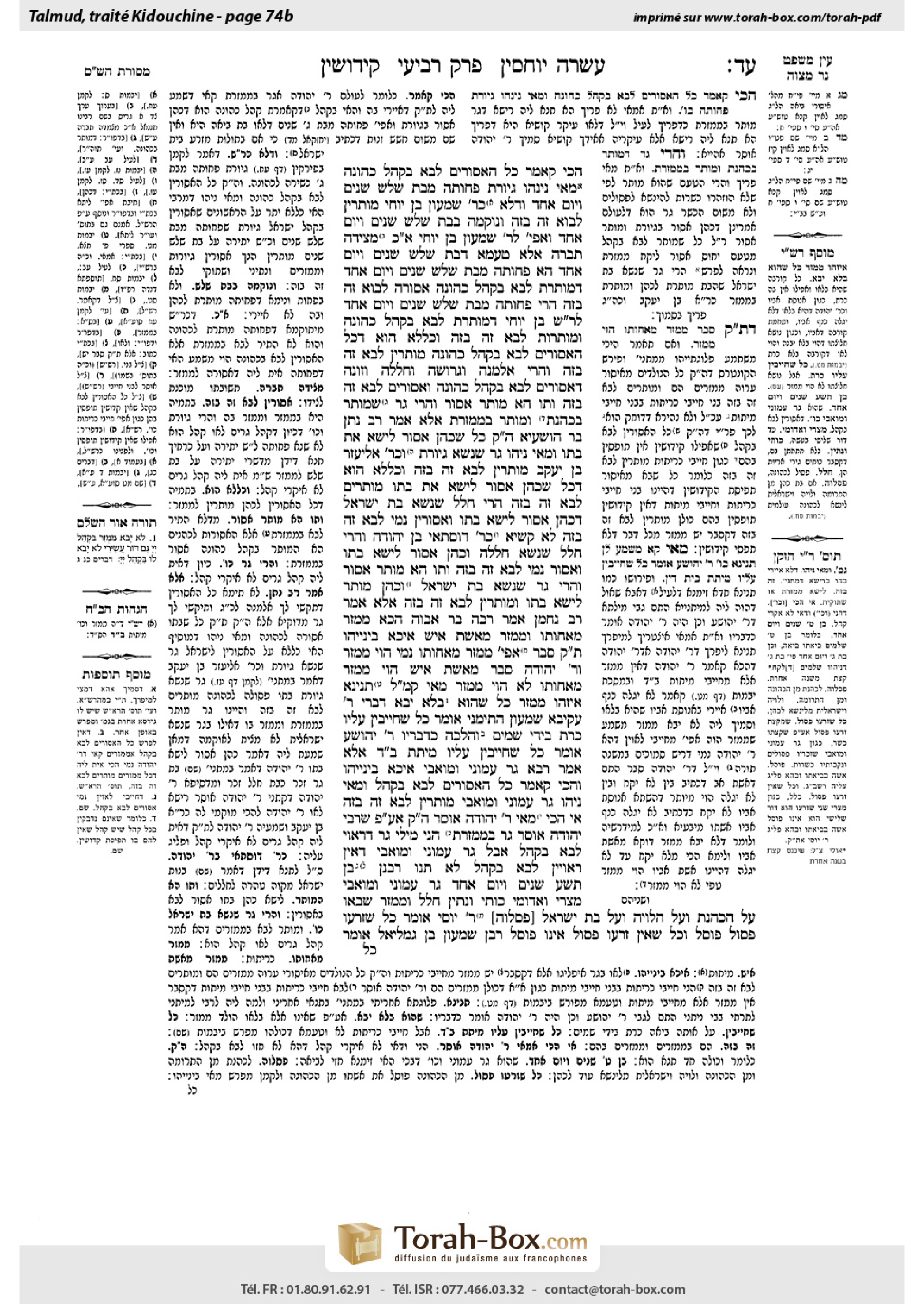
This page of Kiddushin includes the Aramaic text, an English translation and an AI-generated French translation, alongside the scan above.
קידושין ע״ד ב · Aramaic and Hebrew text
הָכִי קָאָמַר: כׇּל הָאֲסוּרִים לָבֹא בִּקְהַל כְּהוּנָּה, מַאי נִינְהוּ – גִּיּוֹרֶת פְּחוּתָה מִבַּת שָׁלֹשׁ שָׁנִים וְיוֹם אֶחָד, וּדְלָא כְּרַבִּי שִׁמְעוֹן בֶּן יוֹחַי – מוּתָּרִין לָבוֹא זֶה בָּזֶה.
וְנוֹקְמַהּ בְּבַת שָׁלֹשׁ שָׁנִים וְיוֹם אֶחָד, וַאֲפִילּוּ לְרַבִּי שִׁמְעוֹן בֶּן יוֹחַי! אִם כֵּן, מִצִּידַּהּ תָּבְרַהּ.
אֶלָּא טַעְמָא דְּבַת שָׁלֹשׁ שָׁנִים וְיוֹם אֶחָד, הָא פְּחוּתָה מִבַּת שָׁלֹשׁ שָׁנִים וְיוֹם אֶחָד, דְּמוּתֶּרֶת לָבֹא בִּקְהַל כְּהוּנָּה, אֲסוּרָה לָבוֹא זֶה בָּזֶה? הֲרֵי פְּחוּתָה מִבַּת שָׁלֹשׁ שָׁנִים וְיוֹם אֶחָד לְרַבִּי שִׁמְעוֹן בֶּן יוֹחַי, דְּמוּתֶּרֶת לָבֹא בִּקְהַל כְּהוּנָּה וּמֻותֶּרֶת לָבֹא זֶה בָּזֶה!
וּכְלָלָא הוּא דְּכׇל הָאֲסוּרִים לָבֹא בִּקְהַל כְּהוּנָּה מוּתָּרִין לָבֹא זֶה בָּזֶה? וַהֲרֵי אַלְמָנָה וּגְרוּשָׁה וַחֲלָלָה וְזוֹנָה דַּאֲסוּרִים לָבֹא בִּקְהַל כְּהוּנָּה, וַאֲסוּרִים לָבֹא זֶה בָּזֶה! וְתוּ: הָא מוּתָּר אָסוּר? וַהֲרֵי גֵּר שֶׁמּוּתָּר בְּכֹהֶנֶת וּמוּתָּר בְּמַמְזֶרֶת!
אֶלָּא אָמַר רַב נָתָן בַּר הוֹשַׁעְיָא: הָכִי קָאָמַר: כׇּל שֶׁכֹּהֵן אָסוּר לִישָּׂא אֶת בִּתּוֹ, וּמַאי נִיהוּ – גֵּר שֶׁנָּשָׂא גִּיּוֹרֶת. וּכְרַבִּי אֱלִיעֶזֶר בֶּן יַעֲקֹב – מוּתָּרִין לָבֹא זֶה בָּזֶה.
וּכְלָלָא הוּא דְּכׇל שֶׁכֹּהֵן אָסוּר לִישָּׂא אֶת בִּתּוֹ מוּתָּרִים לָבֹא זֶה בָּזֶה? הֲרֵי חָלָל שֶׁנָּשָׂא בַּת יִשְׂרָאֵל, דְּכֹהֵן אָסוּר לִישָּׂא בִּתּוֹ, וַאֲסוּרִין נָמֵי לָבֹא זֶה בָּזֶה! לָא קַשְׁיָא, כְּרַבִּי דּוֹסְתַּאי בֶּן יְהוּדָה.
וַהֲרֵי חָלָל שֶׁנָּשָׂא חֲלָלָה וְכֹהֵן אָסוּר לִישָּׂא בִּתּוֹ, וְאָסוּר נָמֵי לָבֹא זֶה בָּזֶה! וְתוּ: הָא מוּתָּר אָסוּר? וַהֲרֵי גֵּר שֶׁנָּשָׂא בַּת יִשְׂרָאֵל, וְכֹהֵן מוּתָּר לִישָּׂא בִּתּוֹ, וּמוּתָּרִין לָבֹא זֶה בָּזֶה!
אֶלָּא אָמַר רַב נַחְמָן אָמַר רַבָּה בַּר אֲבוּהּ: הָכָא מַמְזֵר מֵאֲחוֹתוֹ וּמַמְזֵר מֵאֵשֶׁת אִישׁ אִיכָּא בֵּינַיְיהוּ.
תַּנָּא קַמָּא סָבַר: אֲפִילּוּ מַמְזֵר מֵאֲחוֹתוֹ נָמֵי הָוֵי מַמְזֵר. וְרַבִּי יְהוּדָה סָבַר: מֵאֵשֶׁת אִישׁ הָוֵי מַמְזֵר, מֵאֲחוֹתוֹ – לָא הָוֵי מַמְזֵר.
מַאי קָא מַשְׁמַע לַן? תְּנֵינָא: אֵיזֶהוּ מַמְזֵר – כֹּל שֶׁהוּא בְּ״לֹא יָבֹא״, דִּבְרֵי רַבִּי עֲקִיבָא.
שִׁמְעוֹן הַתִּימְנִי אוֹמֵר: כֹּל שֶׁחַיָּיבִין עָלָיו כָּרֵת בִּידֵי שָׁמַיִם, וַהֲלָכָה כִּדְבָרָיו. רַבִּי יְהוֹשֻׁעַ אוֹמֵר: כֹּל שֶׁחַיָּיבִין עָלָיו מִיתַת בֵּית דִּין.
אֶלָּא אָמַר רָבָא: גֵּר עַמּוֹנִי וּמוֹאָבִי אִיכָּא בֵּינַיְיהוּ, וְהָכִי קָאָמַר: כׇּל הָאֲסוּרִים לָבֹא בַּקָּהָל, וּמַאי נִיהוּ: גֵּר עַמּוֹנִי וּמוֹאָבִי – מוּתָּרִין לָבֹא זֶה בָּזֶה.
אִי הָכִי מַאי רַבִּי יְהוּדָה אוֹסֵר? הָכִי קָאָמַר: אַף עַל פִּי שֶׁרַבִּי יְהוּדָה אוֹסֵר גֵּר בְּמַמְזֶרֶת, הָנֵי מִילֵּי גֵּר דְּרָאוּי לָבֹא בַּקָּהָל, אֲבָל גֵּר עַמּוֹנִי וּמוֹאָבִי דְּאֵין רְאוּיִין לָבֹא בַּקָּהָל – לָא.
תָּנוּ רַבָּנַן: בֶּן תֵּשַׁע שָׁנִים וְיוֹם אֶחָד גֵּר עַמּוֹנִי וּמוֹאָבִי, מִצְרִי וַאֲדוֹמִי, כּוּתִי וְנָתִין, חָלָל וּמַמְזֵר שֶׁבָּאוּ עַל הַכֹּהֶנֶת וְעַל הַלְוִיָּה וְעַל בַּת יִשְׂרָאֵל – [פְּסָלוּהָ]. רַבִּי יוֹסֵי אוֹמֵר: כֹּל שֶׁזַּרְעוֹ פָּסוּל – פּוֹסֵל, וְכֹל שֶׁאֵין זַרְעוֹ פָּסוּל – אֵינוֹ פּוֹסֵל. רַבָּן שִׁמְעוֹן בֶּן גַּמְלִיאֵל אוֹמֵר:
Kiddushin 74b · English translation
This is what the mishna is saying: All those for whom it is prohibited to enter into the congregation of the priesthood. Rav Yehuda adds parenthetically: And who are they? Even a female who became a convert at less than three years and one day old, and this is not in accordance with the opinion of Rabbi Shimon ben Yoḥai, who holds that such a girl is permitted to marry a priest. Rav Yehuda resumes his presentation of the statement of Rabbi Yehuda: They are permitted to marry into those families that are prohibited from entering into the congregation but are permitted to marry one another.
The Gemara asks: And let us establish the mishna as referring to a girl who became a convert at three years and one day old or older, and then it will accord even with Rabbi Shimon ben Yoḥai’s opinion, as he agrees that this convert may not marry a priest. The Gemara answers: If so, the mishna is broken, i.e., contradicted, from within itself, as if the mishna states that even a female who converted when she was older than three years and a day may marry one with flawed lineage, one would make an incorrect inference, as follows.
Rather, the reason that she may marry one with flawed lineage is that she converted when she was already three years and one day old. But if she converted when she was less than three years and one day old, as she is permitted to enter into the congregation of the priesthood, is she prohibited from marrying into those families that are prohibited from entering into the congregation but are permitted to marry one another? This cannot be, since according to the opinion of Rabbi Shimon ben Yoḥai, there is also the case of a female who converted when she was less than three years and one day old, who is permitted to enter the congregation of the priesthood and is also permitted to marry into those families that are prohibited from entering into the congregation but are permitted to marry one another. Consequently, the mishna cannot be explained to accord with the opinion of Rabbi Shimon ben Yoḥai.
The Gemara continues to ask: But is it an established principle that all those for whom it is prohibited to enter into the congregation of the priesthood are permitted to marry into those families that are prohibited from entering into the congregation but are permitted to marry one another? But a widow, who may not marry a High Priest, and a divorcée, and a woman disqualified from marrying a priest [ḥalala], and a woman who has engaged in sexual intercourse with a man forbidden to her by the Torah [zona], are prohibited to enter into the congregation of the priesthood and are also prohibited to marry into those families that are prohibited from entering into the congregation but are permitted to marry one another. And furthermore, can it be inferred: But one who is permitted to enter into the congregation of the priesthood is prohibited from marrying a man of flawed lineage? But there is the convert, who is permitted to marry a daughter of a priest, and is also permitted to marry a mamzeret.
Rather, Rav Natan bar Hoshaya said: This is what the tanna of the mishna is saying: Any person about whom the halakha is that a priest may not marry his daughter. Rav Natan bar Hoshaya adds parenthetically: And who is that? A convert who married a female convert, and this is in accordance with the opinion of Rabbi Eliezer ben Ya’akov, who prohibits the daughter of two converts to marry a priest. Rav Natan bar Hoshaya resumes his presentation of the statement of Rabbi Yehuda: People of that status are permitted to marry into those families that are prohibited from entering into the congregation but are permitted to marry one another, since converts are not in the category of “congregation.”
The Gemara asks: But is it an established principle that anyone whose daughter a priest may not marry is permitted to marry into those families that are prohibited from entering into the congregation but are permitted to marry one another? But there is the case of a priest disqualified due to flawed lineage [ḥalal] who married a Jewish woman, as a priest may not marry his daughter, since she is a ḥalala. And despite this, she is included among those who are prohibited to marry into those families that are prohibited from entering into the congregation but are permitted to marry one another. The Gemara answers: This is not difficult, since this mishna is in accordance with the opinion of Rabbi Dostai ben Yehuda, who holds that the daughter of a ḥalal and a Jewish woman may marry a priest.
The Gemara asks: But there is the case of a ḥalal who married a ḥalala, as a priest may not marry his daughter, since she is a ḥalala. And despite this, she is included among those who are prohibited to marry into those families that are prohibited from entering into the congregation but are permitted to marry one another. And furthermore, can it be inferred: One with regard to whom it is permitted for a priest to marry his daughter, is he prohibited from marrying Jews of flawed lineage? But there is the case of a convert who married a Jewish woman, and a priest is permitted to marry his daughter. And despite this, people of that status are permitted to marry into those families that are prohibited from entering into the congregation but are permitted to marry one another.
Rather, Rav Naḥman said that Rabba bar Avuh said a different explanation of the dispute between the first tanna and Rabbi Yehuda: Here, the difference between them concerns a mamzer resulting from intercourse between a man and his sister, and a mamzer resulting from intercourse between a married woman and a man other than her husband.
The first tanna holds: Even a mamzer resulting from intercourse between a man and his sister is also considered a mamzer. And Rabbi Yehuda holds: The offspring resulting from intercourse with a married woman is a mamzer, but offspring resulting from intercourse between a man and his sister is not a mamzer. According to this explanation, the dispute is that according to the first tanna, offspring resulting from intercourse between siblings may marry offspring resulting from intercourse with a married woman, while according to Rabbi Yehuda, the offspring resulting from intercourse between siblings is of unflawed lineage and may not marry a mamzer.
The Gemara asks: What is the tanna teaching us with this? We already learned this in a mishna (Yevamot 49a): Who is a mamzer? Any offspring who is born of a union prohibited by the verse: “He shall not enter” (Deuteronomy 23:2). In other words, if the union was a violation of any kind of prohibition, even that of a prohibition that is not subject to the punishment of karet, the child is a mamzer; this is the statement of Rabbi Akiva.
The mishna continues: Shimon HaTimni says: Any offspring who is born of a union enjoined by a prohibition for which one is liable to receive karet at the hand of Heaven, and the halakha is in accordance with his statement. Rabbi Yehoshua says: Any offspring who is born of a union enjoined by a prohibition for which one is liable to receive court-imposed capital punishment. This demonstrates that the question of whether mamzer status results from sexual intercourse between siblings, for which one is liable to receive karet rather than capital punishment, has already been addressed in a mishna. Therefore, Rav Naḥman’s explanation of this mishna must be rejected.
Rather, Rava said: The difference between them involves the halakha of a male Ammonite and a male Moabite convert, and this is what the tanna is saying: All those for whom it is prohibited to enter into the congregation. Rava adds parenthetically: And who are they? A male Ammonite and a male Moabite convert. Rava resumes his presentation of the statement of Rabbi Yehuda: They are permitted to marry one another.
The Gemara asks: If so, what is the reason of Rabbi Yehuda for prohibiting these marriages? Rabbi Yehuda should also permit an Ammonite convert to marry a mamzeret, as an Ammonite is not fit to enter the congregation. The Gemara answers: This is what the tanna is saying: Although Rabbi Yehuda generally prohibits a convert from marrying a mamzeret, this matter applies only to a regular convert, who is fit to enter into the congregation. But a male Ammonite convert and a male Moabite convert, who are not fit to enter into the congregation, are not prohibited from marrying a mamzeret, and there is no dispute between Rabbi Yehuda and the first tanna.
The Sages taught (Tosefta, Yevamot 8:1): A boy nine years and one day old, whose sexual intercourse is considered an act of intercourse with regard to sexual transgressions, who was an Ammonite or Moabite convert, or an Egyptian or Edomite convert, or a Samaritan, or a Gibeonite, a ḥalal, or a mamzer, and who engaged in sexual intercourse with the daughter of a priest, or the daughter of a Levite, or an Israelite woman, has thereby disqualified her from the priesthood. Rabbi Yosei says: Anyone whose offspring is unfit to marry a priest disqualifies a woman with whom he engages in intercourse from marrying a priest; and anyone whose offspring is not unfit does not disqualify her. Rabban Shimon ben Gamliel says:
Kiddushin 74b · Traduction française (IA)
Voici ce que la Michna signifie : Tous ceux pour qui il est interdit d'entrer dans la congrégation du sacerdoce. Rav Yehuda ajoute entre parenthèses : Et qui sont-ils ? Même une femme qui est devenue convertie à l'âge de moins de trois ans et un jour, et cela ne concorde pas avec l'opinion de Rabbi Shimon ben Yoḥai, qui soutient qu'une telle fille est autorisée à épouser un prêtre. Rav Yehuda reprend sa présentation de l'énoncé de Rabbi Yehuda : Ils sont autorisés à épouser au sein de ces familles qui sont interdites d'entrer dans la congrégation, mais qui sont autorisées à se marier entre elles.
La Guemara demande : Et ne pouvons-nous pas établir que la Michna se réfère à une fille qui est devenue convertie à l'âge de trois ans et un jour ou plus, et alors cela concordera même avec l'opinion de Rabbi Shimon ben Yoḥai, car il convient que cette convertie ne peut pas épouser un prêtre. La Guemara répond : Si c'était le cas, la Michna serait brisée, c'est-à-dire contredite, par elle-même, car si la Michna énonce que même une femme qui s'est convertie alors qu'elle était âgée de plus de trois ans et un jour peut épouser une personne de lignée défectueuse, on ferait une inférence incorrecte, comme suit.
Plutôt, la raison pour laquelle elle peut épouser une personne de lignée défectueuse est qu'elle s'est convertie alors qu'elle était déjà âgée de trois ans et un jour. Mais si elle s'est convertie alors qu'elle avait moins de trois ans et un jour, comme elle est autorisée à entrer dans la congrégation du sacerdoce, est-elle interdite d'épouser au sein de ces familles qui sont interdites d'entrer dans la congrégation, mais qui sont autorisées à se marier entre elles ? Cela ne peut pas être, car selon l'opinion de Rabbi Shimon ben Yoḥai, il y a aussi le cas d'une femme qui s'est convertie alors qu'elle avait moins de trois ans et un jour, qui est autorisée à entrer dans la congrégation du sacerdoce et qui est également autorisée à épouser au sein de ces familles qui sont interdites d'entrer dans la congrégation, mais qui sont autorisées à se marier entre elles. En conséquence, la Michna ne peut pas être expliquée pour concorder avec l'opinion de Rabbi Shimon ben Yoḥai.
La Guemara continue de demander : Mais est-ce un principe établi que tous ceux pour qui il est interdit d'entrer dans la congrégation du sacerdoce sont autorisés à épouser au sein de ces familles qui sont interdites d'entrer dans la congrégation, mais qui sont autorisées à se marier entre elles ? Mais une veuve, qui ne peut pas épouser un Grand Prêtre, et une divorcée, et une femme disqualifiée pour épouser un prêtre [ḥalala], et une femme qui a eu des rapports sexuels avec un homme qui lui est interdit par la Torah [zona], sont interdites d'entrer dans la congrégation du sacerdoce et sont également interdites d'épouser au sein de ces familles qui sont interdites d'entrer dans la congrégation, mais qui sont autorisées à se marier entre elles. Et de plus, peut-on en inférer : Mais celui qui est autorisé à entrer dans la congrégation du sacerdoce est-il interdit d'épouser un homme de lignée défectueuse ? Mais il y a le converti, qui est autorisé à épouser une fille de prêtre, et qui est également autorisé à épouser une mamzeret.
Plutôt, Rav Natan bar Hoshaya a dit : Voici ce que le tanna de la Michna signifie : Toute personne à propos de laquelle la halakha est qu'un prêtre ne peut pas épouser sa fille. Rav Natan bar Hoshaya ajoute entre parenthèses : Et qui est-ce ? Un converti qui a épousé une femme convertie, et cela est en accord avec l'opinion de Rabbi Eliezer ben Ya’akov, qui interdit à la fille de deux convertis d'épouser un prêtre. Rav Natan bar Hoshaya reprend sa présentation de l'énoncé de Rabbi Yehuda : Les personnes de ce statut sont autorisées à épouser au sein de ces familles qui sont interdites d'entrer dans la congrégation, mais qui sont autorisées à se marier entre elles, car les convertis ne sont pas dans la catégorie de « congrégation ».
La Guemara demande : Mais est-ce un principe établi que quiconque dont la fille ne peut pas être épousée par un prêtre est autorisé à épouser au sein de ces familles qui sont interdites d'entrer dans la congrégation, mais qui sont autorisées à se marier entre elles ? Mais il y a le cas d'un prêtre disqualifié en raison d'une lignée défectueuse [ḥalal] qui a épousé une femme juive, car un prêtre ne peut pas épouser sa fille, car elle est une ḥalala. Et malgré cela, elle est incluse parmi celles qui sont interdites d'épouser au sein de ces familles qui sont interdites d'entrer dans la congrégation, mais qui sont autorisées à se marier entre elles. La Guemara répond : Ce n'est pas difficile, car cette Michna est en accord avec l'opinion de Rabbi Dostai ben Yehuda, qui soutient que la fille d'un ḥalal et d'une femme juive peut épouser un prêtre.
La Guemara demande : Mais il y a le cas d'un ḥalal qui a épousé une ḥalala, car un prêtre ne peut pas épouser sa fille, car elle est une ḥalala. Et malgré cela, elle est incluse parmi celles qui sont interdites d'épouser au sein de ces familles qui sont interdites d'entrer dans la congrégation, mais qui sont autorisées à se marier entre elles. Et de plus, peut-on en inférer : Celui à propos de qui il est permis pour un prêtre d'épouser sa fille, est-il interdit d'épouser des Juifs de lignée défectueuse ? Mais il y a le cas d'un converti qui a épousé une femme juive, et un prêtre est autorisé à épouser sa fille. Et malgré cela, les personnes de ce statut sont autorisées à épouser au sein de ces familles qui sont interdites d'entrer dans la congrégation, mais qui sont autorisées à se marier entre elles.
Plutôt, Rav Naḥman a dit que Rabba bar Avuh a dit une explication différente de la dispute entre le premier tanna et Rabbi Yehuda : Ici, la différence entre eux concerne un mamzer résultant de rapports entre un homme et sa sœur, et un mamzer résultant de rapports entre une femme mariée et un homme autre que son mari.
Le premier tanna soutient : Même un mamzer issu de la relation entre un homme et sa sœur est considéré comme un mamzer. Et Rabbi Yehuda soutient : La descendance issue de la relation avec une femme mariée est un mamzer, mais la descendance issue de la relation entre un homme et sa sœur n'est pas un mamzer. Selon cette explication, la controverse porte sur le fait que, selon le premier tanna, la descendance issue de la relation entre frères et sœurs peut épouser la descendance issue de la relation avec une femme mariée, tandis que, selon Rabbi Yehuda, la descendance issue de la relation entre frères et sœurs est de lignée irréprochable et ne peut pas épouser un mamzer.
La Guemara demande : Qu'est-ce que le tanna nous enseigne par cela ? Nous avons déjà appris cela dans une Michna (Yevamot 49a) : Qui est un mamzer ? Tout enfant issu d'une union interdite par le verset : « Il ne doit pas entrer » (Deutéronome 23:2). En d'autres termes, si l'union constituait une violation de toute sorte d'interdiction, même celle d'une interdiction qui n'entraîne pas la peine de karet, l'enfant est un mamzer ; c'est l'avis de Rabbi Akiva.
La Michna continue : Shimon HaTimni dit : Tout enfant issu d'une union interdite par une interdiction pour laquelle on est passible de la peine de karet par la main du Ciel, et la halakha est conforme à son avis. Rabbi Yehoshua dit : Tout enfant issu d'une union interdite par une interdiction pour laquelle on est passible de la peine capitale infligée par le tribunal. Cela démontre que la question de savoir si le statut de mamzer résulte de la relation sexuelle entre frères et sœurs, pour laquelle on est passible de la peine de karet plutôt que de la peine capitale, a déjà été traitée dans une Michna. Par conséquent, l'explication de cette Michna par Rav Naḥman doit être rejetée.
Plutôt, Rava a dit : La différence entre eux concerne la halakha d'un Ammonite mâle converti et d'un Moabite mâle converti, et voici ce que le tanna dit : Tous ceux pour qui il est interdit d'entrer dans la congrégation. Rava ajoute entre parenthèses : Et qui sont-ils ? Un Ammonite mâle converti et un Moabite mâle converti. Rava reprend sa présentation de l'avis de Rabbi Yehuda : Ils sont autorisés à se marier entre eux.
La Guemara demande : Si c'est le cas, quelle est la raison de Rabbi Yehuda pour interdire ces mariages ? Rabbi Yehuda devrait également autoriser un Ammonite converti à épouser une mamzeret, car un Ammonite n'est pas apte à entrer dans la congrégation. La Guemara répond : Voici ce que le tanna dit : Bien que Rabbi Yehuda interdise généralement à un converti d'épouser une mamzeret, cette règle ne s'applique qu'à un converti ordinaire, qui est apte à entrer dans la congrégation. Mais un Ammonite mâle converti et un Moabite mâle converti, qui ne sont pas aptes à entrer dans la congrégation, ne sont pas interdits d'épouser une mamzeret, et il n'y a pas de controverse entre Rabbi Yehuda et le premier tanna.
Les Sages ont enseigné (Tosefta, Yevamot 8:1) : Un garçon de neuf ans et un jour, dont la relation sexuelle est considérée comme un acte de rapport au regard des transgressions sexuelles, qui était un Ammonite ou un Moabite converti, ou un Égyptien ou un Édomite converti, ou un Samaritain, ou un Gibéonite, un ḥalal, ou un mamzer, et qui a eu des relations sexuelles avec la fille d'un Cohen, ou la fille d'un Lévi, ou une femme israélite, l'a ainsi disqualifiée du sacerdoce. Rabbi Yosei dit : Quiconque dont la descendance n'est pas apte à épouser un Cohen disqualifie une femme avec laquelle il a des relations d'épouser un Cohen ; et quiconque dont la descendance n'est pas inapte ne la disqualifie pas. Rabban Shimon ben Gamliel dit :
Traduction française générée par IA à partir de l’édition anglaise de Sefaria. Vérifie toujours un passage avec le texte source.
Text from Sefaria: William Davidson Edition - Vocalized Aramaic (CC BY NC); William Davidson Edition - English (CC BY NC).