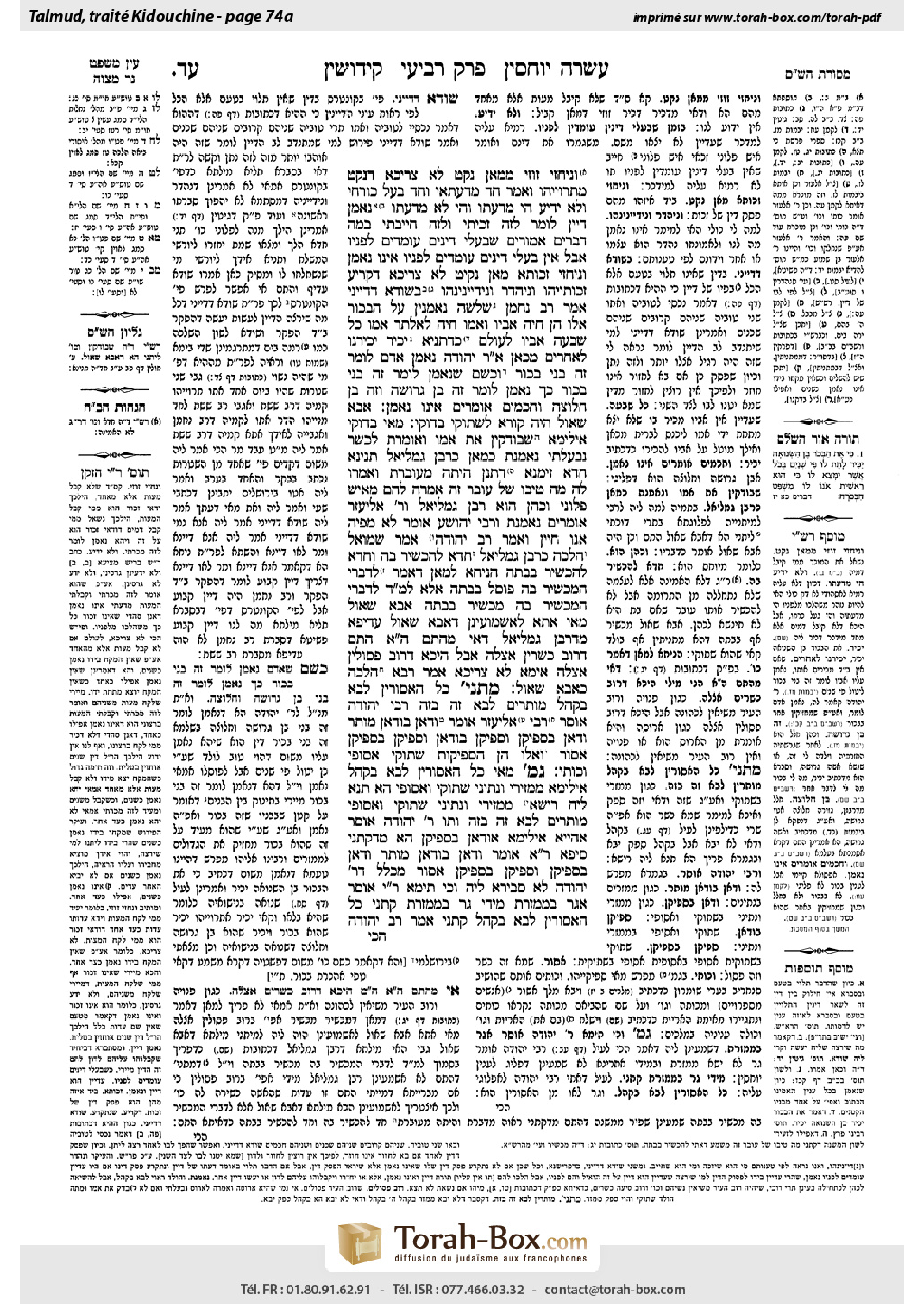
Kiddushin 74a: Talmud study for Daf Yomi
Daf Yomi is the daily study of one Talmud folio. Explore 37 tractates with scans, Hebrew text, Sefaria English and AI-generated French translations where annotated.
Passage selection and English or AI-generated French translation are available where the scan has annotations. Daf Study is independent of Torah-Box and Sefaria.
Browse Kiddushin · קידושין · All tractatesKiddushin 74a text and translations
This page of Kiddushin includes the Aramaic text, an English translation and an AI-generated French translation, alongside the scan above.
קידושין ע״ד א · Aramaic and Hebrew text
וְנִיחְזֵי זוּזֵי מִמַּאן נָקֵט? לָא צְרִיכָא דְּנָקֵט מִתַּרְוַיְיהוּ וְאָמַר: חַד מִדַּעְתַּאי, וְחַד בְּעַל כּוּרְחַי. וְלָא יְדִיעַ הֵי מִדַּעְתּוֹ וְהֵי לֹא מִדַּעְתּוֹ.
נֶאֱמָן דַּיָּין לוֹמַר: לָזֶה זִכִּיתִי וְלָזֶה חִיַּיבְתִּי. בַּמֶּה דְּבָרִים אֲמוּרִים – שֶׁבַּעֲלֵי דִינִים עוֹמְדִים לְפָנָיו, אֲבָל אֵין בַּעֲלֵי דִינִים עוֹמְדִים לְפָנָיו – אֵינוֹ נֶאֱמָן. וְנִיחְזֵי זְכוּתָא מַאן נָקֵיט?
לָא צְרִיכָא, דִּקְרִיעַ זְכוּתַיְיהוּ. וְנִיהְדַּר וְנִידַיְּינִינְהוּ! בְּשׁוּדָא דְּדַיָּינֵי.
אָמַר רַב נַחְמָן: שְׁלֹשָׁה נֶאֱמָנִין עַל הַבְּכוֹר, אֵלּוּ הֵן: חַיָּה, אָבִיו, וְאִמּוֹ. חַיָּה – לְאַלְתַּר, אִמּוֹ – כׇּל שִׁבְעָה, אָבִיו – לְעוֹלָם. כִּדְתַנְיָא. ״יַכִּיר״ – יַכִּירֶנּוּ לַאֲחֵרִים.
מִכָּאן אָמַר רַבִּי יְהוּדָה: נֶאֱמָן אָדָם לוֹמַר: ״זֶה בְּנִי בְּכוֹר״. וּכְשֵׁם שֶׁנֶּאֱמָן לוֹמַר: ״זֶה בְּנִי בְּכוֹר״, כָּךְ נֶאֱמָן לוֹמַר: ״זֶה בֶּן גְּרוּשָׁה״ וְ״זֶה בֶּן חֲלוּצָה״. וַחֲכָמִים אוֹמְרִים: אֵינוֹ נֶאֱמָן.
אַבָּא שָׁאוּל הָיָה קוֹרֵא לַשְּׁתוּקִי ״בְּדוּקִי״. מַאי ״בְּדוּקִי״? אִילֵימָא שֶׁבּוֹדְקִין אֶת אִמּוֹ וְאוֹמֶרֶת: לְכָשֵׁר נִבְעַלְתִּי – נֶאֱמֶנֶת, כְּמַאן – כְּרַבָּן גַּמְלִיאֵל, תְּנֵינָא חֲדָא זִימְנָא! דִּתְנַן: הָיְתָה מְעוּבֶּרֶת, וְאָמְרוּ לָהּ: מָה טִיבוֹ שֶׁל עוּבָּר זֶה? אָמְרָה לָהֶם: מֵאִישׁ פְּלוֹנִי וְכֹהֵן הוּא. רַבָּן גַּמְלִיאֵל וְרַבִּי אֱלִיעֶזֶר אוֹמְרִים: נֶאֱמֶנֶת, וְרַבִּי יְהוֹשֻׁעַ אוֹמֵר: לֹא מִפִּיהָ אָנוּ חַיִּין. וְאָמַר רַב יְהוּדָה, אָמַר שְׁמוּאֵל: הֲלָכָה כְּרַבָּן גַּמְלִיאֵל.
– חֲדָא לְהַכְשִׁיר בָּהּ, וַחֲדָא לְהַכְשִׁיר בְּבִתָּהּ. הָנִיחָא לְמַאן דְּאָמַר: לְדִבְרֵי הַמַּכְשִׁיר בָּהּ – פּוֹסֵל בְּבִתָּהּ.
אֶלָּא לְמַאן דְּאָמַר: לְדִבְרֵי הַמַּכְשִׁיר בָּהּ – מַכְשִׁיר בְּבִתָּהּ, אַבָּא שָׁאוּל מַאי אֲתָא לְאַשְׁמוֹעִינַן?
דְּאַבָּא שָׁאוּל עֲדִיפָא מִדְּרַבָּן גַּמְלִיאֵל. דְּאִי מֵהָתָם הֲוָה אָמֵינָא: הָתָם, דְּרוֹב כְּשֵׁרִין אֶצְלָהּ, אֲבָל הֵיכָא דְּרוֹב פְּסוּלִין אֶצְלָהּ – אֵימָא לָא, צְרִיכָא. אָמַר רָבָא: הֲלָכָה כְּאַבָּא שָׁאוּל.
מַתְנִי׳ כׇּל הָאֲסוּרִין לָבֹא בַּקָּהָל – מוּתָּרִים לָבֹא זֶה בָּזֶה. רַבִּי יְהוּדָה אוֹסֵר.
רַבִּי אֱלִיעֶזֶר אוֹמֵר: וַדָּאָן בְּוַדָּאָן – מוּתָּר, וַדָּאָן בִּסְפֵיקָן, וּסְפֵיקָן בְּוַדָּאָן, וּסְפֵיקָן בִּסְפֵיקָן – אָסוּר. וְאֵלּוּ הֵן הַסְּפֵיקוֹת: שְׁתוּקִי, אֲסוּפִי, וְכוּתִי.
גְּמָ׳ מַאי כׇּל הָאֲסוּרִין לָבֹא בַּקָּהָל? אִילֵימָא מַמְזֵירֵי וּנְתִינֵי שְׁתוּקֵי וַאֲסוּפֵי – הָא תְּנָא לֵיהּ רֵישָׁא, מַמְזֵירֵי וּנְתִינֵי שְׁתוּקֵי וַאֲסוּפֵי מוּתָּרִים לָבֹא זֶה בָּזֶה!
וְתוּ: רַבִּי יְהוּדָה אוֹסֵר, אַהֵיָיא? אִילֵּימָא אַוַּדָּאָן בִּסְפֵיקָן – הָא מִדְּקָתָנֵי סֵיפָא רַבִּי אֱלִיעֶזֶר אוֹמֵר: וַדָּאָן בְּוַדָּאָן – מוּתָּר, וַדָּאָן בִּסְפֵיקָן, וּסְפֵיקָן בִּסְפֵיקָן – אָסוּר, מִכְּלָל דְּרַבִּי יְהוּדָה לָא סְבִירָא לֵיהּ!
וְכִי תֵּימָא: רַבִּי יְהוּדָה אוֹסֵר אַגֵּר בְּמַמְזֶרֶת, מִידֵּי גֵּר בְּמַמְזֶרֶת קָתָנֵי? כׇּל הָאֲסוּרִין לָבֹא בַּקָּהָל קָתָנֵי!
אָמַר רַב יְהוּדָה:
Kiddushin 74a · English translation
The Gemara asks: And let us see from whom he took the money, as it will be obvious that he is the one who bought it. The Gemara answers: No, it is necessary to teach this halakha in a case where the seller took money from both of them, and he then said: One payment I accepted willingly, and one payment was given to me against my will, and it is not known which person gave him money in accordance with his will and which did so against his will. In that case, if the item is no longer in the seller’s possession, he is not deemed credible to testify to whom he sold it.
The Gemara cites the continuation of the baraita: Similarly, a judge is deemed credible to say: I found this person victorious in a civil case, and I found this one obligated to pay. In what case is this statement said? When the litigants are still standing before him. But if the litigants are not standing before him but have left, he is not deemed credible. The Gemara asks: And let us see who holds the writ of a favorable verdict. Why is there a need to rely on the statement of the judge?
The Gemara answers: No, it is necessary to teach this halakha in a case where their writs of a favorable verdict have been torn up and cannot be examined. The Gemara asks: If so, then let him return and judge them again, and presumably the same verdict will be issued. The Gemara answers: It was a case of the judges’ discretion [shuda dedayyanei]. In certain cases, the verdict depends on the decision of the judges based solely on their sense of which litigant deserves to win. There is no guarantee that they will make the same decision the second time around.
The Gemara continues to discuss the credibility of various people with regard to a firstborn. Rav Naḥman says: Three are deemed credible with regard to stating that a child is a firstborn, and they are: A midwife, his father, and his mother. A midwife is deemed credible only immediately; his mother is deemed credible all of the first seven days after his birth; his father is deemed credible forever. As it is taught in a baraita: Expounding the verse: “But he shall acknowledge the firstborn” (Deuteronomy 21:17), the Sages said: The father shall acknowledge him to others. In other words, he is deemed credible to tell others that this is his firstborn.
From here, Rabbi Yehuda said: A person is deemed credible to say: This is my firstborn son. And just as he is deemed credible to say: This is my firstborn son, so too, if he is a priest he is deemed credible to say about his son: This is a son of a divorced woman, or: This is a son of a ḥalutza. And the Rabbis say: As far as these latter claims are concerned, he is not deemed credible. He is deemed credible to state only which son is his firstborn.
§ The mishna teaches that Abba Shaul would call a shetuki by the label of beduki. The Gemara asks: What is the meaning of beduki? If we say that they examine [bodekin] his mother, and if she says: I engaged in sexual intercourse with a man of unflawed lineage, in which case she is deemed credible, then with whose opinion does this halakha accord? With that of Rabban Gamliel. But we already learned this on another occasion, as we learned in a mishna (Ketubot 13a): If an unmarried woman was pregnant, and they said to her: What is the status of this fetus, and she said to them: It is from so-and-so, and he is a priest, then Rabban Gamliel and Rabbi Eliezer say: She is deemed credible, and Rabbi Yehoshua says: We don’t live from, i.e., we don’t rely on, the words of her mouth, and she is not trusted. And Rav Yehuda says that Shmuel says: The halakha is in accordance with the opinion of Rabban Gamliel. What, then, did Abba Shaul add beyond what was taught in that mishna?
The Gemara answers: Abba Shaul’s statement that the woman is deemed credible when she states that the father of the child was of unflawed lineage is nevertheless necessary. One halakha was stated in order to render her fit to marry a priest, and one halakha was stated to render her daughter fit to marry a priest as well. The Gemara asks: This works out well according to the one who says: According to the statement of the one who deems her fit to marry a priest, he nevertheless deems her daughter unfit, as her credibility does not extend to her daughter, who never had a presumptive status of unflawed lineage. Abba Shaul therefore presents a novel ruling, that if she claims to have engaged in intercourse with a man of unflawed lineage, she is deemed credible even with regard to the status of her daughter.
But according to the one who says: According to the statement of the one who deems her fit to marry a priest, he deems her daughter fit to do so as well, what is Abba Shaul coming to teach us?
The Gemara answers: The statement of Abba Shaul is preferable and is more far-reaching than that of Rabban Gamliel, as, if the halakha were learned only from there, the case of an unmarried woman, I would say: There it is a case when most are fit with regard to her, as it is permitted for most people to engage in intercourse with a single woman. But in a circumstance where most are unfit with regard to her, e.g., if she was betrothed and claimed that the man betrothed to her was the father, you might say this: She is not deemed credible when she claims to have engaged in intercourse with a man that would result in the child being of unflawed lineage, as only a small minority of people, i.e., her betrothed, would not render the child unfit, while the rest of the people in the world would render him unfit. Therefore, Abba Shaul’s halakha was necessary in order to include that case. Rava says: The halakha is in accordance with the statement of Abba Shaul.
MISHNA: All those for whom it is prohibited to enter into the congregation, i.e., to marry a Jew of unflawed lineage, are permitted to marry into each other’s families. Rabbi Yehuda prohibits them from marrying anyone other than those who share their specific flaw.
Rabbi Eliezer says: It is permitted for those with definite flaws to marry with those with definite flaws. For example, it is permitted for mamzerim and Gibeonites to marry each other. By contrast, it is prohibited for those with definite flaws, such as mamzerim, to marry with those whose flaws result from an uncertainty, such as a child of unknown paternity [shetuki] and a foundling; and it is prohibited for those whose flaws result from an uncertainty to marry with those with definite flaws; and it is prohibited for those whose flaws result from an uncertainty to marry with those whose flaws result from an uncertainty, such as a shetuki and a female shetuki. And these are the ones whose flaws result from an uncertainty: A shetuki, a foundling, and a Samaritan.
GEMARA: What is the meaning of: All those for whom it is prohibited to enter into the congregation? If we say mamzerim and Gibeonites, shetukim, and foundlings, wasn’t it already taught in the first clause of the first mishna of the chapter that with regard to mamzerim and Gibeonites, shetukim, and foundlings, it is permitted for men and women in these categories to marry into each other’s families?
And furthermore, to which case in the mishna here is it referring when it states: Rabbi Yehuda prohibits them? If we say it is referring to those with definite flaws marrying with those whose flaws result from an uncertainty, and it is teaching that Rabbi Yehuda prohibits them from marrying each other, this is difficult. But from the fact that it teaches in the latter clause that Rabbi Eliezer says: It is permitted for those with definite flaws to marry with those with definite flaws; by contrast, it is prohibited for those with definite flaws to marry with those whose flaws result from an uncertainty, and it is prohibited for those whose flaws result from an uncertainty to marry with those with definite flaws, and it is prohibited for those whose flaws result from an uncertainty to marry with those whose flaws result from an uncertainty; then by inference, it is clear that Rabbi Yehuda does not maintain this opinion.
And if you would say that when Rabbi Yehuda prohibits those with flawed lineage from marrying each other, he is referring to the prohibition against a convert marrying with a mamzeret, does the mishna teach the halakha of a convert marrying with a mamzeret? It teaches: All those for whom it is prohibited to enter into the congregation, which does not include a convert.
Rav Yehuda says:
Kiddushin 74a · Traduction française (IA)
La Guemara demande : Pourquoi ne pas voir de qui il a reçu l’argent ? Il serait alors évident que c’est cette personne qui a acheté l’objet. La Guemara répond : Non, cette halakha est nécessaire dans le cas où le vendeur a reçu de l’argent des deux hommes, puis a déclaré : « J’ai accepté l’un des paiements de mon plein gré, et l’autre m’a été donné contre mon gré », sans que l’on sache lequel des deux lui a donné de l’argent de son plein gré et lequel l’a fait contre son gré. Dans ce cas, si l’objet n’est plus en possession du vendeur, celui-ci n’est pas considéré comme digne de foi lorsqu’il témoigne à qui il l’a vendu.
La Guemara cite la suite de la baraïta : De même, un juge est considéré comme digne de foi lorsqu’il dit : « J’ai trouvé cette personne victorieuse dans un procès civil, et j’ai trouvé celle-ci tenue de payer. » Dans quel cas cette déclaration s’applique-t-elle ? Lorsque les plaideurs se tiennent encore devant lui. Mais s’ils ne se tiennent plus devant lui et sont partis, il n’est pas considéré comme digne de foi. La Guemara demande : Pourquoi ne pas voir qui détient l’acte constatant le verdict favorable ? Pourquoi faut-il se fier à la déclaration du juge ?
La Guemara répond : Non, cette halakha est nécessaire dans le cas où les actes constatant leurs verdicts favorables ont été déchirés et ne peuvent être examinés. La Guemara demande : Dans ce cas, qu’il les juge à nouveau ; vraisemblablement, le même verdict sera rendu. La Guemara répond : Il s’agissait d’un cas relevant du pouvoir discrétionnaire des juges [shuda dedayyanei]. Dans certains cas, le verdict dépend uniquement de l’appréciation des juges quant au plaideur qui mérite de gagner. Rien ne garantit qu’ils prendront la même décision une seconde fois.
La Guemara poursuit sa discussion sur la crédibilité de diverses personnes concernant le statut de premier-né. Rav Naḥman dit : Trois personnes sont considérées comme dignes de foi lorsqu’elles déclarent qu’un enfant est un premier-né : une sage-femme, son père et sa mère. Une sage-femme n’est considérée comme digne de foi que sur-le-champ ; sa mère l’est pendant les sept premiers jours suivant sa naissance ; son père l’est pour toujours. Comme il est enseigné dans une baraïta : En interprétant le verset « Mais il reconnaîtra le premier-né » (Deutéronome 21:17), les Sages ont dit : « Le père le fera reconnaître aux autres. » Autrement dit, il est considéré comme digne de foi lorsqu’il dit aux autres que cet enfant est son premier-né.
De là, Rabbi Yehuda a dit : Une personne est considérée comme digne de foi lorsqu’elle dit : « Celui-ci est mon fils premier-né. » Et de même qu’elle est considérée comme digne de foi lorsqu’elle dit : « Celui-ci est mon fils premier-né », de même, si elle est prêtre, elle est considérée comme digne de foi lorsqu’elle dit de son fils : « Celui-ci est le fils d’une femme divorcée », ou : « Celui-ci est le fils d’une ḥalutza. » Les Sages disent : En ce qui concerne ces dernières déclarations, elle n’est pas considérée comme digne de foi. Elle est considérée comme digne de foi uniquement pour déclarer lequel de ses fils est son premier-né.
§ La Michna enseigne qu’Abba Shaul appelait un shetuki beduki. La Guemara demande : Que signifie beduki ? Si l’on dit qu’on examine [bodekin] sa mère et que, si elle dit : « J’ai eu des rapports sexuels avec un homme de filiation sans défaut », elle est considérée comme digne de foi, à l’opinion de qui cette halakha correspond-elle ? À celle de Rabban Gamliel. Mais nous avons déjà appris cela ailleurs, comme nous l’avons appris dans une Michna (Ketoubot 13a) : Si une femme non mariée était enceinte et qu’on lui disait : « Quel est le statut de ce fœtus ? », et qu’elle leur répondait : « Il est de tel homme, qui est prêtre », Rabban Gamliel et Rabbi Eliezer disent qu’elle est considérée comme digne de foi, tandis que Rabbi Yehoshua dit : « Nous ne nous fions pas à ses paroles », c’est-à-dire que nous ne nous y fions pas et qu’elle n’est pas digne de foi. Rav Yehuda dit au nom de Shmuel : La halakha est conforme à l’opinion de Rabban Gamliel. Qu’a donc ajouté Abba Shaul par rapport à ce qui a été enseigné dans cette Michna ?
La Guemara répond : La déclaration d’Abba Shaul selon laquelle la femme est considérée comme digne de foi lorsqu’elle affirme que le père de l’enfant était de filiation sans défaut est néanmoins nécessaire. Une halakha a été énoncée afin de la rendre apte à épouser un prêtre, et l’autre afin de rendre également sa fille apte à épouser un prêtre. La Guemara demande : Cela se comprend selon celui qui dit que, d’après l’opinion de celui qui la rend apte à épouser un prêtre, sa fille reste inapte, car sa crédibilité ne s’étend pas à sa fille, qui n’a jamais eu de présomption de filiation sans défaut. Abba Shaul énonce donc une décision novatrice : si elle affirme avoir eu des rapports avec un homme de filiation sans défaut, elle est considérée comme digne de foi également quant au statut de sa fille.
Mais selon celui qui dit que, d’après l’opinion de celui qui la rend apte à épouser un prêtre, il rend également sa fille apte à le faire, qu’est-ce qu’Abba Shaul vient nous enseigner ?
La Guemara répond : La déclaration d’Abba Shaul est préférable et a une portée plus large que celle de Rabban Gamliel. En effet, si l’on apprenait la halakha uniquement de ce passage, celui de la femme non mariée, je dirais : là, il s’agit d’un cas où la majorité des hommes sont aptes à avoir des rapports avec elle, puisque la plupart des hommes ont le droit d’avoir des rapports avec une femme célibataire. Mais dans une situation où la majorité des hommes ne sont pas aptes à avoir des rapports avec elle — par exemple, si elle était fiancée et prétendait que son fiancé est le père —, on pourrait dire qu’elle n’est pas considérée comme digne de foi lorsqu’elle affirme avoir eu des rapports avec un homme qui ferait de l’enfant une personne de filiation sans défaut. En effet, seule une petite minorité d’hommes, à savoir son fiancé, ne rendrait pas l’enfant inapte, tandis que tous les autres hommes du monde le rendraient inapte. La halakha d’Abba Shaul était donc nécessaire pour inclure ce cas. Rava dit : La halakha est conforme à la déclaration d’Abba Shaul.
MICHNA : Tous ceux à qui il est interdit d’entrer dans l’assemblée, c’est-à-dire d’épouser un Juif de filiation sans défaut, peuvent épouser des personnes appartenant aux familles les unes des autres. Rabbi Yehuda leur interdit d’épouser toute personne autre que celles qui partagent leur défaut particulier.
Rabbi Eliezer dit : Ceux qui ont un défaut certain peuvent épouser ceux qui ont un défaut certain. Par exemple, les mamzerim et les Gabaonites peuvent s’épouser. En revanche, il est interdit à ceux qui ont un défaut certain, comme les mamzerim, d’épouser ceux dont le défaut résulte d’une incertitude, comme un enfant à la paternité inconnue [shetuki] et un enfant trouvé ; il est interdit à ceux dont le défaut résulte d’une incertitude d’épouser ceux qui ont un défaut certain ; et il est interdit à ceux dont le défaut résulte d’une incertitude d’épouser ceux dont le défaut résulte également d’une incertitude, comme un shetuki et une shetuki. Voici ceux dont le défaut résulte d’une incertitude : un shetuki, un enfant trouvé et un Samaritain.
GUEMARA : Que signifie : « Tous ceux à qui il est interdit d’entrer dans l’assemblée » ? S’il s’agit des mamzerim, des Gabaonites, des shetukim et des enfants trouvés, n’a-t-on pas déjà enseigné dans la première partie de la première Michna du chapitre que les hommes et les femmes de ces catégories peuvent s’épouser entre eux ?
De plus, à quel cas de la Michna renvoie-t-on ici en disant : « Rabbi Yehuda leur interdit » ? Si l’on dit qu’il s’agit de ceux qui ont un défaut certain épousant ceux dont le défaut résulte d’une incertitude, et que l’enseignement signifie que Rabbi Yehuda leur interdit de s’épouser entre eux, cela pose difficulté. En effet, la dernière partie enseigne que Rabbi Eliezer dit : « Ceux qui ont un défaut certain peuvent épouser ceux qui ont un défaut certain » ; en revanche, il est interdit à ceux qui ont un défaut certain d’épouser ceux dont le défaut résulte d’une incertitude, il est interdit à ceux dont le défaut résulte d’une incertitude d’épouser ceux qui ont un défaut certain, et il est interdit à ceux dont le défaut résulte d’une incertitude d’épouser ceux dont le défaut résulte d’une incertitude. On en déduit clairement que Rabbi Yehuda ne soutient pas cette opinion.
Et si tu dis que, lorsque Rabbi Yehuda interdit à ceux dont la filiation est entachée d’un défaut de s’épouser entre eux, il fait référence à l’interdiction pour un converti d’épouser une mamzeret, la Michna enseigne-t-elle la halakha concernant le mariage d’un converti avec une mamzeret ? Elle enseigne : « Tous ceux à qui il est interdit d’entrer dans l’assemblée », ce qui n’inclut pas un converti.
Rav Yehuda dit :
Traduction française générée par IA à partir de l’édition anglaise de Sefaria. Vérifie toujours un passage avec le texte source.
Text from Sefaria: William Davidson Edition - Vocalized Aramaic (CC BY NC); William Davidson Edition - English (CC BY NC).