Kiddushin 73b: Talmud study for Daf Yomi
Daf Yomi is the daily study of one Talmud folio. Explore 37 tractates with scans, Hebrew text, Sefaria English and AI-generated French translations where annotated.
Passage selection and English or AI-generated French translation are available where the scan has annotations. Daf Study is independent of Torah-Box and Sefaria.
Browse Kiddushin · קידושין · All tractatesKiddushin 73b text and translations
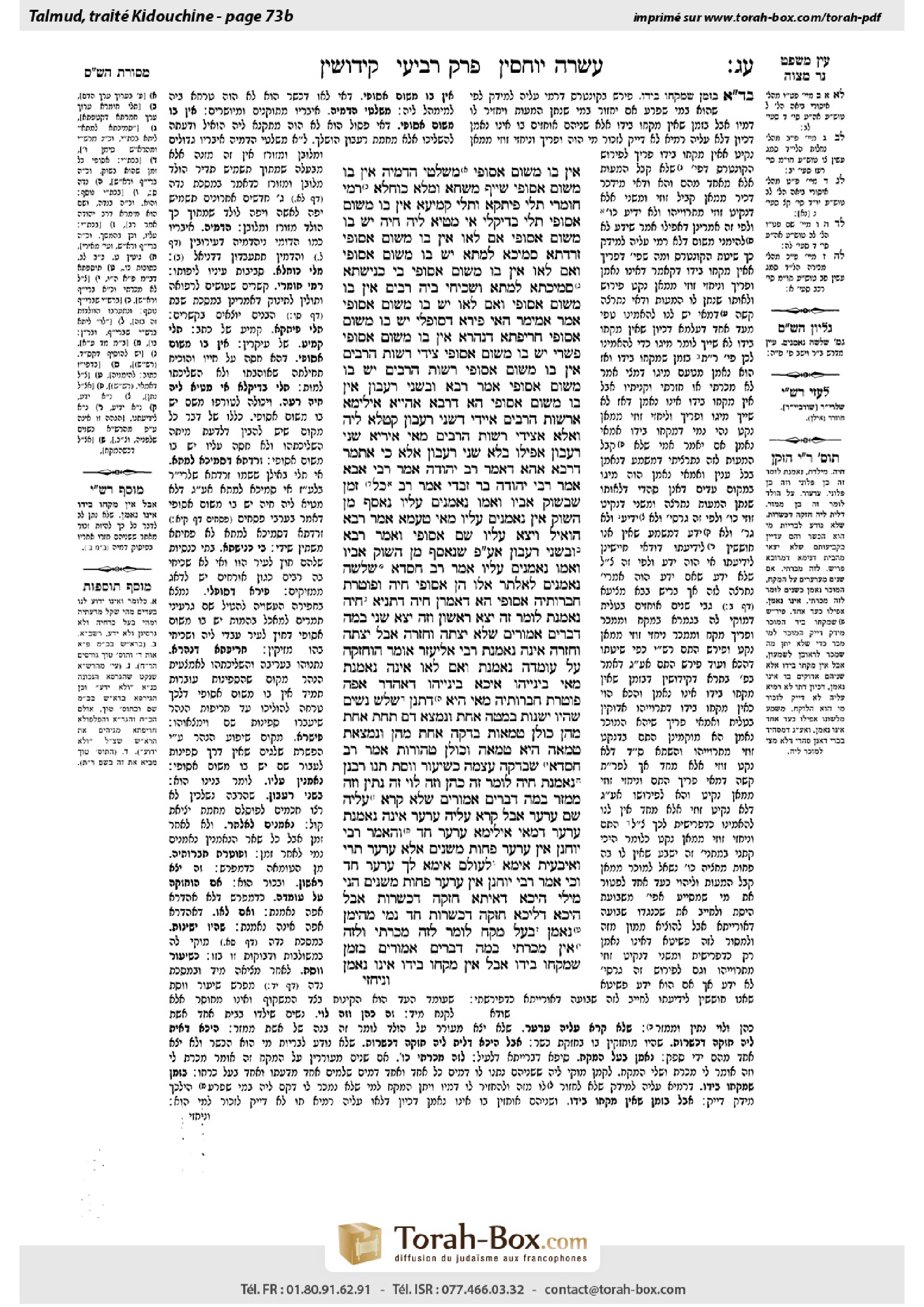
This page of Kiddushin includes the Aramaic text, an English translation and an AI-generated French translation, alongside the scan above.
קידושין ע״ג ב · Aramaic and Hebrew text
אֵין בּוֹ מִשּׁוּם אֲסוּפִי. מְשַׁלְּטִי הַדָּמֵיהּ – אֵין בּוֹ מִשּׁוּם אֲסוּפִי. שַׁיִיף מִשְׁחָא, וּמְלֵא כּוּחְלָא, רְמֵי חוּמְרֵי, תְּלֵי פִּיתְקָא, וּתְלֵי קְמִיעָא – אֵין בּוֹ מִשּׁוּם אֲסוּפִי.
תְּלֵי בְּדִיקְלֵי, אִי מָטְיָא לֵיהּ חַיָּה – יֵשׁ בּוֹ מִשּׁוּם אֲסוּפִי, אִם לָאו – אֵין בּוֹ מִשּׁוּם אֲסוּפִי.
זַרְדְּתָא סְמִיכָא לְמָתָא – יֵשׁ בּוֹ מִשּׁוּם אֲסוּפִי, וְאִם לָאו – אֵין בּוֹ מִשּׁוּם אֲסוּפִי. בֵּי כְנִישְׁתָּא סְמִיכְתָּא לְמָתָא וּשְׁכִיחִי בֵּיהּ רַבִּים – אֵין בּוֹ מִשּׁוּם אֲסוּפִי, וְאִם לָאו – יֵשׁ בּוֹ מִשּׁוּם אֲסוּפִי.
אָמַר אַמֵּימָר: הַאי פֵּירָא דְסוּפְלֵי – יֵשׁ בּוֹ מִשּׁוּם אֲסוּפִי, חֲרִיפְתָּא דְנַהֲרָא – אֵין בּוֹ מִשּׁוּם אֲסוּפִי. פִּשְׁרֵי – יֵשׁ בּוֹ מִשּׁוּם אֲסוּפִי. צִידֵּי רְשׁוּת הָרַבִּים – אֵין בּוֹ מִשּׁוּם אֲסוּפִי. רְשׁוּת הָרַבִּים – יֵשׁ בּוֹ מִשּׁוּם אֲסוּפִי.
אָמַר רָבָא: וּבִשְׁנֵי רְעָבוֹן אֵין בּוֹ מִשּׁוּם אֲסוּפִי. הָא דְּרָבָא אַהֵיָיא? אִילֵּימָא אַרְשׁוּת הָרַבִּים – אַיְּידֵי דִּשְׁנֵי רְעָבוֹן קָטְלָא לֵיהּ?! וְאֶלָּא אַצִּידֵּי רְשׁוּת הָרַבִּים – מַאי אִירְיָא שְׁנֵי רְעָבוֹן? אֲפִילּוּ בְּלָא שְׁנֵי רְעָבוֹן!
אֶלָּא כִּי אִתְּמַר דְּרָבָא – אַהָא דְּאָמַר רַב יְהוּדָה אָמַר רַבִּי אַבָּא אָמַר רַבִּי יְהוּדָה בַּר זַבְדִּי אָמַר רַב: כׇּל זְמַן שֶׁבַּשּׁוּק – אָבִיו וְאִמּוֹ נֶאֱמָנִים עָלָיו, נֶאֱסַף מִן הַשּׁוּק – אֵין נֶאֱמָנִים עָלָיו.
מַאי טַעְמָא? אָמַר רָבָא: הוֹאִיל וְיָצָא עָלָיו שֵׁם אֲסוּפִי. וְאָמַר רָבָא: וּבִשְׁנֵי רְעָבוֹן, אַף עַל פִּי שֶׁנֶּאֱסַף מִן הַשּׁוּק אָבִיו וְאִמּוֹ נֶאֱמָנִים עָלָיו.
אָמַר רַב חִסְדָּא: שְׁלֹשָׁה נֶאֱמָנִים לְאַלְתַּר, אֵלּוּ הֵן: אֲסוּפִי, חַיָּה, וּפוֹטֶרֶת חַבְרוֹתֶיהָ.
אֲסוּפִי – הָא דַּאֲמַרַן.
חַיָּה – דְּתַנְיָא: חַיָּה נֶאֱמֶנֶת לוֹמַר זֶה יָצָא רִאשׁוֹן וְזֶה יָצָא שֵׁנִי. בַּמֶּה דְּבָרִים אֲמוּרִים – שֶׁלֹּא יָצְתָה וְחָזְרָה, אֲבָל יָצְתָה וְחָזְרָה – אֵינָהּ נֶאֱמֶנֶת. רַבִּי אֱלִיעֶזֶר אוֹמֵר: הוּחְזְקָה עַל עוֹמְדָּהּ – נֶאֱמֶנֶת, וְאִם לָאו – אֵינָהּ נֶאֱמֶנֶת. מַאי בֵּינַיְיהוּ? אִיכָּא בֵּינַיְיהוּ דְּאַהְדַּר אַפַּהּ.
פּוֹטֶרֶת חַבְרוֹתֶיהָ מַאי הִיא? דִּתְנַן: שָׁלֹשׁ נָשִׁים שֶׁהָיוּ יְשֵׁנוֹת בְּמִטָּה אַחַת וְנִמְצָא דָּם תַּחַת אַחַת מֵהֶן – כּוּלָּן טְמֵאוֹת. בָּדְקָה אַחַת מֵהֶן וְנִמְצֵאת טְמֵאָה – הִיא טְמֵאָה, וְכוּלָּן טְהוֹרוֹת. אָמַר רַב חִסְדָּא: שֶׁבָּדְקָה עַצְמָהּ כְּשִׁיעוּר וֶוסֶת.
תָּנוּ רַבָּנַן: נֶאֱמֶנֶת חַיָּה לוֹמַר: זֶה כֹּהֵן וְזֶה לֵוִי, זֶה נָתִין וְזֶה מַמְזֵר. בַּמֶּה דְּבָרִים אֲמוּרִים – שֶׁלֹּא קָרָא עָלֶיהָ שֵׁם עַרְעָר, אֲבָל קָרָא עָלֶיהָ עַרְעָר – אֵינָהּ נֶאֱמֶנֶת.
עַרְעָר דְּמַאי? אִילֵּימָא עַרְעָר חַד, וְהָאָמַר רַבִּי יוֹחָנָן: אֵין עַרְעָר פָּחוֹת מִשְּׁנַיִם! אֶלָּא עַרְעָר תְּרֵי.
וְאִיבָּעֵית אֵימָא: לְעוֹלָם אֵימָא לָךְ עַרְעָר חַד. וְכִי אָמַר רַבִּי יוֹחָנָן אֵין עַרְעָר פָּחוֹת מִשְּׁנַיִם – הָנֵי מִילֵּי הֵיכָא דְּאִיתָא חֲזָקָה דְכַשְׁרוּת, אֲבָל הֵיכָא דְּלֵיכָּא חֲזָקָה דְכַשְׁרוּת – חַד נָמֵי מְהֵימַן.
נֶאֱמָן בַּעַל מִקָּח לוֹמַר: לָזֶה מָכַרְתִּי, וְלָזֶה אֵין מָכַרְתִּי. בַּמֶּה דְּבָרִים אֲמוּרִים – בִּזְמַן שֶׁמִּקָּחוֹ בְּיָדוֹ, אֲבָל אֵין מִקָּחוֹ בְּיָדוֹ – אֵינוֹ נֶאֱמָן.
Kiddushin 73b · English translation
he is not subject to the halakhot of a foundling. If the baby’s lineage were unfit, his parents would not have gone to the trouble of circumcising him. Likewise, if his limbs are adjusted, indicating that he was cared for after birth, he is not subject to the halakhot of a foundling. Similarly, if he was anointed with oil, or if his eyes were smeared with eye salve, or if he was adorned with rings, or if a note [pitka] was hanging on him, or if an amulet was hanging on him, he is not subject to the halakhot of a foundling.
Concerning a child found hanging from a palm tree, if he was in such a place that an animal could reach him, he is subject to the halakhot of a foundling. If not, if he was placed on a palm tree in a way that he could not be reached by an animal, he is not subject to the halakhot of a foundling, since he was cared for enough to be placed in a safe location.
Similarly, if the child was placed in a thicket near a town, where people are not commonly found, he is subject to the halakhot of a foundling. But if not, he is not subject to the halakhot of a foundling. If the child was discovered in a synagogue near a town, and people are commonly found there, he is not subject to the halakhot of a foundling, since the parents wanted to give him to others. But if not, if the synagogue was not near a town or if it was not frequented by people, he is subject to the halakhot of a foundling.
Ameimar said: With regard to this cistern into which date pits are placed [peira desuflei] as animal fodder, if a child is found there, he is subject to the halakhot of a foundling. If he was found in the middle of a fast-flowing river with boats passing by, he is not subject to the halakhot of a foundling. If he was placed at the side of the river, he is subject to the halakhot of a foundling. If he was found at the sides of a public domain, which is not frequented by many people, he is not subject to the halakhot of a foundling. But if the child was discovered in the public domain itself, where he might easily be trampled, he is subject to the halakhot of a foundling.
Rava said: And in famine years, he is not subject to the halakhot of a foundling. The Gemara asks: With regard to this statement of Rava, to which specific case is it referring? If we say it is referring to the case where the child was left in the public domain because it is a famine year, would a mother kill him by placing him in a place where he is likely to be trampled? Rather, if Rava’s statement is referring to the case where the child was found at the sides of a public domain, why specifically mention famine years? Even when it is not famine years, the child was placed in a safe location where he was likely to be found.
Rather, it must be that when Rava’s halakha was stated, it was stated with regard to that which Rav Yehuda says that Rabbi Abba says that Rabbi Yehuda bar Zavdi says that Rav says: As long as the abandoned child is still in the marketplace, his father and mother are deemed credible with regard to him when they later claim the child as theirs. But once the child has been collected from the marketplace, they are no longer deemed credible with regard to him.
The Gemara asks: What is the reason for this? Rava said: Since the child has already been publicized with the name of being of flawed lineage as a foundling, they cannot change the status of the child. And it is with regard to this halakha that Rava says: And in famine years, although the child has been collected from the marketplace, his father and mother are deemed credible with regard to him, as it is common even for parents of unflawed lineage to abandon their children in famine years, and it is likely that they are speaking the truth.
§ Rav Ḥisda says: There are three cases where people are deemed credible if they immediately offer testimony with regard to a matter about which they are not ordinarily deemed credible to testify. These are they: A foundling, a midwife, and one who exempts her friends from uncertain impurity.
How so? The case of a foundling is that which we said, that his parents can testify with regard to his lineage before he is collected from the marketplace.
The case of a midwife is as it is taught in a baraita: A midwife is deemed credible to say that this child emerged first from the womb and that child emerged second from the womb. Her testimony is relied upon to determine which of them is the firstborn. In what case is this statement said? When she has not left the birthing room and returned. But if she left the birthing room and returned, she is not deemed credible, since the babies might have been exchanged in the meantime. Rabbi Eliezer says: If she has stood in her place, she is deemed credible. But if not, she is not deemed credible. The Gemara asks: What is the difference between them? The Gemara answers: The difference between them is in a case when the midwife turned her head aside after the birth. According to Rabbi Eliezer she is no longer deemed credible, despite having remained in the room.
What is the case of one who exempts her friends? As we learned in a mishna (Nidda 60b): If there were three women who were sleeping in one bed, and blood was found beneath one of them, they are all deemed impure as menstruating women, as it is not known from which of them the blood came. If one of them examined herself and was found to be impure, i.e., she saw that she was menstruating, she is impure and all the rest are pure. With regard to this, Rav Ḥisda said: This applies provided that she examined herself within the period of time needed for the onset of menstruation, i.e., immediately after the discovery of the blood. But if she did so even a short while later, her discovery is not accepted as proof with regard to the source of the blood.
The Sages taught: If several women gave birth at the same time, the midwife is deemed credible to say: This baby is a priest and that baby is a Levite; this baby is a Gibeonite and that baby is a mamzer. In other words, she is deemed credible to say which baby was born to which mother. In what case is this statement said? When no objection was registered about it. But if an objection was registered about it, she is not deemed credible.
The Gemara clarifies: An objection of what type? If we say it is an objection of one witness claiming that her testimony is not accurate, but doesn’t Rabbi Yoḥanan say: There is no objection with less than two witnesses? Rather, the baraita must refer to the objection of two witnesses, but she is deemed credible when contradicted by a single witness.
And if you wish, say: Actually, I could say to you that she is not deemed credible even when contradicted by the objection of one witness, and when Rabbi Yoḥanan said that there is no objection with less than two witnesses, that statement applies only in a case where there is a presumption of validity, which can be countered only by the objection of two witnesses. But in a case where there is no presumption of validity, such as in this case, when the baby was just born, one witness is also deemed credible to object.
Similarly, if the owner of an item being purchased is confronted by two people, each claiming to have purchased the item, he is deemed credible to say: I sold to this one, and I did not sell to that one. In what case is this statement said? When the item being purchased is still in the seller’s possession. But if the item being purchased is not in his possession, he is not deemed credible any more than a single witness is.
Kiddushin 73b · Traduction française (IA)
Il n’est pas soumis aux règles relatives à un enfant trouvé. Si sa filiation était irrégulière, ses parents ne se seraient pas donné la peine de le circoncire. De même, si ses membres ont été remis en place, ce qui indique qu’on a pris soin de lui après sa naissance, il n’est pas soumis aux règles relatives à un enfant trouvé. De même, s’il a été oint d’huile, si ses yeux ont été enduits de collyre, s’il a été paré d’anneaux, si un billet [pitka] était suspendu à lui ou si une amulette était suspendue à lui, il n’est pas soumis aux règles relatives à un enfant trouvé.
Concernant un enfant trouvé suspendu à un palmier, s’il se trouvait en un endroit où un animal pouvait l’atteindre, il est soumis aux règles relatives à un enfant trouvé. Sinon, s’il avait été placé sur un palmier de telle sorte qu’un animal ne puisse pas l’atteindre, il n’est pas soumis à ces règles, puisqu’on a pris soin de le placer en lieu sûr.
De même, si l’enfant avait été placé dans un fourré près d’une ville, où les gens ne se rendent généralement pas, il est soumis aux règles relatives à un enfant trouvé. Dans le cas contraire, il n’y est pas soumis. Si l’enfant a été découvert dans une synagogue près d’une ville, où les gens se rendent généralement, il n’est pas soumis aux règles relatives à un enfant trouvé, puisque ses parents voulaient le confier à d’autres. Mais si ce n’est pas le cas, si la synagogue n’était pas près d’une ville ou si les gens ne la fréquentaient pas, il est soumis aux règles relatives à un enfant trouvé.
Ameimar a dit : Dans cette citerne où l’on met des noyaux de dattes [peira desuflei] pour nourrir les animaux, si un enfant y est trouvé, il est soumis aux règles relatives à un enfant trouvé. S’il a été trouvé au milieu d’un fleuve au courant rapide, où passent des bateaux, il n’y est pas soumis. S’il a été placé au bord du fleuve, il y est soumis. S’il a été trouvé sur les côtés d’un domaine public, où peu de gens passent, il n’est pas soumis aux règles relatives à un enfant trouvé. Mais si l’enfant a été découvert dans le domaine public même, où il risque facilement d’être piétiné, il y est soumis.
Rava a dit : Et pendant les années de famine, l’enfant n’est pas soumis aux règles relatives à un enfant trouvé. La Guemara demande : À quel cas précis cette déclaration de Rava se rapporte-t-elle ? Si l’on dit qu’elle concerne le cas où l’enfant a été laissé dans le domaine public parce que c’est une année de famine, une mère le tuerait-elle en le plaçant dans un endroit où il risque d’être piétiné ? Il faut plutôt dire que la déclaration de Rava concerne le cas où l’enfant a été trouvé sur les côtés d’un domaine public. Pourquoi alors mentionner spécifiquement les années de famine ? Même en dehors des années de famine, l’enfant a été placé en lieu sûr, où il risquait d’être trouvé.
Il faut donc comprendre que la halakha de Rava a été énoncée à propos de ce que Rav Yehouda dit au nom de Rabbi Abba, qui le dit au nom de Rabbi Yehouda bar Zavdi, qui le dit au nom de Rav : Tant que l’enfant abandonné se trouve encore sur la place du marché, son père et sa mère sont considérés comme crédibles à son sujet lorsqu’ils le revendiquent ensuite comme leur enfant. Mais une fois que l’enfant a été recueilli sur la place du marché, ils ne sont plus considérés comme crédibles à son sujet.
La Guemara demande : Quelle en est la raison ? Rava a dit : Puisque l’enfant a déjà été publiquement considéré comme ayant une filiation irrégulière, en tant qu’enfant trouvé, ils ne peuvent pas modifier son statut. Et c’est à propos de cette halakha que Rava dit : Pendant les années de famine, bien que l’enfant ait été recueilli sur la place du marché, son père et sa mère sont considérés comme crédibles à son sujet, car il est courant que même des parents de filiation irréprochable abandonnent leurs enfants pendant les années de famine, et il est vraisemblable qu’ils disent la vérité.
§ Rav Ḥisda dit : Il y a trois cas où des personnes sont considérées comme crédibles si elles témoignent immédiatement au sujet d’une question sur laquelle elles ne sont généralement pas considérées comme crédibles. Les voici : un enfant trouvé, une sage-femme et une femme qui déclare ses amies exemptes d’impureté incertaine.
Comment cela ? Le cas de l’enfant trouvé est celui que nous avons évoqué : ses parents peuvent témoigner au sujet de sa filiation avant qu’il soit recueilli sur la place du marché.
Le cas de la sage-femme est celui qui est enseigné dans une baraïta : une sage-femme est considérée comme crédible lorsqu’elle dit que tel enfant est sorti le premier du ventre et tel autre le second. Son témoignage est retenu pour déterminer lequel des deux est l’aîné. Dans quel cas cette déclaration s’applique-t-elle ? Lorsqu’elle n’a pas quitté la salle d’accouchement. Mais si elle l’a quittée puis y est revenue, elle n’est pas considérée comme crédible, car les bébés ont pu être échangés entre-temps. Rabbi Eliezer dit : Si elle est restée à sa place, elle est considérée comme crédible. Sinon, elle ne l’est pas. La Guemara demande : Quelle est la différence entre eux ? La Guemara répond : La différence porte sur le cas où la sage-femme a détourné la tête après la naissance. Selon Rabbi Eliezer, elle n’est alors plus considérée comme crédible, bien qu’elle soit restée dans la pièce.
Quel est le cas de celle qui déclare ses amies exemptes ? Comme nous l’avons appris dans une Michna (Nidda 60b) : si trois femmes dormaient dans un même lit et que du sang était trouvé sous l’une d’elles, elles sont toutes considérées comme impures, en tant que femmes menstruées, puisqu’on ne sait pas de laquelle d’entre elles venait le sang. Si l’une d’elles s’est examinée et a été trouvée impure, c’est-à-dire qu’elle a constaté qu’elle avait ses règles, elle est impure et toutes les autres sont pures. À ce sujet, Rav Ḥisda a dit : Cela s’applique à condition qu’elle se soit examinée dans le délai correspondant à l’apparition des règles, c’est-à-dire immédiatement après la découverte du sang. Mais si elle l’a fait même peu de temps après, sa constatation n’est pas admise comme preuve quant à l’origine du sang.
Les Sages ont enseigné : Si plusieurs femmes ont accouché en même temps, la sage-femme est considérée comme crédible lorsqu’elle dit : « Cet enfant est un prêtre et cet enfant un lévite ; cet enfant est un Guibonite et cet enfant un mamzer. » Autrement dit, elle est considérée comme crédible pour dire quel enfant est né de quelle mère. Dans quel cas cette déclaration s’applique-t-elle ? Lorsqu’aucune contestation n’a été formulée à ce sujet. Mais si une contestation a été formulée, elle n’est pas considérée comme crédible.
La Guemara précise : De quel type de contestation s’agit-il ? Si l’on dit qu’il s’agit de la contestation d’un témoin affirmant que son témoignage est inexact, Rabbi Yoḥanan ne dit-il pas : « Il n’y a pas de contestation recevable avec moins de deux témoins » ? Il faut plutôt comprendre que la baraïta parle d’une contestation formulée par deux témoins ; mais elle est considérée comme crédible lorsqu’un seul témoin la contredit.
Et si tu le souhaites, dis : En réalité, je pourrais te dire qu’elle n’est pas considérée comme crédible même lorsqu’elle est contredite par la contestation d’un seul témoin. Lorsque Rabbi Yoḥanan a dit qu’il n’y a pas de contestation recevable avec moins de deux témoins, cela ne s’applique qu’à un cas où il existe une présomption de validité, qui ne peut être réfutée que par une contestation formulée par deux témoins. Mais dans un cas où il n’existe pas de présomption de validité, comme ici, où l’enfant vient de naître, un seul témoin est également considéré comme crédible pour contester.
De même, si le propriétaire d’un objet mis en vente est confronté à deux personnes qui prétendent chacune avoir acheté l’objet, il est considéré comme crédible lorsqu’il dit : « J’ai vendu à celui-ci et je n’ai pas vendu à celui-là. » Dans quel cas cette déclaration s’applique-t-elle ? Lorsque l’objet se trouve encore en possession du vendeur. Mais si l’objet ne se trouve plus en sa possession, il n’est pas considéré comme plus crédible qu’un témoin unique.
Traduction française générée par IA à partir de l’édition anglaise de Sefaria. Vérifie toujours un passage avec le texte source.
Text from Sefaria: William Davidson Edition - Vocalized Aramaic (CC BY NC); William Davidson Edition - English (CC BY NC).