Kiddushin 73a: Talmud study for Daf Yomi
Daf Yomi is the daily study of one Talmud folio. Explore 37 tractates with scans, Hebrew text, Sefaria English and AI-generated French translations where annotated.
Passage selection and English or AI-generated French translation are available where the scan has annotations. Daf Study is independent of Torah-Box and Sefaria.
Browse Kiddushin · קידושין · All tractatesKiddushin 73a text and translations
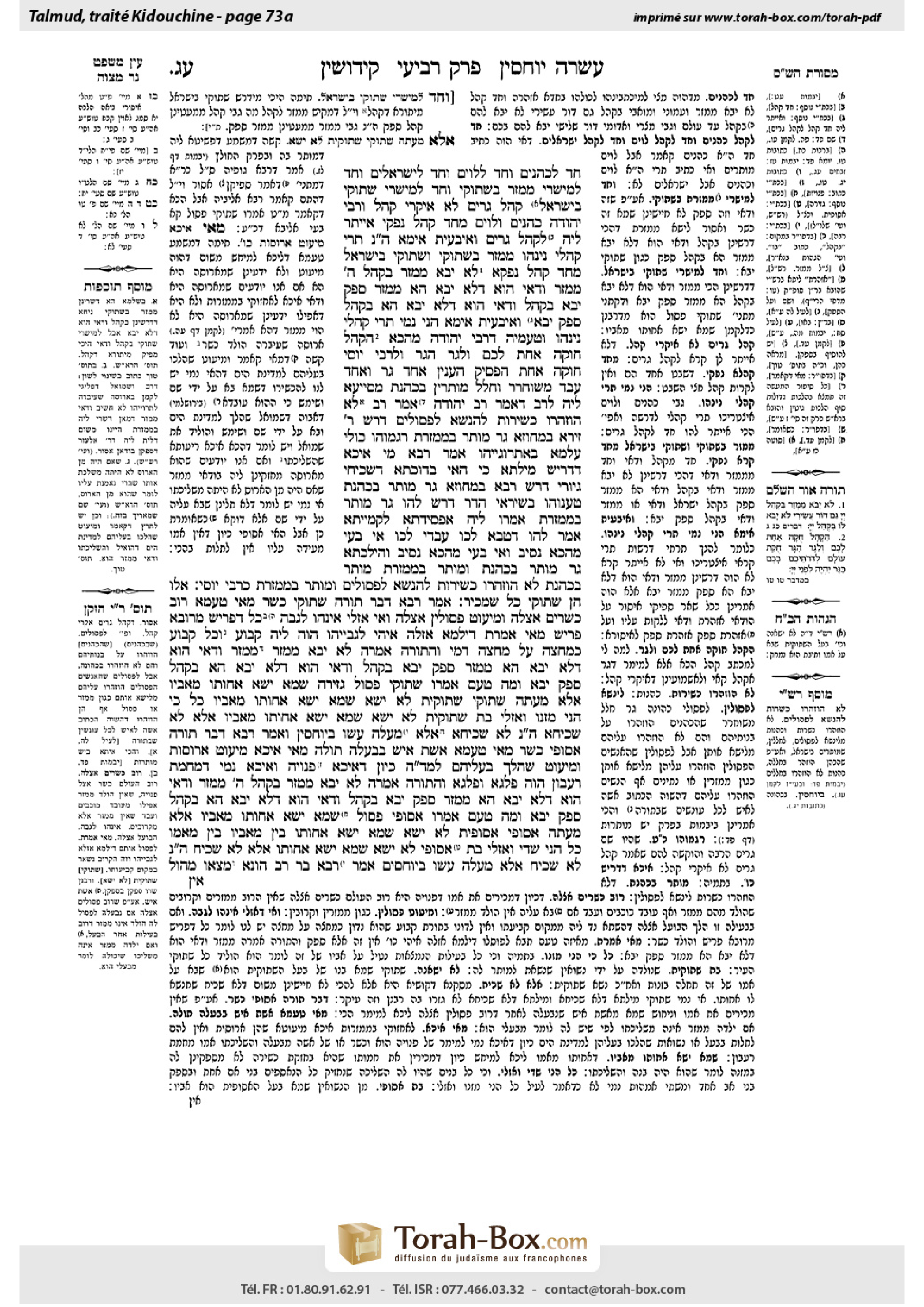
This page of Kiddushin includes the Aramaic text, an English translation and an AI-generated French translation, alongside the scan above.
קידושין ע״ג א · Aramaic and Hebrew text
חַד – לְכֹהֲנִים, וְחַד – לַלְוִיִּם, וְחַד – לְיִשְׂרְאֵלִים, וְחַד – לְמִישְׁרֵי מַמְזֵר בִּשְׁתוּקִי, וְחַד – לְמִישְׁרֵי שְׁתוּקִי בְּיִשְׂרָאֵל. קְהַל גֵּרִים לָא אִיקְּרִי קָהָל. וְרַבִּי יְהוּדָה? כֹּהֲנִים וּלְוִיִּם מֵחַד ״קָהָל״ נָפְקִי, אִיַּיתַּר לֵיהּ לִקְהַל גֵּרִים.
וְאִיבָּעֵית אֵימָא: הָכִי נָמֵי, תְּרֵי קְהָלֵי נִינְהוּ, מַמְזֵר בִּשְׁתוּקִי וּשְׁתוּקִי בְּיִשְׂרָאֵל מֵחַד ״קָהָל״ נָפְקָא – ״לֹא יָבֹא מַמְזֵר בִּקְהַל ה׳״ –
מַמְזֵר וַדַּאי הוּא דְּלֹא יָבֹא, הָא מַמְזֵר סָפֵק – יָבֹא, בְּקָהָל וַדַּאי הוּא דְּלֹא יָבֹא, הָא בְּקָהָל סָפֵק – יָבֹא.
וְאִיבָּעֵית אֵימָא: הָנֵי נָמֵי תְּרֵי קְהָלֵי נִינְהוּ, וְטַעְמֵיהּ דְּרַבִּי יְהוּדָה מֵהָכָא: ״הַקָּהָל חֻקָּה אַחַת לָכֶם וְלַגֵּר הַגָּר״. וּלְרַבִּי יוֹסֵי? ״חֻקָּה אַחַת״ – הִפְסִיק הָעִנְיָן.
אֶחָד גֵּר וְאֶחָד עֶבֶד מְשׁוּחְרָר וְחָלָל מוּתָּרִין בְּכֹהֶנֶת. מְסַיְּיעָא לֵיהּ לְרַב, דְּאָמַר רַב יְהוּדָה אָמַר רַב: לֹא הוּזְהֲרוּ כְּשֵׁירוֹת לְהִנָּשֵׂא לִפְסוּלִים.
דְּרַשׁ רַבִּי זֵירָא בְּמָחוֹזָא: גֵּר מוּתָּר בְּמַמְזֶרֶת. רַגְמוּהּ כּוּלֵּי עָלְמָא בְּאֶתְרוֹגַיְיהוּ. אֲמַר רָבָא: מִי אִיכָּא דְּדָרֵישׁ מִילְּתָא כִּי הַאי בְּדוּכְתָּא דִּשְׁכִיחִי גִּיּוֹרֵי? דְּרַשׁ רָבָא בְּמָחוֹזָא: גֵּר מוּתָּר בְּכֹהֶנֶת. טַעֲנוּהּ בְּשִׁירָאֵי. הֲדַר דְּרַשׁ לְהוּ: גֵּר מוּתָּר בְּמַמְזֶרֶת. אֲמַרוּ לֵיהּ: אַפְסֵידְתָּא לְקַמַּיְיתָא. אֲמַר לְהוּ: דְּטָבָא לְכוּ עֲבַדִי לְכוּ, אִי בָּעֵי מֵהָכָא נָסֵיב וְאִי בָּעֵי מֵהָכָא נָסֵיב.
וְהִילְכְתָא: גֵּר מוּתָּר בְּכֹהֶנֶת וּמוּתָּר בְּמַמְזֶרֶת. מוּתָּר בְּכֹהֶנֶת – לֹא הוּזְהֲרוּ כְּשֵׁירוֹת לְהִנָּשֵׂא לִפְסוּלִים, וּמוּתָּר בְּמַמְזֶרֶת – כְּרַבִּי יוֹסֵי.
אֵלּוּ הֵן: שְׁתוּקִי – כֹּל שֶׁמַּכִּיר. אָמַר רָבָא: דְּבַר תּוֹרָה שְׁתוּקִי כָּשֵׁר. מַאי טַעְמָא – רוֹב כְּשֵׁרִים אֶצְלָהּ, וּמִיעוּט פְּסוּלִין אֶצְלָהּ.
וְאִי אָזְלִי אִינְהוּ לְגַבַּהּ, כֹּל דְּפָרֵישׁ – מֵרוּבָּא פָּרֵישׁ. מַאי אָמְרַתְּ – דִּילְמָא אָזְלָה אִיהִי לְגַבַּיְיהוּ הֲוָה לֵיהּ קָבוּעַ, וְכֹל קָבוּעַ כְּמֶחֱצָה עַל מֶחֱצָה דָּמֵי,
וְהַתּוֹרָה אָמְרָה: ״לֹא יָבֹא מַמְזֵר״ – מַמְזֵר וַדַּאי הוּא דְּלֹא יָבֹא, הָא מַמְזֵר סָפֵק – יָבֹא. בְּקָהָל וַדַּאי הוּא דְּלֹא יָבֹא, הָא בְּקָהָל סָפֵק – יָבֹא!
וּמָה טַעַם אָמְרוּ שְׁתוּקִי פָּסוּל? גְּזֵירָה שֶׁמָּא יִשָּׂא אֲחוֹתוֹ מֵאָבִיו. אֶלָּא מֵעַתָּה, שְׁתוּקִי – שְׁתוּקִית לֹא יִשָּׂא, שֶׁמָּא יִשָּׂא אֲחוֹתוֹ מֵאָבִיו!
כֹּל כִּי הָנֵי מְזַנּוּ וְאָזְלִי? בַּת שְׁתוּקִית לֹא יִשָּׂא, שֶׁמָּא יִשָּׂא אֲחוֹתוֹ מֵאָבִיו! אֶלָּא: לָא שְׁכִיחָא, הָכִי נָמֵי לָא שְׁכִיחָא!
אֶלָּא מַעֲלָה עָשׂוּ בְּיוּחֲסִין.
וְאָמַר רָבָא, דְּבַר תּוֹרָה: אֲסוּפִי – כָּשֵׁר. מַאי טַעְמָא? אֵשֶׁת אִישׁ – בְּבַעְלָהּ תּוֹלָה. מַאי אִיכָּא? מִיעוּט אֲרוּסוֹת וּמִיעוּט שֶׁהָלַךְ בַּעֲלֵיהֶם לִמְדִינַת הַיָּם,
כֵּיוָן דְּאִיכָּא פְּנוּיָה, וְאִיכָּא נָמֵי דְּמֵחֲמַת רְעָבוֹן, הָוֵה פַּלְגָא וּפַלְגָא. וְהַתּוֹרָה אָמְרָה: ״לֹא יָבֹא מַמְזֵר בְּקָהָל ה׳״ – מַמְזֵר וַדַּאי הוּא דְּלֹא יָבֹא, הָא מַמְזֵר סָפֵק יָבֹא. בְּקָהָל וַדַּאי הוּא דְּלֹא יָבֹא, הָא בְּקָהָל סָפֵק יָבֹא.
וּמָה טַעַם אָמְרוּ אֲסוּפִי פָּסוּל – שֶׁמָּא יִשָּׂא אֲחוֹתוֹ מֵאָבִיו. אֶלָּא מֵעַתָּה אֲסוּפִי – אֲסוּפִית לֹא יִשָּׂא, שֶׁמָּא יִשָּׂא אֲחוֹתוֹ בֵּין מֵאָבִיו בֵּין מֵאִמּוֹ! כֹּל הָנֵי שָׁדוּ וְאָזְלִי?! בַּת אֲסוּפִי לֹא יִשָּׂא, שֶׁמָּא יִשָּׂא אֲחוֹתוֹ! אֶלָּא לָא שְׁכִיחַ, הָכִי נָמֵי לָא שְׁכִיחַ.
אֶלָּא, מַעֲלָה עָשׂוּ בְּיוֹחֲסִים.
אָמַר רָבָא בַּר רַב הוּנָא: מְצָאוֹ מָהוּל –
Kiddushin 73a · English translation
One is referring to priests, to teach that people with flawed lineage may not enter their congregation; and one is referring to Levites; and one to Israelites; and one serves to permit a mamzer to marry a shetuki, since a mamzer is prohibited from entering only the congregation of God, but he may marry someone who is not definitely a member of the congregation, e.g., a shetuki; and one serves to permit a shetuki to marry an Israelite, as only one who is a definite mamzer may not marry an Israelite. As for the congregation of converts, it is not called a congregation at all, and they may marry those prohibited from entering the congregation of Israel. And Rabbi Yehuda holds that priests and Levites are derived from one instance of the word “congregation,” since they are from the same tribe, that of Levi. Consequently, one instance of the word “congregation” remains for him to interpret. He interprets it as referring to the congregation of converts, and deems it prohibited for a mamzer to enter that congregation as well.
And if you wish, say: So too, Rabbi Yehuda agrees with Rabbi Yosei that Levites and priests are two congregations, since there are special halakhot of marriage that apply only to priests. Rather, Rabbi Yehuda holds that the permissibility of the marriage of a mamzer with a shetuki and a shetuki with an Israelite is derived from one instance of the word “congregation,” from the verse: “A mamzer shall not enter into the congregation of the Lord” (Deuteronomy 23:3).
This is accomplished by inferring the following: It is one who is a definite mamzer who may not enter, but one who is a mamzer as a result of an uncertainty, e.g., a shetuki, may enter. And similarly, it is into the congregation of those with definite unflawed lineage that a mamzer may not enter, but into a congregation of those with uncertain lineage, e.g., a shetuki, he may enter. This verse therefore teaches that both types of marriage are permitted. In any event, Rabbi Yehuda remains with one instance of the word “congregation” to interpret, from which he derives that it is also prohibited for a convert to marry a mamzeret.
And if you wish, say: These too, one who is a definite mamzer and one who is a mamzer as the result of an uncertainty, are two congregations, each requiring its own verse, and the reason of Rabbi Yehuda is from here: “As for the congregation, there shall be one statute both for you, and for the stranger that sojourns with you” (Numbers 15:15), which indicates that converts are considered like Israelites with regard to their being included in the category of “congregation.” And according to Rabbi Yosei, who holds that a convert may marry a mamzeret, the phrase “one statute” interrupts the matter, and converts are not considered part of the congregation of God.
§ The Gemara comments: The statement of the Tosefta that a convert, and an emancipated slave, and a ḥalal are all permitted to marry the daughter of a priest supports the opinion of Rav, as Rav Yehuda says that Rav says: Women of unflawed lineage who are daughters of priests were not prohibited from marrying those disqualified from the priesthood due to flawed lineage [ḥalalim], since that prohibition applies only to male priests.
Rabbi Zeira taught in Meḥoza: It is permitted for a convert to marry a mamzeret. Everyone stoned him with their etrogim, since the many converts present were insulted by his statement, which they understood to mean that converts are not members of God’s congregation. Rava said: Is there a person who teaches such a matter in a place where there are commonly converts? He should have been more circumspect. Rava himself taught this in Meḥoza to ameliorate the situation: It is permitted for a convert to marry the daughter of a priest. They carried him on silk [beshira’ei] for elevating the honor of converts. He later taught them: It is permitted for a convert to marry a mamzeret. They said to him: You have forfeited the honor of your first sermon. Rava said to them: I have done for you what is good for you. If a convert wishes, he may marry from here, i.e., from those of pure lineage, and if he wishes, he may marry from here, i.e., a mamzeret.
The Gemara concludes: And the halakha is: It is permitted for a convert to marry the daughter of a priest, and it is permitted for him to marry a mamzeret. It is permitted for a convert to marry the daughter of a priest, since women of unflawed lineage were not prohibited from marrying those disqualified for the priesthood. And it is permitted for him to marry a mamzeret, in accordance with the opinion of Rabbi Yosei, who holds that the congregation of converts is not called a congregation.
§ The mishna teaches: And these are the last two categories: A shetuki is any person who knows the identity of his mother but does not know the identity of his father. Rava says: By Torah law, a shetuki is fit to enter the congregation. What is the reason for this? Most are fit with regard to her, i.e., most men are fit to engage in intercourse with an unmarried woman, and only a minority are unfit with regard to engaging in intercourse with her. There are few men who are related to a woman in a way that would render the offspring mamzerim.
Rava analyzes two possibilities: And if they came to her, i.e., if the father came to the mother’s location when the child was conceived, the following principle with regard to an uncertain prohibition takes effect: Anything that separates from its fixed location is presumed to have separated from the majority of items like it in that location. If the father separated from the population at large and came to the mother, one can assume that he was from the majority, who are of unflawed lineage. What might you say, that perhaps she went to them, and the child was conceived in the place where the father was? In such a case, it is an uncertain prohibition located in its fixed place, and the halakhic principle is: Anything fixed is considered as though it were half and half, i.e., fifty percent, and it remains a case of uncertainty, and it should be prohibited for the shetuki to marry a Jew with unflawed lineage.
And in any case, this does not suffice to prevent her shetuki child from marrying a Jew with unflawed lineage, since the Torah states: “A mamzer shall not enter into the congregation of the Lord” (Deuteronomy 23:3), which indicates: It is a definite mamzer who may not enter, but one who is a mamzer as a result of an uncertainty may enter. Similarly, it is into a congregation of those with definite unflawed lineage that he may not enter, but into a congregation of those with uncertain lineage he may enter. Therefore, even if it is uncertain if one is a mamzer, by Torah law he may marry a Jew with unflawed lineage.
And for what reason did the Sages nevertheless say that a shetuki is of flawed lineage? Due to a rabbinic decree, lest he marry his sister from his father, since the identity of his father is unknown. The Gemara asks: If that is so, it should not be permitted for a shetuki to marry even a female shetuki, lest he marry his sister from his father.
The Gemara responds: And do people engage in licentiousness to such an extent that one should be concerned that all the children of unknown paternity in one city were fathered by the same man? By the same reasoning, there should also be a decree that a shetuki may not marry the daughter of a female shetuki from a proper marriage, lest he marry his sister from his father, since the man who married the female shetuki might have been his father. Rather, it must be that it is not common for a shetuki to happen to marry his sister, and therefore he may marry the daughter of a female shetuki. So too, it is not common for him to happen to marry his sister, and the Sages would not issue a decree to prevent this from occurring.
The question therefore remains, why did they render it prohibited for a shetuki to marry a Jew with unflawed lineage? The Gemara answers that it is not prohibited for a shetuki to marry a Jew with unflawed lineage due to any halakhic concern. Rather, the Sages established a higher standard with regard to lineage, in that they rendered it prohibited for people from unknown backgrounds to marry those with unflawed lineage.
And Rava says a similar statement: By Torah law, a foundling, a child found in the marketplace whose parents are unknown, is fit, and there is no concern that the child is a mamzer. What is the reason for this? A married woman who becomes pregnant through extramarital intercourse, which results in the child being a mamzer, ascribes the child to her husband. Since everyone assumes that her husband is the father, she has no reason to abandon the child in the marketplace. What case is there where a mother would want to abandon her mamzer child? There is the minority of situations involving betrothed women who committed adultery but cannot claim that her betrothed is the father, as they had not been living together. And there is the minority of women whose husbands have gone overseas and could not have fathered the children.
Since there are many other cases of unmarried women who do abandon their children although those children have unflawed lineage, and there are also children with unflawed lineage who are abandoned by their parents due to hunger, the concern that the child is a mamzer is no more than half and half, i.e., fifty percent. And the Torah states: “A mamzer shall not enter into the congregation of the Lord” (Deuteronomy 23:3), which indicates: It is one who is a definite mamzer who may not enter, but one who is a mamzer as a result of an uncertainty may enter. Similarly, it is into a congregation of those with definite unflawed lineage that he may not enter, but into a congregation of those with uncertain lineage he may enter. This child is a mamzer as the result of an uncertainty, and by Torah law may marry a Jew with unflawed lineage.
And for what reason did the Sages say that a foundling is unfit? Lest he marry his sister from his father. The Gemara asks: If that is so, it should not be permitted for a foundling to marry even a female foundling, lest he marry his sister from either his father or his mother. The Gemara rejects this: Are they continually throwing away all these children? Is it likely that the same parents abandoned both a son and a daughter? If you accept that suggestion, it should not be permitted for him to marry the daughter of a foundling, lest he marry his sister, as perhaps the father of the one he wishes to marry is his father as well. Rather, it must be that it is not common for a foundling to happen to marry his sister, and therefore he may marry the daughter of a foundling. So too, it is not common for him to happen to marry his sister, and the Sages would not make a decree to prevent this from occurring.
The question therefore remains: Why did they prohibit a foundling from marrying a Jew with unflawed lineage? The Gemara answers that it is prohibited for a foundling to marry a Jew with unflawed lineage not due to any halakhic concern. Rather, the Sages established a higher standard with regard to lineage, in that they rendered it prohibited for people from unknown backgrounds to marry those with unflawed lineage.
§ Rava bar Rav Huna says: If an abandoned boy was found circumcised,
Kiddushin 73a · Traduction française (IA)
L’un des versets concerne les prêtres, afin d’enseigner que les personnes de filiation imparfaite ne peuvent pas entrer dans leur assemblée ; un autre concerne les Lévites, un autre les Israélites, et un autre permet à un mamzer d’épouser une shetuki, car un mamzer ne peut entrer que dans l’assemblée de Dieu ; il peut toutefois épouser une personne dont l’appartenance à l’assemblée n’est pas certaine, par exemple une shetuki. Un autre verset permet à une shetuki d’épouser un Israélite, car seul celui qui est certainement mamzer ne peut épouser un Israélite. Quant à l’assemblée des convertis, elle n’est pas appelée une assemblée et ses membres peuvent épouser ceux qui ne peuvent pas entrer dans l’assemblée d’Israël. Rabbi Yehouda considère que les prêtres et les Lévites sont déduits d’une seule occurrence du mot « assemblée », puisqu’ils appartiennent à la même tribu, celle de Lévi. Il lui reste donc une occurrence du mot « assemblée » à interpréter. Il l’interprète comme désignant l’assemblée des convertis et considère qu’un mamzer ne peut pas non plus entrer dans cette assemblée.
Et si tu le souhaites, dis plutôt que Rabbi Yehouda est lui aussi d’accord avec Rabbi Yossi pour considérer les Lévites et les prêtres comme deux assemblées, puisqu’il existe des règles matrimoniales particulières qui ne s’appliquent qu’aux prêtres. Rabbi Yehouda considère plutôt que la permission pour un mamzer d’épouser une shetuki et pour une shetuki d’épouser un Israélite se déduit d’une seule occurrence du mot « assemblée », dans le verset : « Un mamzer n’entrera pas dans l’assemblée du Seigneur » (Deutéronome 23, 3).
On en déduit ceci : seul celui qui est certainement mamzer ne peut pas entrer ; celui qui est mamzer en raison d’une incertitude, par exemple une shetuki, peut entrer. De même, un mamzer ne peut pas entrer dans l’assemblée de ceux dont la filiation est certainement sans défaut, mais il peut entrer dans l’assemblée de ceux dont la filiation est incertaine, par exemple une shetuki. Ce verset enseigne donc que ces deux types de mariage sont permis. Quoi qu’il en soit, il reste à Rabbi Yehouda une occurrence du mot « assemblée » à interpréter ; il en déduit qu’un converti ne peut pas non plus épouser une mamzeret.
Et si tu le souhaites, dis plutôt que ces deux catégories — celui qui est certainement mamzer et celui qui l’est en raison d’une incertitude — constituent elles aussi deux assemblées, chacune nécessitant son propre verset. Rabbi Yehouda tire alors son raisonnement de ce verset : « Pour l’assemblée, il y aura une seule loi, pour vous comme pour l’étranger qui séjourne parmi vous » (Nombres 15, 15), ce qui indique que les convertis sont considérés comme des Israélites quant à leur inclusion dans la catégorie d’« assemblée ». Selon Rabbi Yossi, qui considère qu’un converti peut épouser une mamzeret, l’expression « une seule loi » interrompt le sujet, et les convertis ne sont pas considérés comme faisant partie de l’assemblée de Dieu.
§ La Guemara fait remarquer que l’affirmation de la Tosefta selon laquelle un converti, un esclave affranchi et un ḥalal peuvent tous épouser la fille d’un prêtre appuie l’opinion de Rav. En effet, Rav Yehouda dit au nom de Rav : les femmes de filiation sans défaut qui sont filles de prêtres n’ont pas été interdites d’épouser ceux qui sont disqualifiés pour la prêtrise en raison d’une filiation imparfaite [ḥalalim], car cette interdiction ne s’applique qu’aux prêtres de sexe masculin.
Rabbi Zeira enseignait à Meḥoza qu’un converti peut épouser une mamzeret. Tous lui lancèrent leurs etrogim, car les nombreux convertis présents furent offensés par ses propos, qu’ils comprirent comme signifiant que les convertis ne faisaient pas partie de l’assemblée de Dieu. Rava dit : « Peut-on enseigner une telle chose dans un endroit où les convertis sont nombreux ? Il aurait dû se montrer plus prudent. » Rava enseigna lui-même cela à Meḥoza afin d’apaiser la situation : un converti peut épouser la fille d’un prêtre. On le porta sur de la soie [beshira’ei], pour avoir rehaussé l’honneur des convertis. Plus tard, il leur enseigna qu’un converti peut épouser une mamzeret. Ils lui dirent : « Tu as compromis l’honneur que t’avait valu ton premier enseignement. » Rava leur répondit : « J’ai fait ce qui est bon pour vous. Si un converti le souhaite, il peut épouser quelqu’un d’ici, c’est-à-dire parmi les personnes de filiation pure ; s’il le souhaite, il peut aussi épouser quelqu’un d’ici, c’est-à-dire une mamzeret. »
La Guemara conclut : la halakha est qu’un converti peut épouser la fille d’un prêtre et qu’il peut épouser une mamzeret. Il peut épouser la fille d’un prêtre, puisque les femmes de filiation sans défaut n’ont pas été interdites d’épouser ceux qui sont disqualifiés pour la prêtrise. Il peut épouser une mamzeret, conformément à l’opinion de Rabbi Yossi, qui considère que l’assemblée des convertis n’est pas appelée une assemblée.
§ La Michna enseigne les deux dernières catégories : une shetuki est toute personne qui connaît l’identité de sa mère mais ignore celle de son père. Rava dit : selon la Torah écrite, une shetuki est apte à entrer dans l’assemblée. Pourquoi ? La plupart des hommes peuvent avoir des rapports avec elle, tandis qu’une minorité seulement ne le peut pas. Peu d’hommes ont avec une femme un lien de parenté qui ferait de leurs enfants des mamzerim.
Rava examine deux possibilités : si le père est venu auprès de la mère, c’est-à-dire à l’endroit où elle se trouvait au moment de la conception, le principe relatif à une interdiction incertaine s’applique : tout ce qui s’éloigne de son emplacement fixe est présumé provenir de la majorité des éléments qui s’y trouvent. Si le père s’est détaché de la population en général et est venu auprès de la mère, on peut supposer qu’il appartenait à la majorité, dont la filiation est sans défaut. Que pourrait-on objecter ? Peut-être est-ce elle qui est allée vers eux, et l’enfant a été conçu à l’endroit où se trouvait le père. Dans ce cas, il s’agit d’une interdiction incertaine à son emplacement fixe ; or, selon le principe halakhique, tout élément fixe est considéré comme représentant des parts égales, soit cinquante pour cent. Le cas demeure donc incertain, et il faudrait interdire à la shetuki d’épouser un Juif de filiation sans défaut.
Quoi qu’il en soit, cela ne suffit pas à empêcher son enfant shetuki d’épouser un Juif de filiation sans défaut, car la Torah dit : « Un mamzer n’entrera pas dans l’assemblée du Seigneur » (Deutéronome 23, 3), ce qui indique que seul celui qui est certainement mamzer ne peut pas entrer, tandis que celui qui l’est en raison d’une incertitude peut entrer. De même, il ne peut pas entrer dans l’assemblée de ceux dont la filiation est certainement sans défaut, mais il peut entrer dans l’assemblée de ceux dont la filiation est incertaine. Ainsi, même si l’on ne sait pas avec certitude qu’une personne est mamzer, selon la Torah écrite, elle peut épouser un Juif de filiation sans défaut.
Pourquoi les Sages ont-ils malgré tout dit qu’une shetuki a une filiation imparfaite ? À cause d’un décret rabbinique, de peur qu’elle n’épouse son frère paternel, puisque l’identité de son père est inconnue. La Guemara demande : dans ce cas, ne devrait-il pas être également interdit à une shetuki d’épouser une femme shetuki, de peur qu’elle n’épouse son frère paternel ?
La Guemara répond : les gens se livrent-ils à la débauche à un point tel qu’il faudrait craindre que tous les enfants de paternité inconnue d’une même ville aient le même père ? Selon le même raisonnement, il faudrait aussi décréter qu’une shetuki ne peut pas épouser la fille d’une femme shetuki née d’un mariage régulier, de peur qu’elle n’épouse sa sœur paternelle, puisque l’homme qui a épousé cette femme shetuki pourrait être son père. Il faut plutôt conclure qu’il est peu probable qu’une shetuki épouse par hasard sa sœur ; elle peut donc épouser la fille d’une femme shetuki. De même, il est peu probable qu’elle épouse par hasard sa sœur, et les Sages ne décréteraient pas une interdiction pour prévenir un tel cas.
La question demeure donc : pourquoi ont-ils interdit à une shetuki d’épouser un Juif de filiation sans défaut ? La Guemara répond qu’aucune préoccupation halakhique n’interdit à une shetuki d’épouser un Juif de filiation sans défaut. Les Sages ont plutôt établi une exigence plus stricte en matière de filiation, en interdisant aux personnes d’origine inconnue d’épouser celles dont la filiation est sans défaut.
Rava formule une affirmation similaire : selon la Torah écrite, un enfant trouvé — un enfant découvert sur la place publique dont les parents sont inconnus — est apte, et l’on ne craint pas qu’il soit mamzer. Pourquoi ? Une femme mariée qui tombe enceinte à la suite d’un rapport extraconjugal, lequel ferait de l’enfant un mamzer, attribue l’enfant à son mari. Puisque tout le monde suppose que son mari est le père, elle n’a aucune raison d’abandonner l’enfant sur la place publique. Dans quel cas une mère voudrait-elle abandonner son enfant mamzer ? Dans la minorité de cas où des femmes fiancées ont commis l’adultère, mais ne peuvent pas prétendre que leur fiancé est le père, puisqu’elles ne vivaient pas avec lui. Il y a aussi la minorité de femmes dont les maris sont partis à l’étranger et ne pouvaient pas être les pères de ces enfants.
Puisqu’il existe de nombreux autres cas de femmes non mariées qui abandonnent leurs enfants alors que ceux-ci ont une filiation sans défaut, et que des enfants de filiation sans défaut sont aussi abandonnés par leurs parents à cause de la faim, la probabilité que l’enfant soit mamzer n’est que d’une chance sur deux, soit cinquante pour cent. Or la Torah dit : « Un mamzer n’entrera pas dans l’assemblée du Seigneur » (Deutéronome 23, 3), ce qui indique que seul celui qui est certainement mamzer ne peut pas entrer, tandis que celui qui l’est en raison d’une incertitude peut entrer. De même, il ne peut pas entrer dans l’assemblée de ceux dont la filiation est certainement sans défaut, mais il peut entrer dans l’assemblée de ceux dont la filiation est incertaine. Cet enfant est mamzer en raison d’une incertitude et, selon la Torah écrite, peut épouser un Juif de filiation sans défaut.
Pourquoi les Sages ont-ils dit qu’un enfant trouvé est inapte ? De peur qu’il n’épouse sa sœur paternelle. La Guemara demande : dans ce cas, ne devrait-il pas être également interdit à un enfant trouvé d’épouser une fille trouvée, de peur qu’il n’épouse sa sœur, du côté de son père ou de sa mère ? La Guemara rejette cette possibilité : abandonne-t-on sans cesse tous ces enfants ? Est-il vraisemblable que les mêmes parents aient abandonné un fils et une fille ? Si l’on accepte cette hypothèse, il faudrait aussi lui interdire d’épouser la fille d’un enfant trouvé, de peur qu’il n’épouse sa sœur, car le père de celle qu’il souhaite épouser pourrait aussi être son père. Il faut plutôt conclure qu’il est peu probable qu’un enfant trouvé épouse par hasard sa sœur ; il peut donc épouser la fille d’un enfant trouvé. De même, il est peu probable qu’il épouse par hasard sa sœur, et les Sages ne décréteraient pas d’interdiction pour prévenir un tel cas.
La question demeure donc : pourquoi ont-ils interdit à un enfant trouvé d’épouser un Juif de filiation sans défaut ? La Guemara répond qu’aucune préoccupation halakhique n’interdit à un enfant trouvé d’épouser un Juif de filiation sans défaut. Les Sages ont plutôt établi une exigence plus stricte en matière de filiation, en interdisant aux personnes d’origine inconnue d’épouser celles dont la filiation est sans défaut.
§ Rava bar Rav Houna dit : si l’on a trouvé un garçon abandonné circoncis,
Traduction française générée par IA à partir de l’édition anglaise de Sefaria. Vérifie toujours un passage avec le texte source.
Text from Sefaria: William Davidson Edition - Vocalized Aramaic (CC BY NC); William Davidson Edition - English (CC BY NC).