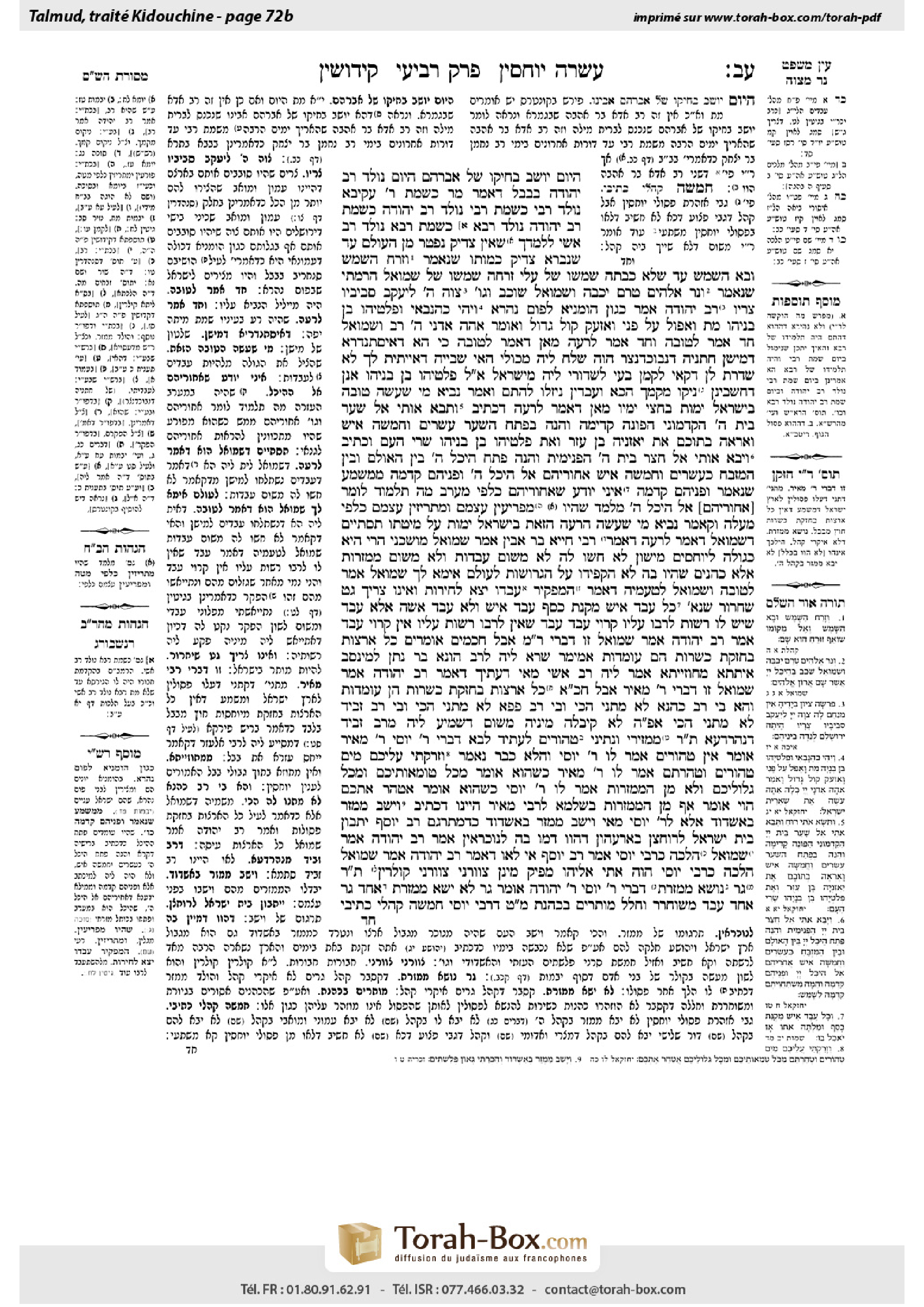
Kiddushin 72b: Talmud study for Daf Yomi
Daf Yomi is the daily study of one Talmud folio. Explore 37 tractates with scans, Hebrew text, Sefaria English and AI-generated French translations where annotated.
Passage selection and English or AI-generated French translation are available where the scan has annotations. Daf Study is independent of Torah-Box and Sefaria.
Browse Kiddushin · קידושין · All tractatesKiddushin 72b text and translations
This page of Kiddushin includes the Aramaic text, an English translation and an AI-generated French translation, alongside the scan above.
קידושין ע״ב ב · Aramaic and Hebrew text
הַיּוֹם יוֹשֵׁב בְּחֵיקוֹ שֶׁל אַבְרָהָם. הַיּוֹם נוֹלַד רַב יְהוּדָה בְּבָבֶל.
דְּאָמַר מָר: כְּשֶׁמֵּת רַבִּי עֲקִיבָא נוֹלַד רַבִּי. כְּשֶׁמֵּת רַבִּי נוֹלַד רַב יְהוּדָה. כְּשֶׁמֵּת רַב יְהוּדָה נוֹלַד רָבָא. כְּשֶׁמֵּת רָבָא נוֹלַד רַב אָשֵׁי. לְלַמֶּדְךָ שֶׁאֵין צַדִּיק נִפְטָר מִן הָעוֹלָם עַד שֶׁנִּבְרָא צַדִּיק כְּמוֹתוֹ, שֶׁנֶּאֱמַר: ״וְזָרַח הַשֶּׁמֶשׁ וּבָא הַשָּׁמֶשׁ״. עַד שֶׁלֹּא כָּבְתָה שִׁמְשׁוֹ שֶׁל עֵלִי זָרְחָה שִׁמְשׁוֹ שֶׁל שְׁמוּאֵל הָרָמָתִי, שֶׁנֶּאֱמַר: ״וְנֵר אֱלֹהִים טֶרֶם יִכְבֶּה וּשְׁמוּאֵל שׁוֹכֵב וְגוֹ׳״.
״צִוָּה ה׳ לְיַעֲקֹב סְבִיבָיו צָרָיו״. רַב יְהוּדָה אָמַר: כְּגוֹן הוּמַנְיָא לְפוּם נַהֲרָא.
״וַיְהִי כְּהִנָּבְאִי וּפְלַטְיָהוּ בֶן בְּנָיָה מֵת וָאֶפֹּל עַל פָּנַי וָאֶזְעַק קוֹל גָּדוֹל וָאֹמַר אֲהָהּ אֲדֹנָי ה׳״, רַב וּשְׁמוּאֵל: חַד אָמַר: לְטוֹבָה, וְחַד אָמַר: לְרָעָה. מַאן דְּאָמַר לְטוֹבָה – כִּי הָא דְּאִיסְתַּנְדְּרָא דְמֵישָׁן חַתְנֵיהּ דִּנְבוּכַדְנֶצַּר הֲוָה, שְׁלַח לֵיהּ: מִכּוּלֵּי הַאי שְׁבִיָּיה דְּאַיְיתֵית לָךְ – לָא שַׁדַּרְתְּ לַן דְּקָאֵי לְקַמַּן?
בָּעֵי לְשַׁדּוֹרֵי לֵיהּ מִיִּשְׂרָאֵל. אֲמַר לֵיהּ פְּלַטְיָהוּ בֶּן בְּנָיָהוּ: אֲנַן דַּחֲשִׁבִינַן נֵיקוּ מִקַּמָּךְ הָכָא, וְעַבְדִין נֵיזְלוּ לְהָתָם. וַאֲמַר נְבִיָּא: מִי שֶׁעָשָׂה טוֹבָה בְּיִשְׂרָאֵל, יָמוּת בַּחֲצִי יָמָיו?
מַאן דְּאָמַר לְרָעָה, דִּכְתִיב: ״וַתָּבֵא אֹתִי אֶל שַׁעַר בֵּית ה׳ הַקַּדְמוֹנִי הַפּוֹנֶה קָדִימָה וְהִנֵּה בְּפֶתַח הַשַּׁעַר עֶשְׂרִים וַחֲמִשָּׁה אִישׁ וָאֶרְאֶה בְתוֹכָם אֶת יַאֲזַנְיָה בֶן עַזֻּר וְאֶת פְּלַטְיָהוּ בֶן בְּנָיָהוּ שָׂרֵי הָעָם״, וּכְתִיב: ״וַיָּבֹא אֹתִי אֶל חֲצַר בֵּית ה׳ הַפְּנִימִית וְהִנֵּה פֶתַח הֵיכַל ה׳ בֵּין הָאוּלָם וּבֵין הַמִּזְבֵּחַ כְּעֶשְׂרִים וַחֲמִשָּׁה אִישׁ אֲחֹרֵיהֶם אֶל הֵיכַל ה׳ וּפְנֵיהֶם קֵדְמָה״.
מִמַּשְׁמַע שֶׁנֶּאֱמַר: ״וּפְנֵיהֶם קֵדְמָה״ אֵינִי יוֹדֵעַ שֶׁאֲחוֹרֵיהֶם כְּלַפֵּי מַעֲרָב? מָה תַּלְמוּד לוֹמַר ״[אֲחֹרֵיהֶם] אֶל הֵיכַל ה׳״ – מְלַמֵּד שֶׁהָיוּ מַפְרִיעִין עַצְמָם וּמַתְרִיזִין עַצְמָם כְּלַפֵּי מַעְלָה. וְקָאָמַר נְבִיָּא: מִי שֶׁעָשָׂה הָרָעָה הַזֹּאת בְּיִשְׂרָאֵל יָמוּת עַל מִיטָּתוֹ?!
תִּסְתַּיֵּים דִּשְׁמוּאֵל דְּאָמַר לְרָעָה, דְּאָמַר רַבִּי חִיָּיא בַּר אָבִין אָמַר שְׁמוּאֵל: מוּשְׁכְּנֵי – הֲרֵי הִיא כַּגּוֹלָה לַיּוֹחֲסִים. מֵישׁוֹן – לֹא חָשׁוּ לָהּ לֹא מִשּׁוּם עַבְדוּת וְלֹא מִשּׁוּם מַמְזֵרוּת, אֶלָּא כֹּהֲנִים שֶׁהָיוּ בָּהּ לֹא הִקְפִּידוּ עַל הַגְּרוּשׁוֹת.
לְעוֹלָם אֵימָא לָךְ שְׁמוּאֵל אָמַר לְטוֹבָה, וּשְׁמוּאֵל לְטַעְמֵיהּ דְּאָמַר: הַמַּפְקִיר עַבְדּוֹ – יָצָא לְחֵירוּת וְאֵינוֹ צָרִיךְ גֵּט שִׁחְרוּר, שֶׁנֶּאֱמַר: ״כׇּל עֶבֶד אִישׁ מִקְנַת כָּסֶף״, עֶבֶד אִישׁ וְלֹא עֶבֶד אִשָּׁה? אֶלָּא: עֶבֶד שֶׁיֵּשׁ לוֹ רְשׁוּת לְרַבּוֹ עָלָיו – קָרוּי עֶבֶד, עֶבֶד שֶׁאֵין לְרַבּוֹ רְשׁוּת עָלָיו – אֵין קָרוּי עֶבֶד.
אָמַר רַב יְהוּדָה אָמַר שְׁמוּאֵל: זוֹ דִּבְרֵי רַבִּי מֵאִיר, אֲבָל חֲכָמִים אוֹמְרִים: כׇּל אֲרָצוֹת בְּחֶזְקַת כְּשֵׁרוֹת הֵם עוֹמְדוֹת.
אַמֵּימָר שְׁרָא לֵיהּ לְרַב הוּנָא בַּר נָתָן לְמִינְסַב אִיתְּתָא מְחוּזְיָיתָא. אֲמַר לֵיהּ רַב אָשֵׁי: מַאי דַּעְתָּיךְ – דְּאָמַר רַב יְהוּדָה אָמַר שְׁמוּאֵל: זוֹ דִּבְרֵי רַבִּי מֵאִיר, אֲבָל חֲכָמִים אוֹמְרִים: כׇּל אֲרָצוֹת בְּחֶזְקַת כְּשֵׁרוֹת הֵן עוֹמְדוֹת? וְהָא בֵּי רַב כָּהֲנָא לָא מַתְנוּ הָכִי, וּבֵי רַב פָּפָּא לָא מַתְנוּ הָכִי, וּבֵי רַב זְבִיד לָא מַתְנוּ הָכִי! אֲפִילּוּ הָכִי לָא קַיבְּלַהּ מִינֵּיהּ, מִשּׁוּם דִּשְׁמִיעַ לֵיהּ מֵרַב זְבִיד דִּנְהַרְדְּעָא.
תָּנוּ רַבָּנַן: מַמְזֵירֵי וּנְתִינֵי טְהוֹרִים לֶעָתִיד לָבֹא, דִּבְרֵי רַבִּי יוֹסֵי. רַבִּי מֵאִיר אוֹמֵר: אֵין טְהוֹרִים. אָמַר לוֹ רַבִּי יוֹסֵי: וַהֲלֹא כְּבָר נֶאֱמַר: ״וְזָרַקְתִּי עֲלֵיכֶם מַיִם טְהוֹרִים וּטְהַרְתֶּם״! אָמַר לוֹ רַבִּי מֵאִיר: כְּשֶׁהוּא אוֹמֵר: ״מִכֹּל טֻמְאוֹתֵיכֶם וּמִכׇּל גִּלּוּלֵיכֶם״ – וְלֹא מִן הַמַּמְזֵרוּת. אָמַר לוֹ רַבִּי יוֹסֵי: כְּשֶׁהוּא אוֹמֵר: ״אֲטַהֵר אֶתְכֶם״ – הֱוֵי אוֹמֵר אַף מִן הַמַּמְזֵרוּת.
בִּשְׁלָמָא לְרַבִּי מֵאִיר, הַיְינוּ דִּכְתִיב: ״וְיָשַׁב מַמְזֵר בְּאַשְׁדּוֹד״. אֶלָּא לְרַבִּי יוֹסֵי, מַאי ״וְיָשַׁב מַמְזֵר בְּאַשְׁדּוֹד״? כְּדִמְתַרְגֵּם רַב יוֹסֵף: יֵתְבוּן בֵּית יִשְׂרָאֵל לְרוּחְצָן בְּאַרְעֲהוֹן דַּהֲווֹ (דָּמוּ) [דָּמַיִין] בַּהּ לְנוּכְרָאִין.
אָמַר רַב יְהוּדָה, אָמַר שְׁמוּאֵל: הֲלָכָה כְּרַבִּי יוֹסֵי. אָמַר רַב יוֹסֵף: אִי לָאו דְּאָמַר רַב יְהוּדָה אָמַר שְׁמוּאֵל הֲלָכָה כְּרַבִּי יוֹסֵי, הֲוָה אָתֵי אֵלִיָּהוּ מַפֵּיק מִינַּן צַוְורָנֵי צַוְורָנֵי קוֹלָרִין.
תָּנוּ רַבָּנַן: גֵּר נוֹשֵׂא מַמְזֶרֶת, דִּבְרֵי רַבִּי יוֹסֵי. רַבִּי יְהוּדָה אוֹמֵר: גֵּר לֹא יִשָּׂא מַמְזֶרֶת. אֶחָד גֵּר אֶחָד עֶבֶד מְשׁוּחְרָר וְחָלָל מוּתָּרִים בְּכֹהֶנֶת. מַאי טַעְמָא דְּרַבִּי יוֹסֵי? חֲמִשָּׁה קְהָלֵי כְּתִיבִי.
Kiddushin 72b · English translation
Today he is sitting in the lap of Abraham our forefather, since he has just been circumcised. He added: Today Rav Yehuda was born in Babylonia.
The Gemara comments: As the Master said: While Rabbi Akiva was dying, Rabbi Yehuda HaNasi was born; while Rabbi Yehuda HaNasi was dying, Rav Yehuda was born; while Rav Yehuda was dying, Rava was born; while Rava was dying, Rav Ashi was born. This teaches you that a righteous person does not leave the world before an equally righteous person is created, as it is stated: “The sun also rises and the sun also sets” (Ecclesiastes 1:5). The same applies to earlier generations: Before Eli’s sun had gone out, Samuel the Ramathite’s sun was already rising, as it is stated: “And the lamp of God was not yet gone out, and Samuel was lying in the Temple of the Lord” (I Samuel 3:3), which teaches that Samuel was already prophesying in the days of Eli.
The Gemara stated above that Homanya is an Ammonite city. The verse states: “The Lord has commanded concerning Jacob, that they that are round about him should be his adversaries” (Lamentations 1:17), indicating that the Jewish people are surrounded by enemies even in its exile. Rav Yehuda says: Homanya is close to Pum Nahara, which had Jewish residents.
The verse states: “And it came to pass, when I prophesied, that Pelatiah the son of Benaiah died. Then fell I down upon my face, and cried with a loud voice, and said: Ah Lord God!” (Ezekiel 11:13). Rav and Shmuel disagreed with regard to the meaning of this verse. One said it should be interpreted for good, and one said it should be interpreted for evil. How so? The one who says that it should be interpreted for good claims it is like that story involving the governor [de’istandera] of the province of Meishan, who was the son-in-law of Nebuchadnezzar. He sent a message to his father-in-law: From all those captives you have brought for yourself from your wars you have not sent us anyone to stand before us.
Nebuchadnezzar wanted to send him captives from the Jews to serve his son-in-law. Pelatiah, son of Benaiah, said to Nebuchadnezzar: We, who are important, shall stand and serve before you here, and our slaves will go there, to your son-in-law. Nebuchadnezzar took his advice. And about him the prophet Ezekiel said: One who did this good for the Jewish people, i.e., Pelatiah ben Benaiah, who spared them this exile, should he die at half of his days?
The one who says that the verse should be interpreted for evil cites the following verse, as it is written: “Then a spirit lifted me up, and brought me unto the east gate of the Lord’s House, which looked eastward; and behold, at the door of the gate five and twenty men; and I saw in the midst of them Jaazaniah the son of Azzur, and Pelatiah the son of Benaiah, princes of the people” (Ezekiel 11:1), and it is written: “And He brought me into the inner court of the Lord’s House, and, behold, at the door of the Temple of the Lord, between the porch and the altar, were about five and twenty men, with their backs toward the Temple of the Lord, and their faces toward the east” (Ezekiel 8:16).
The second verse is analyzed in light of the first verse, which states that Pelatiah ben Benaiah was among the twenty-five people: From the fact that it is stated: “And their faces toward the east,” don’t I know that their backs were toward the west, where the Temple was? What is the meaning when the verse states: “Their backs toward the Temple of the Lord”? These words hint at another matter, as the verse teaches that they exposed themselves from behind and discharged excrement toward the One above, in the direction of the Temple. And the prophet is saying: Shall he who did this evil in Israel die peacefully on his bed?
The Gemara comments: It may be concluded that it was Shmuel who said this was for evil, as Rabbi Ḥiyya bar Avin says that Shmuel says: Mushekanei is like the exile with regard to lineage. And even with regard to Mishon, they were not concerned due to slavery nor due to mamzer status. Rather, the priests who were there were not particular with regard to the prohibition against priests marrying divorced women. Consequently, Shmuel maintains that the only flaw of lineage in Mishon was that of ḥalalim, whereas the opinion that the verse was stated for good maintains that the some of the residents of Mishon were slaves.
The Gemara rejects this: Actually, I could say to you that Shmuel said it was for good, and there is no contradiction, since Shmuel conforms to his standard line of reasoning, as he says: With regard to one who renounces ownership of his slave, the slave is emancipated and he does not even require a bill of manumission. Shmuel cited a proof from that which is stated: “But every slave man that is bought for money” (Exodus 12:44). Does this apply only to a slave who is a man, and not to a woman slave? Rather, it means: The slave of a man, i.e., a slave whose master has authority and control over him, is called a slave, since he is the slave of a particular man. A slave whose master does not have authority over him, such as one who has been declared ownerless, is not called a slave but a freeman. The slaves who went to Mishon no longer had the status of slaves because their masters remained behind.
Rav Yehuda says that Shmuel says: This mishna, which indicates that only the inhabitants of Babylonia have unflawed lineage, is the statement of Rabbi Meir. But the Rabbis say: All lands retain a presumptive status of unflawed lineage.
The Gemara comments: Ameimar permitted Rav Huna bar Natan to marry a woman from Meḥoza, which is outside the borders of Babylonia as pertains to lineage. Rav Ashi said to Ameimar: What is your reasoning in allowing him to do so? Is it because Rav Yehuda says that Shmuel says: This is the statement of Rabbi Meir, but the Rabbis say all lands retain a presumptive status of unflawed lineage. The halakha follows the opinion of the Rabbis, but the school of Rav Kahana did not teach like this, and the school of Rav Pappa did not teach like this, and the school of Rav Zevid did not teach like this. The Gemara comments: Nevertheless, despite hearing of all these reports, Ameimar did not accept this halakha from him, because he had heard this halakha directly from Rav Zevid of Neharde’a, upon whom he relied.
The Sages taught (Tosefta 5:5): Mamzerim and Gibeonites will be pure in the future; this is the statement of Rabbi Yosei. Rabbi Meir says: They will not be pure. Rabbi Yosei said to him: But hasn’t it already been stated: “And I will sprinkle clean water upon you, and you shall be clean from all your uncleanness, and from all your idols, will I cleanse you” (Ezekiel 36:25)? Rabbi Meir said to him: When it says: “From all your uncleanness, and from all your idols,” this emphasizes that God will purify people from these types of impurity, but not from mamzer status. Rabbi Yosei said to him: When it says: “Will I cleanse you,” at the end of the verse, you must say this means even from mamzer status.
The Gemara comments: Granted, according to Rabbi Meir, who maintains that mamzerim will not be purified, this is as it is written: “And a mamzer shall dwell in Ashdod” (Zechariah 9:6), indicating that they will have their own isolated living area. But according to Rabbi Yosei, what is the meaning of the phrase “And a mamzer shall dwell in Ashdod”? The Gemara answers: He understands that verse as Rav Yosef would translate it: The Jewish people shall dwell in tranquility in their land, where they were formerly like strangers, reading mamzer as me’am zar, from a strange people.
Rav Yehuda says that Shmuel says: The halakha is in accordance with the opinion of Rabbi Yosei, that mamzerim and Gibeonites will be pure in the future. Rav Yosef says: If it were not for the fact that Rav Yehuda said that Shmuel said that the halakha is in accordance with the opinion of Rabbi Yosei, Elijah would come and remove from us group after group of forbidden people [kolarin], since he would reveal how many mamzerim there are among the Jewish people.
The Sages taught (Tosefta 5:3): A convert may marry a mamzeret ab initio; this is the statement of Rabbi Yosei. Rabbi Yehuda says: A convert may not marry a mamzeret. A convert, an emancipated slave, and a ḥalal are all permitted to marry the daughter of a priest. The Gemara asks: What is the reason of Rabbi Yosei, who deems it permitted for a convert to marry a mamzeret? The Gemara answers: Five congregations are written, meaning, the word congregation appears five times in the Torah with regard to various people of flawed lineage who are prohibited from entering the congregation of God.
Kiddushin 72b · Traduction française (IA)
Aujourd’hui, il est assis sur les genoux d’Abraham notre ancêtre, puisqu’il vient d’être circoncis. Il ajouta : Aujourd’hui, Rav Yehuda est né en Babylonie.
La Guemara fait remarquer : Comme le Maître l’a dit, Rabbi Yehuda HaNassi naquit au moment où Rabbi Akiva mourait ; Rav Yehuda naquit au moment où Rabbi Yehuda HaNassi mourait ; Rava naquit au moment où Rav Yehuda mourait ; et Rav Ashi naquit au moment où Rava mourait. Cela t’enseigne qu’un juste ne quitte pas le monde avant qu’un autre juste d’une valeur égale ne soit créé, comme il est dit : « Le soleil se lève aussi, et le soleil se couche aussi » (Ecclésiaste 1:5). Il en va de même pour les générations antérieures : avant que le soleil d’Eli ne se soit couché, celui de Samuel de Ramata se levait déjà, comme il est dit : « La lampe de Dieu n’était pas encore éteinte, et Samuel était couché dans le Temple de l’Éternel » (I Samuel 3:3), ce qui enseigne que Samuel prophétisait déjà du vivant d’Eli.
La Guemara a indiqué plus haut que Homanya est une ville ammonite. Le verset dit : « L’Éternel a ordonné contre Jacob que ceux qui l’entourent soient ses adversaires » (Lamentations 1:17), ce qui indique que le peuple juif est entouré d’ennemis, même en exil. Rav Yehuda dit : Homanya est proche de Pum Nahara, où résidaient des Juifs.
Le verset dit : « Et il arriva, tandis que je prophétisais, que Pelatiah, fils de Benaiah, mourut. Alors je tombai face contre terre, je poussai un grand cri et je dis : Ah ! Seigneur Dieu ! » (Ézéchiel 11:13). Rav et Shmuel étaient en désaccord sur le sens de ce verset. Selon l’un, il faut l’interpréter en bien ; selon l’autre, en mal. Comment cela ? Celui qui dit qu’il faut l’interpréter en bien soutient que cela ressemble à l’histoire du gouverneur [de’istandera] de la province de Meishan, qui était le gendre de Nabuchodonosor. Il envoya un message à son beau-père : « Parmi tous les captifs que tu as ramenés de tes guerres, tu ne nous as envoyé personne pour se tenir devant nous. »
Nabuchodonosor voulut lui envoyer des captifs juifs pour servir son gendre. Pelatiah, fils de Benaiah, dit à Nabuchodonosor : « Nous, qui sommes des personnages importants, nous nous tiendrons ici devant toi pour te servir, et nos esclaves iront là-bas, chez ton gendre. » Nabuchodonosor suivit son conseil. Et le prophète Ézéchiel dit à son sujet : Celui qui a fait ce bien au peuple juif, c’est-à-dire Pelatiah ben Benaiah, qui lui a épargné cet exil, devrait-il mourir à la moitié de ses jours ?
Celui qui dit qu’il faut interpréter le verset en mal cite le verset suivant, comme il est écrit : « Un esprit m’enleva et me conduisit à la porte orientale de la Maison de l’Éternel, qui regarde vers l’orient ; et voici, à l’entrée de la porte, vingt-cinq hommes ; je vis au milieu d’eux Jaazaniah, fils d’Azzur, et Pelatiah, fils de Benaiah, chefs du peuple » (Ézéchiel 11:1). Et il est écrit : « Il me conduisit dans le parvis intérieur de la Maison de l’Éternel ; et voici, à l’entrée du Temple de l’Éternel, entre le vestibule et l’autel, se tenaient environ vingt-cinq hommes, le dos tourné au Temple de l’Éternel et le visage tourné vers l’orient » (Ézéchiel 8:16).
Le second verset est analysé à la lumière du premier, qui indique que Pelatiah ben Benaiah figurait parmi les vingt-cinq hommes : Puisqu’il est dit « le visage tourné vers l’orient », ne sais-je pas que leur dos était tourné vers l’occident, là où se trouvait le Temple ? Que signifie donc la mention « le dos tourné au Temple de l’Éternel » ? Ces mots font allusion à autre chose : le verset enseigne qu’ils exposaient leur derrière et déféquaient en direction de Celui qui est là-haut, c’est-à-dire vers le Temple. Et le prophète dit : Celui qui a fait ce mal en Israël mourrait-il paisiblement dans son lit ?
La Guemara fait remarquer : On peut en conclure que c’est Shmuel qui a dit qu’il fallait interpréter le verset en mal, car Rabbi Ḥiyya bar Avin dit au nom de Shmuel : Du point de vue de la généalogie, Mushekanei est comme l’exil. Même à Mishon, on ne s’inquiétait ni du statut d’esclave ni du statut de mamzer. En réalité, les prêtres qui s’y trouvaient ne tenaient pas compte de l’interdiction faite aux prêtres d’épouser des femmes divorcées. Par conséquent, selon Shmuel, le seul défaut de lignage à Mishon était celui des ḥalalim, tandis que, selon l’opinion voulant que le verset ait été prononcé en bien, certains habitants de Mishon étaient des esclaves.
La Guemara rejette cette conclusion : En réalité, je pourrais te dire que Shmuel a dit qu’il fallait interpréter le verset en bien, sans qu’il y ait de contradiction, car Shmuel est cohérent avec son raisonnement habituel. En effet, il dit : Celui qui renonce à la propriété de son esclave l’affranchit, et celui-ci n’a même pas besoin d’un acte d’affranchissement. Shmuel en apporte la preuve à partir de ce qui est dit : « Tout esclave mâle acheté à prix d’argent » (Exode 12:44). Cela ne s’appliquerait-il qu’à un esclave de sexe masculin, et non à une esclave ? Il faut plutôt comprendre : l’esclave d’un homme, c’est-à-dire un esclave sur lequel son maître a autorité et contrôle, est appelé esclave, puisqu’il est l’esclave d’un homme en particulier. Un esclave sur lequel son maître n’a pas autorité, tel celui qui a été déclaré sans propriétaire, n’est pas appelé esclave, mais homme libre. Les esclaves qui partirent pour Mishon n’avaient plus le statut d’esclaves, car leurs maîtres étaient restés sur place.
Rav Yehuda dit au nom de Shmuel : Cette Michna, qui indique que seuls les habitants de Babylonie ont un lignage sans défaut, exprime l’opinion de Rabbi Meir. Mais les Rabbins disent : Toutes les contrées conservent une présomption de lignage sans défaut.
La Guemara fait remarquer : Ameimar autorisa Rav Huna bar Natan à épouser une femme de Meḥoza, qui se trouve hors des frontières de Babylonie en matière de lignage. Rav Ashi dit à Ameimar : Sur quoi fondes-tu cette autorisation ? Est-ce parce que Rav Yehuda dit au nom de Shmuel : « Cela est l’opinion de Rabbi Meir, mais les Rabbins disent que toutes les contrées conservent une présomption de lignage sans défaut » ? La halakha suit l’opinion des Rabbins. Pourtant, l’école de Rav Kahana n’enseignait pas ainsi, pas plus que l’école de Rav Pappa ni celle de Rav Zevid. La Guemara fait remarquer : Malgré tous ces témoignages, Ameimar n’accepta pas cette halakha de sa part, car il l’avait directement entendue de Rav Zevid de Neharde’a, sur qui il s’appuyait.
Les Sages ont enseigné (Tosefta 5:5) : À l’avenir, les mamzerim et les Gabaonites seront purs ; telle est l’opinion de Rabbi Yosei. Rabbi Meir dit : Ils ne seront pas purs. Rabbi Yosei lui dit : N’est-il pas déjà dit : « Je répandrai sur vous une eau pure, et vous serez purs ; je vous purifierai de toutes vos impuretés et de toutes vos idoles » (Ézéchiel 36:25) ? Rabbi Meir lui dit : Lorsque le verset dit « de toutes vos impuretés et de toutes vos idoles », cela souligne que Dieu purifiera les gens de ces formes d’impureté, mais non du statut de mamzer. Rabbi Yosei lui dit : Puisque le verset dit à la fin « Je vous purifierai », il faut comprendre qu’Il purifiera même du statut de mamzer.
La Guemara fait remarquer : Il est logique que, selon Rabbi Meir, qui soutient que les mamzerim ne seront pas purifiés, le verset dise : « Un mamzer habitera à Ashdod » (Zacharie 9:6), ce qui indique qu’ils auront un lieu de résidence isolé qui leur sera propre. Mais selon Rabbi Yosei, que signifie l’expression « Un mamzer habitera à Ashdod » ? La Guemara répond : Il comprend ce verset comme Rav Yosef le traduirait : Le peuple juif habitera paisiblement dans son pays, où il était auparavant comme un étranger ; il lit mamzer comme me’am zar, « d’un peuple étranger ».
Rav Yehuda dit au nom de Shmuel : La halakha est conforme à l’opinion de Rabbi Yosei, selon laquelle les mamzerim et les Gabaonites seront purs à l’avenir. Rav Yosef dit : Si Rav Yehuda n’avait pas rapporté que Shmuel avait déclaré que la halakha est conforme à l’opinion de Rabbi Yosei, Élie viendrait et retirerait de parmi nous des groupes entiers de personnes interdites [kolarin], car il révélerait combien il y a de mamzerim parmi le peuple juif.
Les Sages ont enseigné (Tosefta 5:3) : Un converti peut épouser d’emblée une mamzeret ; telle est l’opinion de Rabbi Yosei. Rabbi Yehuda dit : Un converti ne peut pas épouser une mamzeret. Un converti, un esclave affranchi et un ḥalal peuvent tous épouser la fille d’un prêtre. La Guemara demande : Pour quelle raison Rabbi Yosei considère-t-il qu’un converti peut épouser une mamzeret ? La Guemara répond : Le mot « assemblée » apparaît cinq fois dans la Torah au sujet de différentes personnes au lignage défectueux auxquelles il est interdit d’entrer dans l’assemblée de Dieu.
Traduction française générée par IA à partir de l’édition anglaise de Sefaria. Vérifie toujours un passage avec le texte source.
Text from Sefaria: William Davidson Edition - Vocalized Aramaic (CC BY NC); William Davidson Edition - English (CC BY NC).