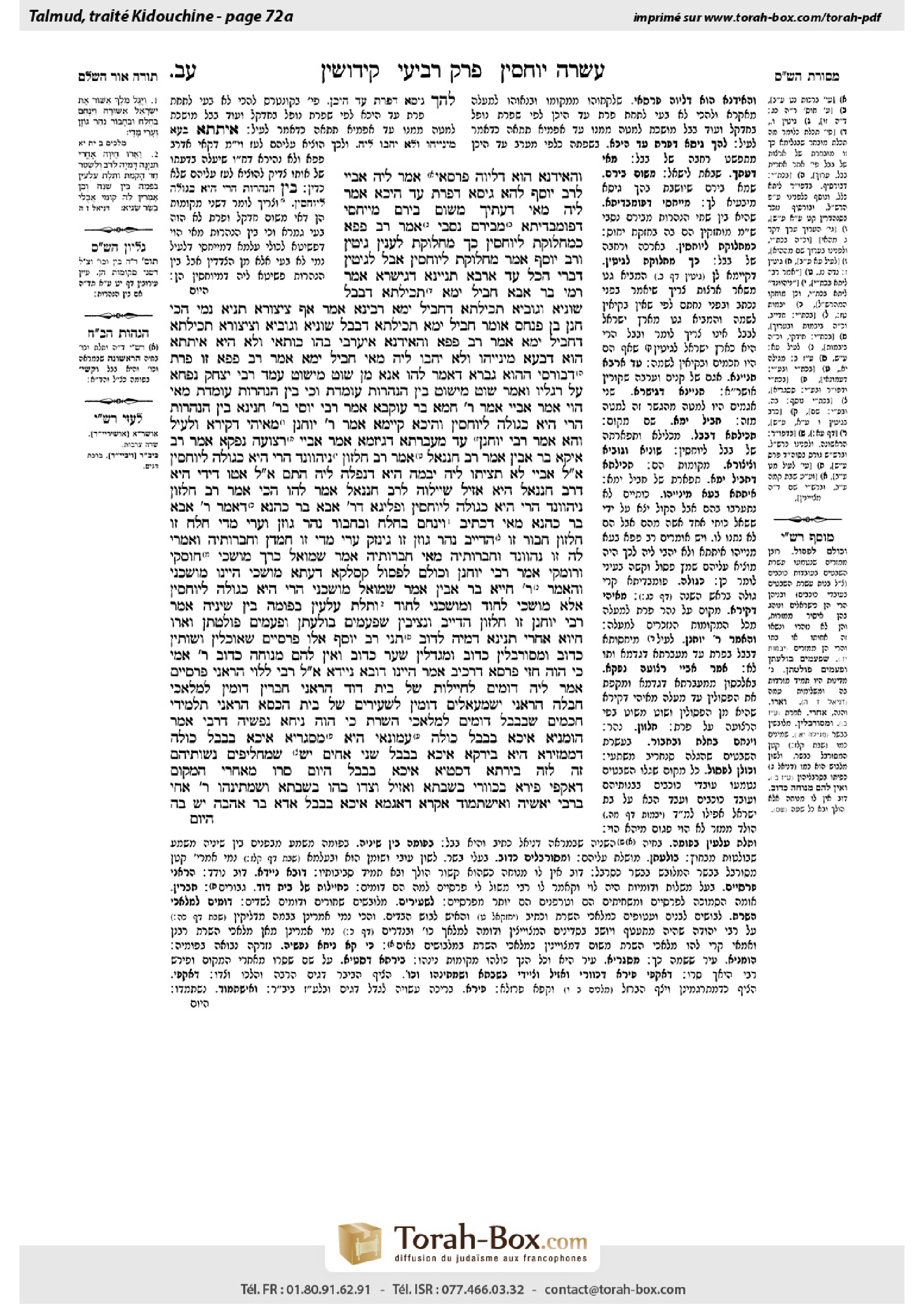
Kiddushin 72a: Talmud study for Daf Yomi
Daf Yomi is the daily study of one Talmud folio. Explore 37 tractates with scans, Hebrew text, Sefaria English and AI-generated French translations where annotated.
Passage selection and English or AI-generated French translation are available where the scan has annotations. Daf Study is independent of Torah-Box and Sefaria.
Browse Kiddushin · קידושין · All tractatesKiddushin 72a text and translations
This page of Kiddushin includes the Aramaic text, an English translation and an AI-generated French translation, alongside the scan above.
קידושין ע״ב א · Aramaic and Hebrew text
וְהָאִידָּנָא הוּא [דְּ]דַלְיוּהּ פָּרְסָאֵי. אֲמַר לֵיהּ אַבָּיֵי לְרַב יוֹסֵף: לְהָא גִּיסָא דִפְרָת עַד הֵיכָא? אֲמַר לֵיהּ: מַאי דַּעְתָּיךְ? מִשּׁוּם בִּירָם? מְיַיחֲסִי דְּפוּמְבְּדִיתָא מִבִּירָם נָסְבִי.
אָמַר רַב פָּפָּא: כְּמַחְלוֹקֶת לְיוּחֲסִין, כָּךְ מַחְלוֹקֶת לְעִנְיַן גִּיטִּין. וְרַב יוֹסֵף אָמַר: מַחְלוֹקֶת לְיוּחֲסִין, אֲבָל לְגִיטִּין – דִּבְרֵי הַכֹּל עַד אַרְבָּא תִנְיָינָא דְּגִישְׁרָא.
אָמַר רָמֵי בַּר אַבָּא: חֲבֵיל יַמָּא – תְּכֵילְתָּא דְבָבֶל. שׁוּנְיָא וְגוּבְיָא – תְּכֵילְתָּא דַּחֲבֵיל יַמָּא. רָבִינָא אָמַר: אַף צִיצוֹרָא. תַּנְיָא נָמֵי הָכִי, חָנָן בֶּן פִּנְחָס אוֹמֵר: חֲבֵיל יַמָּא – תְּכֵילְתָּא דְּבָבֶל, שׁוּנְיָא וְגוּבְיָא וְצִיצוֹרָא – תְּכֵילְתָּא דַּחֲבֵיל יַמָּא. אָמַר רַב פָּפָּא: וְהָאִידָּנָא אִיעָרַבִי בְּהוּ כּוּתָאֵי. וְלָא הִיא, אִיתְּתָא הוּא דִּבְעָא מִינַּיְיהוּ, וְלָא יְהַבוּ לֵיהּ. מַאי חֲבֵיל יַמָּא? אָמַר רַב פָּפָּא: זוֹ פְּרָת דְּבוֹרְסִי.
הָהוּא גַּבְרָא דַּאֲמַר לְהוּ: אֲנָא מִן שׁוֹט מֵישׁוֹט, עָמַד רַבִּי יִצְחָק נַפָּחָא עַל רַגְלָיו וְאָמַר: שׁוֹט מֵישׁוֹט בֵּין הַנְּהָרוֹת עוֹמֶדֶת. וְכִי בֵּין הַנְּהָרוֹת עוֹמֶדֶת, מַאי הָוֵי? אָמַר אַבָּיֵי, אָמַר רַבִּי חָמָא בַּר עוּקְבָא, אָמַר רַבִּי יוֹסֵי בְּרַבִּי חֲנִינָא: בֵּין הַנְּהָרוֹת הֲרֵי הִיא כַּגּוֹלָה לְיוּחֲסִין. וְהֵיכָא קָיְימָא? אָמַר רַבִּי יוֹחָנָן: מֵאִיהִי דְקִירָא וּלְעֵיל. וְהָא אָמַר רַבִּי יוֹחָנָן: עַד מַעְבַּרְתָּא דְגִיזְמָא! אָמַר אַבָּיֵי: רְצוּעָה נָפְקָא.
אָמַר רַב אִיקָא בַּר אָבִין אָמַר רַב חֲנַנְאֵל אָמַר רַב: חִלָּזוֹן נִיהֲוַונְד הֲרֵי הִיא כַּגּוֹלָה לְיוּחֲסִין. אֲמַר לְהוּ אַבָּיֵי: לָא תְּצִיתוּ לֵיהּ, יְבָמָה הִיא דִּנְפַלָה לֵיהּ הָתָם. אֲמַר לֵיהּ: אַטּוּ דִּידִי הִיא? דְּרַב חֲנַנְאֵל הִיא! אֲזוּל שַׁיְילוּהּ לְרַב חֲנַנְאֵל, אֲמַר לְהוּ: הָכִי אָמַר רַב: חִלָּזוֹן נִיהֲוַונְד הֲרֵי הִיא כַּגּוֹלָה לְיוּחֲסִין.
וּפְלִיגָא דְּרַבִּי אַבָּא בַּר כָּהֲנָא. דְּאָמַר רַבִּי אַבָּא בַּר כָּהֲנָא: מַאי דִּכְתִיב: ״וַיַּנְחֵם בַּחְלַח וּבְחָבוֹר נְהַר גּוֹזָן וְעָרֵי מָדָי״, חֲלַח – זוֹ חִלָּזוֹן, חָבוֹר – זוֹ הַדְיָיב, נְהַר גּוֹזָן – זוֹ גִּינְזַק, עָרֵי מָדָי – זוֹ חֲמָדָן וְחַבְרוֹתֶיהָ, וְאָמְרִי לַהּ: זוֹ נִהֲוַונְד וְחַבְרוֹתֶיהָ.
מַאי חַבְרוֹתֶיהָ? אָמַר שְׁמוּאֵל: כְּרַךְ מוּשְׁכֵּי חוּסְקֵי וְרוּמְקֵי. אָמַר רַבִּי יוֹחָנָן: וְכוּלָּם לִפְסוּל. קָסָלְקָא דַּעְתָּא: מוּשְׁכֵּי הַיְינוּ מוּשְׁכְּנֵי. וְהָאָמַר רַבִּי חִיָּיא בַּר אָבִין אָמַר שְׁמוּאֵל: מוּשְׁכְּנֵי הֲרֵי הִיא כַּגּוֹלָה לְיוּחֲסִין! אֶלָּא מוּשְׁכֵּי לְחוּד וּמוּשְׁכְּנֵי לְחוּד.
״וּתְלָת עִלְעִין בְּפֻמַּהּ בֵּין שִׁנַּהּ״. אָמַר רַבִּי יוֹחָנָן: זוֹ חִלָּזוֹן, הַדְיָיב, וּנְצִיבִין, שֶׁפְּעָמִים בּוֹלַעְתָּן וּפְעָמִים פּוֹלַטְתָּן.
״וַאֲרוּ חֵיוָה אׇחֳרִי תִנְיָנָה דָּמְיָה לְדֹב״. תָּנֵי רַב יוֹסֵף: אֵלּוּ פָּרְסִיִּים, שֶׁאוֹכְלִין וְשׁוֹתִין כְּדוֹב, וּמְסוּרְבָּלִין כְּדוֹב, וּמְגַדְּלִין שֵׂעָר כְּדוֹב, וְאֵין לָהֶם מְנוּחָה כְּדוֹב. רַבִּי אַמֵּי כִּי הֲוָה חָזֵי פָּרְסָא דְּרָכֵיב, אָמַר: הַיְינוּ דּוּבָּא נָיְידָא.
אֲמַר לֵיהּ רַבִּי לְלֵוִי: הַרְאֵנִי פָּרְסִיִּים. אֲמַר לֵיהּ: דּוֹמִים לַחֲיָילוֹת שֶׁל בֵּית דָּוִד. הַרְאֵנִי חַבָּרִין. דּוֹמִין לְמַלְאֲכֵי חַבָּלָה. הַרְאֵנִי יִשְׁמְעֵאלִים. דּוֹמִין לִשְׂעִירִים שֶׁל בֵּית הַכִּסֵּא. הַרְאֵנִי תַּלְמִידֵי חֲכָמִים שֶׁבְּבָבֶל. דּוֹמִים לְמַלְאֲכֵי הַשָּׁרֵת.
כִּי הֲוָה נִיחָא נַפְשֵׁיהּ דְּרַבִּי אֲמַר: הוּמַנְיָא אִיכָּא בְּבָבֶל – כּוּלַּהּ עַמּוֹנָאֵי הִיא. מַסְגַּרְיָא אִיכָּא בְּבָבֶל – כּוּלָּהּ דְּמַמְזֵירֵי הִיא. בִּירְקָא אִיכָּא בְּבָבֶל – שְׁנֵי אַחִים יֵשׁ [בָּהּ] שֶׁמַּחֲלִיפִים נְשׁוֹתֵיהֶם זֶה לָזֶה. בִּירְתָּא דְּסָטְיָא אִיכָּא בְּבָבֶל – הַיּוֹם סָרוּ מֵאַחֲרֵי הַמָּקוֹם, דְּאַקְפִּי פִּירָא בִּכְווֹרֵי בְּשַׁבְּתָא וַאֲזֻיל וְצָדוּ בְּהוּ בְּשַׁבְּתָא וְשַׁמְּתִינְהוּ רַבִּי אַחַי בְּרַבִּי יֹאשִׁיָּה וְאִישְׁתַּמּוּד. אַקְרָא דְאַגְמָא אִיכָּא בְּבָבֶל – אַדָּא בַּר אַהֲבָה יֵשׁ בָּהּ,
Kiddushin 72a · English translation
And it is only now that the Persians moved the bridge further up northward. Abaye said to Rav Yosef: Until where does the border extend on this western side of the Euphrates? Rav Yosef said to him: What are you thinking? Why do you ask? Is it due to the town of Biram? Even those of pure lineage who live in Pumbedita marry women from Biram, which demonstrates that the residents of Biram are presumed to have unflawed lineage.
Rav Pappa says: Just as there is a dispute between Rav and Shmuel as to the northern border of Babylonia with regard to lineage, so is there a dispute with regard to bills of divorce. An agent bringing a bill of divorce from a country overseas to Eretz Yisrael must state that it was written and signed in his presence. If he brought it from Babylonia, there is no requirement for him to state this. Rav Pappa is teaching that the borders that define Babylonia with regard to this issue are the same as the borders with regard to lineage. And Rav Yosef says: This dispute is with regard to lineage, but with regard to bills of divorce, everyone agrees that it is considered Babylonia up to the second lake of the bridge that Shmuel mentioned.
Rami bar Abba said: The province of Ḥaveil Yamma is the glory of Babylonia with regard to lineage; Shunya and Guvya are the glory of Ḥaveil Yamma. Ravina said: The town of Tzitzora is also like Shunya and Guvya. This is also taught in a baraita: Ḥanan ben Pineḥas says: Ḥaveil Yamma is the glory of Babylonia; Shunya and Guvya and Tzitzora are the glory of Ḥaveil Yamma. Rav Pappa says: And nowadays, Samaritans have assimilated with them, and their lineage is problematic. The Gemara comments: And that is not so. Rather, one Samaritan requested to marry a woman from them and they would not give her to him, which led to the rumor that Samaritans had assimilated with them. The Gemara asks: What is this region called Ḥaveil Yamma? Rav Pappa said: This is the area near the Euphrates adjacent to Bursi.
The Gemara relates: There was a certain man who said to the Sages: I am from a place called Shot Mishot. Rabbi Yitzḥak Nappaḥa stood on his feet and said: Shot Mishot is located between the Tigris and Euphrates Rivers. The Gemara asks: And if it is located between the rivers, what of it? What halakha is this relevant for? Abaye said that Rabbi Ḥama bar Ukva says that Rabbi Yosei, son of Rabbi Ḥanina, says: The area between the rivers is like the exile, meaning Pumbedita, with regard to lineage. The Gemara inquires: And where is the area between the rivers located for the purpose of this halakha? Rabbi Yoḥanan said: From Ihi Dekira and upward, i.e., northward. The Gemara asks: But doesn’t Rabbi Yoḥanan say: Until the crossing at Gizma but no further? Abaye said: A strip extends from that region past Ihi Dekira.
Rav Ika bar Avin says that Rav Ḥananel says that Rav says: Ḥillazon Nihavnad is like the exile with regard to lineage. Abaye said to them: Do not listen to Rav Ika bar Avin about this, as it was a yevama who fell before him from there to perform levirate marriage, and he said that its lineage was unflawed because he wished to marry her. Rav Ika bar Avin said to him: Is that to say that this halakha is mine? It is Rav Ḥananel’s, and it is not reasonable to say that I was influenced by my own interests in stating it. They went and asked Rav Ḥananel. He said to them: Rav said as follows: Ḥillazon Nihavnad is like the exile with regard to lineage.
The Gemara comments: And this disagrees with the statement of Rabbi Abba bar Kahana, as Rabbi Abba bar Kahana says: What is the meaning of that which is written with regard to the exile of the ten tribes of the kingdom of Israel: “And he put them in Halah, and in Habor, on the river of Gozan, and in the cities of the Medes” (II Kings 18:11)? Halah is Ḥillazon; Habor is Hadyav; the river of Gozan is Ginzak; the cities of the Medes are Ḥamadan and its neighboring towns, and some say: This is Nihavnad and its neighboring towns. Since the ten tribes assimilated with the gentiles, the lineage of Jews from those places is flawed, unlike that which was taught before.
The Gemara asks: What are the neighboring towns of Nihavnad? Shmuel said: The city of Mushekhei, Ḥosekei, and Rumekei. Rabbi Yoḥanan says: And all of these are the same with regard to flawed lineage. It was assumed that Mushekhei is the same as Mushekanei. The Gemara therefore asks: But doesn’t Rabbi Ḥiyya bar Avin say that Shmuel says: Mushekanei is like the exile with regard to lineage? Rather, it must be that Mushekhei is discrete, and Mushekanei is discrete.
In connection to the aforementioned places, the Gemara analyzes the following verse, describing a vision of a bear-like animal: “And it had three ribs in its mouth between its teeth” (Daniel 7:5). Rabbi Yoḥanan says: This is Ḥillazon, Hadyav, and Netzivin, which the Persian government sometimes swallows and sometimes discharges. In other words, control over these places passed from the Persians to the Romans and back again several times.
The first part of that verse stated: “And behold a second beast, similar to a bear” (Daniel 7:5). Rav Yosef taught: These are Persians, who eat and drink copious amounts like a bear, and are corpulent like a bear, and grow hair like a bear, and have no rest like a bear, which is constantly on the move from one place to another. When Rabbi Ami saw a Persian riding, he would say: This is a bear on the move.
Rabbi Yehuda HaNasi said to Levi: Show me Persians, i.e., describe a typical Persian to me. Levi said to him: They are similar to the legions of the house of David. Rabbi Yehuda HaNasi said: Show me Ḥabbarin, Persian priests. Levi said to him: They are similar to angels of destruction. Rabbi Yehuda HaNasi said: Show me Ishmaelites. Levi said to him: They are similar to demons of an outhouse. Rabbi Yehuda HaNasi said: Show me Torah scholars of Babylonia. Levi said to him: They are similar to ministering angels.
When Rabbi Yehuda HaNasi was dying, he said prophetically: There is a place called Homanya in Babylonia, and all its people are the sons of Ammon. There is a place called Masgariya in Babylonia, and all its people are mamzerim. There is a place called Bireka in Babylonia, and there are two brothers there who exchange wives with each other, and their children are therefore mamzerim. There is a place called Bireta DeSatya in Babylonia. Today they turned away from the Omnipresent. What did they do? A ditch with fish overflowed, and they went and trapped the fish on Shabbat. Rabbi Aḥai, son of Rabbi Yoshiya, excommunicated them, and they all became apostates. There is a place called Akra DeAgma in Babylonia. There is a man named Adda bar Ahava there.
Kiddushin 72a · Traduction française (IA)
Et ce n’est que maintenant que les Perses ont déplacé le pont plus au nord. Abayé dit à Rav Yosef : Jusqu’où s’étend la frontière sur la rive occidentale de l’Euphrate ? Rav Yosef lui dit : À quoi penses-tu ? Pourquoi poses-tu cette question ? Est-ce à cause de la ville de Biram ? Même les personnes de pure ascendance qui vivent à Poumbedita épousent des femmes de Biram, ce qui montre que les habitants de Biram sont réputés avoir une ascendance irréprochable.
Rav Pappa dit : De même qu’il existe un désaccord entre Rav et Chmouel au sujet de la frontière nord de la Babylonie en matière d’ascendance, il existe aussi un désaccord au sujet des actes de divorce. Un agent qui apporte un acte de divorce d’un pays d’outre-mer en Eretz Israël doit déclarer qu’il a été rédigé et signé en sa présence. S’il l’a apporté de Babylonie, il n’est pas tenu de faire cette déclaration. Rav Pappa enseigne que les frontières qui délimitent la Babylonie pour cette question sont les mêmes que celles qui la délimitent en matière d’ascendance. Rav Yosef, lui, dit : Ce désaccord concerne l’ascendance, mais, pour les actes de divorce, tous conviennent que la Babylonie s’étend jusqu’au second lac du pont mentionné par Chmouel.
Rami bar Abba dit : La province de Ḥaveil Yamma est la gloire de la Babylonie en matière d’ascendance ; Chunya et Gouvya sont la gloire de Ḥaveil Yamma. Ravina dit : La ville de Tsitsora est également comme Chunya et Gouvya. Cela est aussi enseigné dans une baraïta : Ḥanan ben Pineḥas dit : Ḥaveil Yamma est la gloire de la Babylonie ; Chunya, Gouvya et Tsitsora sont la gloire de Ḥaveil Yamma. Rav Pappa dit : De nos jours, des Samaritains se sont mêlés à eux, et leur ascendance est problématique. La Guemara précise : Ce n’est pas le cas. En réalité, un Samaritain demanda à épouser une femme de chez eux, mais ils refusèrent de la lui donner, ce qui donna naissance à la rumeur selon laquelle des Samaritains s’étaient mêlés à eux. La Guemara demande : Quelle est cette région appelée Ḥaveil Yamma ? Rav Pappa dit : C’est la zone située près de l’Euphrate, à proximité de Boursi.
La Guemara rapporte : Un homme dit aux Sages : Je viens d’un endroit appelé Shot Mishot. Rabbi Yitsḥak Nappaḥa se leva et dit : Shot Mishot se trouve entre le Tigre et l’Euphrate. La Guemara demande : Et alors, s’il se trouve entre les fleuves ? En quoi cela concerne-t-il la halakha ? Abayé dit que Rabbi Ḥama bar Oukva dit que Rabbi Yossei, fils de Rabbi Ḥanina, dit : La région située entre les fleuves est comme l’exil, c’est-à-dire Poumbedita, en matière d’ascendance. La Guemara demande : Et où se trouve la région située entre les fleuves aux fins de cette halakha ? Rabbi Yoḥanan dit : À partir d’Ihi Dekira et vers le nord. La Guemara demande : Mais Rabbi Yoḥanan ne dit-il pas que cela va jusqu’au gué de Gizma, sans aller plus loin ? Abayé dit : Une bande s’étend de cette région au-delà d’Ihi Dekira.
Rav Ika bar Avin dit que Rav Ḥananel dit que Rav dit : Ḥillazon Nihavnad est comme l’exil en matière d’ascendance. Abayé leur dit : Ne prêtez pas attention à Rav Ika bar Avin à ce sujet, car une yevama de là-bas lui était échue pour un mariage léviratique et il a déclaré que son ascendance était irréprochable parce qu’il voulait l’épouser. Rav Ika bar Avin lui dit : Est-ce à dire que cette halakha vient de moi ? Elle vient de Rav Ḥananel, et il n’est pas raisonnable de prétendre que j’ai été influencé par mes propres intérêts en l’énonçant. Ils allèrent interroger Rav Ḥananel. Il leur dit : Rav a dit ce qui suit : Ḥillazon Nihavnad est comme l’exil en matière d’ascendance.
La Guemara remarque que cela contredit l’énoncé de Rabbi Abba bar Kahana. En effet, Rabbi Abba bar Kahana dit : Quel est le sens de ce qui est écrit au sujet de l’exil des dix tribus du royaume d’Israël : « Il les établit à Ḥalaḥ, à Ḥavor, sur le fleuve de Gozan, et dans les villes des Mèdes » (II Rois 18:11) ? Ḥalaḥ, c’est Ḥillazon ; Ḥavor, c’est Hadyav ; le fleuve de Gozan, c’est Ginzak ; les villes des Mèdes sont Ḥamadan et ses villes voisines. Certains disent : Il s’agit de Nihavnad et de ses villes voisines. Puisque les dix tribus se sont mêlées aux nations, l’ascendance des Juifs de ces endroits est compromise, contrairement à ce qui a été enseigné précédemment.
La Guemara demande : Quelles sont les villes voisines de Nihavnad ? Chmouel dit : la ville de Moushekhei, Ḥosekei et Roumekei. Rabbi Yoḥanan dit : Toutes ces villes présentent également une ascendance compromise. On supposait que Moushekhei était la même ville que Moushekané. La Guemara demande donc : Mais Rabbi Ḥiyya bar Avin ne dit-il pas que Chmouel dit que Moushekané est comme l’exil en matière d’ascendance ? Il faut donc dire que Moushekhei est une ville distincte et que Moushekané est une ville distincte.
À propos des lieux mentionnés ci-dessus, la Guemara analyse le verset suivant, qui décrit la vision d’un animal semblable à un ours : « Il avait trois côtes dans sa gueule, entre ses dents » (Daniel 7:5). Rabbi Yoḥanan dit : Il s’agit de Ḥillazon, Hadyav et Netsivin, que le pouvoir perse engloutit parfois et rejette parfois. Autrement dit, le contrôle de ces lieux passa plusieurs fois des Perses aux Romains, puis revint aux Perses.
La première partie de ce verset disait : « Et voici une seconde bête, semblable à un ours » (Daniel 7:5). Rav Yosef enseigna : Il s’agit des Perses, qui mangent et boivent en abondance comme un ours, sont corpulents comme un ours, ont une pilosité semblable à celle d’un ours et ne connaissent pas le repos, comme un ours qui se déplace constamment d’un endroit à un autre. Lorsque Rabbi Ami voyait un Perse à cheval, il disait : Voilà un ours en mouvement.
Rabbi Yehouda HaNassi dit à Levi : Montre-moi les Perses, c’est-à-dire décris-moi un Perse typique. Levi lui dit : Ils ressemblent aux légions de la maison de David. Rabbi Yehouda HaNassi dit : Montre-moi les Ḥabbarin, les prêtres perses. Levi lui dit : Ils ressemblent à des anges de destruction. Rabbi Yehouda HaNassi dit : Montre-moi les Ismaélites. Levi lui dit : Ils ressemblent à des démons des latrines. Rabbi Yehouda HaNassi dit : Montre-moi les érudits de Torah de Babylonie. Levi lui dit : Ils ressemblent à des anges de service.
Alors que Rabbi Yehouda HaNassi était mourant, il dit prophétiquement : Il existe en Babylonie un endroit appelé Homanya, et tous ses habitants sont des fils d’Ammon. Il existe en Babylonie un endroit appelé Masgariya, et tous ses habitants sont des mamzerim. Il existe en Babylonie un endroit appelé Bireka, où deux frères échangent leurs épouses ; leurs enfants sont donc des mamzerim. Il existe en Babylonie un endroit appelé Bireta DeSatya. Aujourd’hui, ses habitants se sont détournés du Tout-Puissant. Qu’ont-ils fait ? Un fossé rempli de poissons déborda, et ils allèrent les piéger pendant Chabbat. Rabbi Aḥai, fils de Rabbi Yoshiya, les mit au ḥerem, et ils devinrent tous apostats. Il existe en Babylonie un endroit appelé Akra DeAgma. Un homme nommé Adda bar Ahava s’y trouve.
Traduction française générée par IA à partir de l’édition anglaise de Sefaria. Vérifie toujours un passage avec le texte source.
Text from Sefaria: William Davidson Edition - Vocalized Aramaic (CC BY NC); William Davidson Edition - English (CC BY NC).