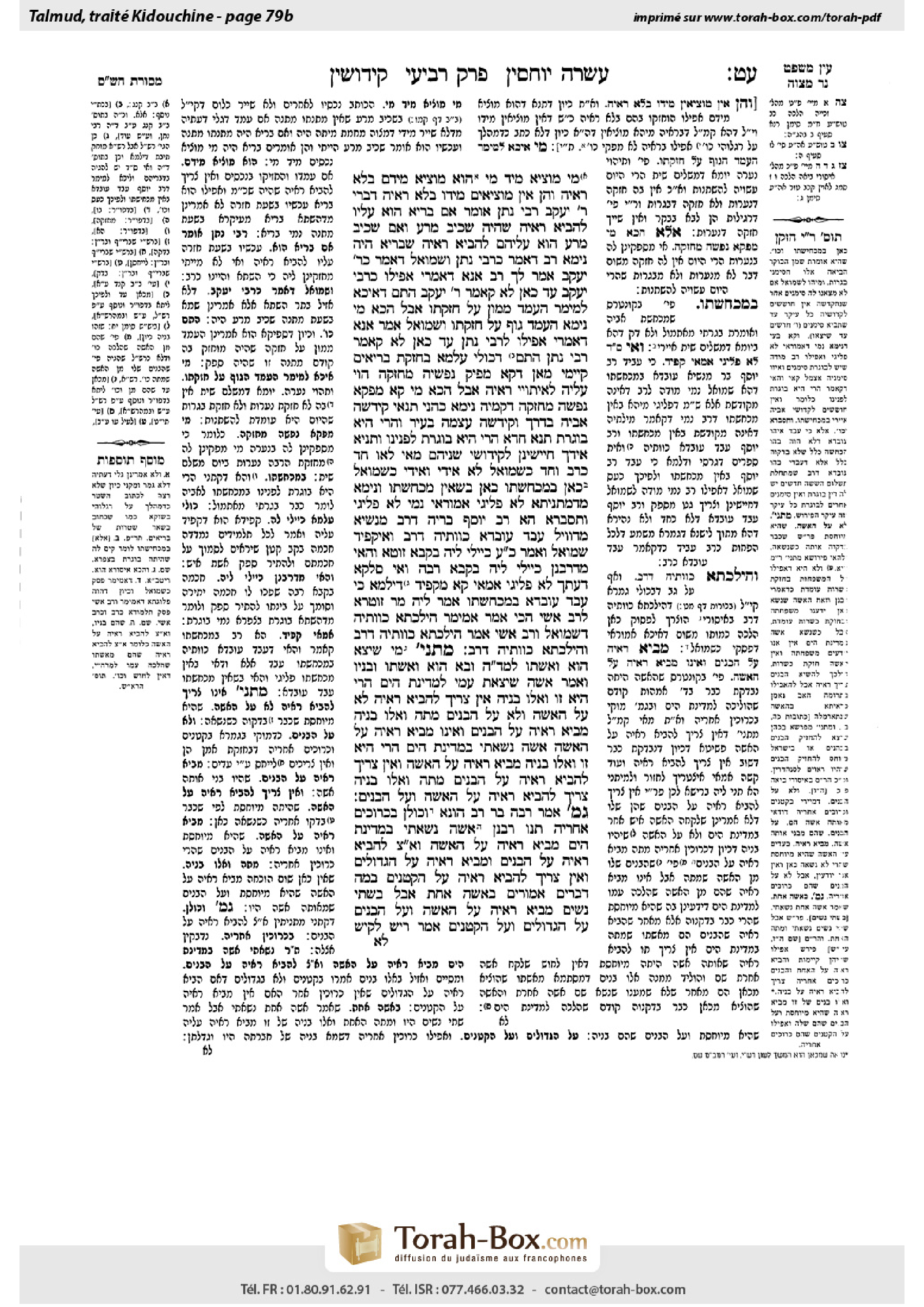
Kiddushin 79b: Talmud study for Daf Yomi
Daf Yomi is the daily study of one Talmud folio. Explore 37 tractates with scans, Hebrew text, Sefaria English and AI-generated French translations where annotated.
Passage selection and English or AI-generated French translation are available where the scan has annotations. Daf Study is independent of Torah-Box and Sefaria.
Browse Kiddushin · קידושין · All tractatesKiddushin 79b text and translations
This page of Kiddushin includes the Aramaic text, an English translation and an AI-generated French translation, alongside the scan above.
קידושין ע״ט ב · Aramaic and Hebrew text
מִי מוֹצִיא מִיַּד מִי?
הוּא מוֹצִיא מִיָּדָם בְּלֹא רְאָיָה, וְהֵן אֵין מוֹצִיאִים מִיָּדוֹ בְּלֹא רְאָיָה, דִּבְרֵי רַבִּי יַעֲקֹב. רַבִּי נָתָן אוֹמֵר: אִם בָּרִיא הוּא – עָלָיו לְהָבִיא רְאָיָה שֶׁהָיָה שְׁכִיב מְרַע, וְאִם שְׁכִיב מְרַע הוּא – עֲלֵיהֶם לְהָבִיא רְאָיָה שֶׁבָּרִיא הָיָה.
נֵימָא רַב דְּאָמַר כְּרַבִּי נָתָן וּשְׁמוּאֵל דְּאָמַר כְּרַבִּי יַעֲקֹב? אָמַר לָךְ רַב: אֲנָא דַּאֲמַרִי אֲפִילּוּ כְּרַבִּי יַעֲקֹב. עַד כָּאן לָא קָאָמַר רַבִּי יַעֲקֹב הָתָם דְּאִיכָּא לְמֵימַר הַעֲמֵד מָמוֹן עַל חֶזְקָתוֹ, אֲבָל הָכָא מִי נֵימָא הַעֲמֵד גּוּף עַל חֶזְקָתוֹ?!
וּשְׁמוּאֵל אָמַר: אֲנָא דַּאֲמַרִי אֲפִילּוּ לְרַבִּי נָתָן. עַד כָּאן לָא קָאָמַר רַבִּי נָתָן הָתָם דְּכוּלֵּי עָלְמָא בְּחֶזְקַת בְּרִיאִים קָיְימִי, מַאן דְּקָא מַפֵּיק נַפְשֵׁיהּ מֵחֲזָקָה – (הָוֵי) עֲלֵיהּ לְאֵיתוֹיֵי רְאָיָה, אֲבָל הָכָא מִי קָא מַפְּקָא נַפְשַׁהּ מֵחֲזָקָה דְּקַמֵּיהּ?
נֵימָא כְּהָנֵי תַּנָּאֵי: קִידְּשָׁהּ אָבִיהָ בַּדֶּרֶךְ וְקִידְּשָׁה עַצְמָהּ בָּעִיר וַהֲרֵי הִיא בּוֹגֶרֶת, תָּנָא חֲדָא: הֲרֵי הִיא בּוֹגֶרֶת לְפָנֵינוּ, וְתַנְיָא אִידַּךְ: חָיְישִׁינַן לְקִידּוּשֵׁי שְׁנֵיהֶם. מַאי לָאו: חַד כְּרַב וְחַד כִּשְׁמוּאֵל?
לָא, אִידִי וְאִידִי כִּשְׁמוּאֵל – כָּאן בְּמַכְחַשְׁתּוֹ, כָּאן בְּשֶׁאֵין מַכְחַשְׁתּוֹ.
וְנֵימָא מִדְּמַתְנִיתָא לָא פְּלִיגִי, אָמוֹרָאֵי נָמֵי לָא פְּלִיגִי! וְתִסְבְּרָא? הָא רַב יוֹסֵף בְּרֵיהּ דְּרַב מְנַשְּׁיָא מִדְּוִויל עֲבַד עוֹבָדָא כְּווֹתֵיהּ דְּרַב, וְאִיקְּפִיד שְׁמוּאֵל וְאָמַר: כּוּלֵּי עָלְמָא כָּיְילִי לֵיהּ בְּקַבָּא זוּטָא וְהַאי מִדְּרַבָּנַן כָּיְילִי לֵיהּ בְּקַבָּא רַבָּה? וְאִי סָלְקָא דַּעְתָּךְ לָא פְּלִיגִי, אַמַּאי קָא מִקְּפֵיד?
דִּילְמָא כִּי עֲבַד עוֹבָדָא, בְּמַכְחַשְׁתּוֹ.
אֲמַר לֵיהּ מָר זוּטְרָא לְרַב אָשֵׁי, הָכִי אָמַר אַמֵּימָר: הִילְכְתָא כְּווֹתֵיהּ דִּשְׁמוּאֵל. וְרַב אָשֵׁי אָמַר: הִילְכְתָא כְּווֹתֵיהּ דְּרַב. וְהִילְכְתָא כְּווֹתֵיהּ דְּרַב.
מַתְנִי׳ מִי שֶׁיָּצָא הוּא וְאִשְׁתּוֹ לִמְדִינַת הַיָּם, וּבָא הוּא וְאִשְׁתּוֹ וּבָנָיו וְאָמַר: ״אִשָּׁה שֶׁיָּצָאת עִמִּי לִמְדִינַת הַיָּם – הֲרֵי הִיא זוֹ, וְאֵלּוּ בָּנֶיהָ״ – אֵין צָרִיךְ לְהָבִיא רְאָיָה לֹא עַל הָאִשָּׁה, וְלֹא עַל הַבָּנִים. ״מֵתָה וְאֵלּוּ בָּנֶיהָ״ – מֵבִיא רְאָיָה עַל הַבָּנִים, וְאֵינוֹ מֵבִיא רְאָיָה עַל הָאִשָּׁה.
״אִשָּׁה נָשָׂאתִי בִּמְדִינַת הַיָּם – הֲרֵי הִיא זוֹ, וְאֵלּוּ בָּנֶיהָ״ – מֵבִיא רְאָיָה עַל הָאִשָּׁה וְאֵין צָרִיךְ לְהָבִיא רְאָיָה עַל הַבָּנִים. ״מֵתָה וְאֵלּוּ בָּנֶיהָ״ – צָרִיךְ לְהָבִיא רְאָיָה עַל הָאִשָּׁה וְעַל הַבָּנִים.
גְּמָ׳ אָמַר רַבָּה בַּר רַב הוּנָא: וְכוּלָּן בִּכְרוּכִים אַחֲרֶיהָ.
תָּנוּ רַבָּנַן: ״אִשָּׁה נָשָׂאתִי בִּמְדִינַת הַיָּם״ – מֵבִיא רְאָיָה עַל הָאִשָּׁה, וְאֵין צָרִיךְ לְהָבִיא רְאָיָה עַל הַבָּנִים. וּמֵבִיא רְאָיָה עַל הַגְּדוֹלִים, וְאֵין צָרִיךְ לְהָבִיא רְאָיָה עַל הַקְּטַנִּים. בַּמֶּה דְּבָרִים אֲמוּרִים: בְּאִשָּׁה אַחַת, אֲבָל בִּשְׁתֵּי נָשִׁים – מֵבִיא רְאָיָה עַל הָאִשָּׁה וְעַל הַבָּנִים, עַל הַגְּדוֹלִים וְעַל הַקְּטַנִּים.
אָמַר רֵישׁ לָקִישׁ:
Kiddushin 79b · English translation
The halakha is that a moribund person who transfers all of his property to others without leaving anything for himself can retract his bequest upon regaining his health. This is due to the assumption that one would give away all his possessions only if he believes he is going to die, and the bequest was therefore made in error. By contrast, if a healthy person gave all his property to others, he cannot later retract his bequest. The tanna’im discuss the case of one who gave away all his property and later, seeking to retrieve his property, claims that he was moribund at the time, while the recipients of the bequest maintain that he was healthy. Who is able to remove the property from the possession of whom?
He is able to remove his property held by others from their possession without needing to bring proof that he was moribund at the time, and they may not remove the property from his possession, if he still is in possession of the property, without proof that he was healthy. This is the statement of Rabbi Ya’akov. Rabbi Natan says: If he is currently healthy, the obligation is upon him to bring proof that he was on his deathbed at the time of the bequest, and if he is now on his deathbed, the obligation is upon them to bring proof that he was healthy at the time of the bequest.
The Gemara suggests: Let us say that Rav spoke in accordance with the opinion of Rabbi Natan that one’s current status is paramount, and Shmuel spoke in accordance with the opinion of Rabbi Ya’akov, who holds that the question of whether he was moribund remains a matter of uncertainty, and they may not claim the property from him even if he is now healthy. The Gemara rejects this: Rav could have said to you: I spoke even in accordance with the opinion of Rabbi Ya’akov, as Rabbi Ya’akov states his opinion only there, because it can be said that the principle of: Leave the property in its previous status, applies, so the property should remain where it is. But here, with regard to the question of when a young woman became a grown woman, shall we say: Establish the body according to its previous status? It is obvious that her body was due to mature.
And Shmuel could have said: I spoke even in accordance with the opinion of Rabbi Natan, since Rabbi Natan states his opinion that the current state is paramount only there, as everyone has a presumptive status of being healthy. Consequently, if a person removes himself from this presumption by claiming he was moribund, the obligation falls upon him to bring proof. But here, does she remove herself from a presumption that was present? There is no presumption that she was a grown woman in the morning.
The Gemara further suggests: Let us say that this dispute between Rav and Shmuel is parallel to a dispute between these tanna’im: With regard to a case where her father betrothed her on the way, when he was traveling, and in the meantime she betrothed herself in the city, and she is now a grown woman, one baraita taught: She is a grown woman at present, and her father cannot currently betroth her; therefore, his betrothal does not take effect. And it is taught in another baraita: We are concerned with regard to the betrothal of both of them. What, is it not the case that one baraita is in accordance with the opinion of Rav, and one baraita is in accordance with the opinion of Shmuel?
The Gemara rejects this: No; it is possible that both this and that are in accordance with the opinion of Shmuel. Here, in this baraita, it is referring to a case where she denies his right to betroth her, as she claims that she was a grown woman before his betrothal. There, it is referring to a situation where she does not deny his right to betroth her, and therefore it is uncertain which betrothal takes effect.
The Gemara asks: If so, let us also say that since the baraitot do not disagree, the opinions of the amora’im, Rav and Shmuel, do not disagree either. One is referring to a case where she denies her father’s right to betroth her, while the other is referring to a case where she does not. The Gemara rejects this: And how can you understand it that way? But Rav Yosef, son of Rav Menashya of Dabil, performed an action in this case in accordance with the opinion of Rav and did not take the father’s betrothal into account, and Shmuel took offense at this and said sarcastically: Is wisdom measured out to everyone in a small measure, and measured out to this member of the Sages in a large measure? He was angered that Rav Yosef had the audacity to rule against him in this case. Now, if it enters your mind that they did not disagree at all, why did Shmuel take offense?
Perhaps when Rav Yosef performed an action, he did so in an instance where she denied her father’s right to betroth her, in which case even Shmuel would agree that the father’s betrothal does not take effect. Rather, it must be that Rav and Shmuel did disagree, and Rav Yosef must have ruled in the case of a woman who did not deny her father’s right to betroth her, which explains why Shmuel took exception to his ruling.
Mar Zutra said to Rav Ashi: This is what Ameimar said: The halakha is in accordance with the opinion of Shmuel. And Rav Ashi said: The halakha is in accordance with the opinion of Rav. The Gemara concludes: And the halakha is in accordance with the opinion of Rav.
MISHNA: With regard to one who went overseas with his wife, and returned with his wife and children, and said: This is the woman who went overseas with me and these are her children, he is not required to bring proof with regard to the lineage of the woman, since her lineage was already investigated at the time of their marriage, nor with regard to the lineage of the children. If he returned without the woman and said: My wife died and these are her children, he must bring proof that the children were born to his wife, but he does not need to bring proof with regard to the lineage of the woman.
If he left when he was unmarried and said upon his return: I married a woman overseas, and this is she, and these are her children, he must bring proof with regard to the lineage of the woman, but he is not required to bring proof with regard to the lineage of the children. If he said: I married a woman overseas and she died, and these are her children, he is required to bring proof with regard to both the lineage of the woman and the children.
GEMARA: Rabba bar Rav Huna says: And all of the statements that he is not required to bring proof with regard to the lineage of the children are said in a case where they cling to her and treat the woman like their mother.
The Sages taught that if a man says: I married a woman overseas, he must bring proof with regard to the lineage of the woman, but he is not required to bring proof with regard to the lineage of the children. And he must bring proof with regard to the lineage of the adult children, but he is not required to bring proof with regard to the lineage of the minor children. Since their attachment to their mother is apparent, it can be assumed they are her offspring. In what case is this statement said? It is in the case of one who said he married one woman, but when it is the case of one who said he married two women overseas, he must bring proof with regard to the lineage of both the woman and the children, with regard to the adult ones and with regard to the minor ones. Even if they cling to the woman whose lineage has been found to be unflawed, they might be the children of the other wife and are merely being raised by this one.
Reish Lakish said:
Kiddushin 79b · Traduction française (IA)
La halakha est qu’un moribond qui transfère tous ses biens à autrui sans rien garder pour lui-même peut révoquer sa donation s’il recouvre la santé. Cela repose sur l’hypothèse qu’on ne donnerait tous ses biens que si l’on croit être sur le point de mourir ; la donation a donc été faite par erreur. En revanche, si une personne en bonne santé a donné tous ses biens à autrui, elle ne peut pas révoquer ensuite sa donation. Les tannaïm examinent le cas d’une personne qui a donné tous ses biens puis, cherchant à les récupérer, prétend qu’elle était moribonde à ce moment-là, tandis que les bénéficiaires de la donation soutiennent qu’elle était en bonne santé. Qui peut reprendre les biens à qui ?
Il peut reprendre ses biens détenus par d’autres sans avoir à prouver qu’il était moribond au moment de la donation ; et ceux-ci ne peuvent pas lui reprendre les biens qu’il détient encore sans prouver qu’il était en bonne santé. Telle est l’opinion de Rabbi Ya’akov. Rabbi Natan dit : s’il est actuellement en bonne santé, c’est à lui qu’incombe la charge de prouver qu’il était sur son lit de mort au moment de la donation ; et s’il est actuellement sur son lit de mort, c’est à eux qu’incombe la charge de prouver qu’il était en bonne santé au moment de la donation.
La Guemara suggère : Disons que Rav s’est exprimé conformément à l’opinion de Rabbi Natan, selon laquelle la situation actuelle est déterminante, et que Shmuel s’est exprimé conformément à l’opinion de Rabbi Ya’akov, qui considère qu’il demeure incertain s’il était moribond et qu’on ne peut pas lui réclamer les biens, même s’il est actuellement en bonne santé. La Guemara rejette cette possibilité : Rav aurait pu te dire : « Je me suis exprimé même conformément à l’opinion de Rabbi Ya’akov, car celui-ci ne donne son avis que dans ce cas, où l’on peut dire que le principe “laisser les biens dans leur état antérieur” s’applique ; les biens doivent donc rester là où ils se trouvent. Mais ici, concernant la question de savoir quand une jeune fille est devenue majeure, dirons-nous : “Établissons l’état du corps selon son état antérieur” ? Il est évident que son corps devait parvenir à maturité. »
Et Shmuel aurait pu dire : « Je me suis exprimé même conformément à l’opinion de Rabbi Natan, puisque celui-ci ne soutient que dans ce cas que la situation actuelle est déterminante, car chacun bénéficie d’une présomption de bonne santé. Par conséquent, si une personne s’écarte de cette présomption en affirmant qu’elle était moribonde, la charge de la preuve lui incombe. Mais ici, s’écarte-t-elle d’une présomption qui existait ? Il n’y a aucune présomption selon laquelle elle était majeure le matin. »
La Guemara suggère encore : Disons que cette controverse entre Rav et Shmuel correspond à une controverse entre ces tannaïm : dans le cas où son père l’a fiancée en chemin, alors qu’il voyageait, et où, entre-temps, elle s’est fiancée elle-même en ville, alors qu’elle est maintenant majeure, une baraïta enseigne : « Elle est majeure à présent et son père ne peut plus la fiancer ; par conséquent, ses fiançailles à lui ne prennent pas effet. » Une autre baraïta enseigne : « Nous devons tenir compte des fiançailles de l’un comme de l’autre. » N’est-ce pas que l’une des baraïtot est conforme à l’opinion de Rav et l’autre à celle de Shmuel ?
La Guemara rejette cette interprétation : Non ; il est possible que les deux baraïtot soient conformes à l’opinion de Shmuel. Ici, dans cette baraïta, il s’agit d’un cas où elle conteste le droit de son père à la fiancer, car elle affirme qu’elle était majeure avant ses fiançailles. Là, il s’agit d’une situation où elle ne conteste pas son droit à la fiancer ; il y a donc une incertitude quant aux fiançailles qui prennent effet.
La Guemara demande : Si c’est ainsi, disons également que, puisque les baraïtot ne sont pas en désaccord, Rav et Shmuel, les amoraïm, ne le sont pas non plus : l’un parle d’un cas où elle conteste le droit de son père à la fiancer, tandis que l’autre parle d’un cas où elle ne le conteste pas. La Guemara rejette cette possibilité : « Mais comment peux-tu comprendre les choses ainsi ? Rav Yosef, fils de Rav Menashya de Dabil, a pourtant statué dans cette affaire conformément à l’opinion de Rav, sans tenir compte des fiançailles du père, et Shmuel s’en est offusqué en disant sarcastiquement : “La sagesse est-elle distribuée à tout le monde en petite quantité, et à ce membre des Sages en grande quantité ?” » Il était irrité que Rav Yosef ait eu l’audace de statuer contre lui dans cette affaire. Or, si tu penses qu’ils n’étaient pas du tout en désaccord, pourquoi Shmuel s’en serait-il offusqué ?
Peut-être que, lorsque Rav Yosef a statué, c’était dans un cas où elle contestait le droit de son père à la fiancer ; dans ce cas, même Shmuel conviendrait que les fiançailles du père ne prennent pas effet. Il faut donc plutôt conclure que Rav et Shmuel étaient bien en désaccord, et que Rav Yosef a dû statuer dans le cas d’une femme qui ne contestait pas le droit de son père à la fiancer, ce qui explique pourquoi Shmuel a contesté sa décision.
Mar Zutra dit à Rav Ashi : « Voici ce qu’Ameimar a dit : la halakha est conforme à l’opinion de Shmuel. » Rav Ashi dit : « La halakha est conforme à l’opinion de Rav. » La Guemara conclut : la halakha est conforme à l’opinion de Rav.
MICHNA : À propos de celui qui est parti outre-mer avec sa femme, puis est revenu avec elle et ses enfants en disant : « Voici la femme qui est partie outre-mer avec moi, et voici ses enfants », il n’a pas à apporter de preuve concernant la lignée de la femme, puisque celle-ci a déjà été vérifiée au moment de leur mariage, ni concernant la lignée des enfants. S’il est revenu sans sa femme en disant : « Ma femme est morte et voici ses enfants », il doit prouver que les enfants sont nés de sa femme, mais il n’a pas à apporter de preuve concernant la lignée de la femme.
S’il est parti alors qu’il n’était pas marié et qu’à son retour il a dit : « J’ai épousé une femme outre-mer ; la voici, et voici ses enfants », il doit apporter une preuve concernant la lignée de la femme, mais n’a pas à en apporter concernant la lignée des enfants. S’il a dit : « J’ai épousé une femme outre-mer, elle est morte, et voici ses enfants », il doit apporter une preuve concernant la lignée de la femme comme celle des enfants.
GUEMARA : Rabba bar Rav Huna dit : Toutes les affirmations selon lesquelles il n’a pas à apporter de preuve concernant la lignée des enfants s’appliquent à un cas où ceux-ci s’attachent à la femme et la traitent comme leur mère.
Les Sages ont enseigné que si un homme dit : « J’ai épousé une femme outre-mer », il doit apporter une preuve concernant la lignée de la femme, mais n’a pas à en apporter concernant celle des enfants. Il doit toutefois apporter une preuve concernant la lignée des enfants adultes, mais n’a pas à en apporter concernant celle des enfants mineurs. Puisqu’il est manifeste qu’ils sont attachés à leur mère, on peut supposer qu’ils sont ses enfants. Dans quel cas cette déclaration s’applique-t-elle ? Dans celui d’un homme qui dit avoir épousé une seule femme. Mais s’il dit avoir épousé deux femmes outre-mer, il doit apporter une preuve concernant la lignée de la femme comme celle des enfants, adultes et mineurs. Même s’ils s’attachent à la femme dont la lignée a été reconnue irréprochable, ils peuvent être les enfants de l’autre épouse et être simplement élevés par celle-ci.
Reish Lakish a dit :
Traduction française générée par IA à partir de l’édition anglaise de Sefaria. Vérifie toujours un passage avec le texte source.
Text from Sefaria: William Davidson Edition - Vocalized Aramaic (CC BY NC); William Davidson Edition - English (CC BY NC).