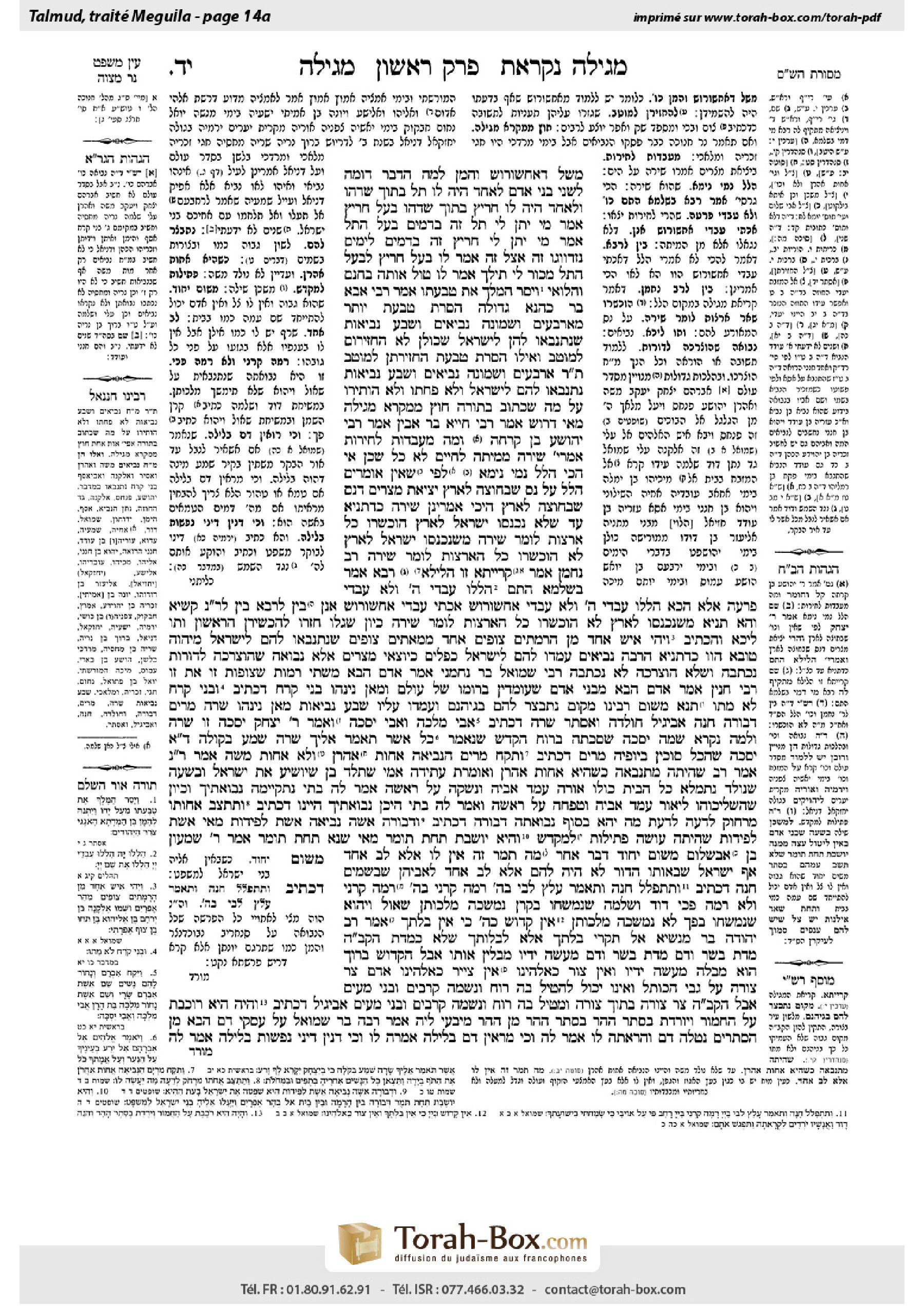
Megillah 14a: Talmud study for Daf Yomi
Daf Yomi is the daily study of one Talmud folio. Explore 37 tractates with scans, Hebrew text, Sefaria English and AI-generated French translations where annotated.
Passage selection and English or AI-generated French translation are available where the scan has annotations. Daf Study is independent of Torah-Box and Sefaria.
Browse Megillah · מגילה · All tractatesMegillah 14a text and translations
This page of Megillah includes the Aramaic text, an English translation and an AI-generated French translation, alongside the scan above.
מגילה י״ד א · Aramaic and Hebrew text
מָשָׁל דַּאֲחַשְׁוֵרוֹשׁ וְהָמָן לָמָּה הַדָּבָר דּוֹמֶה? לִשְׁנֵי בְּנֵי אָדָם, לְאֶחָד הָיָה לוֹ תֵּל בְּתוֹךְ שָׂדֵהוּ וּלְאֶחָד הָיָה לוֹ חָרִיץ בְּתוֹךְ שָׂדֵהוּ. בַּעַל חָרִיץ אָמַר: מִי יִתֵּן לִי תֵּל זֶה בְּדָמִים! בַּעַל הַתֵּל אָמַר: מִי יִתֵּן לִי חָרִיץ זֶה בְּדָמִים!
לְיָמִים נִזְדַּוְּוגוּ זֶה אֵצֶל זֶה. אָמַר לוֹ בַּעַל חָרִיץ לְבַעַל הַתֵּל: מְכוֹר לִי תִּילְּךָ! אָמַר לוֹ: טוֹל אוֹתוֹ בְּחִנָּם, וְהַלְוַאי!
״וַיָּסַר הַמֶּלֶךְ אֶת טַבַּעְתּוֹ״, אָמַר רַבִּי אַבָּא בַּר כָּהֲנָא: גְּדוֹלָה הֲסָרַת טַבַּעַת יוֹתֵר מֵאַרְבָּעִים וּשְׁמוֹנָה נְבִיאִים וְשֶׁבַע נְבִיאוֹת שֶׁנִּתְנַבְּאוּ לָהֶן לְיִשְׂרָאֵל, שֶׁכּוּלָּן לֹא הֶחֱזִירוּם לְמוּטָב, וְאִילּוּ הֲסָרַת טַבַּעַת הֶחְזִירָתַן לְמוּטָב.
תָּנוּ רַבָּנַן: אַרְבָּעִים וּשְׁמוֹנָה נְבִיאִים וְשֶׁבַע נְבִיאוֹת נִתְנַבְּאוּ לָהֶם לְיִשְׂרָאֵל, וְלֹא פִּחֲתוּ וְלֹא הוֹתִירוּ עַל מַה שֶּׁכָּתוּב בַּתּוֹרָה, חוּץ מִמִּקְרָא מְגִילָּה.
מַאי דְּרוּשׁ? אָמַר רַבִּי חִיָּיא בַּר אָבִין אָמַר רַבִּי יְהוֹשֻׁעַ בֶּן קׇרְחָה: וּמָה מֵעַבְדוּת לְחֵירוּת אָמְרִינַן שִׁירָה — מִמִּיתָה לְחַיִּים לֹא כׇּל שֶׁכֵּן.
אִי הָכִי, הַלֵּל נָמֵי נֵימָא! לְפִי שֶׁאֵין אוֹמְרִים הַלֵּל עַל נֵס שֶׁבַּחוּצָה לָאָרֶץ. יְצִיאַת מִצְרַיִם, דְּנֵס שֶׁבְּחוּצָה לָאָרֶץ, הֵיכִי אָמְרִינַן שִׁירָה?
כִּדְתַנְיָא: עַד שֶׁלֹּא נִכְנְסוּ יִשְׂרָאֵל לָאָרֶץ — הוּכְשְׁרוּ כׇּל אֲרָצוֹת לוֹמַר שִׁירָה. מִשֶּׁנִּכְנְסוּ יִשְׂרָאֵל לָאָרֶץ — לֹא הוּכְשְׁרוּ כׇּל הָאֲרָצוֹת לוֹמַר שִׁירָה.
רַב נַחְמָן אָמַר: קְרִיָּיתָהּ זוֹ הַלֵּילָהּ. רָבָא אָמַר, בִּשְׁלָמָא הָתָם: ״הַלְלוּ עַבְדֵי ה׳״ — וְלֹא עַבְדֵי פַרְעֹה, אֶלָּא הָכָא: ״הַלְלוּ עַבְדֵי ה׳״ — וְלֹא עַבְדֵי אֲחַשְׁוֵרוֹשׁ? אַכַּתִּי עַבְדֵי אֲחַשְׁוֵרוֹשׁ אֲנַן.
בֵּין לְרָבָא בֵּין לְרַב נַחְמָן קַשְׁיָא, וְהָא תַּנְיָא: מִשֶּׁנִּכְנְסוּ לָאָרֶץ — לֹא הוּכְשְׁרוּ כׇּל הָאֲרָצוֹת לוֹמַר שִׁירָה! כֵּיוָן שֶׁגָּלוּ, חָזְרוּ לְהֶכְשֵׁירָן הָרִאשׁוֹן.
וְתוּ לֵיכָּא? וְהָכְתִיב: ״וַיְהִי אִישׁ אֶחָד מִן הָרָמָתַיִם צוֹפִים״, אֶחָד מִמָּאתַיִם צוֹפִים שֶׁנִּתְנַבְּאוּ לָהֶם לְיִשְׂרָאֵל.
מִיהְוֵה טוּבָא הֲווֹ, כִּדְתַנְיָא: הַרְבֵּה נְבִיאִים עָמְדוּ לָהֶם לְיִשְׂרָאֵל, כִּפְלַיִם כְּיוֹצְאֵי מִצְרַיִם. אֶלָּא נְבוּאָה שֶׁהוּצְרְכָה לְדוֹרוֹת — נִכְתְּבָה, וְשֶׁלֹּא הוּצְרְכָה — לֹא נִכְתְּבָה.
רַבִּי שְׁמוּאֵל בַּר נַחְמָנִי אָמַר: אָדָם הַבָּא מִשְׁתֵּי רָמוֹת שֶׁצּוֹפוֹת זוֹ אֶת זוֹ. רַבִּי חָנִין אָמַר: אָדָם הַבָּא מִבְּנֵי אָדָם שֶׁעוֹמְדִין בְּרוּמוֹ שֶׁל עוֹלָם. וּמַאן נִינְהוּ? בְּנֵי קֹרַח, דִּכְתִיב: ״וּבְנֵי קֹרַח לֹא מֵתוּ״, תָּנָא מִשּׁוּם רַבֵּינוּ: מָקוֹם נִתְבַּצֵּר לָהֶם בְּגֵיהִנָּם, וְעָמְדוּ עָלָיו.
שֶׁבַע נְבִיאוֹת מַאן נִינְהוּ? שָׂרָה, מִרְיָם, דְּבוֹרָה, חַנָּה, אֲבִיגַיִל, חוּלְדָּה וְאֶסְתֵּר. שָׂרָה, דִּכְתִיב: ״אֲבִי מִלְכָּה וַאֲבִי יִסְכָּה״, וְאָמַר רַבִּי יִצְחָק: ״יִסְכָּה״ זוֹ שָׂרָה, וְלָמָּה נִקְרָא שְׁמָהּ יִסְכָּה — שֶׁסָּכְתָה בְּרוּחַ הַקֹּדֶשׁ, שֶׁנֶּאֱמַר: ״כֹּל אֲשֶׁר תֹּאמַר אֵלֶיךָ שָׂרָה שְׁמַע בְּקוֹלָהּ״. דָּבָר אַחֵר: ״יִסְכָּה״ — שֶׁהַכֹּל סוֹכִין בְּיוֹפְיָהּ.
מִרְיָם — דִּכְתִיב: ״וַתִּקַּח מִרְיָם הַנְּבִיאָה אֲחוֹת אַהֲרֹן״, וְלֹא אֲחוֹת מֹשֶׁה, אָמַר רַב נַחְמָן אָמַר רַב: שֶׁהָיְתָה מִתְנַבְּאָה כְּשֶׁהִיא אֲחוֹת אַהֲרֹן, וְאוֹמֶרֶת: עֲתִידָה אִמִּי שֶׁתֵּלֵד בֵּן שֶׁיּוֹשִׁיעַ אֶת יִשְׂרָאֵל. וּבְשָׁעָה שֶׁנּוֹלַד נִתְמַלֵּא כָּל הַבַּיִת כּוּלּוֹ אוֹרָה, עָמַד אָבִיהָ וּנְשָׁקָהּ עַל רֹאשָׁהּ, אָמַר לָהּ: בִּתִּי נִתְקַיְּימָה נְבוּאָתִיךְ.
וְכֵיוָן שֶׁהִשְׁלִיכוּהוּ לַיְאוֹר, עָמַד אָבִיהָ וּטְפָחָהּ עַל רֹאשָׁהּ, וְאָמַר לָהּ: בִּתִּי הֵיכָן נְבוּאָתִיךְ? הַיְינוּ דִּכְתִיב: ״וַתֵּתַצַּב אֲחוֹתוֹ מֵרָחוֹק לְדֵעָה״. לָדַעַת מָה יְהֵא בְּסוֹף נְבוּאָתָהּ.
דְּבוֹרָה, דִּכְתִיב: ״וּדְבוֹרָה אִשָּׁה נְבִיאָה אֵשֶׁת לַפִּידוֹת״, מַאי ״אֵשֶׁת לַפִּידוֹת״? שֶׁהָיְתָה עוֹשָׂה פְּתִילוֹת לַמִּקְדָּשׁ.
״וְהִיא יוֹשֶׁבֶת תַּחַת תּוֹמֶר״. מַאי שְׁנָא תַּחַת תּוֹמֶר? אָמַר רַבִּי שִׁמְעוֹן בֶּן אַבְשָׁלוֹם: מִשּׁוּם יִחוּד. דָּבָר אַחֵר: מָה תָּמָר זֶה אֵין לוֹ אֶלָּא לֵב אֶחָד — אַף יִשְׂרָאֵל שֶׁבְּאוֹתוֹ הַדּוֹר לֹא הָיָה לָהֶם אֶלָּא לֵב אֶחָד לַאֲבִיהֶן שֶׁבַּשָּׁמַיִם.
חַנָּה — דִּכְתִיב: ״וַתִּתְפַּלֵּל חַנָּה וַתֹּאמַר עָלַץ לִבִּי בַּה׳ רָמָה קַרְנִי בַּה׳״. ״רָמָה קַרְנִי״, וְלֹא רָמָה פַּכִּי. דָּוִד וּשְׁלֹמֹה שֶׁנִּמְשְׁחוּ בְּקֶרֶן — נִמְשְׁכָה מַלְכוּתָן, שָׁאוּל וְיֵהוּא שֶׁנִּמְשְׁחוּ בְּפַךְ — לֹא נִמְשְׁכָה מַלְכוּתָן.
״אֵין קָדוֹשׁ כַּה׳ כִּי אֵין בִּלְתֶּךָ״, אָמַר רַב יְהוּדָה בַּר מְנַשְּׁיָא: אַל תִּקְרֵי ״בִּלְתֶּךָ״, אֶלָּא ״לְבַלּוֹתֶךָ״. שֶׁלֹּא כְּמִדַּת הַקָּדוֹשׁ בָּרוּךְ הוּא מִדַּת בָּשָׂר וְדָם. מִדַּת בָּשָׂר וְדָם — מַעֲשֵׂה יָדָיו מְבַלִּין אוֹתוֹ, אֲבָל הַקָּדוֹשׁ בָּרוּךְ הוּא — מְבַלֶּה מַעֲשֵׂה יָדָיו.
״וְאֵין צוּר כֵּאלֹהֵינוּ״, אֵין צַיָּיר כֵּאלֹהֵינוּ. אָדָם צָר צוּרָה עַל גַּבֵּי הַכּוֹתֶל וְאֵינוֹ יָכוֹל לְהַטִּיל בָּהּ רוּחַ וּנְשָׁמָה, קְרָבַיִם וּבְנֵי מֵעַיִם. אֲבָל הַקָּדוֹשׁ בָּרוּךְ הוּא צָר צוּרָה בְּתוֹךְ צוּרָה, וּמֵטִיל בָּהּ רוּחַ וּנְשָׁמָה, קְרָבַיִם וּבְנֵי מֵעַיִם.
אֲבִיגַיִל, דִּכְתִיב: ״וְהָיָה הִיא רוֹכֶבֶת עַל הַחֲמוֹר וְיוֹרֶדֶת בְּסֵתֶר הָהָר״. ״בְּסֵתֶר הָהָר״? ״מִן הָהָר״ מִיבְּעֵי לֵיהּ!
אָמַר רַבָּה בַּר שְׁמוּאֵל: עַל עִסְקֵי דָם הַבָּא מִן הַסְּתָרִים. נָטְלָה דָּם וְהֶרְאֲתָה לוֹ. אָמַר לָהּ: וְכִי מַרְאִין דָּם בַּלַּיְלָה? אָמְרָה לוֹ: וְכִי דָּנִין דִּינֵי נְפָשׁוֹת בַּלַּיְלָה? אָמַר לָהּ:
Megillah 14a · English translation
The actions of Ahasuerus and Haman can be understood with a parable; to what may they be compared? To two individuals, one of whom had a mound in the middle of his field and the other of whom had a ditch in the middle of his field, each one suffering from his own predicament. The owner of the ditch, noticing the other’s mound of dirt, said to himself: Who will give me this mound of dirt suitable for filling in my ditch; I would even be willing to pay for it with money, and the owner of the mound, noticing the other’s ditch, said to himself: Who will give me this ditch for money, so that I may use it to remove the mound of earth from my property?
At a later point, one day, they happened to have met one another. The owner of the ditch said to the owner of the mound: Sell me your mound so I can fill in my ditch. The mound’s owner, anxious to rid himself of the excess dirt on his property, said to him: Take it for free; if only you had done so sooner. Similarly, Ahasuerus himself wanted to destroy the Jews. As he was delighted that Haman had similar aspirations and was willing to do the job for him, he demanded no money from him.
§ The verse states: “And the king removed his ring from his hand” (Esther 3:10). Rabbi Abba bar Kahana said: The removal of Ahasuerus’s ring for the sealing of Haman’s decree was more effective than the forty-eight prophets and the seven prophetesses who prophesied on behalf of the Jewish people. As, they were all unable to return the Jewish people to the right way, but the removal of Ahasuerus’s ring returned them to the right way, since it brought them to repentance.
The Sages taught in a baraita: Forty-eight prophets and seven prophetesses prophesied on behalf of the Jewish people, and they neither subtracted from nor added onto what is written in the Torah, introducing no changes or additions to the mitzvot except for the reading of the Megilla, which they added as an obligation for all future generations.
The Gemara asks: What exposition led them to determine that this was a proper mode of action? On what basis did they add this mitzva? Rabbi Ḥiyya bar Avin said that Rabbi Yehoshua ben Korḥa said that they reasoned as follows: If, when recalling the exodus from Egypt, in which the Jews were delivered from slavery to freedom, we recite songs of praise, the Song of the Sea and the hymns of hallel, then, in order to properly recall the miracle of Purim and commemorate God’s delivering us from death to life, is it not all the more so the case that we must sing God’s praise by reading the story in the Megilla?
The Gemara asks: If so, our obligation should be at least as great as when we recall the exodus from Egypt, and let us also recite hallel on Purim. The Gemara answers: Hallel is not said on Purim, because hallel is not recited on a miracle that occurred outside Eretz Yisrael. The Gemara asks: If so, with regard to the exodus from Egypt as well, which was a miracle that occurred outside Eretz Yisrael, how are we able to recite songs of praise?
The Gemara answers: As it is taught in a baraita: Prior to the time when the Jewish people entered Eretz Yisrael, all lands were deemed fit for songs of praise to be recited for miracles performed within their borders, as all lands were treated equally. But after the Jewish people entered Eretz Yisrael, that land became endowed with greater sanctity, and all the other lands were no longer deemed fit for songs of praise to be recited for miracles performed within them.
Rav Naḥman said an alternative answer as to why hallel is not recited on Purim: The reading of the Megilla itself is an act of reciting hallel. Rava said a third reason why hallel is not recited on Purim: Granted that hallel is said there, when recalling the exodus from Egypt, as after the salvation there, they could recite the phrase in hallel: “Give praise, O servants of the Lord” (Psalms 113:1); after their servitude to Pharaoh ended with their salvation, they were truly servants of the Lord and not servants of Pharaoh. But can it be said here, after the limited salvation commemorated on Purim: “Give praise, O servants of the Lord,” which would indicate that after the salvation the Jewish people were only servants of the Lord and not servants of Ahasuerus? No, even after the miracle of Purim, we were still the servants of Ahasuerus, as the Jews remained in exile under Persian rule, and consequently the salvation, which was incomplete, did not merit an obligation to say hallel.
The Gemara asks: Both according to the opinion of Rava and according to the opinion of Rav Naḥman, this is difficult. Isn’t it taught in the baraita cited earlier: After the Jewish people entered Eretz Yisrael, that land became endowed with greater sanctity, and all the other lands were no longer deemed fit for songs of praise to be recited for miracles performed within them. Therefore, there should be no hallel obligation on Purim for the miracle performed outside of the land of Israel, and Rav Naḥman’s and Rava’s alternative explanations are incorrect. The Gemara answers: They understood differently, as it can be argued that when the people were exiled from Eretz Yisrael, the other lands returned to their initial suitability, and were once again deemed fit for reciting hallel on miracles performed within them.
With regard to the statement that forty-eight prophets and seven prophetesses prophesied on behalf of the Jewish people, the Gemara asks: Is there no one else? Isn’t it written with regard to Samuel’s father, Elkanah: “And there was a certain [eḥad] man from Ramathaim-zophim” (I Samuel 1:1), which is expounded as follows to indicate that Elkanah was a prophet: He was one [eḥad] of two hundred [mata’im] prophets [tzofim] who prophesied on behalf of the Jewish people. If so, why was it stated here that there were only forty-eight prophets?
The Gemara answers: In fact, there were more prophets, as it is taught in a baraita: Many prophets arose for the Jewish people, numbering double the number of Israelites who left Egypt. However, only a portion of the prophecies were recorded, because only prophecy that was needed for future generations was written down in the Bible for posterity, but that which was not needed, as it was not pertinent to later generations, was not written. Therefore, the fifty-five prophets recorded in the Bible, although not the only prophets of the Jewish people, were the only ones recorded, due to their eternal messages.
Rabbi Shmuel bar Naḥmani said another explanation of the verse “And there was a certain man from Ramathaim-zophim”: A man who comes from two heights [ramot] that face [tzofot] one another. Rabbi Ḥanin said an additional interpretation: A man who descends from people who stood at the height of [rumo] the world. The Gemara asks: And who are these people? The Gemara answers: These are the sons of Korah, as it is written: “But the sons of Korah did not die” (Numbers 26:11), and with regard to them it is taught in the name of our teacher, Rabbi Yehuda HaNasi: A high place was set aside for them in Gehenna, as the sons of Korah repented in their hearts, and were consequently not propelled very far down in Gehenna when the earth opened to swallow Korah and his followers; and they stood on this high place and sung to the Lord. They alone stood at the height of the lower world.
§ The Gemara asks with regard to the prophetesses recorded in the baraita: Who were the seven prophetesses? The Gemara answers: Sarah, Miriam, Deborah, Hannah, Abigail, Huldah, and Esther. The Gemara offers textual support: Sarah, as it is written: “Haran, the father of Milcah, and the father of Iscah” (Genesis 11:29). And Rabbi Yitzḥak said: Iscah is in fact Sarah. And why was she called Iscah? For she saw [sakhta] by means of divine inspiration, as it is stated: “In all that Sarah has said to you, hearken to her voice” (Genesis 21:12). Alternatively, Sarah was also called Iscah, for all gazed [sokhin] upon her beauty.
Miriam was a prophetess, as it is written explicitly: “And Miriam the prophetess, the sister of Aaron, took a timbrel in her hand” (Exodus 15:20). The Gemara asks: Was she the sister only of Aaron, and not the sister of Moses? Why does the verse mention only one of her brothers? Rav Naḥman said that Rav said: For she prophesied when she was the sister of Aaron, i.e., she prophesied since her youth, even before Moses was born, and she would say: My mother is destined to bear a son who will deliver the Jewish people to salvation. And at the time when Moses was born the entire house was filled with light, and her father stood and kissed her on the head, and said to her: My daughter, your prophecy has been fulfilled.
But once Moses was cast into the river, her father arose and rapped her on the head, saying to her: My daughter, where is your prophecy now, as it looked as though the young Moses would soon meet his end. This is the meaning of that which is written with regard to Miriam’s watching Moses in the river: “And his sister stood at a distance to know what would be done to him” (Exodus 2:4), i.e., to know what would be with the end of her prophecy, as she had prophesied that her brother was destined to be the savior of the Jewish people.
Deborah was a prophetess, as it is written explicitly: “And Deborah, a prophetess, the wife of Lappidoth” (Judges 4:4). The Gemara asks: What is the meaning of “the wife of Lappidoth”? The Gemara answers: For she used to make wicks for the Sanctuary, and due to the flames [lappidot] on these wicks she was called the wife of Lappidoth, literally, a woman of flames.
With regard to Deborah, it says: “And she sat under a palm tree” (Judges 4:5). The Gemara asks: What is different and unique with regard to her sitting “under a palm tree” that there is a need for it to be written? Rabbi Shimon ben Avshalom said: It is due to the prohibition against being alone together with a man. Since men would come before her for judgment, she established for herself a place out in the open and visible to all, in order to avoid a situation in which she would be secluded with a man behind closed doors. Alternatively, the verse means: Just as a palm tree has only one heart, as a palm tree does not send out separate branches, but rather has only one main trunk, so too, the Jewish people in that generation had only one heart, directed to their Father in Heaven.
Hannah was a prophetess, as it is written: “And Hannah prayed and said, My heart rejoices in the Lord, my horn is exalted in the Lord” (I Samuel 2:1), and her words were prophecy, in that she said: “My horn is exalted,” and not: My pitcher is exalted. As, with regard to David and Solomon, who were anointed with oil from a horn, their kingship continued, whereas with regard to Saul and Jehu, who were anointed with oil from a pitcher, their kingship did not continue. This demonstrates that Hannah was a prophetess, as she prophesied that only those anointed with oil from a horn will merit that their kingships continue.
Apropos the song of Hannah, the Gemara further explains her words: “There is none sacred as the Lord; for there is none beside You [biltekha]” (I Samuel 2:2). Rav Yehuda bar Menashya said: Do not read it as biltekha, “beside You,” but rather read it as levalotekha, to outlast You. As the attribute of the Holy One, Blessed be He, is unlike the attribute of flesh and blood. It is an attribute of man that his handiwork outlasts him and continues to exist even after he dies, but the Holy One, Blessed be He, outlasts His handiwork, as He exists eternally.
Hannah further said: “Neither is there any rock [tzur] like our God” (I Samuel 2:1). This can be understood as saying that there is no artist [tzayyar] like our God. How is He better than all other artists? Man fashions a form upon a wall, but is unable to endow it with breath and a soul, or fill it with innards and intestines, whereas the Holy One, Blessed be He, fashions a form of a fetus inside the form of its mother, rather than on a flat surface, and endows it with breath and a soul and fills it with innards and intestines.
Abigail was a prophetess, as it is written: “And it was so, as she rode on the donkey, and came down by the covert of the mountain” (I Samuel 25:20). The Gemara asks: Why does it say: “By the covert [beseter] of the mountain”? It should have said: From the mountain.
The Gemara answers that in fact this must be understood as an allusion to something else. Rabba bar Shmuel said: Abigail, in her attempt to prevent David from killing her husband Nabal, came to David and questioned him on account of menstrual blood that comes from the hidden parts [setarim] of a body. How so? She took a blood-stained cloth and showed it to him, asking him to rule on her status, whether or not she was ritually impure as a menstruating woman. He said to her: Is blood shown at night? One does not examine blood-stained cloths at night, as it is difficult to distinguish between the different shades by candlelight. She said to him: If so, you should also remember another halakha: Are cases of capital law tried at night? Since one does not try capital cases at night, you cannot condemn Nabal to death at night. David said to her:
Megillah 14a · Traduction française (IA)
Les actes d’Assuérus et de Haman peuvent être compris au moyen d’une parabole. À quoi peut-on les comparer ? À deux hommes, dont l’un avait un monticule au milieu de son champ et l’autre une fosse au milieu du sien, chacun souffrant de son propre problème. Le propriétaire de la fosse, remarquant le monticule de terre de l’autre, se dit : « Qui me donnera ce monticule de terre, qui conviendrait pour combler ma fosse ? Je serais même prêt à le payer. » Et le propriétaire du monticule, remarquant la fosse de l’autre, se dit : « Qui me donnera cette fosse contre de l’argent, afin que je puisse m’en servir pour enlever le monticule de terre de ma propriété ? »
Plus tard, un jour, il arriva qu’ils se rencontrèrent. Le propriétaire de la fosse dit au propriétaire du monticule : « Vends-moi ton monticule, afin que je puisse combler ma fosse. » Le propriétaire du monticule, désireux de se débarrasser de l’excédent de terre sur sa propriété, lui dit : « Prends-le gratuitement ; si seulement tu l’avais fait plus tôt ! » De même, Assuérus lui-même voulait détruire les Juifs. Ravi que Haman nourrisse les mêmes ambitions et soit prêt à faire le travail pour lui, il ne lui réclama pas d’argent.
§ Le verset dit : « Le roi ôta son anneau de sa main » (Esther 3, 10). Rabbi Abba bar Kahana dit : Le retrait de l’anneau d’Assuérus pour sceller le décret de Haman fut plus efficace que les quarante-huit prophètes et les sept prophétesses qui prophétisèrent en faveur du peuple juif. En effet, tous furent incapables de ramener le peuple juif dans la bonne voie, tandis que le retrait de l’anneau d’Assuérus le ramena dans la bonne voie, car il le conduisit à la repentance.
Les Sages ont enseigné dans une baraïta : Quarante-huit prophètes et sept prophétesses prophétisèrent en faveur du peuple juif, et ils ne retranchèrent ni n’ajoutèrent rien à ce qui est écrit dans la Torah. Ils n’introduisirent aucun changement ni ajout aux mitsvot, à l’exception de la lecture de la Meguila, qu’ils instituèrent comme obligation pour toutes les générations à venir.
La Guemara demande : Quel raisonnement les conduisit à déterminer qu’il s’agissait d’une conduite appropriée ? Sur quelle base ajoutèrent-ils cette mitsva ? Rabbi Ḥiyya bar Avin dit au nom de Rabbi Yehoshua ben Korḥa qu’ils raisonnèrent ainsi : Si, lorsque nous évoquons la sortie d’Égypte, au cours de laquelle les Juifs furent délivrés de l’esclavage et rendus à la liberté, nous chantons des louanges — le Chant de la mer et les hymnes du Hallel —, alors, pour rappeler comme il se doit le miracle de Pourim et commémorer le fait que Dieu nous délivra de la mort pour nous rendre à la vie, n’est-il pas à plus forte raison nécessaire de chanter les louanges de Dieu en lisant le récit dans la Meguila ?
La Guemara demande : Si tel est le cas, notre obligation devrait être au moins aussi grande que lorsque nous évoquons la sortie d’Égypte, et nous devrions aussi réciter le Hallel à Pourim. La Guemara répond : On ne récite pas le Hallel à Pourim, car on ne récite pas le Hallel pour un miracle qui s’est produit hors d’Eretz Israël. La Guemara demande : Si tel est le cas, comment pouvons-nous réciter des chants de louange à propos de la sortie d’Égypte, qui fut elle aussi un miracle survenu hors d’Eretz Israël ?
La Guemara répond : Comme l’enseigne une baraïta : Avant que le peuple juif n’entre en Eretz Israël, toutes les terres étaient considérées comme propices à la récitation de chants de louange pour les miracles accomplis sur leur territoire, car toutes étaient traitées de la même manière. Mais après l’entrée du peuple juif en Eretz Israël, cette terre fut dotée d’une plus grande sainteté, et toutes les autres terres ne furent plus considérées comme propices à la récitation de chants de louange pour les miracles qui s’y étaient produits.
Rav Naḥman donna une autre réponse à la question de savoir pourquoi on ne récite pas le Hallel à Pourim : la lecture de la Meguila constitue en elle-même une récitation du Hallel. Rava donna une troisième raison : certes, on récite le Hallel là-bas, lorsqu’on évoque la sortie d’Égypte, car après cette délivrance, ils pouvaient réciter cette phrase du Hallel : « Louez, serviteurs de l’Éternel » (Psaumes 113, 1). Une fois délivrés de leur servitude à Pharaon, ils étaient véritablement serviteurs de l’Éternel et non de Pharaon. Mais peut-on dire ici, après la délivrance limitée commémorée à Pourim : « Louez, serviteurs de l’Éternel », ce qui indiquerait qu’après cette délivrance le peuple juif n’était serviteur que de l’Éternel et non d’Assuérus ? Non, même après le miracle de Pourim, nous étions encore les serviteurs d’Assuérus, puisque les Juifs demeuraient en exil sous la domination perse. Par conséquent, cette délivrance, qui était incomplète, ne justifiait pas l’obligation de réciter le Hallel.
La Guemara demande : Les opinions de Rava et de Rav Naḥman soulèvent toutes deux une difficulté. N’enseigne-t-on pas dans la baraïta citée précédemment qu’après l’entrée du peuple juif en Eretz Israël, cette terre fut dotée d’une plus grande sainteté, et que toutes les autres terres ne furent plus considérées comme propices à la récitation de chants de louange pour les miracles qui s’y étaient produits ? Il ne devrait donc pas y avoir d’obligation de réciter le Hallel à Pourim pour un miracle survenu hors d’Eretz Israël, et les explications alternatives de Rav Naḥman et de Rava sont erronées. La Guemara répond : Ils comprenaient la chose autrement, car on peut soutenir que lorsque le peuple fut exilé d’Eretz Israël, les autres terres retrouvèrent leur aptitude initiale et furent de nouveau considérées comme propices à la récitation du Hallel pour les miracles qui s’y étaient produits.
À propos de l’affirmation selon laquelle quarante-huit prophètes et sept prophétesses prophétisèrent en faveur du peuple juif, la Guemara demande : N’y en eut-il pas d’autres ? À propos du père de Samuel, Elkana, n’est-il pas écrit : « Il y avait un certain homme [eḥad] de Ramataïm-Tsofim » (I Samuel 1, 1), expression interprétée ainsi pour indiquer qu’Elkana était prophète : il était l’un [eḥad] des deux cents [mata’im] prophètes [tzofim] qui prophétisaient en faveur du peuple juif. Si tel est le cas, pourquoi a-t-on dit ici qu’il n’y avait que quarante-huit prophètes ?
La Guemara répond : En réalité, il y eut davantage de prophètes, comme l’enseigne une baraïta : De nombreux prophètes se levèrent pour le peuple juif, leur nombre étant le double de celui des Israélites sortis d’Égypte. Toutefois, seule une partie de leurs prophéties fut consignée, car seules celles qui étaient nécessaires aux générations futures furent inscrites dans la Bible pour la postérité ; celles qui n’étaient pas nécessaires, parce qu’elles ne concernaient pas les générations ultérieures, ne furent pas consignées. Ainsi, les cinquante-cinq prophètes mentionnés dans la Bible, bien qu’ils n’aient pas été les seuls prophètes du peuple juif, furent les seuls à y être consignés en raison de la portée durable de leurs messages.
Rabbi Shmuel bar Naḥmani donna une autre explication du verset : « Il y avait un certain homme de Ramataïm-Tsofim » : un homme issu de deux hauteurs [ramot] qui se font face [tzofot]. Rabbi Ḥanin donna une interprétation supplémentaire : un homme descendant de personnes qui se tenaient au sommet [rumo] du monde. La Guemara demande : Et qui sont ces personnes ? La Guemara répond : Ce sont les fils de Koré, comme il est écrit : « Mais les fils de Koré ne moururent pas » (Nombres 26, 11). À leur propos, on enseigne au nom de notre maître, Rabbi Yehuda HaNasi : une haute place leur fut réservée dans la Géhenne, car les fils de Koré se repentirent dans leur cœur et ne furent donc pas précipités très bas dans la Géhenne lorsque la terre s’ouvrit pour engloutir Koré et ses partisans ; ils se tinrent sur cette haute place et chantèrent pour l’Éternel. Eux seuls se tinrent au sommet du monde inférieur.
§ À propos des prophétesses mentionnées dans la baraïta, la Guemara demande : Qui étaient les sept prophétesses ? La Guemara répond : Sarah, Miriam, Déborah, Hanna, Abigaïl, Houlda et Esther. Elle apporte des preuves tirées des textes : Sarah, comme il est écrit : « Haran, père de Milca et père d’Isca » (Genèse 11, 29). Rabbi Yitzḥak dit : Isca, en réalité, c’est Sarah. Et pourquoi l’appelait-on Isca ? Parce qu’elle voyait [sakhta] par inspiration divine, comme il est dit : « En tout ce que Sarah te dira, écoute sa voix » (Genèse 21, 12). Autre explication : Sarah était aussi appelée Isca parce que tous contemplaient [sokhin] sa beauté.
Miriam était prophétesse, comme il est explicitement écrit : « Miriam la prophétesse, sœur d’Aaron, prit un tambourin dans sa main » (Exode 15, 20). La Guemara demande : Était-elle seulement la sœur d’Aaron, et non celle de Moïse ? Pourquoi le verset ne mentionne-t-il qu’un seul de ses frères ? Rav Naḥman dit au nom de Rav : Parce qu’elle prophétisait lorsqu’elle était la sœur d’Aaron, c’est-à-dire dès sa jeunesse, avant même la naissance de Moïse, et qu’elle disait : « Ma mère est destinée à mettre au monde un fils qui conduira le peuple juif au salut. » Au moment de la naissance de Moïse, toute la maison fut emplie de lumière. Son père se leva, l’embrassa sur la tête et lui dit : « Ma fille, ta prophétie s’est accomplie. »
Mais une fois que Moïse fut jeté dans le fleuve, son père se leva et lui donna un coup sur la tête en lui disant : « Ma fille, où est donc ta prophétie maintenant ? », car il semblait que le jeune Moïse allait bientôt mourir. C’est le sens de ce qui est écrit à propos de Miriam qui surveillait Moïse dans le fleuve : « Sa sœur se tint à distance pour savoir ce qui lui arriverait » (Exode 2, 4), c’est-à-dire pour savoir ce qu’il adviendrait de sa prophétie, puisqu’elle avait prophétisé que son frère devait être le sauveur du peuple juif.
Déborah était prophétesse, comme il est explicitement écrit : « Déborah, une prophétesse, femme de Lappidoth » (Juges 4, 4). La Guemara demande : Que signifie « femme de Lappidoth » ? La Guemara répond : Elle avait l’habitude de fabriquer des mèches pour le Sanctuaire et, à cause des flammes [lappidot] de ces mèches, on l’appelait « femme de Lappidoth », littéralement « femme de flammes ».
À propos de Déborah, il est dit : « Elle siégeait sous un palmier » (Juges 4, 5). La Guemara demande : Qu’y a-t-il de particulier dans le fait qu’elle siégeait « sous un palmier », pour que cela soit mentionné ? Rabbi Shimon ben Avshalom dit : Cela tient à l’interdiction de se retrouver seul avec un homme. Comme les hommes venaient la voir pour obtenir un jugement, elle s’était aménagé un lieu en plein air, visible de tous, afin d’éviter de se trouver isolée avec un homme derrière des portes closes. Autre explication : le verset signifie que, de même qu’un palmier n’a qu’un seul cœur, car il ne produit pas de branches distinctes mais possède un seul tronc principal, le peuple juif de cette génération n’avait lui aussi qu’un seul cœur, tourné vers son Père qui est dans les Cieux.
Hanna était prophétesse, comme il est écrit : « Hanna pria et dit : Mon cœur se réjouit en l’Éternel, ma corne s’élève en l’Éternel » (I Samuel 2, 1). Ses paroles étaient prophétiques, car elle dit : « Ma corne s’élève », et non : « Ma cruche s’élève ». En effet, la royauté de David et de Salomon, qui furent oints avec de l’huile provenant d’une corne, se perpétua, tandis que celle de Saül et de Jéhu, qui furent oints avec de l’huile provenant d’une cruche, ne se perpétua pas. Cela démontre que Hanna était prophétesse, puisqu’elle prophétisa que seuls ceux qui seraient oints avec de l’huile provenant d’une corne verraient leur royauté se perpétuer.
À propos du chant de Hanna, la Guemara explique encore ses paroles : « Nul n’est saint comme l’Éternel, car il n’y en a pas d’autre que Toi [biltekha] » (I Samuel 2, 2). Rav Yehuda bar Menashya dit : Ne lis pas biltekha, « à côté de Toi », mais plutôt levalotekha, « qui te survivrait ». Car l’attribut du Saint, béni soit-Il, diffère de celui des êtres de chair et de sang. L’homme peut laisser une œuvre qui lui survit et continue d’exister après sa mort, mais le Saint, béni soit-Il, survit à son œuvre, car Il existe éternellement.
Hanna dit encore : « Il n’y a pas de rocher [tzur] comme notre Dieu » (I Samuel 2, 1). On peut comprendre cela comme signifiant qu’il n’y a pas d’artiste [tzayyar] comme notre Dieu. En quoi est-Il supérieur à tous les autres artistes ? L’homme façonne une forme sur un mur, mais il est incapable de lui insuffler le souffle et une âme, ou de la remplir d’organes et d’intestins. En revanche, le Saint, béni soit-Il, façonne la forme d’un fœtus à l’intérieur de sa mère, et non sur une surface plane, lui insuffle le souffle et une âme, et le remplit d’organes et d’intestins.
Abigaïl était prophétesse, comme il est écrit : « Et il arriva, tandis qu’elle chevauchait l’âne et descendait par l’abri de la montagne » (I Samuel 25, 20). La Guemara demande : Pourquoi est-il dit « par l’abri [beseter] de la montagne » ? Il aurait fallu dire : « de la montagne ».
La Guemara répond qu’en réalité, il faut comprendre cela comme une allusion à autre chose. Rabba bar Shmuel dit : Abigaïl, dans sa tentative d’empêcher David de tuer son mari Naval, vint trouver David et l’interrogea au sujet du sang menstruel, qui provient des parties cachées [setarim] du corps. Comment cela ? Elle prit un linge taché de sang et le lui montra, en lui demandant de statuer sur son statut, c’est-à-dire de déterminer si elle était ou non rituellement impure comme une femme menstruée. Il lui dit : « Montre-t-on du sang la nuit ? » On n’examine pas les linges tachés de sang la nuit, car il est difficile de distinguer les différentes nuances à la lumière d’une bougie. Elle lui dit : « Dans ce cas, tu devrais aussi te rappeler une autre halakha : juge-t-on les affaires de droit pénal capital la nuit ? » Puisqu’on ne juge pas les affaires capitales la nuit, tu ne peux pas condamner Naval à mort pendant la nuit. David lui dit :
Traduction française générée par IA à partir de l’édition anglaise de Sefaria. Vérifie toujours un passage avec le texte source.
Text from Sefaria: William Davidson Edition - Vocalized Aramaic (CC BY NC); William Davidson Edition - English (CC BY NC).