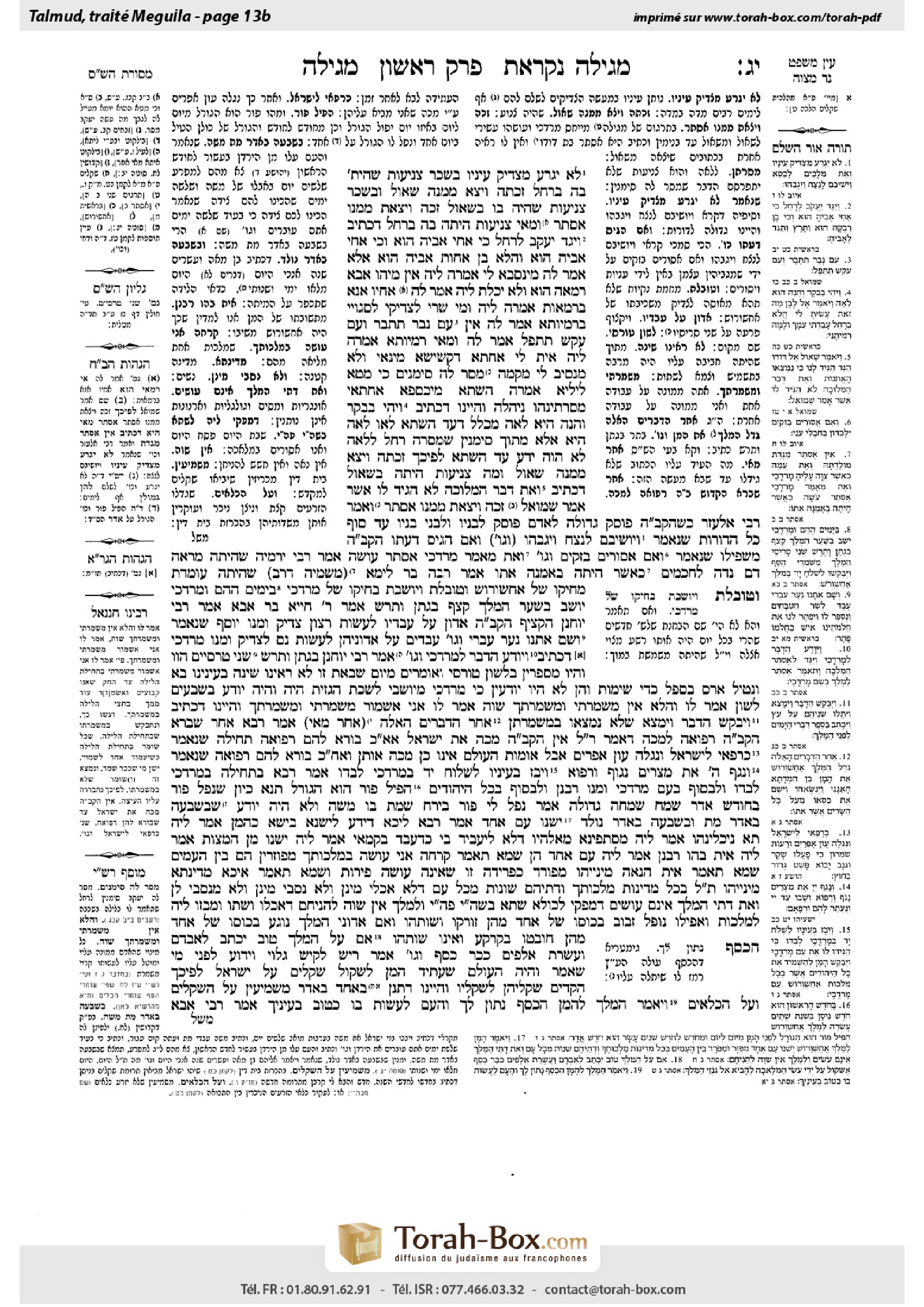
Megillah 13b: Talmud study for Daf Yomi
Daf Yomi is the daily study of one Talmud folio. Explore 37 tractates with scans, Hebrew text, Sefaria English and AI-generated French translations where annotated.
Passage selection and English or AI-generated French translation are available where the scan has annotations. Daf Study is independent of Torah-Box and Sefaria.
Browse Megillah · מגילה · All tractatesMegillah 13b text and translations
This page of Megillah includes the Aramaic text, an English translation and an AI-generated French translation, alongside the scan above.
מגילה י״ג ב · Aramaic and Hebrew text
״לֹא יִגְרַע מִצַּדִּיק עֵינָיו״ — בִּשְׂכַר צְנִיעוּת שֶׁהָיְתָה בָּהּ בְּרָחֵל זָכְתָה וְיָצָא מִמֶּנָּה שָׁאוּל, וּבִשְׂכַר צְנִיעוּת שֶׁהָיָה בּוֹ בְּשָׁאוּל זָכָה וְיָצָאת מִמֶּנּוּ אֶסְתֵּר.
וּמַאי צְנִיעוּת הָיְתָה בָּהּ בְּרָחֵל? דִּכְתִיב: ״וַיַּגֵּד יַעֲקֹב לְרָחֵל כִּי אֲחִי אָבִיהָ הוּא״. וְכִי אֲחִי אָבִיהָ הוּא? וַהֲלֹא בֶּן אֲחוֹת אָבִיהָ הוּא?
אֶלָּא, אֲמַר לַהּ: מִינַּסְבָא לִי? אֲמַרָה לֵיהּ: אִין, מִיהוּ אַבָּא רַמָּאָה הוּא וְלָא יָכְלַתְּ לֵיהּ. אֲמַר לַהּ: אָחִיו אֲנָא בְּרַמָּאוּת. אֲמַרָה לֵיהּ: וּמִי שְׁרֵי לְצַדִּיקֵי לְסַגּוֹיֵי בְּרַמָּיוּתָא? אֲמַר לַהּ, אִין: ״עִם נָבָר תִּתָּבָר וְעִם עִקֵּשׁ תִּתַּפָּל״.
אֲמַר לַהּ: וּמַאי רַמָּיוּתָא? אֲמַרָה לֵיהּ: אִית לִי אֲחָתָא דְּקַשִּׁישָׁא מִינַּאי וְלָא מַנְסֵיב לִי מִקַּמַּהּ. מְסַר לַהּ סִימָנִים.
כִּי מְטָא לֵילְיָא, אֲמַרָה: הַשְׁתָּא מִיכַּסְפָא אֲחָתַאי. מְסַרְתִּינְהוּ נִיהֲלַהּ. וְהַיְינוּ דִּכְתִיב: ״וַיְהִי בַבֹּקֶר וְהִנֵּה הִיא לֵאָה״, מִכְּלָל דְּעַד הַשְׁתָּא לָאו לֵאָה הִיא? אֶלָּא: מִתּוֹךְ סִימָנִין שֶׁמָּסְרָה רָחֵל לְלֵאָה — לָא הֲוָה יָדַע עַד הַשְׁתָּא. לְפִיכָךְ זָכְתָה וְיָצָא מִמֶּנָּה שָׁאוּל.
וּמָה צְנִיעוּת הָיְתָה בְּשָׁאוּל? דִּכְתִיב: ״וְאֶת דְּבַר הַמְּלוּכָה לֹא הִגִּיד לוֹ אֲשֶׁר אָמַר שְׁמוּאֵל״, זָכָה וְיָצָאת מִמֶּנּוּ אֶסְתֵּר. וְאָמַר רַבִּי אֶלְעָזָר: כְּשֶׁהַקָּדוֹשׁ בָּרוּךְ הוּא פּוֹסֵק גְּדוּלָּה לְאָדָם — פּוֹסֵק לְבָנָיו וְלִבְנֵי בָנָיו עַד סוֹף כׇּל הַדּוֹרוֹת, שֶׁנֶּאֱמַר: ״וַיּוֹשִׁיבֵם לָנֶצַח וַיִּגְבָּהוּ (וְגוֹ׳)״. וְאִם הֵגִיס דַּעְתּוֹ — הַקָּדוֹשׁ בָּרוּךְ הוּא מַשְׁפִּילוֹ, שֶׁנֶּאֱמַר: ״וְאִם אֲסוּרִים בַּזִּקִּים וְגוֹ׳״.
״וְאֶת מַאֲמַר מׇרְדֳּכַי אֶסְתֵּר עוֹשָׂה״, אָמַר רַבִּי יִרְמְיָה: שֶׁהָיְתָה מַרְאָה דַּם נִדָּה לַחֲכָמִים. ״כַּאֲשֶׁר הָיְתָה בְאׇמְנָה אִתּוֹ״, אָמַר רַבָּה בַּר לִימָא (מִשְּׁמֵיהּ דְּרַב): שֶׁהָיְתָה עוֹמֶדֶת מֵחֵיקוֹ שֶׁל אֲחַשְׁוֵרוֹשׁ וְטוֹבֶלֶת וְיוֹשֶׁבֶת בְּחֵיקוֹ שֶׁל מָרְדֳּכַי.
״בַּיָּמִים הָהֵם וּמׇרְדֳּכַי יוֹשֵׁב בְּשַׁעַר הַמֶּלֶךְ קָצַף בִּגְתָן וָתֶרֶשׁ״, אָמַר רַבִּי חִיָּיא בַּר אַבָּא אָמַר רַבִּי יוֹחָנָן: הִקְצִיף הַקָּדוֹשׁ בָּרוּךְ הוּא אָדוֹן עַל עֲבָדָיו לַעֲשׂוֹת רְצוֹן צַדִּיק. וּמַנּוּ? יוֹסֵף, שֶׁנֶּאֱמַר: ״וְשָׁם אִתָּנוּ נַעַר עִבְרִי וְגוֹ׳״.
עֲבָדִים עַל אֲדוֹנֵיהֶן לַעֲשׂוֹת נֵס לַצַּדִּיק, וּמַנּוּ? מָרְדֳּכַי, דִּכְתִיב: ״וַיִּוָּדַע הַדָּבָר לְמׇרְדֳּכַי וְגוֹ׳״.
אָמַר רַבִּי יוֹחָנָן: בִּגְתָן וָתֶרֶשׁ שְׁנֵי טַרְסִיִּים הֲווֹ, וְהָיוּ מְסַפְּרִין בְּלָשׁוֹן טוּרְסִי, וְאוֹמְרִים: מִיּוֹם שֶׁבָּאת זוֹ לֹא רָאִינוּ שֵׁינָה בְּעֵינֵינוּ, בֹּא וְנַטִּיל אֶרֶס בַּסֵּפֶל כְּדֵי שֶׁיָּמוּת. וְהֵן לֹא הָיוּ יוֹדְעִין כִּי מָרְדֳּכַי מִיּוֹשְׁבֵי לִשְׁכַּת הַגָּזִית הָיָה, וְהָיָה יוֹדֵעַ בְּשִׁבְעִים לָשׁוֹן.
אָמַר לוֹ: וַהֲלֹא אֵין מִשְׁמַרְתִּי וּמִשְׁמַרְתְּךָ שָׁוָה? אָמַר לוֹ: אֲנִי אֶשְׁמוֹר מִשְׁמַרְתִּי וּמִשְׁמַרְתְּךָ. וְהַיְינוּ דִּכְתִיב: ״וַיְבֻקַּשׁ הַדָּבָר וַיִּמָּצֵא״ — שֶׁלֹּא נִמְצְאוּ בְּמִשְׁמַרְתָּן.
״אַחַר הַדְּבָרִים הָאֵלֶּה״. (אַחַר מַאי?) אָמַר רָבָא: אַחַר שֶׁבָּרָא הַקָּדוֹשׁ בָּרוּךְ הוּא רְפוּאָה לַמַּכָּה.
דְּאָמַר רֵישׁ לָקִישׁ: אֵין הַקָּדוֹשׁ בָּרוּךְ הוּא מַכֶּה אֶת יִשְׂרָאֵל אֶלָּא אִם כֵּן בּוֹרֵא לָהֶם רְפוּאָה תְּחִילָּה, שֶׁנֶּאֱמַר: ״כְּרׇפְאִי לְיִשְׂרָאֵל וְנִגְלָה עֲוֹן אֶפְרַיִם״. אֲבָל אוּמּוֹת הָעוֹלָם אֵינוֹ כֵּן — מַכֶּה אוֹתָן וְאַחַר כָּךְ בּוֹרֵא לָהֶם רְפוּאָה, שֶׁנֶּאֱמַר: ״וְנָגַף ה׳ אֶת מִצְרַיִם נָגוֹף וְרָפוֹא״.
״וַיִּבֶז בְּעֵינָיו לִשְׁלוֹחַ יָד בְּמׇרְדֳּכַי לְבַדּוֹ״. אָמַר רָבָא: בַּתְּחִילָּה בְּמָרְדְּכַי לְבַדּוֹ, וּלְבַסּוֹף בְּעַם מָרְדֳּכַי, וּמַנּוּ — רַבָּנַן, וּלְבַסּוֹף בְּכׇל הַיְּהוּדִים.
״הִפִּיל פּוּר הוּא הַגּוֹרָל״, תָּנָא: כֵּיוָן שֶׁנָּפַל פּוּר בְּחוֹדֶשׁ אֲדָר שָׂמַח שִׂמְחָה גְּדוֹלָה, אָמַר: נָפַל לִי פּוּר בְּיֶרַח שֶׁמֵּת בּוֹ מֹשֶׁה. וְלֹא הָיָה יוֹדֵעַ שֶׁבְּשִׁבְעָה בַּאֲדָר מֵת, וּבְשִׁבְעָה בַּאֲדָר נוֹלָד.
״יֶשְׁנוֹ עַם אֶחָד״, אָמַר רָבָא: לֵיכָּא דְּיָדַע לִישָּׁנָא בִּישָׁא כְּהָמָן. אֲמַר לֵיהּ: תָּא נִיכַלִּינְהוּ. אֲמַר לֵיהּ: מִסְתְּפֵינָא מֵאֱלָהַיְהוּ דְּלָא לֶיעְבֵּיד בִּי כְּדַעֲבַד בְּקַמָּאֵי. אֲמַר לֵיהּ: [״יֶשְׁנוֹ״ —] יָשְׁנוּ מִן הַמִּצְוֹת.
אֲמַר לֵיהּ: אִית בְּהוּ רַבָּנַן. אֲמַר לֵיהּ: עַם אֶחָד הֵן.
שֶׁמָּא תֹּאמַר, קָרְחָה אֲנִי עוֹשֶׂה בְּמַלְכוּתֶךָ — מְפוּזָּרִין הֵם בֵּין הָעַמִּים. שֶׁמָּא תֹּאמַר: אִית הֲנָאָה מִינַּיְיהוּ — ״מְפוֹרָד״, כִּפְרֵידָה זוֹ שֶׁאֵינָהּ עוֹשָׂה פֵּירוֹת. וְשֶׁמָּא תֹּאמַר, אִיכָּא מְדִינְתָּא מִינַּיְיהוּ — תַּלְמוּד לוֹמַר: ״בְּכׇל מְדִינוֹת מַלְכוּתֶךָ״.
״וְדָתֵיהֶם שׁוֹנוֹת מִכׇּל עָם״, דְּלָא אָכְלִי מִינַּן וְלָא נָסְבִי מִינַּן וְלָא מִנַּסְבִי לַן. ״וְאֶת דָּתֵי הַמֶּלֶךְ אֵינָם עוֹשִׂים״, דְּמַפְּקִי לְכוּלָּא שַׁתָּא בְּשִׁהֵי פִּהֵי. ״וְלַמֶּלֶךְ אֵין שֹׁוֶה לְהַנִּיחָם״, דְּאָכְלוּ וְשָׁתוּ וּמְבַזּוּ לֵיהּ לְמַלְכָּא, וַאֲפִילּוּ נוֹפֵל זְבוּב בְּכוֹסוֹ שֶׁל אֶחָד מֵהֶן — זוֹרְקוֹ וְשׁוֹתֵהוּ, וְאִם אֲדוֹנִי הַמֶּלֶךְ נוֹגֵעַ בְּכוֹסוֹ שֶׁל אֶחָד מֵהֶן — חוֹבְטוֹ בַּקַּרְקַע וְאֵינוֹ שׁוֹתֵהוּ.
״אִם עַל הַמֶּלֶךְ טוֹב יִכָּתֵב לְאַבְּדָם וַעֲשֶׂרֶת אֲלָפִים כִּכַּר כֶּסֶף וְגוֹ׳״, אָמַר רֵישׁ לָקִישׁ: גָּלוּי וְיָדוּעַ לִפְנֵי מִי שֶׁאָמַר וְהָיָה הָעוֹלָם שֶׁעָתִיד הָמָן לִשְׁקוֹל שְׁקָלִים עַל יִשְׂרָאֵל, לְפִיכָךְ הִקְדִּים שִׁקְלֵיהֶן לִשְׁקָלָיו.
וְהַיְינוּ דִּתְנַן: בְּאֶחָד בַּאֲדָר מַשְׁמִיעִין עַל הַשְּׁקָלִים וְעַל הַכִּלְאַיִם.
״וַיֹּאמֶר הַמֶּלֶךְ לְהָמָן הַכֶּסֶף נָתוּן לָךְ וְהָעָם לַעֲשׂוֹת בּוֹ כַּטּוֹב בְּעֵינֶיךָ״, אָמַר רַבִּי אַבָּא:
Megillah 13b · English translation
“He withdraws not His eyes from the righteous; but with kings upon the throne He establishes them forever, and they are exalted” (Job 36:7)? This teaches that in reward for the modesty shown by Rachel she merited that Saul, who was also modest, should descend from her, and in reward for the modesty shown by Saul, he merited that Esther should descend from him.
The Gemara explains: What was the modesty shown by Rachel? It is as it is written: “And Jacob told Rachel that he was her father’s brother, and that he was Rebecca’s son” (Genesis 29:12). It may be asked: Was he, Jacob, in fact her father’s brother? But wasn’t he the son of her father’s sister?
Rather, it must be understood that when Jacob met Rachel, he said to her: Will you marry me? She said to him: Yes, but my father, Laban, is a swindler, and you will not be able to outwit him. Jacob alleviated her fears, as he said to her that he is her father’s brother, referring not to their familial affiliation but rather to his ability to deal with her father on his level, as if to say: I am his brother in deception. She said to him: But is it really permitted for the righteous to be involved in deception? He said to her: Yes, it is permitted when dealing with deceptive individuals, as the verse states: “With the pure you will show yourself pure, and with the perverse you will show yourself subtle” (II Samuel 22:27), indicating that one should deal with others in the manner appropriate for their personality.
Jacob then said to her: What is the deception that he will plan to carry out and I should be prepared for? Rachel said to him: I have a sister who is older than I, and he will not marry me off before her, and will try to give you her in my place. So Jacob gave her certain distinguishing signs that she should use to indicate to him that she was actually Rachel and not her sister.
When the wedding night arrived, and Laban planned to switch the sisters, Rachel said to herself: Now my sister will be embarassed, for Jacob will ask her for the signs and she will not know them. So she gave them to her. And this is as it is written: “And it came to pass, that in the morning, behold, it was Leah” (Genesis 29:25). Does this imply by inference that until now she was not Leah? Rather, due to the distinguishing signs that Rachel had given to Leah, he did not know until now, when it was light outside, that she was Leah. Therefore, Rachel merited that Saul should descend from her, due to her act of modesty in not revealing to Jacob that she had shown the signs to Leah.
And what was the modesty shown by Saul? As it is written: “But of the matter of the kingdom, of which Samuel spoke, he did not tell him” (I Samuel 10:16). Saul expressed his modesty by not revealing Samuel’s promise that he would be king, and thereby merited that Esther would descend from him. Similarly, Rabbi Elazar said: When the Holy One, Blessed be He, assigns greatness to a person, He assigns it to his sons and to his son’s sons for all generations, as it is stated: “He withdraws not his eyes from the righteous; but with kings upon the throne He establishes them forever, and they are exalted” (Job 36:7). And if he becomes arrogant due to this, the Holy One, Blessed be He, lowers him in order to humble him, as it is stated in the next verse: “And if they are bound in chains, and are held in cords of affliction, then He declares unto them their work, and their transgressions, that they have behaved proudly” (Job 36:8–9).
§ The Gemara returns to its exposition of the Megilla. The verse states: “For Esther adhered to the words of Mordecai, as she did when she was brought up with him” (Esther 2:20). Rabbi Yirmeya said: This teaches that she would show discharges of her menstrual blood to the Sages to inquire whether she was pure or impure. The verse continues: “As she did when she was brought up with him” (Esther 2:20). Rabba bar Lima said in the name of Rav: This means that she maintained a relationship with Mordecai, as she would arise from the lap of Ahasuerus, immerse herself in a ritual bath, and sit in the lap of Mordecai.
The Megilla continues: “In those days, while Mordecai sat in the king’s gate, two of the king’s chamberlains, Bigthan and Teresh, of those that guarded the doors, became angry, and sought to lay hands on the king Ahasuerus” (Esther 2:21). Rabbi Ḥiyya bar Abba said that Rabbi Yoḥanan said: The Holy One, Blessed be He, caused a master to become angry with his servants in order to fulfill the will of a righteous man. And who is this? It is Joseph, as it is stated in the chief butler’s account of how Pharaoh had become angry with him and with the chief baker and sent them to jail: “And there was with us there a young man, a Hebrew” (Genesis 41:12).
Similarly, the Holy One, Blessed be He, also caused servants to become angry with their master in order to perform a miracle for another righteous man. And who is he? It is Mordecai, as with regard to the plot to kill the king it is written: “And the matter became known to Mordecai” (Esther 2:22).
The Gemara explains how the matter became known to him. Rabbi Yoḥanan said: Bigthan and Teresh were two Tarsians, and they would talk with one another in the Tarsian language. They said: From the day that Esther arrived we have not slept, as Ahasuerus has been with Esther all night, and he has been busying us with his demands. Come, let us cast poison in the goblet from which he drinks so that he will die. But they did not know that Mordecai was one of those who sat on the Sanhedrin, which convened in the Chamber of Hewn Stone, and that he knew seventy languages, a necessity for members of the Sanhedrin.
While planning their plot, one of them said to the other: But my post and your post are not identical. How then can one of us leave our position to succeed in our plot to poison the king? The other one said to him: I will guard both my post and your post. And this is as it is written with regard to the king’s verifying Mordecai’s revelation of the plan to kill the king: “And when inquiry was made of the matter, it was found to be so” (Esther 2:23); it was discovered that they were not both found at their posts.
The verse describes when the rest of the events of the Megilla occurred: “After these events did King Ahasuerus promote Haman” (Esther 3:1). The Gemara asks: After what particular events? Rava said: Only after the Holy One, Blessed be He, created a remedy for the blow and set in place the chain of events that would lead to the miraculous salvation was Haman appointed, setting the stage for the decree against the Jews to be issued.
Rava explains: As Reish Lakish said: The Holy One, Blessed be He, does not strike at the Jewish people unless He has already created a remedy for them beforehand, as it is stated: “When I would have healed Israel, then the iniquity of Ephraim was uncovered” (Hosea 7:1). But this is not so with regard to the nations of the world. With them, God first strikes them and only afterward does He create a remedy, as it is stated: “And the Lord shall smite Egypt, smiting and healing” (Isaiah 19:22).
The verse states: “But it seemed contemptible in his eyes to lay his hand on Mordecai alone; for they had made known to him the people of Mordecai; wherefore Haman sought to destroy all the Jews that were throughout the whole kingdom of Ahasuerus, even the people of Mordecai” (Esther 3:6). Rava said: At first he wanted to lay his hands on Mordecai alone, and in the end on the people of Mordecai. And who were the people of Mordecai? They were the Sages, i.e., Mordecai’s special people. And ultimately he sought to bring harm on all the Jews.
The verse states: “They cast pur, that is, the lot” (Esther 3:7). A Sage taught the following baraita: Once the lot fell on the month of Adar, he, Haman, greatly rejoiced, for he saw this as a favorable omen for the execution of his plans. He said: The lot has fallen for me in the month that Moses died, which is consequently a time of calamity for the Jewish people. But he did not know that not only did Moses die on the seventh of Adar, but he was also born on the seventh of Adar, and therefore it is also a time of rejoicing for the Jewish people.
Haman said to Ahasuerus: “There is [yeshno] one people scattered abroad [mefuzar] and dispersed [meforad] among the peoples in all the provinces of your kingdom; and their laws are diverse from those of every people; nor do they keep the king’s laws; therefore it does not profit the king to tolerate them” (Esther 3:8). Rava said: There was none who knew how to slander like Haman, as in his request to the king he included responses to all the reasons Ahasuerus might be reluctant to destroy the Jewish people. He said to Ahasuerus: Let us destroy them. Ahasuerus said to him: I am afraid of their God, lest He do to me as He did to those who stood against them before me. Haman said to him: They have been asleep [yashnu] with respect to the mitzvot, having ceased to observe the mitzvot, and, therefore there is no reason to fear.
Ahasuerus said to him: There are the Sages among them who observe the mitzvot. Haman said to him: They are one people, i.e., they are all the same; nobody observes the mitzvot.
Haman continued with his next response as expressed in the verse: Perhaps you will say that I am making a bald spot in your kingdom, i.e., you fear that if an entire nation is wiped out there will be a desolate area within the kingdom. There is no need to worry, though, as they are scattered [mefuzarin] among the peoples, and eradicating them will not result in the creation of an unpopulated zone in the area where they had once lived. Furthermore, perhaps you will say that there is benefit from them; but this nation is meforad, like this barren mule [pereida] that cannot bear offspring, and there is no benefit to be gained from them. And perhaps you will say that there is at least a province that is filled with them. Therefore the verse states that they are scattered “in all the provinces of your kingdom” (Esther 3:8), and they do not inhabit one place.
Haman continued: “And their laws are diverse from those of every people” (Esther 3:8), as they do not eat from our food, nor do they marry from our women, nor do they marry off their women to us. “Nor do they keep the king’s laws” (Esther 3:8). They spend the entire year in idleness, as they are constantly saying: Shehi pehi, an acronym for: It is Shabbat today [Shabbat hayom]; it is Passover today [Pesaḥ hayom]. The verse continues: “Therefore it does not profit the king to tolerate them,” as they eat and drink and scorn the throne. And a proof of this is that even if a fly falls into the cup of one of them, he will throw the fly out and drink the wine it fell into, but if my master the king were to touch the glass of one of them, he would throw it to the ground, and would not drink it, since it is prohibited to drink wine that was touched by a gentile.
Therefore, Haman concluded: “If it please the king, let it be written that they be destroyed, and I will weigh out ten thousand talents of silver into the hands of those who have the charge of the business, to bring it into the king’s treasuries” (Esther 3:9). Reish Lakish said: It is revealed and known in advance to the One Who spoke and the world came into being, that in the future Haman was going to weigh out shekels against the Jewish people; therefore, He arranged that the Jewish people’s shekels that were given to the Temple preceded Haman’s shekels.
And this is as we learned in a mishna (Shekalim 2a): On the first of Adar the court makes a public announcement about the contribution to the Temple of half-shekels that will soon be due, and about the need to uproot forbidden mixtures of diverse kinds of seeds from the fields now that they have begun to sprout. Therefore, it turns out that the Jewish people give the shekels on the first of Adar, preceding the date of Haman’s planned destruction of the Jewish people and his own collecting of shekels.
Ahasuerus responded to Haman’s request: “And the king said to Haman: The silver is given to you; the people also, to do with them as it seems good to you” (Esther 3:11). Rabbi Abba said:
Megillah 13b · Traduction française (IA)
« Il ne détourne pas les yeux des justes ; il les établit pour toujours auprès des rois sur leur trône, et ils sont exaltés » (Job 36,7). Cela enseigne qu’en récompense de la modestie dont Rachel fit preuve, elle mérita que Saül, qui était lui aussi modeste, descende d’elle ; et qu’en récompense de la modestie dont Saül fit preuve, il mérita qu’Esther descende de lui.
La Guemara explique : En quoi consistait la modestie de Rachel ? Comme il est écrit : « Jacob dit à Rachel qu’il était le frère de son père et le fils de Rébecca » (Genèse 29,12). On peut demander : Jacob était-il vraiment le frère de son père ? N’était-il pas le fils de la sœur de son père ?
Il faut plutôt comprendre que, lorsque Jacob rencontra Rachel, il lui demanda : « Veux-tu m’épouser ? » Elle lui répondit : « Oui, mais mon père, Laban, est un escroc, et tu ne pourras pas le duper. » Jacob la rassura en lui disant qu’il était le frère de son père, non pas au sens de leur lien de parenté, mais quant à sa capacité à traiter avec son père sur un pied d’égalité, comme pour dire : « Je suis son frère en matière de tromperie. » Elle lui demanda : « Mais est-il vraiment permis aux justes de recourir à la tromperie ? » Il lui répondit : « Oui, c’est permis lorsqu’on a affaire à des gens trompeurs », comme le dit le verset : « Avec celui qui est pur, tu te montres pur, et avec le pervers, tu te montres habile » (II Samuel 22,27), ce qui indique qu’il faut agir envers autrui d’une manière adaptée à son caractère.
Jacob lui demanda alors : « Quelle tromperie va-t-il préparer, et à quoi dois-je me tenir prêt ? » Rachel lui répondit : « J’ai une sœur plus âgée que moi, et il ne me mariera pas avant elle ; il essaiera de te la donner à ma place. » Jacob lui donna donc des signes distinctifs qu’elle devait utiliser pour lui faire savoir qu’elle était bien Rachel et non sa sœur.
Lorsque arriva la nuit des noces et que Laban projeta d’échanger les sœurs, Rachel se dit : « Maintenant, ma sœur va être embarrassée, car Jacob lui demandera les signes et elle ne les connaîtra pas. » Elle les lui transmit donc. Et c’est ce que dit le verset : « Or, le matin, voici que c’était Léa » (Genèse 29,25). Cela signifie-t-il que jusque-là, elle n’était pas Léa ? Non ; à cause des signes distinctifs que Rachel avait donnés à Léa, Jacob ne comprit qu’à présent, au lever du jour, qu’il s’agissait de Léa. Rachel mérita donc que Saül descende d’elle, en raison de son acte de modestie : elle ne révéla pas à Jacob qu’elle avait transmis les signes à Léa.
Et en quoi consistait la modestie de Saül ? Comme il est écrit : « Mais il ne lui parla pas de l’affaire de la royauté, dont Samuel avait parlé » (I Samuel 10,16). Saül fit preuve de modestie en ne révélant pas la promesse de Samuel selon laquelle il serait roi ; il mérita ainsi qu’Esther descende de lui. De même, Rabbi Elazar a dit : Lorsque le Saint, béni soit-Il, accorde la grandeur à quelqu’un, Il l’accorde à ses fils et aux fils de ses fils, pour toutes les générations, comme il est dit : « Il ne détourne pas les yeux des justes ; il les établit pour toujours auprès des rois sur leur trône, et ils sont exaltés » (Job 36,7). Mais s’il devient arrogant à cause de cela, le Saint, béni soit-Il, l’abaisse afin de l’humilier, comme il est dit dans le verset suivant : « S’ils sont liés par des chaînes et retenus par les liens de l’affliction, alors Il leur déclare leurs œuvres et leurs transgressions, car ils se sont conduits avec orgueil » (Job 36,8-9).
§ La Guemara reprend son commentaire de la Meguila. Le verset dit : « Esther se conformait aux paroles de Mordecai, comme lorsqu’elle était élevée auprès de lui » (Esther 2,20). Rabbi Yirmeya a dit : Cela enseigne qu’elle montrait aux Sages ses écoulements de sang menstruel afin de leur demander si elle était pure ou impure. Le verset poursuit : « Comme lorsqu’elle était élevée auprès de lui » (Esther 2,20). Rabba bar Lima a dit au nom de Rav : Cela signifie qu’elle entretenait une relation avec Mordecai : elle se levait des genoux d’Assuérus, s’immergeait dans un bain rituel, puis s’asseyait sur les genoux de Mordecai.
La Meguila poursuit : « En ces jours-là, tandis que Mordecai siégeait à la porte du roi, Bigthan et Teresh, deux eunuques du roi qui gardaient le seuil, se mirent en colère et cherchèrent à porter la main sur le roi Assuérus » (Esther 2,21). Rabbi Ḥiyya bar Abba a dit au nom de Rabbi Yoḥanan : Le Saint, béni soit-Il, suscita la colère d’un maître contre ses serviteurs afin d’accomplir la volonté d’un juste. Et de qui s’agit-il ? De Joseph, comme il est dit dans le récit du chef des échansons, qui raconte comment Pharaon s’était mis en colère contre lui et contre le chef des boulangers, puis les avait envoyés en prison : « Il y avait là avec nous un jeune homme, un Hébreu » (Genèse 41,12).
De même, le Saint, béni soit-Il, suscita aussi la colère de serviteurs contre leur maître afin d’accomplir un miracle en faveur d’un autre juste. Et de qui s’agit-il ? De Mordecai, car, au sujet du complot visant à tuer le roi, il est écrit : « La chose fut connue de Mordecai » (Esther 2,22).
La Guemara explique comment la chose fut connue de lui. Rabbi Yoḥanan a dit : Bigthan et Teresh étaient deux Tarsiens, et ils parlaient entre eux en langue tarse. Ils dirent : « Depuis l’arrivée d’Esther, nous n’avons pas dormi, car Assuérus passe toute la nuit avec Esther et nous accable de ses demandes. Allons, mettons du poison dans la coupe dont il boit afin qu’il meure. » Mais ils ne savaient pas que Mordecai faisait partie de ceux qui siégeaient au Sanhédrin, lequel se réunissait dans la Chambre de la pierre taillée, et qu’il connaissait soixante-dix langues, ce qui était indispensable aux membres du Sanhédrin.
Alors qu’ils préparaient leur complot, l’un dit à l’autre : « Mais mon poste et le tien ne sont pas identiques. Comment l’un de nous pourrait-il donc quitter son poste pour réussir notre projet d’empoisonner le roi ? » L’autre lui répondit : « Je garderai mon poste et le tien. » Et c’est ce que dit le verset à propos de la vérification, par le roi, de la révélation faite par Mordecai concernant le projet d’assassinat : « Après enquête sur l’affaire, on constata qu’il en était bien ainsi » (Esther 2,23) ; on découvrit qu’ils ne se trouvaient pas tous deux à leur poste.
Le verset décrit le moment où se produisirent les événements suivants de la Meguila : « Après ces événements, le roi Assuérus éleva Haman » (Esther 3,1). La Guemara demande : Après quels événements en particulier ? Rava a dit : Haman ne fut nommé qu’après que le Saint, béni soit-Il, eut créé un remède au mal et mis en place la chaîne d’événements qui conduirait au salut miraculeux ; cela préparait le terrain à la promulgation du décret contre les Juifs.
Rava explique : Reish Lakish a dit que le Saint, béni soit-Il, ne frappe le peuple juif que lorsqu’Il lui a déjà préparé un remède à l’avance, comme il est dit : « Quand je voulais guérir Israël, alors l’iniquité d’Éphraïm fut dévoilée » (Osée 7,1). Mais il n’en va pas ainsi pour les nations du monde. Pour elles, Dieu les frappe d’abord, puis ne leur prépare un remède qu’ensuite, comme il est dit : « Le Seigneur frappera l’Égypte, frappant et guérissant » (Isaïe 19,22).
Le verset dit : « Il jugea indigne de porter la main sur Mordecai seul, car on lui avait fait connaître le peuple de Mordecai ; Haman chercha donc à exterminer tous les Juifs qui se trouvaient dans tout le royaume d’Assuérus, le peuple de Mordecai » (Esther 3,6). Rava a dit : Au début, Haman voulait porter la main sur Mordecai seul, puis sur le peuple de Mordecai. Qui était le peuple de Mordecai ? Les Sages, c’est-à-dire le groupe particulier de Mordecai. Finalement, il chercha à nuire à tous les Juifs.
Le verset dit : « Ils jetèrent le pour, c’est-à-dire le sort » (Esther 3,7). Un Sage enseigna la baraïta suivante : Lorsque le sort tomba sur le mois d’Adar, Haman se réjouit grandement, car il y vit un présage favorable à la réalisation de ses projets. Il se dit : « Le sort est tombé pour moi sur le mois où Moïse est mort ; c’est donc une période de malheur pour le peuple juif. » Mais il ne savait pas que Moïse était non seulement mort le sept Adar, mais aussi né le sept Adar ; c’est donc également une période de réjouissance pour le peuple juif.
Haman dit à Assuérus : « Il y a [yeshno] un peuple dispersé [mefuzar] et disséminé [meforad] parmi les peuples, dans toutes les provinces de ton royaume ; ses lois diffèrent de celles de tous les peuples et il n’observe pas les lois du roi. Il n’est donc pas dans l’intérêt du roi de le tolérer » (Esther 3,8). Rava a dit : Personne ne savait calomnier comme Haman, car, dans sa requête au roi, il avait prévu des réponses à toutes les raisons qui auraient pu rendre Assuérus réticent à exterminer le peuple juif. Il lui dit : « Détruisons-les. » Assuérus lui répondit : « Je crains leur Dieu ; qu’Il ne me traite comme ceux qui se sont dressés contre eux avant moi. » Haman lui dit : « Ils se sont endormis [yashnu] à l’égard des mitsvot, ayant cessé de les observer ; il n’y a donc pas lieu de craindre. »
Assuérus lui dit : « Il y a parmi eux des Sages qui observent les mitsvot. » Haman lui répondit : « Ils forment un seul peuple, c’est-à-dire qu’ils sont tous pareils ; personne n’observe les mitsvot. »
Haman poursuivit avec la réponse suivante, exprimée dans le verset : « Peut-être diras-tu que je crée une zone dénudée dans ton royaume », c’est-à-dire que tu crains que l’extermination d’un peuple entier ne laisse une région désertée dans le royaume. Mais il n’y a pas lieu de s’inquiéter, puisqu’ils sont dispersés [mefuzarin] parmi les peuples ; les éradiquer ne créera pas de zone inhabitée dans la région où ils vivaient. De plus, peut-être diras-tu qu’ils sont utiles ; mais ce peuple est meforad, comme cette mule stérile [pereida] qui ne peut pas avoir de descendance, et on ne peut tirer aucun profit de lui. Peut-être diras-tu qu’il existe au moins une province où ils sont nombreux. Le verset précise donc qu’ils sont dispersés « dans toutes les provinces de ton royaume » (Esther 3,8) et qu’ils ne vivent pas en un seul endroit.
Haman poursuivit : « Leurs lois diffèrent de celles de tous les peuples » (Esther 3,8), car ils ne mangent pas de nos aliments, ne prennent pas nos femmes pour épouses et ne donnent pas non plus leurs femmes en mariage chez nous. « Ils n’observent pas les lois du roi » (Esther 3,8). Ils passent toute l’année dans l’oisiveté, répétant sans cesse : Shehi pehi, acronyme de : « Aujourd’hui, c’est Chabbat » [Shabbat hayom] ; « Aujourd’hui, c’est Pessaḥ » [Pesaḥ hayom]. Le verset poursuit : « Il n’est donc pas dans l’intérêt du roi de les tolérer », car ils mangent et boivent et méprisent le trône. La preuve en est que, même si une mouche tombe dans la coupe de l’un d’eux, il la retire et boit le vin dans lequel elle est tombée ; mais si mon maître le roi touchait le verre de l’un d’eux, il le jetterait à terre et ne boirait pas, car il est interdit de boire du vin qu’un non-Juif a touché.
Haman conclut donc : « S’il plaît au roi, qu’on écrive qu’ils doivent être exterminés, et je pèserai dix mille talents d’argent entre les mains de ceux qui sont chargés des affaires, afin qu’ils les versent dans les trésors du roi » (Esther 3,9). Reish Lakish a dit : Il est révélé et connu à l’avance de Celui qui a parlé et le monde fut, que Haman allait peser des chekalim contre le peuple juif ; Il fit donc en sorte que les chekalim du peuple juif, donnés au Temple, précèdent ceux de Haman.
Et c’est ce que nous avons appris dans une Michna (Chekalim 2a) : Le premier Adar, le tribunal annonce publiquement que la contribution des demi-chekalim au Temple sera bientôt due, ainsi que la nécessité d’arracher des champs les mélanges interdits de différentes espèces de semences, maintenant qu’elles ont commencé à germer. Il s’ensuit donc que le peuple juif donne les chekalim le premier Adar, avant la date à laquelle Haman projetait d’exterminer le peuple juif et de collecter lui-même des chekalim.
Assuérus répondit à la requête de Haman : « Le roi dit à Haman : L’argent t’est donné, et le peuple aussi ; fais-en ce qui te semble bon » (Esther 3,11). Rabbi Abba a dit :
Traduction française générée par IA à partir de l’édition anglaise de Sefaria. Vérifie toujours un passage avec le texte source.
Text from Sefaria: William Davidson Edition - Vocalized Aramaic (CC BY NC); William Davidson Edition - English (CC BY NC).